
GLP-1 research peptides are best understood as a family map, not a single interchangeable class: the landscape includes GLP-1 mono-agonists, dual incretin agonists, triple GIP/GLP-1/glucagon multi-receptor agonists, GLP-1/glucagon co-agonists, and adjacent amylin programs. Each material owns a separate molecular identity, evidence record, formulation context, and regulatory status, so a result for one compound cannot be transferred to another or treated as class-wide evidence.
“GLP-1” has become shorthand for a rapidly expanding metabolic-research field. That shorthand is useful for discovery, but it can also blur scientifically important boundaries. Semaglutide and liraglutide act through the GLP-1 receptor; tirzepatide adds GIP-receptor agonism; retatrutide adds both GIP and glucagon receptor activity; survodutide and mazdutide pair GLP-1 and glucagon receptor agonism; cagrilintide belongs to the amylin system rather than the incretin-receptor family. AOD9604, 5-Amino-1MQ, and AICAR sit farther outside the core and should be treated as metabolic-adjacent research tools.
This pillar provides the map: how the families differ, which evidence tier supports a claim, where current development programs sit as of the July 25, 2026 UTC evidence check, and which dedicated Apex guide owns the next question. Compound-level trial interpretation, formulation history, and direct comparisons remain with the relevant entity or comparison page. That separation makes the site easier for readers and search systems to understand while preventing multiple pages from competing for the same query.
- The GLP-1-centered landscape contains mono-agonists, dual incretin agonists, and multi-receptor programs that add GIP or glucagon-receptor activity.
- Receptor count is a classification aid, not a potency or effectiveness ranking.
- Cagrilintide and CagriSema belong in the same research landscape but use an amylin pathway, not a second GLP-1 mechanism.
- Retatrutide remains investigational despite positive Phase 3 announcements; mazdutide’s direct June 2025 NMPA notice, peer-reviewed first-approval review, and later sponsor-reported milestone remain jurisdiction-specific to China and do not transfer to the United States or to research reagents.
- A pharmaceutical label, a clinical trial, a preclinical model, and a batch-specific analytical record answer different questions.
- This pillar owns broad family navigation; dedicated guides own individual compounds, comparisons, and current program detail.
What Counts as a GLP-1 Research Peptide?
At the strictest level, a GLP-1 receptor agonist is a material evaluated for activity at the glucagon-like peptide-1 receptor. At the broader search level, “GLP-1 research peptides” also retrieves multi-agonists, amylin combinations, and metabolic probes because they are studied beside the incretin field. A scientifically useful hub should acknowledge that search behavior without pretending the neighboring materials are one chemical or pharmacological class.
Endogenous GLP-1 and GIP are incretin hormones. They contribute to the difference between insulin responses to oral and intravenous glucose, but they arise from different precursors and signal through distinct receptors. Both receptors are class B G-protein-coupled receptors, yet adding a receptor target changes the experimental object. A dual agonist is not simply “more GLP-1,” and a triple agonist is not automatically superior to a dual agonist. Receptor balance, intrinsic activity, exposure, molecular engineering, model, endpoint, and formulation all influence the observed result. The two mechanism sources cited here are narrative reviews of incretin pharmacology and report no single quantitative endpoint to quote.[1][2]
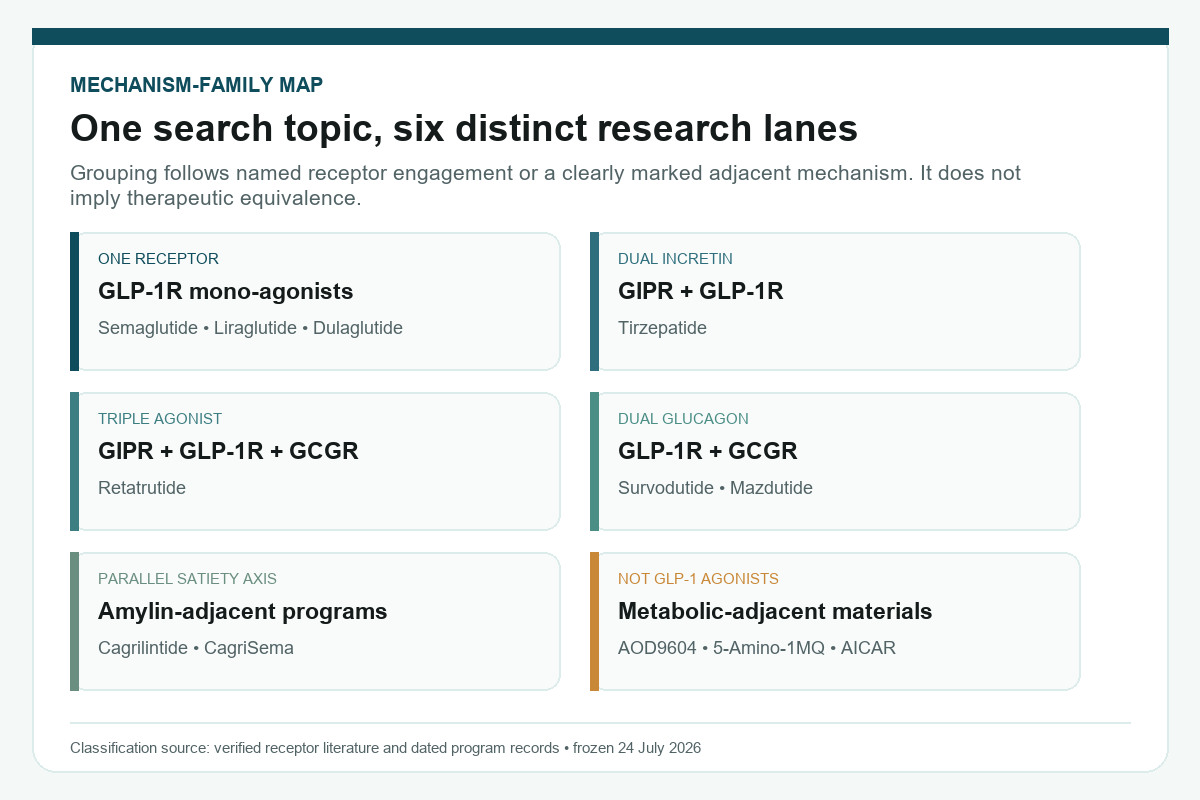
| Research family | Representative materials | Boundary that must remain explicit |
|---|---|---|
| GLP-1 receptor mono-agonists | Semaglutide, liraglutide, dulaglutide | Different molecular engineering and formulation records prevent interchangeability |
| GIP/GLP-1 dual agonist | Tirzepatide | Dual-receptor activity is not equivalent to GLP-1-only activity |
| GIP/GLP-1/glucagon triple agonist | Retatrutide | Investigational program evidence does not create an approved use or formulation |
| GLP-1/glucagon dual agonists | Survodutide, mazdutide | Shared receptor names do not make the molecules, programs, or jurisdictions equivalent |
| Amylin analog and combination | Cagrilintide, CagriSema | Amylin receptors are distinct from GLP-1, GIP, and glucagon receptors |
| Metabolic-adjacent research tools | AOD9604, 5-Amino-1MQ, AICAR | These materials do not become incretin agonists through catalog or search proximity |
The exact material is the first evidence gate. “Semaglutide,” for example, can refer to a molecule discussed in the literature, a specific finished pharmaceutical product governed by a current label, or a research reagent with its own batch record. Those contexts share a molecule but not a regulatory framework, formulation, route, quality system, or permitted use. The same principle applies across the field.
From the Incretin Effect to Multi-Receptor Programs
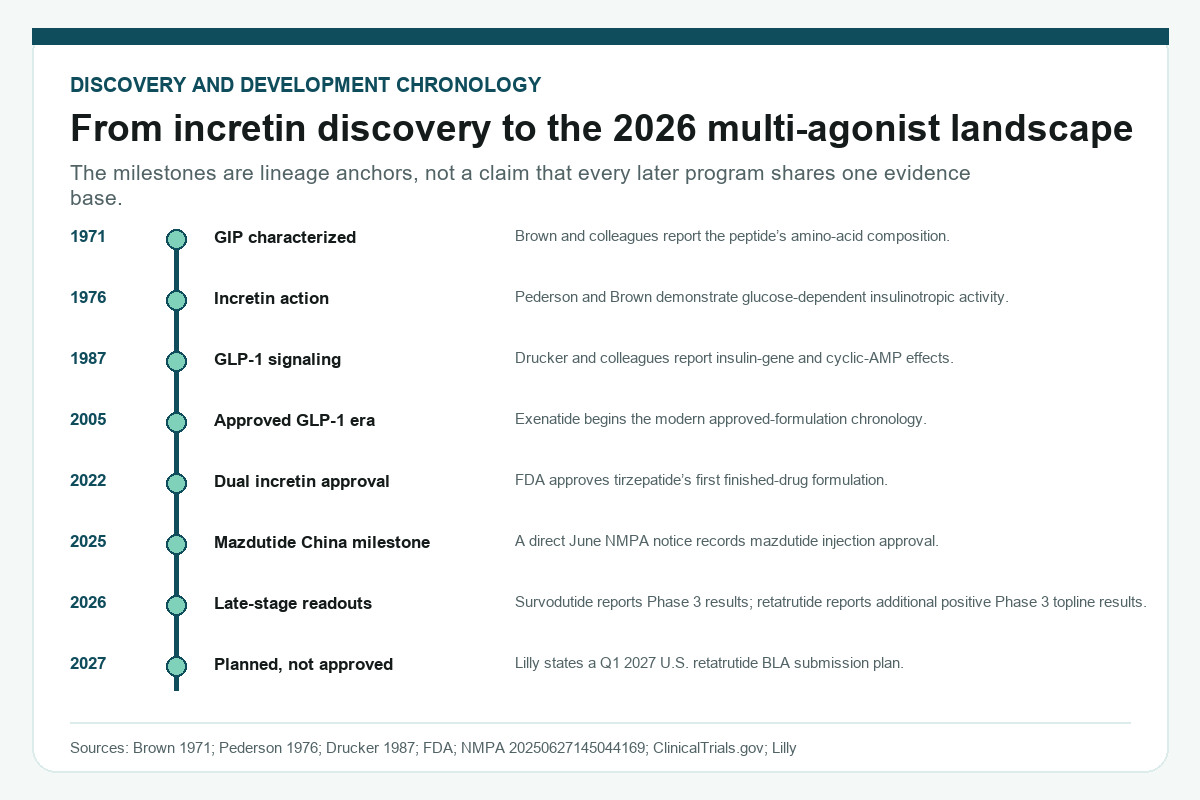
The modern landscape grew from a sequence of distinct discoveries rather than a single product program. John C. Brown’s group characterized gastric inhibitory polypeptide in 1971; that paper establishes amino-acid composition and tryptic peptides and reports no quantitative endpoint of the kind this table records.[3] Raymond Pederson and Brown then demonstrated glucose-dependent insulinotropic activity in the isolated rat pancreas in 1976, helping establish GIP as an incretin.[4]
In 1987, Daniel Drucker, Jacques Philippe, Svetlana Mojsov, William Chick, and Joel Habener reported that GLP-1 increased cyclic AMP, insulin messenger RNA, and insulin release in cultured rat insulinoma cells.[5] Jens Juul Holst’s later synthesis described the physiology that made GLP-1 analog design intelligible, including rapid endogenous degradation and the coordinated pancreatic, gastrointestinal, and central actions studied across the field.[6] Drucker’s 2024 retrospective places the early molecular work and later therapeutic development on the same historical line without collapsing their evidence tiers.[7]
Industrial programs subsequently used several engineering strategies to extend exposure or combine receptor activities. Fatty-acid acylation, albumin association, fusion-protein design, and sequence modification are not cosmetic differences: they can alter stability, distribution, receptor pharmacology, and assay behavior. A hub can compare those strategies at a high level; any quantitative head-to-head conclusion belongs in a comparison built from matched evidence.
Family 1: GLP-1 Receptor Mono-Agonists
Semaglutide, liraglutide, and dulaglutide are often grouped because their intended primary receptor activity centers on GLP-1R. They nevertheless represent different molecular designs. Semaglutide and liraglutide are acylated analogs with different structures and exposure profiles. Dulaglutide is an Fc-fusion construct. Those differences matter for analytical methods, biological assays, trial programs, formulation context, and regulatory records.
Semaglutide
Semaglutide has a large clinical and regulatory evidence base, but the broad pillar should not reproduce a living label or every trial endpoint. SUSTAIN-6 evaluated cardiovascular outcomes in people with type 2 diabetes, while STEP 1 evaluated a different population, formulation context, endpoint set, and study duration.[8][9] Neither study converts a research reagent into the studied finished formulation.
The Semaglutide Research Guide owns the compound’s identity, engineering, evidence chronology, and current regulatory firewall. The Liraglutide vs Dulaglutide guide owns the direct AWARD-6 comparison and the acylation-versus-Fc-fusion question. The GLP-1 Agonists Compared page owns the modern single-, dual-, and triple-agonist comparison across semaglutide, tirzepatide, and retatrutide, while the Semaglutide vs Tirzepatide comparison retains the detailed two-compound decision task.
Liraglutide and dulaglutide
Liraglutide’s published evidence includes the LEADER cardiovascular-outcomes trial and SCALE weight-management trial; dulaglutide’s includes AWARD-3 and the REWIND cardiovascular-outcomes program.[10][11][12][13] Trial-to-trial numerical comparison is inappropriate when populations, comparators, endpoints, durations, and estimands differ.
The Liraglutide and Dulaglutide Research Guide focuses on their engineering contrast: acylated analog versus Fc-fusion design. That is a more defensible organizing question than treating the compounds as interchangeable “older GLP-1s.”
Families 2 and 3: Dual Incretin and Triple GIP/GLP-1/Glucagon Agonists
Tirzepatide: GIP/GLP-1 dual agonism
Tirzepatide combines GIP-receptor and GLP-1-receptor agonism in one molecule. Published programs include SURPASS for type 2 diabetes and SURMOUNT for obesity-related endpoints. SURPASS-1 established placebo-controlled evidence in one type 2 diabetes population; SURPASS-2 provided a direct comparison with semaglutide under one defined protocol; SURMOUNT-1 addressed a different population and outcome framework.[14][15][16]
One direct trial can support a conclusion within its protocol; it does not establish that every dose, formulation, population, or endpoint follows the same ordering. The Tirzepatide Research Guide owns the molecule and program chronology. The Retatrutide vs Tirzepatide page owns the dual-versus-triple comparison and must keep approved-product evidence separate from investigational evidence.
Retatrutide: GIP/GLP-1/glucagon triple agonism
Retatrutide adds glucagon-receptor agonism to a GIP/GLP-1 multi-agonist design. Two 2023 Phase 2 publications reported results in obesity and type 2 diabetes populations, respectively.[17][18] They support defined investigational findings; they do not create an approved indication, product, or general claim that “three receptors are better than two.”
On July 23, 2026, Eli Lilly announced positive topline results from two additional Phase 3 TRIUMPH studies and stated that a biologics license application was planned for the first quarter of 2027. A company announcement is current program evidence, not a substitute for a peer-reviewed paper, complete regulatory review, or approved label. As of this evidence freeze, retatrutide remains investigational. The Retatrutide Research Guide should be rechecked for any program update immediately before deployment.
Family 4: GLP-1/Glucagon Dual-Agonist Programs
Survodutide and mazdutide are usually placed together because both are studied as GLP-1/glucagon receptor co-agonists. That shared classification does not make their molecular designs, receptor balance, trial programs, or regulatory histories interchangeable.
Survodutide
A 2024 Phase 2 publication reported survodutide results in adults with overweight or obesity.[19] A Phase 3 study record, NCT06066515, reports a completed study and links a 2026 publication indexed as PMID 42253238.[20] The exact peer-reviewed paper and current sponsor or regulator status should govern any quantitative update. This pillar records survodutide as an investigational program, not an approved finished product.
The Survodutide Research Guide owns receptor pharmacology, study-by-study interpretation, and current status. Researchers should not infer identical glucagon-receptor activity from the mere fact that survodutide and mazdutide share a two-receptor label.
Mazdutide
Mazdutide evidence includes a Phase 2 study in Chinese participants with overweight or obesity and a later randomized Phase 3 type 2 diabetes report.[21][22] A 2025 first-approval review records China’s jurisdiction-specific milestone.[23] A direct June 2025 NMPA notice records approval of mazdutide injection. Innovent published dated sponsor announcements for the June milestone and a September 2025 type 2 diabetes indication.
The direct June NMPA notice and the later sponsor-reported milestone apply to named finished products in China. They are not FDA approvals, are not global authorizations, and do not attach to a separately supplied research reagent. This evidence pack does not contain a direct NMPA decision record for the September indication; SSH-side review must resolve that current regulator record before presenting the later indication as regulator-confirmed. The Mazdutide Research Guide owns the full jurisdiction table and must be refreshed if a regulator changes status.
Family 5: Amylin Adjacency and CagriSema
Amylin is a pancreatic peptide hormone that signals through receptor complexes assembled from the calcitonin receptor and receptor activity-modifying proteins. That receptor architecture is distinct from GLP-1R, GIPR, and GCGR. Cagrilintide is a long-acting amylin analog; CagriSema combines cagrilintide with semaglutide. Their inclusion in a GLP-1 landscape reflects a research and search relationship, not membership in a single-receptor family.
A 2021 Phase 2 trial evaluated cagrilintide as a standalone investigational compound.[24] A 2023 Phase 2 study evaluated the cagrilintide/semaglutide combination in people with type 2 diabetes.[25] Novo Nordisk’s 2026 Phase 3 communications describe an active program, including REDEFINE 4 results announced in February 2026 and REIMAGINE program data announced in June 2026. Those official company pages state that a CagriSema weight-management New Drug Application was filed with the FDA in December 2025 and that a decision was anticipated in late or the fourth quarter of 2026; they continue to describe CagriSema as investigational. A filed application and anticipated decision do not establish approval, and company communications remain secondary to complete peer-reviewed and regulatory records.
The Cagrilintide and CagriSema Research Guide owns the combination’s current development status. This pillar’s job is to keep the category boundary visible: semaglutide supplies the GLP-1 component; cagrilintide supplies a separate amylin component.
Family 6: Metabolic-Adjacent Research Tools
AOD9604, 5-Amino-1MQ, and AICAR appear in the same catalog and keyword neighborhood as GLP-1 compounds, but they do not engage the incretin-receptor family. Treating them as “GLP-1 peptides” would be chemically and mechanistically inaccurate.
AOD9604
AOD9604 arose from research on the C-terminal region of human growth hormone. The Bornstein lineage includes early characterization of synthetic C-terminal peptides and later mouse work on a modified fragment; those figures stay with the dedicated AOD9604 guide rather than being transferred to this hub.[26][27][28] That mouse work is cited for lineage only; its figures belong to a rodent model and are reported in the dedicated AOD9604 guide rather than transferred here. Those preclinical findings are not incretin-receptor evidence and do not establish human efficacy. The AOD9604 Research Guide owns the growth-hormone-fragment lineage.
5-Amino-1MQ
5-Amino-1MQ is a small-molecule nicotinamide N-methyltransferase inhibitor, not a peptide. A 2018 paper reported cellular and mouse-model findings connected to NNMT inhibition.[29] The compound belongs in a metabolic enzyme-research lane and needs small-molecule identity and assay controls.
AICAR
AICAR is an adenosine analog used in AMPK-related research. Narkar and colleagues reported exercise-endurance and oxidative-gene-expression findings in mice in 2008.[30] The popular “exercise mimetic” phrase came from that experimental context; it is not a recommendation, approved use, or evidence of an incretin mechanism.
Adipotide (FTPP)
Adipotide is a peptidomimetic that pairs a homing sequence with a pro-apoptotic motif and is studied for vascular-targeting effects in adipose tissue. It is metabolic-adjacent by research interest only: it does not engage GLP-1, GIP, glucagon, or amylin receptors, so nothing on this page transfers to it and it belongs in no incretin comparison. It has no regulatory approval in any jurisdiction and no approved pharmaceutical formulation exists. Apex Laboratory supplies Adipotide (FTPP) as a research-grade chemical reagent for in-vitro and preclinical research only.
What the cited trials actually reported
The programs named above are cited throughout this pillar. A trial name without its readout is not evidence, so the reported primary results are recorded here with the population each figure belongs to. Every row describes a finished pharmaceutical formulation studied under its own protocol; none of it transfers to a research reagent, and the rows must not be read against one another as a ranking, because the populations, comparators, endpoints, durations, and estimands differ.
| Program | Population studied | Duration | Reported primary readout | Source |
|---|---|---|---|---|
| SUSTAIN-6 (semaglutide 0.5/1.0 mg weekly) | 3,297 adults with type 2 diabetes at high cardiovascular risk | 104 weeks | Primary composite cardiovascular event in 6.6% vs 8.9% on placebo (hazard ratio 0.74; 95% CI 0.58–0.95) | PMID 27633186 |
| STEP 1 (semaglutide 2.4 mg weekly) | 1,961 adults with overweight or obesity, without diabetes | 68 weeks | Mean body-weight change −14.9% vs −2.4% on placebo; ≥5% reduction reached by 86.4% vs 31.5% | PMID 33567185 |
| LEADER (liraglutide) | 9,340 adults with type 2 diabetes at high cardiovascular risk | Median 3.8 years | Primary composite cardiovascular event in 13.0% vs 14.9% on placebo (hazard ratio 0.87; 95% CI 0.78–0.97) | PMID 27295427 |
| SCALE (liraglutide 3.0 mg daily) | 3,731 adults without type 2 diabetes | 56 weeks | Mean weight loss 8.4 kg vs 2.8 kg on placebo | PMID 26132939 |
| AWARD-3 (dulaglutide vs metformin) | 807 adults with early type 2 diabetes | 52-week study; 26-week primary readout | HbA1c change −0.78% (1.5 mg) and −0.71% (0.75 mg) vs −0.56% on metformin | PMID 24842985 |
| REWIND (dulaglutide 1.5 mg weekly) | 9,901 adults with type 2 diabetes, with and without prior cardiovascular disease | Median 5.4 years | Primary composite cardiovascular event in 12.0% vs 13.4% on placebo (hazard ratio 0.88; 95% CI 0.79–0.99) | PMID 31189511 |
| SURPASS-1 (tirzepatide 5/10/15 mg weekly) | 478 adults with type 2 diabetes, naive to injectable therapy | 40 weeks | HbA1c change −1.87%, −1.89%, and −2.07% vs +0.04% on placebo | PMID 34186022 |
| SURPASS-2 (tirzepatide vs semaglutide 1 mg) | 1,879 adults with type 2 diabetes | 40 weeks | HbA1c change −2.01%, −2.24%, −2.30% vs −1.86% on semaglutide; weight difference −1.9 to −5.5 kg | PMID 34170647 |
| SURMOUNT-1 (tirzepatide 5/10/15 mg weekly) | 2,539 adults with obesity, excluding diabetes | 72 weeks | Mean body-weight change −15.0%, −19.5%, and −20.9% vs −3.1% on placebo | PMID 35658024 |
| Retatrutide Phase 2, obesity | 338 adults with obesity | 48 weeks | Mean body-weight change −8.7%, −17.1%, −22.8%, and −24.2% (1/4/8/12 mg) vs −2.1% on placebo | PMID 37366315 |
| Retatrutide Phase 2, type 2 diabetes | 281 adults with type 2 diabetes (275 in the efficacy analysis) | 24 weeks | HbA1c change −2.02% (12 mg) vs −0.01% on placebo and −1.41% on dulaglutide 1.5 mg | PMID 37385280 |
Two readings of this table are wrong. The first is cross-trial ranking: SURMOUNT-1 and STEP 1 studied different molecules in different protocols, so their weight-change figures are not a head-to-head result. The second is transfer to a reagent: each figure belongs to the finished formulation, dose, and population that generated it, and says nothing about a research-grade material in a laboratory system.
How to Read GLP-1 and Metabolic Evidence
A search result can place a receptor assay, mouse study, randomized clinical trial, regulator label, and corporate topline announcement beside one another. They do not carry the same authority or answer the same question. The evidence ladder prevents a mechanism result from becoming a clinical claim and prevents an approved pharmaceutical record from becoming a research-reagent claim.

1. Identity and receptor pharmacology
This tier asks what the material is and which receptors or molecular targets it engages under a defined procedure. Sequence, modifications, counterions, molecular mass, purity procedure, reference standard, assay platform, species ortholog, intrinsic activity, and concentration range can all matter. A receptor name in a development slide is not a substitute for a complete pharmacology record.
2. Preclinical models
Cell and animal studies can test mechanisms, exposure, tissue response, and model-specific phenotypes. They do not establish a human indication. Translational interpretation should identify the model, comparator, sex, age, diet or disease construct, exposure procedure, endpoint timing, randomization, blinding, and whether the result has been independently replicated.
3. Human studies
A human trial belongs to its exact compound, formulation, dose protocol, population, comparator, duration, endpoint hierarchy, estimand, and safety collection. A result cannot be transferred from an approved finished product to a research material, from one population to another, or from one compound to a neighbor. Cross-trial comparisons should be labeled as indirect unless a randomized head-to-head design supports them.
4. Synthesis and regulatory decisions
Systematic reviews and meta-analyses can assess consistency and heterogeneity across eligible studies, but they inherit the limitations of included evidence. Regulatory decisions operate at an even narrower object: one named finished product, jurisdiction, sponsor, manufacturing record, label, and date. Approval of one formulation is not approval of a molecule in every form.
Development programs can change between drafting and deployment. Recheck FDA, the direct NMPA database or decision record, ClinicalTrials.gov, sponsor, and peer-reviewed records immediately before publishing any status, label, or trial-completion statement.
The Pharmaceutical–Research Reagent Firewall
Several molecules in this field exist in both pharmaceutical and research contexts. The correct framing is: same molecule where applicable; categorically distinct regulatory frameworks. A finished pharmaceutical product is governed by its approved label, formulation, manufacturing controls, packaging, supply chain, pharmacovigilance, and jurisdiction. A research reagent is supplied for laboratory research and must not be represented as the approved product or as a substitute for it.
For semaglutide and tirzepatide, current FDA records—not a blog summary—control the names, indications, dosage forms, contraindications, warnings, and label revisions for approved products. For mazdutide, the direct June NMPA notice and later sponsor-reported China milestone do not create FDA or EMA approval; the direct NMPA record for the later indication remains a deployment-side verification requirement. For retatrutide, positive Phase 3 news does not equal a submitted application or approved label. For CagriSema, sponsor-reported NDA submission remains an investigational status pending FDA action; survodutide is likewise presented as investigational rather than as an approved finished product.
The Research Grade vs Pharmaceutical Grade guide explains this boundary across the Apex corpus. The distinction also governs imagery and claims: an editorial image is not product proof; a chromatogram is not a clinical result; an approved product label is not an analytical certificate for a different material.
| Record type | What it can establish | What it cannot establish |
|---|---|---|
| Batch analytical record | Results for a named batch under stated procedures | Clinical safety, efficacy, approval, or equivalence to a finished drug |
| Receptor or cell assay | Procedure-specific activity in a defined system | Human outcome, approved use, or universal receptor profile |
| Animal study | Model-specific exposure or biological findings | Human benefit, human safety, or approved formulation |
| Randomized clinical trial | Protocol-specific evidence for the studied formulation and population | Evidence for a separate reagent or untested compound |
| Regulatory label or decision | Status and conditions for one named product in one jurisdiction | Global approval or authorization of every material containing the molecule |
Regulatory status by compound
Supplier status and regulatory status are different claims. Stating that Apex Laboratory supplies a research material says nothing about whether any regulator has approved a product containing that molecule. The status below is stated per compound as of the July 25, 2026 UTC evidence check; approval attaches to a named finished product in a named jurisdiction, never to a research reagent.
| Compound | Regulatory status of the pharmaceutical formulation | Status of the Apex research material |
|---|---|---|
| Semaglutide | FDA-approved finished formulations exist (Ozempic, Wegovy, Rybelsus), each under its own label and indication | Research reagent; not approved, not a pharmaceutical, not for human or veterinary use |
| Liraglutide | FDA-approved finished formulations exist (Victoza, Saxenda) | Research reagent; no regulatory approval in any jurisdiction |
| Dulaglutide | FDA-approved finished formulation exists (Trulicity) | Research reagent; no regulatory approval in any jurisdiction |
| Tirzepatide | FDA-approved finished formulations exist (Mounjaro, Zepbound) | Research reagent; no regulatory approval in any jurisdiction |
| Retatrutide | Investigational. No FDA, EMA, NMPA, or other approval anywhere. Sponsor has reported positive Phase 3 TRIUMPH results and a planned 2027 filing; an announcement is not a submission or an approval | Research reagent; no approved product exists for this molecule anywhere |
| Survodutide | Investigational. No regulatory approval anywhere; in the SYNCHRONIZE Phase 3 program | Research reagent; no approved product exists for this molecule anywhere |
| Mazdutide | China NMPA approval for chronic weight management (June 2025, marketed as Xinermei by Innovent Biologics). A later China indication is sponsor-reported and requires direct NMPA confirmation. No FDA or EMA approval | Research reagent; the China approval is jurisdiction-specific and does not transfer to the United States, the EU, or to any research material |
| Cagrilintide and CagriSema | Investigational. Sponsor-reported regulatory submission does not constitute approval; no approved product in any jurisdiction | Research reagent; no approved product exists for these programs anywhere |
| AOD9604, 5-Amino-1MQ, AICAR | No approved pharmaceutical formulation in any jurisdiction | Research reagent; no regulatory approval anywhere, and none is pending |
Choose the Resource That Owns the Question
Strong site architecture gives each page one job. This pillar owns the broad family landscape, evidence boundaries, and navigation. Individual guides own compound identity and chronology. Comparison pages own matched decision questions. Emerging-program pages own fast-changing pipeline context.

Semaglutide Research Guide
Entity identity, lineage, pharmacology, evidence, and pharmaceutical/reagent boundary.
GLP-1 Agonists Compared
Semaglutide, tirzepatide, and retatrutide compared as single-, dual-, and triple-agonist architectures.
Liraglutide and Dulaglutide Guide
Acylated-analog and Fc-fusion engineering strategies without false equivalence.
Tirzepatide Research Guide
GIP/GLP-1 dual-agonist identity, program evidence, and regulatory context.
Retatrutide Research Guide
Triple-agonist pharmacology and the current TRIUMPH development record.
Retatrutide vs Tirzepatide
Symmetric dual-versus-triple comparison with evidence-tier and status controls.
Next-Generation GLP-1 Research Peptides
Emerging programs, pipeline shifts, and the freshness-sensitive compound landscape.
Survodutide Research Guide
GLP-1/glucagon co-agonist pharmacology and study-level evidence.
Mazdutide Research Guide
Program evidence and jurisdiction-specific China regulatory record.
Cagrilintide and CagriSema Guide
Amylin adjacency, combination logic, and current investigational status.
Frequently Asked Questions About GLP-1 Research Peptides
What are GLP-1 research peptides?
GLP-1 research peptides are materials studied in connection with glucagon-like peptide-1 receptor biology and the broader incretin field. The strict core includes GLP-1 receptor agonists; the broader research landscape also includes multi-receptor agonists, amylin combinations, and metabolic-adjacent tools. Those neighboring materials are not interchangeable and do not share one evidence record.
How do GLP-1, GIP, and glucagon receptor agonists differ?
They engage different receptors with distinct physiological roles. A GLP-1 mono-agonist centers GLP-1R, tirzepatide combines GIPR and GLP-1R agonism, and retatrutide adds GCGR activity. Receptor count alone does not determine potency, safety, effectiveness, or suitability; molecular design, receptor balance, exposure, model, endpoint, and formulation also matter.
Is retatrutide approved?
No. As of the July 25, 2026 UTC evidence check, retatrutide remains investigational. Eli Lilly announced positive Phase 3 topline results on July 23, 2026 and stated that a biologics license application was planned for the first quarter of 2027, but a positive trial announcement and a planned application are not regulatory approval.
Is mazdutide approved?
A direct June 2025 NMPA notice records approval of mazdutide injection in China, while a peer-reviewed first-approval review and Innovent announcements supply additional chronology. The later type 2 diabetes indication is sponsor-reported in this pack because a corresponding direct NMPA decision was not captured. Neither status creates United States FDA or European Medicines Agency approval, applies globally, or transfers to a separately supplied research reagent.
Are cagrilintide and CagriSema GLP-1 agonists?
Cagrilintide is a long-acting amylin analog, not a GLP-1 receptor agonist. CagriSema combines cagrilintide with semaglutide, so the combination includes a GLP-1 component through semaglutide and a separate amylin component through cagrilintide. The two mechanisms should remain distinct in evidence and regulatory interpretation.
Are AOD9604, 5-Amino-1MQ, and AICAR GLP-1 compounds?
No. AOD9604 is a growth-hormone-fragment research peptide, 5-Amino-1MQ is a small-molecule NNMT inhibitor, and AICAR is an adenosine analog used in AMPK-related research. They appear in the wider metabolic-research landscape but do not become incretin agonists through catalog or keyword proximity.
Does evidence for an approved GLP-1 drug apply to an Apex research reagent?
No. A pharmaceutical study and label apply to the exact finished formulation, manufacturer, quality system, population, protocol, and jurisdiction described in those records. A research reagent has its own identity and batch documentation and is not represented as the approved pharmaceutical product, a therapeutic equivalent, or a material for human consumption.
Selected References and Current Program Sources
- Drucker DJ. Mechanisms of Action and Therapeutic Application of Glucagon-like Peptide-1. Cell Metab. 2018;27(4):740-756. PMID: 29617641.
- Müller TD, et al. Glucagon-like peptide 1 (GLP-1). Mol Metab. 2019;30:72-130. PMID: 31767182.
- Brown JC. A gastric inhibitory polypeptide. I. The amino acid composition and the tryptic peptides. Can J Biochem. 1971;49(2):255-61. PMID: 5545261.
- Pederson RA, et al. The insulinotropic action of gastric inhibitory polypeptide in the perfused isolated rat pancreas. Endocrinology. 1976;99(3):780-5. PMID: 954669.
- Drucker DJ, et al. Glucagon-like peptide I stimulates insulin gene expression and increases cyclic AMP levels in a rat islet cell line. Proc Natl Acad Sci U S A. 1987;84(10):3434-8. PMID: 3033647.
- Holst JJ. The physiology of glucagon-like peptide 1. Physiol Rev. 2007;87(4):1409-39. PMID: 17928588.
- Drucker DJ. The GLP-1 journey: from discovery science to therapeutic impact. J Clin Invest. 2024;134(2). doi:10.1172/JCI175634. PMID: 38226625.
- Marso SP, et al. Semaglutide and Cardiovascular Outcomes in Patients with Type 2 Diabetes. N Engl J Med. 2016;375(19):1834-1844. PMID: 27633186.
- Wilding JPH, et al. Once-Weekly Semaglutide in Adults with Overweight or Obesity. N Engl J Med. 2021;384(11):989-1002. PMID: 33567185.
- Marso SP, et al. Liraglutide and Cardiovascular Outcomes in Type 2 Diabetes. N Engl J Med. 2016;375(4):311-22. PMID: 27295427.
- Pi-Sunyer X, et al. A Randomized, Controlled Trial of 3.0 mg of Liraglutide in Weight Management. N Engl J Med. 2015;373(1):11-22. PMID: 26132939.
- Umpierrez G, et al. Efficacy and safety of dulaglutide monotherapy versus metformin in type 2 diabetes in a randomized controlled trial (AWARD-3). Diabetes Care. 2014;37(8):2168-76. PMID: 24842985.
- Gerstein HC, et al. Dulaglutide and cardiovascular outcomes in type 2 diabetes (REWIND): a double-blind, randomised placebo-controlled trial. Lancet. 2019;394(10193):121-130. PMID: 31189511.
- Rosenstock J, et al. Efficacy and safety of a novel dual GIP and GLP-1 receptor agonist tirzepatide in patients with type 2 diabetes (SURPASS-1): a double-blind, randomised, phase 3 trial. Lancet. 2021;398(10295):143-155. PMID: 34186022.
- Frías JP, et al. Tirzepatide versus Semaglutide Once Weekly in Patients with Type 2 Diabetes. N Engl J Med. 2021;385(6):503-515. PMID: 34170647.
- Jastreboff AM, et al. Tirzepatide Once Weekly for the Treatment of Obesity. N Engl J Med. 2022;387(3):205-216. PMID: 35658024.
- Jastreboff AM, et al. Triple-Hormone-Receptor Agonist Retatrutide for Obesity – A Phase 2 Trial. N Engl J Med. 2023;389(6):514-526. PMID: 37366315.
- Rosenstock J, et al. Retatrutide, a GIP, GLP-1 and glucagon receptor agonist, for people with type 2 diabetes: a randomised, double-blind, placebo and active-controlled, parallel-group, phase 2 trial conducted in the USA. Lancet. 2023;402(10401):529-544. PMID: 37385280.
- le Roux CW, et al. Glucagon and GLP-1 receptor dual agonist survodutide for obesity: a randomised, double-blind, placebo-controlled, dose-finding phase 2 trial. Lancet Diabetes Endocrinol. 2024;12(3):162-173. PMID: 38330987.
- le Roux CW, et al. Survodutide Once Weekly for the Treatment of Adults with Obesity. N Engl J Med. 2026. doi:10.1056/NEJMoa2600751. PMID: 42253238.
- Ji L, et al. A phase 2 randomised controlled trial of mazdutide in Chinese overweight adults or adults with obesity. Nat Commun. 2023;14(1):8289. PMID: 38092790.
- Zhu D, et al. Mazdutide versus placebo in Chinese adults with type 2 diabetes. Nature. 2026;652(8108):174-180. PMID: 41407859.
- Shirley M. Mazdutide: First Approval. Drugs. 2025;85(12):1621-1627. PMID: 41028652.
- Lau DCW, et al. Once-weekly cagrilintide for weight management in people with overweight and obesity: a multicentre, randomised, double-blind, placebo-controlled and active-controlled, dose-finding phase 2 trial. Lancet. 2021;398(10317):2160-2172. PMID: 34798060.
- Frias JP, et al. Efficacy and safety of co-administered once-weekly cagrilintide 2·4 mg with once-weekly semaglutide 2·4 mg in type 2 diabetes: a multicentre, randomised, double-blind, active-controlled, phase 2 trial. Lancet. 2023;402(10403):720-730. PMID: 37364590.
- Ma GY, et al. The mechanism of the hyperglycaemic action of synthetic peptides related to the C-terminal sequence of human growth hormone. Biochim Biophys Acta. 1982;716(3):400-9. PMID: 6810951.
- Heffernan MA, et al. Effects of oral administration of a synthetic fragment of human growth hormone on lipid metabolism. Am J Physiol Endocrinol Metab. 2000;279(3):E501-7. PMID: 10950816.
- Neelakantan H, et al. Selective and membrane-permeable small molecule inhibitors of nicotinamide N-methyltransferase reverse high fat diet-induced obesity in mice. Biochem Pharmacol. 2018;147:141-152. PMID: 29155147.
- Narkar VA, et al. AMPK and PPARdelta agonists are exercise mimetics. Cell. 2008;134(3):405-15. PMID: 18674809.
- Eli Lilly. Retatrutide Phase 3 topline announcement. July 23, 2026.
- ClinicalTrials.gov. NCT06066515: survodutide Phase 3 study record. Accessed July 25, 2026 UTC.
- Innovent Biologics. Mazdutide weight-management approval announcement and type 2 diabetes approval announcement. 2025.
- National Medical Products Administration. 国家药监局批准玛仕度肽注射液上市 (NMPA approves mazdutide injection for marketing). June 27, 2025.
- Novo Nordisk. REDEFINE 4 topline announcement and REIMAGINE program data announcement. 2026.
Research Use Disclaimer
Content is provided for educational and scientific discussion. Apex Laboratory materials are sold for laboratory research use only and are not medicines, foods, cosmetics, or medical devices. They are not for human or veterinary consumption. Nothing on this page is medical advice, a diagnosis, a treatment recommendation, or a representation that a research reagent is equivalent to an approved pharmaceutical formulation.
Research materials and supporting guides
Research materials
- Retatrutide
- Tirzepatide
- Semaglutide
- 5-Amino-1MQ
- Aicar
- AOD9604
- Adipotide (FTTP)
- Cagrilintide
- Cagrisema (2.5mg+2.5mg)
- Dulaglutide
- Liraglutide
- Mazdutide 10mg
- SLU-PP-332 5mg
- SLU-PP-332 Caps (100pcs)
- Survodutide 10mg
Supporting research guides
- What Is Cagrilintide? CagriSema, Weight Results and Side Effects
- Mazdutide Research Guide: Dual Agonism, Trials, and 2026 Status
- Survodutide Research Guide: Dual GCGR/GLP-1R Evidence
- Retatrutide TRIUMPH-1 Phase 3 Results: What the 2026 Data Show
- Liraglutide vs Dulaglutide: Structure, Pharmacology, and AWARD-6 Evidence
- What Is 5-Amino-1MQ? NNMT, Fat-Loss Research and Human Evidence
- What Is SLU-PP-332? Benefits, Human Evidence and Side Effects
- Next-Generation GLP-1 Research: Classes, Evidence, and 2026 Status
- What Is Semaglutide? How It Works, Oral vs Injection and Evidence
- Semaglutide vs Tirzepatide vs Retatrutide: Single, Dual, and Triple Agonists Compared
- Retatrutide vs Tirzepatide: Mechanism, Evidence, and Approval Status
- What Is Tirzepatide? How It Works, Half-Life and Results
- What Is AOD9604? Weight-Loss Evidence, Side Effects and Studies
- Retatrutide Explained: Human Results, Risks and Current Status
- Semaglutide vs Tirzepatide: Mechanism and Head-to-Head Evidence