Peptide Reconstitution Calculator
Calculate concentration from material mass and final solution volume: mg/mL = mg ÷ mL. Add an optional target mass to convert that concentration to a volume and a U-100 scale equivalent. This is research arithmetic, not a dosing recommendation.
Calculate concentrations and volume equivalents from your laboratory inputs. Presets are editable arithmetic examples, not preparation recommendations.
Enter finite positive values. Use final solution volume; solvent added is only an approximation. Results are rounded arithmetic, not device precision or biological activity.
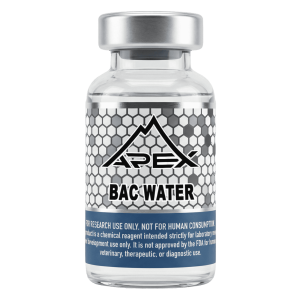
Solvent choice and prepared-solution storage depend on the material and validated laboratory method. A preservative does not establish peptide stability.
Shop Bacteriostatic WaterThis tool performs concentration and syringe-unit arithmetic for laboratory workflow planning only. It is not dosing, medical, or veterinary guidance and does not recommend any dose. All compounds referenced are sold for laboratory research use only — not for human use. Researchers are responsible for compliance with all applicable institutional, local, and national regulations.
How to use the peptide reconstitution calculator
- Enter the material mass in mg. Use the mass basis relevant to your laboratory calculation. A vial’s nominal label amount, a measured active-content result and chromatographic purity percentage are different quantities.
- Enter final solution volume in mL. The tool divides mass by this volume. Entering solvent added instead assumes negligible volume change on dissolution.
- Read mg/mL, mcg/mL and mcg per U-100 scale unit. An optional target mass in mcg gives its calculated volume. The target is your input; the tool does not choose it.
The dropdown contains 33 compound and blend examples. Their mass and volume values are editable arithmetic examples, not a current-stock list, a recommended solvent volume or a validated preparation method. Match the actual material and configuration before using a preset. You can enter custom values without selecting a compound.
What the calculator results mean
Concentration in mg/mL
Divide the material mass in milligrams by the final solution volume in milliliters. For an arithmetic example, 5 mg in a final volume of 2 mL gives 2.5 mg/mL. Doubling the volume while holding mass fixed halves the concentration; it does not change the amount of material in the whole solution.
Concentration in mcg/mL
Multiply mg/mL by 1,000. The same 2.5 mg/mL example is 2,500 mcg/mL. Here “mcg” means micrograms (µg). The conversion follows the metric prefixes milli and micro; see NIST’s metric prefix reference.
Mass per U-100 scale unit
The U-100 scale maps 100 marked units to 1 mL, so one scale unit represents 0.01 mL. Divide mcg/mL by 100 to calculate mcg per scale unit. At 2,500 mcg/mL, one U-100 scale unit corresponds to 25 mcg. This volume scale is not a measurement of a peptide’s international units or biological activity.
Volume for a target mass
Volume (mL) = target mass (mcg) ÷ concentration (mcg/mL). Multiply the resulting mL by 100 for its U-100 scale equivalent. In the same example, an illustrative target of 250 mcg corresponds to 0.1 mL and 10 U-100 scale units. This is a worked calculation, not an experimental or personal-use recommendation.
Worked concentration examples
These rows demonstrate the formula with arbitrary inputs. They do not specify a solvent, recommend a preparation or establish material stability.
| Material mass | Final volume | mg/mL | mcg per U-100 unit |
|---|---|---|---|
| 5 mg | 1 mL | 5 | 50 |
| 5 mg | 2 mL | 2.5 | 25 |
| 10 mg | 2 mL | 5 | 50 |
| 10 mg | 4 mL | 2.5 | 25 |
How blend calculations differ
The main concentration and target-mass results use total blend mass. They do not mean that each component is present at that concentration. For example, the illustrative KLOW 80 mg preset contains 50 mg GHK-Cu, 10 mg BPC-157, 10 mg TB-500 and 10 mg KPV. Its component table allocates 62.5%, 12.5%, 12.5% and 12.5% of the total mass respectively. Changing the total mass keeps those assumed proportions; it does not verify a different blend formulation.
Read the actual configuration and applicable report before entering values. The KLOW, GLOW and BPC-157/TB-500 comparison explains composition and evidence differences. The COA library and complete-lot lookup help locate published analytical records; they do not establish a preparation protocol.
What this tool cannot determine
A correct calculation cannot validate an incorrect input. This tool does not measure vial contents, verify purity, choose a solvent, assess compatibility, determine stability or confirm sterility. Displayed numbers are rounded; they do not establish the precision or smallest usable increment of a syringe or pipette. Very small nonzero results remain distinguishable from zero.
A U-100 scale also does not determine device capacity: manufacturers offer different barrel sizes. Check the actual device markings and instructions. embecta’s product reference guide (PDF, page 2) lists 1 mL (100 units), 0.5 mL (50 units) and 0.3 mL (30 units) capacities for the illustrated insulin syringes.
Bacteriostatic water is not a universal solvent for every material. As a formulation-specific reference, the published bacteriostatic-water label directs users to the solute manufacturer’s instructions and discusses incompatibilities and storage limits. It does not validate an Apex research preparation. A container-use or discard period must not be presented as proof that a dissolved peptide remains stable for that period.
Frequently asked calculation questions
How do I convert mg to mcg?
Multiply milligrams by 1,000 to get micrograms: 1 mg = 1,000 mcg. Divide micrograms by 1,000 to return to milligrams. These are mass units, not units of biological activity.
How do I convert U-100 syringe units to mL?
For the U-100 scale, divide the scale number by 100: 10 units = 0.1 mL, 25 units = 0.25 mL and 100 units = 1 mL. Check the actual device capacity and graduation spacing. A 0.3 mL U-100 syringe holds 30 scale units; the U-100 label does not make every syringe a 1 mL device.
Are syringe scale units the same as peptide IU?
No. Here, a U-100 scale unit is a volume conversion equal to 0.01 mL. An international unit (IU) describes a defined biological activity for a particular substance. A mass-and-volume calculation cannot determine peptide potency or convert arbitrary peptide mass into IU.
What if the calculated volume is more than 100 U-100 units?
The result is greater than 1 mL and lies outside this tool’s 0–100 scale illustration. The numerical volume remains visible. Check the volume against the actual measuring device and the validated laboratory procedure; the calculator does not recommend changing a preparation to fit the illustration.
Does the reconstitution volume tell me peptide stability?
No. Concentration arithmetic does not establish solubility, solvent compatibility, sterility or storage stability. Those depend on the specific material, formulation, container and conditions. Use material-specific instructions and a validated laboratory procedure; the preset volumes are illustrative examples.
Can I use this calculator for a blend or another supplier’s material?
Yes, for mass-and-volume arithmetic when the inputs are known. For a blend, the main result uses total blend mass. The component table assumes the selected preset’s stated ratio and scales that ratio if you change the total mass. Replace those assumptions with the actual configuration when they differ. The result does not verify the supplier, assay or label claim.
Do I enter solvent added or final solution volume?
The concentration formula uses final solution volume. If you enter the amount of solvent added, you are assuming that it approximates the final solution volume. That approximation can be unsuitable for precise work; use the volume established by the applicable laboratory method.
For laboratory research workflow planning only. No human or veterinary dosing, administration, diagnosis or treatment guidance is provided. Material-specific methods and institutional procedures remain necessary.