
Specialty research peptides are an editorial navigation category for biologically different materials that do not fit one mechanism family. The group spans the HPG axis, melanocortin pharmacology, neuropeptide systems, glycoprotein hormones, and designed compounds with sparse evidence. Each material must be evaluated by its exact identity, source maturity, regulatory context, and analytical record; category membership does not establish a shared pathway, clinical status, or outcome.
This hub is a map, not an omnibus compound monograph. Its job is to show how the specialty research category is organized, explain why its evidence is uneven, and route a reader to the page that owns the next question. Detailed receptor pharmacology, formulation history, and study interpretation remain with the relevant entity guides.
- “Specialty” is a navigation label, not a biochemical mechanism.
- Gonadorelin and Triptorelin belong to the GnRH-receptor layer of the HPG axis; HCG and HMG are downstream glycoprotein hormone preparations.
- Melanotan I, Melanotan II, and PT-141 share a melanocortin lineage but differ in receptor emphasis, evidence, and regulatory context.
- Kisspeptin and oxytocin are separate neuropeptide systems and should not be treated as interchangeable.
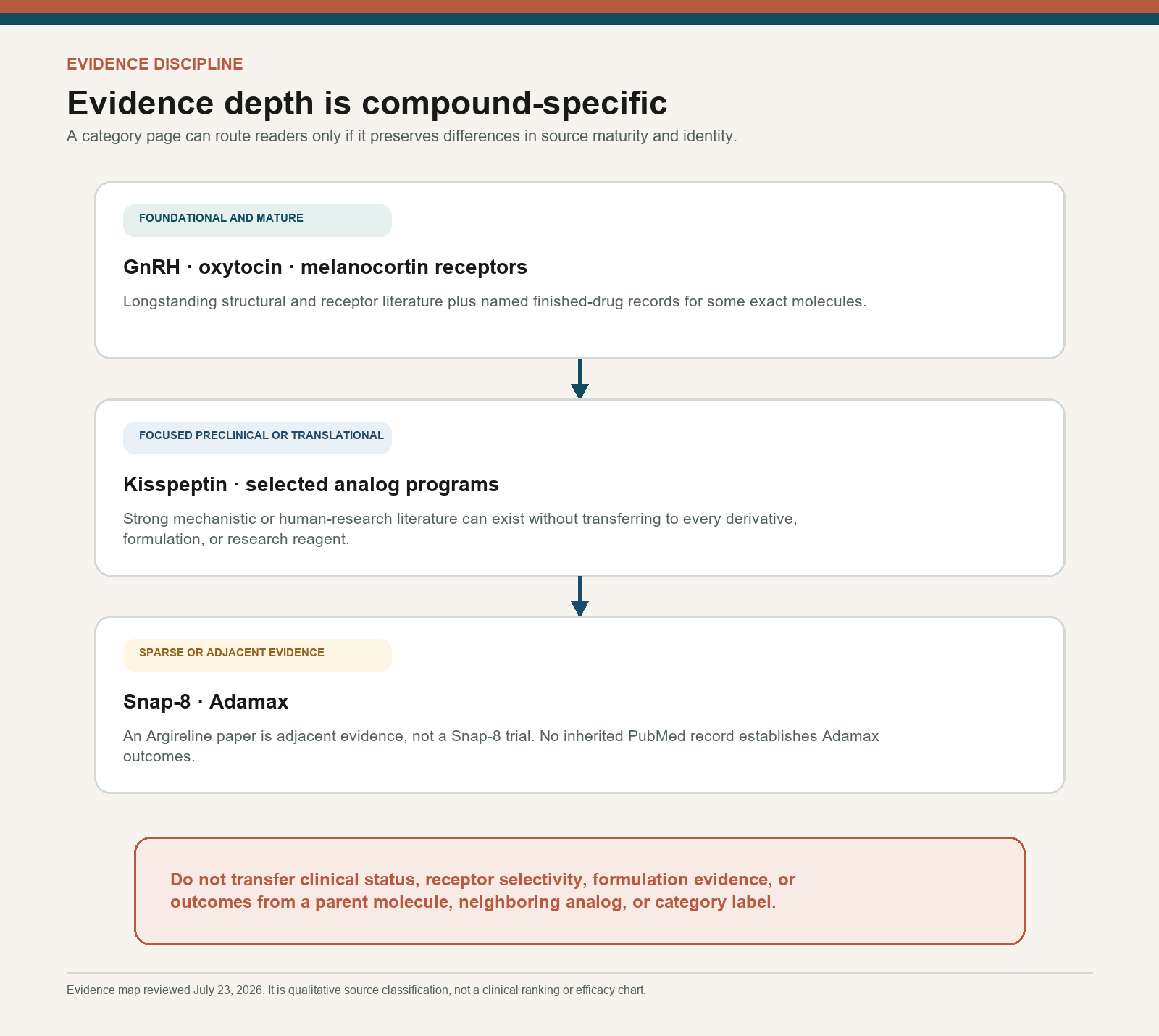
- Evidence for Argireline does not become evidence for Snap-8, and adjacent Semax literature does not become Adamax evidence.
- Approved finished drugs and Apex research reagents occupy categorically distinct regulatory frameworks.
- Seven catalog materials with no destination guide — Gonadorelin, HCG, HMG, Oxytocin, Kisspeptin-10, Snap-8 and Melanotan I — carry a bounded evidence record on this page rather than a passing mention.
- Regulatory statements here were re-checked against the FDA application register and the European product record on July 25, 2026; one inherited application number was wrong and has been corrected.
How to Use This Specialty Research Hub
The fastest route is to begin with the material’s family and then move to the exact entity. A family label can orient the question, but it cannot supply the final answer. The same category contains a native releasing hormone, synthetic receptor agonists, large glycoprotein preparations, cyclic melanocortin analogs, neuropeptides, and designed derivatives with little indexed evidence.
| Navigation family | Representative materials | What the family label can tell you | What still requires an exact-source review |
|---|---|---|---|
| GnRH and gonadotropin axis | Gonadorelin, Triptorelin, HCG, HMG | Position within hypothalamic, pituitary, or gonadal signaling | Exact molecular identity, preparation type, receptor action, and formulation record |
| Melanocortin | Melanotan I, Melanotan II, PT-141 | Shared α-MSH-derived research lineage | Receptor selectivity, compound-specific evidence, and approved-drug context |
| Neuropeptide systems | Kisspeptin-10, oxytocin | Upstream reproductive signaling or oxytocin-receptor biology | Exact peptide, model, endpoint, and evidence limitations |
| Designed sparse-evidence materials | Snap-8, Adamax | Why an evidence-gap-first review is required | Whether a source studies the named compound rather than a related parent or neighbor |

Reagent Identity Across the Specialty Catalog
Identity comes before evidence. A published result can only be attached to a material once that material is pinned to a CAS number, a molecular weight, a molecular formula where one exists, and a stated sequence. Two rows deliberately break the pattern: HCG and HMG are glycoprotein preparations rather than sequence-defined synthetic peptides, so they carry an approximate mass, no single formula, and no linear sequence. Recording that absence is part of the identity record, not a hole in it.
| Material | CAS | Molecular weight | Molecular formula | Sequence or structural note |
|---|---|---|---|---|
| Gonadorelin (GnRH) | 33515-09-2 | 1,182.29 Da | C55H75N17O13 | pGlu-His-Trp-Ser-Tyr-Gly-Leu-Arg-Pro-Gly-NH₂ (decapeptide) |
| Triptorelin (free base) | 57773-63-4 | 1,311.45 Da | C64H82N18O13 | [D-Trp⁶]-GnRH; D-tryptophan substituted at position 6. The registry number, mass and formula in this row are free-base values; the catalog supplies the acetate salt, which carries its own separate registry number and a higher salt-form mass that is not asserted here |
| HCG (chorionic gonadotropin) | 9002-61-3 | ≈36,700 Da | Not applicable — heterodimeric glycoprotein | α-subunit shared with LH, FSH and TSH; β-subunit unique to HCG; glycosylation heterogeneous |
| HMG (menotropins) | 9002-68-0 | ≈34,000 Da | Not applicable — glycoprotein mixture | Purified urinary preparation carrying FSH and LH activity, conventionally 75 IU of each per vial; not a single molecular entity |
| Melanotan I (afamelanotide) | 75921-69-6 | 1,646.85 Da | C78H111N21O19 | Ac-Ser-Tyr-Ser-Nle-Glu-His-D-Phe-Arg-Trp-Gly-Lys-Pro-Val-NH₂ (13 residues, linear) |
| Melanotan II | 121062-08-6 | 1,024.18 Da | C50H69N15O9 | Ac-Nle-cyclo(Asp-His-D-Phe-Arg-Trp-Lys)-NH₂; lactam-bridged cyclic heptapeptide |
| PT-141 (bremelanotide) | 189691-06-3 | 1,025.18 Da | C50H68N14O10 | Ac-Nle-cyclo(Asp-His-D-Phe-Arg-Trp-Lys)-OH; C-terminal acid counterpart of Melanotan II |
| Kisspeptin-10 | 374675-21-5 | 1,302.47 Da | C63H83N17O14 | Tyr-Asn-Trp-Asn-Ser-Phe-Gly-Leu-Arg-Phe-NH₂ |
| Oxytocin | 50-56-6 | 1,007.19 Da | C43H66N12O12S2 | Cys-Tyr-Ile-Gln-Asn-Cys-Pro-Leu-Gly-NH₂ closed by a Cys1–Cys6 disulfide |
| Snap-8 (acetyl octapeptide-3) | 868844-74-0 | 1,075.16 Da | C41H70N16O16S | Ac-Glu-Glu-Met-Gln-Arg-Arg-Ala-Asp-NH₂ (8 residues) |
| Adamax | Not specified in the catalog record | Not resolved — no analytically supported value | Not resolved | Identity unresolved. Circulating descriptions of this material conflict with one another and no primary supplier specification packet fixes a sequence, formula or mass, so no structural value is asserted in this row; the material is held under a documented product-governance hold recorded July 22, 2026 |
Molecular weights are supplier-reported Apex catalog specifications, not values measured for this page; the CAS registry number in each row is that row’s identity source of record. For the sequence-defined entries, each formula is the composition implied by the stated sequence and reconciles with the listed mass to within rounding; where the catalog records no value, or where the identity itself is unresolved, the cell says so rather than carrying an estimate. The HCG figure sits inside the 36,000–37,000 Da range reported for regular hCG in the biochemistry source cited later on this page. Lot-specific identity still belongs to the certificate of analysis, not to a reference table.
GnRH and Gonadotropin Materials in the HPG Axis
The HPG axis begins with hypothalamic gonadotropin-releasing hormone, continues through pituitary luteinizing hormone and follicle-stimulating hormone, and reaches downstream gonadal signaling. Schally and colleagues reported in 1971 that a single decapeptide isolated from porcine hypothalami regulates secretion of both pituitary hormones, and identified it as pGlu-His-Trp-Ser-Tyr-Gly-Leu-Arg-Pro-Gly-NH₂, with natural and synthetic material sharing biological properties; Matsuo and colleagues proposed the porcine sequence in a companion publication.[1][2] That work was recognised by the 1977 Nobel Prize in Physiology or Medicine, shared by Andrew V. Schally and Roger Guillemin for discoveries concerning the peptide hormone production of the brain.
Gonadorelin is the native GnRH decapeptide. Triptorelin is a synthetic D-Trp6 GnRH agonist analog. Those identities place both at the GnRH-receptor layer, but they do not make their kinetics, receptor behavior, formulations, or literature interchangeable. The dedicated Triptorelin research guide owns the analog-specific identity and evidence review.
HCG and HMG belong in this navigation family because they act farther downstream in reproductive-axis research, yet neither is a small monomeric peptide comparable to Gonadorelin. HCG is a heterodimeric glycoprotein hormone with structurally distinct molecular forms: the oligosaccharides on hyperglycosylated hCG raise the mass from 36,000–37,000 Da for regular hCG to 40,000–41,000 Da, and the two forms are made by different placental cell populations with separate biological functions.[10] HMG is a urinary gonadotropin preparation carrying FSH and LH activity at a conventional 75 IU of each per vial, and the Apex HCG entry is presented at 5,000 IU and 10,000 IU. Calling the entire group “peptides” without these qualifications hides a meaningful material-class difference.
A sequence-defined peptide, a synthetic analog, and a heterogeneous glycoprotein preparation require different identity controls and different source interpretation. The category label cannot replace the material specification.
The Melanocortin Family: Shared Lineage, Different Entities
Melanotan I, Melanotan II, and PT-141 trace to the University of Arizona College of Medicine melanocortin program. Sawyer, Hruby, Hadley, and colleagues reported a cyclic α-MSH analog with superagonist activity in 1982: the cyclic [half-Cys4,half-Cys10] analog was more than 10,000-fold more potent than the native hormone in the frog Rana pipiens skin-darkening assay, roughly 30-fold more potent at lizard Anolis carolinensis melanophores in vitro, and about 3-fold more potent at stimulating adenylate cyclase in a cell-free Cloudman S-91 mouse melanoma membrane preparation.[3] Those are amphibian, reptilian and mouse-melanoma in-vitro figures; they establish a structure–activity foundation, not a human potency claim. A later receptor-focused review by Hadley and colleagues described how labelled melanotropic agonists and antagonists were used to identify and characterize melanocortin receptor subtypes.[4]
The definitive 1998 Hadley, Hruby, Blanchard, and Dorr review documents the discovery and development of Melanotan I and Melanotan II, while the 2006 Hadley and Dorr historical-milestones synthesis follows the program into clinical studies and commercialization.[5][6] Both analogs reached human phase 1 testing out of that program, and the two dose records must stay separate. Melanotan I was studied across three open-label trials: 0.08 mg/kg per day for 10 days in the first, 0.16 mg/kg per day for 10 days in the second, and 0.16 mg/kg on 5 days per week for 4 weeks in the third (PMID 15262693). Melanotan II was started at 0.01 mg/kg in three normal male volunteers and escalated in 0.005 mg/kg increments to 0.03 mg/kg in two of the three, the remaining subject reaching 0.025 mg/kg; the paper’s recommended single dose for future phase 1 work was 0.025 mg/kg per day (PMID 8637402). Palatin Technologies licensed the program and developed Bremelanotide, also called PT-141. That lineage is specific to the melanocortin family and is not assigned to unrelated specialty materials.
That shared history does not collapse the three molecules into one. Melanotan I, also called afamelanotide, is associated primarily with MC1R-focused pharmacology. Melanotan II has a broader melanocortin receptor profile. PT-141, or bremelanotide, is a distinct cyclic analog with central melanocortin research context. Use the Melanotan II research guide and the PT-141 research guide for their exact identity, receptor, and evidence lanes.
The regulatory layer must remain equally specific. FDA approved Scenesse (afamelanotide), with Clinuvel Inc. as the approval-time applicant under NDA 210797, on October 8, 2019 to increase pain-free light exposure in adults with a history of phototoxic reactions from erythropoietic protoporphyria. Same molecule (afamelanotide); categorically distinct regulatory frameworks. FDA approved Vyleesi (bremelanotide), sponsored at approval by AMAG Pharmaceuticals after development by Palatin Technologies, under NDA 210557 on June 21, 2019 for acquired, generalized hypoactive sexual desire disorder in premenopausal women. Same molecule (bremelanotide); categorically distinct regulatory frameworks. Apex supplies Melanotan I and PT-141/Bremelanotide as research-grade chemical reagents in lyophilized powder form for in-vitro and preclinical research only; neither is a pharmaceutical or for human consumption. The finished-drug approvals do not transfer formulation, labeling, indication, or evidence to those research materials.
Kisspeptin and Oxytocin Are Separate Neuropeptide Systems
Kisspeptin research changed the model of reproductive-axis control by identifying KISS1R, historically called GPR54, as an upstream regulator. Independent 2003 reports linked loss-of-function variants in that receptor to hypogonadotropic hypogonadism and pubertal failure, establishing a direct human-genetic bridge between kisspeptin signaling and the HPG axis.[7][8]
Oxytocin is a different nonapeptide and receptor system. Its literature covers receptor structure, tissue expression, signaling, and regulation rather than KISS1R biology.[9] The two systems may both appear in neuroendocrine research, but proximity within a catalog or an HPG-axis discussion does not establish functional equivalence.
A useful evidence review therefore names the exact peptide, receptor, model, and endpoint. “Neuropeptide” is too broad to carry a mechanistic claim by itself.
Snap-8 and Adamax Require Evidence-Gap-First Review
Snap-8 is commonly identified as acetyl octapeptide-3. The inherited source set includes a 2002 paper on Argireline, a related acetyl hexapeptide, reporting that an oil-in-water emulsion containing 10% of that hexapeptide reduced wrinkle depth by up to 30% over 30 days in healthy women volunteers.[11] Those figures describe Argireline. They do not become Snap-8 figures simply because both materials are discussed in cosmetic-peptide contexts. A responsible page labels the paper as adjacent evidence and stops short of assigning its numbers to the octapeptide.
“Adamax” functions as a market and search term rather than a resolved chemical identity. Public-facing descriptions of the material contradict one another, the catalog records no CAS number, and no primary supplier specification establishing a sequence, molecular formula or molecular mass was available for this page — so none is asserted here, and the identity table above carries no mass for it. An identity cannot be inferred from a market name, another seller’s description, a plausible mass, a related Semax paper, or an adamantane paper. No Adamax-specific PubMed record was present in the inherited article source set or current-run verification either. That absence is information: the Adamax research guide should lead with identity and evidence limitations rather than borrow outcomes from Semax or other nootropic peptides, which supply comparison context only.
Catalog Compounds Without a Dedicated Guide
Seven materials in this category have no destination guide anywhere in the Apex corpus. On a navigation page that is a defect, because a reader who arrives asking about them leaves with a passing clause. Each therefore gets a bounded record below: identity first, mechanism in a sentence or two, the strongest verified evidence with its actual figures and species, an explicit regulatory status checked against a primary register, and the catalog entry. These are deliberately short. They are not entity guides and do not attempt that depth.
The evidence firewall applies inside every record. A result reported for one molecule stays with that molecule: Melanotan I is not Melanotan II, Snap-8 is not Argireline, Kisspeptin-10 is not Gonadorelin, and Kisspeptin-10 is not kisspeptin-54.
Gonadorelin
Identity. CAS 33515-09-2; molecular weight 1,182.29 Da; formula C55H75N17O13; sequence pGlu-His-Trp-Ser-Tyr-Gly-Leu-Arg-Pro-Gly-NH₂. This is the native hypothalamic decapeptide, not an analog of it.
Mechanism. Gonadorelin binds the GnRH receptor on anterior-pituitary gonadotrophs. Pulsatile exposure sustains luteinizing hormone and follicle-stimulating hormone output, whereas continuous exposure desensitises the receptor and suppresses both.
Evidence. Schally and colleagues isolated the peptide from porcine hypothalami and showed that one decapeptide regulates release of both gonadotropins across several species (PMID 4938639). Conn and Crowley’s review separated the two pharmacological modes: portable-pump pulsatile infusion restoring gonadotropin secretion, versus long-acting depot agonists producing a reversible, complete ablation of the reproductive axis through receptor desensitisation (PMID 8198390). That review reports no pooled effect estimate.
Regulatory status, verified against the FDA application register on July 25, 2026. Factrel — gonadorelin hydrochloride at 0.1 mg, 0.2 mg and 0.5 mg per vial — was approved under NDA 018123 on September 30, 1982, and every strength is now listed Discontinued. Lutrepulse Kit — gonadorelin acetate at 0.8 mg and 3.2 mg per vial, Ferring — was approved under NDA 019687 on October 10, 1989 and is likewise Discontinued. No gonadorelin drug product is currently marketed in the United States. An inherited note recording Factrel as “NDA 19-595” was wrong: that number returns no record.
Catalog. Apex offers Gonadorelin Acetate in 2 mg and 5 mg presentations for in-vitro and preclinical work. It is neither discontinued formulation above.
HCG (human chorionic gonadotropin)
Identity. CAS 9002-61-3; approximate molecular weight 36,700 Da. HCG is a heterodimer of an α-subunit shared with LH, FSH and TSH plus a β-subunit unique to HCG. Glycosylation is heterogeneous, so neither a single molecular formula nor a linear sequence describes the material.
Mechanism. It behaves as a long-acting agonist at the LH/CG receptor, driving cyclic-AMP-dependent gonadal steroidogenesis downstream of the pituitary.
Evidence. Cole’s biochemistry review quantifies why that heterogeneity matters. Hyperglycosylated hCG carries triantennary N-linked and double-size O-linked oligosaccharides that raise the molecular weight from 36,000–37,000 Da for regular hCG to 40,000–41,000 Da; it is secreted by extravillous cytotrophoblast rather than syncytiotrophoblast cells, promotes trophoblast invasion, and behaves as an independent molecule with separate biological functions detected by monoclonal antibody B152 (PMID 20619452). Human placental biology.
Regulatory status. FDA application records checked on July 25, 2026 show chorionic gonadotropin as an approved and currently marketed biologic. Pregnyl (Organon, BLA 017692, 10,000 units per vial) was approved on October 20, 1976 and holds Prescription status; Novarel (Ferring, BLA 017016) holds Prescription status at 5,000 and 10,000 units per vial. Same molecule (chorionic gonadotropin); categorically distinct regulatory frameworks separate those biologics from a laboratory reagent.
Catalog. The Apex research reagent is listed as HCG in 5,000 IU and 10,000 IU presentations. It carries none of the labelling, indication or pharmaceutical manufacturing status of the approved products.
HMG (menotropins)
Identity. CAS 9002-68-0; approximate molecular weight 34,000 Da. HMG is a purified urinary gonadotropin preparation rather than a defined molecular entity, so it has no formula and no sequence. The meaningful specification is activity per vial, conventionally 75 IU of FSH and 75 IU of LH.
Mechanism. LH-receptor activity accompanies FSH-receptor activity in the same preparation, which shifts downstream steroidogenesis relative to an FSH-only recombinant product.
Evidence. In a randomised, assessor-blind, multinational IVF study of 731 women — 363 stimulated with highly purified hMG and 368 with recombinant FSH — serum androstenedione, total testosterone and free androgen index were higher under HP-hMG (P < 0.001); follicular-fluid estradiol and androgens were higher under HP-hMG while progesterone was higher under recombinant FSH (P < 0.001); and mid- and end-follicular serum hCG in the HP-hMG arm measured 2.5 and 2.9 IU/l (PMID 17110397). Human, assisted-reproduction population.
Regulatory status. The July 25, 2026 register check returns Menopur (Ferring, BLA 021663, 75 IU FSH and 75 IU LH per vial), approved on October 29, 2004 and still Prescription. Repronex (BLA 021047, approved August 27, 1999), Pergonal (BLA 017646, 1975) and Humegon (BLA 020328, 1994) are all Discontinued.
Catalog. Apex’s HMG 75iu entry is a research-grade urinary gonadotropin preparation, separate from every menotropin drug product named above.
Oxytocin
Identity. CAS 50-56-6; molecular weight 1,007.19 Da; formula C43H66N12O12S2; sequence Cys-Tyr-Ile-Gln-Asn-Cys-Pro-Leu-Gly-NH₂, closed by a Cys1–Cys6 disulfide. It was the first polypeptide hormone to be synthesised, work recognised by the 1955 Nobel Prize in Chemistry awarded to Vincent du Vigneaud.
Mechanism. The oxytocin receptor is a class I G-protein-coupled receptor signalling mainly through G(q) to phospholipase C-β. Its high-affinity state requires both Mg²⁺ and cholesterol, which act as allosteric modulators.
Evidence. Gimpl and Fahrenholz’s Physiological Reviews synthesis remains the reference description of that system, covering receptor structure, distinct agonist- and antagonist-binding regions, steroid-dependent regulation, and the observation that oxytocin-deficient mice confirmed an essential role in the milk-ejection reflex while the role in parturition proved more complex (PMID 11274341). Mouse-knockout and tissue data, not a clinical effect estimate. Carter’s later review places the peptide in comparative social neurobiology beside vasopressin (PMID 24050183); it is a narrative synthesis and reports no effect size.
Regulatory status at the July 25, 2026 register check: oxytocin injection is approved and marketed. Pitocin (NDA 018261, 10 USP units/mL) was approved on November 19, 1980 and is Prescription; two further oxytocin injection applications, NDA 018243 and NDA 018248, also hold Prescription status, while Syntocinon (NDA 018245) is Discontinued. Same molecule (oxytocin); categorically distinct regulatory frameworks govern an approved injection and a research reagent.
Catalog. Oxytocin Acetate is offered in 2 mg, 5 mg and 10 mg vials for laboratory research, and is none of the injection products above.
Kisspeptin-10
Identity. CAS 374675-21-5; molecular weight 1,302.47 Da; formula C63H83N17O14; sequence Tyr-Asn-Trp-Asn-Ser-Phe-Gly-Leu-Arg-Phe-NH₂, the C-terminal decapeptide of the KISS1 product.
Mechanism. It is an agonist at KISS1R, historically GPR54, expressed on hypothalamic GnRH neurons — one signalling layer above the pituitary. Kisspeptin-10 does not act at the pituitary GnRH receptor, so Gonadorelin results describe a different step and are not carried across.
Evidence. Two 2003 human-genetic reports fixed that position. De Roux and colleagues mapped a consanguineous family with five affected siblings to chromosome 19p13 and found a homozygous 155-nucleotide deletion in GPR54 spanning the intron 4 to exon 5 splice acceptor (PMID 12944565). Seminara and colleagues found a homozygous L148S mutation plus compound heterozygous R331X and X399R, showed significantly reduced inositol-phosphate accumulation in transfected COS-7 cells, and phenotyped a Gpr54-deficient mouse with hypogonadotropic hypogonadism (PMID 14573733). Human evidence for kisspeptin exists, but neither abstract states which kisspeptin form was administered, so its numbers are not carried across to this decapeptide. Comninos and colleagues studied kisspeptin in healthy men in a randomised, double-blind, two-way placebo-controlled neuroimaging study; default-mode-network modulation correlated with limbic activity in response to sexual stimuli — globus pallidus r = 0.500, P = 0.005; cingulate r = 0.475, P = 0.009 (PMID 30333302). Yang and colleagues reported that kisspeptin enhanced brain responses to olfactory and visual cues of attraction in men, largest in men with lower sexual quality-of-life scores; that abstract reports no effect size (PMID 32051344). Neither abstract identifies the administered peptide as this decapeptide, so both sets of human figures stay with their source reports and are not restated as Kisspeptin-10 results anywhere on this page.
Regulatory status. A search of the FDA application register for kisspeptin in any salt or formulation returned no record on July 25, 2026, and no marketing authorisation for the compound was identified in any register consulted this run. It is a research compound.
Catalog. The Kisspeptin-10 reagent is listed in 5 mg and 10 mg sizes for in-vitro and preclinical use.
Snap-8
Identity. CAS 868844-74-0; molecular weight 1,075.16 Da; formula C41H70N16O16S; sequence Ac-Glu-Glu-Met-Gln-Arg-Arg-Ala-Asp-NH₂. It is acetyl octapeptide-3, an eight-residue material.
Mechanism. The design intent is competitive interference with SNARE-complex assembly by mimicking the N-terminal region of SNAP-25, which would reduce calcium-dependent vesicular exocytosis. That is a stated design rationale, not a demonstrated result for this octapeptide.
Evidence gap. No Snap-8-specific PubMed-indexed record was located in the cached NCBI set or in current-run verification, so this record has no compound-specific figure to report. The nearest indexed paper studies a different molecule: Blanes-Mira and colleagues reported that an emulsion containing 10% of the hexapeptide Argireline, Ac-Glu-Glu-Met-Gln-Arg-Arg-NH₂, cut wrinkle depth by as much as 30% across 30 days in healthy women volunteers, attributing the effect to interference with SNARE-complex formation (PMID 18498523). Those numbers belong to Argireline. The two molecules differ by the terminal Ala-Asp pair, no head-to-head comparison was found, and the 30% value is not restated as a Snap-8 result anywhere on this page.
Regulatory status. No application for acetyl octapeptide-3, or for any Snap-8 brand, appears in the FDA register as of July 25, 2026, and no approved medicine containing it was identified in any register consulted. Cosmetic-ingredient listings are not drug approvals and are not presented as such.
Catalog. Snap-8 10mg appears in the catalog as a single 10 mg presentation.
Melanotan I (afamelanotide)
Identity. CAS 75921-69-6; molecular weight 1,646.85 Da; formula C78H111N21O19; sequence Ac-Ser-Tyr-Ser-Nle-Glu-His-D-Phe-Arg-Trp-Gly-Lys-Pro-Val-NH₂, the [Nle4, D-Phe7]-α-MSH 13-residue linear analog. It is not Melanotan II, a cyclic heptapeptide of 1,024.18 Da; only Melanotan I data appear below.
Mechanism. It is a melanocortin agonist directed at MC1R on epidermal melanocytes, stimulating eumelanin synthesis.
Evidence. Langendonk and colleagues ran two randomised, double-blind, placebo-controlled trials of a 16 mg subcutaneous implant given every 60 days. In the 94-patient US trial, median pain-free sun exposure at six months was 69.4 hours against 40.8 hours on placebo (P = 0.04); in the 74-patient EU trial the medians at nine months were 6.0 versus 0.8 hours (P = 0.005), with 77 phototoxic reactions against 146 (P = 0.04) (PMID 26132941). Human, erythropoietic protoporphyria. Earlier Arizona phase 1 work ran three separate open-label studies. In the first, tanning was achieved in 3 of 4 subjects given 0.08 mg/kg per day for 10 days, and those subjects had 47% fewer sunburn cells at the irradiated neck site; in the third study (8 subjects randomised across both arms, 0.16 mg/kg on 5 days per week for 4 weeks), the sunlight-only controls required 50% more sun-exposure time for equivalent tanning (PMID 15262693). Human volunteers.
Regulatory status, confirmed July 25, 2026. FDA approved Scenesse, the afamelanotide 16 mg implant, under NDA 210797 on October 8, 2019; it holds Prescription status. The EU marketing authorisation issued 22 December 2014 to Clinuvel Europe Limited for phototoxicity prevention in adult erythropoietic protoporphyria. Same molecule (afamelanotide); categorically distinct regulatory frameworks apply to that implant and to a laboratory reagent.
Catalog. Melanotan I 10mg is a single-size research reagent, lyophilized powder for laboratory research only, not for human consumption.
Regulatory Status by Compound
Regulatory status is a per-compound fact, not a category property. Seven of the eleven catalog materials correspond to a molecule with at least one approved finished-drug application; four have none. The table states each position explicitly, using application numbers and approval dates read from the FDA register on July 25, 2026 and, for afamelanotide, from the European product record. A supplier statement about research materials is a different assertion from a regulatory status, and is not substituted for one here.
| Compound | Approved product of the same molecule | Application and date | Current register status |
|---|---|---|---|
| Gonadorelin | Factrel; Lutrepulse Kit | NDA 018123, September 30, 1982; NDA 019687, October 10, 1989 | Both Discontinued; nothing currently marketed |
| Triptorelin | Trelstar; Triptodur Kit | NDA 020715, June 15, 2000; NDA 208956, June 29, 2017 | Prescription |
| HCG | Pregnyl; Novarel | BLA 017692, October 20, 1976; BLA 017016 | Prescription |
| HMG | Menopur | BLA 021663, October 29, 2004 | Prescription; Repronex, Pergonal and Humegon Discontinued |
| Melanotan I (afamelanotide) | Scenesse 16 mg implant | NDA 210797, October 8, 2019; EU authorisation 22 December 2014 | Prescription in the United States; authorised in the European Union |
| PT-141 (bremelanotide) | Vyleesi autoinjector, 1.75 mg per 0.3 mL | NDA 210557, June 21, 2019 | Prescription |
| Oxytocin | Pitocin and other oxytocin injections | NDA 018261, November 19, 1980 | Prescription; Syntocinon Discontinued |
| Melanotan II | None | The FDA register returns no record for melanotan II | Research-only; no authorisation found in the registers consulted |
| Kisspeptin-10 | None identified | No application located in the FDA register | No approval identified in any register consulted |
| Snap-8 | None identified | No application located in the FDA register | No drug approval identified; cosmetic-ingredient listing only |
| Adamax | None | Not present in the FDA register | Research-only; nothing found this run in any register |
The four negative rows are stated at the scope actually verified. The FDA application register was queried directly and returned no record for those molecules on July 25, 2026. The European Medicines Agency search interface could not be queried programmatically during this pass, so “no approval identified” is the honest wording rather than a global negative asserted from one register. Where an approval does exist, the approved product and the Apex material remain different things: an approval attaches to a named formulation, its sponsor, its manufacturing controls and its labelled indication, none of which transfer to a reagent supplied for laboratory work.
Additional Reported Findings
Sources that informed the earlier version of this page but no longer have a home in the running prose are kept here as compact rows rather than discarded. Each row names the compound, the study design, the species, the endpoint and the reported result, so a reader can judge whether the source is worth opening. Where an abstract reports no effect estimate, the row says so instead of implying one.
| Compound | Model or design | Species | Endpoint | Reported result | PMID |
|---|---|---|---|---|---|
| HMG (HP-hMG) | Randomised assessor-blind multinational IVF trial, n = 731 | Human | Serum and follicular-fluid endocrine profile | Androstenedione, total testosterone and free androgen index higher than recombinant FSH, P < 0.001; mean mid- and end-follicular serum hCG 2.5 and 2.9 IU/l in the HP-hMG group | 17110397 |
| Gonadorelin and GnRH analogs | Narrative review of pulsatile versus depot administration | Human | Pituitary gonadotropin output | Pulsatile infusion restores secretion; depot agonist gives reversible ablation of the axis. Review; no pooled estimate | 8198390 |
| Melanotan I (afamelanotide) | US randomised double-blind placebo-controlled trial, n = 94, 16 mg subcutaneous implant every 60 days, 180-day study period | Human, erythropoietic protoporphyria | Pain-free direct sun exposure at 6 months | Median 69.4 h against 40.8 h on placebo, P = 0.04. US trial only; the companion 74-patient EU trial reported medians of 6.0 h against 0.8 h at 9 months (P = 0.005) over a 270-day period, so the two are not interchangeable | 26132941 |
| Kisspeptin — endogenous hypothalamic system, not the Kisspeptin-10 reagent | Neuroanatomical review of the human hypothalamic kisspeptin system | Human, with comparative mammalian data | Distribution of kisspeptin-synthesizing neurons | In mammals the majority of these neurons concentrate in two populations, the preoptic region and the arcuate nucleus. Review; no effect estimate | 24401651 |
| Kisspeptin — form not stated in the abstract, not the Kisspeptin-10 reagent | Randomised double-blind two-way placebo-controlled resting-state fMRI | Human, healthy men | Resting brain connectivity | Default-mode-network modulation correlated with limbic response, globus pallidus r = 0.500, P = 0.005; cingulate r = 0.475, P = 0.009 | 30333302 |
| Kisspeptin — form not stated in the abstract, not the Kisspeptin-10 reagent | Functional neuroimaging with olfactory and visual cues of attraction; the abstract states no trial design | Human, men | Attraction-related brain response | Enhanced olfactory and limbic responses, largest in men with lower sexual quality-of-life scores; the abstract reports no effect size | 32051344 |
| PT-141 (bremelanotide) | Ovariectomised, hormone-primed paced-mating model | Rat | Appetitive sexual behaviour | Increased solicitations without change in pacing or lordosis after subcutaneous or medial preoptic infusion; no effect size reported | 17958619 |
| Oxytocin | Comparative and evolutionary review | Human and other mammals | Social behaviour and autonomic regulation | Synthesis of oxytocin and vasopressin pathways; no effect estimate reported | 24050183 |
Every row carries its own design and species because the rows are not comparable with one another. Different compounds, doses, endpoints, durations and populations sit in one table for source navigation only, and no figure in one row may be read across to another row’s compound. Two rows record kisspeptin studies whose abstracts do not state which kisspeptin form was administered: those are not Kisspeptin-10 results, even though the catalog material is the decapeptide.
Four inherited sources were retired rather than restored, each for a stated reason. The 1953 performic-acid oxidation methods note carries no endpoint this page can report. The 2005 comparative review of melanocortin receptors in fish would risk moving non-mammalian receptor pharmacology onto named catalog compounds. The 2018 triptorelin depot review, covering 3.75 mg per 28 days and longer-interval formulations, belongs to the Triptorelin research guide. The 52-week open-label RECONNECT extension belongs to the PT-141 guide, which already owns the core phase 3 trials.
Evidence and Regulatory Boundaries Across the Category
Three lanes must be kept separate. The molecule lane covers structure, sequence, receptor pharmacology, and exact-compound studies. The finished-drug lane adds a named formulation, sponsor, manufacturing controls, regulator review, labeling, and an approved use. The research-reagent lane concerns a material supplied for a defined in-vitro or preclinical purpose and its lot-specific analytical documentation.
Movement between those lanes requires evidence; it cannot be inferred from a shared name. A clinical paper can explain why a molecular target matters, but it does not validate the identity, quality, sterility, safety, or efficacy of a separate research material. Conversely, an HPLC or mass-spectrometry result can support a bounded analytical question without establishing clinical performance.

Find the Right Next Page
The hub hands each search task to the narrowest page that can answer it well. This prevents a category page from competing with entity guides and gives readers a cleaner source trail.
Single-compound identity
Use the Triptorelin, Melanotan II, PT-141, or Adamax guide.
Analytical documentation
Read how to read a peptide COA, the HPLC purity guide, and the mass-spectrometry identity guide.
Research-grade boundary
Use research grade versus pharmaceutical grade to separate material identity from finished-drug status.
Neighboring research families
Continue to the tissue-repair, growth-hormone-axis, or nootropic and CNS hub when the question belongs elsewhere.

Method, Source Date, and Limitations
This refresh used the July 22, 2026 WordPress export as the identity and internal-link baseline. Scientific claims were reduced to a curated current-run PubMed set and verified through NCBI E-utilities; every PMID on this page was checked against a cached E-utilities record before it was written. Regulatory statements were re-derived on July 25, 2026 from the FDA application register and, for afamelanotide, from the European product record, a pass that corrected one inherited application number. The navigation map was reviewed July 23, 2026 and should be rechecked when a new entity guide, approved formulation, product record, or material definition changes.
A second limitation is register coverage. The FDA application register was queried directly, but the European Medicines Agency and other national registers were not machine-readable during this pass, so wording of the form “no approval identified” is scoped to the registers actually consulted rather than asserted globally. Two further constraints are worth naming: the Snap-8 record has no compound-specific published study to cite, and the Adamax entry has no CAS number in the catalog source.
The principal limitation is intentional breadth. This hub does not attempt to reproduce every entity guide or clinical history. It also does not treat absence of an indexed paper as proof that no evidence exists anywhere; it records what was identified in the defined search and inherited source set. Readers should use the linked exact-compound guide for deeper assessment.
Primary References
- Schally AV, et al. Gonadotropin-releasing hormone: one polypeptide regulates secretion of luteinizing and follicle-stimulating hormones. Science. 1971;173(4001):1036-8. PMID: PMID 4938639.
- Matsuo H, et al. Structure of the porcine LH- and FSH-releasing hormone. I. The proposed amino acid sequence. Biochem Biophys Res Commun. 1971;43(6):1334-9. PMID: PMID 4936338.
- Sawyer TK, et al. [half-Cys4,half-Cys10]-alpha-Melanocyte-stimulating hormone: a cyclic alpha-melanotropin exhibiting superagonist biological activity. Proc Natl Acad Sci U S A. 1982;79(6):1751-5. PMID: PMID 6281785.
- Hadley ME, et al. Melanocortin receptors: identification and characterization by melanotropic peptide agonists and antagonists. Pigment Cell Res. 1996;9(5):213-34. PMID: PMID 9014208.
- Hadley ME, et al. Discovery and development of novel melanogenic drugs. Melanotan-I and -II. Pharm Biotechnol. 1998;11:575-95. PMID: PMID 9760697.
- Hadley ME, et al. Melanocortin peptide therapeutics: historical milestones, clinical studies and commercialization. Peptides. 2006;27(4):921-30. PMID: PMID 16412534.
- de Roux N, et al. Hypogonadotropic hypogonadism due to loss of function of the KiSS1-derived peptide receptor GPR54. Proc Natl Acad Sci U S A. 2003;100(19):10972-6. PMID: PMID 12944565.
- Seminara SB, et al. The GPR54 gene as a regulator of puberty. N Engl J Med. 2003;349(17):1614-27. PMID: PMID 14573733.
- Gimpl G, et al. The oxytocin receptor system: structure, function, and regulation. Physiol Rev. 2001;81(2):629-83. PMID: PMID 11274341.
- Cole LA. Hyperglycosylated hCG, a review. Placenta. 2010;31(8):653-64. PMID: PMID 20619452.
- Blanes-Mira C, et al. A synthetic hexapeptide (Argireline) with antiwrinkle activity. Int J Cosmet Sci. 2002;24(5):303-10. PMID: PMID 18498523.
Research materials and supporting guides
Research materials
- Melanotan II 10mg
- Melanotan I 10mg
- PT-141 10mg
- ACE 031 1mg
- Follistatin 344 1mg
- Gonadorelin Acetate
- Kisspeptin-10
- Oxytocin Acetate
- Thymosin Alpha 1
- Triptorelin Acetate 2mg
- VIP
- Snap-8 10mg
- HCG
- HMG 75iu