Liraglutide and Dulaglutide are GLP-1 receptor agonists engineered to extend the short activity of native GLP-1 through different molecular strategies. Liraglutide uses C16 fatty-acid acylation and albumin association; Dulaglutide covalently links modified GLP-1 analog chains to a modified IgG4 Fc portion; AWARD-6 directly compared their finished pharmaceutical products within one defined 26-week protocol. FDA-approved formulations and Apex research reagents containing these molecules occupy categorically distinct regulatory frameworks.
For the broader family taxonomy and links to adjacent single-, dual-, and triple-agonist programs, begin with the GLP-1 and metabolic research-peptide hub.
The most useful Liraglutide-versus-Dulaglutide comparison starts with what can actually be compared. Both molecules activate the GLP-1 receptor, but their size, architecture, exposure strategy, clinical evidence programs, and approved pharmaceutical identities differ. One randomized study—AWARD-6—directly compared the named pharmaceutical formulations within a shared protocol. Other major programs, including LEADER and REWIND, answer different questions and should not be treated as a second head-to-head trial.
- Both compounds target GLP-1R, but Liraglutide is an acylated peptide analog while Dulaglutide is a much larger GLP-1 analog–Fc fusion protein.
- AWARD-6 is the central direct comparison: a 26-week, randomized, open-label Phase 3 non-inferiority trial in 599 adults with type 2 diabetes receiving metformin.
- AWARD-6 supported non-inferiority of Dulaglutide to Liraglutide for its prespecified HbA1c endpoint; it did not establish a universal winner across all populations or outcomes.
- LEADER and REWIND are separate cardiovascular-outcomes trials with different study populations and protocols. Their effect estimates should not be ranked as though they came from one experiment.
- Victoza and Saxenda are FDA-approved finished formulations containing Liraglutide; Trulicity is an FDA-approved finished formulation containing Dulaglutide.
- Same molecule (Liraglutide or Dulaglutide); categorically distinct regulatory frameworks for approved pharmaceutical formulations and Apex research reagents.
Liraglutide vs Dulaglutide at a Glance
| Comparison field | Liraglutide | Dulaglutide |
|---|---|---|
| Molecular format | Acylated GLP-1 analog | Modified GLP-1 analog chains joined to a modified human IgG4 Fc domain |
| Primary receptor | GLP-1 receptor | GLP-1 receptor |
| Exposure-extension strategy | C16 fatty-acid attachment supports albumin association and slower disposition | Large Fc-fusion architecture supports prolonged systemic persistence |
| FDA-labeled elimination half-life in finished-product studies | Approximately 13 hours[6] | Approximately 5 days[7] |
| Foundational engineering source | Knudsen et al., 2000[1] | Glaesner et al., 2010[2] |
| Direct shared trial | AWARD-6, NCT01624259, directly compared the pharmaceutical formulations over 26 weeks[3] | |
| Major cardiovascular-outcomes program | LEADER[4] | REWIND[5] |
| FDA-approved finished formulations | Victoza; Saxenda | Trulicity |
| Apex context | Research-grade chemical reagents for in-vitro and preclinical research; not the approved finished drugs and not for human consumption | |
The shared GLP-1R target does not make the molecules interchangeable. “GLP-1 receptor agonist” identifies a pharmacological class; it does not specify molecular mass, construct, exposure, formulation, approved indication, evidence maturity, or analytical identity. A defensible comparison keeps those dimensions separate.
How Do Their Molecular Engineering Strategies Differ?
Native GLP-1 has a short biological lifetime because enzymatic inactivation and clearance occur rapidly. Liraglutide and Dulaglutide address that limitation through different architectures. The Liraglutide development program explored fatty-acid derivatization of GLP-1 analogs to increase association with serum albumin while retaining receptor activity. Knudsen and colleagues reported that sufficiently long fatty-acid substituents could substantially prolong action in the tested systems, providing a structure–activity foundation for the acylated analog strategy.[1]
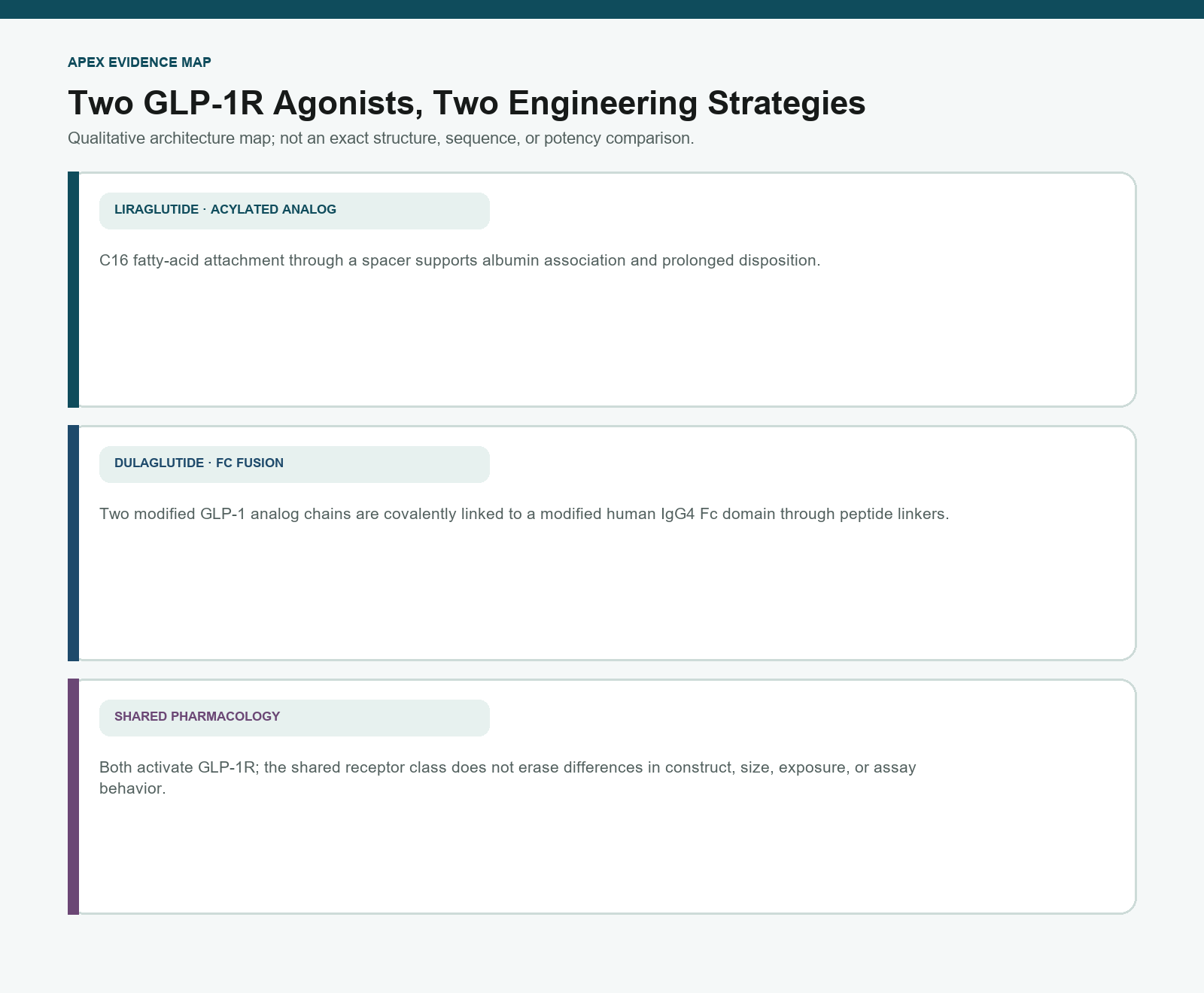
Liraglutide’s retained molecule uses a C16 fatty-acid moiety connected through a spacer at Lys26, together with a sequence substitution that supports controlled attachment. Albumin association, self-association, and reduced exposure to rapid clearance contribute to the extended profile. That description is a molecular-design summary, not a claim that a fatty-acid-modified research material duplicates a specific drug formulation.
Dulaglutide takes a fusion-protein route. Glaesner and colleagues described LY2189265 as a GLP-1 analog–IgG4 Fc fusion engineered for prolonged pharmacokinetics and activity. The construct contains modified GLP-1 analog portions covalently linked to a modified human IgG4 Fc region. The Fc-based size and architecture distinguish Dulaglutide from a conventional acylated peptide, even though both ultimately use GLP-1R signaling as their primary pharmacological lane.[2]
The practical scientific implication is not that one extension strategy is intrinsically superior. Construct size, receptor potency, binding interactions, assay matrix, exposure, sample handling, and endpoint selection can affect observations. Researchers should specify the exact molecule and construct in every claim instead of carrying conclusions across the class label.
What Did AWARD-6 Directly Compare?
AWARD-6 is the strongest direct bridge between the two molecules because both appeared within one randomized protocol. The Phase 3 study enrolled 599 adults with type 2 diabetes whose glycemic control was inadequate on metformin. Investigators randomly assigned participants, all receiving metformin at 1,500 mg per day or more, to once-weekly Dulaglutide 1.5 mg or once-daily Liraglutide 1.8 mg, and evaluated the prespecified change in HbA1c at 26 weeks. The trial was open-label and designed to test non-inferiority, with a 0.4-percentage-point margin.[3]
The reported least-squares mean HbA1c changes were −1.42 percentage points for Dulaglutide and −1.36 for Liraglutide. The between-group estimate was −0.06 percentage points, with a 95% confidence interval from −0.19 to 0.07; the prespecified non-inferiority criterion was met. Gastrointestinal events were the most commonly reported adverse events in both groups, with nausea in 20% of the Dulaglutide arm versus 18% of the Liraglutide arm; 6% of each group discontinued because of adverse events, and hypoglycaemia rates were 0.34 and 0.52 events per patient per year with no severe episodes.[3]
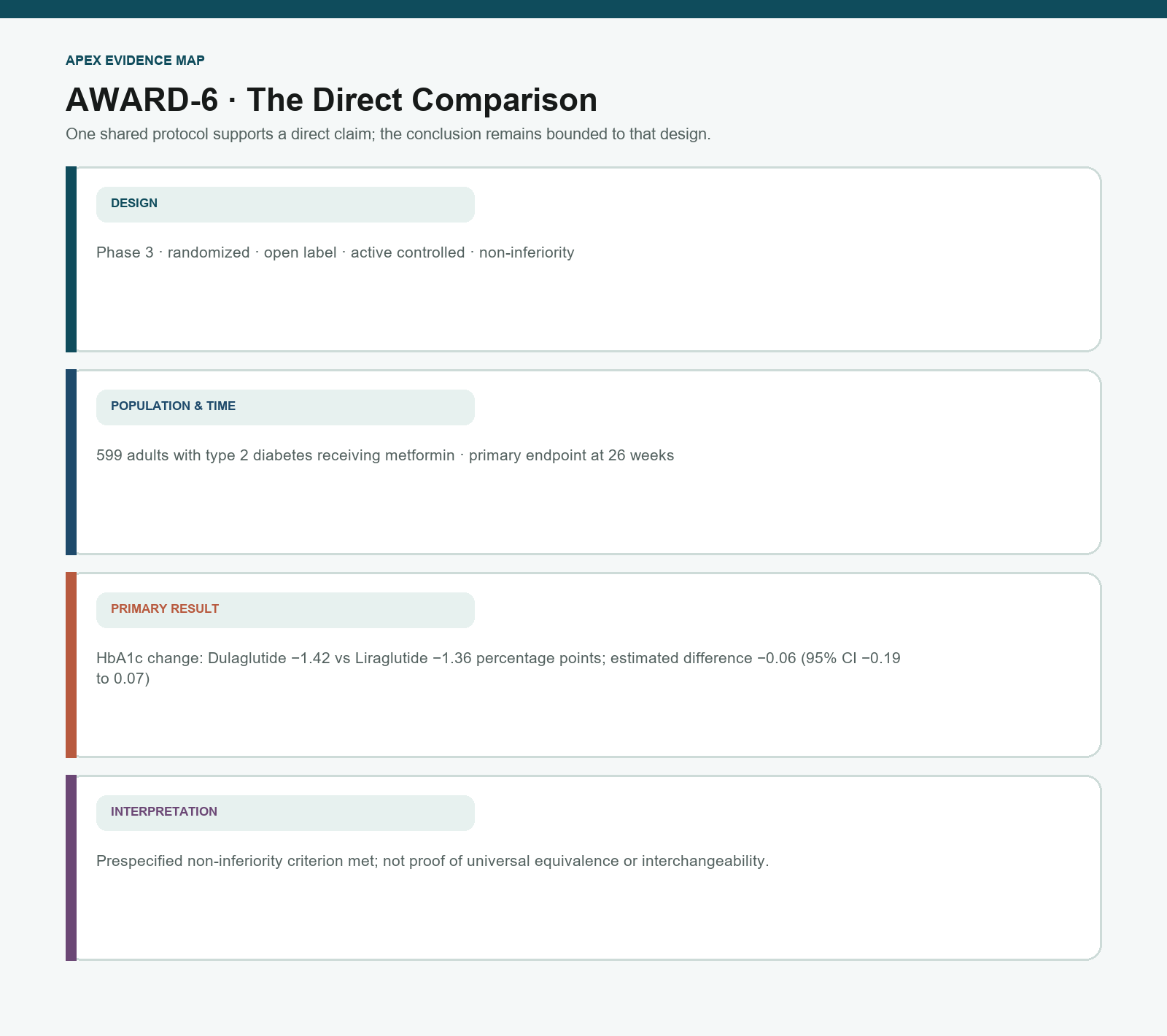
Non-inferiority has a precise meaning. It shows that the Dulaglutide arm did not cross the study’s prespecified unacceptable-difference boundary for that endpoint, population, duration, and analysis. It does not prove the molecules are identical, interchangeable, equally effective for every outcome, or equivalent in every laboratory system. The study also evaluated finished pharmaceutical formulations under clinical controls; it did not test Apex research reagents.
How Do LEAD, LEADER, AWARD, and REWIND Fit Together?
The broader evidence programs provide compound-specific context, but most of their studies were not direct Liraglutide-versus-Dulaglutide comparisons. Liraglutide’s LEAD program examined glycemic-control questions across several controlled trials. LEADER then studied cardiovascular outcomes in 9,340 people with type 2 diabetes at high cardiovascular risk. Over a median 3.8 years, the primary composite outcome occurred in 13.0% of the Liraglutide group and 14.9% of the placebo group, corresponding to a hazard ratio of 0.87 in the published analysis. In the same trial, death from cardiovascular causes occurred in 4.7% of the Liraglutide group versus 6.0% of the placebo group (hazard ratio 0.78), and death from any cause in 8.2% versus 9.6% (hazard ratio 0.85).[4]
Dulaglutide’s AWARD program addressed glycemic-control questions across multiple comparators and populations. REWIND then randomized 9,901 participants with type 2 diabetes and either previous cardiovascular events or cardiovascular risk factors to weekly subcutaneous Dulaglutide 1.5 mg or placebo. Over a median 5.4 years, the primary composite occurred in 12.0% of the Dulaglutide group and 13.4% of the placebo group, corresponding to a hazard ratio of 0.88 in that trial.[5]
The numerical similarity between 0.87 and 0.88 is not a head-to-head result. LEADER and REWIND enrolled different populations, used different protocols, occurred across different periods, and compared each molecule with its own placebo control. Their effect estimates establish findings within the respective trials. Subtracting one hazard ratio from the other would ignore the uncertainty and design differences that determine whether a between-treatment contrast is valid.
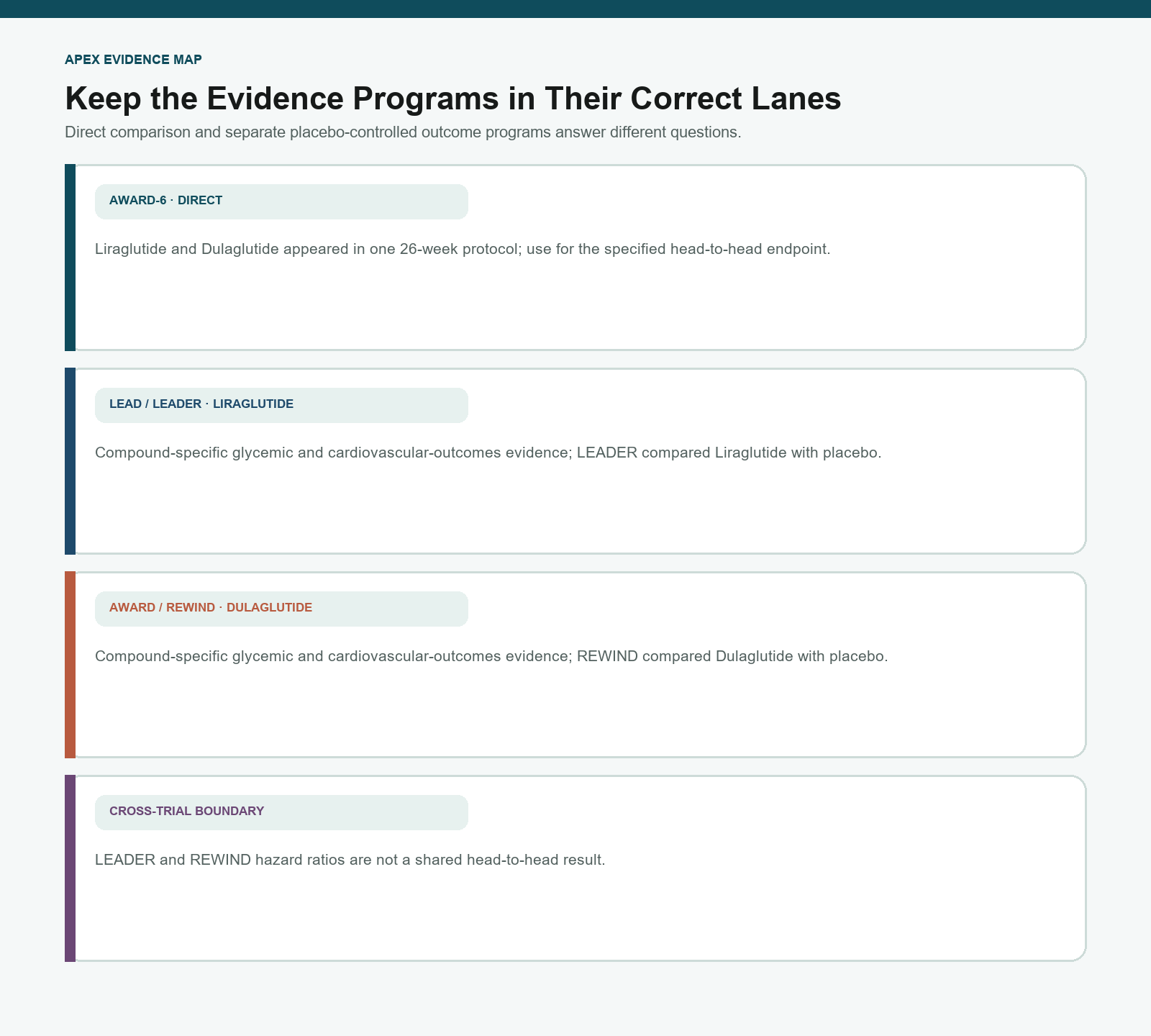
Use AWARD-6 for the direct 26-week Liraglutide-versus-Dulaglutide question. Use LEADER and REWIND for compound-specific cardiovascular-outcomes questions. Do not turn separate placebo-controlled trials into an unsupported direct ranking.
Additional reported findings
Further readouts sit outside the direct comparison but still carry specific figures, each with its own model or population and source.
| Compound and regimen | Model or population | Endpoint | Reported result | Source |
|---|---|---|---|---|
| Liraglutide, LEADER renal analysis | 9,340 adults, type 2 diabetes, high cardiovascular risk; median 3.84 years | Composite renal outcome | 268/4,668 vs 337/4,672 on placebo; HR 0.78 (95% CI 0.67–0.92; P=0.003); new macroalbuminuria 161 vs 215, HR 0.74 | Mann 2017 · PMID 28854085 |
| Liraglutide, twice-daily dosing, 14 days | Rat, preclinical | Gastric emptying vs body weight | Acute gastric-emptying reduction markedly diminished by day 14 while the body-weight reduction persisted; exenatide still reduced gastric emptying at day 14 | Jelsing 2012 · PMID 22226053 |
| Dulaglutide (LY2189265), single subcutaneous doses 0.1–12 mg | Healthy humans, phase 1 crossover | Half-life and insulin secretion | Half-life approximately 90 hours, peak concentration at 24–48 hours; dose-dependent rise in glucose-dependent insulin secretion vs placebo; no anti-drug antibodies | Barrington 2011 · PMID 21251179 |
| Dulaglutide 1.5 mg weekly, REWIND exploratory analysis | 9,901 adults, type 2 diabetes; median 5.4 years | Composite renal outcome | 848 (17.1%) vs 970 (19.6%) on placebo; HR 0.85 (95% CI 0.77–0.93; p=0.0004); new macroalbuminuria HR 0.77 | Gerstein 2019 · PMID 31189509 |
What Are the Current Regulatory Identities?
Liraglutide is the active ingredient in more than one FDA-approved finished pharmaceutical formulation. Victoza was originally approved under NDA 022341 on January 25, 2010.[8] The current FDA label identifies it as a GLP-1 receptor agonist for labeled type 2 diabetes and cardiovascular-risk-reduction uses.[6] Saxenda was approved under NDA 206321 in December 2014 for its labeled chronic weight-management context.[9] Those approvals belong to the named formulations, their manufacturers, approved presentations, and labeled conditions.
Dulaglutide is the active ingredient in Trulicity. FDA approved BLA 125469 on September 18, 2014.[10] The March 2026 label identifies labeled glycemic-control and cardiovascular-risk-reduction uses.[7] The approval record and current label are the primary sources for the pharmaceutical identity; a clinical paper or supplier page should not substitute for the current regulatory record.
Each approval belongs to a named sponsor: Novo Nordisk holds the Victoza and Saxenda applications, and Eli Lilly and Company holds the Trulicity application. Trulicity was filed as a biologics license application rather than a new drug application because Dulaglutide is an Fc-fusion protein rather than a small molecule. The research-grade reagents hold no marketing authorization of their own: neither Apex Liraglutide nor Apex Dulaglutide is approved by FDA, EMA, NMPA, or any other regulator, anywhere, for any human or veterinary use.
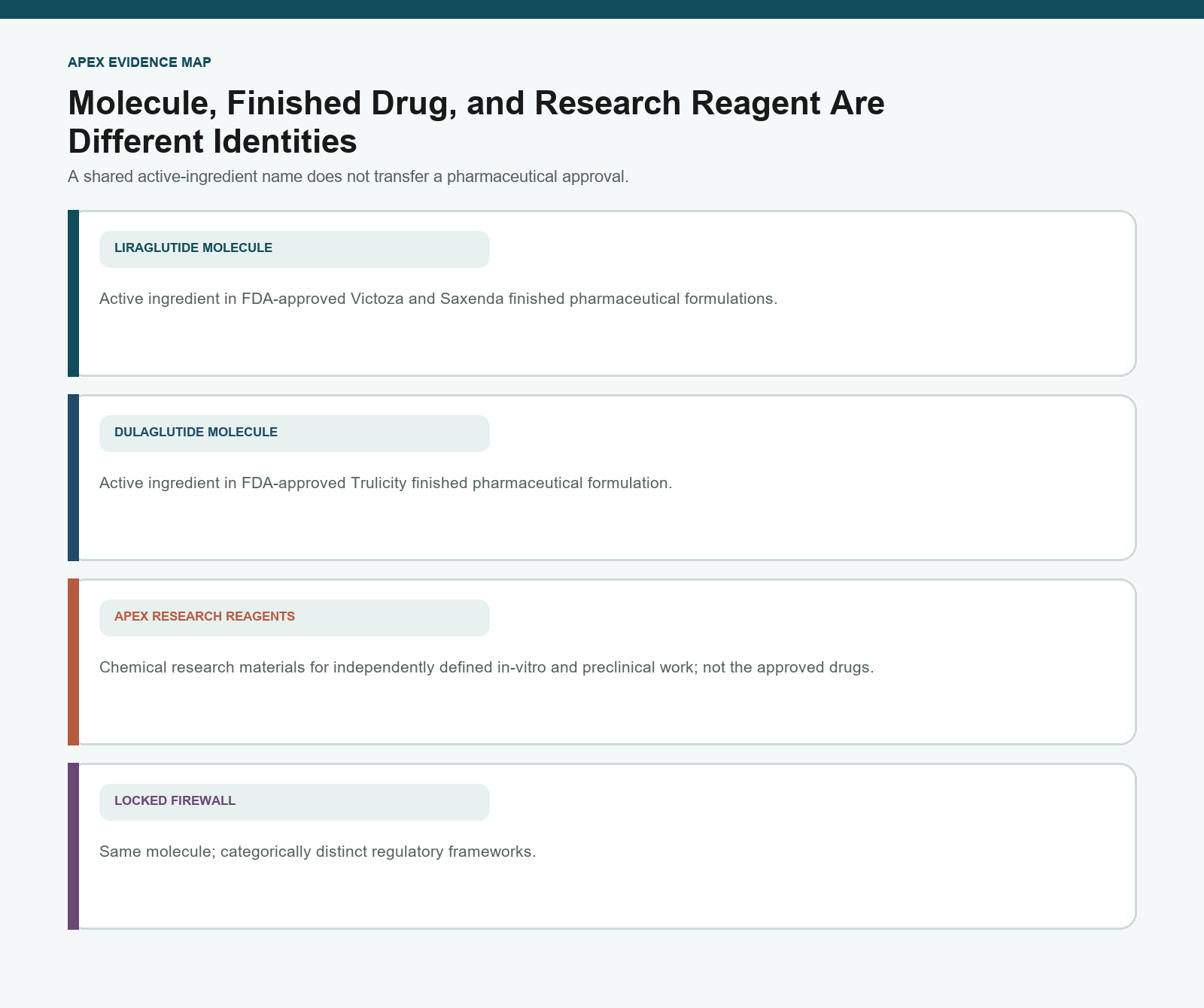
Apex Liraglutide and Dulaglutide are chemical research reagents supplied for independently defined in-vitro and preclinical work. They are not Victoza, Saxenda, or Trulicity; they are not approved pharmaceutical substitutes; and their analytical records do not confer clinical approval. Same molecule (Liraglutide or Dulaglutide); categorically distinct regulatory frameworks. The research-grade versus pharmaceutical-grade guide explains that boundary in more detail.
What Can—and Cannot—Be Inferred from the Comparison?
At the receptor-class level, both molecules support GLP-1R-focused experiments. At the construct level, their different architectures can matter for assay choice, matrix effects, nonspecific binding, diffusion, detection, and exposure. At the clinical-evidence level, AWARD-6 provides a direct comparison for a defined primary endpoint; LEADER and REWIND provide separate compound-specific outcome evidence. At the regulatory level, each approved formulation has its own application, label, manufacturing controls, and presentation.
Those evidence lanes should not be collapsed. A trial outcome does not establish the expected result in a cell assay. A chromatographic purity result does not prove receptor activity. A matching active-ingredient name does not make a research reagent pharmaceutically equivalent. A large fusion protein also should not be handled analytically as though it were merely another small peptide analog; method suitability must be established for the exact analyte and matrix.
For the modern multi-agonist landscape, use the Semaglutide, Tirzepatide, and Retatrutide comparison. The GLP-1 and metabolic research-peptide hub owns the class taxonomy. The Semaglutide research guide owns that molecule’s entity and evidence questions. This page remains the focused Liraglutide-versus-Dulaglutide destination.
Research-Material and Analytical Boundaries
Qualified laboratories should define the target analyte, assay system, controls, acceptance criteria, and method suitability before selecting a research material. A lot-specific Certificate of Analysis can document the tests reported for that lot. HPLC can characterize chromatographic purity under a defined method, while mass spectrometry can support identity when the method and analyte are suitable. Neither technique alone establishes biological potency, sterility, clinical safety, efficacy, or equivalence to an approved finished drug.
Reagent identity records
Analytical identity is a separate record from trial evidence and confers no approval.
| Identity field | Liraglutide | Dulaglutide |
|---|---|---|
| CAS number | 204656-20-2 | 923950-08-7 |
| Molecular formula | C172H265N43O51 (PubChem CID 16134956) | Not published as a single formula; a modified IgG4 Fc-fusion protein |
| Molecular weight | 3751.20 g/mol | Approximately 59,670 g/mol (catalog-stated, approximate) |
| Backbone | GLP-1(7-37) analog, C16 acylation at Lys26 | GLP-1(7-37) analog chains on a modified IgG4 Fc (LY2189265) |
| Apex lot specification | Lyophilized powder; review each material’s applicable configuration report for its identity, lot, methods, results and acceptance criteria | |
The current research records below should be rechecked immediately before deployment because availability, variants, lot documents, and specifications can change. They are balanced material-record handoffs, not treatment recommendations or instructions to administer, combine, dilute, or reconstitute either material.
Liraglutide research record
Review the current Apex material identity, available variants, and lot-specific analytical documentation separately from Victoza or Saxenda.
View the current Liraglutide recordDulaglutide research record
Review the current Apex fusion-protein material record and lot documentation separately from Trulicity.
View the current Dulaglutide recordFrequently Asked Questions
What is the main difference between Liraglutide and Dulaglutide?
Both are GLP-1 receptor agonists, but Liraglutide is an acylated peptide analog that uses a C16 fatty-acid strategy, while Dulaglutide is a larger fusion protein that joins modified GLP-1 analog chains to a modified IgG4 Fc domain. The shared receptor class does not make their molecular architectures interchangeable.
Did AWARD-6 directly compare Dulaglutide and Liraglutide?
Yes. AWARD-6 directly compared the named pharmaceutical formulations in a 26-week randomized, open-label Phase 3 trial in 599 adults with type 2 diabetes receiving metformin. It supported non-inferiority of Dulaglutide for the prespecified HbA1c endpoint within that exact protocol.
Does AWARD-6 prove that Dulaglutide and Liraglutide are equivalent?
No. Non-inferiority for one prespecified endpoint and margin does not establish molecular equivalence, interchangeability, identical safety, or equal performance across every population and outcome. AWARD-6 tested finished pharmaceutical formulations, not Apex research reagents.
Can LEADER and REWIND be used to rank Liraglutide and Dulaglutide?
No direct ranking follows from those two trials. LEADER and REWIND were separate placebo-controlled cardiovascular-outcomes studies with different populations, protocols, and follow-up. Their hazard ratios describe findings within each trial rather than a shared head-to-head comparison.
Which FDA-approved products contain Liraglutide or Dulaglutide?
Victoza and Saxenda are FDA-approved finished pharmaceutical formulations containing Liraglutide. Trulicity is an FDA-approved finished pharmaceutical formulation containing Dulaglutide. The current FDA label and approval record define each product’s authorized identity and uses.
Are Apex Liraglutide and Dulaglutide the same as Victoza, Saxenda, or Trulicity?
No. Apex supplies chemical research reagents for independently defined in-vitro and preclinical work. They are not the FDA-approved finished pharmaceutical products, are not substitutes for them, and are not for human consumption. Same molecule; categorically distinct regulatory frameworks.
Sources and Verification
- Knudsen LB, et al. Potent derivatives of glucagon-like peptide-1 with pharmacokinetic properties suitable for once daily administration. J Med Chem. 2000;43(9):1664-9. PMID: Potent derivatives of glucagon-like peptide-1 with pharmacokinetic properties suitable for once daily administration..
- Glaesner W, et al. Engineering and characterization of the long-acting glucagon-like peptide-1 analogue LY2189265, an Fc fusion protein. Diabetes Metab Res Rev. 2010;26(4):287-96. PMID: Engineering and characterization of the long-acting glucagon-like peptide-1 analogue LY2189265, an Fc fusion protein..
- Dungan KM, et al. Once-weekly dulaglutide versus once-daily liraglutide in metformin-treated patients with type 2 diabetes (AWARD-6): a randomised, open-label, phase 3, non-inferiority trial. Lancet. 2014;384(9951):1349-57. PMID: Once-weekly Dulaglutide versus once-daily Liraglutide in metformin-treated patients with type 2 diabetes (AWARD-6)..
- Marso SP, et al. Liraglutide and Cardiovascular Outcomes in Type 2 Diabetes. N Engl J Med. 2016;375(4):311-22. PMID: Liraglutide and cardiovascular outcomes in type 2 diabetes..
- Gerstein HC, et al. Dulaglutide and cardiovascular outcomes in type 2 diabetes (REWIND): a double-blind, randomised placebo-controlled trial. Lancet. 2019;394(10193):121-130. PMID: Dulaglutide and cardiovascular outcomes in type 2 diabetes (REWIND)..
- U.S. Food and Drug Administration. Current Victoza prescribing information. Revised October 2025; NDA 022341.
- U.S. Food and Drug Administration. Current Trulicity prescribing information. Revised March 2026; BLA 125469.
- U.S. Food and Drug Administration. Victoza NDA approval letter. January 25, 2010.
- U.S. Food and Drug Administration. Saxenda NDA approval letter. December 23, 2014.
- U.S. Food and Drug Administration. Trulicity BLA approval letter. September 18, 2014.