The phrase research grade vs pharmaceutical grade sounds like a simple quality comparison. It is not. Regulators and standards bodies define concrete objects—drug substances, finished drug products, compounded preparations, specifications, quality systems, laboratory scopes, and marketing applications. The word “grade” often compresses all of those layers into one adjective.
This explainer replaces that adjective with verifiable fields. It shows what FDA approval covers, where active pharmaceutical ingredients fit, why compounded drugs are not FDA-approved, what research-use-only labeling means, and what HPLC, mass spectrometry, a Certificate of Analysis, ISO certification, and USP monograph conformance can actually establish. It is a regulatory and quality framework, not medical or legal advice.
- There is no universal purity percentage that converts a research reagent into an approved drug product.
- FDA approval applies to a specific finished product and application, including its formulation, strength, manufacturing controls, labeling, and reviewed use.
- An active pharmaceutical ingredient is a drug substance intended for use in a drug product; it is not the finished dosage form and does not carry a finished product’s approval.
- Compounded drugs are not FDA-approved. Section 503A and 503B create different conditions, and FDA premarket review is not replaced by pharmacy preparation.
- ISO 9001 concerns a quality-management system, while ISO/IEC 17025 concerns laboratory competence for an accredited testing scope. Neither certifies a peptide as an approved medicine.
- HPLC, mass spectrometry, a COA, and compendial tests are useful evidence only within the questions and limits of their methods.
What Does “Grade” Actually Mean?
On its own, “grade” is incomplete. It may refer to a seller’s internal category, conformance to a named pharmacopeial monograph, manufacture under a stated quality system, suitability for a defined laboratory method, or the regulatory status of a finished product. Those are different claims and require different evidence.
The authoritative sources used for this review define drug substances, drug products, GMP, specifications, compounding, laboratory competence, and regulatory approval separately. They do not establish one universal purity threshold called “pharmaceutical grade.” That is an editorial inference from the scope of the cited standards—not a new regulatory definition.
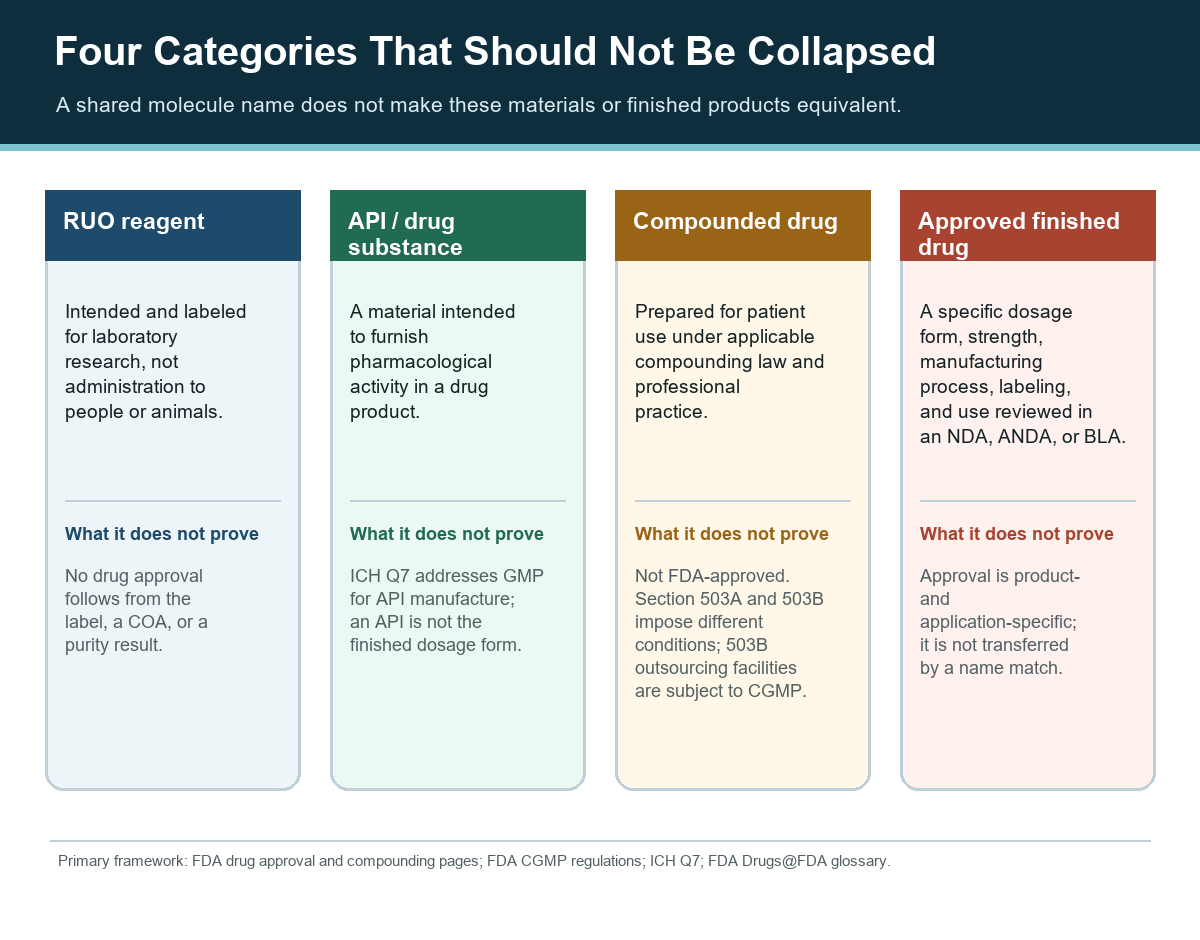
Four Categories That Should Not Be Collapsed
A useful comparison begins by separating four objects: a research-use-only reagent, an API or drug substance, a compounded drug, and an approved finished drug. A molecule name may appear in more than one lane, but the surrounding manufacturing, formulation, documentation, and authorization do not transfer with the name.
| Field | RUO research reagent | API / drug substance | Compounded drug | Approved finished drug |
|---|---|---|---|---|
| Primary role | Laboratory research material | Active component intended for manufacture of a drug product | Patient-specific or outsourcing-facility preparation under applicable law | Marketed medicine under an approved application |
| Premarket FDA approval | No approval follows from RUO status | Not the same as approval of a finished product | No; compounded drugs are not FDA-approved | Yes, for the specific NDA, ANDA, or BLA product |
| Manufacturing framework | Seller-defined unless a named standard and scope are evidenced | ICH Q7 and applicable GMP expectations when used for drug manufacture | Depends on 503A or 503B; outsourcing facilities under 503B are subject to CGMP | CGMP plus application-specific controls and commitments |
| Evidence unit | Lot, method, specification, and intended use | Drug-substance process, specification, impurity controls, and release | Formula, ingredients, compounding controls, prescription/outsourcing context, and release | Finished dosage form, strength, stability, container, labeling, and approved use |
| What cannot be assumed | Sterility, human safety, efficacy, or drug equivalence | Finished-product approval or interchangeability | FDA-reviewed safety, effectiveness, or quality before marketing | Equivalence of an unrelated reagent, API lot, or compounded preparation |
What FDA Approval Covers
FDA approval is product-specific. According to the FDA drug development and approval overview, the agency reviews submitted evidence and proposed labeling to determine whether benefits outweigh known and potential risks for the intended population. The application also contains chemistry, manufacturing, and control information for the specific product.
A finished drug is more than its active ingredient. The Drugs@FDA glossary defines a drug product as the finished dosage form containing a drug substance, generally with other active or inactive ingredients. Strength, route, dosage form, excipients, container-closure system, manufacturing process, stability, labeling, and approved use belong to the finished product record.
CGMP is part of that record, but “made under cGMP” and “FDA-approved” are not synonyms. FDA’s CGMP regulations page points to 21 CFR Parts 210 and 211 for drug manufacture and finished pharmaceuticals and to Part 314 for approval to market a new drug. A facility or process can be discussed under GMP without creating a marketing authorization for every material it handles.
What an approval record actually names
Because approval is product-specific, it can always be named: sponsor, application number, indication, date — which is what makes a “pharmaceutical grade” claim checkable.
| Finished product | Molecule / sponsor | Application | Approved use and date |
|---|---|---|---|
| Mounjaro | Tirzepatide / Eli Lilly | NDA 215866 | Type 2 diabetes; initial U.S. approval May 13, 2022 |
| Zepbound | Tirzepatide / Eli Lilly | NDA 217806 | Chronic weight management; approved November 8, 2023 |
| Ozempic | Semaglutide / Novo Nordisk | NDA 209637 | Type 2 diabetes; initial U.S. approval December 5, 2017 |
| Wegovy | Semaglutide / Novo Nordisk | NDA 215256 | Chronic weight management; approved June 4, 2021 |
| Rybelsus | Oral semaglutide / Novo Nordisk | NDA 213051 | Type 2 diabetes; approved September 20, 2019 |
| Cerebrolysin | Peptide mixture / EVER Neuro Pharma | None (U.S.) | Nationally authorised in Austria and some other markets; not EU-wide; no EMA centralized authorisation, no FDA approval |
A research reagent sharing the molecule name inherits none of it; the trial readouts stay with the dedicated GLP-1 metabolic research pillar.
Where an API or Drug Substance Fits
An active pharmaceutical ingredient is a material intended to furnish pharmacological activity or another direct effect as a component of a drug. It is upstream of the finished dosage form. The ICH Q7 guideline addresses GMP for API manufacture under an appropriate quality-management system, including production, packaging, labeling, quality control, release, storage, and distribution.
Q7 does not turn an API into an approved finished drug. The API still needs a defined process and specification, while the finished product adds formulation, dosage-form manufacture, container, stability, and application-specific review. A drug master file or supplier qualification record also should not be presented as an FDA approval letter for the finished product.
Peptide manufacture illustrates why the layers matter. Solid-phase peptide synthesis, purification, and analytical characterization are technical operations that can support research material or pharmaceutical development. The Fmoc/tBu protocol of Coin et al., 2007 assembles the 41-residue peptide CRF in roughly 80 hours of bench work and was applied to more than 400 CRF analogues; Lau and Dunn, 2018 count over 60 approved peptide drugs in major markets and more than 150 peptides in active clinical development. The chemistry route alone does not determine the regulatory category; intended use, controls, specifications, and the downstream product record do.
The cross-industry Perspective of Isidro-Llobet et al., 2019 surveys peptide-API synthesis and purification at production scale, against a pipeline of more than 50 marketed peptide drugs, roughly 170 in clinical trials, and over 200 in preclinical development — constraints reagent-scale synthesis never has to solve. What that drug substance must document for a marketing application is set out in ICH Q11, announced in the U.S. Federal Register (77 Fed. Reg. 69634, 2012) — a notice that reports no quantitative endpoint and instead defines what development and manufacturing information belongs in the Common Technical Document.
Why a Compounded Drug Is a Separate Category
Compounding can serve an important patient need when an FDA-approved drug is not medically appropriate for an individual. It does not create an FDA-approved generic or transfer the approval of a commercial product. FDA states plainly that compounded drugs are not FDA-approved, so the agency does not verify their safety, effectiveness, or quality before they are marketed in the way it does for approved drugs.
Section 503A and Section 503B are not interchangeable. Traditional pharmacy or physician compounding that satisfies 503A conditions is generally exempt from the federal CGMP requirement that applies to drug manufacturers. Outsourcing facilities that elect to register under 503B must meet additional conditions and are subject to CGMP requirements. Registration as an outsourcing facility still does not mean the facility or each compounded product is “FDA-approved.”
Bulk drug substances used in compounding are also controlled by specific statutory conditions. FDA’s bulk-substance guidance page explains that applicable USP/NF monographs and other statutory criteria can govern whether a substance may be used. That is not permission to treat any research reagent with the same name as a compounding API.
What Research-Use-Only Means
A research-use-only reagent is intended and labeled for laboratory research rather than human or veterinary administration. The category sets an intended-use boundary. It does not, by itself, state a universal purity level, certify sterility, prove endotoxin status, define a quality-management system, or guarantee fitness for every assay.
Quality must be demonstrated at the level relevant to the experiment. A laboratory may need exact sequence, molecular identity, chromatographic purity, counterion, water content, residual-solvent controls, endotoxin, bioburden, stability, or functional qualification depending on the method. A COA should tell the reader which of those questions were tested, which method and acceptance criteria were used, and which lot was released. Apex publishes in-house configuration reports with stated methods, results and acceptance criteria. Their scope is the identified material and lot; they are neither independent third-party verification nor a pharmaceutical approval.
ISO claims need the same scope discipline. ISO 9001 defines requirements for an organizational quality-management system. ISO/IEC 17025 defines competence, impartiality, and consistent operation requirements for testing and calibration laboratories. A certificate applies within its stated scope; it is not a blanket certification of every product tested or sold.
What HPLC, Mass Spectrometry, COAs, ISO, and USP Prove
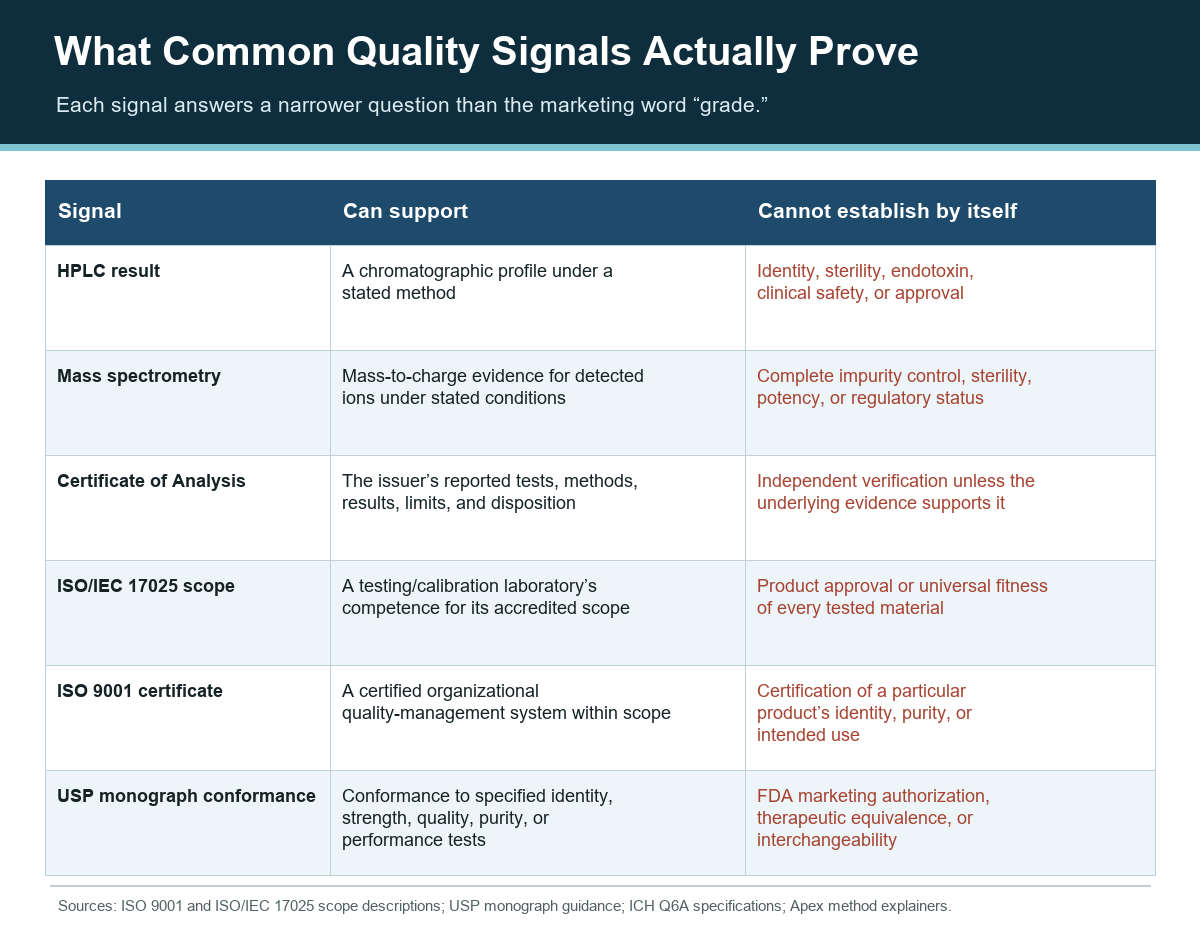
Analytical methods answer bounded questions. HPLC can separate and quantify components under a stated method, but a single area-percent result does not establish molecular identity, sterility, endotoxin, potency, or clinical safety. Mass spectrometry can provide mass-to-charge evidence for detected ions and is central to proteomic and peptide analysis (Aebersold and Mann, 2003, a methodological review that reports no quantitative endpoint of its own), but it does not automatically quantify every impurity or prove a finished product is approved.
A Certificate of Analysis is a report, not a method. Its value depends on the lot, sample, methods, specifications, acceptance criteria, results, reviewer, and traceability to raw evidence. The COA-reading guide, HPLC explainer, and mass-spectrometry guide show how those records complement rather than replace one another.
USP monographs and specifications
USP develops public standards for identity, strength, quality, and purity. Its legal-recognition overview explains that USP is not a government agency, while its standards have legal recognition in the United States and elsewhere. A monograph defines quality attributes and methods for the article it covers.
Monograph conformance is valuable, but USP also states that conformance is not a license to market a medicine and does not demonstrate biosimilarity or interchangeability. Approval decisions remain with FDA. Similarly, ICH Q6A defines a specification as tests, analytical procedures, and acceptance criteria. A specification is one layer of control, not the entire product or approval record.
Medicine Quality Is a Stack
Finished-product quality is built through linked layers: sample identity and chain of custody; laboratory and method controls; material specifications; manufacturing systems; finished-product formulation and release; and regulatory authorization. Strong evidence at one layer cannot silently replace missing evidence at another.
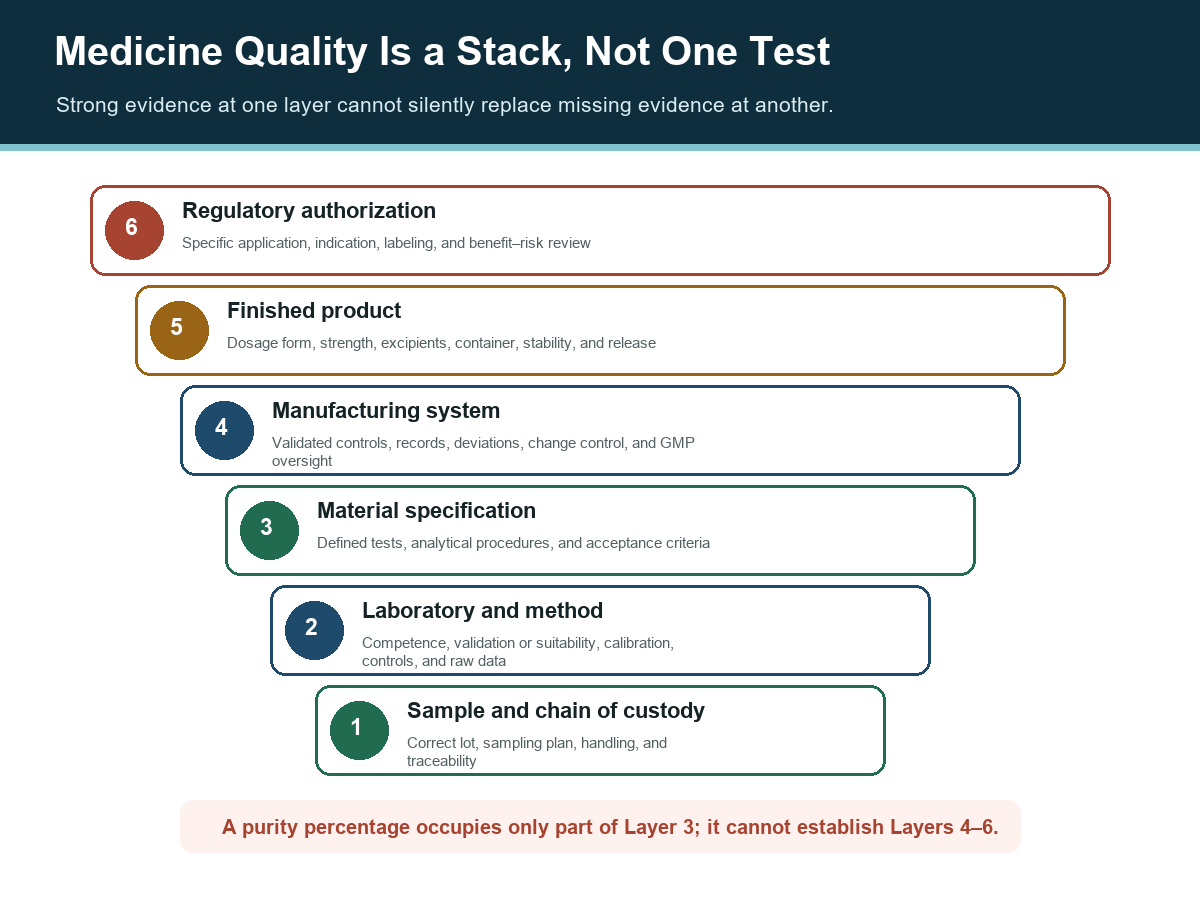
The World Health Organization describes GMP as the part of quality assurance that ensures medicinal products are consistently produced and controlled to standards appropriate to their intended use and product specification. WHO also emphasizes that quality must be built into production rather than tested into the finished product afterward. See the WHO GMP overview.
This is why two materials with similar HPLC area percentages can still occupy different quality and regulatory contexts. They may differ in identity confirmation, impurity characterization, sampling, validated methods, process controls, stability, container systems, sterility assurance, deviation management, or release authority. Conversely, an RUO reagent can be well characterized for a laboratory purpose without becoming a medicine.
Who releases the lot
Release authority is a field, not an adjective. A research reagent is dispositioned by the seller’s own quality function. In the European Union, every batch of a medicinal product must be certified by a Qualified Person — a named, legally accountable individual attesting that the batch was manufactured and tested in accordance with GMP and the marketing authorisation. In the United States that accountability runs through the quality unit under 21 CFR 211 together with the approved application.
How to Audit a “Grade” Claim
Start by asking for the exact object and intended use, then walk outward through standards and evidence. Avoid comparing slogans. A seller who uses “pharmaceutical grade” should identify the pharmacopeial monograph, API specification, GMP framework, manufacturing role, or finished-product authorization that makes the phrase meaningful.
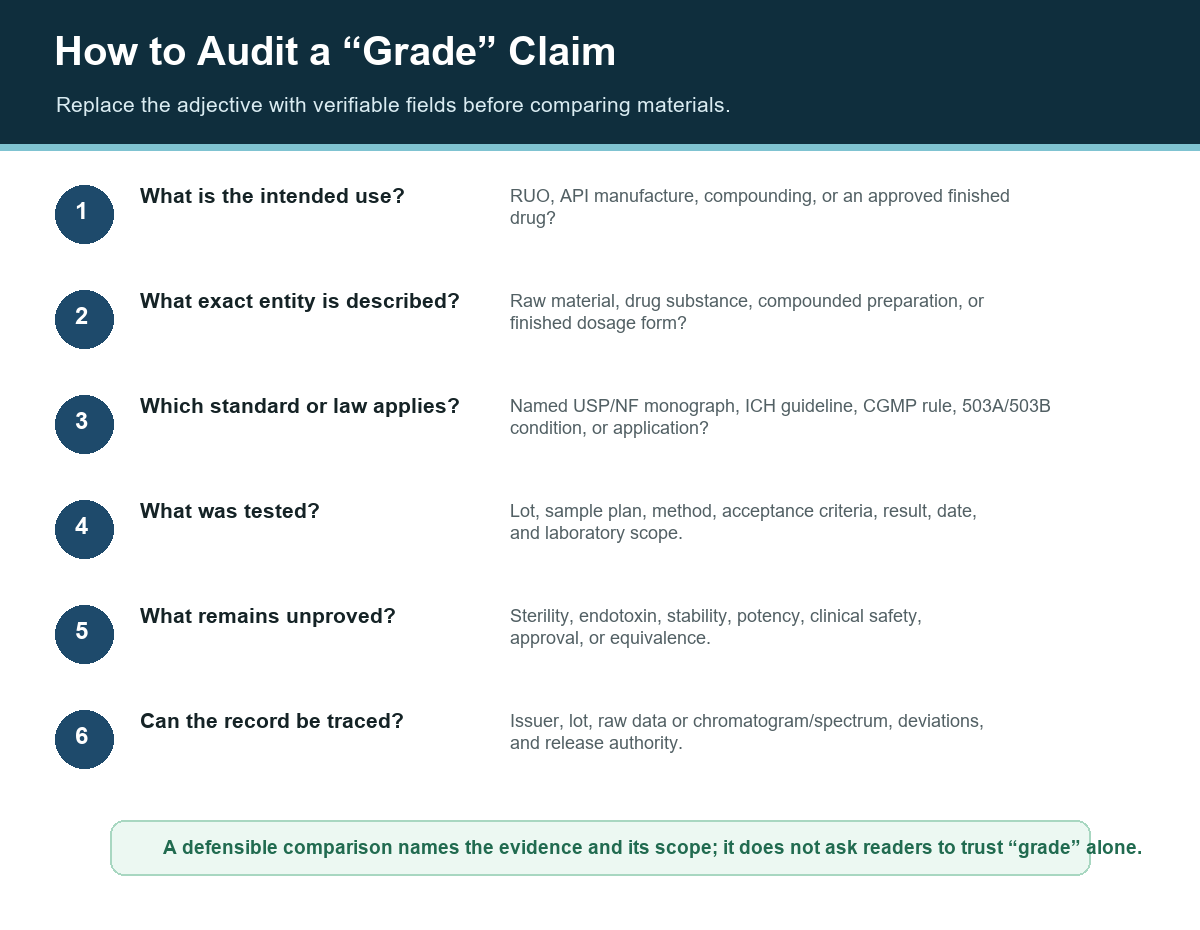
- Intended use: laboratory research, API manufacture, lawful compounding, or an approved finished medicine.
- Material identity: exact molecule, salt or counterion, stereochemistry, terminal modifications, formulation, and lot.
- Applicable authority: named law, regulation, ICH guideline, USP/NF monograph, quality-system certificate, or approved application.
- Evidence: sample plan, method, system suitability, raw data, acceptance criteria, result, and reviewer.
- Release: who had authority to disposition the lot and under which quality system.
- Limits: what remains untested or unreviewed, including sterility, endotoxin, stability, potency, clinical safety, approval, or equivalence.
Red flags
Be cautious when a claim uses a purity percentage as proof of clinical suitability, calls an ISO-certified organization an FDA-approved facility, treats an FDA registration or UNII as product approval, calls a compounded drug a generic, or uses a molecule-name match as proof that a research reagent is equivalent to an approved formulation. Each shortcut crosses at least one category boundary.
Forensic laboratories have measured how often a label claim on seized, unregulated-market product matched the contents.
| Study | Material analysed | Reported result | Source |
|---|---|---|---|
| Fabresse et al., 2021 (France, 2016–2019) | 75 seized items presented as pharmaceuticals, from 110 products total | 25/75 (33%) substandard on dose, 24/75 (32%) counterfeit on qualitative formulation, 14/75 (19%) fully matching the label, and 11/75 (15%) with correct qualitative content that could not be quantified for lack of reference standards | PMID 33838562 |
| Krug et al., 2014 (Germany, 2010–2013) | 337 black-market products screened by the Cologne anti-doping laboratory | 67 active ingredients identified, 49 of them WADA-classified doping agents; 12.8% of products contained peptide hormones or growth factors | PMID 25168622 |
Neither dataset describes a regulated research reagent or an approved medicine, which is the point: identity and content guarantees attach to a release record, not to an adjective on a label.
What This Means for Researchers Choosing Material
Choose material against the experiment, not the broadest adjective. Define the sequence or chemical identity, matrix, concentration basis, required impurity controls, assay sensitivity, contamination risks, storage conditions, and acceptance criteria before evaluating a supplier record. Then confirm that the lot documentation answers those questions.
For supplier evaluation, use the peptide-vendor evaluation guide and request traceable batch evidence. For method interpretation, use the linked HPLC, mass-spectrometry, and COA resources. If a project involves a drug-development, compounding, clinical, or regulatory pathway, use qualified legal, regulatory, pharmacy, and quality professionals; an educational article cannot determine compliance for a specific program.
Apex Laboratory supplies research-use chemical reagents. Those products are not FDA-approved drugs, compounded medications, or finished pharmaceutical formulations. Their research-material records should be evaluated for the laboratory purpose stated, while approved and compounded products remain in their own regulatory categories.
Frequently Asked Questions
What is the difference between research grade and pharmaceutical grade?
The useful difference is not a universal purity ranking. Research-use material is intended for laboratory work, while pharmaceutical contexts involve defined drug-substance, manufacturing, compendial, finished-product, and regulatory controls. The exact claim must identify which of those fields applies.
Is research grade always lower purity?
No. Purity is one measured attribute under a stated method. A research reagent can show a high chromatographic area percentage, while a pharmaceutical program can require many controls beyond that value. Neither category should be inferred from purity alone.
Does cGMP mean a product is FDA-approved?
No. CGMP governs manufacturing controls. FDA approval is a separate, product-specific action under an NDA, ANDA, or BLA. A GMP statement does not create an approval letter.
Are compounded drugs FDA-approved?
No. FDA states that compounded drugs do not undergo its premarket review for safety, effectiveness, and quality. Sections 503A and 503B impose different legal conditions, and 503B outsourcing facilities are subject to CGMP requirements.
Does ISO 17025 make a peptide pharmaceutical grade?
No. ISO/IEC 17025 concerns the competence and consistent operation of a testing or calibration laboratory for its accredited scope. It does not approve a product, create a medicinal intended use, or certify every attribute of a peptide.
What does a USP monograph prove?
Conformance can support specified identity, strength, quality, purity, or performance attributes for the covered article. It does not by itself create FDA marketing authorization, therapeutic equivalence, biosimilarity, or interchangeability.
Can a research reagent be used as a compounded-drug ingredient?
Do not infer that from a shared name or COA. Federal and state compounding law, bulk-substance eligibility, pharmacopeial requirements, supplier qualification, intended use, and professional controls must be evaluated by qualified parties. An RUO label does not establish suitability for patient administration.
Primary Standards and Sources
- FDA. Development and Approval Process—Drugs.
- FDA. Drugs@FDA Glossary of Terms.
- FDA. Current Good Manufacturing Practice Regulations.
- FDA. Compounding and the FDA: Questions and Answers.
- FDA. Bulk Drug Substances Used in Compounding.
- ICH Q7. Good Manufacturing Practice Guide for Active Pharmaceutical Ingredients.
- ICH Q6A. Specifications: Test Procedures and Acceptance Criteria.
- USP. Legal Recognition of USP Standards.
- ISO. ISO/IEC 17025:2017—Testing and Calibration Laboratories.
- ISO. ISO 9001 Explained.
- WHO. Good Manufacturing Practices.
- Coin I, et al. Solid-phase peptide synthesis: from standard procedures to the synthesis of difficult sequences. Nat Protoc. 2007;2(12):3247-56. PMID: Coin I et al. (2007). Solid-phase peptide synthesis. PMID 18079725..
- Aebersold R, et al. Mass spectrometry-based proteomics. Nature. 2003;422(6928):198-207. PMID: Aebersold R, Mann M. (2003). Mass spectrometry-based proteomics. PMID 12634793..
- Lau JL, et al. Therapeutic peptides: Historical perspectives, current development trends, and future directions. Bioorg Med Chem. 2018;26(10):2700-2707. PMID: Lau JL, Dunn MK. (2018). Therapeutic peptides: development context. PMID 28720325..