
Semaglutide is a GLP-1 receptor agonist; tirzepatide combines GIP- and GLP-1-receptor agonism; retatrutide adds glucagon-receptor agonism to those two targets. Semaglutide and tirzepatide are active ingredients in FDA-approved finished drug products, while Lilly still described retatrutide as investigational on July 23, 2026. Separate trials cannot establish a three-way winner, so this comparison distinguishes completed direct evidence from cross-trial and sponsor-reported evidence.
Semaglutide, tirzepatide, and retatrutide sit in the same metabolic-research conversation, but they are not interchangeable versions of one compound. They differ at the receptor level, in the maturity and comparability of the evidence, and in current United States regulatory context.
This page owns the broad three-way query. The dedicated semaglutide-versus-tirzepatide comparison owns the completed binary evidence, retatrutide versus tirzepatide owns the direct-study status for that pair, and the GLP-1 and metabolic research hub provides family navigation.
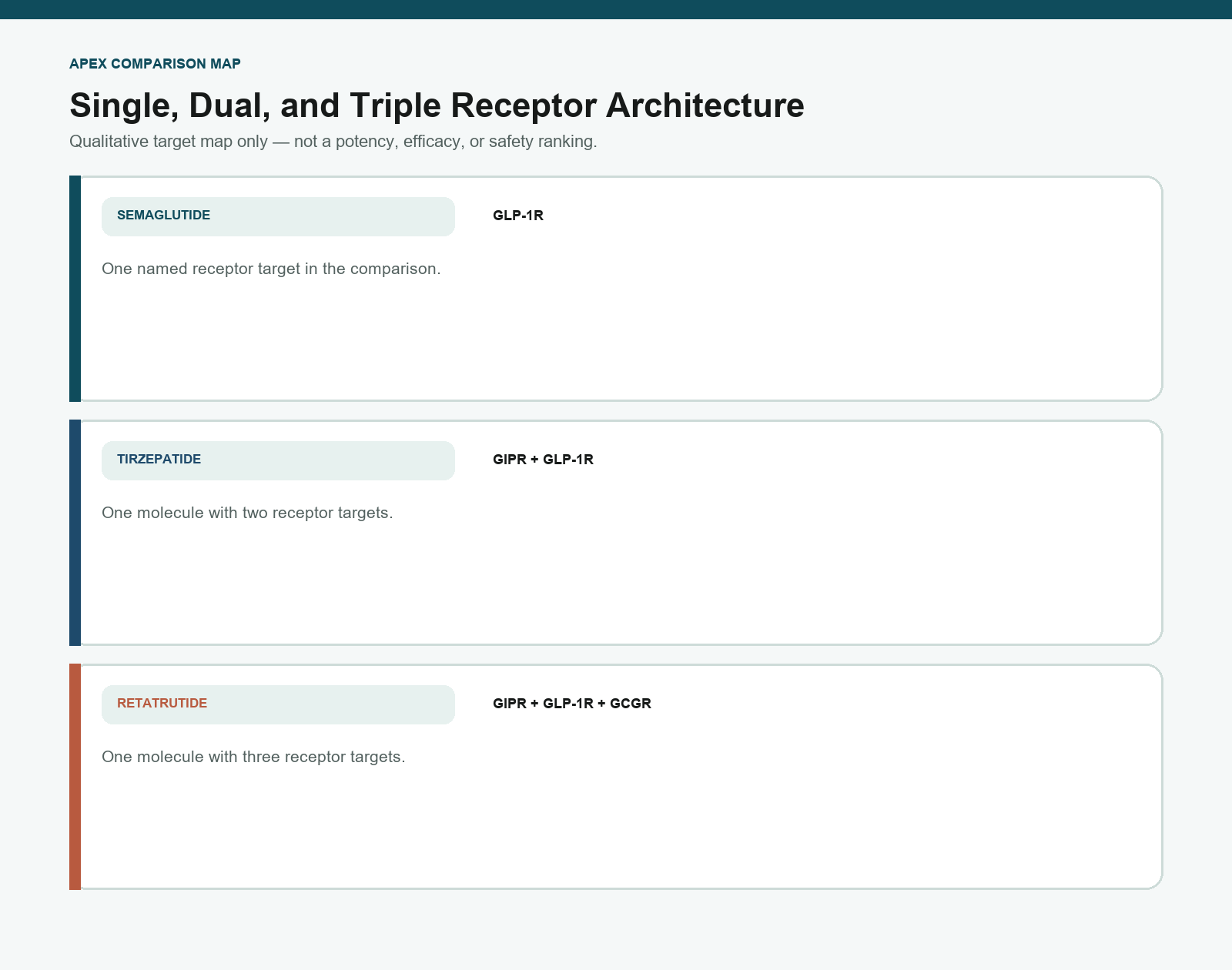
- Semaglutide targets GLP-1R; tirzepatide targets GIPR and GLP-1R; retatrutide targets GIPR, GLP-1R, and GCGR.
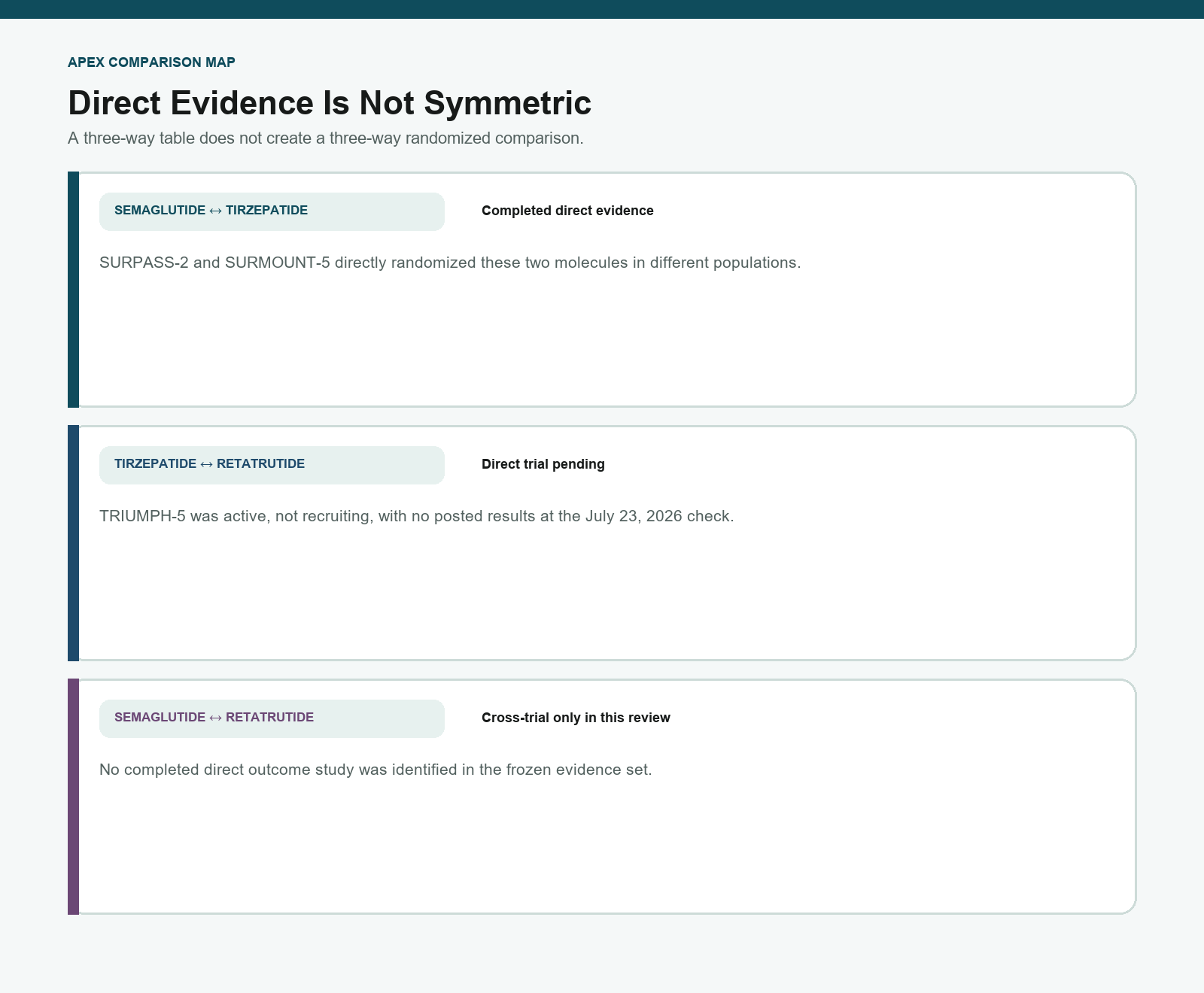
- Completed direct randomized evidence exists for semaglutide versus tirzepatide in two distinct clinical contexts.
- TRIUMPH-5 is the direct retatrutide-versus-tirzepatide study, but its registry had no posted results at the July 23, 2026 evidence check.
- No completed direct semaglutide-versus-retatrutide outcome study was identified in the frozen evidence set.
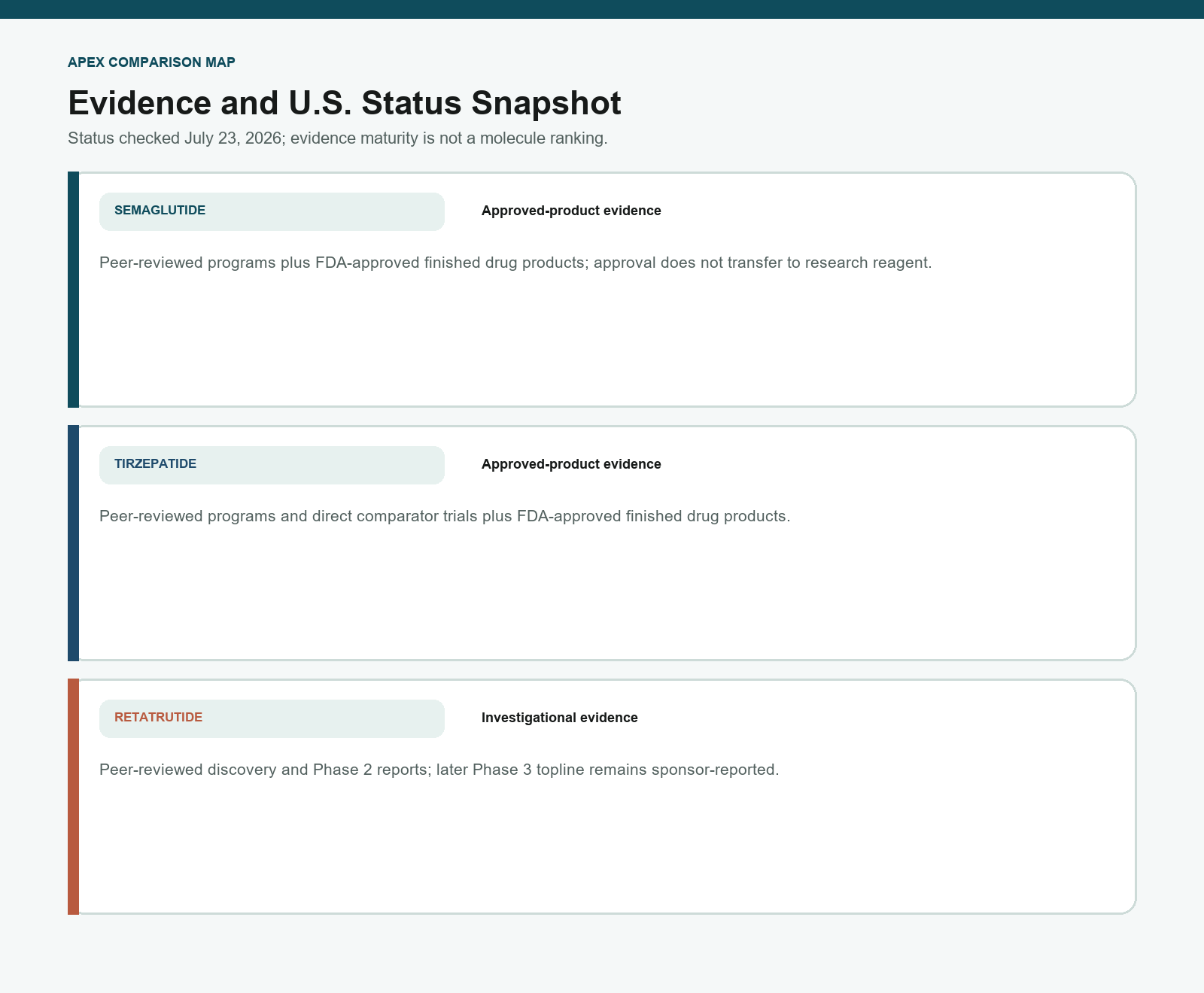
- Semaglutide and tirzepatide finished drug products have FDA approvals; retatrutide remained investigational.
- Across the wider class, liraglutide, dulaglutide, semaglutide, and tirzepatide are the approved reference points; retatrutide, survodutide, and CagriSema sit in investigational programs.
- Evidence from a named pharmaceutical program does not transfer to an Apex research reagent.
Semaglutide vs Tirzepatide vs Retatrutide at a Glance
| Dimension | Semaglutide | Tirzepatide | Retatrutide |
|---|---|---|---|
| Receptor set | GLP-1R | GIPR + GLP-1R | GIPR + GLP-1R + GCGR |
| Architecture | Single GLP-1-receptor agonist | Single molecule with dual agonism | Single molecule with triple agonism |
| Completed direct evidence within this trio | Directly compared with tirzepatide in SURPASS-2 and SURMOUNT-5; no completed direct retatrutide outcome study identified here | Directly compared with semaglutide; direct retatrutide comparison is pending | No completed direct result against either molecule in this evidence freeze |
| Peer-reviewed anchor | Discovery paper and extensive clinical program, including STEP 1 | Discovery and receptor-signaling papers plus SURPASS and SURMOUNT programs | Discovery paper and Phase 2 obesity and type 2 diabetes reports |
| U.S. status, July 23, 2026 | Active ingredient in FDA-approved finished drug products | Active ingredient in FDA-approved finished drug products | Investigational; sponsor stated that a BLA was planned for Q1 2027 |
| Correct interpretation | Compare receptor scope and evidence lanes. Do not rank headline percentages from separate studies as if they came from one three-arm randomized trial. | ||
“Single,” “dual,” and “triple” count named receptor targets. They do not describe three mixed compounds, and a larger receptor count does not establish greater potency, benefit, safety, or suitability. Those are separate questions that require source-matched evidence.
Single, Dual, and Triple Receptor Architecture
Semaglutide is a modified GLP-1 analogue engineered for extended exposure and GLP-1-receptor agonism. The molecule-development paper reports two amino-acid substitutions (Aib8, Arg34) with derivatization at lysine 26, a GLP-1R affinity of 0.38 ± 0.06 nM (about three-fold lower than liraglutide), a 46.1-hour plasma half-life after intravenous dosing in mini-pigs, and a 63.6-hour mean residence time after subcutaneous dosing in the same species.[1] In this three-way comparison, that makes semaglutide the single-target reference point.
Tirzepatide is one peptide with activity at GIPR and GLP-1R. In the discovery paper’s Phase 1 program, 142 human subjects received tirzepatide, dulaglutide, or placebo across a 0.25–15 mg range, and four weeks of 10 mg or 15 mg dosing lowered fasting serum glucose by 49.12 mg/dL and 43.15 mg/dL versus placebo in participants with type 2 diabetes.[2] The receptor-signaling follow-up is directional rather than numeric: occupancy modeling at clinically efficacious doses showed greater GIP-receptor than GLP-1-receptor engagement, and at GLP-1R the molecule favored cAMP generation over β-arrestin recruitment in the cell and primary-islet systems studied.[3] “Dual” therefore names a receptor architecture; it is not shorthand for a universal outcome.
Retatrutide is also one peptide, but it combines GIPR, GLP-1R, and GCGR agonism. In vitro the molecule showed balanced GCGR and GLP-1R activity with greater GIPR activity; in obese mice it reduced body weight and improved glycemic control, and in a Phase 1 single-ascending-dose study weight reduction persisted to day 43 after one dose.[4] The glucagon-receptor component is the defining difference from tirzepatide and semaglutide.
Why Receptor Count Is Not a Ranking
Receptor count is only the beginning of mechanism. Activity balance, signaling bias, exposure, species, receptor construct, cellular background, endpoint, and readout timing all shape a result, and no trial outcome reveals how much each receptor contributed. That is why calling retatrutide a “stronger GLP-1” is a search-summary error: it introduces a third receptor system and a different integrated question rather than a larger value on one scale. Tirzepatide likewise is not semaglutide plus one automatic effect.
Three Concise Molecule Profiles
Semaglutide: GLP-1R Anchor
Semaglutide has the longest-established evidence base of the three molecules discussed here. STEP 1 randomized 1,961 adults with overweight or obesity and without diabetes to 68 weeks of once-weekly semaglutide 2.4 mg or placebo; mean weight change was −14.9% versus −2.4%, a treatment difference of −12.4 percentage points (95% CI −13.4 to −11.5; P<0.001), and 86.4% versus 31.5% of participants reached at least 5% weight reduction.[5] That history is broad, but it does not create a direct comparison against every later incretin program.
For entity-level pharmacology, study chronology, and regulatory framing, use the semaglutide research guide; this page stays on the comparison layer.
Tirzepatide: Dual GIPR/GLP-1R Agonism
Tirzepatide extends the comparison from one named receptor to two. SURMOUNT-1 randomized 2,539 adults with obesity, or with overweight plus a weight-related complication and without diabetes, to 72 weeks of tirzepatide or placebo; mean weight change was −15.0%, −19.5%, and −20.9% at 5, 10, and 15 mg versus −3.1% on placebo.[6] SURPASS-2 and SURMOUNT-5 then supply the completed direct comparisons with semaglutide, and randomization within one protocol supports claims that separate program headlines cannot.
The tirzepatide research guide owns molecule-level depth, and the semaglutide versus tirzepatide page owns the direct-study designs.
Retatrutide: Triple GIPR/GLP-1R/GCGR Agonism
Retatrutide adds GCGR to the two incretin-family receptors. Its Phase 2 obesity trial randomized 338 adults with obesity, or with overweight plus a weight-related condition, to retatrutide or placebo for 48 weeks, with mean weight change of −24.2% at 12 mg versus −2.1% on placebo.[7] Its Phase 2 type 2 diabetes trial randomized 281 adults and carried a 1.5 mg dulaglutide comparator arm, reporting HbA1c −2.02% at 12 mg versus −1.41% on dulaglutide at 24 weeks (P=0.0002).[8] Neither publication is a randomized three-way comparison with semaglutide and tirzepatide.
The retatrutide research guide owns the full mechanism and current program record; this page only places retatrutide in the evidence map.
Approved Agents and Investigational Programs Across the Class
Those three molecules are the query this page owns, but they sit inside a wider class. Approved agents and investigational programs are listed separately below, because a sponsor readout does not carry the regulatory weight of a marketed product. Every readout names its population, dose, and duration; because these are separate trials with different endpoints, the values are not comparable across rows.
Approved GLP-1-Receptor Agonists
| Agent | Receptor set and schedule | Representative registrational readout | U.S. regulatory record |
|---|---|---|---|
| Liraglutide | GLP-1R; once-daily subcutaneous | SCALE Obesity and Prediabetes: 3,731 adults without type 2 diabetes, 56 weeks, mean weight −8.4 kg on liraglutide 3.0 mg versus −2.8 kg on placebo (PMID 26132939) | FDA-approved as Victoza (type 2 diabetes, January 25, 2010) and Saxenda (chronic weight management, December 23, 2014) |
| Dulaglutide | GLP-1R as an IgG4-Fc fusion; once-weekly subcutaneous | AWARD-1: adults with type 2 diabetes on pioglitazone and metformin, 26-week primary endpoint, least-squares mean HbA1c −1.51% at dulaglutide 1.5 mg versus −0.99% on exenatide and −0.46% on placebo; the source abstract states no total enrollment (PMID 24879836) | FDA-approved as Trulicity (type 2 diabetes, September 18, 2014) |
| Semaglutide | GLP-1R; once-weekly subcutaneous or daily oral | STEP 1: 1,961 adults with overweight or obesity and without diabetes, 68 weeks, mean weight −14.9% on semaglutide 2.4 mg once weekly versus −2.4% on placebo (PMID 33567185) | FDA-approved as Ozempic (December 5, 2017), Rybelsus (oral, September 20, 2019), and Wegovy (chronic weight management, June 4, 2021) |
| Tirzepatide | GIPR + GLP-1R; once-weekly subcutaneous | SURMOUNT-1: 2,539 adults with obesity or overweight plus a complication, excluding diabetes, 72 weeks, mean weight −20.9% at 15 mg versus −3.1% on placebo (PMID 35658024) | Active ingredient in approved finished drug products; Drugs@FDA application records NDA 215866 and NDA 217806 |
Investigational Programs
| Program | Target set | Reported readout | Status at the July 23, 2026 check |
|---|---|---|---|
| Retatrutide | GIPR + GLP-1R + GCGR | Phase 2 obesity trial: 338 adults with obesity, or overweight plus a weight-related condition, 48 weeks, mean weight −24.2% at 12 mg versus −2.1% on placebo (PMID 37366315) | Investigational; the sponsor stated a planned U.S. Biologics License Application for the first quarter of 2027 |
| Survodutide | GCGR + GLP-1R | SYNCHRONIZE-1 Phase 3: 725 adults with obesity and without diabetes, 76 weeks, mean weight −13.0% at 6.0 mg and −12.2% at 3.6 mg versus −5.4% on placebo (PMID 42253238) | Described as investigational in its own Phase 3 report; no approved U.S. finished drug product appears in this evidence freeze |
| CagriSema | GLP-1R via semaglutide plus the amylin analogue cagrilintide; not an incretin multi-agonist | REDEFINE 1 Phase 3a: 3,417 adults with obesity, or overweight plus an obesity-related complication, and without diabetes, 68 weeks, mean weight −20.4% versus −3.0% on placebo (PMID 40544433) | No approved U.S. finished drug product for the combination appears in this evidence freeze |
Additional Reported Findings
These results belong to the class comparison rather than the three-molecule spine.
| Compound | Study and population | Duration | Endpoint | Result | Source |
|---|---|---|---|---|---|
| Liraglutide | LEAD-1 SU; 1,041 adults with type 2 diabetes on glimepiride | 26 weeks | HbA1c change | −1.1% at 1.2 and 1.8 mg versus +0.2% on placebo and −0.4% on rosiglitazone (P<0.0001) | PMID 19317822 |
| Semaglutide versus dulaglutide | SUSTAIN 7 open-label Phase 3b; 1,201 adults with type 2 diabetes on metformin | 40 weeks | HbA1c and body weight | HbA1c −1.8 versus −1.4 percentage points and weight −6.5 kg versus −3.0 kg with semaglutide 1.0 mg versus dulaglutide 1.5 mg (P<0.0001) | PMID 29397376 |
| Oral semaglutide | PIONEER 8; 731 adults with type 2 diabetes on insulin with or without metformin | 26-week primary endpoint | HbA1c and weight versus placebo | Treatment differences −0.5%, −0.9%, and −1.2% at 3, 7, and 14 mg; weight −0.9, −2.0, and −3.3 kg | PMID 31530667 |
| Dulaglutide | Pooled clinical pharmacokinetic analysis in patients with type 2 diabetes | Steady state by the second to fourth dose | Terminal elimination half-life | 5 days, which is what supports the once-weekly schedule | PMID 26507721 |
Direct Evidence Versus Cross-Trial Comparison
A direct randomized comparison assigns the relevant molecules inside one protocol, aligning population, follow-up, outcome definitions, missing-data rules, and event collection. Direct trials remain context-specific, but they support a stronger comparative inference than a cross-trial calculation.
Completed Semaglutide–Tirzepatide Evidence
SURPASS-2 randomized 1,879 adults with type 2 diabetes to 40 weeks of tirzepatide 5, 10, or 15 mg or semaglutide 1 mg, with change in glycated hemoglobin as the primary endpoint. Mean change was −2.01, −2.24, and −2.30 percentage points with tirzepatide versus −1.86 with semaglutide (estimated differences −0.15, P=0.02; −0.39 and −0.45, P<0.001), and body-weight treatment differences were −1.9, −3.6, and −5.5 kg.[9] It does not answer every obesity, cardiovascular, tolerability, or long-term durability question.
SURMOUNT-5 randomized 751 adults with obesity and without type 2 diabetes to 72 weeks of maximum tolerated tirzepatide or semaglutide, with percent change in body weight as the primary endpoint. Mean change was −20.2% versus −13.7% (P<0.001), and waist circumference fell 18.4 cm versus 13.0 cm.[10] The population and primary outcome differ from SURPASS-2, so the two studies should not be collapsed into one context-free result.
Those binary findings are summarized at Semaglutide vs Tirzepatide: Mechanism and Head-to-Head Evidence, which owns that pair.
Pending Retatrutide–Tirzepatide Evidence
TRIUMPH-5, NCT06662383, is the direct Phase 3 comparison of retatrutide and tirzepatide. At the July 23, 2026 registry check, the study was active, not recruiting, and had no posted results. A protocol shows that a direct question is being studied; it cannot supply an outcome.
The 2026 TRIUMPH design publication describes four Phase 3 studies enrolling over 5,800 participants.[11] It is a design source, not a substitute for a future TRIUMPH-5 results report. The dedicated retatrutide-versus-tirzepatide page owns this pair and should be refreshed when direct results appear.
Semaglutide–Retatrutide Boundary
No completed direct semaglutide-versus-retatrutide outcome study was identified in the evidence review frozen for this article. Comparing STEP 1 with the retatrutide Phase 2 obesity trial places different populations, durations, protocols, estimands, and evidence eras side by side, which can generate a hypothesis but not a randomized winner.
Before comparing separate studies, check population, comparator, protocol duration, endpoint, estimand, missing-data method, discontinuation, event capture, and publication maturity. If those elements differ, the headline values should not be ranked as if they came from one trial.
Evidence Maturity and Regulatory Status
Evidence maturity is not biological potential. It describes what has been documented, reviewed, and made available at a particular date. Semaglutide and tirzepatide have peer-reviewed programs plus FDA-approved finished drug products that belong to named formulations, manufacturers, applications, and labeled uses.
Retatrutide remained investigational on July 23, 2026. Lilly announced positive topline information from TRIUMPH-2 and TRIUMPH-3, stated that it planned a U.S. Biologics License Application for the first quarter of 2027, and said detailed results would be published later. A sponsor release documents what the sponsor reported on a date; it is not a peer-reviewed paper, a filed application, or an FDA approval.
Finished Drug Products and Research Reagents Are Categorically Distinct
Semaglutide and tirzepatide each appear as active ingredients in approved finished drug products, which does not convert a separately sourced chemical reagent into the approved formulation. Retatrutide has no approved product at this evidence freeze, and a reagent sold under the same common name is not Lilly’s investigational material.
Same molecule where applicable; categorically distinct regulatory frameworks. Approval, formulation, manufacturing controls, clinical evidence, labeling, and intended use do not transfer from a pharmaceutical product to an Apex research material. The research-grade versus pharmaceutical-grade guide explains the boundary.
Match the Molecule to the Research Question
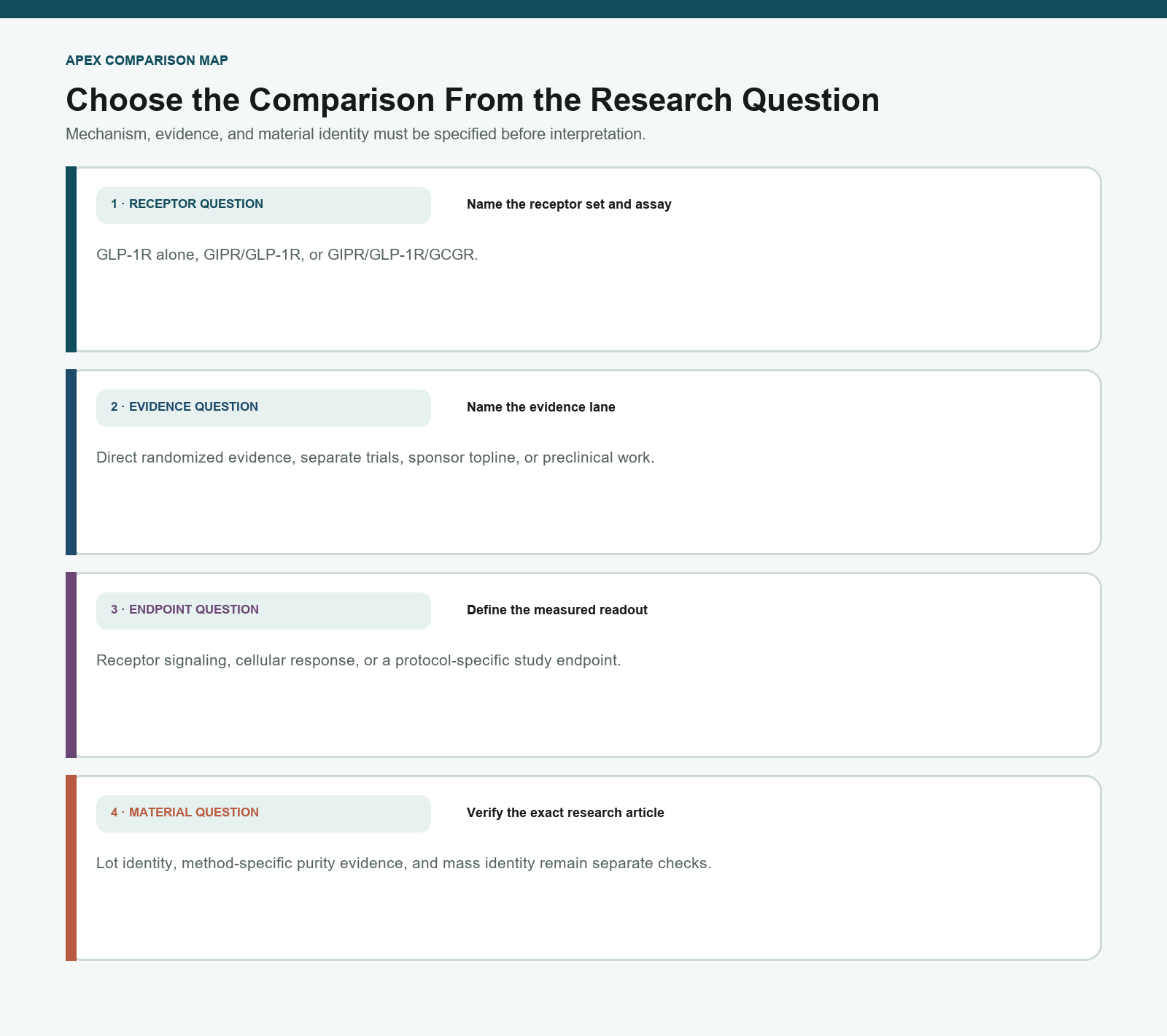
A laboratory comparison starts from the question, not from a popularity ranking. A GLP-1R-only question, a dual incretin-receptor question, and a triple-receptor question are different experimental scopes with different controls, receptor panels, cell systems, endpoints, and interpretation limits.
For a Mechanistic Comparison
Specify the receptor construct, species, assay format, time point, comparator, and readout. A receptor-activation value from one system cannot be compared directly with a value generated under another method, and an assay result should never be extended into a clinical outcome.
For an Evidence Comparison
Label every claim by its design: direct randomized evidence, separate-trial evidence, sponsor-reported topline, regulatory record, preclinical work, or analytical material evidence. Direct semaglutide-versus-tirzepatide evidence sits in the completed lane; retatrutide comparisons sit in the pending or cross-trial lanes until a direct result changes that status.
Research-Material Verification and Current Lot Handoffs
For a procurement decision, the relevant record is the current lot and its documentation, not the compound name. The three links below are balanced handoffs to Apex material pages rather than comparative-efficacy claims, and availability must be rechecked before procurement.
Semaglutide
Review the current research-material record and lot-specific documentation.
Tirzepatide
Check the current lot record and available documentation.
Retatrutide
Open the current material record and lot documentation.
What HPLC Can and Cannot Show
High-performance liquid chromatography reports a chromatographic profile under a defined method, so interpretation requires the column, mobile phases, gradient, detection settings, integration rules, and date. A stated purity value is method-specific and does not establish identity, sterility, biological function, or clinical equivalence. See HPLC purity testing in peptide research.
What Mass Spectrometry Can and Cannot Show
Mass spectrometry supports mass identity when the expected species, observed signals, charge-state interpretation, adducts, and tolerance are documented, but it replaces neither chromatographic nor functional testing. See mass spectrometry for peptide verification and how to read a peptide certificate of analysis.
Frequently Asked Questions
What is the main difference between semaglutide, tirzepatide, and retatrutide?
The primary mechanistic difference is receptor scope. Semaglutide targets GLP-1R; tirzepatide targets GIPR and GLP-1R; retatrutide targets GIPR, GLP-1R, and GCGR. Receptor count does not by itself establish comparative efficacy, safety, or suitability.
Which of the three molecules have been directly compared?
Semaglutide and tirzepatide have completed direct randomized evidence from SURPASS-2 and SURMOUNT-5. TRIUMPH-5 directly studies retatrutide versus tirzepatide, but its registry had no posted results at the July 23, 2026 check. No completed direct semaglutide-versus-retatrutide outcome study was identified in this review.
Can headline weight-change percentages from separate trials be ranked?
No. Separate studies can differ in population, duration, endpoint, estimand, comparator, missing-data method, discontinuation, and publication maturity. Placing their headline values in one list does not create a randomized three-way comparison.
Is retatrutide FDA approved?
No. Lilly still described retatrutide as investigational on July 23, 2026 and stated that it planned a U.S. Biologics License Application for the first quarter of 2027. A planned application is not a filing or an FDA approval.
Do single, dual, and triple agonist mean one, two, or three compounds?
No. In this comparison, each name refers to one molecule. Single, dual, and triple describe the number of named receptor systems the molecule is designed to activate: one for semaglutide, two for tirzepatide, and three for retatrutide.
Are Apex research reagents the same as approved or investigational pharmaceutical materials?
No. Apex materials are chemical research reagents for in-vitro and preclinical research only. They are not approved finished drug products, Lilly investigational materials, therapeutic equivalents, or materials for human or veterinary use.
References and Current Official Sources
- Lau J, et al. Discovery of the Once-Weekly Glucagon-Like Peptide-1 (GLP-1) Analogue Semaglutide. J Med Chem. 2015;58(18):7370-80. PMID: 26308095.
- Coskun T, et al. LY3298176, a novel dual GIP and GLP-1 receptor agonist for the treatment of type 2 diabetes mellitus: From discovery to clinical proof of concept. Mol Metab. 2018;18:3-14. PMID: 30473097.
- Willard FS, et al. Tirzepatide is an imbalanced and biased dual GIP and GLP-1 receptor agonist. JCI Insight. 2020;5(17). doi:10.1172/jci.insight.140532. PMID: 32730231.
- Coskun T, et al. LY3437943, a novel triple glucagon, GIP, and GLP-1 receptor agonist for glycemic control and weight loss: From discovery to clinical proof of concept. Cell Metab. 2022;34(9):1234-1247.e9. PMID: 35985340.
- Wilding JPH, et al. Once-Weekly Semaglutide in Adults with Overweight or Obesity. N Engl J Med. 2021;384(11):989-1002. PMID: 33567185.
- Jastreboff AM, et al. Tirzepatide Once Weekly for the Treatment of Obesity. N Engl J Med. 2022;387(3):205-216. PMID: 35658024.
- Jastreboff AM, et al. Triple-Hormone-Receptor Agonist Retatrutide for Obesity – A Phase 2 Trial. N Engl J Med. 2023;389(6):514-526. PMID: 37366315.
- Rosenstock J, et al. Retatrutide, a GIP, GLP-1 and glucagon receptor agonist, for people with type 2 diabetes: a randomised, double-blind, placebo and active-controlled, parallel-group, phase 2 trial conducted in the USA. Lancet. 2023;402(10401):529-544. PMID: 37385280.
- Frías JP, et al. Tirzepatide versus Semaglutide Once Weekly in Patients with Type 2 Diabetes. N Engl J Med. 2021;385(6):503-515. PMID: 34170647.
- Aronne LJ, et al. Tirzepatide as Compared with Semaglutide for the Treatment of Obesity. N Engl J Med. 2025;393(1):26-36. PMID: 40353578.
- Giblin K, et al. Retatrutide for the treatment of obesity, obstructive sleep apnea and knee osteoarthritis: Rationale and design of the TRIUMPH registrational clinical trials. Diabetes Obes Metab. 2026;28(1):83-93. PMID: 41090431.
- ClinicalTrials.gov. TRIUMPH-5, NCT06662383. Status checked July 23, 2026.
- Eli Lilly and Company. TRIUMPH-2 and TRIUMPH-3 topline announcement. July 23, 2026.
- FDA Drugs@FDA. Semaglutide application record, NDA 209637. Current-source context.
- FDA Drugs@FDA. Semaglutide application record, NDA 215256. Current-source context.
- FDA Drugs@FDA. Tirzepatide application record, NDA 215866. Current-source context.
- FDA Drugs@FDA. Tirzepatide application record, NDA 217806. Current-source context.