
Next-generation GLP-1 research describes single-molecule co-agonists and two-component combinations that extend beyond GLP-1-only signaling through GIP, glucagon, or amylin pathways. The label includes triple agonist retatrutide, dual glucagon/GLP-1 agonists survodutide and mazdutide, and the cagrilintide–semaglutide combination CagriSema, but these programs differ in molecular identity, evidence maturity, jurisdictional status, and the source needed to support each claim.
Status checked July 23, 2026. “Next-generation GLP-1” is useful shorthand, but it can hide the distinctions that matter most. Some programs place several receptor activities in one peptide. CagriSema instead pairs two separate molecules. One program has approvals limited to China, several remain investigational, and a sponsor’s planned filing is not an approval. This guide maps those differences without turning a research landscape into drug-selection or use guidance.
The page is designed as a current navigation layer for the Apex Research Library. It answers class-level questions, identifies the evidence source appropriate to each claim, and then hands molecule-specific detail to dedicated guides. The broader GLP-1 and metabolic research peptides hub covers the surrounding cluster; the research-grade versus pharmaceutical-grade guide explains why an Apex chemical reagent does not inherit the identity, approval, evidence, or intended use of a pharmaceutical formulation or development program.
How to read the 2026 landscape
- The umbrella spans several architectures: dual incretin, dual glucagon/GLP-1, triple GIP/GLP-1/glucagon, and amylin-plus-GLP-1 combinations.
- CagriSema is cagrilintide plus semaglutide. It is a two-molecule combination, not a new single peptide with one formula or one receptor profile.
- Survodutide and mazdutide share dual glucagon/GLP-1 labels but remain separate molecules, developer programs, evidence sets, and regulatory records.
- As of this check, retatrutide, survodutide, and CagriSema are not FDA-approved. Mazdutide’s announced NMPA approvals are China-specific.
- Peer-reviewed papers support identity, mechanism, and trial observations; regulators and dated first-party issuer sources control current filing, approval, and planned-milestone statements.
- Every readout below carries its population qualifier. Mazdutide’s efficacy record comes from Chinese adults, survodutide’s from multinational cohorts, and the combination pharmacology from a small healthy sample, so the figures are not interchangeable.
What “Next-Generation GLP-1 Research” Means
The phrase does not name one formal pharmacological class. It describes a design landscape that begins with GLP-1 signaling and adds a second receptor, a third receptor, or a complementary peptide pathway. Tirzepatide provides the dual GIP/GLP-1 reference point, while retatrutide extends that architecture to GIP, GLP-1, and glucagon receptors. Reviews of tirzepatide and GLP-1/glucagon co-agonism help establish that class context, but they cannot substitute for compound-specific assay or trial evidence.PMID 36050763 PMID 34566894
| Architecture | Representative program | What must stay distinct |
|---|---|---|
| Dual GIP/GLP-1 co-agonist | Tirzepatide | Approved-pharmaceutical evidence versus any research-material record |
| Triple GIP/GLP-1/glucagon co-agonist | Retatrutide | Investigational candidate status, individual trial record, and future sponsor plans |
| Dual glucagon/GLP-1 co-agonist | Survodutide; mazdutide | Each molecule’s identity, receptor balance, developer, population, evidence, and jurisdiction |
| Amylin analogue plus GLP-1 agonist | Cagrilintide plus semaglutide (CagriSema) | Two constituent molecules and a combination program—not one molecular entity |
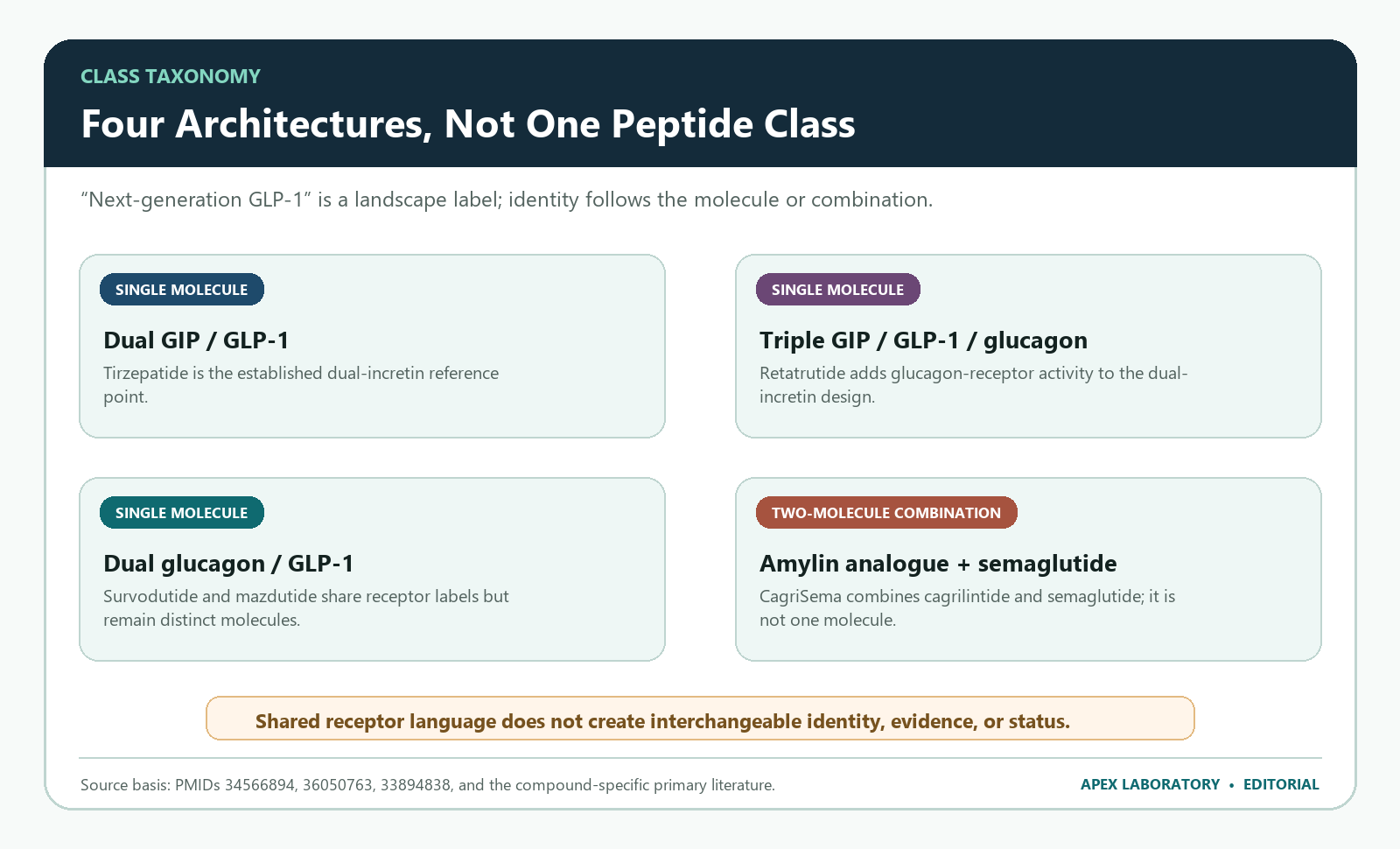
This taxonomy prevents a common extraction error: counting receptor names and treating compounds with the same count as interchangeable. Relative receptor activity depends on the assay system, and clinical observations depend on the studied formulation, population, comparator, duration, and endpoint. A class label is therefore an orientation tool, not a conclusion about equivalence, efficacy, safety, or experimental suitability.
Reagent Identity and Program Designators
Landscape reading fails first at the name. One molecule travels under a company code, a trial acronym, an international nonproprietary name, and sometimes a combination label, and a single identifier slip propagates into every claim downstream of it. The table fixes the identity layer before any evidence is discussed. CAS registry numbers below are the supplier-reported Apex product catalog record for each reagent; molecular weight, formula, and sequence detail stay with the dedicated compound guides, which hold the lot-level identity evidence for each material.
| Compound | Program designators | CAS registry number | Structural note |
|---|---|---|---|
| Retatrutide | LY3437943 | 2381089-83-2 | One 39-residue peptide engineered against GIP, GLP-1, and glucagon receptors |
| Survodutide | BI 456906 | 2805997-46-8 | One lipidated peptide carrying glucagon and GLP-1 receptor activity; Boehringer Ingelheim with Zealand Pharma |
| Mazdutide | IBI362; LY3305677 | 2259884-03-0 | Oxyntomodulin-analogue backbone with glucagon and GLP-1 receptor activity; Innovent Biologics with Lilly |
| Cagrilintide | AM833 | 1415456-99-3 | Long-acting amylin analogue, lipidated and cyclized through an intramolecular disulfide bridge |
| Semaglutide | — | 910463-68-2 | GLP-1 receptor agonist; the GLP-1 half of the CagriSema pairing |
| Tirzepatide | — | 2023788-19-2 | Dual GIP/GLP-1 co-agonist, held here only as a reference architecture |
| CagriSema | Cagrilintide with semaglutide | No single registry number exists | Two molecules studied together; each keeps its own registry entry and its own certificate of analysis |
The final row is the one most often collapsed. A combination has a trial identity but no molecular identity, so it cannot be assigned one registry number, one formula, or one purity figure. Review each Apex constituent against its own applicable published configuration record. Keep the declared identity, lot, methods, results and acceptance criteria separate, and check the meaning of each reported date. Publication does not identify the lot currently shipping; match the printed lot to the received label. Such paperwork describes material integrity for laboratory reproducibility; it asserts no pharmacological property, and it attaches no trial result to a vial.
Evidence Map for a Fast-Moving Field
Current landscape content needs four separate evidence lanes. Peer-reviewed primary literature controls claims about molecular identity, receptor pharmacology, and observed trial endpoints. Trial registries help locate protocol identity and recruitment or completion status. A regulator or responsible sponsor’s dated first-party statement controls filing and approval facts. Company statements can document intended future milestones, but those statements must remain labeled as plans rather than outcomes.
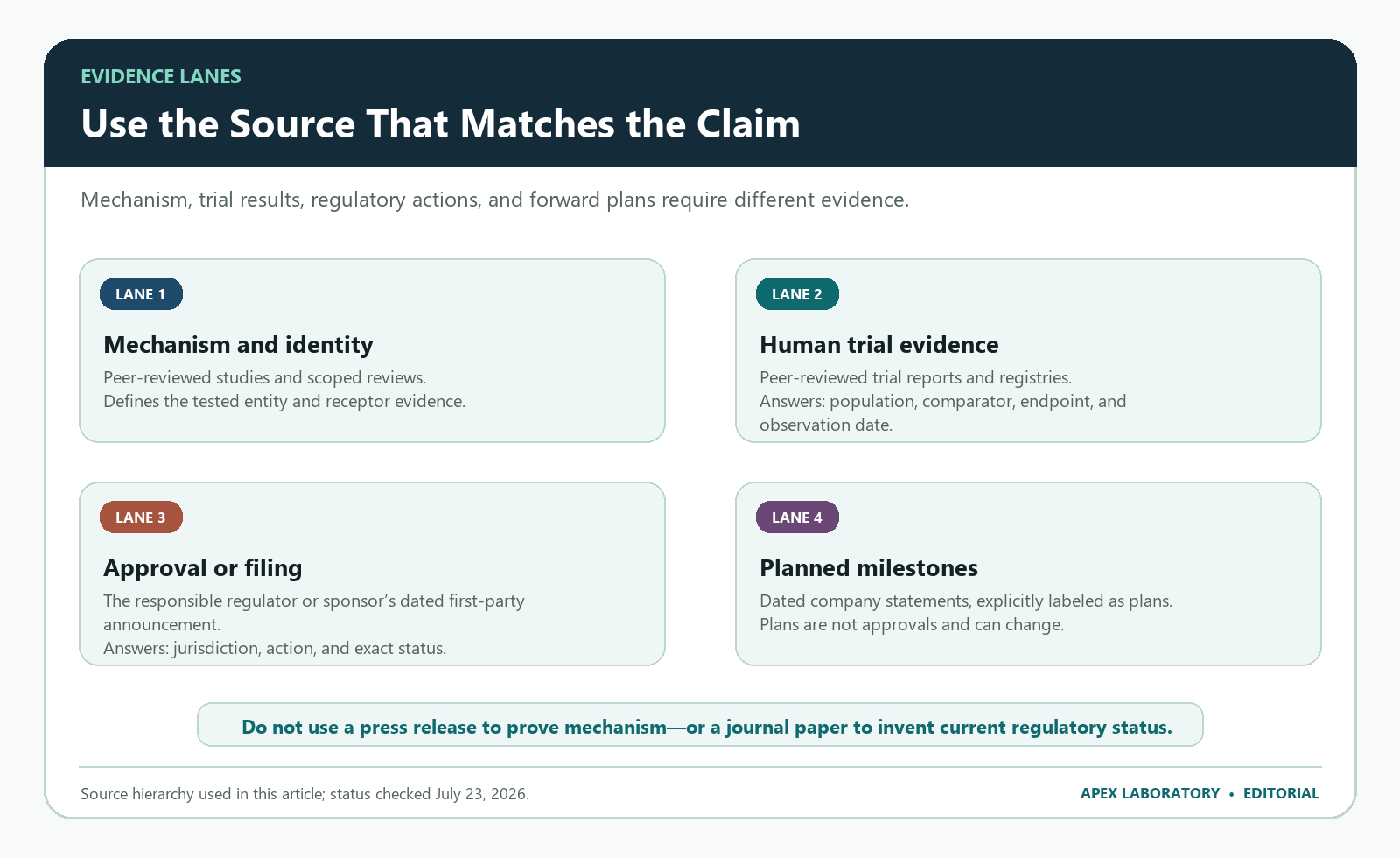
The distinction matters because the evidence can change at different speeds. A receptor-pharmacology paper remains part of the historical record; an “under review” status can change after a regulatory action; and a planned filing date can move. This page therefore uses an explicit July 23, 2026 status date and routes deep trial interpretation to the compound pages that can be updated independently.
Program Status as of July 23, 2026
The matrix below is a navigation snapshot, not a prediction of approval and not a comparison of treatments. It separates peer-reviewed study evidence from first-party status reporting. The corresponding dedicated guides remain the canonical locations for molecule-level pharmacology, study design, and limitations.
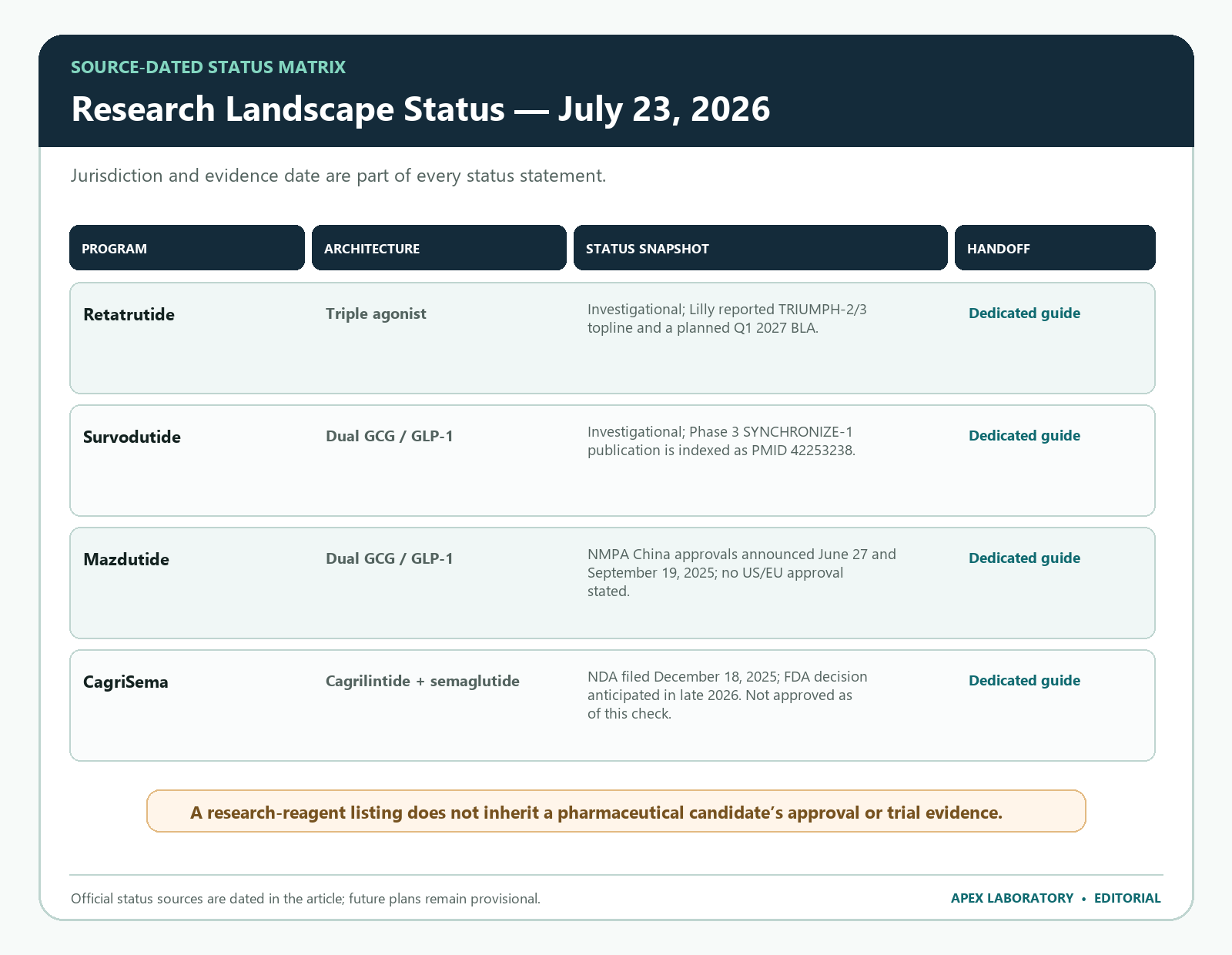
| Program | Identity | Source-dated status | Detail page |
|---|---|---|---|
| Retatrutide | Single triple GIP/GLP-1/glucagon receptor agonist | Lilly’s July 23, 2026 update reported TRIUMPH-2 and TRIUMPH-3 topline results and stated that a biologics license application was planned for Q1 2027. Retatrutide remained investigational at this check. | Retatrutide research guide |
| Survodutide | Single dual glucagon/GLP-1 receptor agonist | The Phase 3 SYNCHRONIZE-1 report is indexed as PMID 42253238; the program remained investigational. The trial record is NCT06066515.PMID 42253238 | Survodutide research guide |
| Mazdutide | Single dual glucagon/GLP-1 receptor agonist | Innovent announced China NMPA approval for chronic weight management on June 27, 2025 and for glycemic control in adults with type 2 diabetes on September 19, 2025. Those actions are jurisdiction-specific. | Mazdutide research guide |
| Cagrilintide / CagriSema | Amylin analogue; cagrilintide plus semaglutide combination | Novo Nordisk announced a CagriSema NDA filing on December 18, 2025 and anticipated an FDA decision in late 2026. CagriSema was not FDA-approved at this check. | Cagrilintide and CagriSema guide |
Primary status sources: Lilly, July 23, 2026; ClinicalTrials.gov NCT06066515; Innovent weight-management announcement; Innovent glycemic-control announcement; and Novo Nordisk’s CagriSema filing announcement.
Regulatory Status, Program by Program
Status is the fastest-decaying fact on this page, and it is also the one most often flattened into a single sentence about the class. There is no class-level status. Every program holds a separate record with every regulator, and an Apex research reagent holds none of those records at all. The rows below state the explicit positive or negative for each program in each jurisdiction as of the July 23, 2026 check, naming the acting body and the date rather than leaving the reader with a vague impression of novelty.
| Program | Jurisdiction | Explicit status at the July 23, 2026 check |
|---|---|---|
| Retatrutide | United States and European Union | No FDA marketing approval and no EMA marketing authorization; the molecule remained investigational. Lilly reported TRIUMPH-2 and TRIUMPH-3 topline results on July 23, 2026 and stated that a biologics license application was planned for the first quarter of 2027. A stated plan is neither a submission nor an authorization. |
| Survodutide | United States | Not approved by the FDA for any indication. The program carries Fast Track designation and, from 2024, Breakthrough Therapy designation for the treatment of adults with non-cirrhotic MASH and moderate or advanced fibrosis. Designations expedite development and review of an investigational candidate; neither one permits marketing. |
| Survodutide | European Union and all other markets | No EMA marketing authorization, and no approval by the NMPA or any other national regulator. |
| Mazdutide | China | Innovent announced NMPA approval for chronic weight management in adults with overweight or obesity on June 27, 2025, and a separate NMPA approval for glycemic control in adults with type 2 diabetes on September 19, 2025. |
| Mazdutide | United States and European Union | No FDA approval and no EMA marketing authorization. The two China actions confer no status outside China. |
| Cagrilintide as a single agent | Every jurisdiction | No FDA, EMA, NMPA, or other regulatory approval anywhere globally; cagrilintide on its own remained an investigational molecule. |
| CagriSema | United States | Novo Nordisk announced a New Drug Application submission for chronic weight management on December 18, 2025 and anticipated a decision in late 2026. A pending application is not an authorization, and the combination was not approved. |
| CagriSema | European Union and all other markets | No marketing authorization held anywhere at the time of this check. |
| Semaglutide and tirzepatide | United States and European Union | Approved pharmaceutical formulations, present on this page only as reference architectures. The peer-reviewed record describes tirzepatide as the first dual GIP/GLP-1 co-agonist approved for type 2 diabetes in the USA, Europe, and the UAE, at 5–15 mg per week.PMID 36050763 |
Three separations keep that table honest. A designation is not an approval, so Fast Track and Breakthrough Therapy status for survodutide cannot be reported as a regulatory endorsement of the molecule. A filing is not a decision, so the CagriSema application and the planned retatrutide submission are both events in a process rather than outcomes of one. And an approval is bounded by its jurisdiction and its indication, so the two mazdutide authorizations describe what the NMPA permitted in China for named populations, nothing more.
None of these records transfers to laboratory material. An Apex reagent is a chemical supplied for in-vitro and preclinical research; it does not acquire an investigational candidate’s trial evidence, and it does not acquire an approved formulation’s regulatory standing. The research-grade versus pharmaceutical-grade guide sets out why those two categories stay distinct even when the underlying molecule is the same.
Retatrutide: The Triple-Agonist Branch
Retatrutide is a single investigational peptide designed to engage GIP, GLP-1, and glucagon receptors. Its presence on this page is architectural: it shows how the multi-agonist landscape extends from dual-incretin signaling to a three-receptor design. It should not be collapsed into tirzepatide, which has a different receptor set, or into survodutide and mazdutide, which use the glucagon/GLP-1 pairing without the GIP arm.
The July 23 Lilly announcement is useful for current sponsor-reported program status, including the stated Q1 2027 filing plan. It is not a substitute for the peer-reviewed trial record, and a planned filing is not a filed application or an approval. The retatrutide research guide owns the molecule-level pharmacology and evidence discussion; retatrutide versus tirzepatide owns the symmetric two-program comparison.
Survodutide and Mazdutide: Shared Targets, Separate Evidence
Survodutide and mazdutide are both described as dual glucagon/GLP-1 receptor agonists, yet the shared label is only the beginning of the comparison. Survodutide emerged from the Boehringer Ingelheim and Zealand Pharma program. Mazdutide, also known as IBI362 or LY3305677, is associated with Innovent Biologics and Lilly. Compound-specific publications describe different development programs, populations, comparators, and endpoints.PMID 38330987 PMID 38847460 PMID 39495965 PMID 35750681 PMID 36247927 PMID 38092790
The 2026 update adds two facts that must not be merged. First, the Phase 3 SYNCHRONIZE-1 survodutide report is now indexed under PMID 42253238, advancing the peer-reviewed evidence record without changing the compound’s investigational regulatory status. Second, mazdutide has announced NMPA approvals in China, supported by its own clinical program, including the published GLORY-1 study.PMID 40421736 Neither point licenses a cross-compound efficacy claim, and China-specific approval does not imply FDA or EMA approval.
Use the survodutide guide and mazdutide guide for the full evidence tables tied to each molecule. This page carries the headline readouts with their population qualifiers, because a landscape that names trials without reporting what they measured is not usable as a reference; the dedicated pages carry study-design detail, subgroup analysis, and limitations at depth.
Cagrilintide and CagriSema: The Combination Boundary
Cagrilintide is a long-acting amylin analogue. CagriSema is the co-administration or fixed-combination program pairing cagrilintide with semaglutide. It is not one new peptide, does not have one unified sequence, and should not be assigned one molecular formula or one receptor profile. Amylin reviews provide pathway context, while combination trials provide program-specific evidence.PMID 35183619 PMID 38338796 PMID 33894838 PMID 37364590
The Phase 3 REDEFINE publications report cagrilintide and semaglutide as coadministered components in distinct study populations.PMID 40544433 PMID 40544432 Novo Nordisk’s December 18, 2025 announcement documents the NDA submission and anticipated review timing. That status does not convert cagrilintide into an approved product, merge the two molecules, or confer pharmaceutical status on research-use-only materials.
For the combination’s structure, lineage, and evidence limits, continue to the cagrilintide and CagriSema research guide. For the GLP-1 component, the semaglutide research guide owns semaglutide-specific pharmacology and approved-formulation context.
Reported Trial Readouts by Program
What follows is the measured record: the endpoint each trial prespecified, the population it enrolled, the duration it ran, and the value it reported. Every row is confined to the compound and the population that generated it. Nothing crosses between survodutide and mazdutide despite their shared receptor labels, and nothing crosses between cagrilintide alone and cagrilintide given with semaglutide. Where a review is cited rather than a trial, the row says so, because mechanistic reviews such as the GLP-1/glucagon co-agonism synthesis describe a design variable — the ratio of relative receptor activity — rather than an outcome.PMID 34566894
Survodutide
| Study | Population enrolled | Duration | Reported result |
|---|---|---|---|
| SYNCHRONIZE-1, phase 3 (NCT06066515)PMID 42253238 | 725 adults with obesity and without diabetes (BMI 30 or higher, or 27 or higher with a weight-related complication); mean age 47.1 years, mean baseline weight 108.8 kg, mean BMI 37.9 | 76 weeks | Mean body-weight change −12.2% (95% CI −13.6 to −10.8) at 3.6 mg and −13.0% (95% CI −14.4 to −11.6) at 6.0 mg, against −5.4% (95% CI −6.9 to −4.0) on placebo. Weight reduction of at least 5% was reached by 72.6%, 71.9%, and 46.3% of participants respectively (P<0.001 versus placebo). No deaths were reported. |
| Dose-finding obesity trial, phase 2 (NCT04667377)PMID 38330987 | 386 treated adults aged 18–75 with BMI of 27 kg/m² or above and without diabetes, recruited across 43 centres in 12 countries | 46 weeks, comprising 20 weeks of escalation and 26 weeks of maintenance | Mean body-weight change from baseline to week 46 of −6.2% at 0.6 mg, −12.5% at 2.4 mg, −13.2% at 3.6 mg, and −14.9% at 4.8 mg, against −2.8% on placebo. Completion of the treatment period was 61% on drug and 60% on placebo. |
| MASH and fibrosis trial, phase 2 (NCT04771273)PMID 38847460 | 293 adults with biopsy-confirmed MASH and fibrosis stage F1 through F3 | 48 weeks, split into 24 weeks of rapid escalation and 24 weeks of maintenance | Histologic improvement in MASH without worsening fibrosis in 47% at 2.4 mg, 62% at 4.8 mg, and 43% at 6.0 mg, against 14% on placebo. Liver fat content fell by at least 30% in 63%, 67%, and 57% of participants against 14%; fibrosis improved by at least one stage in 34%, 36%, and 34% against 22%. |
| SYNCHRONIZE-1 and -2 protocol paperPMID 39495965 | Planned enrolment of 726 participants without type 2 diabetes and 755 participants with type 2 diabetes | 76 weeks to the primary assessment | Design record only: doses uptitrated to 3.6 mg or 6.0 mg once weekly, with co-primary endpoints of percentage body-weight change and the proportion reaching at least 5% reduction at week 76. A protocol paper reports intent, not outcome. |
Mazdutide
| Study | Population enrolled | Duration | Reported result |
|---|---|---|---|
| GLORY-1, phase 3 (NCT05607680)PMID 40421736 | 610 Chinese adults aged 18 to 75 with BMI of at least 28, or 24 to under 28 plus one weight-related coexisting condition; mean baseline weight 87.2 kg, mean BMI 31.1 | 48 weeks | At week 32, mean body-weight change was −10.09% on 4 mg and −12.55% on 6 mg, against +0.45% on placebo, with at least 5% reduction in 73.9%, 82.0%, and 10.5% of participants. By week 48 the figures were −11.00% and −14.01% against +0.30%, with at least 15% reduction in 35.7%, 49.5%, and 2.0%. |
| Weight-management trial, phase 2 (NCT04904913)PMID 38092790 | 248 Chinese adults with overweight or obesity assigned to 3 mg (n=62), 4.5 mg (n=63), 6 mg (n=61), or placebo (n=62) at 20 hospitals | 24 weeks | Mean body-weight change of −6.7%, −10.4%, and −11.3% across the three dose groups against +1.0% on placebo, a treatment difference spanning −7.7% to −12.3% (all p<0.0001). |
| Multiple-ascending-dose trial, phase 1b (NCT04440345)PMID 36247927 | 24 Chinese adults with overweight (BMI 24 kg/m² or above with hyperphagia or a comorbidity) or obesity (BMI 28 kg/m² or above), eight on drug and four on placebo within each cohort | 12 weeks in the 9 mg cohort; 16 weeks in the 10 mg cohort | Week-12 body-weight change of −11.7% against −1.8% on placebo in the 9 mg cohort (estimated treatment difference −9.8%, 95% CI −14.4 to −5.3; P=0.0002). Week-16 change of −9.5% against −3.3% in the 10 mg cohort (difference −6.2%, 95% CI −11.5 to −0.9; P=0.024). Earlier work at doses up to 6 mg had reached 6.4% loss over 12 weeks. |
| Type 2 diabetes trial, phase 1b (NCT04466904), reported under the IBI362 designationPMID 35750681 | 42 treated Chinese patients with type 2 diabetes across nine centres, allocated to 3.0, 4.5, or 6.0 mg, to placebo, or to open-label dulaglutide 1.5 mg | 12 weeks | Glycated haemoglobin, fasting plasma glucose, and post-meal glucose all fell from baseline in each of the three dose cohorts. Diarrhoea was recorded in 29.2% on mazdutide, 33.3% on dulaglutide, and 0% on placebo; decreased appetite in 25.0%, 16.7%, and 0%. |
Cagrilintide and CagriSema
Amylin pharmacology supplies the background for this branch. A first-person account of 35 years of amylin research describes the hormone as inhibiting eating, pancreatic glucagon secretion, and gastric emptying, which is the physiology the analogue program was built on.PMID 35183619 A later neuroendocrine review summarizes the clinical pharmacology and applications of amylin and its analogues pramlintide and cagrilintide, describing amylin as co-secreted with insulin and as inducing satiety.PMID 38338796 Neither review reports a quantitative endpoint, and neither can stand in for the combination data below.
| Study | Population enrolled | Duration | Reported result |
|---|---|---|---|
| REDEFINE 1, phase 3a (NCT05567796)PMID 40544433 | 3,417 adults without diabetes; 2,108 received the pairing, 302 semaglutide alone, 302 cagrilintide alone, and 705 placebo | 68 weeks | Mean body-weight change of −20.4% with cagrilintide 2.4 mg plus semaglutide 2.4 mg against −3.0% on placebo, an estimated difference of −17.3 percentage points (95% CI −18.1 to −16.6; P<0.001), with confirmatory thresholds at 20%, 25%, and 30% loss all favouring the pairing. |
| REDEFINE 2, phase 3a (NCT05394519)PMID 40544432 | 1,206 adults with type 2 diabetes, BMI of 27 or above and glycated haemoglobin between 7% and 10%, across 12 countries; 904 on the pairing and 302 on placebo | 68 weeks | Mean body-weight change of −13.7% against −3.4% on placebo, an estimated difference of −10.4 percentage points (95% CI −11.2 to −9.5; P<0.001). Glycated haemoglobin of 6.5% or below was reached by 73.5% of patients on the pairing and 15.9% on placebo. |
| Type 2 diabetes trial, phase 2 (NCT04982575)PMID 37364590 | 92 US adults with type 2 diabetes and BMI of 27 kg/m² or above taking metformin, split 31 to the pairing, 31 to semaglutide, and 30 to cagrilintide, all escalated to 2.4 mg; mean age 58 years | 32 weeks across 17 sites | Glycated haemoglobin fell by 2.2 percentage points on the pairing, 1.8 on semaglutide alone, and 0.9 on cagrilintide alone; against cagrilintide the difference was −1.3 points (95% CI −1.7 to −0.8; p<0.0001) but against semaglutide it was −0.4 points (p=0.075). Body weight fell 15.6%, 5.1%, and 8.1% respectively. |
| Combination pharmacology trial, phase 1b (NCT03600480)PMID 33894838 | 95 exposed adults aged 18 to 55 with BMI between 27.0 and 39.9 kg/m² and otherwise healthy, at one US centre; mean age 40.6 years | 16 weeks of co-escalation, four weeks at target dose, five weeks of follow-up | Half-life measured at 159–195 hours for cagrilintide and 145–165 hours for semaglutide, with exposure proportional to cagrilintide dose and no effect on semaglutide elimination. At week 20 body weight fell 15.7% on cagrilintide 1.2 mg and 17.1% on 2.4 mg against 9.8% for pooled placebo, both alongside semaglutide 2.4 mg. |
Additional reported findings
These entries sit outside the four program tables above but remain part of the evidence record for this landscape. Each row states the compound, the model and species, the endpoint, the result, and the source.
| Compound | Model and species | Endpoint | Reported result | Source |
|---|---|---|---|---|
| Survodutide | Phase 2 randomized trial in adults with type 2 diabetes on background metformin (human) | Glycated haemoglobin and body weight at week 16 | 413 randomized and 411 treated; glycated haemoglobin fell between 0.91 and 1.71 percentage points across dose groups, and the low-dose arm (−1.46) sat alongside open-label semaglutide 1.0 mg (−1.47); body weight fell as far as −8.7% (95% CI −10.1 to −7.3) against −5.3% (95% CI −6.6 to −4.1) on semaglutide | PMID 38095657 |
| Tirzepatide | SURPASS 1–5 program in adults with type 2 diabetes (human), summarized in review | Glycated haemoglobin and body weight | 5–15 mg per week lowered glycated haemoglobin by 1.24 to 2.58% and body weight by 5.4 to 11.7 kg; between 20.7% and 68.4% of patients lost more than a tenth of baseline weight | PMID 36050763 |
| Survodutide | Phase 2 trial in adults with biopsy-confirmed MASH (human) | Serious adverse events | 8% on survodutide against 7% on placebo over the 48-week trial | PMID 38847460 |
| Amylin (endogenous hormone) | Narrative account spanning 35 years of rodent and human amylin physiology | Food intake, glucagon secretion, gastric emptying | Amylin characterized as inhibiting eating, pancreatic glucagon secretion, and gastric emptying, and as the main constituent of islet amyloid in type 2 diabetes | PMID 35183619 |
| Cagrilintide and pramlintide | Narrative review of amylin clinical pharmacology (human) | Satiety signalling and body weight | Amylin described as inducing satiety and decreasing body weight; review summarizes the clinical pharmacology and applications of the analogues pramlintide and cagrilintide | PMID 38338796 |
| GLP-1/glucagon co-agonists as a class | Mechanistic review of preclinical and human findings | Ratio of GLP-1 to glucagon receptor activity | Review reflects on the divergent effects of varying the GLP-1 to glucagon activity ratio and notes the importance of understanding the contributions of individual hormone action; it reports no quantitative endpoint | PMID 34566894 |
Tolerability and Dose Ranges Reported in the Trials
Two categories of number are frequently dropped from landscape pages because they look like clinical advice. They are not. An adverse-event rate is an observation in a named trial population, and a dose is a study-design fact about what investigators administered. Both are reported here strictly in those terms. Neither is guidance for administration, and neither describes how a laboratory reagent should be used.
Reported tolerability observations
| Study population | Participants and duration | Observation as reported |
|---|---|---|
| Adults with obesity, survodutide phase 3PMID 42253238 | 725 adults (241, 242, and 242 per group); 76 weeks | Gastrointestinal symptoms, typically mild to moderate, in 80.9% of the 3.6 mg group, 89.7% of the 6.0 mg group, and 47.9% of the placebo group. No deaths occurred. |
| Adults with obesity, survodutide phase 2PMID 38330987 | 386 treated (309 on survodutide, 77 on placebo); 46 weeks | Any adverse event in 281 of 309 recipients (91%) and 58 of 77 on placebo (75%); the events were primarily gastrointestinal in 232 of 309 (75%) against 32 of 77 (42%). Investigators described all four doses as tolerated. |
| Adults with MASH, survodutide phase 2PMID 38847460 | 293 adults; 48 weeks | Nausea 66% against 23%, diarrhea 49% against 23%, and vomiting 41% against 4%, each compared with placebo; serious events 8% against 7%. |
| Chinese adults with overweight or obesity, mazdutide phase 1bPMID 36247927 | 24 adults; 12 weeks in the 9 mg cohort and 16 weeks in the 10 mg cohort | No serious adverse event was reported in the 24 enrolled participants, and every treatment-emergent event was mild or moderate; the most frequent were upper respiratory tract infection, diarrhoea, decreased appetite, and nausea. |
| Chinese adults with obesity or overweight, mazdutide phase 3PMID 40421736 | 610 adults; 48 weeks | Discontinuation attributed to adverse events in 1.5% at 4 mg, 0.5% at 6 mg, and 1.0% on placebo, with gastrointestinal events predominating and mostly mild or moderate. |
| Otherwise healthy adults, cagrilintide with semaglutide phase 1bPMID 33894838 | 95 exposed adults, events logged in 92 of them; 16-week co-escalation, 4 weeks at target dose, 5-week follow-up | Of 566 events logged in 92 participants, 207 (37%) were gastrointestinal disorders; most were mild to moderate, and the share of participants with at least one event was similar across groups. |
| Adults with overweight or obesity, REDEFINE 1PMID 40544433 | 3,417 adults (2,108 on the pairing, 705 on placebo); 68 weeks | Gastrointestinal events affected 79.6% of the combination group and 39.9% of the placebo group, mainly transient and mild to moderate. |
| Adults with type 2 diabetes, REDEFINE 2PMID 40544432 | 1,206 adults (904 on the pairing, 302 on placebo); 68 weeks | Gastrointestinal events reported by 72.5% of patients on the pairing and 34.4% on placebo, again mostly transient and mild or moderate. |
| US adults with type 2 diabetes, phase 2 active-controlled trialPMID 37364590 | 92 adults (31, 31, and 30 per group); 32 weeks | Adverse events in 21 of 31 on the pairing (68%), 22 of 31 on semaglutide (71%), and 24 of 30 on cagrilintide (80%); no level 2 or 3 hypoglycaemia and no fatal events. |
Dose ranges administered in the published trials
| Study | Population studied | Regimen administered |
|---|---|---|
| Survodutide, phase 2 obesityPMID 38330987 | 386 treated adults without diabetes (human) | Subcutaneous 0.6, 2.4, 3.6, or 4.8 mg once weekly, reached through a 20-week escalation inside a 46-week trial |
| Survodutide, phase 3 obesityPMID 42253238 | 725 adults with obesity and without diabetes (human) | Adjusted upward to either 3.6 mg or 6.0 mg weekly and maintained to week 76 |
| Survodutide, phase 2 MASHPMID 38847460 | 293 adults with biopsy-confirmed MASH, fibrosis F1–F3 (human) | Weekly injections of 2.4, 4.8, or 6.0 mg, with 24 weeks of rapid escalation before 24 weeks of maintenance |
| Survodutide, phase 2 type 2 diabetesPMID 38095657 | 413 randomized adults with type 2 diabetes on metformin (human) | Six arms running to 0.3, 0.9, 1.8, or 2.7 mg weekly, or 1.2 or 1.8 mg twice weekly, over a 16-week treatment period, against placebo and open-label semaglutide up to 1.0 mg weekly |
| Mazdutide, phase 1b ascending dosePMID 36247927 | 24 Chinese adults with overweight or obesity (human) | Stepwise titration of 3 mg for weeks 1–4, 6 mg for weeks 5–8, then 9 mg for weeks 9–12; the second cohort stepped 2.5, 5, 7.5, and 10 mg across 16 weeks |
| Mazdutide, phase 2PMID 38092790 | 248 Chinese adults with overweight or obesity (human) | Weekly assignment to 3 mg, 4.5 mg, or 6 mg for 24 weeks |
| Mazdutide, phase 3PMID 40421736 | 610 Chinese adults with obesity or overweight (human) | Weekly assignment to 4 mg or 6 mg for 48 weeks |
| Mazdutide, phase 1b in type 2 diabetesPMID 35750681 | 42 treated Chinese patients with type 2 diabetes (human) | Three cohorts at 3.0, 4.5, or 6.0 mg weekly for 12 weeks, with dulaglutide 1.5 mg as the open-label comparator |
| Cagrilintide with semaglutide, phase 1bPMID 33894838 | 95 exposed, otherwise healthy US adults aged 18–55 (human) | Six cagrilintide cohorts at 0.16, 0.30, 0.60, 1.2, 2.4, or 4.5 mg, co-escalated at four-week intervals across 16 weeks alongside a fixed semaglutide 2.4 mg |
| CagriSema, phase 2PMID 37364590 and phase 3 REDEFINEPMID 40544433 PMID 40544432 | 92 US adults with type 2 diabetes in phase 2; 3,417 and 1,206 adults in REDEFINE 1 and REDEFINE 2 (human) | A fixed pairing of cagrilintide 2.4 mg with semaglutide 2.4 mg weekly across the 32-week phase 2 trial, and the same 2.4 mg pairing weekly across the 68-week REDEFINE 1 and REDEFINE 2 trials |
Evidence Limitations
The tables above are informative in proportion to how carefully their boundaries are respected, so it is worth naming what they cannot support. Populations are not interchangeable. Mazdutide’s efficacy record was generated in Chinese adults, survodutide’s in multinational cohorts, and the phase 1b combination pharmacology in a small, otherwise healthy sample at one site; a figure lifted out of its population loses most of its meaning.
Estimands and follow-up windows differ too. SYNCHRONIZE-1 reported under a treatment-regimen estimand that absorbs early discontinuation, GLORY-1 under a treatment-policy estimand, and REDEFINE under a treatment-policy analysis at 68 weeks. Comparing a week-32 value from one trial with a week-76 value from another produces an artefact, not a finding.
Almost nothing here is head-to-head. Two exceptions are worth noting precisely because they are exceptions: the survodutide phase 2 diabetes trial carried an open-label semaglutide arm, and the phase 2 CagriSema trial compared the pairing against each constituent separately. Everywhere else the comparator is placebo, which means cross-program ranking is unsupported no matter how similar two receptor labels look.
Duration is the last limit. The longest readout on this page runs 76 weeks, the independent literature outside sponsor-funded programs remains thin, and no long-term outcome record exists for any of these molecules. None of it describes a research reagent in any case: trial evidence attaches to the studied formulation, population, and protocol, never to a vial of laboratory material.
How to Compare Programs Without Flattening Them
A defensible cross-program research design begins with identity, then adds assay context, material state, model alignment, endpoint definition, and a status timestamp. A table that lists only receptor names misses the relative activity and assay system behind those labels. A table that mixes a Phase 1 study in one population with a Phase 3 study in another cannot support a head-to-head conclusion. A table that pairs a China approval with a United States filing status without naming jurisdictions invites a false equivalence.
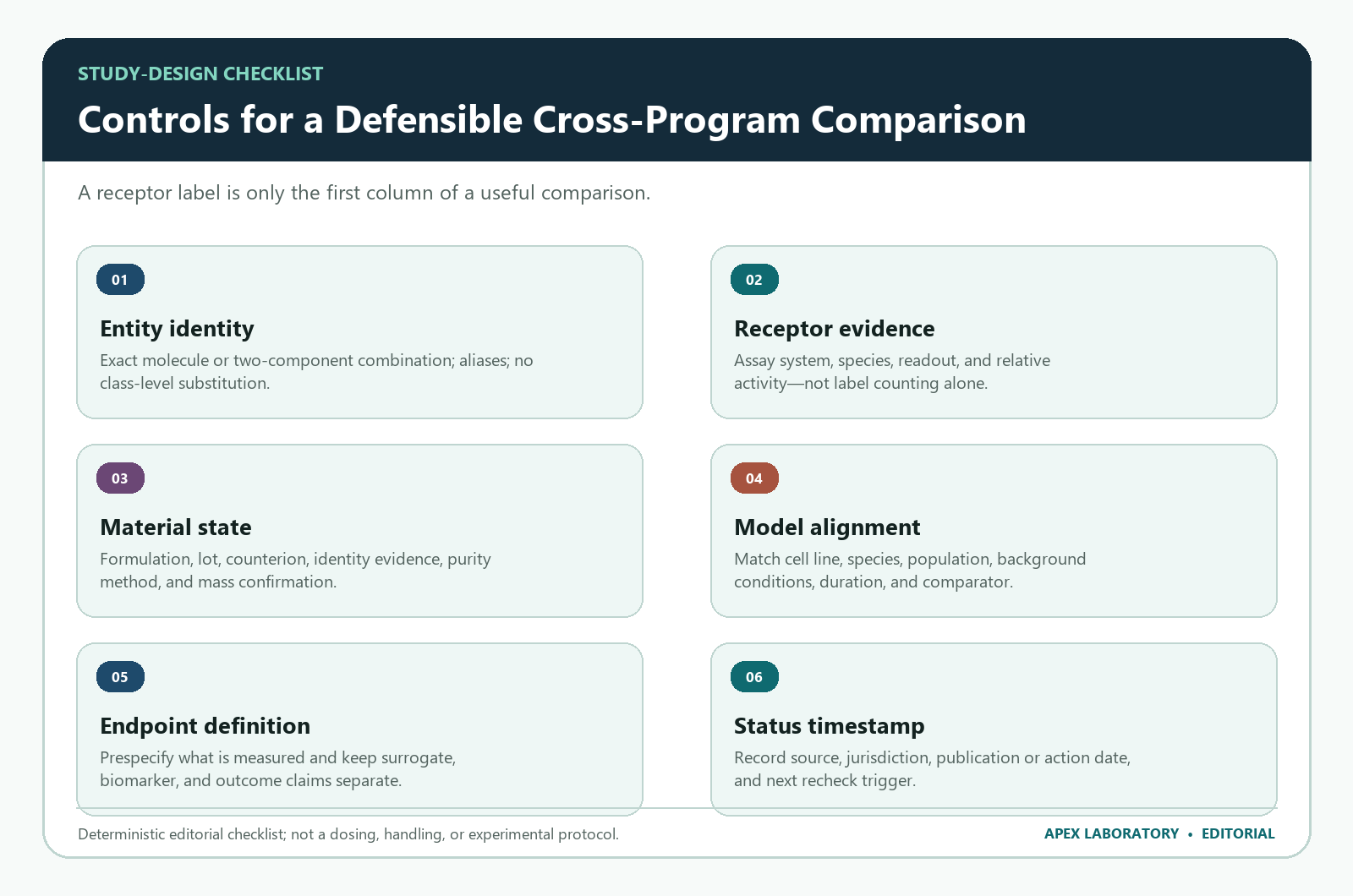
For laboratory research, the material record adds another boundary. Identity evidence, chromatographic method, mass confirmation, lot documentation, matrix, comparator, and prespecified endpoint all affect interpretation. The peptide COA guide, HPLC purity explainer, and mass-spectrometry identity explainer describe those verification layers without turning this landscape page into a handling protocol.
High-Value Research Questions This Landscape Supports
The page is most useful when it helps readers ask narrower, answerable questions rather than rank programs. Examples include:
- How does receptor activity change across assay systems for dual and triple co-agonists?
- Which endpoints are shared across programs, and which are population- or protocol-specific?
- When two programs use the same receptor labels, what molecular and experimental variables still differ?
- How should cagrilintide-only evidence be separated from evidence for cagrilintide plus semaglutide?
- Which statements are supported by peer-reviewed evidence, which by a regulator, and which remain sponsor plans?
- What event should trigger the next status review: publication, filing acceptance, decision date, or trial readout?
These questions also improve AI-search citation readiness because each answer can preserve entity, source type, date, and limitation when extracted. The goal is not to make the article sound certain; it is to make the boundaries portable.
Frequently Asked Questions
What counts as next-generation GLP-1 research?
It is an umbrella for research programs that extend beyond GLP-1-only signaling through another incretin receptor, the glucagon receptor, an amylin pathway, or a combination of those strategies. The label describes a landscape, not one formal chemical class, so each molecule or combination needs its own identity, evidence, and status record.
Is CagriSema one molecule?
No. CagriSema combines cagrilintide, an amylin analogue, with semaglutide, a GLP-1 receptor agonist. The two constituents keep separate molecular identities even when studied or submitted as one combination program.
Are survodutide and mazdutide the same compound?
No. Both are described as dual glucagon/GLP-1 receptor agonists, but they are different molecules from different development programs. Their assay data, study populations, trial records, developers, and regulatory histories must remain separate.
Which program in this guide has an approval?
Innovent announced China NMPA approvals for mazdutide in 2025, first for chronic weight management and later for glycemic control in adults with type 2 diabetes. Those are China-specific actions. They do not imply FDA or EMA approval, and they do not transfer pharmaceutical status to an Apex research reagent.
Is retatrutide FDA-approved?
No. As of July 23, 2026, retatrutide remained investigational. Lilly reported additional topline results and stated that it planned a biologics license application for the first quarter of 2027, but a planned filing is not an approval.
How should researchers compare next-generation GLP-1 programs?
Start with exact entity identity, then compare receptor evidence in the same assay context, material and formulation state, matched models or populations, prespecified endpoints, and source-dated regulatory status. Receptor-count labels alone cannot establish equivalence or rank programs.
What adverse events were reported in these trials?
Gastrointestinal events dominate every program. In 386 treated adults without diabetes over 46 weeks, the survodutide phase 2 obesity trial logged adverse events in 281 of 309 recipients (91%) against 58 of 77 on placebo (75%), primarily gastrointestinal in 232 of 309 (75%) against 32 of 77 (42%). In the phase 1b trial of cagrilintide given with semaglutide, 207 of the 566 events logged in 92 of 95 exposed, otherwise healthy adults (37%) were gastrointestinal disorders, most of them mild to moderate. These are observations in named human trial populations, not guidance, and not a property of any research reagent.
What doses were administered in the published studies?
As study-design facts only: the survodutide phase 2 obesity trial gave 0.6 to 4.8 mg once weekly to the 309 survodutide recipients among 386 treated adults without diabetes after a 20-week escalation inside 46 weeks, the mazdutide phase 1b work titrated eight Chinese adults with overweight or obesity to 9 mg over 12 weeks and eight more to 10 mg over 16 weeks, in two cohorts of 12 that each held four on placebo, and the foundational combination trial co-escalated cagrilintide from 0.16 to 4.5 mg alongside a fixed semaglutide 2.4 mg in the 71 cagrilintide recipients among 95 exposed, otherwise healthy US adults. Every program relied on gradual escalation. None of this is a recommended dose or an administration protocol.
What half-life has been reported for these peptides?
The only directly measured values in the literature cited here come from the phase 1b combination trial, which reported a half-life of 159 to 195 hours for cagrilintide and 145 to 165 hours for semaglutide in otherwise healthy adults. Figures for survodutide, mazdutide, and retatrutide should be taken from the specific publication being cited rather than generalized across the class.
Continue Your Research
- GLP-1 and metabolic research peptides — broader cluster navigation
- Retatrutide research guide — triple-agonist identity and evidence
- Survodutide research guide — dual glucagon/GLP-1 program
- Mazdutide research guide — molecule-specific evidence and China status
- Cagrilintide and CagriSema research guide — amylin and combination boundary
- Semaglutide research guide and tirzepatide research guide — reference architectures
- Research-grade versus pharmaceutical-grade — regulatory and material boundary
References
- Hope et al. GLP-1/glucagon co-agonism review. 2021. PMID 34566894
- Nauck and D’Alessio. Tirzepatide dual GIP/GLP-1 context. 2022. PMID 36050763
- le Roux et al. Survodutide Phase 2 obesity study. 2024. PMID 38330987
- Blüher et al. Survodutide Phase 2 study in type 2 diabetes. 2024. PMID 38095657
- Sanyal et al. Survodutide Phase 2 MASH and fibrosis study. 2024. PMID 38847460
- Wharton et al. SYNCHRONIZE-1 and -2 Phase 3 design. 2025. PMID 39495965
- SYNCHRONIZE-1 Phase 3 survodutide report. 2026. PMID 42253238
- Jiang et al. Mazdutide Phase 1b study in type 2 diabetes. 2022. PMID 35750681
- Ji et al. Higher-dose mazdutide Phase 1b study. 2022. PMID 36247927
- Ji et al. Mazdutide Phase 2 study. 2023. PMID 38092790
- Ji et al. GLORY-1 mazdutide Phase 3 study. 2025. PMID 40421736
- Lutz. Amylin research history and physiology. 2022. PMID 35183619
- Eržen et al. Amylin neuroendocrine review. 2024. PMID 38338796
- Enebo et al. Cagrilintide plus semaglutide Phase 1b study. 2021. PMID 33894838
- Frias et al. Cagrilintide plus semaglutide Phase 2 study. 2023. PMID 37364590
- Garvey et al. REDEFINE 1. 2025. PMID 40544433
- Davies et al. REDEFINE 2. 2025. PMID 40544432
Research Use Disclaimer
This article is an evidence and status map for research context. Trial doses, endpoints, and adverse-event rates are reproduced only as study-design facts and as observations inside the named trial populations that generated them. On that basis, the article does not provide drug-selection, dosing, administration, reconstitution, handling, procurement, efficacy, safety, or treatment guidance. Apex Laboratory materials are chemical reagents for in-vitro and preclinical research only, not pharmaceutical products and not for human or animal consumption. A research reagent does not inherit an investigational candidate’s trial evidence or an approved formulation’s regulatory status. Status statements are jurisdiction- and date-specific and should be rechecked against the responsible regulator or sponsor before reuse.