Batch documentation
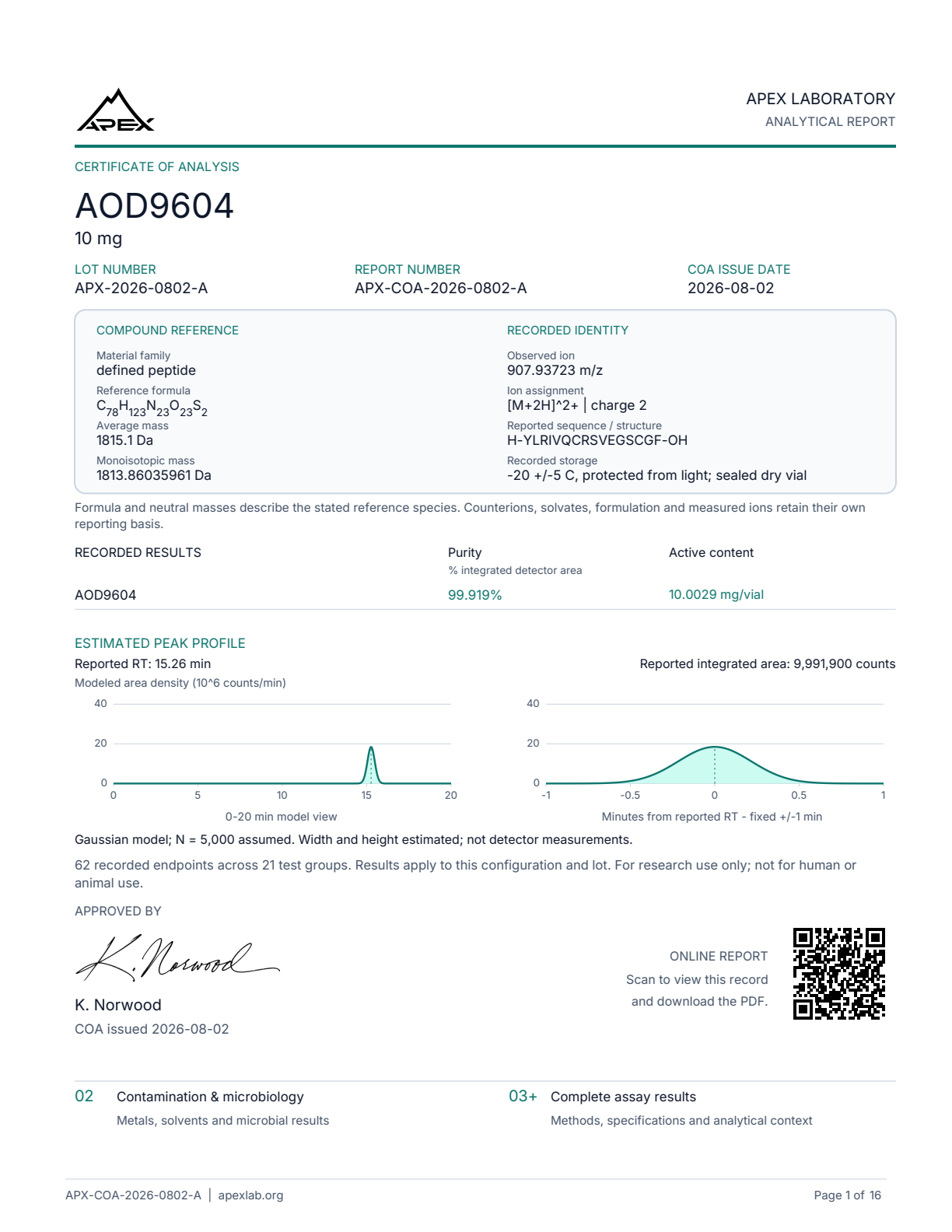
Certificate of analysis
Apex Laboratory results for the listed configurations. Match the lot on your label with the report.
AOD9604 - 10 mg
- AOD9604 chromatographic purity
- 99.919 % integrated detector area
- AOD9604 active content
- 10.0029 mg/vial
- Bacterial endotoxins
- <0.025 EU/mg active-equivalent
- Sterility: FTM
- No growth at 14 days in all 20 units
Chromatographic purity by analyte

About this graph
Recorded scalar results against the stated specification. Each row uses its own labeled scale; purity is detector-area purity, not active-material content.
Measured active content

About this graph
Calibrated active content, concentration or activity compared with the stated same-unit specification. Each row uses its own labeled scale; no conversion from chromatographic purity is made.
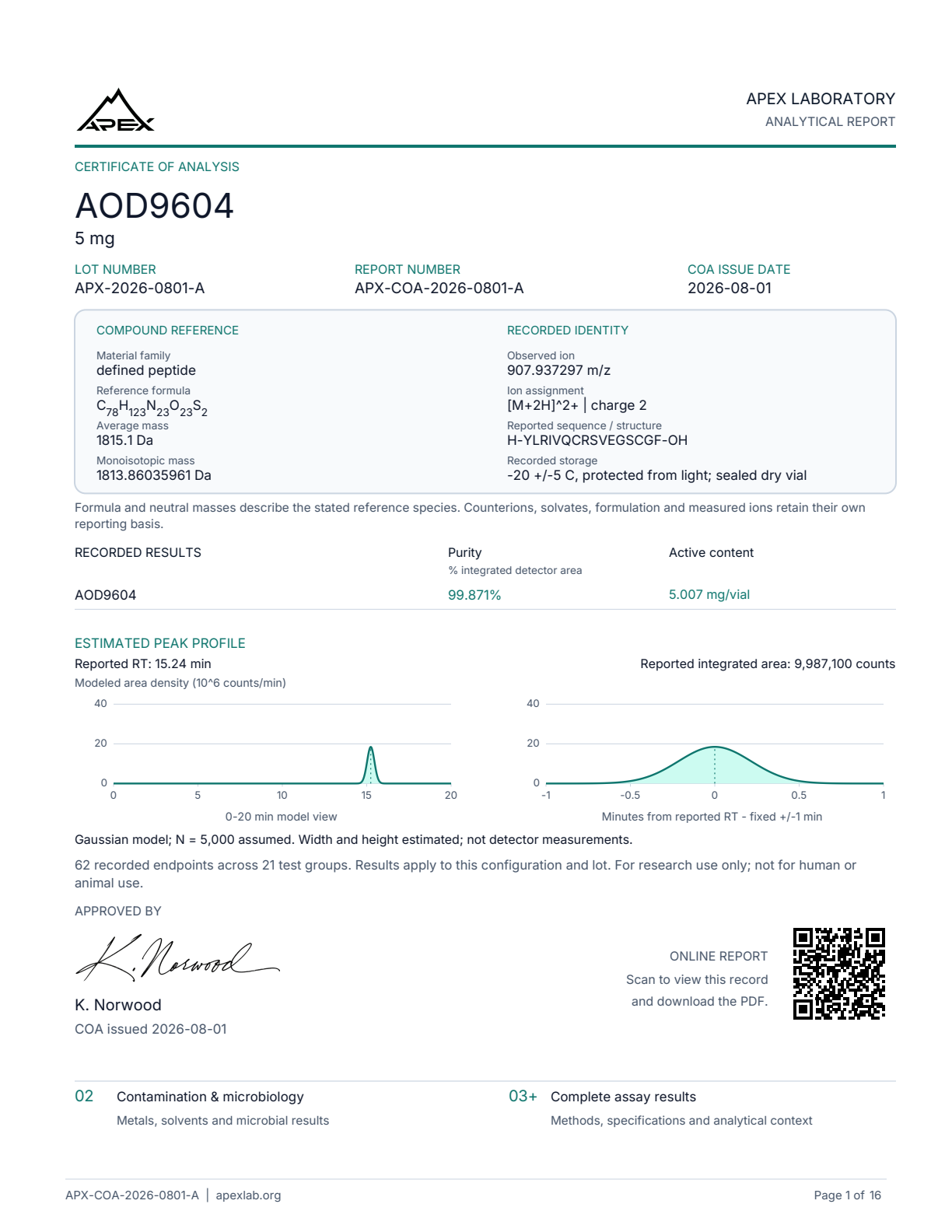
AOD9604 - 5 mg
- AOD9604 chromatographic purity
- 99.871 % integrated detector area
- AOD9604 active content
- 5.007 mg/vial
- Bacterial endotoxins
- <0.025 EU/mg active-equivalent
- Sterility: FTM
- No growth at 14 days in all 20 units
Chromatographic purity by analyte

About this graph
Recorded scalar results against the stated specification. Each row uses its own labeled scale; purity is detector-area purity, not active-material content.
Measured active content

About this graph
Calibrated active content, concentration or activity compared with the stated same-unit specification. Each row uses its own labeled scale; no conversion from chromatographic purity is made.
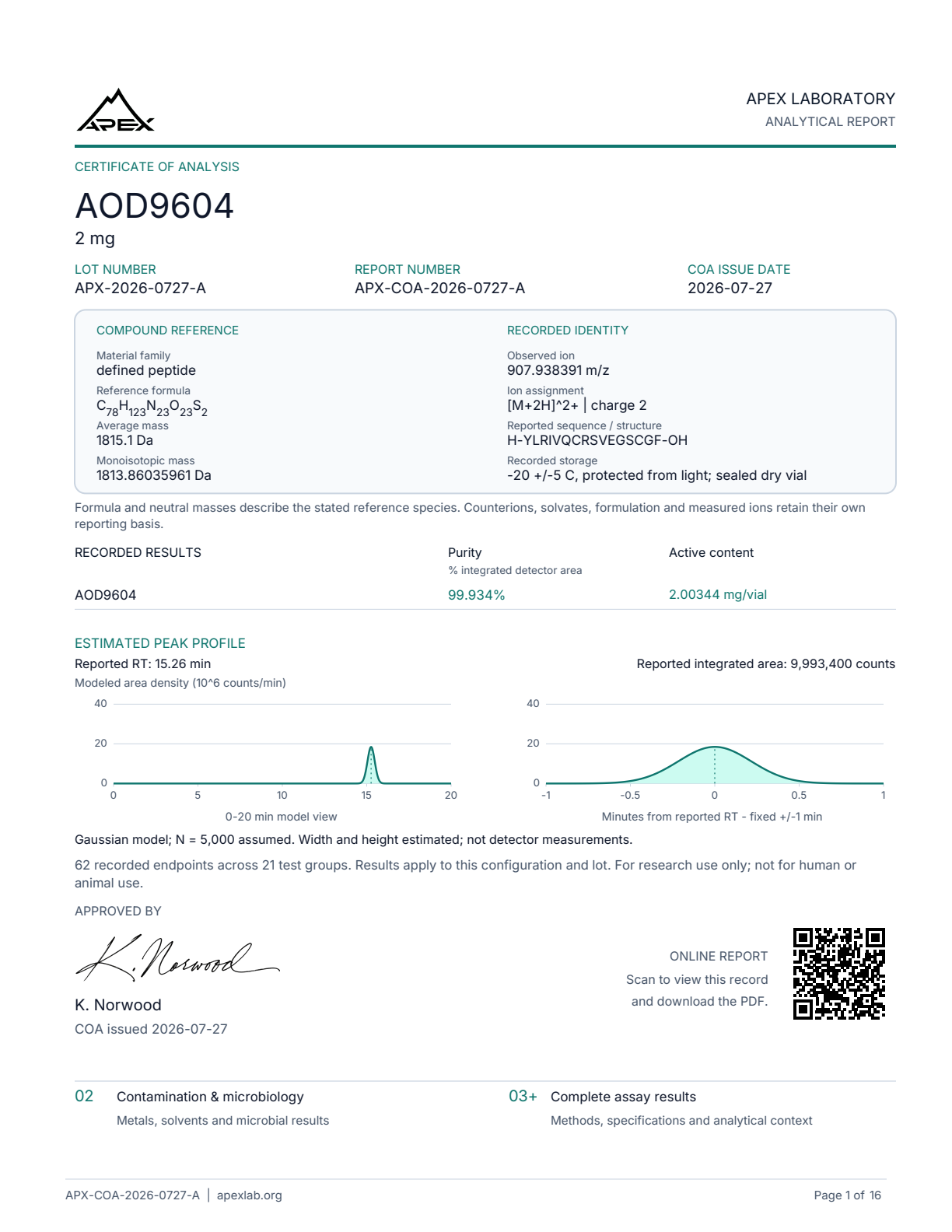
AOD9604 - 2 mg
- AOD9604 chromatographic purity
- 99.934 % integrated detector area
- AOD9604 active content
- 2.00344 mg/vial
- Bacterial endotoxins
- <0.025 EU/mg active-equivalent
- Sterility: FTM
- No growth at 14 days in all 20 units
Chromatographic purity by analyte

About this graph
Recorded scalar results against the stated specification. Each row uses its own labeled scale; purity is detector-area purity, not active-material content.
Measured active content

About this graph
Calibrated active content, concentration or activity compared with the stated same-unit specification. Each row uses its own labeled scale; no conversion from chromatographic purity is made.
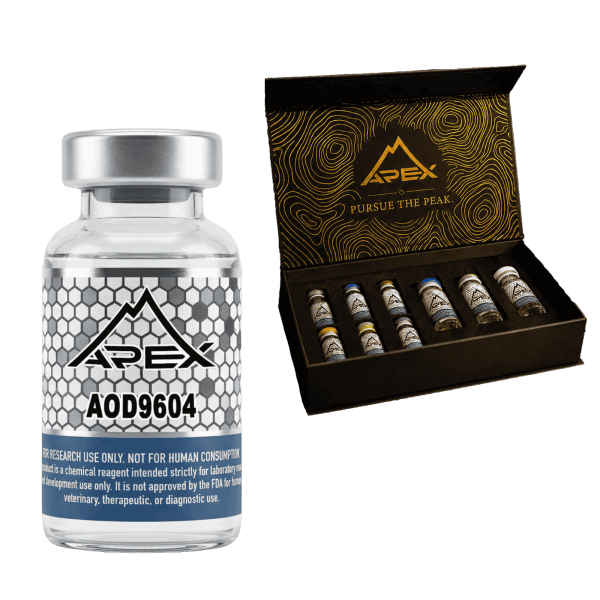
AOD9604 (AOD-9604) is a modified human growth hormone fragment supplied as a lyophilized reagent for in-vitro laboratory research. Choose the required vial size, check its current price and read the corresponding published report in the batch verification panel above. For the difference from HGH Fragment 176–191 and what the animal and human studies actually found, see the AOD9604 identity and research evidence guide.
Compound Overview
AOD9604 contains 16 amino-acid residues: an N-terminal tyrosine followed by residues 177–191 of human growth hormone. It should not be identified simply as native HGH Fragment 176–191, which has a different residue at that position. The identity and metabolism study by Cox et al. (2015) describes this sequence distinction. A shared fragment label does not establish that two materials are interchangeable.
Research Background & Published Literature
Published AOD9604 work includes metabolic studies in obese rats and mice. Ng et al. examined body-weight gain and metabolic endpoints in obese Zucker rats; Heffernan et al. examined lipid metabolism in obese and beta-3-adrenoceptor knockout mice. These animal results do not establish a human weight-loss benefit for this research vial. The linked research guide separates the animal findings and later human trials, and explains why food-use GRAS discussion does not establish drug approval.
These primary papers provide the original model and endpoint context:
- Heffernan et al. (2001) — AOD9604 lipid metabolism in mouse models
- Ng et al. (2000) — AOD9604 metabolic studies in obese Zucker rats
Technical Specifications
- Product Name: AOD9604
- Classification: Modified hGH Fragment
- Structural Description: 16 residues: N-terminal tyrosine followed by hGH residues 177–191
- CAS Number: 221231-10-3
- Molecular Weight: Approximately 1815.08 g/mol for the parent-peptide reference; use the applicable report for the material’s assigned form and content basis.
- Analytical Results: Read the selected report’s chromatographic purity, identity and measured-content results as separate endpoints.
- Physical Form: Lyophilized (freeze-dried) powder
- Intended Use: In-vitro research use only — not for human consumption
Storage, Handling & Stability Guidelines
Use the applicable lot label, supporting documentation and your laboratory’s validated procedure to set dry-material storage, solvent choice and prepared-solution conditions. Peptide length alone does not establish stability, and this page does not establish a universal refrigerated shelf life after preparation.
- Check material identity and lot before preparation; document the solvent, concentration, conditions and preparation date required by the method.
- Label prepared material and aliquots so each can be traced to its lot and laboratory record.
- Use appropriate personal protective equipment and follow your institution’s chemical safety procedures.
Quality Assurance & Analytical Verification
The batch verification panel links published configuration reports issued by Apex Laboratory. Match the vial size and report identity, then read each method and result: HPLC detector-area percentage, mass-spectrometric identity and measured content answer different questions. A published configuration report does not by itself identify the lot assigned to a future shipment. Use the COA library for the report record and contact support if the material label or required documentation cannot be matched.
Frequently Asked Questions
How is AOD9604 related to human growth hormone?
AOD9604 is a 16-residue modified fragment: tyrosine followed by hGH residues 177–191. Native HGH Fragment 176–191 starts with phenylalanine instead. They should not be treated as the same sequence, and their fragment relationship does not establish the same biological effects as intact growth hormone.
What is the CAS number of AOD9604?
The catalogued CAS number is 221231-10-3. Approximately 1815.08 g/mol is the parent-peptide reference mass, not a measured amount in the vial. Confirm the assigned material form and content basis in the applicable report.
Is this product approved for human use?
No. All compounds sold by Apex Laboratory are classified as chemical research reagents intended strictly for in-vitro laboratory research. They are not approved for human consumption, veterinary use, or any therapeutic application. Purchasers who imply intended bodily use will have their orders cancelled and accounts permanently suspended.
What documentation is available for this compound?
Published configuration reports are linked in the panel above and in the Lab Verified archive. Check the issuing laboratory, report ID, lot, vial size, methods and results. A published report is not proof of which lot will ship; use the contact page for a specific lot or documentation question.
Is bulk ordering available?
Yes. For bulk quantities, custom packaging requirements, or recurring supply agreements, contact our team with the compound name, desired quantity, preferred vial size or packaging, and your target delivery timeline. Volume pricing is available for qualifying orders.
Related Research Compounds
Researchers studying modified hgh fragment pathways may also be interested in related compounds available from Apex Laboratory, including HGH Fragment 176-191, Ipamorelin, CJC-1295 No DAC. Explore our complete research catalog to browse all available peptides, reagents, and laboratory supplies, or visit our About page to learn more about our quality verification process.
Shipping, Packaging & Delivery
Orders with cleared payment before 2:00 PM ET on a business day usually ship the same business day. Apex uses USPS tracked domestic service; typical transit is about 2–5 business days after carrier acceptance. Timing is an estimate and exceptions can apply. Review the shipping policy for handling, tracking, coverage and delivery support.
Research Use Disclaimer
For in-vitro research use only. Not for human consumption. All products sold by Apex Laboratory are intended exclusively for qualified researchers, accredited laboratories, and educational institutions. Purchasers assume full responsibility for ensuring safe handling, proper storage, and compliance with all applicable federal, state, and local laws, regulations, and institutional policies governing the purchase and use of chemical research reagents.