Retatrutide and Tirzepatide are multi-receptor incretin-pathway agonists with different designs and regulatory status. Tirzepatide targets GIP and GLP-1 receptors and is the active ingredient in FDA-approved Mounjaro and Zepbound; Retatrutide adds glucagon-receptor agonism and remained investigational on July 23, 2026. The direct Phase 3 TRIUMPH-5 comparison was active, not recruiting, with no results posted, so current evidence does not establish a head-to-head winner.
A useful Retatrutide-versus-Tirzepatide comparison separates three questions that are often collapsed into one: what receptors each molecule engages, what evidence exists for each exact molecule, and what regulators have actually approved. Tirzepatide has a mature clinical and regulatory record. Retatrutide has a growing clinical program, but it remained an investigational molecule at this article’s review date. Adding a third receptor target is a mechanistic difference, not a shortcut to superiority.
- Tirzepatide is a dual GIP- and GLP-1-receptor agonist; Retatrutide adds glucagon-receptor agonism.
- Mounjaro received original FDA approval in 2022 and Zepbound in 2023. Both are finished pharmaceutical formulations containing tirzepatide.
- Retatrutide remained investigational on July 23, 2026, despite sponsor-reported Phase 3 topline results.
- Retatrutide Phase 2 and Tirzepatide Phase 3 results came from different trials and cannot be treated as a direct comparison.
- TRIUMPH-5, NCT06662383, is the direct Phase 3 Retatrutide-versus-Tirzepatide study. It was active, not recruiting, with no results posted at the review cutoff.
- Apex research reagents and approved finished-drug formulations occupy categorically distinct regulatory frameworks.
Retatrutide vs Tirzepatide at a Glance
| Comparison point | Retatrutide | Tirzepatide |
|---|---|---|
| Development code | LY3437943 | LY3298176 |
| Receptor scope | GIP, GLP-1, and glucagon receptors | GIP and GLP-1 receptors |
| Regulatory status at the July 23, 2026 review | Investigational worldwide; no FDA, EMA, or other national marketing approval identified in any jurisdiction | Active ingredient in FDA-approved Mounjaro (NDA 215866, May 13, 2022) and Zepbound (NDA 217806, November 8, 2023) |
| Clinical evidence highlighted here | Discovery work, Phase 2 obesity and type 2 diabetes trials, and an ongoing registrational program | Discovery and receptor-signaling work plus a broad Phase 3 and regulatory record |
| Largest randomized trial here | Phase 2 obesity, 338 adults, 48 weeks, 1–12 mg weekly[5] | Phase 3 SURMOUNT-1 obesity, 2,539 adults, 72 weeks, 5–15 mg weekly[3] |
| Weight change in that trial (figures are arm-level and are not comparable across this row) | Phase 2, 48 weeks, 338 adults with obesity or overweight plus a related condition: −8.7% (1 mg) to −24.2% (12 mg) versus −2.1% placebo[5] | Phase 3, 72 weeks, 2,539 adults with obesity or overweight plus one complication, diabetes excluded: −15.0% (5 mg) to −20.9% (15 mg) versus −3.1% placebo[3] |
| Comparability | None. Different phases, durations, populations, and estimands; do not subtract them | |
| Direct head-to-head evidence | TRIUMPH-5 was active, not recruiting, and had no posted results as of July 23, 2026 | |
| Current Apex context | Research-grade chemical reagents; not approved finished drugs and not for human consumption | |
Regulatory approval, randomized trial evidence, receptor pharmacology, and analytical identity are separate dimensions. A molecule can have an interesting design without an approved use, and a research reagent does not acquire a drug approval because it contains the same named molecule as a pharmaceutical formulation.
What Is the Main Mechanism Difference?
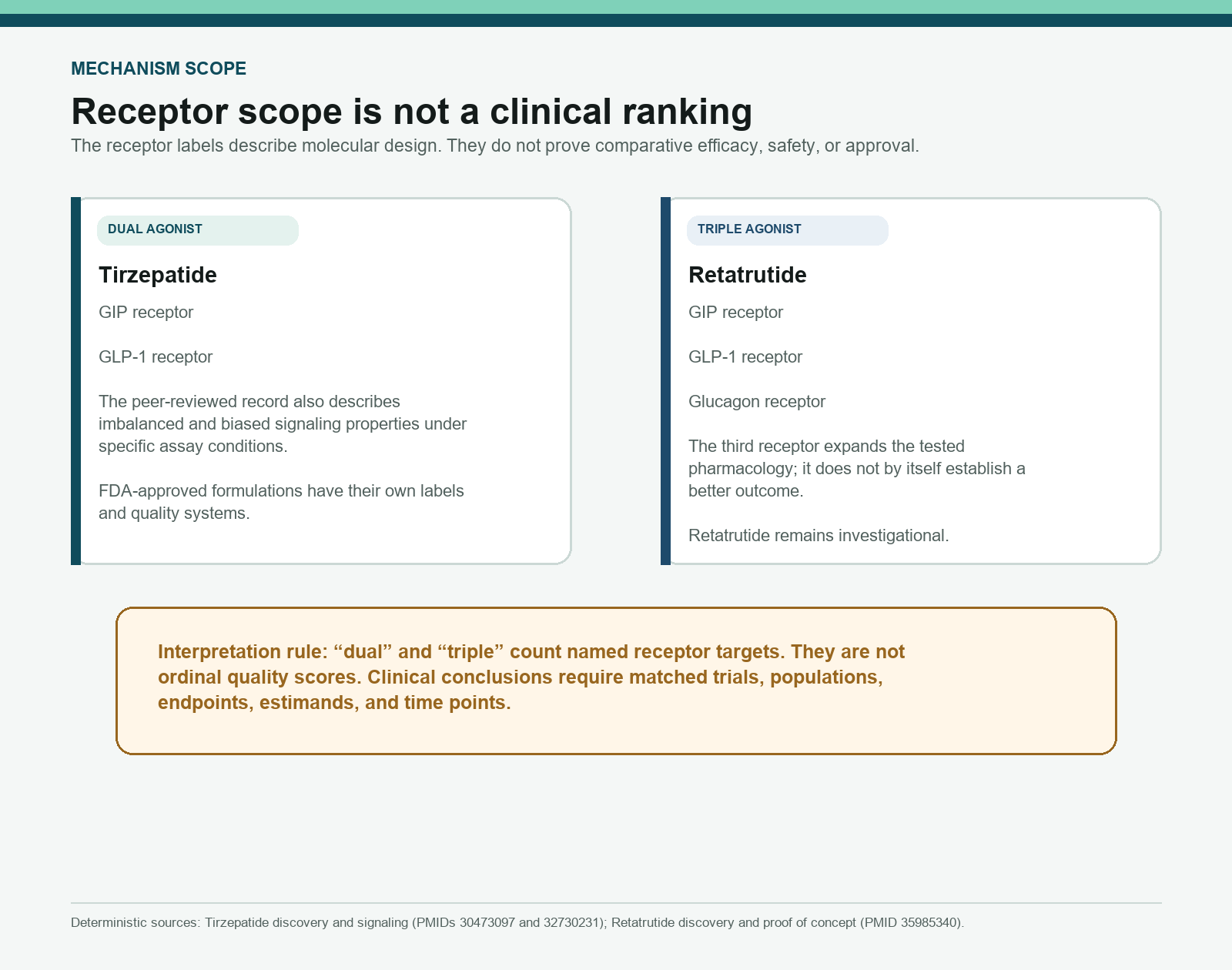
Tirzepatide was developed as a dual agonist of the glucose-dependent insulinotropic polypeptide receptor, or GIPR, and the glucagon-like peptide-1 receptor, or GLP-1R. Discovery work described a single peptide with activity at both receptors, and later receptor-signaling research characterized it as an imbalanced and biased dual agonist rather than a simple equal-strength combination.[1][2]
Retatrutide was developed to engage those same two incretin-pathway receptors plus the glucagon receptor. Its discovery paper characterized the molecule across preclinical assays and early clinical proof-of-concept work.[4] The additional receptor is the clearest design difference, but receptor count alone does not rank net biological effect. Relative signaling, exposure, tissue context, model, endpoint, and tolerability all influence what a study can show.
The dedicated Retatrutide research guide owns the deeper triple-agonist identity and study map. The Tirzepatide research guide owns the dual-agonist entity and formulation context. This page owns the comparison and the limits on direct inference.
What Is Tirzepatide’s Regulatory Status?
Tirzepatide is the active ingredient in FDA-approved pharmaceutical products. Mounjaro received original U.S. approval on May 13, 2022 under NDA 215866 for glycemic control in adults with type 2 diabetes, alongside the conditions stated in its approved labeling. Zepbound received FDA approval on November 8, 2023 under NDA 217806 for chronic weight management in qualifying adults, alongside diet and physical activity. The FDA subsequently approved additional labeled uses and revisions; deployment review should always link readers to the current official label rather than freeze a product’s entire indication set in editorial prose.
Those approvals belong to named finished-drug formulations manufactured under pharmaceutical controls. They do not extend to bulk material, a supplier’s lyophilized research reagent, or another product simply because the molecular name is Tirzepatide. Same molecule (tirzepatide); categorically distinct regulatory frameworks.
What Is Retatrutide’s Regulatory Status?
Retatrutide remained investigational on July 23, 2026. Eli Lilly described it as an investigational GIP, GLP-1, and glucagon triple-hormone-receptor agonist when announcing sponsor-reported topline TRIUMPH-1 results in May 2026. A sponsor announcement can update trial status quickly, but it is not an FDA approval and it is not a substitute for a full peer-reviewed report or an approved prescribing label.
No marketing approval for Retatrutide was identified in any jurisdiction at this refresh’s cutoff: no FDA, EMA, MHRA, NMPA, or other national authorisation, and therefore no approved label, indication, or dose anywhere globally. That boundary matters even when a late-stage trial reports a positive topline endpoint. Clinical development, application review, and marketing approval are separate milestones, and only regulators can establish the last one.
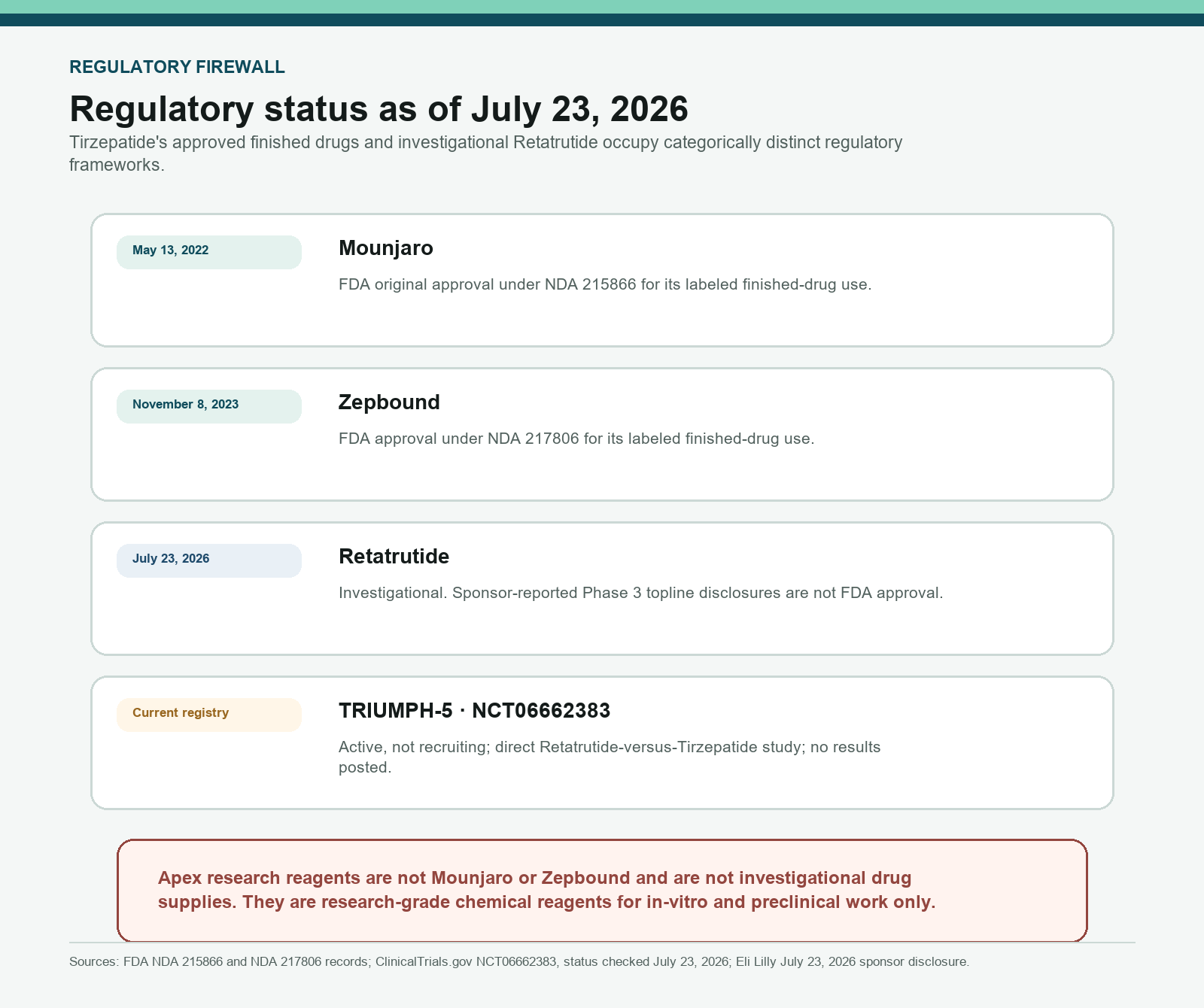
Apex Tirzepatide and Retatrutide materials are research-grade chemical reagents for in-vitro and preclinical research, and are not for human consumption. The boundary is stated separately per molecule, because the two are not in the same regulatory position. Mounjaro and Zepbound are approved pharmaceutical formulations containing tirzepatide; the Apex Tirzepatide reagent is neither of those products and is not a substitute for either. Retatrutide has no approved pharmaceutical formulation in any jurisdiction, so no approved counterpart exists to compare it against; the Apex Retatrutide reagent is distinct from the investigational clinical formulations used in its trial program.
What Does the Tirzepatide Evidence Show?
The Tirzepatide evidence base begins with compound-design and receptor-pharmacology research and extends through large clinical programs. Coskun and colleagues described LY3298176 as a dual GIP- and GLP-1-receptor agonist from discovery through early clinical proof of concept.[1] Willard and colleagues then characterized signaling differences across the two receptor systems, showing why the phrase “dual agonist” is a starting point rather than a complete pharmacological description.[2]
SURMOUNT-1 was a 72-week randomized Phase 3 obesity trial in adults without diabetes. Jastreboff and colleagues reported dose-ordered mean body-weight reductions against placebo, tabulated below, and described gastrointestinal events as the most common adverse events.[3] Those results belong to the enrolled population, protocol, pharmaceutical formulation, and prespecified endpoints. They are not evidence about an Apex research reagent.
Tirzepatide figures with their study conditions
| Study | Design and population | Reported figures |
|---|---|---|
| Coskun 2018, Phase 1[1] | Mice, then 142 human subjects who received at least one dose of LY3298176, dulaglutide, or placebo across three stages: single ascending dose 0.25–8 mg and 4-week multiple ascending dose 0.5–10 mg in healthy subjects, then a 4-week Phase 1b proof-of-concept 0.5–15 mg in type 2 diabetes. No single arm spanned 0.25–15 mg. | 4-week Phase 1b type 2 diabetes stage: fasting serum glucose least-squares mean difference versus placebo −49.12 mg/dL (95% CI −78.14 to −20.12) at 10 mg and −43.15 mg/dL (95% CI −73.06 to −13.21) at 15 mg. 4-week multiple-ascending-dose healthy-subject stage: body-weight least-squares mean difference versus placebo −5.09 kg (95% CI −6.72 to −3.46) at 4.5 mg. Both are placebo-adjusted treatment differences, not raw within-arm changes. |
| SURMOUNT-1, Phase 3[3] | 2,539 adults with obesity, or overweight plus one complication, diabetes excluded; 72 weeks; 5, 10, 15 mg weekly versus placebo | Weight change −15.0%, −19.5%, −20.9% versus −3.1% placebo (P<0.001 each). Loss of 5% or more in 85%, 89%, 91% versus 35%. Loss of 20% or more in 50% at 10 mg and 57% at 15 mg versus 3%. Adverse-event discontinuation 4.3%, 7.1%, 6.2% versus 2.6%. |
The strongest summary is therefore not merely that Tirzepatide “has two targets.” It has compound-specific receptor work, multiple completed randomized studies, and FDA-approved finished-drug formulations. That maturity matters when comparing evidence, but it does not settle a direct Retatrutide comparison before that study reports.
What Does the Retatrutide Evidence Show?
Retatrutide’s discovery paper described LY3437943 as a single peptide agonist of GIP, GLP-1, and glucagon receptors, with preclinical and early clinical experiments designed to assess metabolic outcomes.[4] It supports the triple-receptor design but does not prove that three-receptor activity is categorically better than Tirzepatide’s dual-receptor profile.
Two Phase 2 trials followed: a 48-week obesity trial[5] and a type 2 diabetes trial run against placebo and an active comparator.[6] Both are compound-specific human studies, but they remain Phase 2 evidence from distinct populations and designs.
The TRIUMPH registrational program expanded the questions into Phase 3 settings. A 2026 design paper described four randomized double-blind studies enrolling more than 5,800 planned participants across obesity, obstructive sleep apnea, and knee osteoarthritis, with type I error controlled at α = 0.05.[7] Sponsor-reported TRIUMPH-1 topline results became available before this refresh, but a press release does not provide the same depth of methods, subgroup detail, event adjudication, and peer review as a full publication. The current TRIUMPH-1 status article owns that fast-changing trial update and should be rechecked at deployment.
Retatrutide figures with their study conditions
| Study | Design and population | Reported figures |
|---|---|---|
| Coskun 2022, Phase 1[4] | Obese mice, then a human Phase 1 single-ascending-dose study | In obese mice, glucagon-receptor-mediated energy expenditure added to GIP- and GLP-1-driven calorie-intake reduction. In the human single-ascending-dose stage, a reduction in body weight persisted to day 43 after one dose; for that observation the abstract reports no quantitative endpoint, dose, or sample size. |
| Jastreboff 2023, Phase 2[5] | 338 adults with obesity, or overweight plus a related condition; 48 weeks; 1, 4, 8, 12 mg weekly versus placebo | Least-squares mean weight change at 48 weeks −8.7% (1 mg), −17.1% (combined 4 mg), −22.8% (combined 8 mg), −24.2% (12 mg) versus −2.1% placebo; the same groups at the 24-week primary endpoint −7.2%, −12.9%, −17.3%, −17.5% versus −1.6% placebo. At 48 weeks, a loss of 15% or more occurred in 83% of the 12 mg group versus 2% of the placebo group. |
| Rosenstock 2023, Phase 2[6] | 281 adults with type 2 diabetes randomized and analysed for safety, of whom 275 entered the efficacy analyses after six inadvertent enrolments were excluded; HbA1c 7.0–10.5%, at 42 US centres; 36 weeks; dulaglutide 1.5 mg active comparator | Efficacy population, n=275. Least-squares mean HbA1c change at 24 weeks −2.02 points at 12 mg versus −0.01 placebo and −1.41 dulaglutide 1.5 mg. Weight at 36 weeks −16.94% at 12 mg and −16.81% at 8 mg slow escalation versus −3.00% placebo. |
These are investigational-molecule figures, not approved-product evidence.
Does TRIUMPH-5 Directly Compare Retatrutide and Tirzepatide?
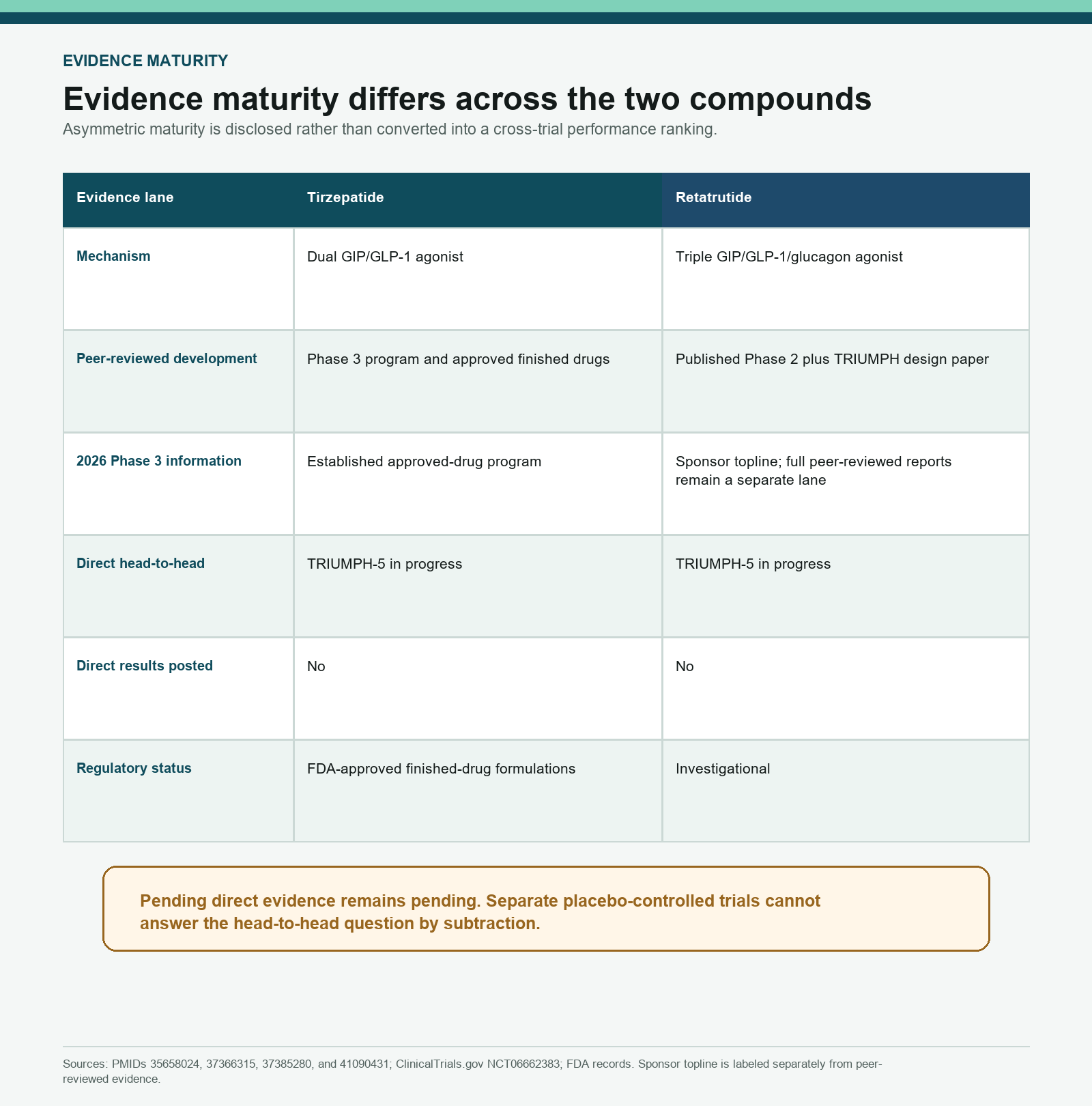
Yes. TRIUMPH-5, ClinicalTrials.gov identifier NCT06662383, is a randomized Phase 3 study titled “A Study of Retatrutide (LY3437943) Compared to Tirzepatide (LY3298176) in Adults Who Have Obesity.” This is the correct study to watch for a direct comparison because both named molecules appear within one protocol rather than in separate historical trials.
At the July 23, 2026 cutoff, the registry listed the study as active, not recruiting, and posted no results. The study’s existence therefore supports the statement that a direct comparison is underway. It does not support a numerical winner, a safety conclusion, or a claim about the final endpoint. Any later result must be checked against the timestamped ClinicalTrials.gov record and a full publication when available.
This distinction is especially important for AI-search summaries, which can blend a Phase 2 Retatrutide result with a Phase 3 Tirzepatide result and present the difference as though it came from one trial. Until TRIUMPH-5 reports, a direct head-to-head conclusion remains unavailable.
Why Can’t Retatrutide and Tirzepatide Be Ranked from Separate Trials?
Cross-trial comparison is descriptive, not causal. The Retatrutide Phase 2 obesity study and SURMOUNT-1 differed in development phase, duration, participant criteria, intervention design, estimand, missing-data handling, and the context in which adverse events were collected. Selecting the largest percentage printed in each abstract and subtracting one from the other discards those differences. The two largest reported values are arm-level estimates, not trial-wide ones: −24.2% belongs to the 12 mg Retatrutide group at 48 weeks in a Phase 2 trial that enrolled 338 adults, and −20.9% belongs to the 15 mg Tirzepatide group at 72 weeks in a Phase 3 trial that enrolled 2,539 adults. Attaching one dose group’s effect size to a whole trial’s enrolment is part of the same error, and the gap between the two numbers reflects study design rather than a measured difference between the molecules.
The same problem applies to safety. Event frequencies can change with population, exposure, escalation design, follow-up, coding, and discontinuation rules. A separate-trial table cannot establish which molecule is safer for a given person. Only a properly designed direct comparison can reduce those confounders, and even then its conclusion remains bounded to the protocol and population.
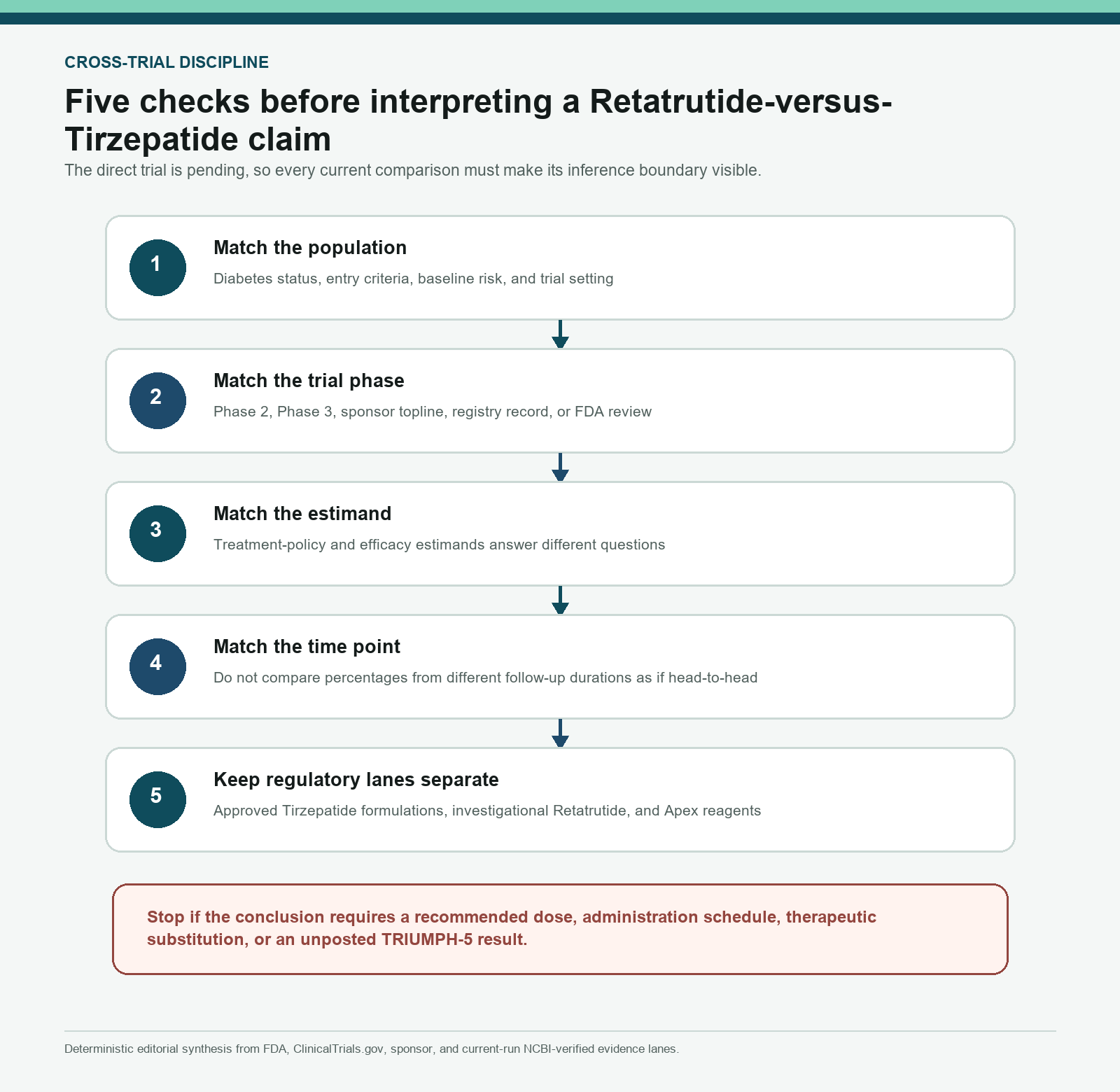
A defensible comparison follows five steps: identify the exact molecule, map receptor scope without ranking by receptor count, match each claim to a compound-specific source, separate completed evidence from pending studies, and state only the conclusion the design supports. On July 23, 2026 it established different mechanisms and different evidence maturity, not a winner.
Research-Material and Pharmaceutical Boundaries
Analytical documentation answers a different question from clinical or regulatory evidence. A lot-specific Certificate of Analysis may record identity and purity testing for a research material. HPLC can characterize chromatographic purity under a defined method, and mass spectrometry can support analyte identity. Neither method establishes pharmaceutical equivalence, sterility, clinical safety, efficacy, or FDA approval. The guides to HPLC purity testing, mass-spectrometry verification, and reading a peptide COA explain those limits.
Qualified laboratories with an independently defined in-vitro or preclinical study can inspect the current research-reagent records below. Availability, variants, specifications, and lot documents should be rechecked at deployment review. The links are balanced research-material handoffs, not a recommendation to combine, administer, or substitute the materials.
Retatrutide research record
Review the current research-reagent identity, variants, and lot-specific analytical documentation separately from investigational clinical formulations. Read the applicable published report for its material identity, configuration, lot, methods and results.
View the current Retatrutide recordTirzepatide research record
Review the current research-reagent record separately from the FDA-approved Mounjaro and Zepbound pharmaceutical formulations. Evaluate this material against its own applicable report, including the configuration, lot, methods and results; do not transfer a result from another reagent.
View the current Tirzepatide recordFor the wider subject map, use the GLP-1 and metabolic research hub. The dedicated entity guides remain the canonical destinations for deeper single-molecule questions, while the trial-status article owns changing TRIUMPH-1 details.
Frequently Asked Questions About Retatrutide vs Tirzepatide
What is the main difference between Retatrutide and Tirzepatide?
Tirzepatide is a dual agonist at GIP and GLP-1 receptors. Retatrutide is a triple agonist that also engages the glucagon receptor. The added receptor is a mechanistic difference, not proof of a better outcome.
Are Retatrutide and Tirzepatide FDA approved?
Tirzepatide is the active ingredient in FDA-approved Mounjaro and Zepbound. Retatrutide remained investigational and had no identified FDA-approved product as of July 23, 2026.
Has Retatrutide been directly compared with Tirzepatide?
TRIUMPH-5, NCT06662383, is a direct Phase 3 comparison. It was active, not recruiting, with no results posted at the July 23, 2026 cutoff, so it did not yet establish a head-to-head winner.
Does Retatrutide’s third receptor make it stronger than Tirzepatide?
No universal conclusion follows from receptor count alone. Relative signaling, exposure, population, protocol, endpoints, and adverse-event findings must be evaluated in compound-specific studies.
Can weight-change results from separate Retatrutide and Tirzepatide trials be compared directly?
They can be described with their study conditions, but they cannot establish a causal ranking. Different populations, durations, protocols, estimands, and missing-data methods prevent a valid head-to-head subtraction.
Are Mounjaro and Zepbound the same as an Apex Tirzepatide research reagent?
No. Mounjaro and Zepbound are FDA-approved finished pharmaceutical formulations. Apex Tirzepatide is a research-grade chemical reagent for in-vitro and preclinical research, within a categorically distinct regulatory framework.
Are Apex Retatrutide and Tirzepatide materials for human use?
No. They are research-grade chemical reagents for in-vitro and preclinical laboratory research only. They are not finished drugs, are not pharmaceutical substitutes, and are not for human consumption.
References and Primary Records
- Coskun T, et al. LY3298176, a novel dual GIP and GLP-1 receptor agonist for the treatment of type 2 diabetes mellitus: From discovery to clinical proof of concept. Mol Metab. 2018;18:3-14. PMID: PMID 30473097.
- Willard FS, et al. Tirzepatide is an imbalanced and biased dual GIP and GLP-1 receptor agonist. JCI Insight. 2020;5(17). doi:10.1172/jci.insight.140532. PMID: PMID 32730231.
- Jastreboff AM, et al. Tirzepatide Once Weekly for the Treatment of Obesity. N Engl J Med. 2022;387(3):205-216. PMID: PMID 35658024.
- Coskun T, et al. LY3437943, a novel triple glucagon, GIP, and GLP-1 receptor agonist for glycemic control and weight loss: From discovery to clinical proof of concept. Cell Metab. 2022;34(9):1234-1247.e9. PMID: PMID 35985340.
- Jastreboff AM, et al. Triple-Hormone-Receptor Agonist Retatrutide for Obesity – A Phase 2 Trial. N Engl J Med. 2023;389(6):514-526. PMID: PMID 37366315.
- Rosenstock J, et al. Retatrutide, a GIP, GLP-1 and glucagon receptor agonist, for people with type 2 diabetes: a randomised, double-blind, placebo and active-controlled, parallel-group, phase 2 trial conducted in the USA. Lancet. 2023;402(10401):529-544. PMID: PMID 37385280.
- Giblin K, et al. Retatrutide for the treatment of obesity, obstructive sleep apnea and knee osteoarthritis: Rationale and design of the TRIUMPH registrational clinical trials. Diabetes Obes Metab. 2026;28(1):83-93. PMID: PMID 41090431.
- U.S. Food and Drug Administration. Drug Trials Snapshot: Mounjaro. Original approval May 13, 2022.
- U.S. Food and Drug Administration. FDA Approves New Medication for Chronic Weight Management. November 8, 2023.
- ClinicalTrials.gov. NCT06662383: Retatrutide Compared to Tirzepatide in Adults Who Have Obesity (TRIUMPH-5). Status checked July 23, 2026.
- Eli Lilly and Company. Sponsor-reported TRIUMPH-1 topline results. May 21, 2026.