
Survodutide (BI 456906) is an investigational acylated peptide designed to activate both the glucagon receptor and GLP-1 receptor. Its evidence base now includes peer-reviewed Phase 3 obesity findings, a biopsy-confirmed Phase 2 MASH trial, and ongoing Phase 3 liver research; the candidate remains investigational, and no approved finished-drug indication was established in the records reviewed through July 23, 2026.
Survodutide has moved quickly from a dual-receptor design hypothesis into several late-stage clinical programs. That progress makes evidence separation more important, not less. A discovery paper can establish receptor activity. A randomized trial can establish outcomes for its enrolled population and study material. A registry can establish that a trial is active or complete. None of those sources, alone, establishes a finished-drug approval or the properties of a separate commercial research lot.
This guide owns the Survodutide entity: its BI 456906 identity, dual glucagon-receptor and GLP-1-receptor pharmacology, obesity evidence, MASH evidence, and current development status. The broader next-generation GLP-1 research landscape retains multi-entity comparison intent. Keeping those jobs separate prevents this page from becoming a list of loosely related pipeline candidates.
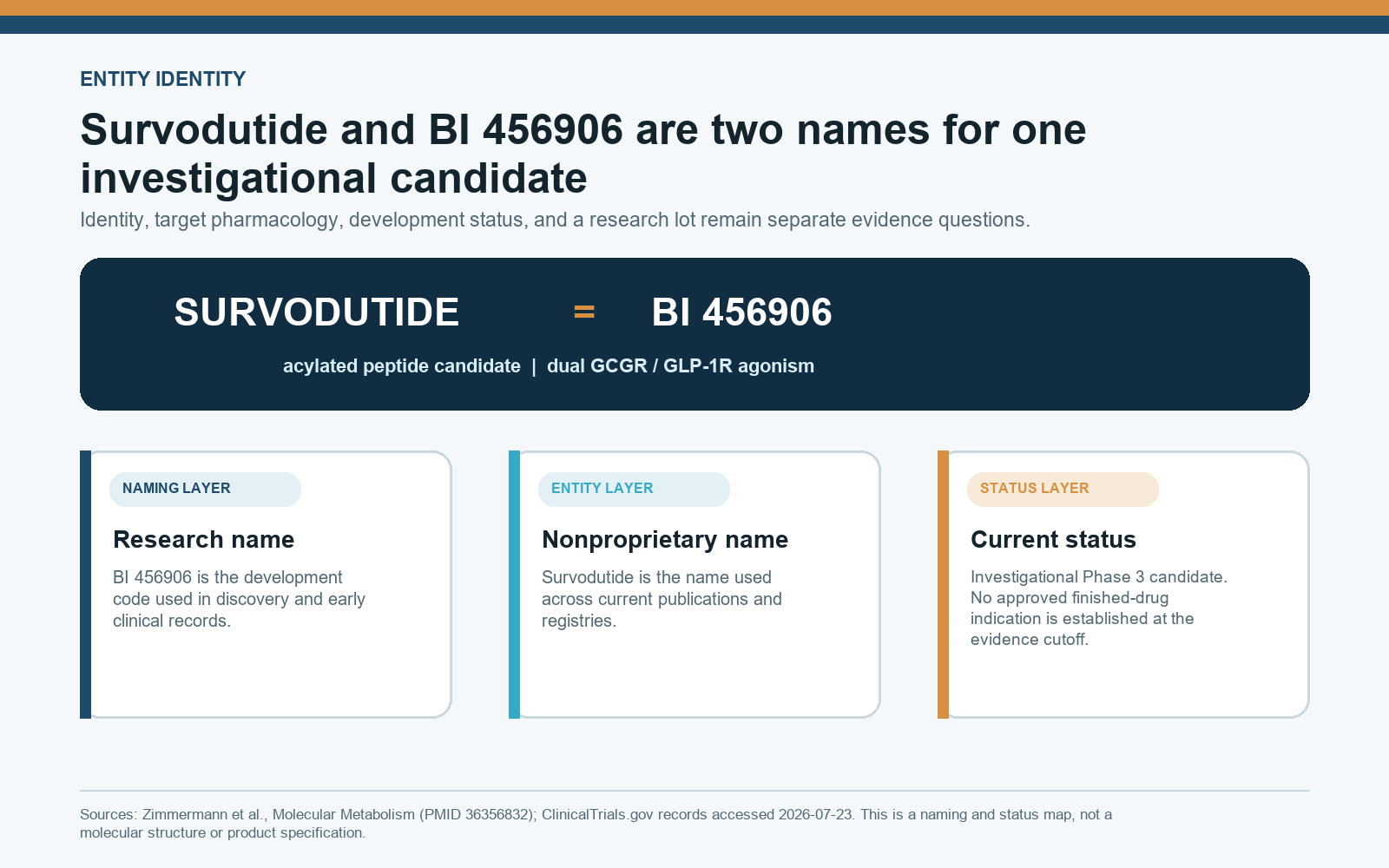
- Survodutide and BI 456906 name the same investigational dual GCGR/GLP-1R candidate.
- Discovery studies support activity at both receptors, but downstream contributions remain model- and endpoint-specific.
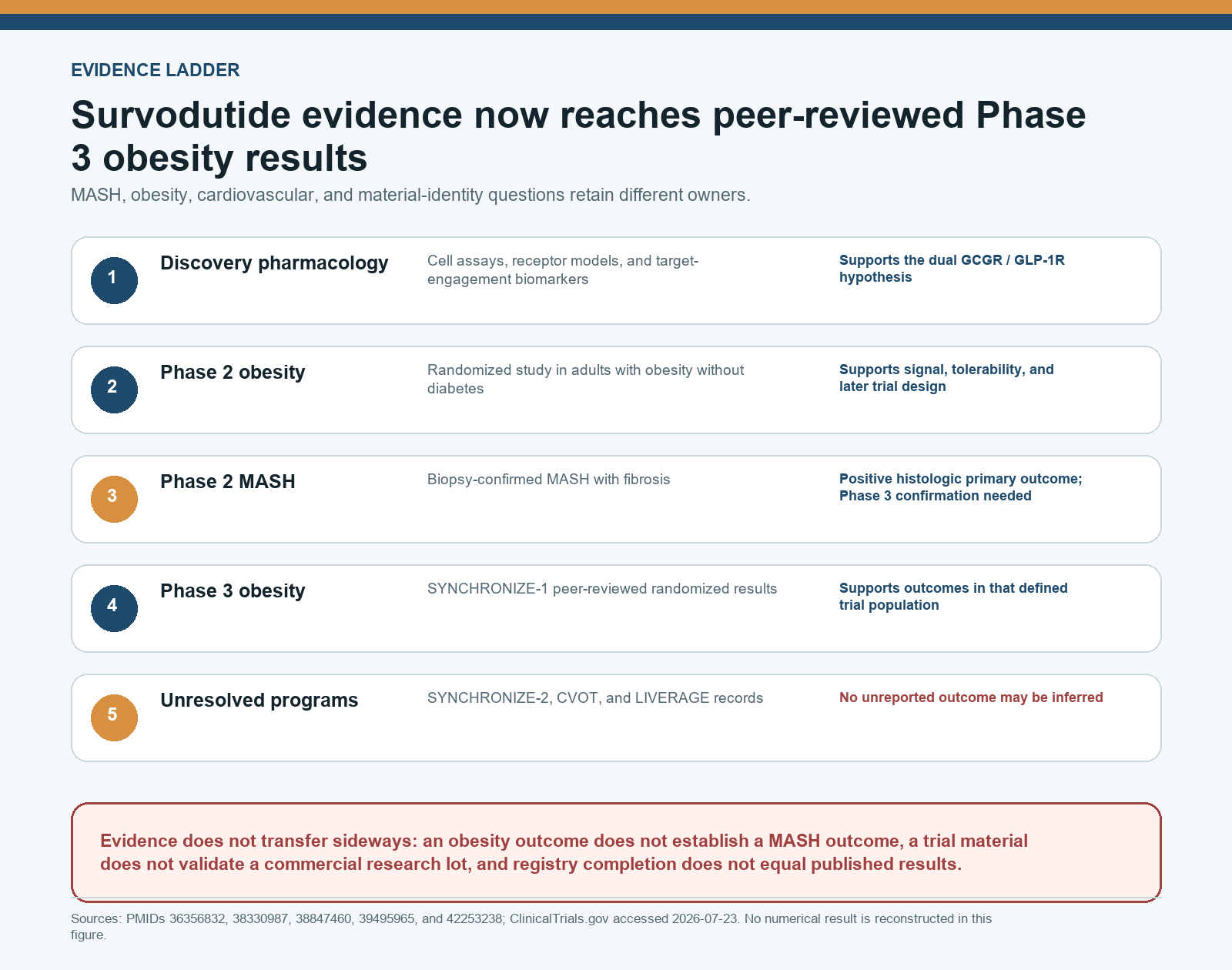
- The Phase 2 MASH trial met its histologic primary endpoint; its fibrosis result was less decisive and requires confirmation.
- Peer-reviewed SYNCHRONIZE-1 results now supersede the older “results expected” framing and provide Phase 3 obesity evidence.
- Other Phase 3 programs have different questions and publication states; registry completion does not equal a reported outcome.
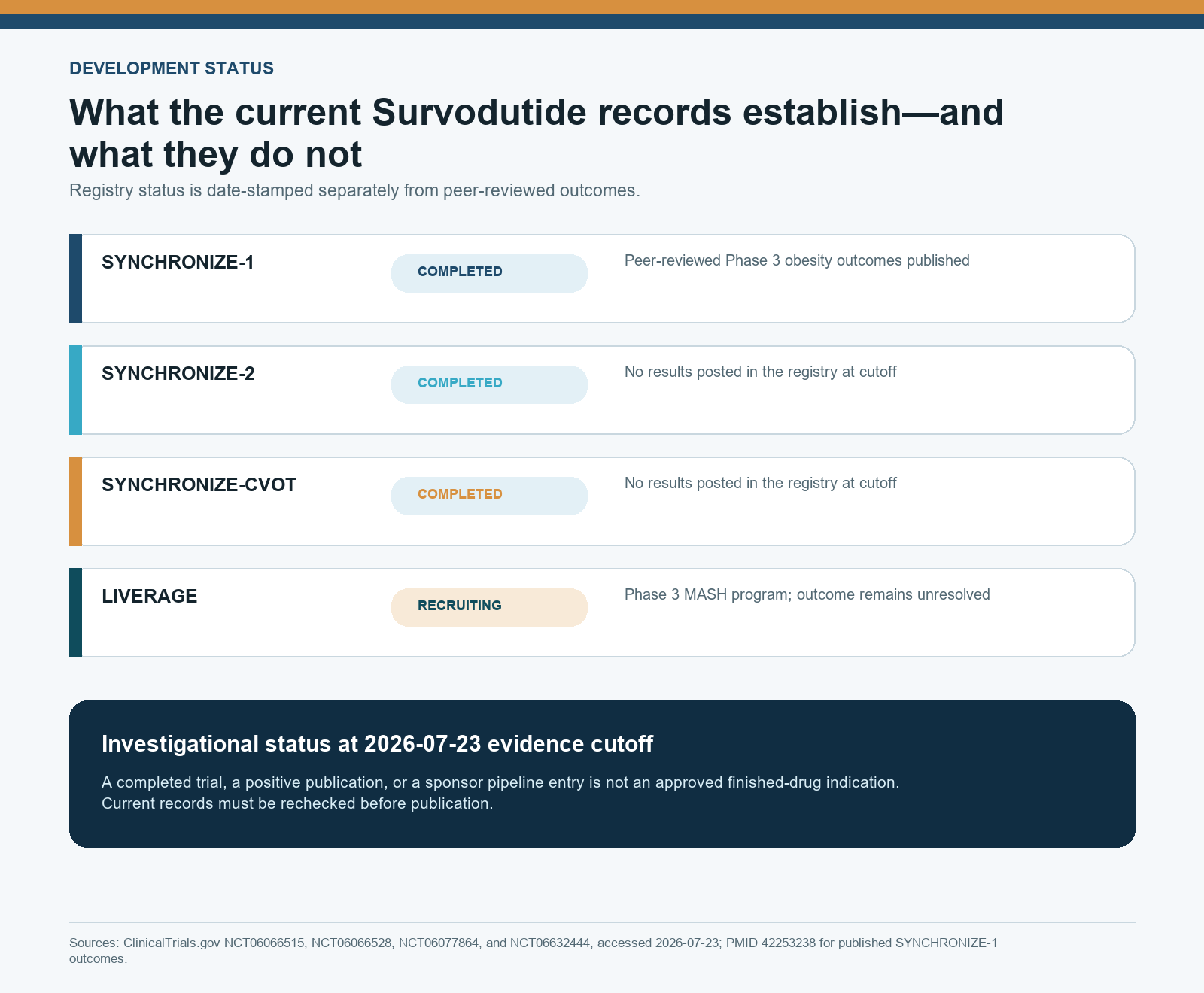
- Survodutide remained investigational at the July 23, 2026 evidence cutoff.
What Is Survodutide (BI 456906)?
Survodutide is the nonproprietary name for the candidate originally identified as BI 456906. It is an acylated peptide developed to activate the glucagon receptor (GCGR) and glucagon-like peptide-1 receptor (GLP-1R). In the discovery publication, the construct included a C18 fatty-acid component and showed functional activity at both receptors in cell and animal systems.[1]
The name change does not create a new molecule. “BI 456906” is common in early pharmacology and trial records; “Survodutide” is common in later publications and the current registry. Researchers should search both names when building a literature set. They should also distinguish the candidate from oxyntomodulin, a native peptide that helped motivate dual GCGR/GLP-1R research, and from other multi-receptor candidates covered in the broader pipeline article.
Reagent identity record
| Identity field | Value | Basis |
|---|---|---|
| CAS registry number | 2805997-46-8 | Supplier-reported Apex catalog record |
| Molecular formula | C192H289N47O61 | PubChem CID 171378821 |
| Molecular weight | About 4,231.7 g/mol, the average mass of that formula; the Apex catalog record instead lists about 4,450 g/mol, a difference of the kind that tracks salt or counterion form | Calculated from the PubChem formula, against the supplier record |
| Residue sequence | Not asserted | No first-party sequence record located; intact mass on the lot document is the identity anchor |
| Purity specification | Read the applicable published survodutide report for its configuration, lot, methods and results | Supplier catalog specification; the lot certificate carries the measured value |
An expected analyte identity does not establish chromatographic purity, counterion content, water content, sterility, stability, receptor activity, or equivalence to material used in a published trial. Those questions require separate analytical or biological evidence.
How Does Survodutide’s Dual-Receptor Pharmacology Work?
GCGR and GLP-1R are distinct class B G-protein-coupled receptors. The Survodutide design hypothesis is that combined signaling may integrate complementary metabolic effects. In the discovery program, investigators assessed cyclic-AMP signaling in receptor-expressing cells and used model-specific readouts to support target engagement. GLP-1R-related observations included glucose tolerance, food intake, and gastric-emptying measures. GCGR-related observations included hepatic messenger-RNA and circulating biomarker changes.[1] That report also states that pharmacological doses lowered bodyweight in mice more than maximally effective semaglutide doses, but its abstract reports no quantitative result for that comparison.
A later candidate-selection analysis screened 19 dual agonists. In lean mice, a single 30 nmol/kg dose of survodutide improved acute oral glucose tolerance, reported as an area under the curve of 54% versus vehicle against 45% for semaglutide, and in diet-induced obese mice 30 nmol/kg once daily lowered body weight by 25% from baseline. Survodutide was advanced because its in-vitro potency and in-vivo biomarker profile supported balanced engagement of the two targets in the tested systems.[2] “Balanced” is a pharmacology description, not a claim that the receptors contribute equally to every endpoint or tissue.
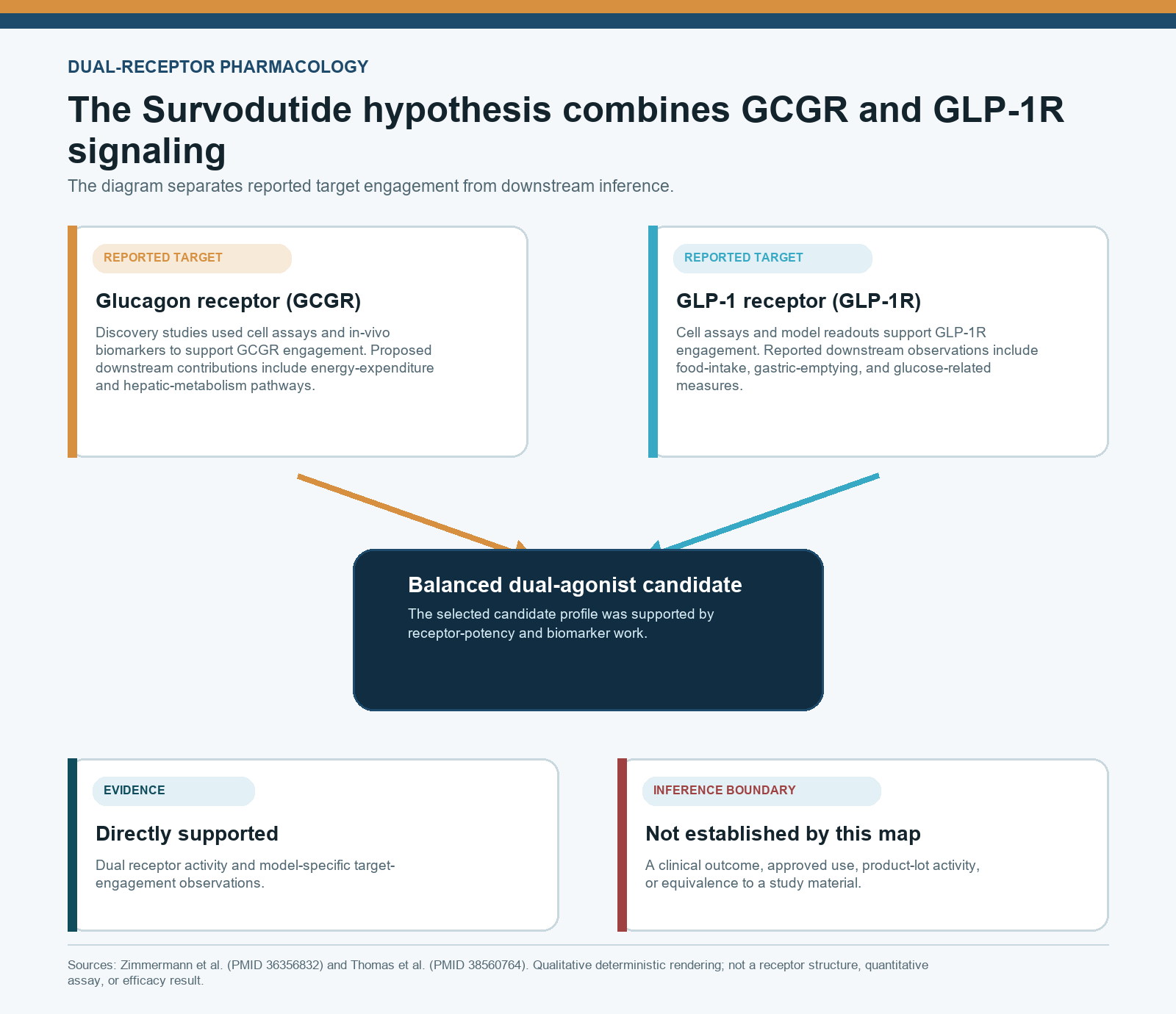
The evidence ladder matters here. Receptor signaling in a recombinant cell line can establish functional agonism under that assay’s conditions. A biomarker in an animal model can support in-vivo target engagement. Neither result proves that a specific clinical endpoint will improve, nor does it show that one receptor explains a later result. The mechanistic record is strongest when used to define testable hypotheses and weakest when treated as a universal outcome claim.
What Did Phase 2 Obesity Research Show?
A randomized, double-blind Phase 2 trial enrolled 387 adults with overweight or obesity and without diabetes. The study compared several Survodutide groups with placebo over 46 weeks. Under the planned-treatment analysis, mean body-weight change at week 46 ran from −6.2% at 0.6 mg once weekly to −14.9% at 4.8 mg, against −2.8% with placebo. Gastrointestinal events were the most frequently reported adverse events. Only 233 participants completed the full treatment period, making discontinuation and estimand choice important parts of interpretation.[3]
This trial supported advancement into Phase 3, but it did not approve the candidate or settle every metabolic question. It enrolled a defined population, used a sponsor-controlled study material, and evaluated prespecified outcomes. It did not test an Apex research lot, establish a MASH result, or determine cardiovascular outcomes. Those questions belong to other evidence lanes.
The trial is also a reminder that a headline percentage is incomplete without its estimand. An analysis that includes events after discontinuation can answer a different question from an analysis limited to participants remaining on assigned treatment. Comparisons across releases should therefore use like-with-like estimands, time points, and populations.
What Does the Survodutide MASH Evidence Show?
The key MASH publication was a 48-week, randomized Phase 2 trial in 293 adults with biopsy-confirmed metabolic dysfunction-associated steatohepatitis and fibrosis stages F1 through F3. The primary endpoint was histologic improvement in MASH without worsening fibrosis. Across the 2.4 mg, 4.8 mg, and 6.0 mg once-weekly groups, that endpoint occurred in 47%, 62%, and 43% of participants, compared with 14% in the placebo group. The prespecified primary analysis favored Survodutide.[4]
The fibrosis result deserves separate treatment. Improvement by at least one fibrosis stage occurred in 34% to 36% of the active groups and 22% of the placebo group. The abstract does not present that secondary observation as equivalent to the primary histologic result. A careful summary should therefore say that the study showed MASH improvement without worsening fibrosis while treating fibrosis regression as a less decisive, still-developing question.
A separate open-label Phase 1 study examined pharmacokinetics, tolerability, and exploratory non-invasive markers in people with cirrhosis.[5] Its small cohorts and exploratory design do not establish histologic efficacy or a clinical outcome in cirrhosis. It is context for later research, not a substitute for a controlled Phase 3 MASH program.
| Evidence lane | What the source directly supports | What remains unresolved |
|---|---|---|
| Discovery pharmacology | Dual GCGR/GLP-1R activity in defined assays and models | Contribution of each receptor to each human outcome |
| Phase 2 obesity | Randomized signal, tolerability observations, and later-study justification | Approval, long-term outcomes, and transfer to other populations |
| Phase 2 MASH | Positive histologic primary endpoint in biopsy-confirmed MASH | Phase 3 confirmation and clinical-outcome meaning |
| Phase 1 cirrhosis | Pharmacokinetic, tolerability, and exploratory-marker observations | Histologic efficacy and patient-centered outcomes |
What Did Phase 3 Obesity Research Show?
SYNCHRONIZE-1 was a double-blind Phase 3 trial in 725 adults with obesity or overweight plus a qualifying complication, excluding diabetes. The peer-reviewed report evaluated outcomes at week 76. Under the treatment-regimen estimand, the two active groups had mean body-weight changes of −12.2% and −13.0%, compared with −5.4% for placebo. The proportion reaching at least 5% reduction was also higher in both active groups. Gastrointestinal symptoms were the most common adverse events, and no deaths were reported.[6]
This publication materially updates the old article. Earlier sponsor topline reporting highlighted a larger “up to” figure under a different analysis framework. That company figure should not be blended with the peer-reviewed treatment-regimen estimates. This guide centers the peer-reviewed report, identifies the estimand, and avoids turning trial arms into use guidance.
The result is important but bounded. It establishes a randomized outcome for the SYNCHRONIZE-1 population and study material. It does not determine results for participants with type 2 diabetes, cardiovascular outcomes, or MASH. It also does not establish an approved indication or validate the composition or biological activity of a research reagent.
What Is Survodutide’s Current Development Status?
Survodutide remained investigational at the July 23, 2026 cutoff, holding no FDA, EMA, NMPA, or other regulatory approval anywhere globally for any indication. The current SYNCHRONIZE-1 registry record lists the obesity trial as completed, and its primary outcomes are now available in the peer-reviewed publication. The SYNCHRONIZE-2 record, which concerns people with obesity and type 2 diabetes, also lists the study as completed, but results were not posted in the registry at the cutoff.
The SYNCHRONIZE-CVOT record was updated on July 23, 2026 to completed status and did not contain posted results. Completion establishes that the registered study reached its recorded end state; it does not reveal the cardiovascular outcome. A design paper explains the prespecified cardiovascular question but cannot answer it in advance.[7] It specifies an event-driven trial recruiting 4,935 adults with a body-mass index of at least 27 kg/m², with a five-point major adverse cardiovascular event composite as the primary endpoint and no outcome yet reported.
For liver research, the LIVERAGE registry record listed a recruiting Phase 3 MASH trial. That program is the appropriate confirmation lane for the Phase 2 histology signal. Until its results are reported and interpreted, the Phase 2 finding should not be promoted into a settled Phase 3 conclusion.
How Should Survodutide Evidence Be Evaluated?
Start with entity identity. Search both Survodutide and BI 456906, then confirm whether a source is discussing discovery material, a clinical investigational product, or a commercial research reagent. Next identify the evidence level: receptor assay, animal model, early human study, randomized trial, registry record, or regulatory action. Each level has different inferential limits.
Then match the question to the correct owner. Obesity, MASH, cardiovascular safety, and research-lot analytics are not interchangeable topics. A result in one lane should not be reused as proof in another. The GLP-1 and metabolic research hub provides the family-level context, while this page remains the entity guide.
For material evaluation, separate identity from purity and from activity. Mass spectrometry can test whether observed ions support the expected analyte mass. HPLC can report chromatographic purity under a stated method. Neither method demonstrates dual-receptor activity, sterility, clinical formulation, or equivalence to the sponsor’s study material. The Apex guides to mass-spectrometry identity testing and HPLC purity interpretation explain those analytical boundaries.
Frequently Asked Questions
What is Survodutide?
Survodutide is an investigational acylated peptide designed as a dual agonist of the glucagon receptor and GLP-1 receptor. It is being studied in obesity, MASH, and related metabolic programs.
Are Survodutide and BI 456906 the same candidate?
Yes. BI 456906 is the development code used in earlier research and registry records, while Survodutide is the nonproprietary name used in current publications.
Which receptors does Survodutide activate?
Mechanistic studies support functional agonism at the glucagon receptor and GLP-1 receptor. The relative contribution of each receptor remains endpoint- and model-dependent.
Are Phase 3 Survodutide obesity results published?
Yes. Peer-reviewed SYNCHRONIZE-1 results were published in 2026 and reported greater average body-weight reduction with Survodutide than placebo in the studied population.
What does the Survodutide MASH trial establish?
The Phase 2 trial met its primary histologic endpoint of MASH improvement without worsening fibrosis. Fibrosis improvement was less decisive, and Phase 3 confirmation remains necessary.
Is Survodutide FDA approved?
No approved finished-drug indication was established in the records reviewed through July 23, 2026. Survodutide remained an investigational Phase 3 candidate at that cutoff.
What can a Survodutide certificate of analysis establish?
A lot-specific certificate can report stated identity and analytical results for that lot. It cannot establish receptor activity, sterility, clinical formulation, trial equivalence, efficacy, or regulatory approval.
References
- Zimmermann T, et al. BI 456906: Discovery and preclinical pharmacology of a novel GCGR/GLP-1R dual agonist with robust anti-obesity efficacy. Mol Metab. 2022;66:101633. PMID: PMID 36356832.
- Thomas L, et al. The dual GCGR/GLP-1R agonist survodutide: Biomarkers and pharmacological profiling for clinical candidate selection. Diabetes Obes Metab. 2024;26(6):2368-2378. PMID: PMID 38560764.
- le Roux CW, et al. Glucagon and GLP-1 receptor dual agonist survodutide for obesity: a randomised, double-blind, placebo-controlled, dose-finding phase 2 trial. Lancet Diabetes Endocrinol. 2024;12(3):162-173. PMID: PMID 38330987.
- Sanyal AJ, et al. A Phase 2 Randomized Trial of Survodutide in MASH and Fibrosis. N Engl J Med. 2024;391(4):311-319. PMID: PMID 38847460.
- Lawitz EJ, et al. Efficacy, tolerability and pharmacokinetics of survodutide, a glucagon/glucagon-like peptide-1 receptor dual agonist, in cirrhosis. J Hepatol. 2024;81(5):837-846. PMID: PMID 38857788.
- le Roux CW, et al. Survodutide Once Weekly for the Treatment of Adults with Obesity. N Engl J Med. 2026. doi:10.1056/NEJMoa2600751. PMID: PMID 42253238.
- Kosiborod MN, et al. Survodutide for the Treatment of Obesity: Rationale and Design of the SYNCHRONIZE Cardiovascular Outcomes Trial. JACC Heart Fail. 2024;12(12):2101-2109. PMID: PMID 39453356.