Batch documentation
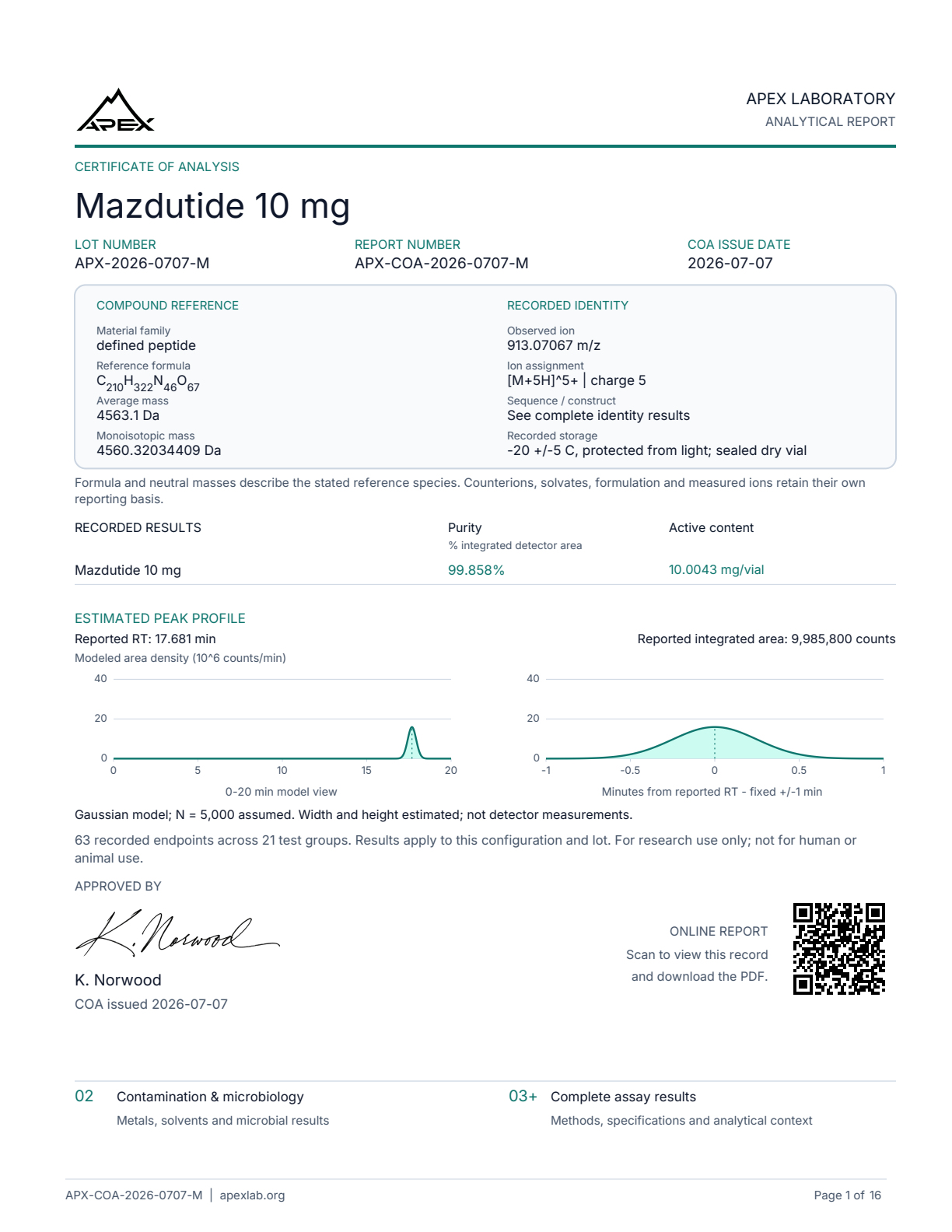
Certificate of analysis
Apex Laboratory results for the listed configurations. Match the lot on your label with the report.
Mazdutide 10 mg
- Mazdutide 10 mg chromatographic purity
- 99.858 % integrated detector area
- Mazdutide 10 mg active content
- 10.0043 mg/vial
- GLP1R relative potency
- 100.05 % reference response potency
- GCGR relative potency
- 100.08 % reference response potency
Chromatographic purity by analyte

About this graph
Recorded scalar results against the stated specification. Each row uses its own labeled scale; purity is detector-area purity, not active-material content.
Measured active content

About this graph
Calibrated active content, concentration or activity compared with the stated same-unit specification. Each row uses its own labeled scale; no conversion from chromatographic purity is made.
Mazdutide 10mg is a dual glp-1/glucagon receptor agonist supplied by Apex Laboratory as a high-purity research peptide intended strictly for in-vitro laboratory research and development applications.
Compound Overview
Mazdutide (IBI362) is a dual-acting peptide that activates both GLP-1 and glucagon receptors. Unlike Tirzepatide (GIP/GLP-1), Mazdutide pairs GLP-1 signaling with glucagon receptor agonism, which may stimulate hepatic energy expenditure and fat oxidation through distinct pathways.
Within the dual-incretin research class, Mazdutide (IBI362; LY3305677) is distinguished by being engineered from a mammalian oxyntomodulin (OXM) backbone rather than from the GLP-1 scaffold that underlies single-agonist peptides. Oxyntomodulin is an endogenous proglucagon-derived peptide that natively engages both the GLP-1 receptor (GLP-1R) and the glucagon receptor (GCGR), so an OXM-derived analog provides a structurally native template for balanced dual agonism. This places Mazdutide in a mechanistically separate lane from Tirzepatide, whose second arm is the glucose-dependent insulinotropic polypeptide (GIP) receptor, and from triple agonists that add GCGR on top of a GLP-1/GIP core. For laboratory comparison studies, the practical consequence is that Mazdutide isolates the GLP-1R + GCGR axis without GIP-receptor confounding, making it a useful reference reagent when investigators wish to attribute observed in-vitro signaling specifically to glucagon-receptor co-activation.
The glucagon-receptor component is the defining feature of interest in published Mazdutide pharmacology. Whereas GLP-1R agonism is associated chiefly with incretin and satiety-related signaling, GCGR engagement has been characterized in the literature as driving hepatic energy expenditure, lipid mobilization, and increased basal metabolic rate — pathways that GLP-1-only and GLP-1/GIP combinations do not directly stimulate. This dual mechanism is why Mazdutide is frequently positioned in research discussions as a tool for probing receptor-balance questions: how the ratio of GLP-1R to GCGR potency shapes downstream cAMP accumulation, hepatic gene-expression readouts, and lipid-handling endpoints in cell-based assays. Investigators studying glucagon biology specifically value a co-agonist whose glucagon arm is intentionally retained rather than minimized, since much of the historical proglucagon literature treated glucagon signaling as something to suppress rather than recruit.
Research Background & Published Literature
Developed by Innovent Biologics and Eli Lilly. Phase 2/3 clinical trials published in Lancet Diabetes & Endocrinology have generated interest in dual GLP-1/glucagon signaling as a metabolic research approach distinct from GIP/GLP-1 combinations.
Researchers interested in the published literature surrounding this compound can explore the following peer-reviewed resources for additional context on its mechanism of action, signaling pathways, and experimental applications in controlled laboratory settings:
Mazdutide’s clinical development program is notable for being centered in China through a collaboration between Innovent Biologics and Eli Lilly, giving it a distinct published-evidence trail from the predominantly Western trial programs of other incretin peptides. The earliest characterization came from a placebo-controlled, multiple-ascending-dose phase 1b study (Ji et al., EClinicalMedicine, 2022), which first described the GLP-1/glucagon dual-agonist profile of IBI362 in humans. As laboratory-research context, this was followed by a phase 2 randomised controlled trial (Ji et al., Nature Communications, 2023) in overweight and obese adults that extended the published characterization of the compound’s dual-agonist activity, providing additional human pharmacology data that later phase 3 work built upon. These references are cited solely as published literature about the compound and not as any guidance for human use.
The pivotal published readout is the phase 3 GLORY-1 trial (Ji et al., New England Journal of Medicine, 2025; NCT05607680), which studied Mazdutide against placebo in humans. Described strictly as laboratory-research context — and not as any guidance for human use — this and the accompanying peer-reviewed reports characterize Mazdutide’s GLP-1/glucagon dual-agonist profile and its movement across prespecified cardiometabolic measures, providing a qualitative anchor that researchers can cite when situating in-vitro potency data against the broader literature. Head-to-head comparative evidence has also emerged, including a phase 3 Mazdutide-versus-dulaglutide trial in type 2 diabetes (Guo et al., Nature, 2026) and the ongoing DREAMS-3 program comparing Mazdutide with semaglutide. Because the glucagon arm is hypothesized to influence the liver directly, a recurring published research theme is Mazdutide’s relevance to hepatic-lipid and steatosis endpoints — an application area less prominent for GLP-1-only or GLP-1/GIP comparators and a useful axis along which to design differentiated in-vitro investigations.
Technical Specifications
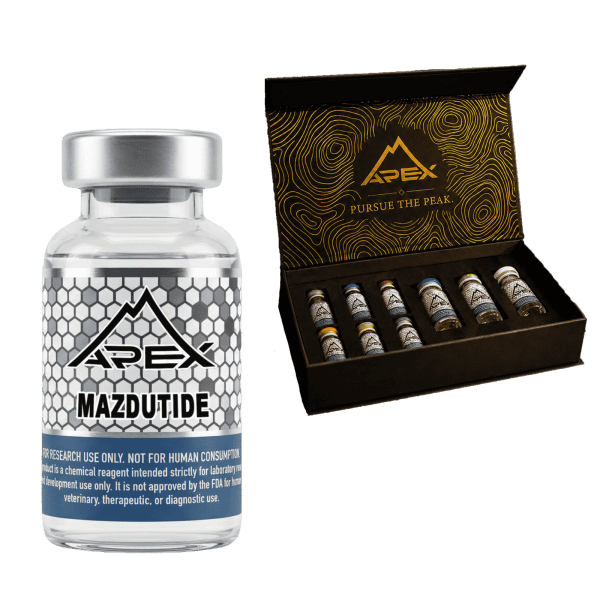
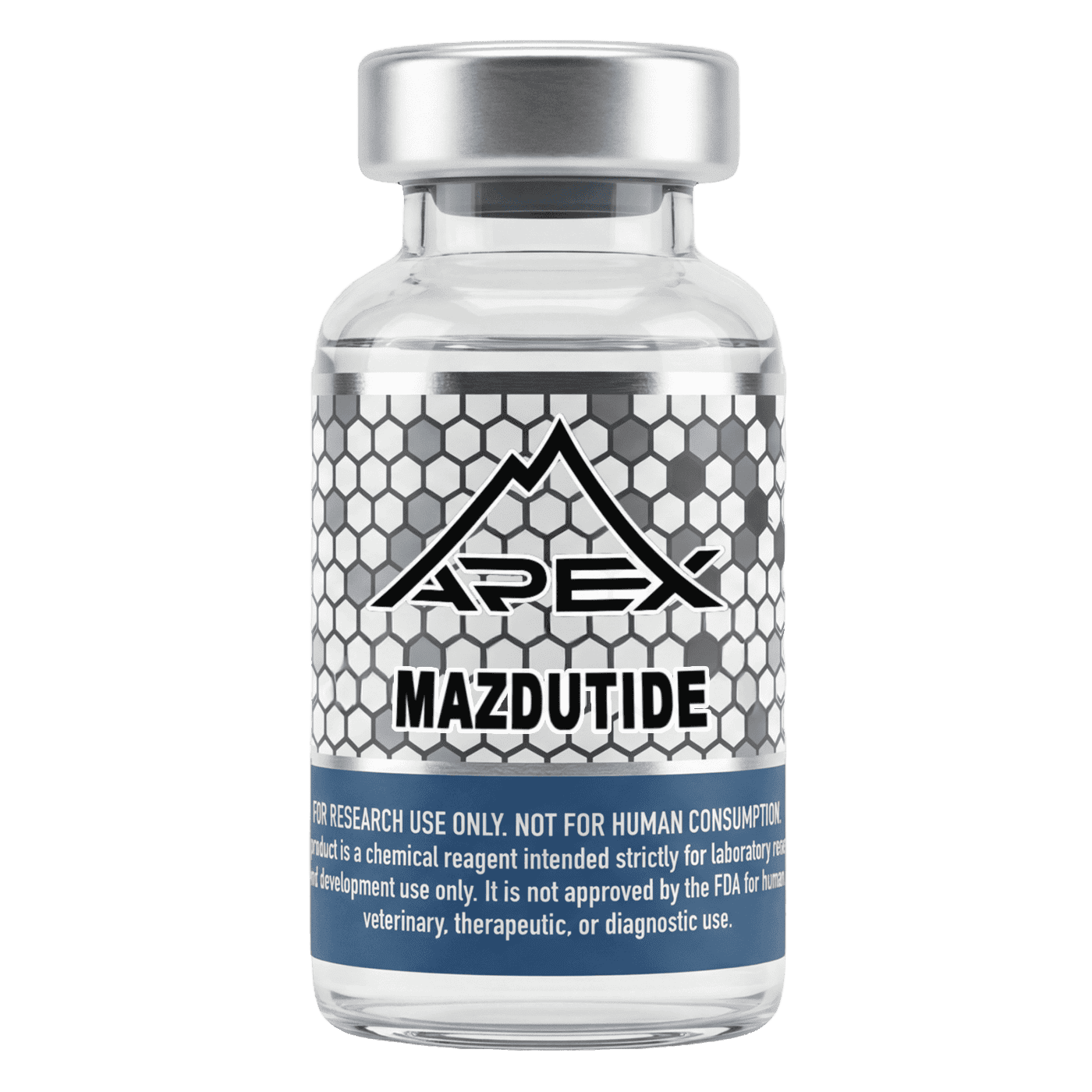
- Product Name: Mazdutide 10mg
- Classification: Dual GLP-1/Glucagon Receptor Agonist
- Structural Description: Dual GLP-1/glucagon receptor agonist peptide (also known as IBI362/LY3305677)
- CAS Number: 2259884-03-0
- Molecular Weight: ~4516 g/mol
- Purity: ≥99% (verified by HPLC and Mass Spectrometry)
- Physical Form: Lyophilized (freeze-dried) powder
- Intended Use: In-vitro research use only — not for human consumption
Storage, Handling & Stability Guidelines
Store lyophilized material at -20°C for long-term stability. After reconstitution with sterile diluent, refrigerate at 2–8°C and minimize freeze-thaw cycles by aliquoting working volumes according to your standard operating procedures.
- Minimize time at ambient temperature during handling to preserve compound integrity.
- Avoid moisture exposure by resealing vials promptly after each withdrawal.
- Use appropriate personal protective equipment and follow your institution’s chemical safety protocols at all times.
- Label all aliquots with the compound name, concentration, date of reconstitution, and operator initials for complete traceability.
Quality Assurance & Analytical Verification
Apex Laboratory applies a dual-verification quality protocol to every batch before it enters inventory. Each lot undergoes High-Performance Liquid Chromatography (HPLC) to confirm chromatographic purity and Mass Spectrometry (MS) to verify molecular identity and molecular weight. This two-step analytical process ensures that the material you receive meets our ≥99% purity standard with confirmed molecular integrity. Certificates of Analysis documenting these results are available in the batch verification panel on this page and in the COA library for your internal quality records.
From an analytical-characterization standpoint, Mazdutide is a fatty-acid-acylated peptide of approximately 4,516 Da (roughly 4.5 kDa), and its lipidation behaves predictably under reversed-phase HPLC: the attached fatty-acid chain increases hydrophobicity and shifts the principal peak to a later retention window than smaller, non-acylated research peptides, a property reviewers can cross-check against the chromatogram on the batch Certificate of Analysis. Mass-spectrometric confirmation targets the intact-mass envelope expected for the acylated OXM-analog backbone — the lot’s COA reports an expected monoisotopic mass of 4516.00 Da with a found value of 4515.84 Da — while HPLC area-percent integration supports the stated ≥99% purity. Investigators performing receptor-pharmacology work are encouraged to confirm lot-specific identity and net peptide content against the supplied COA before normalizing assay concentrations, since acylated peptides of this size can carry counterion and residual-moisture contributions that affect true peptide mass per vial.
Frequently Asked Questions
What is the primary research application of this compound?
This compound is classified as a dual glp-1/glucagon receptor agonist and is used in laboratory settings to study related signaling pathways and biological mechanisms in controlled in-vitro experiments.
What storage conditions are recommended?
For long-term storage, keep the lyophilized material at -20°C in a sealed container away from moisture and light. After reconstitution, refrigerate at 2–8°C and use within the recommended timeframe for your workflow.
How does Mazdutide differ mechanistically from Tirzepatide and from triple-agonist peptides?
All three are multi-receptor incretin peptides, but they engage different receptor combinations. Tirzepatide activates the GLP-1 and GIP receptors; triple agonists add the glucagon receptor (GCGR) to that GLP-1/GIP core. Mazdutide instead pairs GLP-1 receptor agonism directly with GCGR while omitting GIP entirely, and it is built on an oxyntomodulin-derived backbone rather than a GLP-1 scaffold. For laboratory comparison work this makes Mazdutide a useful reagent for isolating GLP-1R + glucagon-receptor signaling without GIP-receptor confounding.
Why is the glucagon-receptor component significant in published Mazdutide research?
In the literature, glucagon-receptor agonism is associated with hepatic energy expenditure, lipid mobilization, and effects on basal metabolic rate — pathways distinct from the satiety- and incretin-oriented signaling attributed to the GLP-1 receptor. Because Mazdutide intentionally retains a meaningful glucagon arm, it is frequently used in research discussions of receptor-balance questions and of hepatic-lipid or steatosis-related endpoints in controlled in-vitro models. These are described here only as published research themes, not as therapeutic claims.
What published clinical literature characterizes this compound?
Mazdutide (IBI362/LY3305677) has a China-centered evidence trail from the Innovent Biologics and Eli Lilly collaboration. Key peer-reviewed references include a phase 1b multiple-ascending-dose study (Ji et al., EClinicalMedicine, 2022), a phase 2 randomised controlled trial (Ji et al., Nature Communications, 2023), the phase 3 GLORY-1 trial (Ji et al., NEJM, 2025; NCT05607680), and a head-to-head comparison versus dulaglutide (Guo et al., Nature, 2026). These are provided strictly as laboratory-research context describing the published literature about the compound.
Related Research Compounds
Researchers studying dual glp-1/glucagon receptor agonist pathways may also be interested in related compounds available from Apex Laboratory, including Survodutide 10mg, Retatrutide, Semaglutide. Explore our complete research catalog to browse all available peptides, reagents, and laboratory supplies, or visit our About page to learn more about our quality verification process.
Shipping, Packaging & Delivery
All orders placed before 2:00 PM Eastern Standard Time ship the same business day via tracked domestic carriers. Products are packaged in insulated, temperature-appropriate containers designed to preserve compound stability during transit. Upon delivery, transfer all materials to appropriate storage conditions immediately. For time-sensitive research protocols or special delivery requirements, contact our support team in advance to coordinate optimal shipping timing for your laboratory workflow.
Research Use Disclaimer
For in-vitro research use only. Not for human consumption. All products sold by Apex Laboratory are intended exclusively for qualified researchers, accredited laboratories, and educational institutions. Purchasers assume full responsibility for ensuring safe handling, proper storage, and compliance with all applicable federal, state, and local laws, regulations, and institutional policies governing the purchase and use of chemical research reagents.