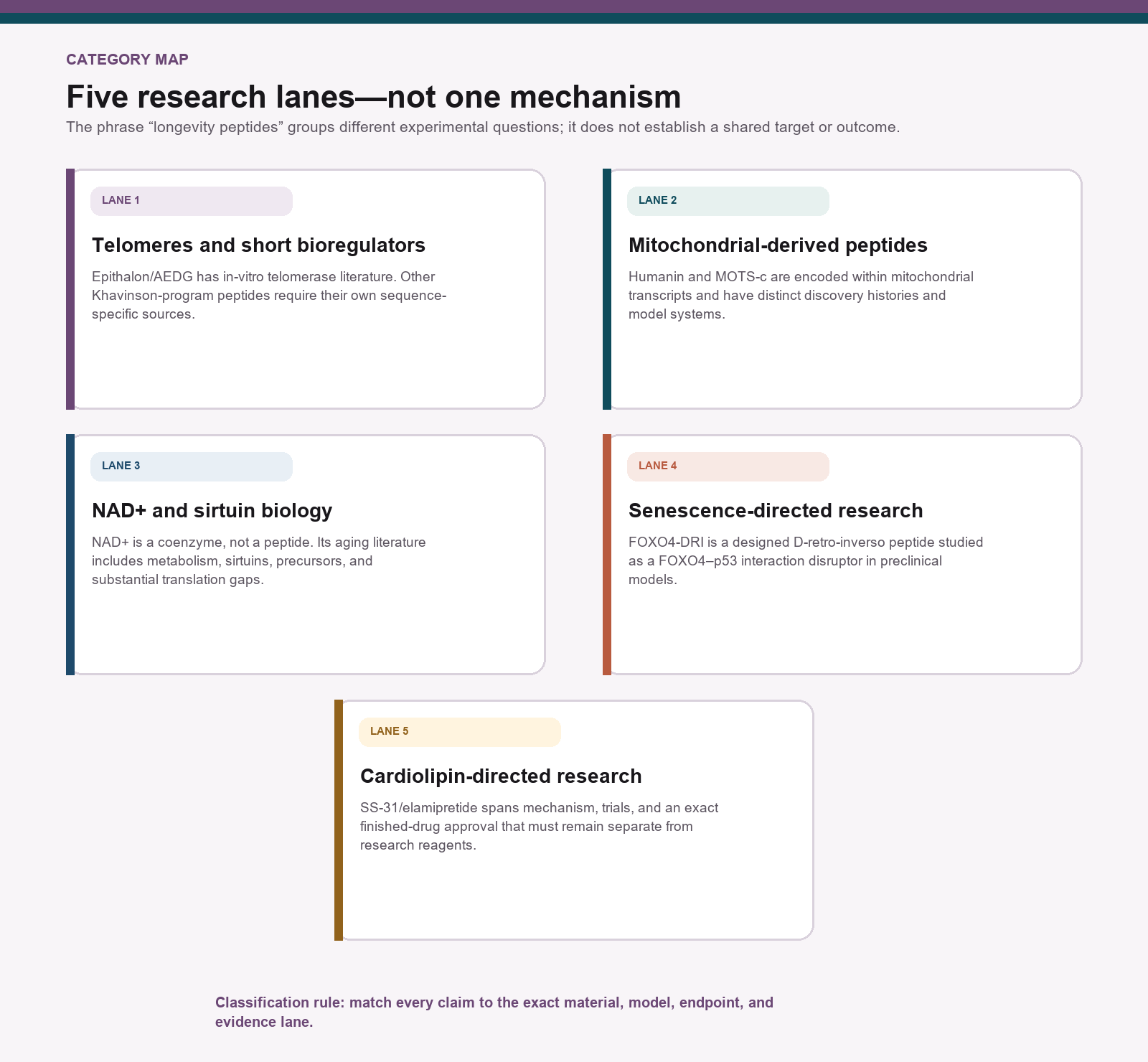
Longevity research peptides are an editorial category spanning short bioregulators, mitochondrial-derived peptides, designed senescence-directed compounds, and cardiolipin-focused agents. The same hub also includes NAD+, which is a dinucleotide coenzyme rather than a peptide. Each lane asks a different experimental question, so evidence must remain attached to the exact material, model, endpoint, formulation, and regulatory context rather than being generalized into an “anti-aging” claim.
This guide is a source-led map of the main longevity and bioregulator research lanes represented in the Apex Research Library. It explains how Epithalon, Humanin, MOTS-c, NAD+, FOXO4-DRI, and SS-31 differ; where the strongest evidence actually sits; and which dedicated guide should own the next question.
- “Longevity peptides” is a navigation term, not one molecular or pharmacological class.
- Epithalon has an in-vitro telomerase record; Humanin and MOTS-c are separate mitochondrial-derived peptides; FOXO4-DRI is a designed senescence-directed peptide.
- NAD+ is a coenzyme, not a peptide, and evidence for NAD+ precursors or enzymes cannot be assigned automatically to an NAD+ research material.
- Animal and cell-model findings are not established human longevity outcomes.
- Pinealon (Glu-Asp-Arg) and Thymalin have no dedicated guide in the corpus, so their identity, mechanism, primary evidence, and regulatory position are held on this hub.
- Restored figures keep their species and model qualifier: mouse lifespan data stay mouse data, HeLa and PC12 results stay cell-line results.
- FORZINITY is an FDA-approved elamipretide finished drug with a narrow label. An Apex SS-31 research reagent is not that pharmaceutical formulation.
What “Longevity Research Peptides” Means
The biological study of aging long predates the modern research-peptide market. Hayflick and Moorhead’s 1961 serial-culture paper established that normal human diploid cell strains have finite proliferative capacity in vitro.[1] Greider and Blackburn identified telomere terminal transferase activity in 1985, creating the foundation for the enzyme later named telomerase.[2] These are foundational aging-biology observations, but neither paper validates a commercial category or a universal intervention.
The useful meaning of this hub is therefore narrower: it organizes materials by the experimental system they are used to interrogate. Telomere biology, mitochondrial signaling, NAD-dependent enzyme activity, cellular senescence, and cardiolipin-associated bioenergetics are related through aging research, yet they are not one pathway. A source that supports one lane cannot silently support the others.
Foundational Research Programs Behind the Category
Two cell-biology reports 24 years apart set the terms for everything that followed. Hayflick and Moorhead described the serial cultivation of human diploid cell strains and the finite proliferative capacity of normal cells in culture.[1] The PubMed record for that 1961 paper carries no abstract, so the population-doubling figure commonly quoted alongside it is not restored here. Greider and Blackburn then found an activity in Tetrahymena cell-free extracts that added tandem TTGGGG repeats onto synthetic telomeric primers; the telomeric oligonucleotides (TTGGGG)4 and a yeast telomeric sequence primed elongation, while (CCCCAA)4 and two non-telomeric oligomers did not.[2] Specificity of that kind is what a citation is for. It is also what disappears when a result is summarised as “telomere research.”
The Russian short-peptide bioregulator tradition runs on a separate track. A 2021 systematic review in Molecules characterises this class as peptides of 2–7 amino-acid residues that penetrate cell nuclei and nucleoli, interact with the nucleosome, histone proteins, and both single- and double-stranded DNA, and can alter DNA methylation status.[14] Fedoreyeva and colleagues incubated HeLa cells with fluorescein-labelled epithalon (Ala-Glu-Asp-Gly), pinealon (Glu-Asp-Arg), and testagen (Lys-Glu-Asp-Gly) and observed fluorescence in cytoplasm, nucleus, and nucleolus, with Stern-Volmer quenching constants indicating sequence-preferential binding to CNG- and CAG-containing deoxyribooligonucleotides.[15] That establishes access and binding preference in a cancer cell line. It does not establish an organism-level outcome.
The NAD-dependent deacetylase lineage begins with the demonstration that yeast and mouse Sir2 proteins are NAD-dependent histone deacetylases, deacetylating lysines 9 and 14 of histone H3 and specifically lysine 16 of histone H4.[7] The mitochondrial-derived peptide lineage begins with a functional expression screen that identified Humanin,[5] continues with the 16-amino-acid peptide MOTS-c encoded in the mitochondrial 12S rRNA,[6] and widens with an in-silico search that identified six further peptides in the same mtDNA region as Humanin, named SHLP1 through SHLP6. SHLP2 and SHLP3 reduced apoptosis and reactive-oxygen-species generation in vitro, enhanced 3T3-L1 pre-adipocyte differentiation, and, for intracerebrally infused SHLP2, increased glucose uptake and suppressed hepatic glucose production in hyperinsulinaemic-euglycaemic clamp studies; circulating SHLP2 fell with age.[16]
These are four different programmes with four different burdens of proof. The table below restores each anchor result with the model it was measured in.
| Year | Report | Model and species | Reported result, with its figures | Source |
|---|---|---|---|---|
| 1961 | Hayflick & Moorhead, Exp Cell Res | Human diploid cell strains, serial culture | Finite proliferative capacity of normal human cells in vitro; PubMed record carries no abstract text | PMID 13905658 |
| 1985 | Greider & Blackburn, Cell | Tetrahymena cell-free extracts | TTGGGG repeat addition onto (TTGGGG)4 and a yeast telomeric primer; (CCCCAA)4 and non-telomeric oligomers not elongated | PMID 3907856 |
| 2000 | Imai et al., Nature | Yeast and mouse Sir2 proteins | NAD-dependent deacetylation of H3 lysines 9 and 14 and H4 lysine 16; two SIR2 mutations link the activity to silencing and lifespan | PMID 10693811 |
| 2001 | Hashimoto et al., PNAS | Neuronal cell death assay | Humanin cDNA abolished death from multiple familial Alzheimer disease genes and amyloid-beta, with no effect on Q79 or SOD1 mutant death | PMID 11371646 |
| 2003 | Khavinson et al., Bull Exp Biol Med | Telomerase-negative human fetal fibroblasts | Induced catalytic-subunit expression, telomerase activity, and telomere elongation | PMID 12937682 |
| 2011 | Baker et al., Nature | BubR1 progeroid mice carrying INK-ATTAC | Drug-induced clearance of p16Ink4a-positive cells delayed adipose, skeletal-muscle, and eye phenotypes; late-life clearance slowed established disorders | PMID 22048312 |
| 2015 | Lee et al., Cell Metab | Mice; skeletal muscle as primary target organ | 16-amino-acid MOTS-c inhibited the folate cycle and de-novo purine synthesis, activated AMPK, and prevented age-dependent and high-fat-diet-induced insulin resistance | PMID 25738459 |
| 2016 | Baker et al., Nature | Wild-type mice, two genetic backgrounds | AP20187 twice weekly from 1 year of age extended median lifespan in males and females and preserved glomeruli, cardio-protective K-ATP channels, and adipocytes | PMID 26840489 |
| 2016 | Cobb et al., Aging | In vitro assays; hyperinsulinaemic-euglycaemic clamp studies, species not named in the abstract | Six SHLPs identified; SHLP2 and SHLP3 cut apoptosis and ROS generation; infused SHLP2 raised glucose uptake and suppressed hepatic glucose output | PMID 27070352 |
| 2017 | Baar et al., Cell | Cultured cells; XpdTTD/TTD and naturally aged mice | FOXO4 peptide drove p53 nuclear exclusion and selective senescent-cell apoptosis, neutralised doxorubicin chemotoxicity, and restored fitness, fur density, and renal function | PMID 28340339 |
The Hallmarks-of-Aging Framework and Where the Lanes Sit
The scaffold most aging researchers use to relate these programmes is the hallmarks framework. The 2013 Cell review proposed nine hallmarks: genomic instability, telomere attrition, epigenetic alterations, loss of proteostasis, deregulated nutrient sensing, mitochondrial dysfunction, cellular senescence, stem cell exhaustion, and altered intercellular communication.[19] The update published 10 years later in the same journal proposed twelve, adding disabled macroautophagy, chronic inflammation, and dysbiosis.[20] The 2023 paper also states the admission criteria explicitly: a hallmark must manifest with age, must accelerate aging when experimentally accentuated, and must offer the opportunity to decelerate, stop, or reverse aging when targeted therapeutically.
Those criteria are useful here because they are stricter than the category label. Mapping a material onto a hallmark is a statement about which biology it interrogates, not a claim that it satisfies criterion three. Epithalon and Pinealon sit against telomere attrition and epigenetic alterations. Humanin, MOTS-c, and SS-31 sit against mitochondrial dysfunction. NAD+ sits against deregulated nutrient sensing through NAD-consuming enzymes. FOXO4-DRI sits against cellular senescence. Thymalin sits against stem cell exhaustion and altered intercellular communication by way of thymic involution and immunosenescence.
A hallmark assignment therefore tells a reader which experiments are relevant. It does not import evidence from one lane to another, and it does not convert a preclinical endpoint into a health outcome.
Identity and Research Lanes
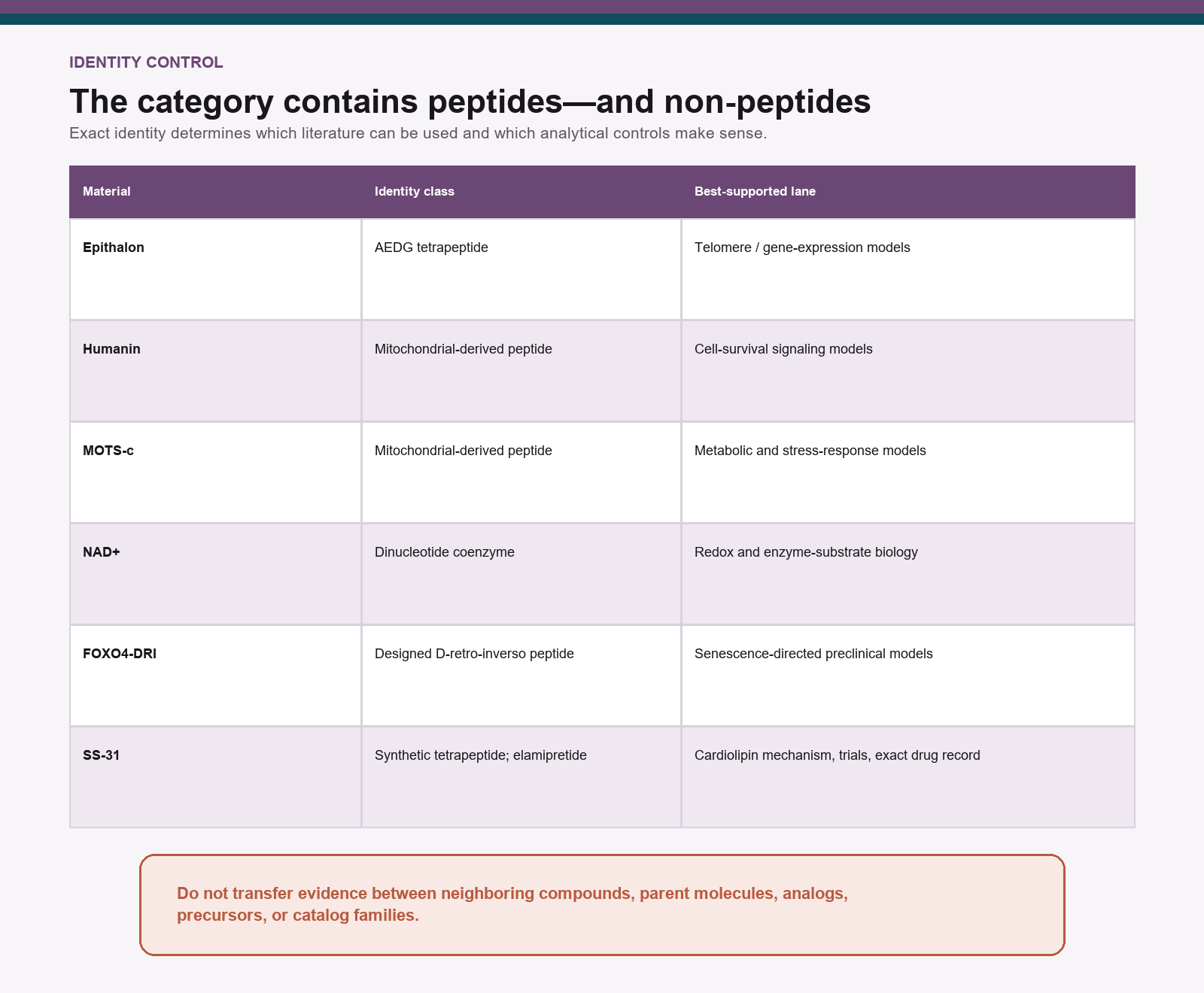
| Material | Identity | Primary research lane | Key interpretation boundary | Dedicated guide |
|---|---|---|---|---|
| Epithalon | Ala-Glu-Asp-Gly (AEDG) tetrapeptide | Telomerase, gene expression, and organism models | In-vitro telomerase results are not human longevity outcomes | Epithalon research guide |
| Humanin | Mitochondrial-derived peptide first identified in a neuronal cell-death screen | Cell-survival and stress-signaling models | Discovery context must not become a clinical claim | This pillar’s Humanin section |
| MOTS-c | 16-amino-acid mitochondrial-derived peptide | Metabolic homeostasis and stress-response models | Mouse phenotypes do not establish human performance or longevity | MOTS-c research guide |
| NAD+ | Dinucleotide coenzyme, not a peptide | Redox chemistry and enzyme-substrate biology | Evidence for a precursor, enzyme, or delivery route is formulation-specific | NAD+ research guide |
| FOXO4-DRI | Designed D-retro-inverso peptide | FOXO4–p53 interaction and senescence models | Evidence remains predominantly preclinical | FOXO4-DRI research guide |
| SS-31 | D-Arg-Dmt-Lys-Phe-NH2; elamipretide | Cardiolipin and mitochondrial membrane research | Keep the molecule, FORZINITY, and research reagent separate | SS-31 research guide |
Reagent identity data
Identity is the first evidence check, not a formality. Where the Apex catalog snapshot records a CAS Registry Number and molecular weight, they are reproduced below; where it does not, the field says so instead of guessing. Supplier-reported and certificate-of-analysis values are labelled as such, and the final column names the catalog certificate-of-analysis batch.
| Material | CAS | Molecular formula | Molecular weight | Sequence or composition | Catalog COA batch |
|---|---|---|---|---|---|
| Epithalon | 307297-39-8 | C14H22N4O9 | 390.35 Da | Ala-Glu-Asp-Gly (AEDG tetrapeptide) | APX-2026-0311-E |
| Pinealon | 175175-23-2 | C15H26N6O8 (free acid) | 418.41 Da, COA-reported | Glu-Asp-Arg (EDR tripeptide) | APX-2026-0402-P |
| Thymalin | Not recorded in the catalog snapshot | Not applicable; multi-component | No single exact MW; components ~1-10 kDa | Thymic polypeptide complex; KE and EW dipeptides reported as active constituents | APX-2026-0418-T |
| Humanin | 330936-69-1 | C119H204N34O32S2 | 2687.1 g/mol, supplier-reported | 24-residue peptide encoded in the mitochondrial 16S rRNA region[16] | APX-2026-0303-H |
| MOTS-c | Not recorded in the catalog snapshot | Not reproduced; catalog string conflicts with the reported mass | 2174.7 g/mol, supplier-reported | 16-amino-acid peptide encoded in the mitochondrial 12S rRNA | APX-2026-0314-M |
| NAD+ | 53-84-9 | C21H27N7O14P2 | 663.43 Da | Dinucleotide coenzyme; not a peptide | APX-2026-0315-N |
| FOXO4-DRI | 2460055-10-9 | C228H388N86O64 | 5358.05 Da per the COA formula; the catalog’s ~4,800 Da summary figure is flagged | D-retro-inverso FOXO4 peptide | APX-2026-0312-F |
| SS-31 | 736992-21-5 | C32H49N9O5 (C-terminal amide) | 640.77 Da, supplier-reported free acid | D-Arg-2′,6′-dimethyl-Tyr-Lys-Phe-NH2 | APX-2026-0321-E |
Four entries carry a flag above; two of them need more explanation than a table cell allows. The catalog summary line lists Pinealon at approximately 358 Da, which conflicts with the certificate-of-analysis record for the same product (C15H26N6O8, expected mass 418.41 Da); the COA value is used above and the summary line is flagged for correction. Thymalin is a polypeptide preparation rather than a single molecule, so a single formula and sequence do not exist for it and none is asserted.
Epithalon, Telomerase, and the Limits of the Evidence
Epithalon—also indexed as Epitalon—is the synthetic tetrapeptide Ala-Glu-Asp-Gly. Khavinson and colleagues reported that Epithalon induced telomerase activity and telomere elongation in cultured human somatic cells.[3] That is a direct, material-specific in-vitro finding. It does not by itself establish extended human lifespan, reversal of biological aging, or a therapeutic effect.
The larger short-peptide bioregulator literature contains other named sequences and preparations. Those papers must be matched exactly. For example, a microarray study of Cortagen, a different tetrapeptide, cannot be cited as if it studied Epithalon simply because both compounds belong to a Khavinson-program lineage.[4] The dedicated Epithalon guide separates sequence identity, cell studies, organism models, and later reviews.
The in-vivo record for the same programme is animal work and should be quoted that way. Anisimov, Khavinson, and colleagues injected female CBA mice subcutaneously with the synthetic tetrapeptide from 6 months of age until death. Body weight, food consumption, physical activity, and behavioural parameters were unaffected; the reported effects were a slowed age-related switching off of oestrus function, decreased body temperature, decelerated free-radical processes, prolonged lifespan, and a lower incidence of spontaneous tumours.[26] The abstract states directions of effect without effect sizes or survival statistics, so no percentage or median-survival figure is reproduced here. Those are mouse results in one strain and one sex, and they are not a human-lifespan claim.
The comparator study in the same lineage shows how precise the matching has to be. The Cortagen microarray experiment analysed 15,247 transcripts in the hearts of female 6-month-old CBA mice after 5 consecutive days of injections and found 234 clones, or 1.53% of the total, with significantly changed expression across 110 known genes, with maximum up- and down-regulation of +5.42 and −2.86.[4] That is a real, quantified result — for Cortagen (Ala-Glu-Asp-Pro), a different tetrapeptide. It is not Epithalon evidence.
Pinealon: A Catalog Material Without a Dedicated Guide
Pinealon is listed in the Apex catalog without a dedicated compound guide, which is how it was previously reduced to a passing clause. It is given a bounded section here, while Thymalin now has a dedicated guide — the Thymalin Research Guide — and keeps a bounded summary below for continuity. Each bounded section covers the same frame — identity, mechanism, strongest reported evidence with its figures, verified regulatory position, and the catalog listing. Neither section borrows a result from the other, and neither borrows from Epithalon.
Pinealon (EDR tripeptide)
Pinealon is the synthetic tripeptide Glu-Asp-Arg, referred to in the primary literature as the EDR peptide. Its free-acid formula is C15H26N6O8, its certificate-of-analysis expected mass is 418.41 Da, and the catalog records CAS 175175-23-2. Mechanistically it belongs to the short-peptide class that enters the nucleus and binds DNA with sequence preference, and a 2020 Molecules review attributes to it the activation of gene expression and protein synthesis supporting neuronal functional activity, with effects reported on MAPK/ERK signalling and on caspase-3, p53, SOD2, and GPX1 protein synthesis.[21] The strongest primary report is a viability study in which the tripeptide produced dose-dependent restriction of reactive-oxygen-species accumulation in cultured cerebellar granule cells, neutrophils, and rat PC12 pheochromocytoma cells under receptor-dependent and receptor-independent oxidative stress, reduced necrotic death measured by propidium iodide, and delayed the time course of ERK1/2 activation.[22] The published abstracts state directions of effect but not effect sizes, so no percentage or fold value is asserted. Regulatory position: no Drugs@FDA record exists for pinealon, confirmed against the FDA application database on July 25, 2026, and no EMA or NMPA marketing authorisation was identified. Apex lists it as Pinealon 10mg, a lyophilised research reagent whose applicable report should be read for its methods and results.
Thymalin (thymic polypeptide complex)
Thymalin is not a single molecule. It is a polypeptide complex isolated from thymus, and the Apex catalog records neither a CAS number nor a sequence for it; the material has no single exact molecular weight (components span roughly 1–10 kDa). Its reported active substances are the dipeptides KE (Lys-Glu) and EW (Glu-Trp).[24] Mechanistically it is characterised as an immunomodulator that shifts haematopoietic stem cell differentiation and dampens pro-inflammatory cytokine output. Two studies carry usable numbers. In human haematopoietic stem cells in vitro, thymalin reduced expression of the stem-cell marker CD44 and the intermediate-stage marker CD117 by 2–3-fold and increased expression of the mature T-lymphocyte marker CD28 by 6.8-fold.[23] That abstract gives no sample size. In lipopolysaccharide-stimulated human peripheral blood mononuclear cells drawn from four donors, thymalin and its EW and KE dipeptides reduced IL-1β, IL-6, and TNF-α synthesis by 1.4–6.0-fold on ELISA.[24] Both are human-cell results, not clinical outcomes. Regulatory position: no Drugs@FDA record exists for thymalin, confirmed against the FDA application database on July 25, 2026. Apex lists it as Thymalin 10mg; read the applicable record for its mixture fingerprint, methods and reported content.
Humanin and MOTS-c: Two Mitochondrial-Derived Peptides
Humanin and MOTS-c are often grouped together because both are mitochondrial-derived peptides, but they were discovered in different contexts and are not interchangeable. Hashimoto and colleagues identified Humanin in a screen for factors that rescued neuronal cells from cell death associated with familial Alzheimer’s disease genes and amyloid-beta exposure.[5] The paper is a cell-model discovery record; it is not evidence that a Humanin research material treats neurodegenerative disease.
Lee and colleagues reported MOTS-c as a 16-amino-acid mitochondrial-derived peptide and described metabolic-homeostasis phenotypes in mouse models, including effects in diet-induced and age-dependent insulin-resistance contexts.[6] The study supports a mechanistic and preclinical research lane. The MOTS-c guide explains later nuclear-signaling, exercise, and human-association research without converting those signals into a personal-use recommendation.
The family is larger than these two. An in-silico search of the same mtDNA region that encodes Humanin identified six additional peptides, designated SHLP1 to SHLP6, whose ability to regulate cell viability differed between members; SHLP2 and SHLP3 were the closest to Humanin in protective profile.[16] Apex lists Humanin 10mg and MOTS-c (Human) as separate reagents with distinct configuration reports, and the corpus routes MOTS-c questions to its own guide because the two peptides have different sequences, different encoding regions, and different published endpoints.
The key comparison is not “which peptide is better.” The useful questions are: Which exact peptide was studied? Was the model cellular, animal, observational human research, or an intervention? What endpoint was measured? Was the named material’s identity independently established? Those questions prevent a broad mitochondrial label from becoming evidence transfer.
NAD+ Biology Belongs in the Hub—But NAD+ Is Not a Peptide
Nicotinamide adenine dinucleotide (NAD+) is a dinucleotide coenzyme. Its inclusion here reflects topic adjacency and catalog navigation, not chemical classification. Imai and colleagues established that the yeast Sir2 longevity protein is an NAD-dependent histone deacetylase, linking NAD availability to a defined enzyme mechanism.[7] Later reviews evaluate the in-vivo evidence for NAD-boosting molecules, including distinct precursors and model systems.[8]
The reagent itself is chemically well defined: NAD+ carries CAS 53-84-9, the formula C21H27N7O14P2, and a molecular weight of 663.43 Da. That precision is exactly why the evidence boundary matters. A defined coenzyme with a known mass is not the same object as a precursor molecule, a delivery route, or an infusion protocol.
That literature has several non-equivalent evidence owners: NAD+ itself, nicotinamide riboside, nicotinamide mononucleotide, enzymes that consume or regenerate NAD, and the route or formulation used in a study. A result for one precursor cannot validate another material. Likewise, a measured increase in a metabolite is not automatically an improvement in a clinical or longevity endpoint. See the NAD+ research guide for the chemistry, evidence layers, and translation gaps.
Cellular Senescence and FOXO4-DRI
Cellular senescence is a state, not one marker or one disease. Coppé and colleagues characterized senescence-associated secretory phenotypes and showed how senescent cells can exert non-cell-autonomous effects through secreted factors.[9] That work helps explain why researchers study both the persistence of senescent cells and the signals they produce.
The proof that senescent cells are causal, rather than merely correlated with age, came from genetic clearance experiments. The INK-ATTAC transgene allowed drug-induced elimination of p16Ink4a-positive cells in BubR1 progeroid mice; life-long removal delayed the onset of adipose-tissue, skeletal-muscle, and eye phenotypes, and late-life clearance attenuated disorders that were already established.[17] The follow-up applied the same transgene to wild-type mice, injecting AP20187 twice a week from 1 year of age, and reported extended median lifespan in males and females across two genetic backgrounds, with preserved glomeruli, cardio-protective K-ATP channels, and adipocytes and no apparent side effects.[18] These are mouse genetic-ablation experiments. They validate the target, not any particular compound.
FOXO4-DRI is a designed D-retro-inverso peptide investigated as a disruptor of the FOXO4–p53 interaction. Baar and colleagues reported selective apoptosis of senescent cells and tissue-homeostasis findings across cultured cells and mouse models.[10] The study is an important preclinical program anchor; it is not a completed human-efficacy record. The FOXO4-DRI guide distinguishes the original design paper from later model-specific studies and unresolved translation questions.
Apex lists FOX04-DRI under CAS 2460055-10-9; its certificate-of-analysis formula gives 5358.05 Da, not the ~4,800 Da catalog summary figure. A 2021 geroscience review frames dietary manipulations, metformin, mTOR inhibitors, and senolytics in early human trials as attempts to extend healthspan by targeting fundamental aging mechanisms rather than one disease at a time.[29] That review names no FOXO4-DRI study, and FOXO4-DRI has no clinical-development programme, so the class context does not transfer to it.
SS-31, Cardiolipin, and the Current Regulatory Context
SS-31 is the research name for the tetrapeptide also known as elamipretide. Birk and colleagues reported that SS-31 interacted with cardiolipin and improved mitochondrial energetic behavior in an ischemic model, providing a direct mechanism-focused anchor.[11] A later randomized crossover trial and extension evaluated elamipretide in Barth syndrome, a disorder of mitochondrial cardiolipin metabolism.[12]
The programme review sets out the same mechanism at greater length: SS-31 is a member of the Szeto-Schiller peptides that selectively target the inner mitochondrial membrane, binds cardiolipin through electrostatic and hydrophobic interactions, prevents cardiolipin from converting cytochrome c into a peroxidase while preserving its electron-carrying function, and thereby protects cristae structure and supports oxidative phosphorylation.[25] Apex lists SS-31 under CAS 736992-21-5 at a supplier-reported 640.77 Da (free-acid convention); the certificate-of-analysis formula C32H49N9O5 gives 639.79 Da for the C-terminal amide, a reporting difference rather than a conflict.
The clinical record should be quoted with its numbers, including the parts that did not work. The phase 2/3 trial randomised 12 subjects with Barth syndrome to 40 mg per day of elamipretide or placebo for 12 weeks, followed by a 4-week washout and 12 weeks on the opposite arm. Neither primary endpoint was met in that randomised crossover phase. Ten subjects continued into an open-label extension, eight of them reaching 36 weeks, where the 6-minute walk test improved by 95.9 m (p = 0.024) and the Barth Syndrome Symptom Assessment score improved by 2.1 points (p = 0.031), with significant secondary improvements in knee-extensor strength and some cardiac parameters.[12]
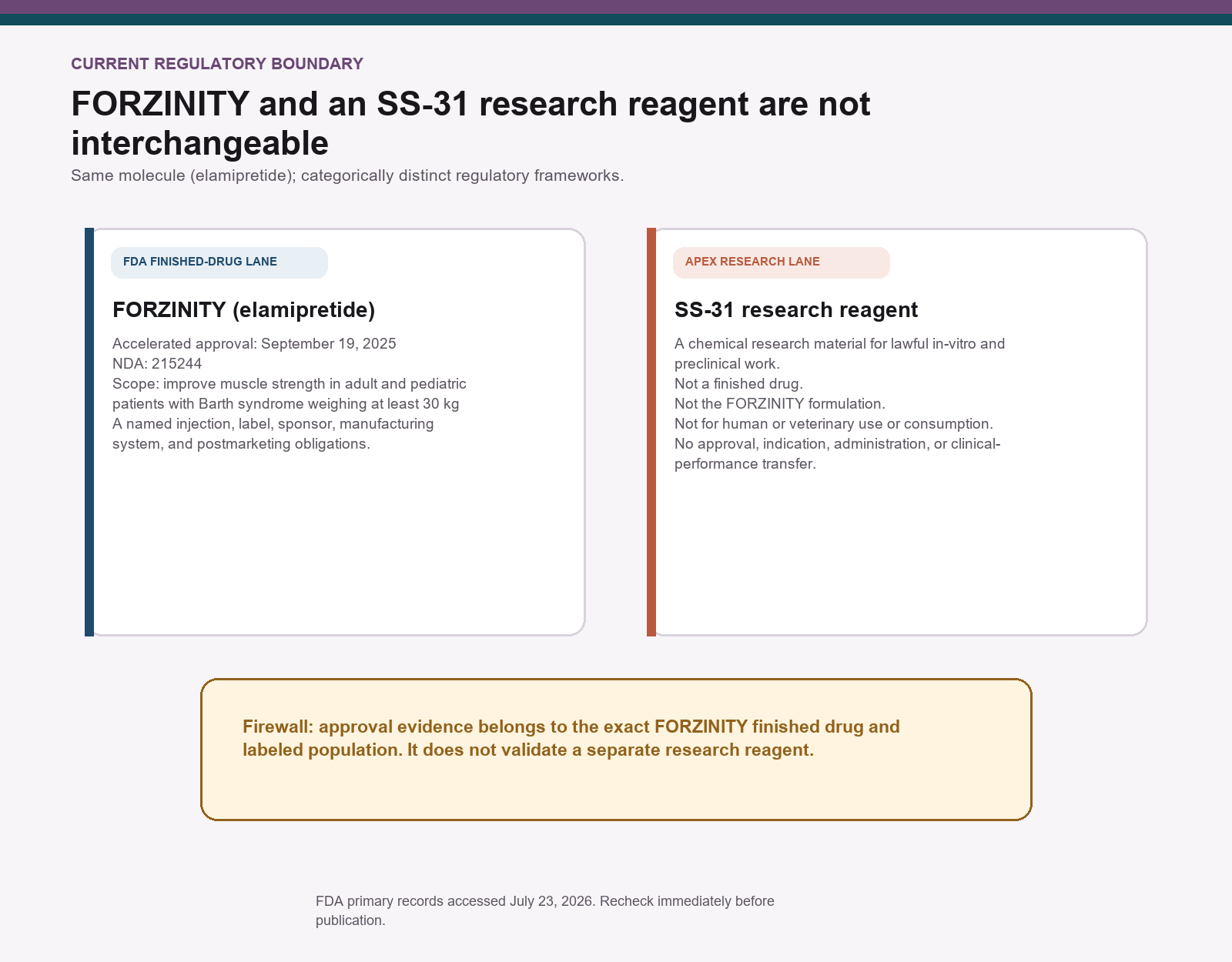
FDA granted accelerated approval to FORZINITY (elamipretide) on September 19, 2025 under NDA 215244. The Drugs@FDA approval record for NDA 215244 states the indication as improving muscle strength in adult and pediatric patients with Barth syndrome weighing at least 30 kg. A 2026 review records elamipretide as the first cardiolipin-directed mitochondrial therapeutic approved under the accelerated-approval pathway, notes that sustained benefits were observed during a 168-week open-label extension after the crossover trial missed its endpoints, reports mild injection-site reactions as the most common adverse events, and records that a confirmatory trial is required as a condition of the accelerated approval.[13]
Same molecule (elamipretide); categorically distinct regulatory frameworks. FORZINITY is a named pharmaceutical formulation with an FDA-reviewed label, sponsor, manufacturing system, and postmarketing obligations. Apex supplies SS-31 only as a research-grade chemical reagent for lawful in-vitro and preclinical research. The research reagent is not FORZINITY, is not a pharmaceutical substitute, and is not for human or veterinary use or consumption.
Per-Compound Regulatory Status
Regulatory status is a per-compound fact, and it is a different assertion from a supplier statement. “Apex supplies research materials” describes a supply arrangement; “no marketing authorisation exists for this molecule” describes a regulatory record. The table records what was actually checked, against which database, and on what date. United States status was verified on July 25, 2026 by querying the FDA application database for each substance. European and Chinese status was not verifiable programmatically in this pass and is reported as such rather than asserted.
| Material | United States, checked 2026-07-25 | Other jurisdictions | Position on this site |
|---|---|---|---|
| Epithalon | No FDA application record | No EMA or NMPA authorisation identified | Research reagent; no approved indication anywhere |
| Pinealon | No FDA application record | None identified in this pass | Research reagent; no approved indication |
| Thymalin | No FDA application record | None identified in this pass | Research reagent; no approved indication |
| Humanin | Not listed in the FDA application database | None identified in this pass | Research reagent; not an approved medicine |
| MOTS-c | No FDA application record | No European or Chinese authorisation found | Research reagent; no marketing authorisation |
| NAD+ | Not an approved drug substance | None identified in this pass | Chemical research reagent; consumer NAD+ infusions are compounded preparations, not approved medicines |
| FOXO4-DRI | Absent from the FDA application database | No authorisation identified anywhere | Tool compound; no clinical-development programme |
| SS-31 / elamipretide | FORZINITY approved 2025-09-19, NDA 215244, Stealth BioTherapeutics, accelerated approval | Not assessed in this pass | Approval belongs to the finished drug and its labelled Barth syndrome population, not to a research reagent |
Two readings of this table are wrong. The first treats the SS-31 row as licence for the other seven; approval attaches to FORZINITY as a finished drug with a sponsor, a manufacturing system, a label, and postmarketing obligations, and does not extend to a molecule sold as a reagent. The second treats an empty database record as proof of danger or of worthlessness; it is neither, it is simply the absence of an approval, and it is the reason every material on this page is confined to laboratory research.
Additional Reported Findings
Four of these sources were cited on an earlier version of this page and are restored here as claim-map rows rather than prose; two are new additions verified for this pass. Each row names the compound, the model, the species, the endpoint, and the reported result, so the citation carries information instead of atmosphere. Where an abstract states a direction of effect without an effect size, the row says so instead of supplying a number.
| Compound | Model | Species or system | Endpoint | Reported result | PMID |
|---|---|---|---|---|---|
| Epithalon | Subcutaneous dosing from 6 months of age until death | Female CBA mice | Lifespan, oestrus function, tumour incidence | Prolonged lifespan, slowed age-related loss of oestrus function, lower spontaneous tumour incidence; no change in body weight or food consumption; effect sizes not given | 11227856 |
| Pinealon | Prenatal hyperhomocysteinaemia from dietary methionine loading | Rat offspring | Spatial orientation, learning, cerebellar neuron ROS and necrosis | Improved spatial orientation and learning; reduced ROS accumulation and necrotic cell numbers; effect sizes not given | 22567179 |
| Pinealon, epithalon, testagen | FITC-labelled peptide uptake and oligonucleotide binding | HeLa cells; cell-free DNA assays | Nuclear and nucleolar localisation; sequence preference | All three entered cytoplasm, nucleus, and nucleolus; Stern-Volmer constants showed CNG and CAG sequence preference and discrimination of cytosine methylation status | 22117547 |
| Thymalin | Standard therapy with or without added thymalin | Patients with COVID-19; group sizes not reported | IL-6, C-reactive protein, D-dimer, T-cell indices | Faster decline in all four indices when thymalin was added to standard care; the abstract reports no quantitative result | 33575961 |
| Senolytics as a class | Narrative review of the geroscience programme | Human and animal studies through 2021 | Healthspan-directed interventions | Dietary manipulations, metformin, mTOR inhibitors, and senolytics described as in early human trials; no compound-specific efficacy claim | 33155651 |
| Short peptides as a class | Systematic review of peptide regulation of gene expression | Plants, microorganisms, insects, birds, rodents, primates, humans | Nuclear penetration and DNA interaction | Peptides of 2–7 residues penetrate nuclei and nucleoli, interact with nucleosome, histones, and single- and double-stranded DNA, and can alter DNA methylation status | 34834147 |
Catalog Materials and Which Guide Owns the Next Question
Eight materials sit inside this hub. Six have or will have a dedicated destination; Pinealon and Thymalin are held here in the bounded sections above. Check each current listing for the supplied format and its applicable configuration report. The lab-methods cluster explains how to interpret the stated methods, results and acceptance criteria.
| Material | Apex listing | Research lane | Owning destination |
|---|---|---|---|
| Epithalon | Epithalon | Telomerase and gene expression | Epithalon research guide |
| Pinealon | Pinealon 10mg | Pineal and CNS short-peptide research | Bounded section on this page |
| Thymalin | Thymalin 10mg | Immunosenescence and thymus axis | Bounded section on this page |
| Humanin | Humanin 10mg | Cell survival and stress signalling | Section on this page; see also the CNS research pillar |
| MOTS-c | MOTS-c (Human) | Metabolic homeostasis | MOTS-c research guide |
| NAD+ | NAD+ | Redox chemistry and enzyme substrate biology | NAD+ research guide |
| FOXO4-DRI | FOX04-DRI | FOXO4-p53 interaction and senescence | FOXO4-DRI research guide |
| SS-31 | SS-31 | Cardiolipin and mitochondrial membranes | SS-31 research guide |
The analytical-quality documentation that research-grade work in this category depends on sits in the lab-methods cluster: how to evaluate a peptide vendor, research-grade versus pharmaceutical-grade, why a 99% purity specification matters, and mass spectrometry peptide verification. Adjacent pillars cover the neighbouring catalogs: tissue repair, GLP-1 and metabolic, growth hormone axis, and specialty research peptides.
How to Read Longevity Evidence Without Overclaiming
Evidence should be read as a ladder, not a pile. Molecular assays can establish interaction or enzyme dependence. Cell models can test bounded pathways. Animal models can examine organism-level phenotypes under controlled conditions. Human studies can address safety, pharmacology, association, or specified endpoints. A regulatory decision applies to the exact finished drug, evidence package, and labeled population. Each tier adds information, but no tier retroactively validates a different material.
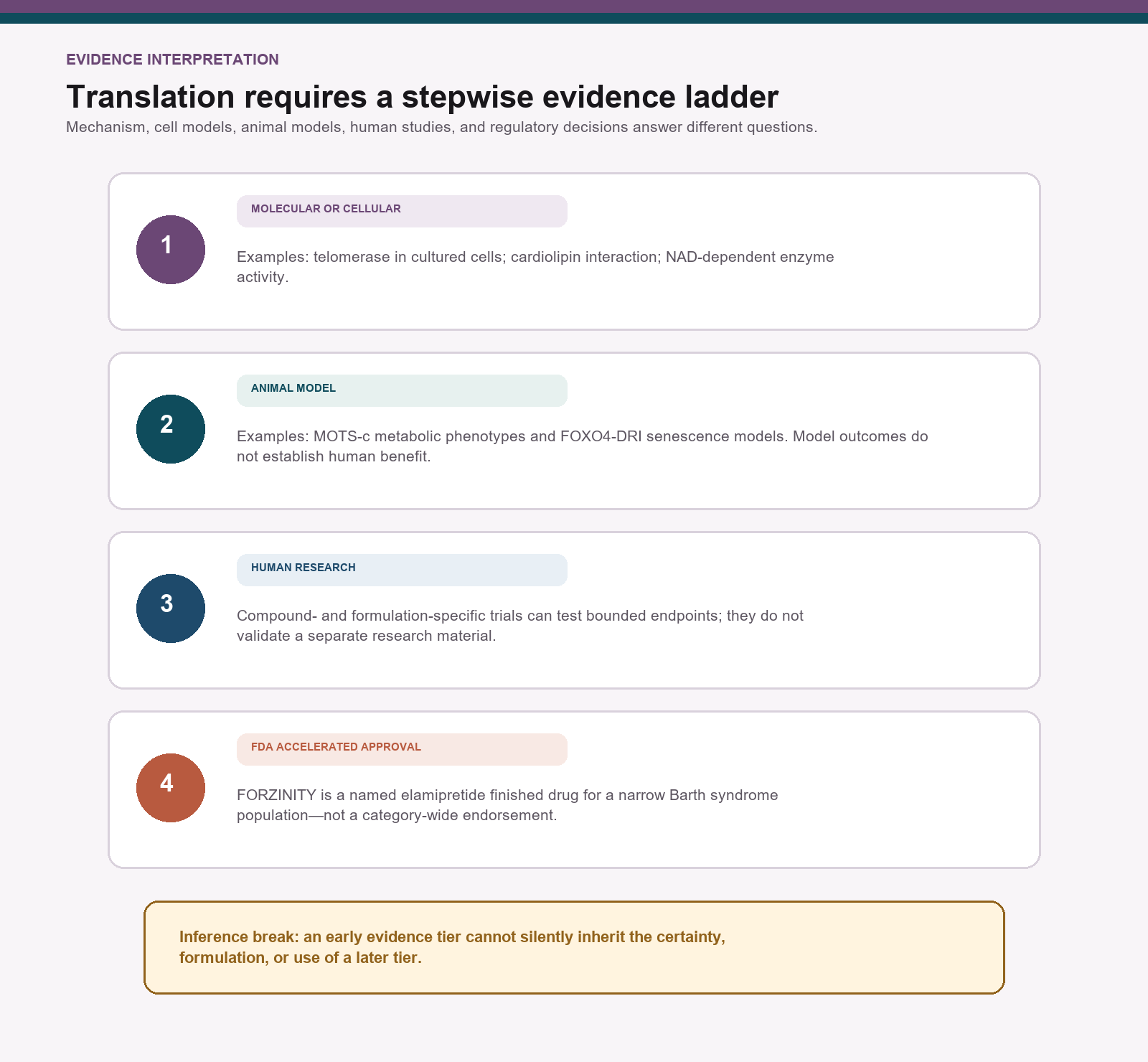
1. Check exact identity
Confirm sequence or chemical identity, salt or complex form, and whether the paper studied the same named material.
2. Name the model
Separate cell, animal, observational human, interventional human, and finished-drug regulatory evidence.
3. Name the endpoint
Telomerase activity, metabolite abundance, gene expression, strength, and lifespan are not interchangeable outcomes.
4. Record the boundary
State what the source does not establish. Missing translation is part of the result, not an inconvenience to hide.
Method, Source Date, and Limitations
This refresh used the July 22, 2026 WordPress export as the post-identity, taxonomy, and internal-link baseline. All cited PMIDs were verified through NCBI E-utilities for title, first author, year, journal, and retraction signal; none is retracted. A July 25, 2026 evidence-restoration pass re-scoped the page as a scientific pillar, returned the quantitative findings, reagent identity data, and per-compound regulatory statements that an earlier refresh had compressed, and added bounded sections for Pinealon and Thymalin, which have no dedicated guide in the corpus. United States regulatory status for every material on this page was re-checked against the FDA application database on July 25, 2026; the FORZINITY approval record for NDA 215244 was confirmed as an original application approved on September 19, 2025 to Stealth BioTherapeutics.
Three limitations are recorded openly. No CAS Registry Number is available in the catalog snapshot for Thymalin or MOTS-c, and none has been invented. Several Khavinson-programme abstracts report the direction of an effect without effect sizes, so those findings appear here without figures rather than with reconstructed ones. European and Chinese regulatory databases, and the Russian State Register of Medicines, were not queryable in this pass, so statements about those jurisdictions are limited to what was actually checked.
This is a curated hub rather than a systematic review. It prioritizes identity, representative program anchors, current regulatory context, and safe routing to exact-compound guides. Absence from this page is not proof that no study exists. Regulatory records, product inventory, and the literature can change; the FDA record and linked destinations should be rechecked immediately before publication.
Frequently Asked Questions
Are longevity research peptides one pharmacological class?
No. The label groups distinct experimental lanes, including short bioregulators, mitochondrial-derived peptides, a designed senescence-directed peptide, and a cardiolipin-focused tetrapeptide. NAD+ also appears in the category even though it is a dinucleotide coenzyme, not a peptide.
Does Epithalon’s telomerase study prove human lifespan extension?
No. The cited study reported telomerase activity and telomere elongation in cultured human somatic cells. That is an in-vitro endpoint and does not establish extended human lifespan, reversal of aging, or therapeutic efficacy.
Are Humanin and MOTS-c the same peptide?
No. They are separate mitochondrial-derived peptides with different sequences, discovery contexts, and evidence bases. Results for one should not be assigned to the other.
Why is NAD+ included if it is not a peptide?
It is included as a neighboring longevity-research topic and catalog navigation route. Its chemistry, enzyme relationships, precursors, and formulations must remain explicitly separate from peptide research.
Is Apex SS-31 the same product as FORZINITY?
No. FORZINITY is an FDA-approved elamipretide finished drug under NDA 215244 for a defined Barth syndrome population. Apex SS-31 is a research-use-only chemical reagent and is not the FORZINITY formulation or a pharmaceutical substitute.
What is Pinealon, and is it approved anywhere?
Pinealon is the synthetic tripeptide Glu-Asp-Arg, also called the EDR peptide, with a sequence-derived mass of 418.41 Da. No FDA application record exists for it, and no EMA or NMPA authorisation was identified. It is supplied as a research reagent only.
Is Thymalin a single peptide?
No. Thymalin is a polypeptide complex, not a single molecule; see the Thymalin Research Guide at apexlab.org/thymalin-research-guide/ for the full identity, evidence, and analytical picture.
Do the mouse senescent-cell clearance results apply to FOXO4-DRI?
Not directly. The INK-ATTAC experiments cleared p16Ink4a-positive cells genetically in mice and validate senescent cells as a target. FOXO4-DRI is a separate designed peptide with its own preclinical record, and the two evidence bases should be kept apart.
Primary References
- HAYFLICK L, et al. The serial cultivation of human diploid cell strains. Exp Cell Res. 1961;25:585-621. PMID: PMID 13905658.
- Greider CW, et al. Identification of a specific telomere terminal transferase activity in Tetrahymena extracts. Cell. 1985;43(2 Pt 1):405-13. PMID: PMID 3907856.
- Khavinson VKh, et al. Epithalon peptide induces telomerase activity and telomere elongation in human somatic cells. Bull Exp Biol Med. 2003;135(6):590-2. PMID: PMID 12937682.
- Anisimov SV, et al. Elucidation of the effect of brain cortex tetrapeptide Cortagen on gene expression in mouse heart by microarray. Neuro Endocrinol Lett. 2004;25(1-2):87-93. PMID: PMID 15159690.
- Hashimoto Y, et al. A rescue factor abolishing neuronal cell death by a wide spectrum of familial Alzheimer’s disease genes and Abeta. Proc Natl Acad Sci U S A. 2001;98(11):6336-41. PMID: PMID 11371646.
- Lee C, et al. The mitochondrial-derived peptide MOTS-c promotes metabolic homeostasis and reduces obesity and insulin resistance. Cell Metab. 2015;21(3):443-54. PMID: PMID 25738459.
- Imai S, et al. Transcriptional silencing and longevity protein Sir2 is an NAD-dependent histone deacetylase. Nature. 2000;403(6771):795-800. PMID: PMID 10693811.
- Rajman L, et al. Therapeutic Potential of NAD-Boosting Molecules: The In Vivo Evidence. Cell Metab. 2018;27(3):529-547. PMID: PMID 29514064.
- Coppé JP, et al. Senescence-associated secretory phenotypes reveal cell-nonautonomous functions of oncogenic RAS and the p53 tumor suppressor. PLoS Biol. 2008;6(12):2853-68. PMID: PMID 19053174.
- Baar MP, et al. Targeted Apoptosis of Senescent Cells Restores Tissue Homeostasis in Response to Chemotoxicity and Aging. Cell. 2017;169(1):132-147.e16. PMID: PMID 28340339.
- Birk AV, et al. The mitochondrial-targeted compound SS-31 re-energizes ischemic mitochondria by interacting with cardiolipin. J Am Soc Nephrol. 2013;24(8):1250-61. PMID: PMID 23813215.
- Reid Thompson W, et al. A phase 2/3 randomized clinical trial followed by an open-label extension to evaluate the effectiveness of elamipretide in Barth syndrome, a genetic disorder of mitochondrial cardiolipin metabolism. Genet Med. 2021;23(3):471-478. PMID: PMID 33077895.
- Zhao C, et al. Elamipretide: The first cardiolipin-directed mitochondrial therapeutic for Barth syndrome approved under accelerated approval. Drug Discov Ther. 2026;19(6):435-436. PMID: PMID 41260682.
- Khavinson VK, et al. Peptide Regulation of Gene Expression: A Systematic Review. Molecules. 2021;26(22). doi:10.3390/molecules26227053. PMID: PMID 34834147.
- Fedoreyeva LI, et al. Penetration of short fluorescence-labeled peptides into the nucleus in HeLa cells and in vitro specific interaction of the peptides with deoxyribooligonucleotides and DNA. Biochemistry (Mosc). 2011;76(11):1210-9. PMID: PMID 22117547.
- Cobb LJ, et al. Naturally occurring mitochondrial-derived peptides are age-dependent regulators of apoptosis, insulin sensitivity, and inflammatory markers. Aging (Albany NY). 2016;8(4):796-809. PMID: PMID 27070352.
- Baker DJ, et al. Clearance of p16Ink4a-positive senescent cells delays ageing-associated disorders. Nature. 2011;479(7372):232-6. PMID: PMID 22048312.
- Baker DJ, et al. Naturally occurring p16(Ink4a)-positive cells shorten healthy lifespan. Nature. 2016;530(7589):184-9. PMID: PMID 26840489.
- López-Otín C, et al. The hallmarks of aging. Cell. 2013;153(6):1194-217. PMID: PMID 23746838.
- López-Otín C, et al. Hallmarks of aging: An expanding universe. Cell. 2023;186(2):243-278. PMID: PMID 36599349.
- Khavinson V, et al. EDR Peptide: Possible Mechanism of Gene Expression and Protein Synthesis Regulation Involved in the Pathogenesis of Alzheimer’s Disease. Molecules. 2020;26(1). doi:10.3390/molecules26010159. PMID: PMID 33396470.
- Khavinson V, et al. Pinealon increases cell viability by suppression of free radical levels and activating proliferative processes. Rejuvenation Res. 2011;14(5):535-41. PMID: PMID 21978084.
- Khavinson VK, et al. Thymalin: Activation of Differentiation of Human Hematopoietic Stem Cells. Bull Exp Biol Med. 2020;170(1):118-122. PMID: PMID 33237528.
- Linkova N, et al. The Influence of KE and EW Dipeptides in the Composition of the Thymalin Drug on Gene Expression and Protein Synthesis Involved in the Pathogenesis of COVID-19. Int J Mol Sci. 2023;24(17). doi:10.3390/ijms241713377. PMID: PMID 37686182.
- Szeto HH. First-in-class cardiolipin-protective compound as a therapeutic agent to restore mitochondrial bioenergetics. Br J Pharmacol. 2014;171(8):2029-50. PMID: PMID 24117165.
- Anisimov VN, et al. [Effect of pineal peptide on parameters of the biological age and life span in mice]. Ross Fiziol Zh Im I M Sechenova. 2001;87(1):125-36. PMID: PMID 11227856.
- Arutjunyan A, et al. Pinealon protects the rat offspring from prenatal hyperhomocysteinemia. Int J Clin Exp Med. 2012;5(2):179-85. PMID: PMID 22567179.
- Khavinson VK, et al. Results and Prospects of Using Activator of Hematopoietic Stem Cell Differentiation in Complex Therapy for Patients with COVID-19. Stem Cell Rev Rep. 2021;17(1):285-290. PMID: PMID 33575961.
- Tchkonia T, et al. New Horizons: Novel Approaches to Enhance Healthspan Through Targeting Cellular Senescence and Related Aging Mechanisms. J Clin Endocrinol Metab. 2021;106(3):e1481-e1487. PMID: PMID 33155651.