
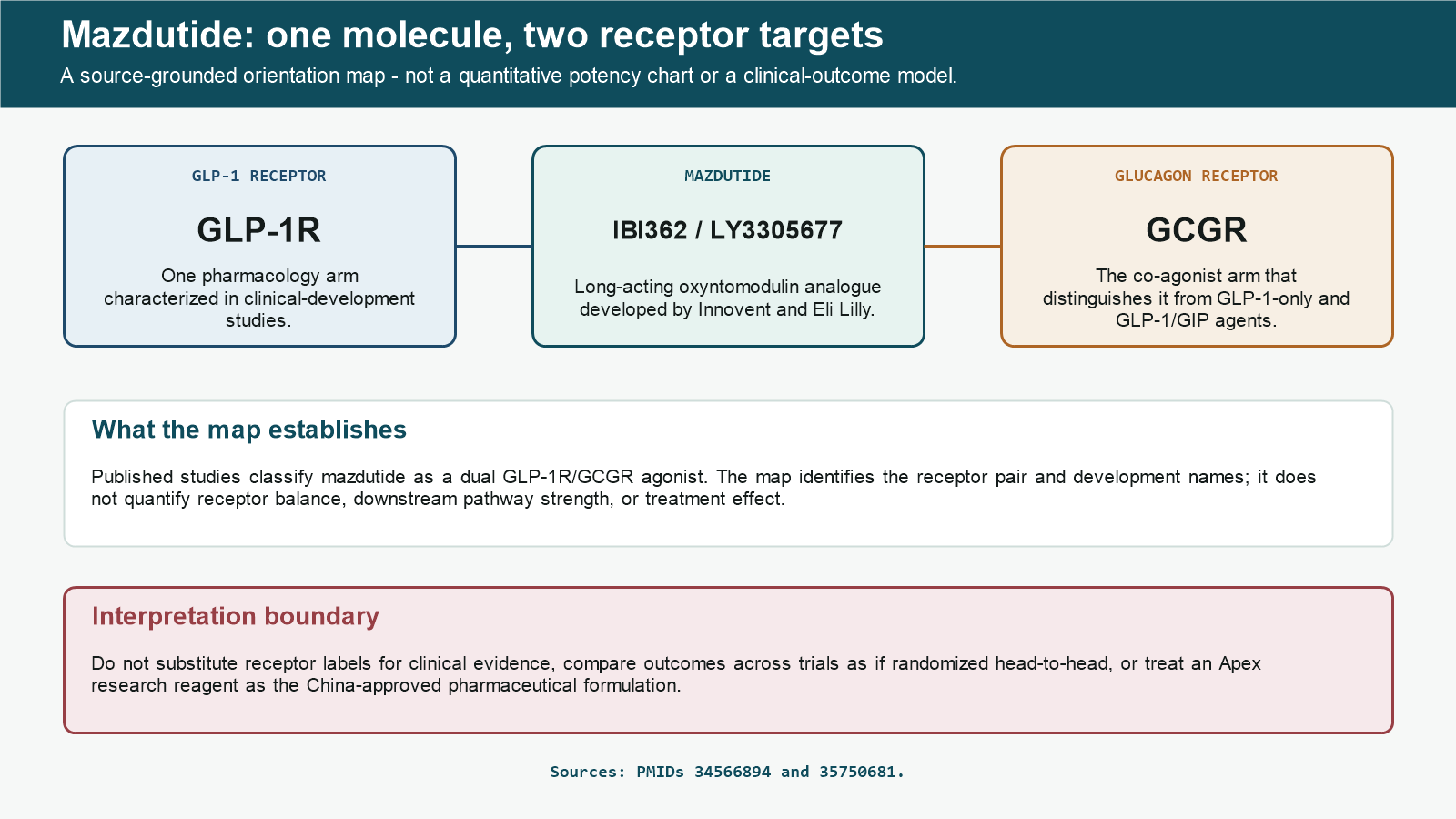
Mazdutide is a long-acting oxyntomodulin analogue that activates the GLP-1 and glucagon receptors and is also identified as IBI362 or LY3305677. Randomized phase 3 studies in China characterize weight and glycemic outcomes in defined trial populations. Apex Laboratory supplies mazdutide as a research-grade chemical reagent for in-vitro and preclinical research, distinct from the Xinermei pharmaceutical formulation approved in China.
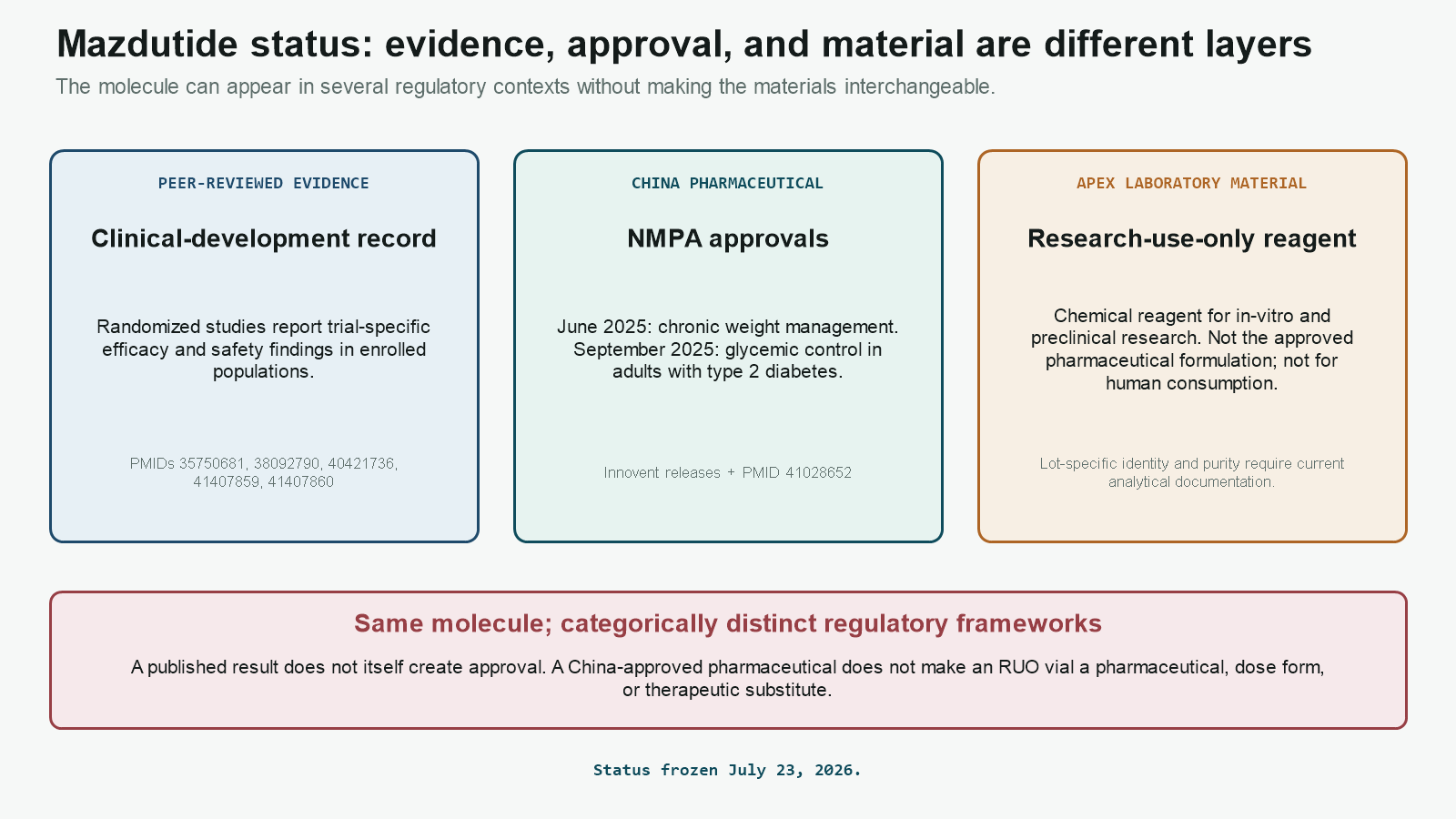
Mazdutide now has three records that readers must keep separate: a dual-receptor molecule described in peer-reviewed studies, a pharmaceutical formulation approved by China’s National Medical Products Administration (NMPA), and research-use material supplied for laboratory work. Collapsing those records produces the most consequential errors around this compound. A trial result is not a reagent specification, and an approved pharmaceutical is not interchangeable with an Apex vial.
- Mazdutide, IBI362, and LY3305677 identify the same long-acting oxyntomodulin analogue in the cited development record.
- Its defining receptor pair is GLP-1R plus GCGR; it does not include the GIP receptor.
- GLORY-1 provides placebo-controlled phase 3 evidence in 610 Chinese adults with overweight or obesity.
- DREAMS-1 and DREAMS-2 provide phase 3 evidence in Chinese adults with type 2 diabetes, against placebo and dulaglutide respectively.
- China approved mazdutide for chronic weight management in June 2025 and for glycemic control in adults with type 2 diabetes in September 2025.
- Same molecule does not mean same regulatory category: Apex research reagent and the China-approved pharmaceutical formulation are categorically distinct.
What Is Mazdutide?
Mazdutide is a long-acting peptide analogue derived from oxyntomodulin pharmacology. The clinical-development literature also uses the identifiers IBI362 and LY3305677. Early randomized work in Chinese participants described it as a co-agonist of the glucagon-like peptide-1 receptor (GLP-1R) and glucagon receptor (GCGR).[1] That receptor combination is the most useful first distinction: mazdutide is not a GLP-1-only agonist, not a GLP-1/GIP dual agonist, and not a GLP-1/GIP/glucagon triple agonist.
Identity should not be reduced to a copied molecular-weight field. Public records can represent the peptide, its conjugate, and related chemical forms differently. For laboratory work, a defensible identity statement names the expected analyte definition and ties the intact-mass target to a current lot document. A database value without that context cannot establish what is in a vial.
Reagent identity record
| Identity field | Value | Basis |
|---|---|---|
| Designators | LY3305677; IBI362; Xinermei (China trade name) | PMIDs 35750681, 41028652 |
| CAS registry number | 2259884-03-0 | Supplier-reported Apex catalog record |
| Molecular formula | C207H317N45O65 | PubChem CID 167312357 |
| Molecular weight | About 4,476 g/mol; vendor sheets instead give C210H322N46O67 at about 4,563 g/mol | PubChem against vendor sheets; the difference tracks salt or counterion form |
| Purity specification | Read the applicable published mazdutide report for its configuration, lot, methods and results | Supplier catalog specification, not a published measurement; the lot certificate carries the measured value |
| Residue sequence | Not asserted | No first-party sequence record; intact mass on the lot document is the identity anchor |
How Is Dual GLP-1/Glucagon Agonism Studied?
The rationale for GLP-1/glucagon co-agonism is to study two signaling arms in one molecule. GLP-1R agonism and GCGR agonism have different physiological roles, so a co-agonist raises questions about receptor balance, exposure, tissue context, and the net result of engaging both systems. A review of the class describes that balance as central to development rather than assuming that adding glucagon activity is automatically beneficial.[2] That paper is a narrative synthesis of the co-agonist literature and reports no quantitative endpoint of its own.
Phase 1b and phase 2 mazdutide studies progressively characterized tolerability and metabolic outcomes in their enrolled populations.[3][4] These human pharmaceutical studies establish trial-specific observations. They do not validate an in-vitro assay, set an RUO reagent specification, or create a transferable administration protocol. Likewise, labeling a reagent “dual agonist” does not prove receptor potency or biological activity in a particular experiment; those are assay questions.
Earlier trial readouts
| Study | Population | Reported readout | Source |
|---|---|---|---|
| Phase 1b, 12 weeks | 43 Chinese adults with type 2 diabetes | Once-weekly 3.0, 4.5 or 6.0 mg versus placebo or dulaglutide 1.5 mg; diarrhoea in 29.2% on mazdutide, 33.3% on dulaglutide, 0% on placebo; HbA1c fell from baseline without per-arm values in the abstract | PMID 35750681 |
| Phase 1b, multiple ascending dose | 24 Chinese adults with overweight or obesity | Body weight −11.7% at week 12 in the 9 mg cohort versus −1.8% placebo (ETD −9.8%); −9.5% at week 16 in the 10 mg cohort versus −3.3% placebo (ETD −6.2%) | PMID 36247927 |
| Phase 2, 24 weeks | 248 Chinese adults with overweight or obesity | Body weight −6.7% (3 mg), −10.4% (4.5 mg) and −11.3% (6 mg) versus +1.0% placebo, all p < 0.0001 | PMID 38092790 |
Identity: What molecule or material was tested? Pharmacology: Which receptor readouts were measured under what conditions? Clinical outcome: Which population, comparator, time point, and estimand produced the reported result? A claim should not move between layers without direct evidence.
What Did the GLORY-1 Trial Show?
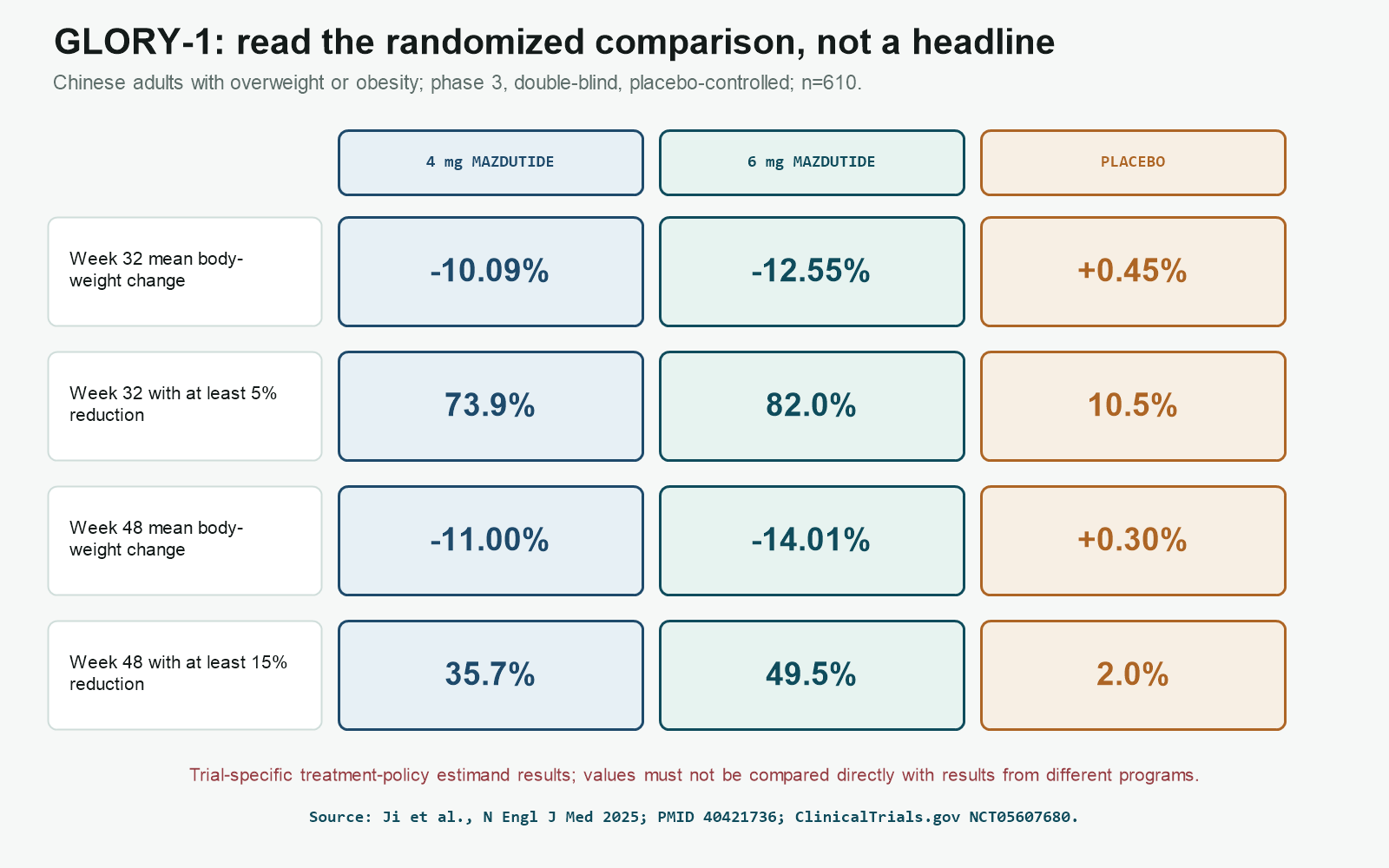
GLORY-1 was a phase 3, double-blind, placebo-controlled trial in China. It randomized 610 adults aged 18 to 75 with obesity or overweight plus at least one weight-related coexisting condition to 4 mg mazdutide, 6 mg mazdutide, or placebo. The two primary endpoints assessed percentage change in body weight and the proportion reaching at least 5% reduction at week 32 using a treatment-policy estimand.[5]
At week 32, mean body-weight change was −10.09% in the 4 mg group, −12.55% in the 6 mg group, and +0.45% with placebo. The proportions with at least 5% reduction were 73.9%, 82.0%, and 10.5%, respectively. At week 48, mean changes were −11.00%, −14.01%, and +0.30%; the proportions with at least 15% reduction were 35.7%, 49.5%, and 2.0%.
The most frequently reported adverse events in GLORY-1 were gastrointestinal and mostly mild to moderate; discontinuation rates were low in all three groups.[5] Those are population-level trial observations, not an individual safety assessment. A separate small phase 1 study escalated 32 adults with overweight or obesity to a 16 mg target dose and reported mean body-weight change at week 20 of −20.0% and −21.0% in its two dose-escalation cohorts versus −0.1% with placebo, but that sample size and phase 1 design make it a different evidence question from GLORY-1.[6]
What Does the DREAMS Program Add?
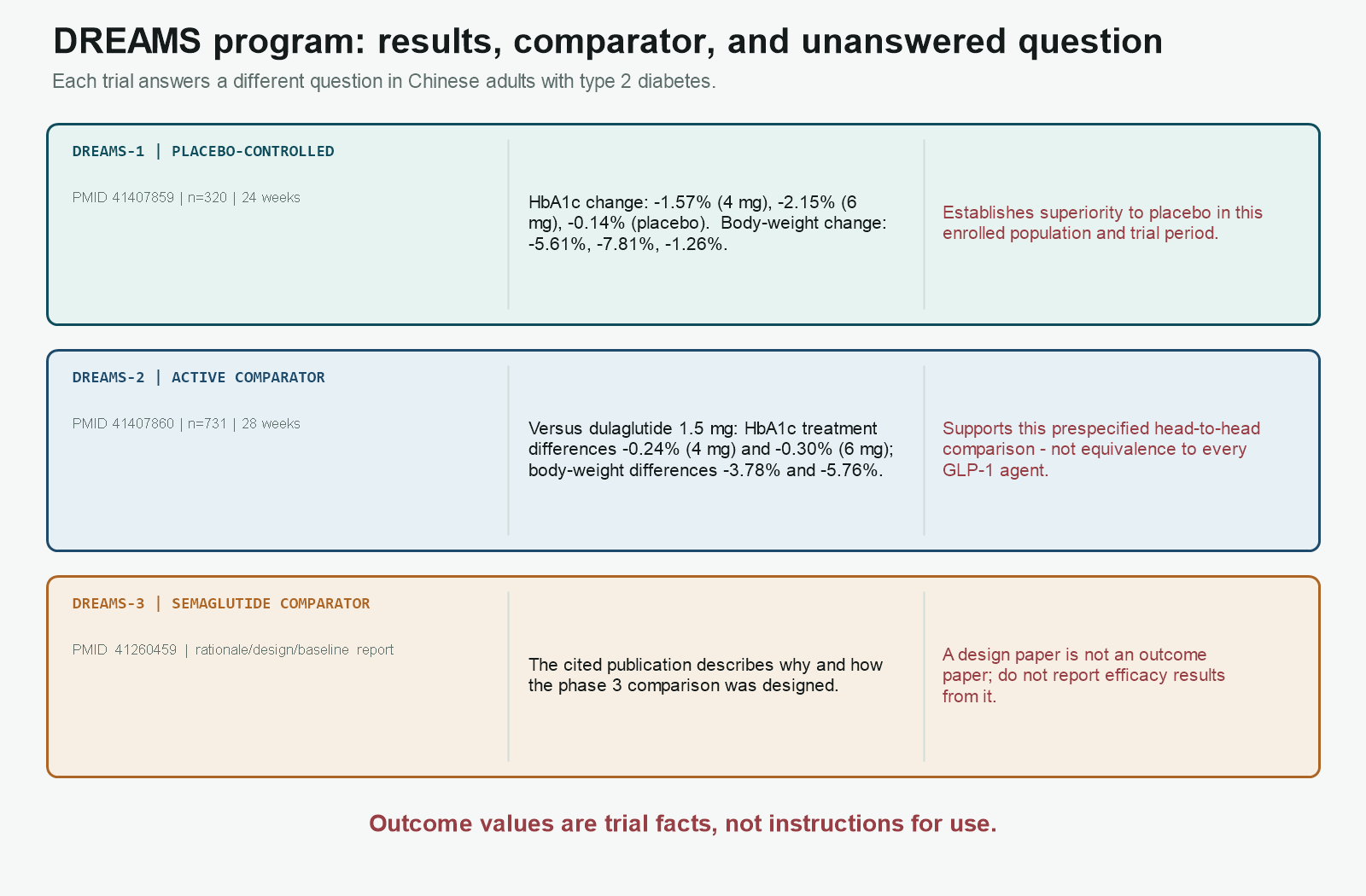
The DREAMS program studies type 2 diabetes rather than duplicating the GLORY-1 question. DREAMS-1 randomized 320 Chinese adults to mazdutide 4 mg, mazdutide 6 mg, or placebo. At week 24, reported HbA1c changes were −1.57%, −2.15%, and −0.14%, while body-weight changes were −5.61%, −7.81%, and −1.26%, respectively.[7]
DREAMS-2 asked an active-comparator question. It randomized 731 Chinese adults with type 2 diabetes to mazdutide 4 mg, mazdutide 6 mg, or dulaglutide 1.5 mg for 28 weeks. Reported HbA1c treatment differences versus dulaglutide were −0.24% and −0.30%; body-weight treatment differences were −3.78% and −5.76%.[8] This is direct evidence for that comparator, dose set, population, and duration. It is not evidence that mazdutide outperforms every GLP-1 medicine.
The cited DREAMS-3 publication is a rationale, design, and baseline paper for a mazdutide-versus-semaglutide phase 3 comparison.[9] It reports baseline characteristics for 349 randomized Chinese adults with type 2 diabetes and obesity — mean HbA1c 8.0%, mean body weight 90.5 kg — allocated 1:1 to mazdutide 6 mg or semaglutide 1 mg once weekly across a 32-week active-controlled period. Those are entry characteristics, not outcomes. A design paper can explain the planned question and analysis. It cannot supply an efficacy result before an outcome report exists.
What Is Mazdutide’s Regulatory Status?
China’s NMPA approved mazdutide for chronic weight management in Chinese adults with overweight or obesity in June 2025. Innovent stated that the decision was mainly based on GLORY-1.[10] In September 2025, Innovent announced a second NMPA approval for glycemic control in adults with type 2 diabetes.[11] A peer-reviewed first-approval review records both decisions and states that the June 2025 weight-management approval covers Chinese adults with a body-mass index of at least 28 kg/m², or at least 24 kg/m² alongside one or more weight-related comorbidity.[12] That review describes the June 2025 decision as mazdutide’s first approval anywhere: as of this writing it holds no FDA, EMA, or other marketing authorization outside China, in any indication.
Country and formulation matter. These are China-specific approvals of a pharmaceutical product under NMPA oversight. They do not convert every material called mazdutide into that product, and they do not authorize Apex research material for human use. The canonical distinction is: same molecule; categorically distinct regulatory frameworks. The broader research-grade versus pharmaceutical-grade guide explains why intended use, manufacturing controls, release testing, labeling, and regulatory authorization must be evaluated together.
How Does Mazdutide Differ From Semaglutide, Tirzepatide, and Retatrutide?
The cleanest comparison uses receptor targets, not promotional rankings. The table below does not compare efficacy, safety, or approved indications. Those require product-specific and trial-specific evidence.
| Compound | Receptor profile | What distinguishes the research question | Interpretation limit |
|---|---|---|---|
| Mazdutide | GLP-1R + GCGR | Dual incretin/glucagon co-agonism without a GIP arm | Do not infer identical receptor balance across assays or materials |
| Semaglutide | GLP-1R | Single-receptor GLP-1 agonism | Not a randomized comparator in GLORY-1 |
| Tirzepatide | GIPR + GLP-1R | Dual incretin agonism without a glucagon arm | Different receptor pair; cross-trial rankings are not head-to-head evidence |
| Retatrutide | GLP-1R + GIPR + GCGR | Triple-receptor agonism | Adding a receptor changes the research question, not just the label |
For deeper context, use the GLP-1 and metabolic research hub, the next-generation GLP-1 research guide, and the dedicated guides for semaglutide, retatrutide, and survodutide. Keeping each receptor profile and evidence record separate reduces cannibalization and factual drift across the cluster.
How Strong Is the Mazdutide Evidence?
Mazdutide has a comparatively mature clinical-development record for an emerging multi-receptor agonist: early phase trials, phase 2 studies, placebo-controlled phase 3 trials, an active-comparator phase 3 trial, and two China approvals. That maturity supports precise statements about the populations and outcomes actually studied.
It does not remove important limits. The pivotal record is centered in Chinese trial populations. Endpoints, comparators, estimands, durations, and background therapies vary. Many studies were funded by the developer, and several authors disclosed Innovent employment, shareholding, or consulting relationships. These facts do not invalidate results, but they belong in an evidence appraisal. Longer-term, population-diverse, and indication-specific questions require their own data.
The literature also cannot answer a current-lot reagent question. Clinical trial material, an approved formulation, and a commercial RUO vial have separate custody, formulation, manufacturing, and release records. A researcher cannot transfer a clinical publication’s identity or quality controls to an unrelated lot.
What Can Analytical Documentation Verify?
Analytical methods answer narrower questions than an article or a trial. Reversed-phase HPLC can estimate chromatographic purity under a stated method by integrating detected peaks. Mass spectrometry can test whether observed ions support the expected analyte mass. Neither method alone proves receptor activity, sterility, clinical suitability, safety, or therapeutic equivalence.
A useful lot review starts with the exact material definition, then checks the lot identifier, test date, method, expected mass basis, observed mass assignment, chromatogram integration, and any stated limitations. The COA reading guide and HPLC guide explain those layers. Current documents should be retrieved from the Lab Verified archive; values should never be copied from an old article into a new lot record.
For laboratories that have already defined an appropriate in-vitro research question, the Mazdutide research reagent page is the current first-party material record. It is not the China-approved pharmaceutical formulation and is not for human consumption.
Frequently Asked Questions
What is mazdutide?
Mazdutide is a long-acting oxyntomodulin analogue and dual GLP-1/glucagon receptor agonist also known as IBI362 or LY3305677. Its clinical-development record includes randomized studies in adults with overweight, obesity, or type 2 diabetes.
What did GLORY-1 study?
GLORY-1 was a phase 3, double-blind, placebo-controlled trial in 610 Chinese adults with overweight or obesity. It compared mazdutide 4 mg, mazdutide 6 mg, and placebo using prespecified body-weight endpoints at weeks 32 and 48.
Is mazdutide approved?
China’s NMPA approved a mazdutide pharmaceutical formulation for chronic weight management in June 2025 and for glycemic control in adults with type 2 diabetes in September 2025. Those China-specific approvals do not apply to Apex research-use material.
How is mazdutide different from tirzepatide?
Mazdutide activates GLP-1 and glucagon receptors, whereas tirzepatide activates GIP and GLP-1 receptors. The different receptor pairs create different pharmacology questions; they do not support a cross-trial efficacy or safety ranking by themselves.
Does the DREAMS-3 design paper prove mazdutide is better than semaglutide?
No. The cited DREAMS-3 publication describes rationale, design, and baseline data for a phase 3 comparison. A design paper does not establish an efficacy or safety result.
Is Apex mazdutide the approved pharmaceutical?
No. Apex Laboratory supplies mazdutide as a research-grade chemical reagent for in-vitro and preclinical research only. It is not the China-approved pharmaceutical formulation, is not for human consumption, and is not represented as a therapeutic substitute.
References
- Jiang H, et al. A phase 1b randomised controlled trial of a glucagon-like peptide-1 and glucagon receptor dual agonist IBI362 (LY3305677) in Chinese patients with type 2 diabetes. Nat Commun. 2022;13(1):3613. PMID: PMID 35750681.
- Hope DCD, et al. Striking the Balance: GLP-1/Glucagon Co-Agonism as a Treatment Strategy for Obesity. Front Endocrinol (Lausanne). 2021;12:735019. PMID: PMID 34566894.
- Ji L, et al. Safety and efficacy of a GLP-1 and glucagon receptor dual agonist mazdutide (IBI362) 9 mg and 10 mg in Chinese adults with overweight or obesity: A randomised, placebo-controlled, multiple-ascending-dose phase 1b trial. EClinicalMedicine. 2022;54:101691. PMID: PMID 36247927.
- Ji L, et al. A phase 2 randomised controlled trial of mazdutide in Chinese overweight adults or adults with obesity. Nat Commun. 2023;14(1):8289. PMID: PMID 38092790.
- Ji L, et al. Once-Weekly Mazdutide in Chinese Adults with Obesity or Overweight. N Engl J Med. 2025;392(22):2215-2225. PMID: PMID 40421736.
- Bhattachar SN, et al. Mazdutide reduces body weight in adults with overweight or obesity: A high-dose Phase 1 trial. Diabetes Obes Metab. 2025;27(11):6460-6469. PMID: PMID 40832785.
- Zhu D, et al. Mazdutide versus placebo in Chinese adults with type 2 diabetes. Nature. 2026;652(8108):174-180. PMID: PMID 41407859.
- Guo L, et al. Mazdutide versus dulaglutide in Chinese adults with type 2 diabetes. Nature. 2026;652(8108):181-188. PMID: PMID 41407860.
- Luo Y, et al. Mazdutide versus Semaglutide for the treatment of type 2 diabetes and obesity: Rationale, design and baseline data of DREAMS-3 phase 3 trial. Contemp Clin Trials. 2026;160:108150. PMID: PMID 41260459.
- Shirley M. Mazdutide: First Approval. Drugs. 2025;85(12):1621-1627. PMID: PMID 41028652.