TRIUMPH-1 (NCT05929066) is a completed Phase 3 randomized, double-blind, placebo-controlled trial of investigational retatrutide in 2,335 adults with obesity or overweight and no type 2 diabetes. Lilly reported topline results on May 21, 2026, including mean body-weight change of -28.3% at week 80 for the 12 mg arm under the efficacy estimand; however, the registry lists no results posted, and a full peer-reviewed TRIUMPH-1 report was not identified as of July 23, 2026.
Evidence checked July 23, 2026. TRIUMPH-1 now has three facts that search summaries often collapse: the trial is complete, Lilly has disclosed topline results, and ClinicalTrials.gov still shows no posted results. A sponsor release can document what the sponsor reported on a specific date; it does not become a peer-reviewed trial paper or a registry results module.
This update preserves the page’s high-value TRIUMPH-1 focus. It explains the study design, the two estimands behind the headline percentages, the selected 104-week extension, the disclosed safety signals, and what the broader program does – and does not – establish. For molecular pharmacology, use the retatrutide research guide. For a symmetric compound comparison, use retatrutide versus tirzepatide.
What the 2026 TRIUMPH-1 update supports
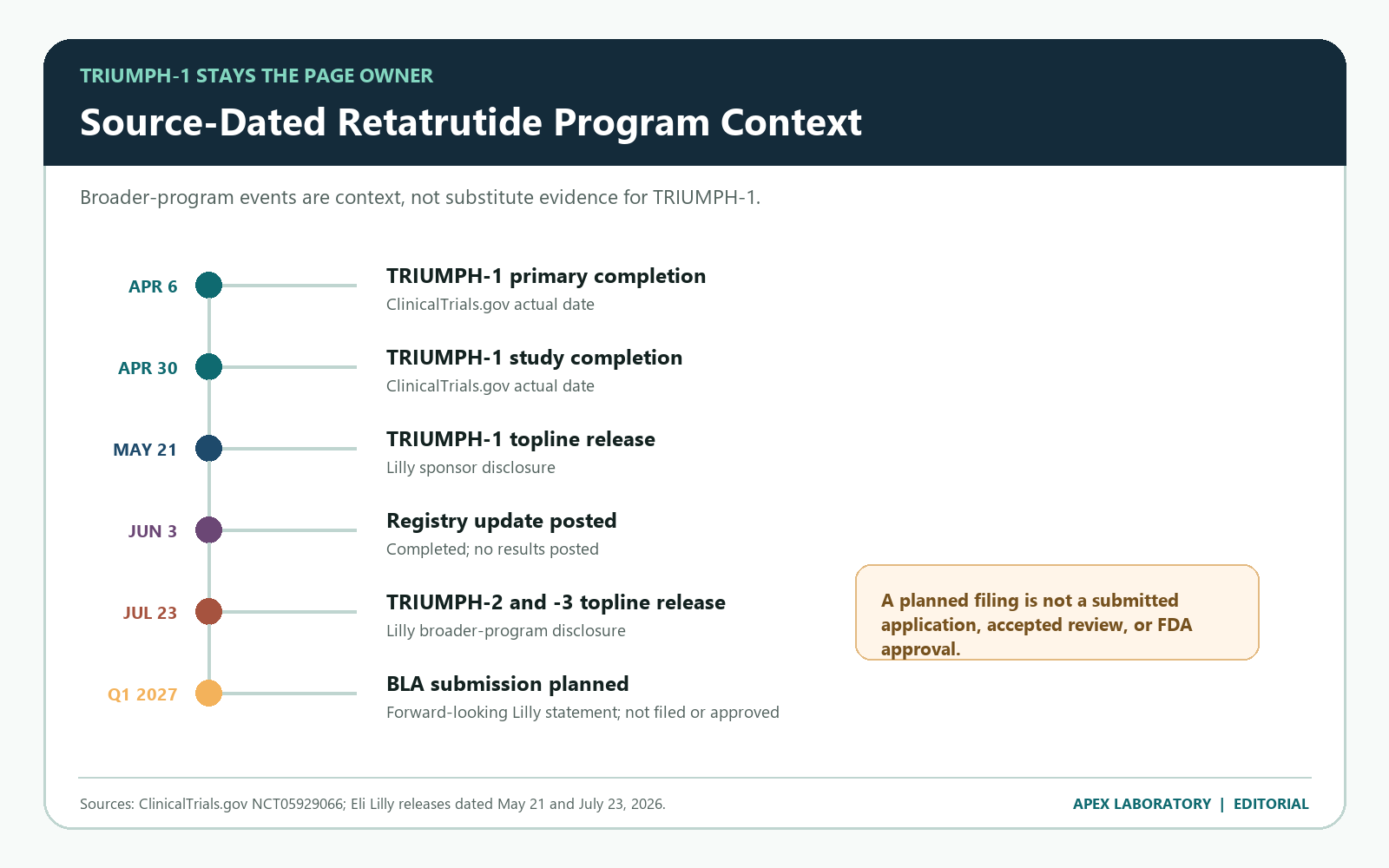
- ClinicalTrials.gov lists TRIUMPH-1 as completed, with 2,335 actual participants and an April 30, 2026 study-completion date.
- Lilly’s May 21 disclosure reported week 80 efficacy-estimand mean body-weight changes of -19.0%, -25.9%, and -28.3% for the 4 mg, 9 mg, and 12 mg groups, versus -2.2% for placebo.
- The treatment-regimen estimand produced different week 80 values: -17.6%, -23.7%, and -25.0%, versus -3.9% for placebo. The estimand must travel with the number.
- The 104-week extension involved a selected subgroup with baseline BMI at least 35; placebo participants crossed to retatrutide, so it was not a continuing placebo-controlled comparison.
- Retatrutide remained investigational. Lilly’s July 23 statement of a planned Q1 2027 BLA submission is not a filed application or an FDA approval.
TRIUMPH-1 Status at a Glance
Registry record
NCT05929066 is completed. Last update posted June 3, 2026. Actual enrollment: 2,335. No results posted.
Sponsor disclosure
Lilly reported topline TRIUMPH-1 results on May 21, 2026, including efficacy, treatment-regimen, extension, and safety summaries.
Peer-reviewed record
Peer-reviewed retatrutide Phase 2 and TRIUMPH design publications exist. A full peer-reviewed TRIUMPH-1 results article was not identified in this July 23 evidence freeze.
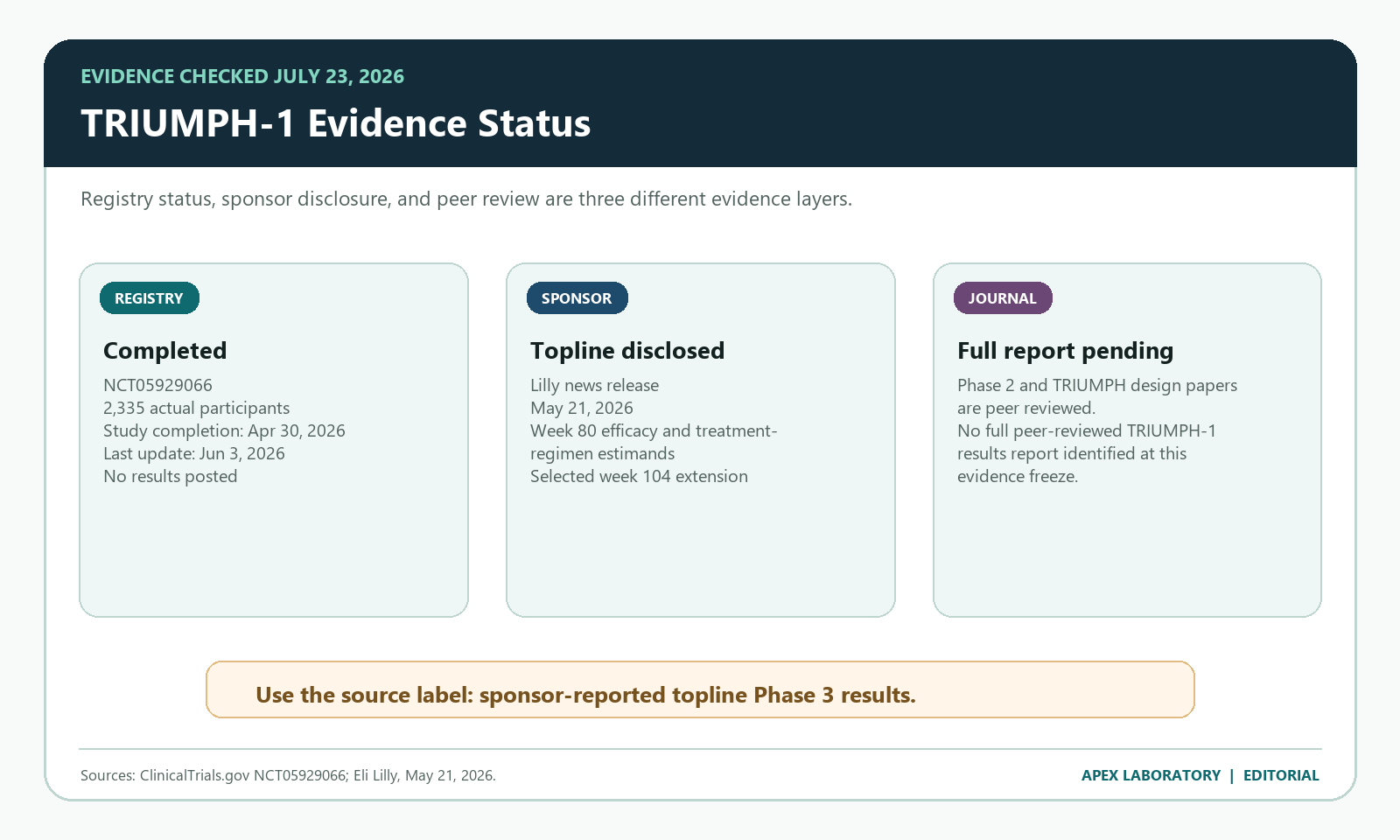
These layers answer different questions. The registry controls protocol identity, completion status, enrollment, and whether results have been posted. The sponsor release controls what Lilly publicly reported and when. A full journal report would add methods and analyses needed for deeper independent appraisal. Until then, the precise label is sponsor-reported topline Phase 3 results.
What TRIUMPH-1 Studied
TRIUMPH-1 is a randomized, double-blind, placebo-controlled Phase 3 master protocol sponsored by Eli Lilly. It enrolled adults with obesity or overweight and at least one weight-related comorbidity, without type 2 diabetes. The registry also includes prespecified knee-osteoarthritis and obstructive-sleep-apnea subsets, but the main body-weight analysis and those subset endpoints should not be conflated.
| Design element | Registry-defined TRIUMPH-1 detail | Interpretation control |
|---|---|---|
| Identifier and phase | NCT05929066; Phase 3 | Use the identifier to separate TRIUMPH-1 from other TRIUMPH and TRANSCEND studies. |
| Population | Adults with obesity or overweight, without type 2 diabetes | Do not generalize the result to a different clinical or laboratory population. |
| Allocation | Retatrutide dose groups or placebo; randomized, parallel assignment | Dose-group observations are trial-specific, not an administration recommendation. |
| Masking | Double masking of participant and investigator | Masking applies to the protocol; the topline release is a later sponsor summary. |
| Main time point | Week 80 | Keep week 80 results separate from the selected week 104 extension. |
| Actual enrollment | 2,335 participants | This supersedes earlier estimated-enrollment language. |
| Recorded dates | Primary completion April 6, 2026; study completion April 30, 2026 | The registry’s last update was posted June 3, 2026. |
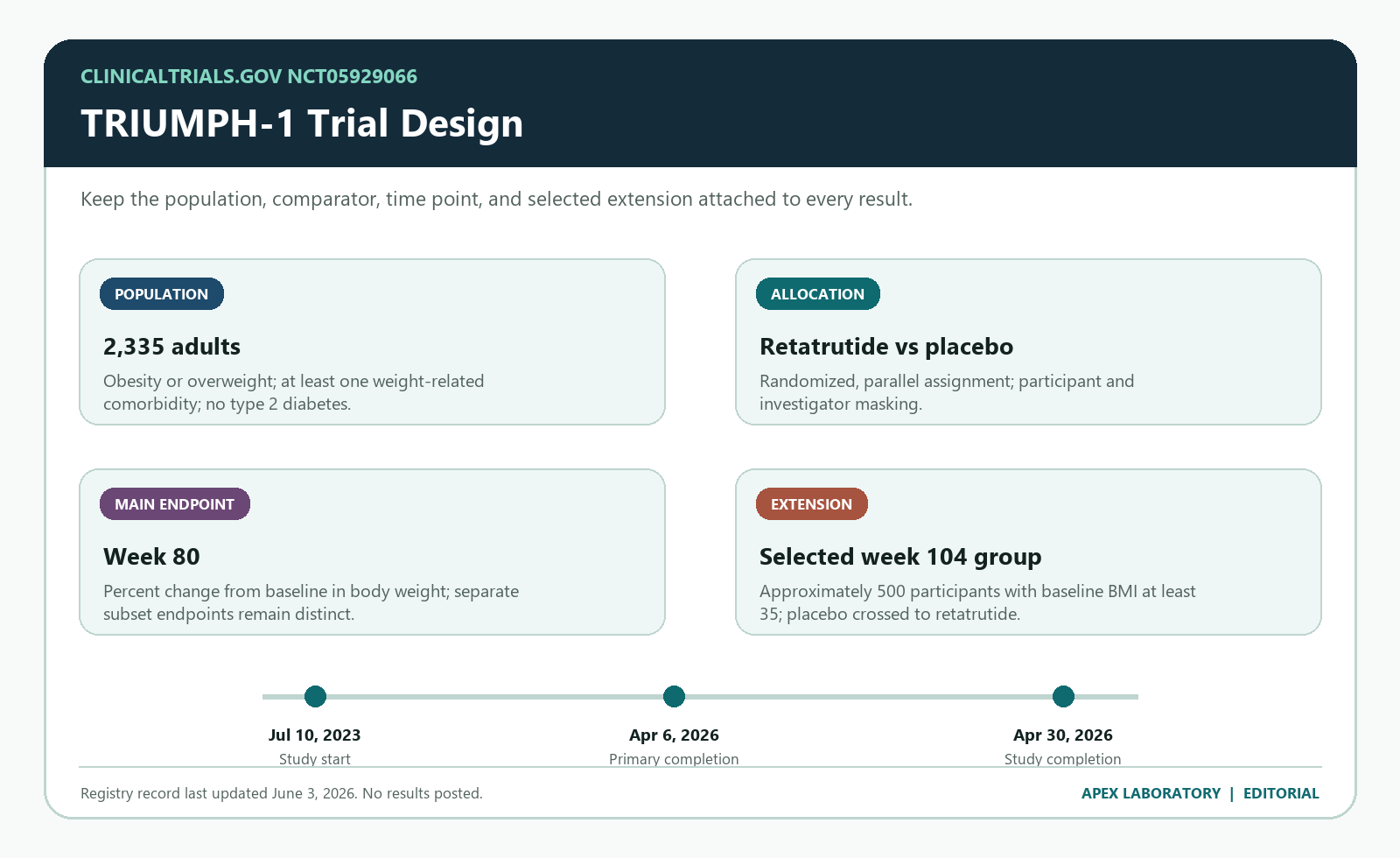
The ClinicalTrials.gov record sets the primary outcome as percent change from baseline in body weight at week 80, and records separate week 80 outcomes for the knee-pain and sleep-apnea subsets plus a week 104 body-weight outcome for an extension group. Those time points are registry facts. The peer-reviewed TRIUMPH design article covers a different layer: it describes a four-study basket program in more than 5,800 participants and names the weight-management, apnea-hypopnea-index, and knee-pain endpoints without attaching time points to them.PMID 41090431
TRIUMPH-1 Results Reported in May 2026
Lilly disclosed two analytical views at week 80. The efficacy estimand describes the outcome under a hypothetical condition in which randomized participants remained on study intervention, with permitted interruptions or modifications and without prohibited weight-management treatment. The treatment-regimen estimand reflects the randomized treatment policy under the release’s stated rules. Because the estimands address different questions, their percentages are not interchangeable.
| Week 80 mean change from baseline | Retatrutide 4 mg | Retatrutide 9 mg | Retatrutide 12 mg | Placebo |
|---|---|---|---|---|
| Efficacy estimand | -19.0% | -25.9% | -28.3% | -2.2% |
| Treatment-regimen estimand | -17.6% | -23.7% | -25.0% | -3.9% |
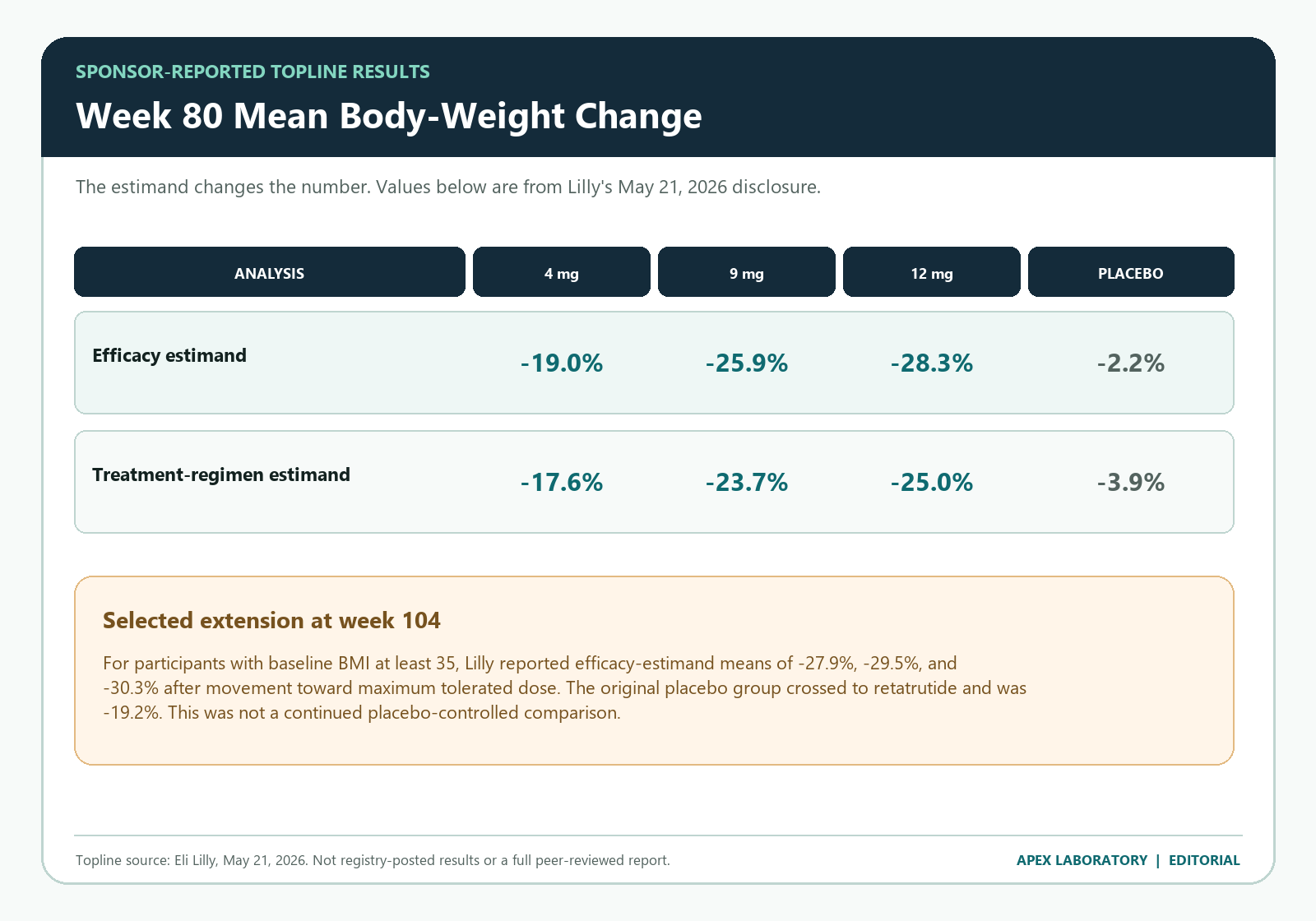
The release also reported that 45.3% of participants in the 12 mg arm achieved at least 30% body-weight reduction at week 80 under the efficacy estimand. That figure is a categorical secondary result, not the group mean. It should not be substituted for the -28.3% mean change, and neither value should be presented without the dose group, time point, population, estimand, and sponsor-source label.
How to read the 104-week extension
Participants with baseline BMI of at least 35 entered a prespecified 24-week extension. Lilly reported week 104 efficacy-estimand mean changes of -27.9%, -29.5%, and -30.3% across the original 4 mg, 9 mg, and 12 mg groups after movement toward a maximum tolerated dose. Participants originally assigned to placebo crossed to retatrutide and had a reported -19.2% mean change at week 104.
That design creates two limits. First, the extension is a selected subgroup rather than the entire randomized population. Second, the former placebo group no longer functions as an untreated placebo comparator after crossover. The 104-week values therefore answer a continuation question; they do not extend the week 80 placebo-controlled contrast unchanged.
Safety Signals in the Topline Disclosure
Lilly reported that the most common events included nausea, diarrhea, constipation, and vomiting. At 12 mg versus placebo, the disclosed incidences were 42.4% versus 14.8% for nausea, 32.0% versus 13.5% for diarrhea, 26.1% versus 10.9% for constipation, and 25.3% versus 4.8% for vomiting. Discontinuation because of adverse events was reported as 4.1%, 6.9%, and 11.3% for the 4 mg, 9 mg, and 12 mg groups, versus 4.9% for placebo.
Those are sponsor-reported trial observations, not a complete safety assessment and not patient guidance. A full paper and regulator review can supply details that a topline release cannot, including complete event definitions, timing, subgroup analyses, missing-data handling, and adjudication. The current evidence therefore supports a scoped description of disclosed signals, not a claim that the safety profile is fully characterized.
What Peer-Reviewed Retatrutide Research Adds
Retatrutide, also identified as LY3437943, was developed as one peptide with activity at GIP, GLP-1, and glucagon receptors. The discovery-to-proof-of-concept paper provides the receptor-pharmacology and early-development basis for that description.PMID 35985340 The Phase 2 obesity trial then reported randomized clinical observations at 24 and 48 weeks and helped motivate the Phase 3 program.PMID 37366315
Those publications make the Phase 3 result biologically and historically legible, but they are not substitutes for TRIUMPH-1 results. A Phase 2 paper cannot verify a Phase 3 sponsor table, and a mechanism paper cannot establish a current regulatory status. This source-to-claim discipline is central to both conventional search quality and AI answer extraction.
Additional reported findings
None of these rows is a TRIUMPH-1 result; all are adult trial populations. TRANSCEND-T2D-1 is the peer-reviewed Phase 3 retatrutide report in type 2 diabetes.
| Trial and design | Population | Endpoint | Reported result | Source |
|---|---|---|---|---|
| TRANSCEND-T2D-1, Phase 3, 40 weeks, retatrutide 4-12 mg | Adults with type 2 diabetes, diet and exercise alone (n=537) | HbA1c and body weight at week 40, treatment-regimen estimand | HbA1c -1.94% at 12 mg versus -0.81% placebo; body weight -15.3% versus -2.6% | PMID 42250575 |
| Phase 2a substudy, 48 weeks, retatrutide 1-12 mg | Adults with MASLD and at least 10% liver fat (n=98) | Mean relative liver-fat change at week 24 | -82.4% at 12 mg versus +0.3% placebo; 86% of that group reached liver fat below 5% | PMID 38858523 |
| Post hoc analysis, two Phase 2 trials | Adults with overweight or obesity, no type 2 diabetes, baseline eGFR at least 45 ml/min/1.73 m2 (n=338) | Urine albumin-to-creatinine ratio and eGFR at week 48 | -31.5% at 12 mg versus placebo (95% CI -49.3 to -7.4); creatinine-derived eGFR +8.5 mL/min/1.73 m2 (95% CI 4.9 to 12.1) | PMID 40630318 |
| Post hoc exploratory metabolomics, two Phase 2 trials | Two separate cohorts: adults with obesity without type 2 diabetes (n=282, 48 weeks) and adults with obesity and type 2 diabetes (n=213, 36 weeks) | Share of the weight-reduction response mediated by a fatty-acid-oxidation biomarker cluster | Mediation analyses suggested 23.2% in the n=282 cohort without type 2 diabetes, blunted to 12.7% in the n=213 cohort with type 2 diabetes; exploratory estimates, not confirmatory results | PMID 42135195 |
The retatrutide research guide owns detailed molecular identity and the broader publication record. The next-generation GLP-1 research hub owns the class landscape. This page retains only the background required to interpret TRIUMPH-1.
Regulatory Status and the Wider Program
Retatrutide remained investigational as of July 23, 2026, with no marketing approval from the FDA, EMA, NMPA, MHRA, or any other regulator anywhere in the world. On that date, Lilly announced topline results from TRIUMPH-2 and TRIUMPH-3 and stated that it planned to submit a biologics license application to the FDA in the first quarter of 2027. The announcement is broader-program context: it does not modify TRIUMPH-1’s population or results, and a planned submission is not a filed application, accepted review, or approval.
For the same reason, TRIUMPH-1 should not be described as proving superiority over semaglutide or tirzepatide. It was placebo-controlled, not a head-to-head trial against either molecule. Cross-trial comparisons can orient a reader, but different populations, estimands, durations, comparator arms, and study procedures prevent a clean winner claim. Use the dedicated comparison for the exact evidence boundary.
Cross-trial context, not a head-to-head result
| Compound and pivotal obesity trial | Randomized population | Mean weight change versus placebo (estimand differs by row) | Evidence lane |
|---|---|---|---|
| Semaglutide 2.4 mg; GLP-1; STEP 1, week 68 | 1,961 adults with BMI at least 30, or at least 27 with a weight-related coexisting condition, without diabetes | -14.9% versus -2.4%, primary estimand (effects regardless of treatment discontinuation or rescue interventions) | Peer-reviewed PMID 33567185 |
| Tirzepatide 15 mg; GIP and GLP-1; SURMOUNT-1, week 72 | 2,539 adults with BMI at least 30, or at least 27 with a weight-related complication, excluding diabetes | -20.9% versus -3.1%, treatment-regimen estimand | Peer-reviewed PMID 35658024 |
| Retatrutide 12 mg; GIP, GLP-1 and glucagon; TRIUMPH-1, week 80 | 2,335 adults with obesity or overweight and a weight-related comorbidity, without type 2 diabetes | -25.0% versus -3.9% treatment-regimen; -28.3% versus -2.2% efficacy | Sponsor-reported topline, not peer-reviewed |
Research-Grade Material Is a Separate Entity Context
The TRIUMPH-1 evidence belongs to Lilly’s investigational pharmaceutical development program and its studied material. An Apex retatrutide listing is a chemical reagent for in-vitro and preclinical research only. It does not inherit the trial formulation, manufacturing controls, clinical evidence, dosing schedule, safety profile, efficacy, or regulatory status.
| Reagent identity | Value |
|---|---|
| CAS number | 2381089-83-2 |
| Molecular formula | C221H342N46O68 |
| Molecular weight | 4731.42 g/mol calculated from the formula above using standard atomic weights; Apex documentation states a supplier-reported expected mass of 4731.33 Da |
| Purity specification | Read the applicable published reagent report for its configuration, lot, methods, results and acceptance criteria |
| Identity source | CAS Registry Number 2381089-83-2; Apex certificate of analysis batch APX-2026-0428-R, tested April 28, 2026, held in the Lab Verified archive |
That lab-verified entry lists 99.49% purity and an observed mass of 4731.50 Da against the supplier-reported expected mass of 4731.33 Da; measured against the calculated formula mass, the same observation sits 0.08 Da high. Both readings are single-lot documentation, not a trial specification.
Researchers evaluating materials should inspect identity and lot-specific documentation rather than using a clinical headline as product proof. The certificate-of-analysis guide, HPLC purity guide, and mass-spectrometry verification guide explain those verification layers. The research-grade versus pharmaceutical-grade guide explains the regulatory boundary.
Frequently Asked Questions
What did TRIUMPH-1 report for retatrutide at week 80?
Lilly reported efficacy-estimand mean body-weight changes of -19.0%, -25.9%, and -28.3% for the 4 mg, 9 mg, and 12 mg retatrutide groups, versus -2.2% for placebo at week 80. Under the treatment-regimen estimand, the corresponding values were -17.6%, -23.7%, and -25.0%, versus -3.9% for placebo. These are sponsor-reported topline results.
Is TRIUMPH-1 complete?
Yes. ClinicalTrials.gov lists NCT05929066 as completed, with actual primary completion on April 6, 2026, actual study completion on April 30, 2026, and actual enrollment of 2,335. The registry record was last updated on June 3, 2026.
Are the TRIUMPH-1 results peer reviewed?
A full peer-reviewed TRIUMPH-1 results report was not identified in the evidence review completed July 23, 2026. Lilly has published topline results, while ClinicalTrials.gov lists no results posted. Peer-reviewed Phase 2 and TRIUMPH program-design papers exist, but they do not replace the Phase 3 results report.
Why do different TRIUMPH-1 percentages appear online?
Lilly reported both efficacy-estimand and treatment-regimen estimand values. The 12 mg week 80 mean was -28.3% under the efficacy estimand and -25.0% under the treatment-regimen estimand. A reliable summary names the estimand, dose group, population, and time point rather than presenting one percentage without context.
Is retatrutide FDA approved?
No. Retatrutide remained investigational as of July 23, 2026. Lilly said it planned a biologics license application submission in the first quarter of 2027, but a planned filing is not a submission or an FDA approval.
Does TRIUMPH-1 establish that research-grade retatrutide has the same effects?
No. TRIUMPH-1 evaluated an investigational pharmaceutical development program under a defined clinical protocol. Research-grade retatrutide is a separate material context and does not inherit the trial formulation, manufacturing record, efficacy, safety, dosing, or regulatory status.
Primary Sources and References
- ClinicalTrials.gov NCT05929066. Protocol identity, status, enrollment, dates, endpoints, and results-posting status. Last update posted June 3, 2026.
- Eli Lilly TRIUMPH-1 topline announcement. May 21, 2026.
- Eli Lilly TRIUMPH-2 and TRIUMPH-3 announcement. July 23, 2026.
- Coskun et al. Discovery and clinical proof of concept for LY3437943. 2022. PMID 35985340
- Jastreboff et al. Retatrutide Phase 2 obesity trial. 2023. PMID 37366315
- Giblin et al. Rationale and design of the TRIUMPH registrational trials. 2026. PMID 41090431
Research Use Disclaimer
This article reports source-dated clinical-development evidence for research and editorial context. It does not provide diagnosis, treatment selection, dosing, administration, reconstitution, handling, or medical advice. Retatrutide is investigational and, as of the stated evidence check, held no FDA, EMA, NMPA, or other regulatory approval anywhere globally. Apex Laboratory materials are chemical reagents for in-vitro and preclinical research only, not pharmaceutical products and not for human or animal consumption. Clinical trial evidence does not transfer to an Apex research reagent.