
Growth hormone peptides are not one mechanism class. The research label spans GHRH-receptor analogs, GHS-R1a secretagogues, and downstream or parallel growth-axis materials that require separate evidence lanes. This guide maps those families across the growth hormone axis, explains what receptor, animal, PK/PD, and regulatory records can establish, and routes each compound or comparison question to the Apex page that owns it.
The growth hormone axis is a useful organizing system only when every claim remains attached to an exact material and experiment. GHRH analogs and ghrelin-receptor secretagogues can converge on pituitary growth-hormone readouts through different receptors. IGF-1 analogs, growth-hormone fragments, and myostatin or activin research agents sit downstream or alongside that core. Treating all of them as interchangeable “growth hormone peptides” erases the distinction that makes the literature interpretable.
- GHRH analogs and GHS-R1a secretagogues are distinct upstream families, even when both influence growth-hormone-axis measurements.
- Ghrelin-receptor, GHRH-receptor, cell, animal, PK/PD, and approved-drug records answer different questions.
- CJC-1295 with DAC and Modified GRF 1-29, often called “CJC-1295 no DAC,” are not the same construct.
- Ipamorelin selectivity was established in defined preclinical models; it is not a universal human-safety or superiority claim.
- Growth-hormone pulsatility is a study design and measurement problem, not proof that two compounds work better together.
- HPLC and mass spectrometry can support lot-specific purity and identity statements; neither establishes receptor activity or clinical effect.
How Is the Growth Hormone Axis Organized?
The classical axis begins with hypothalamic control of pituitary somatotrophs. Human growth-hormone-releasing factor was isolated and characterized in 1982 from a pancreatic tumor associated with acromegaly, establishing the sequence that became central to GHRH research.[1][2] The Science report characterized a 44-amino-acid peptide and published its full primary structure; that identity record is not a potency endpoint transferable to a synthetic analog. That discovery record concerns a native signaling peptide. It does not automatically describe every later analog or commercial label.
A separate growth-hormone-secretagogue receptor was cloned in 1996 from swine and human pituitary and hypothalamic tissue and shown to be the target of the synthetic secretagogues.[3] Ghrelin was then purified from rat stomach in 1999 and identified as a 28-residue acylated peptide whose n-octanoylation at serine 3 is essential for activity, with human ghrelin differing from the rat sequence at two residues.[4] Both are identification records and report no quantitative endpoint for growth-hormone release. These discoveries explain why GHRH analogs and GHS-R1a secretagogues belong in the same axis map but not in the same mechanism bucket.
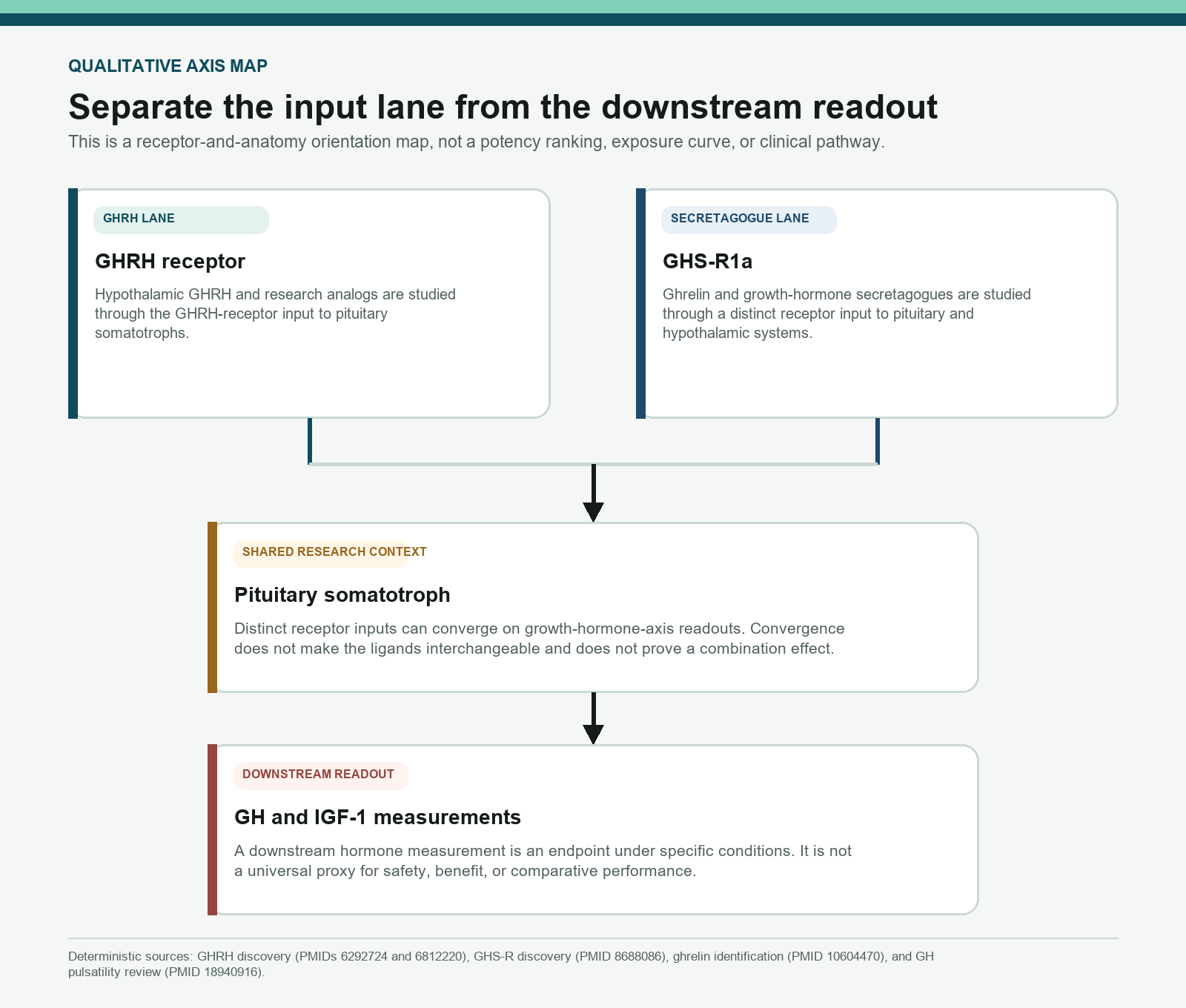
Growth hormone released from the pituitary can be studied directly or through downstream markers such as IGF-1. The architecture is dynamic: secretion is pulsatile, and sampling frequency, assay choice, sex, age, sleep, nutritional state, and experimental design can change what a study observes. A review of pulsatile hormone analysis emphasizes that pulse detection and interpretation depend on the measurement model rather than a single isolated concentration.[13] That review is methodological and reports no quantitative endpoint of its own.
Two distinct receptor inputs reaching the same somatotroph population create a biological question, not a result. A combination, additive, or supra-additive claim requires an experiment that identifies the exact compounds, controls exposure, prespecifies endpoints, and reports the comparison. Receptor diagrams cannot supply that evidence.
What Does “Growth Hormone Peptides” Include?
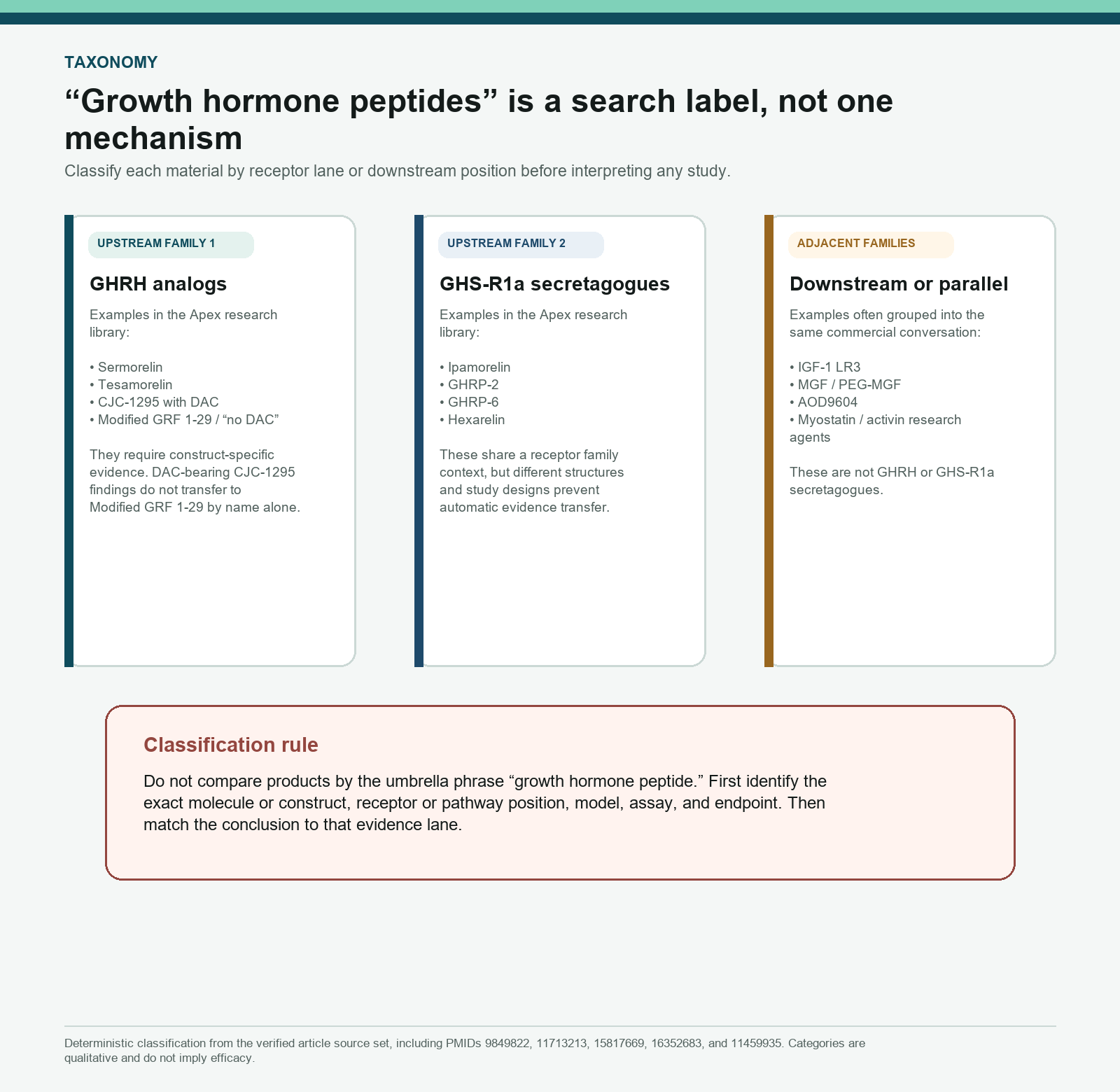
Search results and supplier catalogs often use “growth hormone peptides” as an umbrella phrase. A defensible scientific taxonomy is narrower. It begins with two upstream receptor families and then separates downstream or parallel materials that enter the commercial conversation for different reasons.
| Research family | Primary position in this guide | Representative materials | Evidence-transfer warning |
|---|---|---|---|
| GHRH analogs | GHRH-receptor input | Sermorelin, Tesamorelin, CJC-1295 with DAC, Modified GRF 1-29 | Length, substitutions, and albumin-binding design can change the construct and its evidence lane. |
| GHS-R1a secretagogues | Ghrelin-receptor input | Ipamorelin, GHRP-2, GHRP-6, Hexarelin | A shared receptor context does not make potency, selectivity, exposure, or safety interchangeable. |
| Downstream IGF-related materials | Downstream or adjacent to pituitary GH | IGF-1 LR3, MGF and PEG-MGF research materials | They are not GHRH or GHS-R1a secretagogues. |
| GH-fragment research | Fragment-specific preclinical lane | AOD9604 | Fragment findings cannot be assigned to full-length GH or another analog. |
| Myostatin / activin research | Parallel signaling family | Follistatin-related and activin-pathway research agents | This is not the canonical hypothalamic-pituitary GH receptor sequence. |
GHRH Analogs: One Receptor Lane, Different Constructs
GHRH analog research begins with a ligand designed to engage the GHRH receptor. Sermorelin corresponds to a 29-residue GHRH fragment, while Tesamorelin is a stabilized GHRF analog. CJC-1295 in the foundational literature is a tetrasubstituted GHRH(1-29) analog with a Drug Affinity Complex designed for covalent albumin binding.[6] That DAC element is part of the studied construct: in male Sprague-Dawley rats it produced a 4-fold increase in growth-hormone area under the curve over 2 hours versus unmodified hGRF(1-29) and remained in plasma beyond 72 hours.
The distinction matters because the small healthy-adult CJC-1295 studies used the DAC-bearing material. In randomized ascending-dose trials in healthy adults aged 21–61, single subcutaneous doses raised mean plasma growth hormone 2- to 10-fold for 6 days or more and IGF-1 1.5- to 3-fold for 9–11 days, with an estimated half-life of 5.8–8.1 days.[7] Those findings cannot be assigned to Modified GRF 1-29 merely because a catalog calls it “CJC-1295 no DAC.” No Modified GRF 1-29 half-life appears in this page’s verified sources, so no figure is stated for it. The CJC-1295 research guide owns that nomenclature problem.
Tesamorelin has a separate finished-drug record. In a 26-week randomized, placebo-controlled trial in 412 adults with HIV and excess abdominal fat, 2 mg daily subcutaneous tesamorelin reduced visceral adipose tissue by 15.2% while placebo increased it by 5.0%, and IGF-1 rose 81.0% against a 5.0% decline (P<0.001).[8] A pooled analysis of two phase 3 trials (n=806) reported a −15.4% treatment effect on visceral adipose tissue at week 26.[9] FDA originally approved Theratechnologies’ EGRIFTA (tesamorelin) under NDA 022505 on November 10, 2010 to reduce excess abdominal fat in HIV-infected adults with lipodystrophy; the current EGRIFTA WR label retains the finished-drug context. Same molecule (tesamorelin); categorically distinct regulatory frameworks. That formulation-specific approval does not transfer to an Apex research reagent. The Tesamorelin research guide owns the compound-level evidence and regulatory boundary.
Sermorelin identity
Use the dedicated guide for GHRH(1-29) identity, historical finished-drug context, and source-matched evidence.
Read the Sermorelin research guidePairwise GHRH comparisons
Comparison pages own symmetric criteria. This hub does not choose a universal winner.
Compare Sermorelin and CJC-1295Compare Tesamorelin and Sermorelin
GHS-R1a Secretagogues: Ipamorelin, GHRP-2, GHRP-6, and Hexarelin
Growth-hormone secretagogues are grouped by the GHS-R1a or ghrelin-receptor research lane. The family includes peptides with different sequences and pharmacology. Shared receptor context is therefore the beginning of comparison, not the end.
Raun and colleagues described Ipamorelin as a pentapeptide (Aib-His-D-2-Nal-D-Phe-Lys-NH2) and compared its hormone-release profile with GHRP-2 and GHRP-6 in cell, rat, and swine experiments.[5] In primary rat pituitary cells it released growth hormone with an EC50 near 1.3 nM against 2.2 nM for GHRP-6, and unlike GHRP-6 and GHRP-2 it did not raise ACTH or cortisol at doses more than 200-fold above its growth-hormone ED50. The paper is the source of the familiar “selective” description, but those findings remain attached to those cell, rat, and swine models. It did not establish universal human safety, clinical benefit, or superiority over every GHS-R1a ligand.
A later healthy-volunteer PK/PD study examined Ipamorelin under five 15-minute intravenous infusion rates from 4.21 to 140.45 nmol/kg, with n=8 healthy men per dose level.[14] Terminal half-life was about 2 hours and growth hormone peaked near 0.67 hours before declining. Those values belong to that protocol. They are scientific context, not administration guidance, and they cannot be compared as a direct ratio with a different compound studied by another route or design.
The Ipamorelin research guide owns identity, sequence notation, GHS-R1a pharmacology, selectivity, and assay interpretation. The Ipamorelin-versus-CJC-1295 comparison owns the pairwise receptor and evidence task. It explicitly separates Ipamorelin from both DAC-bearing CJC-1295 and Modified GRF 1-29.
Downstream and Parallel Families Are Not Secretagogues
IGF-1 LR3, MGF-related materials, AOD9604, and myostatin or activin research agents appear near growth-hormone-axis products because they relate to downstream or parallel questions. They should not inherit a GHRH or GHS-R1a mechanism label.
MGF terminology emerged from work on an IGF-1 isoform expressed in mechanically stretched skeletal muscle.[11] In rabbit muscle induced to hypertrophy by stretch, a second IGF-1 transcript carrying a 52-base-pair E-domain insert was expressed, and appreciable levels of that isoform were detected in skeletal muscle after 2 hours to 6 days of altered physical activity. The dedicated IGF-1 LR3 research guide owns the modified IGF-1 analog’s identity and evidence. Grouping it with an upstream secretagogue does not make the materials equivalent.
AOD9604 has its own fragment-specific preclinical record. One mouse study examined a lipolytic fragment of human growth hormone in obese and beta-3 adrenergic receptor knockout models.[10] After 14 days of chronic intraperitoneal dosing, both human GH and the AOD9604 fragment reduced body weight and body fat in obese mice, while producing neither effect in beta-3 receptor knockout mice. The result stays attached to that fragment, species, model, and endpoint. It is not evidence about Ipamorelin or a GHRH analog.
Myostatin and activin-pathway research is another parallel lane. Foundational work on myostatin regulation showed that binding proteins and related factors can alter myostatin activity and muscle growth in experimental systems.[12] That transgenic-mouse work reports no quantitative endpoint for muscle-mass gain, so no effect size from it attaches to a research reagent. It also does not place those agents inside the canonical GHRH-receptor or GHS-R1a pathway.
Additional Reported Findings Across the Axis
Older records behind the family map are kept as a claim map, each result attached to its model and source.
| Compound | Model / species | Endpoint | Reported result | Source |
|---|---|---|---|---|
| GHRP-6 (His-D-Trp-Ala-Trp-D-Phe-Lys-NH2) | Pituitary incubate in vitro; rats in vivo | GH release, hormone specificity | Active at 1–10 ng/mL; GH peaked 10–20 min after IV dosing, with no LH, FSH, TSH or PRL release | PMID 6714155 |
| Hexarelin | Conscious 10-day-old and anaesthetised adult rats | GH release, IV and SC | Peak GH within 10 min of IV dosing; similar to GHRP-6 IV, slightly greater SC | PMID 7910650 A published correction exists for this record and could not be retrieved at the July 2026 freeze; the timing above is the uncorrected published value. |
| MK-0677 (ibutamoren) | Rat pituitary cells; dogs | GH release, specificity | EC50 1.3 nM in vitro; oral 0.125 mg/kg raised GH in dogs, with only modest cortisol increase | PMID 7624358 |
| ACE-031 (soluble ActRIIB-Fc) | 48 postmenopausal women; single SC 0.02–3 mg/kg | Lean mass, muscle volume, day 29 | +3.3% lean mass (DXA) and +5.1% thigh muscle volume (MRI), both P=0.03, at 3 mg/kg; half-life 10–15 days | PMID 23169607 |
| des(1-3)IGF-I — not Long-R3-IGF-1 | Nitrogen-restricted rats; 1.2 mg/kg/day, 7 days | Muscle protein synthesis | +21%, against +31% and +26% for full-length IGF-1 at 1.2 and 2.9 mg/kg/day; does not transfer to IGF-1 LR3 | PMID 1999680 |
| [Nle27]GHRH(1-29)NH2 — not sermorelin | 19 adults aged 55–71; 10 µg/kg SC nightly, 16 weeks | Nocturnal GH, IGF-1, lean mass | Integrated nocturnal GH rose (P<0.01 women, P<0.05 men); IGF-1 and IGFBP-3 up within 2 weeks; lean mass up in men only (P<0.05) | PMID 9141536 |
Each row stays inside its own model. Three narrative reviews cited by the earlier version are not restored, none having reported a quantitative endpoint of its own.
How Should Growth-Hormone-Axis Evidence Be Read?
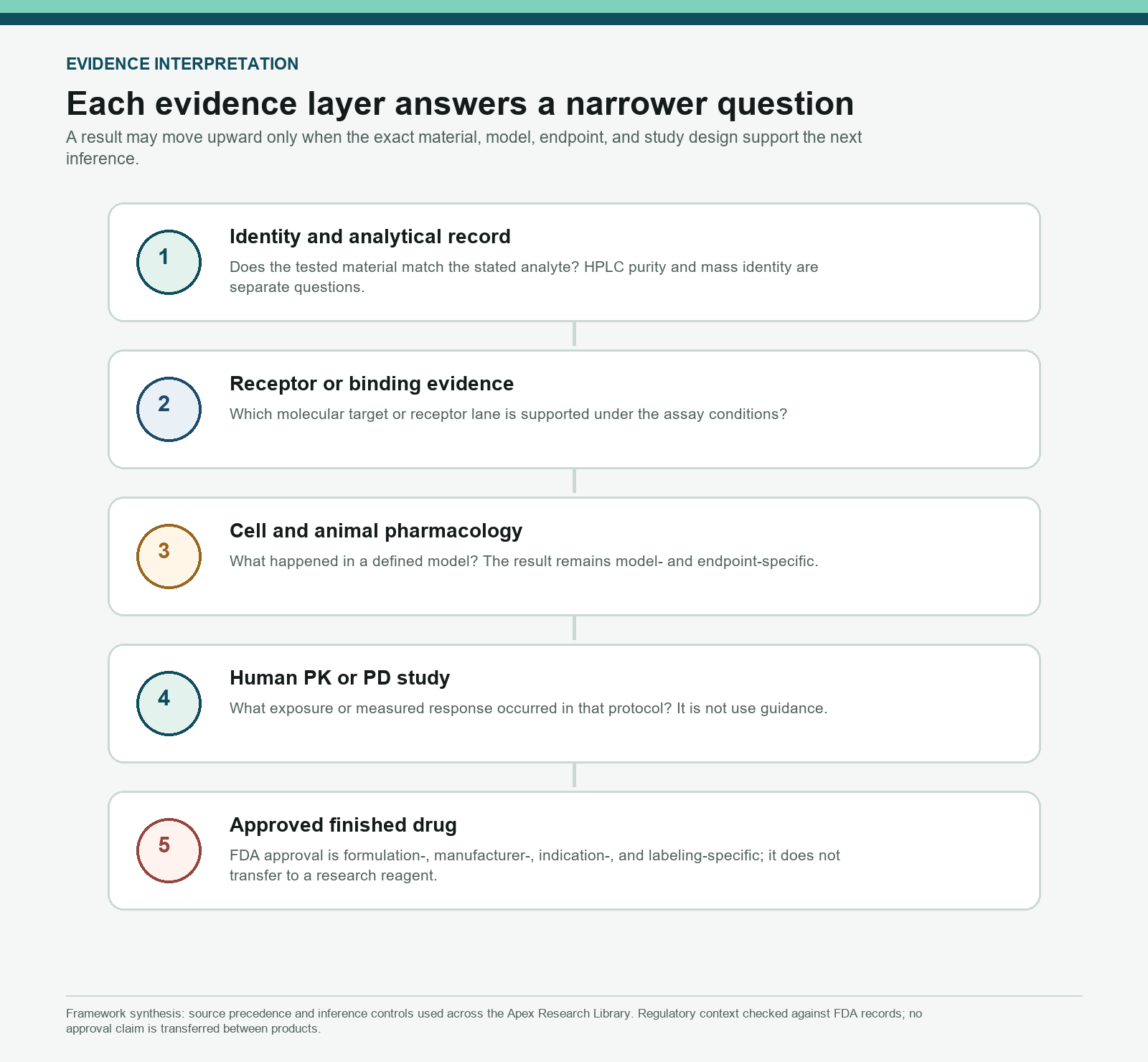
An evidence ladder prevents four common category errors. First, an analytical record is not a receptor assay. Second, a receptor assay is not an animal outcome. Third, an animal or healthy-volunteer result is not a treatment recommendation. Fourth, an FDA approval belongs to the exact finished drug, manufacturer, indication, and labeling that the agency reviewed.
1. Identity and purity
A lot-specific Certificate of Analysis should identify the material, batch, method, and result. HPLC can report a chromatographic purity estimate under a defined method, while mass spectrometry can support mass identity. Neither alone proves biological activity, sterility, safety, or clinical performance. The guides to HPLC purity testing, mass-spectrometry verification, and reading a peptide COA own those method tasks.
2. Receptor, cell, and animal experiments
These studies can establish target engagement or measured responses under defined conditions. Their conclusions remain bounded by analyte, species, tissue, concentration, comparator, and endpoint. A model-specific hormone profile should not become a universal “cleaner,” “safer,” or “better” claim.
3. Human PK/PD and pulsatility
Small human studies can describe exposure and measured hormone responses under a protocol. They do not automatically establish an approved use, and study-specific half-life estimates are not interchangeable across routes, constructs, assays, or sampling schedules. Pulsatility adds a measurement problem: sparse sampling can miss or misclassify episodic secretion.
4. Approved finished drugs
Finished-drug approval is not a molecule-wide badge. Same molecule (tesamorelin); categorically distinct regulatory frameworks. EGRIFTA is a Theratechnologies finished pharmaceutical approved under NDA 022505 for a specific indication. Apex Tesamorelin is a research-grade chemical reagent supplied as lyophilized powder for in-vitro and preclinical research only; it is not a pharmaceutical and not for human consumption. The research-grade versus pharmaceutical-grade explainer covers that distinction.
What Are the Regulatory Boundaries?
The growth-hormone-axis category mixes compounds with very different regulatory histories. Tesamorelin appears in FDA-approved EGRIFTA finished-drug labeling. Sermorelin was the active molecule in Serono’s historical Geref products: NDA 19-863 was approved in December 1990 for diagnostic assessment of pituitary growth-hormone secretory capacity, and NDA 20-443 was approved on September 26, 1997 for pediatric idiopathic growth-hormone deficiency. EMD Serono voluntarily discontinued Geref in 2008 for commercial, not safety, reasons. Same molecule (sermorelin); categorically distinct regulatory frameworks. Ipamorelin, CJC-1295 with DAC, Modified GRF 1-29, GHRP-2, GHRP-6, Hexarelin, IGF-1 LR3, PEG-MGF, AOD9604, and ACE-031 carry no FDA, EMA, NMPA, or other regulatory approval anywhere globally. ACE-031’s sponsor discontinued its clinical program after the phase 1 data above, so no ongoing therapeutic development should be inferred from it.
Apex Laboratory supplies chemical research reagents for in-vitro research. A product page can document the current catalog item and its lot-specific records; it cannot turn a research reagent into a pharmaceutical formulation or transfer an approved indication. This boundary remains in place even when a research reagent and an approved finished drug use the same molecular name.
Always name the exact finished drug or research material. Then state the manufacturer, formulation, indication, and source of the regulatory claim. Avoid molecule-wide phrases such as “FDA-approved peptide” when the approval belongs only to one finished formulation.
Which Guide Owns Each Research Question?
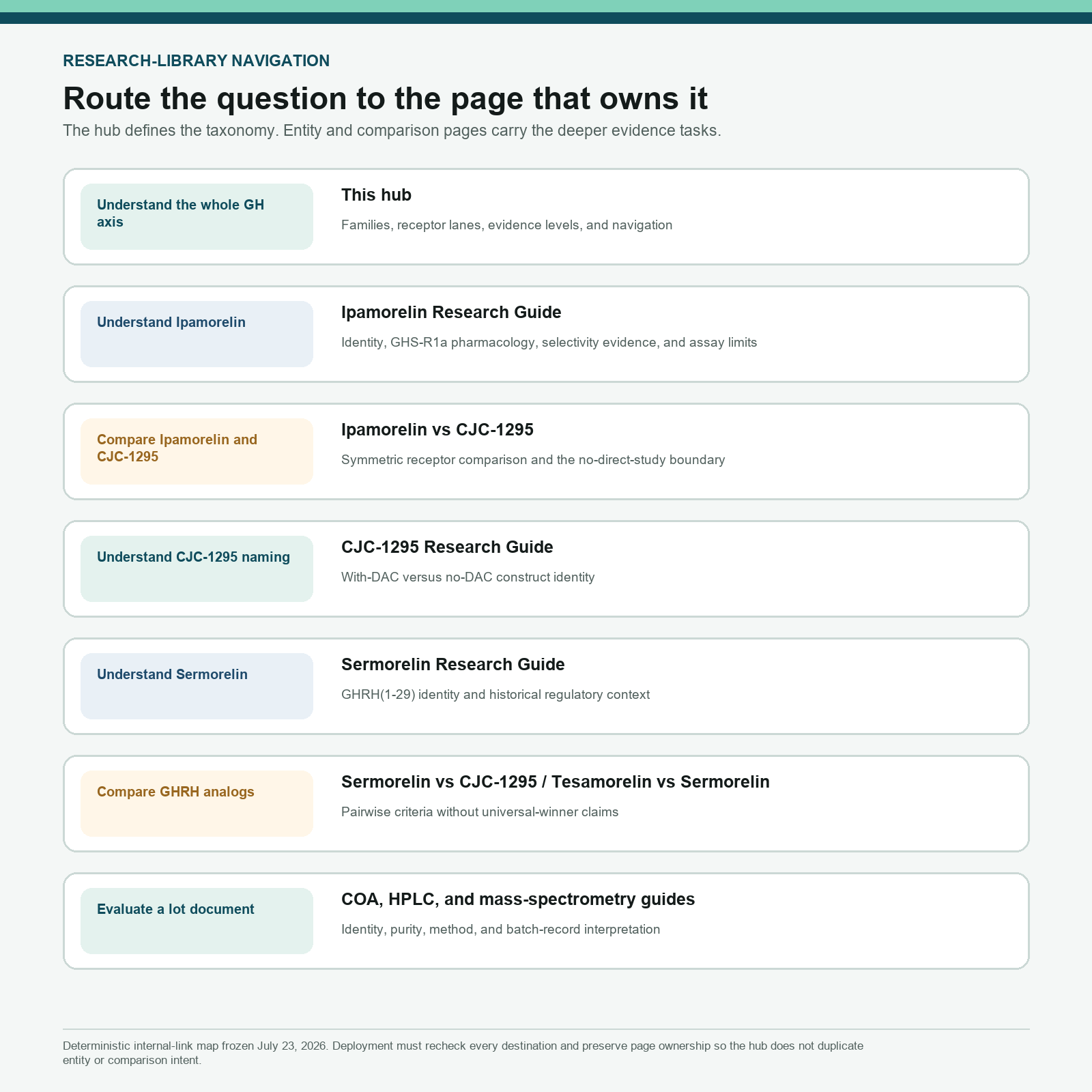
This hub owns taxonomy, evidence hierarchy, and navigation. It intentionally hands compound identity and pairwise comparison intent to narrower pages. That division reduces cannibalization and gives each query one clear answer source.
Compound identity guides
Sermorelin, CJC-1295, Ipamorelin, Tesamorelin, and IGF-1 LR3 each own their analyte-specific evidence.
Comparison guides
Ipamorelin vs CJC-1295, Sermorelin vs CJC-1295, and Tesamorelin vs Sermorelin own symmetric pairwise questions.
Verification and Research-Material Handoff
A high-intent research-material decision should begin with identity and current lot documentation, not an umbrella keyword. Confirm the analyte name, salt or counterion where applicable, stated molecular identity, chromatographic method, mass-spectrometry record, batch number, and document date. Then separate those analytical facts from any biological or regulatory statement.
For current catalog exploration, use no more than the relevant material records and recheck them at deployment. Apex maintains research-material pages for Sermorelin Acetate, Tesamorelin, and Ipamorelin. These are commercial documentation handoffs for research reagents, not treatment recommendations and not evidence of approved-drug equivalence.
Frequently Asked Questions About Growth Hormone Peptides
What are growth hormone peptides?
“Growth hormone peptides” is an umbrella search term, not one scientific class. It can include GHRH-receptor analogs, GHS-R1a secretagogues, and downstream or parallel research materials. Each compound needs its own identity, receptor, model, endpoint, and regulatory evidence.
What is the difference between a GHRH analog and a growth hormone secretagogue?
A GHRH analog is studied through the GHRH-receptor lane. A growth hormone secretagogue such as Ipamorelin is studied through the GHS-R1a or ghrelin-receptor lane. The pathways can converge on pituitary growth-hormone measurements without making the compounds equivalent.
Are Ipamorelin and CJC-1295 the same type of peptide?
No. Ipamorelin is a pentapeptide growth-hormone secretagogue associated with GHS-R1a. Literature-defined CJC-1295 is a DAC-bearing GHRH analog associated with the GHRH receptor. Their dedicated comparison page owns the pairwise evidence and naming limits.
Does using two receptor pathways prove combination synergy?
No. Distinct receptor pathways provide a biological rationale for a research question, not proof of additive or supra-additive performance. A combination claim requires a controlled study of the exact compounds, exposure conditions, comparator, and endpoint.
Can a Certificate of Analysis prove biological activity?
No. A COA can report lot-specific identity and purity evidence under stated analytical methods. HPLC and mass spectrometry do not by themselves establish receptor activity, biological effects, sterility, safety, or clinical performance.
Are research-grade growth hormone peptides FDA-approved drugs?
No. A research reagent is not an FDA-approved finished drug. Some molecular names, including Tesamorelin, also appear in specific approved pharmaceutical formulations, but that formulation-specific approval does not transfer to an Apex research material.
Which growth hormone peptide guide should I read next?
Use this hub for family taxonomy. Use the Ipamorelin, CJC-1295, Sermorelin, Tesamorelin, or IGF-1 LR3 guide for a single compound. Use a dedicated comparison page for pairwise questions, and use the COA, HPLC, or mass-spectrometry guide for analytical verification.
References
- Rivier J, et al. Characterization of a growth hormone-releasing factor from a human pancreatic islet tumour. Nature. 1982;300(5889):276-8. PMID: 6292724.
- Guillemin R, et al. Growth hormone-releasing factor from a human pancreatic tumor that caused acromegaly. Science. 1982;218(4572):585-7. PMID: 6812220.
- Howard AD, et al. A receptor in pituitary and hypothalamus that functions in growth hormone release. Science. 1996;273(5277):974-7. PMID: 8688086.
- Kojima M, et al. Ghrelin is a growth-hormone-releasing acylated peptide from stomach. Nature. 1999;402(6762):656-60. PMID: 10604470.
- Raun K, et al. Ipamorelin, the first selective growth hormone secretagogue. Eur J Endocrinol. 1998;139(5):552-61. PMID: 9849822.
- Jetté L, et al. Human growth hormone-releasing factor (hGRF)1-29-albumin bioconjugates activate the GRF receptor on the anterior pituitary in rats: identification of CJC-1295 as a long-lasting GRF analog. Endocrinology. 2005;146(7):3052-8. PMID: 15817669.
- Teichman SL, et al. Prolonged stimulation of growth hormone (GH) and insulin-like growth factor I secretion by CJC-1295, a long-acting analog of GH-releasing hormone, in healthy adults. J Clin Endocrinol Metab. 2006;91(3):799-805. PMID: 16352683.
- Falutz J, et al. Metabolic effects of a growth hormone-releasing factor in patients with HIV. N Engl J Med. 2007;357(23):2359-70. PMID: 18057338.
- Falutz J, et al. Effects of tesamorelin (TH9507), a growth hormone-releasing factor analog, in human immunodeficiency virus-infected patients with excess abdominal fat: a pooled analysis of two multicenter, double-blind placebo-controlled phase 3 trials with safety extension data. J Clin Endocrinol Metab. 2010;95(9):4291-304. PMID: 20554713.
- Heffernan M, et al. The effects of human GH and its lipolytic fragment (AOD9604) on lipid metabolism following chronic treatment in obese mice and beta(3)-AR knock-out mice. Endocrinology. 2001;142(12):5182-9. PMID: 11713213.
- Yang S, et al. Cloning and characterization of an IGF-1 isoform expressed in skeletal muscle subjected to stretch. J Muscle Res Cell Motil. 1996;17(4):487-95. PMID: 8884603.
- Lee SJ, et al. Regulation of myostatin activity and muscle growth. Proc Natl Acad Sci U S A. 2001;98(16):9306-11. PMID: 11459935.
- Veldhuis JD, et al. Motivations and methods for analyzing pulsatile hormone secretion. Endocr Rev. 2008;29(7):823-64. PMID: 18940916.
- Gobburu JV, et al. Pharmacokinetic-pharmacodynamic modeling of ipamorelin, a growth hormone releasing peptide, in human volunteers. Pharm Res. 1999;16(9):1412-6. PMID: 10496658.
- U.S. Food and Drug Administration. EGRIFTA WR (Tesamorelin) prescribing information. Revised March 2025. Accessed July 23, 2026.
Research materials and supporting guides
Research materials
- Tesamorelin
- Ipamorelin
- CJC-1295 No DAC + Ipamorelin Blend
- CJC-1295 with DAC
- CJC-1295 No DAC
- GHRP-2
- GHRP-6
- Hexarelin Acetate
- HGH Fragment 176-191
- IGF-1 LR3
- PEG-MGF 2mg
- Sermorelin Acetate
Supporting research guides
- GHRP-2 vs GHRP-6 vs Hexarelin: Growth Hormone Secretagogue Comparison
- PEG-MGF Research Guide: What the Evidence Actually Studies
- IGF-1 LR3 Research Guide: Structure, IGFBP Design, and Direct Evidence
- Tesamorelin Explained: Visceral Fat, Human Results and Research Limits
- Sermorelin Explained: Human Studies, Benefit Claims and Geref History
- Ipamorelin vs CJC-1295: Receptors, Evidence, and DAC Naming
- Tesamorelin vs Sermorelin: GHRH Analog Comparison
- Sermorelin vs CJC-1295: Identity, Evidence, and GHRH Pharmacology
- CJC-1295 With DAC vs No DAC: An Identity-First Research Guide
- What Is Ipamorelin? Benefits, Side Effects and Human Studies