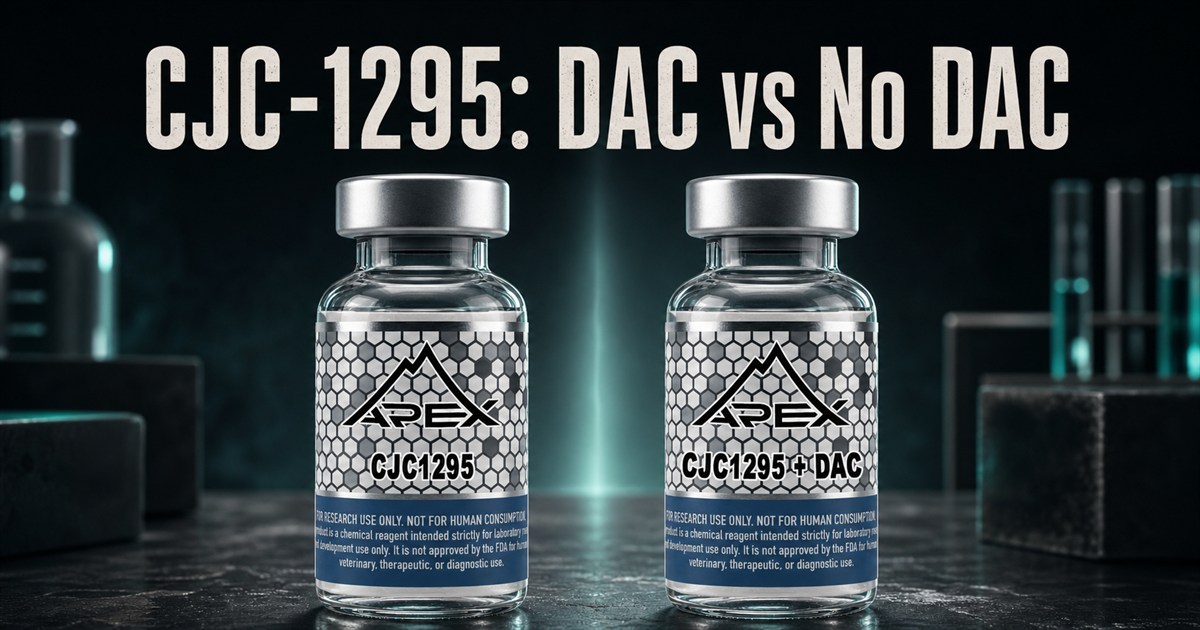
CJC-1295 is frequently presented as a choice between “with DAC” and “without DAC,” but the two labels do not describe two equally documented versions of one material. CJC-1295 with DAC and Modified GRF 1-29 are not the same compound. In the peer-reviewed literature, CJC-1295 is the long-acting growth-hormone-releasing-hormone analog engineered with a Drug Affinity Complex (DAC). The material commonly sold as “CJC-1295 no DAC” is better identified as Modified GRF 1-29, and the distinction determines which pharmacokinetic and endocrine findings can be cited.
Related guide: for the co-formulated CJC-1295 (no DAC) + Ipamorelin vial, see the CJC-1295/Ipamorelin Blend Research Guide.
This guide compares identity, albumin-binding design, receptor mechanism, direct evidence, analytical context, and research-design tradeoffs. It reports historical human findings only as observations from the cited studies and does not provide a personal-use, dosing, combination, treatment, or diagnostic protocol.
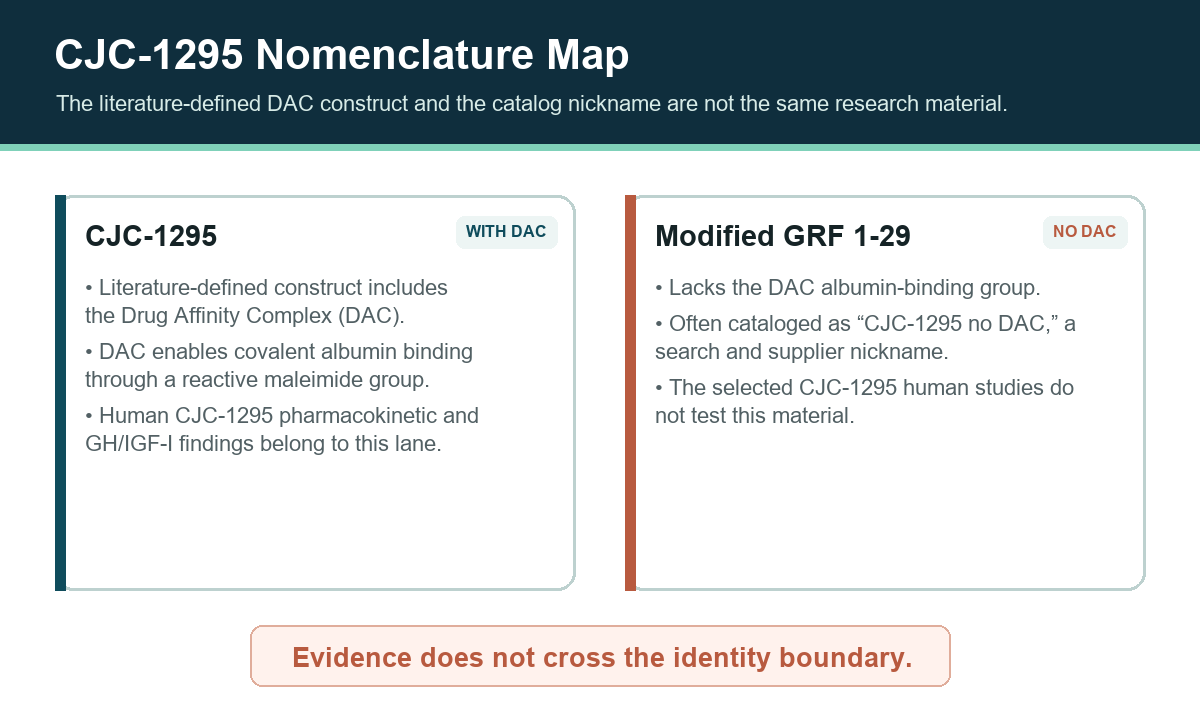
- In the peer-reviewed CJC-1295 literature, the name identifies the long-acting construct that contains a Drug Affinity Complex (DAC).
- “CJC-1295 no DAC” is a common catalog nickname for Modified GRF 1-29; it is not the material tested in the cited CJC-1295 human studies.
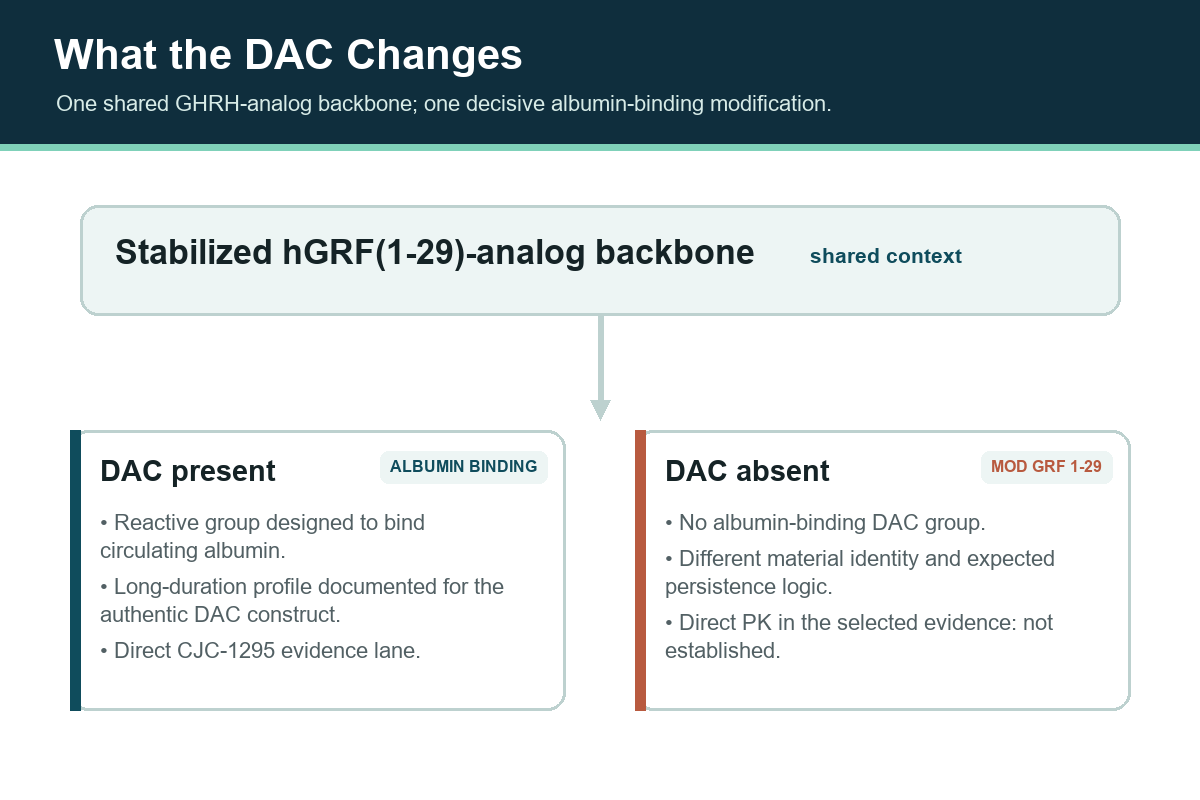
- The DAC group supports covalent albumin binding. Removing it changes molecular identity and prevents direct transfer of the DAC construct’s pharmacokinetics.
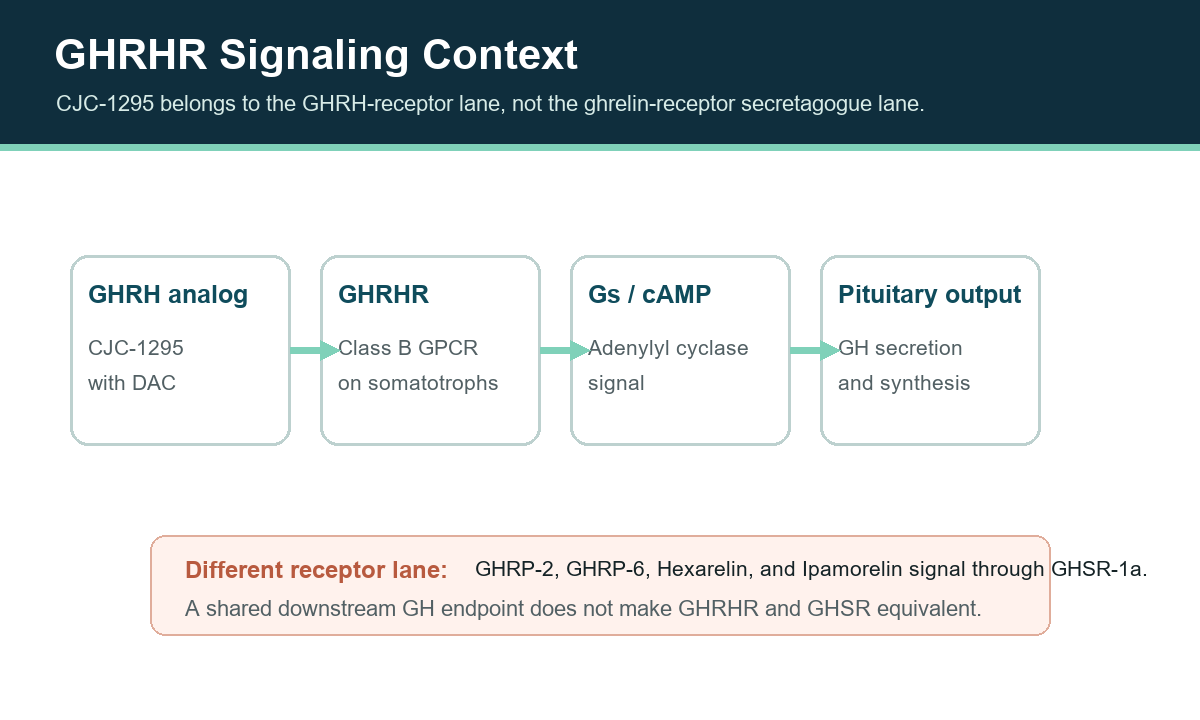
- CJC-1295 signals through the growth-hormone-releasing-hormone receptor (GHRHR), which is distinct from the GHSR-1a receptor used by GHRPs.
- Historical human studies reported a 5.8–8.1-day half-life and prolonged GH/IGF-I changes for CJC-1295 with DAC; these are not no-DAC values.
- The comparison supports research-design choices only after material identity, model, endpoint, and evidence gaps are made explicit.
The CJC-1295 Name Problem
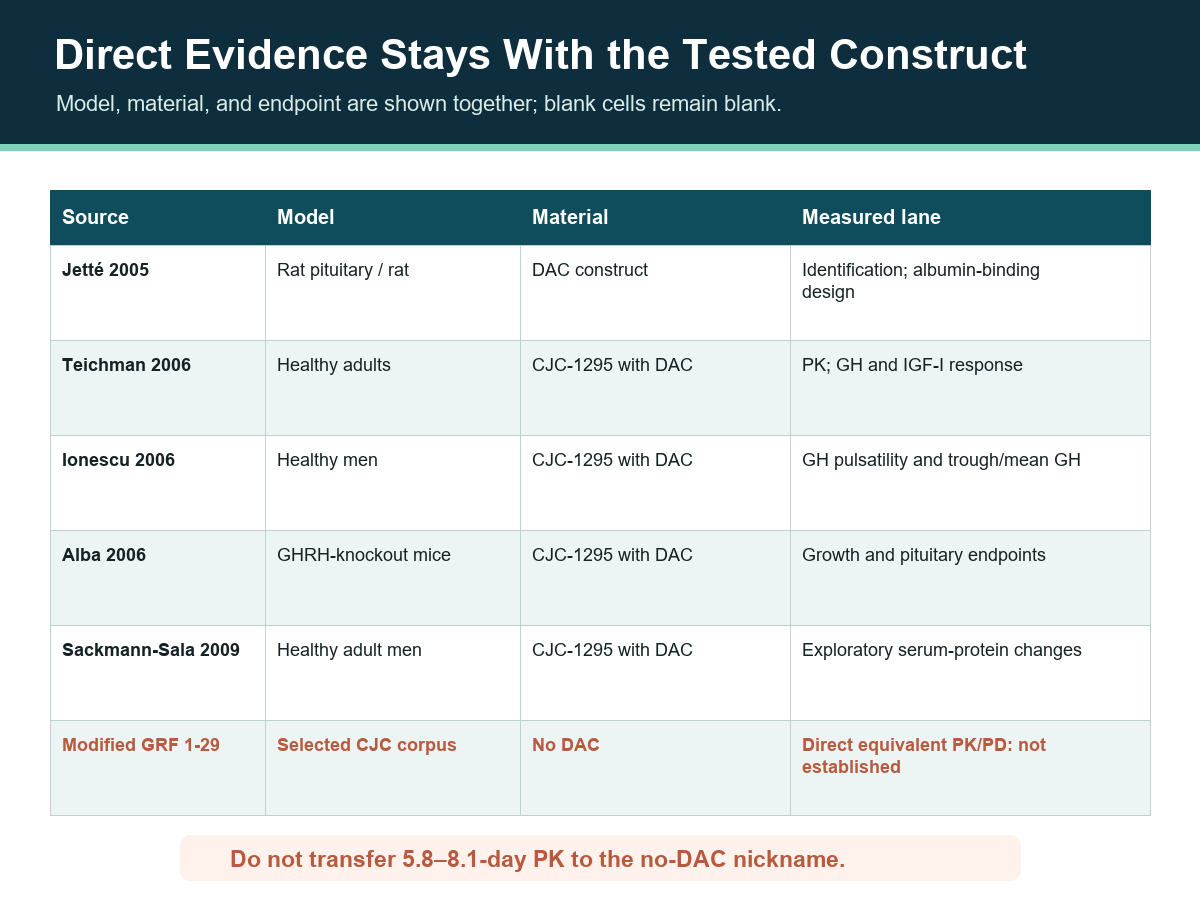
The most consequential error in this topic is semantic. A catalog may place “CJC-1295 with DAC” beside “CJC-1295 no DAC,” implying that both names inherit the same literature. The original characterization does not support that inference. Jetté et al. (2005) identified CJC-1295 as a tetrasubstituted hGRF(1-29) analog carrying a reactive group designed for covalent binding to albumin. In male Sprague-Dawley rats, it produced a 4-fold increase in growth-hormone area under the curve over 2 hours versus hGRF(1-29) and remained detectable in rat plasma beyond 72 hours. That albumin-binding design is part of the studied construct, not an optional footnote.
Modified GRF 1-29 describes a stabilized 1–29 GHRH analog without the DAC albumin-binding group. “CJC-1295 no DAC” remains useful as a search synonym because researchers encounter it in catalogs, but the article uses Modified GRF 1-29 whenever molecular identity matters. This prevents a commercial nickname from becoming an evidence bridge.
What the DAC Changes
Reagent identity of the two materials
The two names resolve to two registry entries. The Drug Affinity Complex adds about 279.3 g/mol, and that mass difference is what a mass-spectrometry identity check separates.
| Identifier | CJC-1295 with DAC | Modified GRF 1-29 (“no DAC”) |
|---|---|---|
| CAS number | 446262-90-4 | 863288-34-0 |
| PubChem CID | 91971820 | 56841945 |
| Molecular formula | C165H269N47O46 | C152H252N44O42 |
| Molecular weight | 3,647.2 g/mol | 3,367.9 g/mol |
| Peptide backbone | Tetrasubstituted human GHRH(1-29) amide: Tyr-D-Ala-Asp-Ala-Ile-Phe-Thr-Gln-Ser-Tyr-Arg-Lys-Val-Leu-Ala-Gln-Leu-Ser-Ala-Arg-Lys-Leu-Leu-Gln-Asp-Ile-Leu-Ser-Arg-NH2 | |
| DAC element | C-terminal Lys30 bearing an Nε-3-maleimidopropionamide group (+279.3 g/mol) for covalent albumin binding | Absent |
The DAC design addresses a central limitation of short GHRH fragments: rapid proteolytic loss. Foundational plasma work showed that native and C-terminally shortened GHRH fragments, including GRH(1-29), are rapidly cleaved, with dipeptidyl peptidase IV playing a primary role (Frohman et al., 1989). That paper maps a degradation pathway and reports no quantitative endpoint for GRF(1-29) survival in plasma. D-amino-acid substitution can improve resistance at the vulnerable N terminus, but the DAC construct adds a separate persistence strategy through albumin binding.
In Jetté’s preclinical characterization, the reactive maleimide-containing group was designed to couple with circulating albumin after administration. Albumin conjugation increases the effective size of the construct and changes its clearance behavior. The study used rat and pituitary experimental systems to identify the candidate; it did not establish human therapeutic efficacy or provide evidence for Modified GRF 1-29.
| Field | CJC-1295 with DAC | Modified GRF 1-29 (“no DAC”) |
|---|---|---|
| Material identity | Long-acting hGRF(1-29)-analog construct with a Drug Affinity Complex | Stabilized GRF(1-29) analog without the albumin-binding DAC group |
| Albumin-binding design | Present and integral to the cited CJC-1295 construct | Absent |
| Direct human PK in selected evidence | Present: historical healthy-adult study | Not established by the selected CJC-1295 studies |
| GH pulsatility paper | Present: CJC-1295 with albumin-binding design | Not established by that paper |
| Safe evidence transfer | Only to the tested DAC construct and conditions | Requires a source that directly identifies the no-DAC material |
GHRHR Mechanism: The Correct Receptor Lane
CJC-1295 belongs to the GHRH-receptor lane. Molecular cloning work identified GHRHR as a pituitary-enriched Class B G-protein-coupled receptor; expressed human receptor bound GHRH and stimulated intracellular cAMP (Mayo, 1992). A later synthesis described GHRHR signaling as predominantly cAMP-dependent and connected the pathway to somatotroph function (Mayo et al., 2000). Both are receptor-characterization papers: each reports no quantitative endpoint for CJC-1295, fixing receptor identity and signalling route rather than an effect size.
This receptor identity separates CJC-1295 from GHRP-2, GHRP-6, Hexarelin, and Ipamorelin, which are studied primarily through GHSR-1a. Both receptor systems can influence pituitary GH release, and experimental designs may investigate their interaction, but a shared downstream endpoint does not make the receptors or compounds equivalent. The growth-hormone-axis research hub provides the broader cluster map.
Evidence by Model and Tested Material
The direct human record for CJC-1295 is historical and limited. In healthy adults, Teichman et al. (2006) reported an estimated half-life of 5.8–8.1 days after single administrations of the DAC construct. The report combined two randomized, placebo-controlled ascending-dose trials of 28 and 49 days in adults aged 21–61. Mean plasma GH increased 2- to 10-fold for 6 days or more, mean IGF-I increased 1.5- to 3-fold for 9–11 days, and after repeated dosing mean IGF-I stayed above baseline for up to 28 days; tolerability was described at 30 and 60 µg/kg. Those quantitative findings belong to that construct, population, assay schedule, and historical study design.
A separate small study addressed pulse structure. Ionescu and Frohman (2006) sampled healthy men aged 20–40 every 20 minutes across a 12-hour overnight window, before and 1 week after 60 or 90 µg/kg. Pulse frequency and magnitude were unaltered, while trough GH rose 7.5-fold (P < 0.0001), mean GH rose 46% (P < 0.01) and IGF-I rose 45% (P < 0.001). The paper is often summarized as “pulsatile release,” but its more precise finding was continued pulsatility during sustained GHRH-receptor stimulation. It did not compare Modified GRF 1-29.
Preclinical work addresses different questions. Alba et al. (2006) gave 1-week-old GHRH-knockout mice 2 µg of CJC-1295 every 24, 48 or 72 hours for 5 weeks. Only the 24-hour interval normalized mouse body weight and length; the longer intervals improved both without normalizing them. That mouse model cannot be used as a human efficacy or safety result. An exploratory two-dimensional gel proteomic analysis in healthy young adult men (n = 11) found 2 serum-protein spots decreased and 3 increased 7 days after a single CJC-1295 injection (Sackmann-Sala et al., 2009), while explicitly noting that the biological interpretation remained unresolved.
Additional reported findings
Two sources from the earlier version are kept as claim-map rows. Neither result belongs to a CJC-1295 material.
| Compound tested | Model | Species | Endpoint | Reported result | Source |
|---|---|---|---|---|---|
| Native GHRH (100 µg IV) and GHRP-2 (200 µg IV) | Incremental cycle exercise to exhaustion | Human, 8 healthy men | GH area under the curve over 120 minutes | Exercise alone 2,324; with GHRH 6,952; with GHRP-2 14,674; with both 17,673 µg·L⁻¹·120 min (P < 0.003). Combination AUCs did not differ significantly from the arithmetical sum of the separate stimuli. | PMID 10912886 |
| GRF (GHRH) receptor, not an analog | Pit-1-deficient Snell and Jackson dwarf pituitary | Mouse and rat cDNA | Receptor expression and GRF-induced cAMP | Receptor cloned; absent in dw/dw pituitary, linking Pit-1 loss to hypoplasia. Reports no quantitative endpoint. | PMID 1334535 |
Comparison by Criterion
Identity and traceability
The DAC construct is easier to trace into the original CJC-1295 literature because albumin binding is part of its definition. A no-DAC material requires more careful documentation: the supplier name alone does not establish sequence, substitutions, counterion, or equivalence to a specific paper. For either material, a Certificate of Analysis should be read as a batch-specific document, not as proof that two names describe one construct.
Duration and sampling design
The CJC-1295 human record supports extended sampling for the DAC construct because the cited study observed multi-day exposure and endocrine changes. It does not provide an equivalent duration for Modified GRF 1-29. A research plan that assumes a popular “approximately 30-minute” no-DAC half-life without a directly verified source converts repetition into evidence. This article therefore records the no-DAC value as not established in the selected evidence set.
Endpoints and interpretation
Pharmacokinetic exposure, GH pulse structure, mean GH, trough GH, IGF-I, growth endpoints, and exploratory serum proteins answer different questions. None is a universal measure of “strength.” The human pulsatility paper did not establish therapeutic benefit, the mouse study did not establish human outcomes, and the proteomic study did not resolve a clinical mechanism.
Analytical identification
Analytical methods can distinguish peptide targets only when the method is built around the correct analyte. An immunoaffinity purification coupled to nano-scale liquid chromatography and high-resolution mass spectrometry simultaneously purified 12 peptides prohibited in sport — CJC-1295 among them, alongside GH-RH(1-29) as a separate target — from human plasma, serum or urine, with limits of detection for each target compound in the low pg/mL range in urine; the paper reports no quantitative endpoint for any individual analyte (Thomas et al., 2012). That the method lists CJC-1295 and GH-RH(1-29) as distinct analytes is itself an identity signal. The record demonstrates analyte-specific detection context; it does not validate a supplier batch, establish purity, or prove that a no-DAC catalog item is CJC-1295.
Literature depth
The DAC construct has direct identification, preclinical, and small historical human studies. Modified GRF 1-29 has a broader parent-GHRH rationale, but the selected CJC-1295 papers cannot be reassigned to it. Uneven literature depth is itself a decision variable: it may favor the better-characterized material for one question while leaving the no-DAC construct appropriate only for a separately sourced design. It does not create a universal winner.
Research-Design Framework
A defensible comparison begins before any endpoint is measured. The protocol should record the exact material name, whether DAC is present, the batch identifier, analytical documentation, model, exposure design, sampling interval, assay, and prespecified endpoint. These controls keep a nomenclature problem from becoming a biological conclusion.
The framework also limits inference. A human PK result cannot establish a mouse growth outcome; a pituitary-cell experiment cannot establish human safety; an analytical detection method cannot substitute for a batch-specific purity record. If a row lacks direct evidence for Modified GRF 1-29, the appropriate entry is “not established,” not a value imported from CJC-1295 with DAC.
Research-Material Context
Apex Laboratory maintains separate research-reagent records for CJC-1295 with DAC and CJC-1295 no DAC / Modified GRF 1-29. The product cards below identify those commercial destinations; they do not make the two materials interchangeable or transfer literature between them. Researchers should verify the current live product record and batch documentation at the time of evaluation.
CJC-1295 with DAC
Research-reagent page for the albumin-binding construct discussed in the direct CJC-1295 literature.
View the current research-reagent recordModified GRF 1-29
Research-reagent page commonly labeled “CJC-1295 no DAC”; evidence remains construct-specific.
View the current research-reagent recordFor verification context, see the HPLC testing explainer and the research-grade versus pharmaceutical-grade framework. For each Apex material, read its applicable published report for the declared identity, configuration, lot, methods and results. A result for one form or lot does not verify the other.
Regulatory status, stated per material. CJC-1295 with DAC has no FDA, EMA, NMPA, MHRA or other regulatory approval anywhere globally, and no approved therapeutic indication. Modified GRF 1-29 (“CJC-1295 no DAC”) has none either. Both are research-use-only chemical reagents, and growth-hormone-axis peptides remain monitored analytes in anti-doping control.
Frequently Asked Questions
Is CJC-1295 without DAC the same as Modified GRF 1-29?
“CJC-1295 no DAC” is a common supplier and search nickname for Modified GRF 1-29. The name should not be interpreted as proof that the material inherits the CJC-1295 DAC construct’s human pharmacokinetic or endocrine data.
Which construct had a 5.8–8.1-day half-life in the cited human study?
The historical estimate was reported for CJC-1295 with the albumin-binding DAC design in healthy adults. The value should not be assigned to Modified GRF 1-29.
Does CJC-1295 eliminate pulsatile GH secretion?
One small historical study reported preserved GH pulse frequency and magnitude one week after CJC-1295, with higher trough and mean GH. The result belongs to that study’s DAC construct, participants, sampling design, and assays.
Does CJC-1295 act through the ghrelin receptor?
CJC-1295 is a GHRH analog studied through GHRHR. Ghrelin-receptor secretagogues such as GHRP-2 and Ipamorelin occupy the distinct GHSR-1a lane, even though both systems can influence pituitary GH release.
Does this comparison establish which material is better?
No. It establishes which evidence belongs to which construct and which fields remain unresolved. A research-design decision depends on the hypothesis, material identity, model, endpoint, controls, and directly verified literature.
Continue Your Research
- Growth Hormone Axis Research Peptides
- Sermorelin vs CJC-1295
- Ipamorelin vs CJC-1295
- How to Read a Peptide Certificate of Analysis
- Apex Laboratory Research Library
Research Use Disclaimer
This article is provided for educational and research reference purposes only. CJC-1295, Modified GRF 1-29, and all products sold by Apex Laboratory are intended exclusively for in-vitro laboratory research use and are not for human consumption. Researchers should consult the primary peer-reviewed literature cited throughout this article for detailed methodological protocols, experimental designs, and complete data sets.