Batch documentation
Certificate of analysis
Apex Laboratory results for the listed configurations. Match the lot on your label with the report.
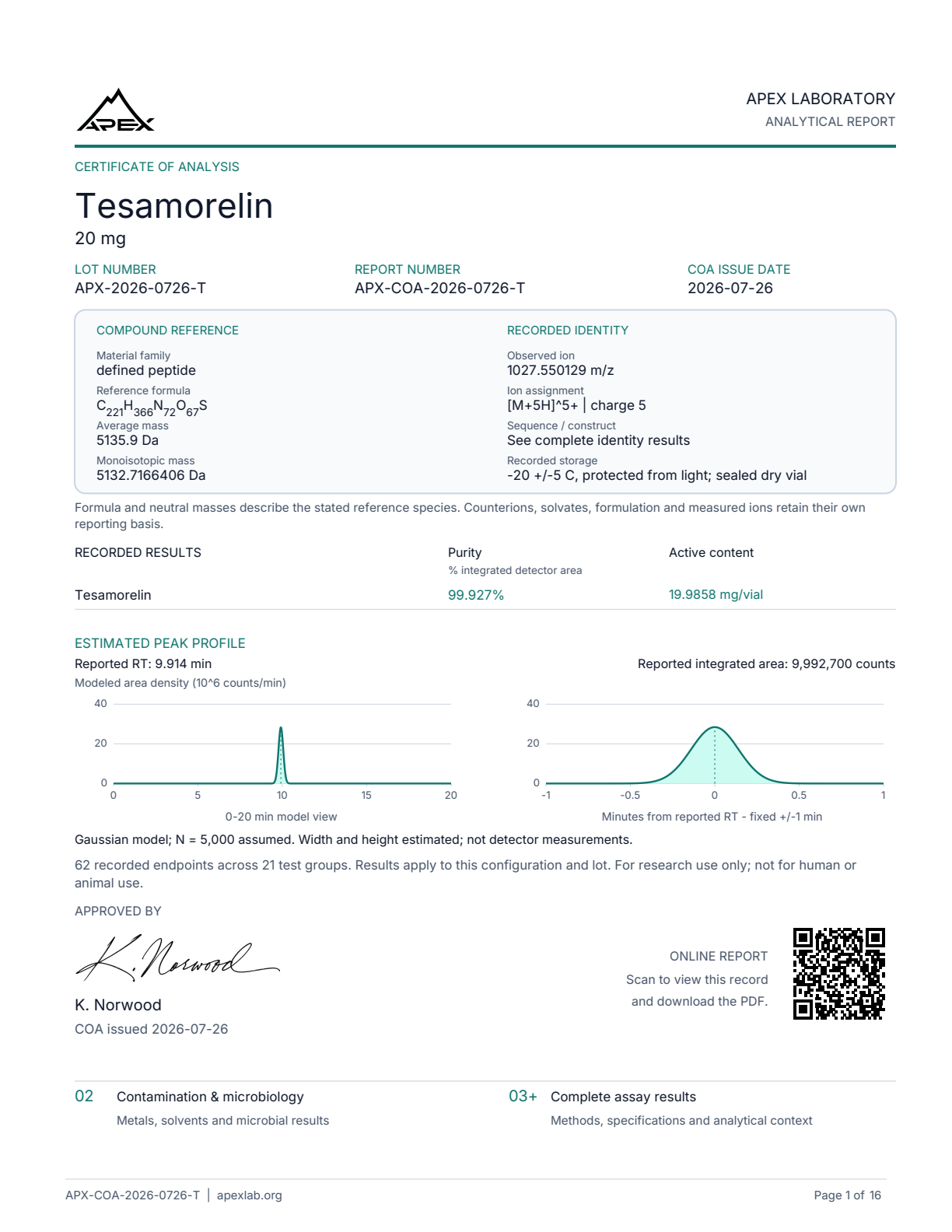
Tesamorelin - 20 mg
- Tesamorelin chromatographic purity
- 99.927 % integrated detector area
- Tesamorelin active content
- 19.9858 mg/vial
- GHRHR cAMP response relative potency
- 100.05 % reference response potency
- Bacterial endotoxins
- <0.025 EU/mg active-equivalent
Chromatographic purity by analyte

About this graph
Recorded scalar results against the stated specification. Each row uses its own labeled scale; purity is detector-area purity, not active-material content.
Measured active content

About this graph
Calibrated active content, concentration or activity compared with the stated same-unit specification. Each row uses its own labeled scale; no conversion from chromatographic purity is made.
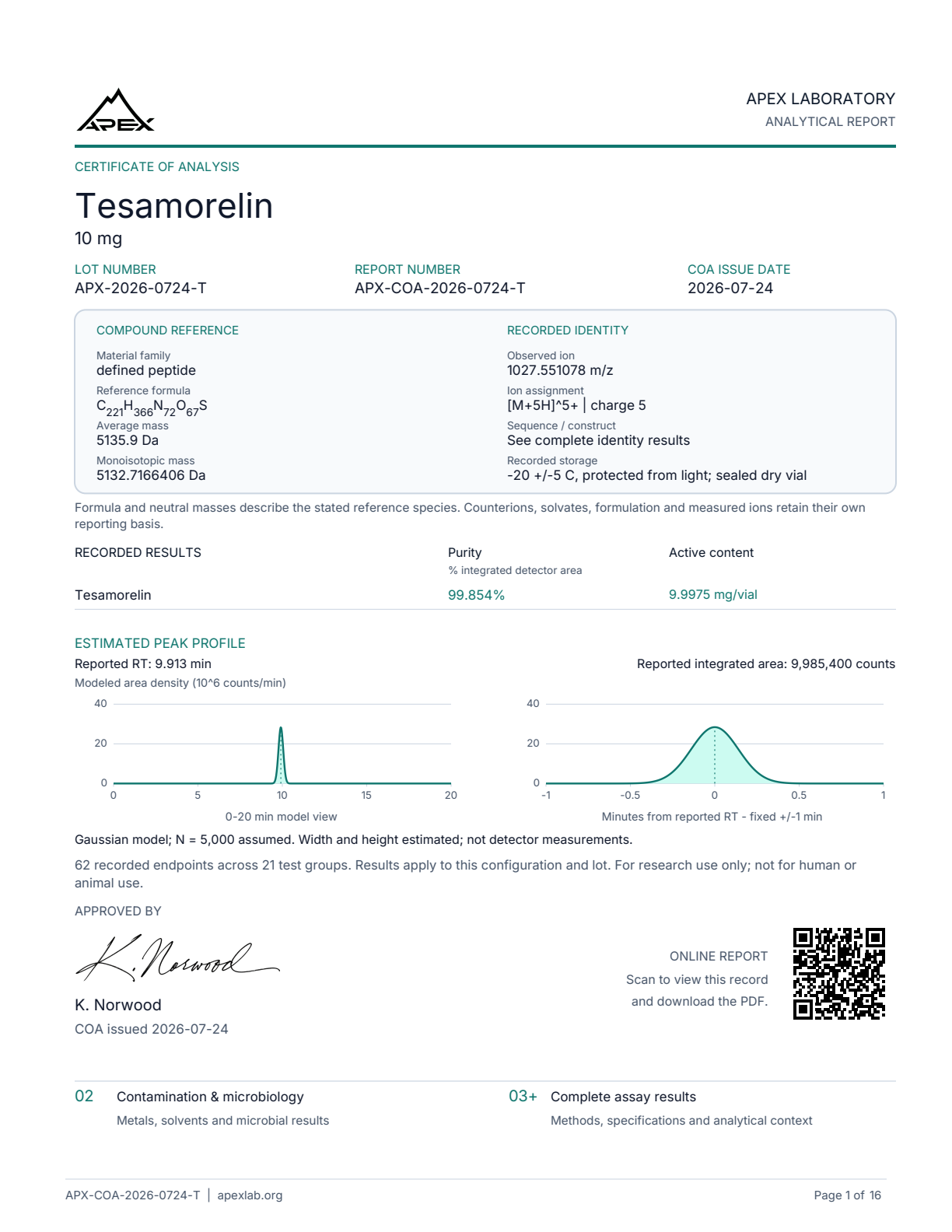
Tesamorelin - 10 mg
- Tesamorelin chromatographic purity
- 99.854 % integrated detector area
- Tesamorelin active content
- 9.9975 mg/vial
- GHRHR cAMP response relative potency
- 100.05 % reference response potency
- Bacterial endotoxins
- <0.025 EU/mg active-equivalent
Chromatographic purity by analyte

About this graph
Recorded scalar results against the stated specification. Each row uses its own labeled scale; purity is detector-area purity, not active-material content.
Measured active content

About this graph
Calibrated active content, concentration or activity compared with the stated same-unit specification. Each row uses its own labeled scale; no conversion from chromatographic purity is made.
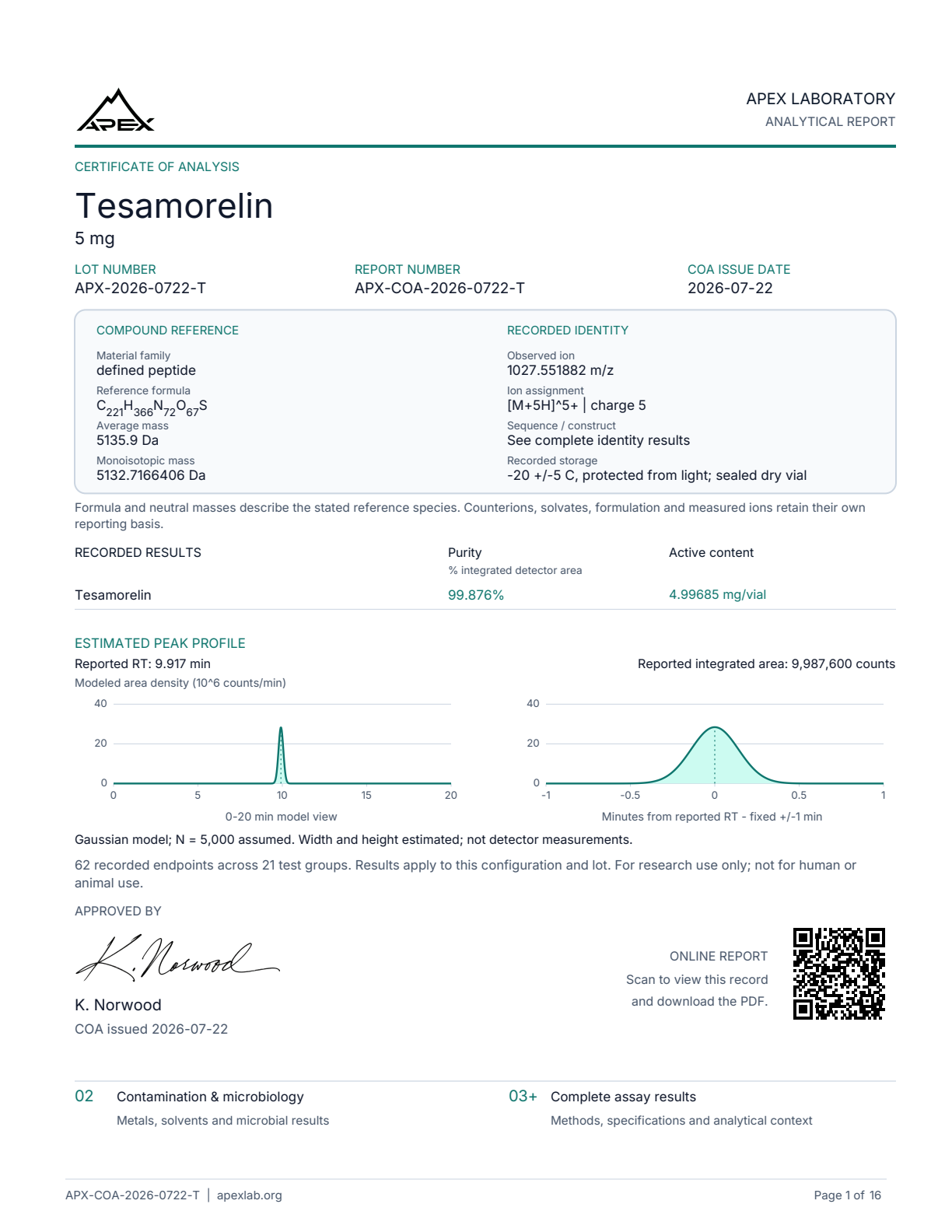
Tesamorelin - 5 mg
- Tesamorelin chromatographic purity
- 99.876 % integrated detector area
- Tesamorelin active content
- 4.99685 mg/vial
- GHRHR cAMP response relative potency
- 100.05 % reference response potency
- Bacterial endotoxins
- <0.025 EU/mg active-equivalent
Chromatographic purity by analyte

About this graph
Recorded scalar results against the stated specification. Each row uses its own labeled scale; purity is detector-area purity, not active-material content.
Measured active content

About this graph
Calibrated active content, concentration or activity compared with the stated same-unit specification. Each row uses its own labeled scale; no conversion from chromatographic purity is made.
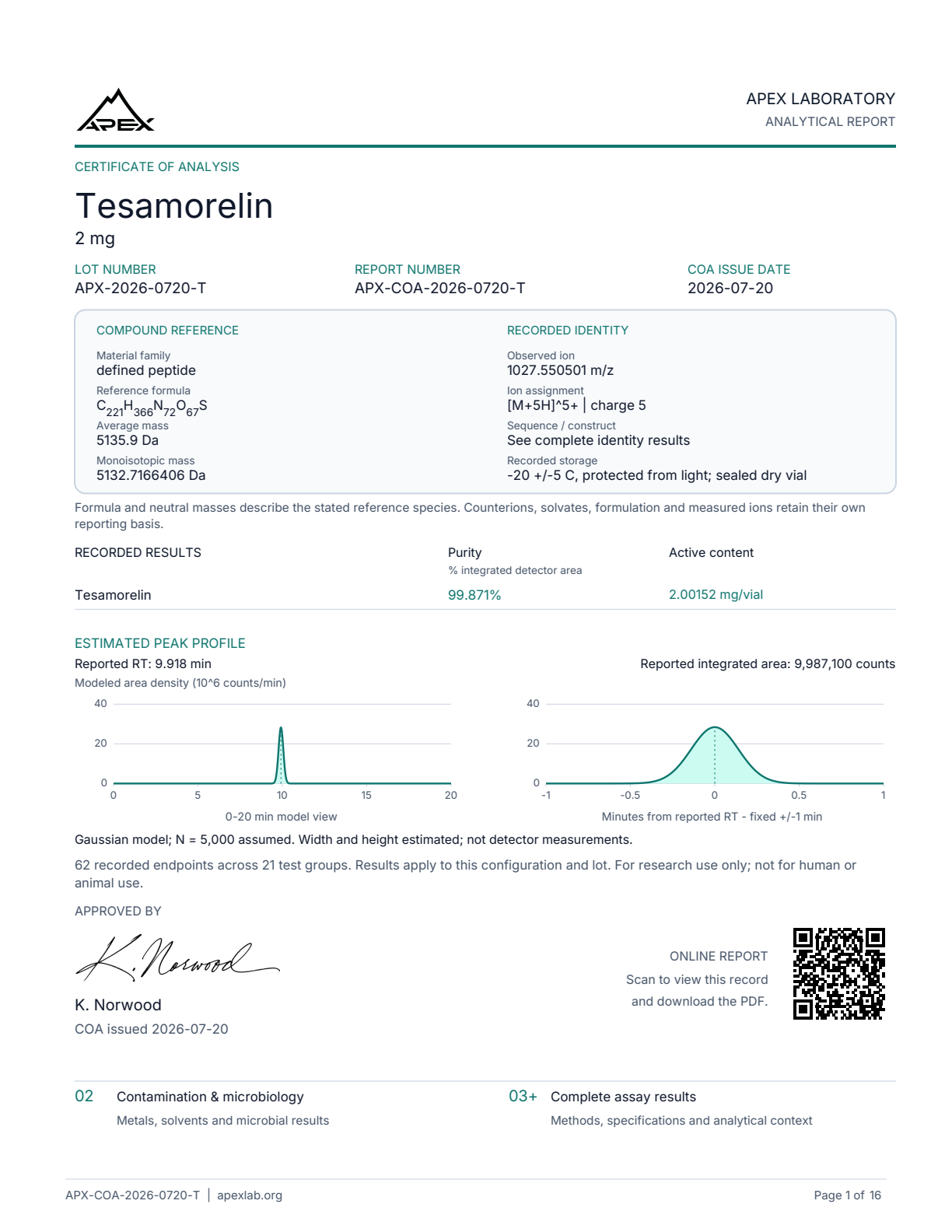
Tesamorelin - 2 mg
- Tesamorelin chromatographic purity
- 99.871 % integrated detector area
- Tesamorelin active content
- 2.00152 mg/vial
- GHRHR cAMP response relative potency
- 100.05 % reference response potency
- Bacterial endotoxins
- <0.025 EU/mg active-equivalent
Chromatographic purity by analyte

About this graph
Recorded scalar results against the stated specification. Each row uses its own labeled scale; purity is detector-area purity, not active-material content.
Measured active content

About this graph
Calibrated active content, concentration or activity compared with the stated same-unit specification. Each row uses its own labeled scale; no conversion from chromatographic purity is made.
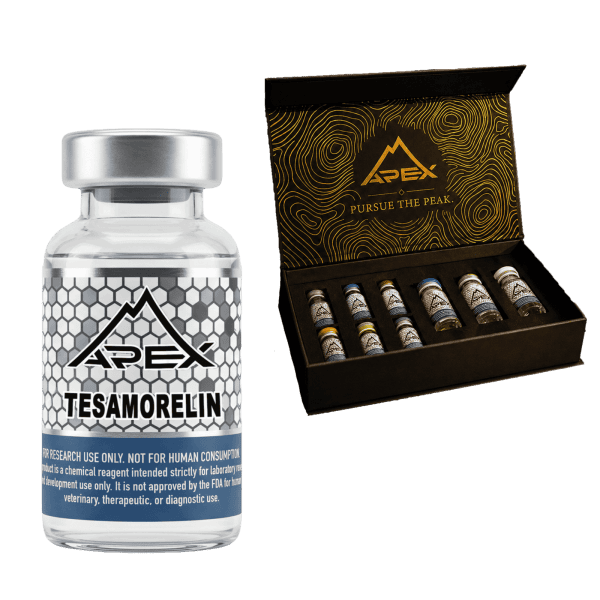
Tesamorelin is a synthetic GHRH(1-44) analog supplied here as a lyophilized research reagent in 2 mg, 5 mg, 10 mg and 20 mg configurations. Select a configuration in the COA panel and match its report to the lot on your material. For example, the 20 mg report for lot APX-2026-0726-T was issued on July 26, 2026; it does not describe every size or identify the lot assigned to a new order. The Tesamorelin evidence guide separately explains human study findings, formulation differences and research limits.
This material is offered strictly for in-vitro laboratory research and development. It is not approved for human consumption, veterinary use, or any therapeutic application.
Compound Overview
Tesamorelin contains the 44-residue GHRH sequence with an N-terminal trans-3-hexenoyl group attached to the amino group of Tyr1 and a C-terminal amide. This is N-terminal acylation, not esterification of the tyrosine side chain. For the unmodified parent GHRH, Frohman and colleagues identified DPP-IV cleavage at the bond between residues 2 and 3, removing the N-terminal Tyr-Ala dipeptide. That parent-peptide degradation study is structural context; it does not establish a shelf life for a prepared Apex vial.
Mechanistically, tesamorelin is characterized as an agonist at the GHRH receptor (GHRHR), a class B G-protein-coupled receptor used as a model target in pituitary-cell and recombinant-receptor systems. In these in-vitro models, receptor engagement is reported to activate adenylate cyclase and raise intracellular cAMP, the canonical second-messenger readout for this receptor class. Because the molecule acts at the receptor level rather than as an exogenous hormone, it is studied as a tool for probing GHRHR coupling and downstream signaling in cell-based assays. This places it in the GHRH-analog family alongside sermorelin (a truncated GHRH(1-29) fragment) and the CJC-1295 analogs; what distinguishes tesamorelin is that it retains the full 44-residue backbone, with an N-terminal modification. Backbone length alone does not establish comparative receptor affinity or potency.
Research Background & Published Literature
Published sources distinguish molecular identity, receptor pharmacology and results from particular clinical formulations. The sources below support structural and mechanistic context. They do not establish finished-drug equivalence, human-use authorization or preparation conditions for this research reagent. The Tesamorelin research guide reviews the separate human evidence and its limits.
Researchers exploring the published literature on this compound can review the following sources for additional context on its structure, GHRH-receptor signaling, and experimental applications in controlled laboratory settings:
- Frohman et al., 1989 — DPP-IV degradation of parent GHRH in plasma
- PubChem — tesamorelin compound record and structural data
- EGRIFTA SV label — molecular identity and pharmacology of that named finished formulation
Technical Specifications
| Product Name | Tesamorelin |
| Other Names | Tesamorelin acetate; TH9507; stabilized GHRH(1-44) analog |
| Classification | Modified GHRH receptor (GHRHR) agonist — growth hormone secretagogue |
| CAS Number | 218949-48-5 |
| Molecular Formula | C₂₂₁H₃₆₆N₇₂O₆₇S |
| Molecular Weight | 5135.9 g/mol |
| Sequence / Structure | 44-amino-acid GHRH(1-44) backbone with N-terminal trans-3-hexenoyl modification at Tyr1 |
| Purity Specification | Read the selected configuration and lot report for the result, acceptance criterion and method; chromatographic purity is separate from measured active content. |
| Physical Form | Lyophilized (freeze-dried) powder · sealed glass vial |
| Preparation vehicle | Selected under the laboratory’s validated procedure for the material, assay and container. |
| Available Sizes | 2mg · 5mg · 10mg · 20mg |
| Intended Use | In-vitro research only — not for human consumption |
Storage, Handling & Stability
Follow the applicable lot record for unopened material and use a validated laboratory procedure for preparation, containers and storage. The published report describes dry, sealed-vial storage at -20 ±5 °C with protection from light. It does not establish a universal shelf life after reconstitution. Diluent, concentration, container, handling and assay requirements must be considered for the prepared material.
- Use the preparation and mixing procedure validated for the selected material and experiment.
- Record preparation conditions and permitted holding times under the laboratory procedure.
- Keep material and aliquot labels traceable to the original lot, and document preparation and storage under the applicable laboratory procedure.
- Label every aliquot with compound name, concentration, reconstitution date, and operator initials for complete lot traceability, and follow your institution’s chemical safety protocols with appropriate PPE.
Quality Assurance & Analytical Verification
The COA panel links to Apex Laboratory in-house reports for the named configurations and lots. Open the report for the material being evaluated and read identity, chromatographic purity and active content as separate measurements. In the 20 mg record APX-COA-2026-0726-T, for example, chromatographic purity is reported as 99.927% integrated detector area, while active content is 19.9858 mg/vial. Neither number is a result for another configuration, a guaranteed future lot or a clinical-performance measure.
For identity, check the report’s assigned structure, mass basis, ion and charge state. A neutral average mass, a monoisotopic reference mass and a measured ion m/z are different values. The same 20 mg record assigns a measured ion to [M+5H]5+; its reference masses are identified separately. Read the stated tolerance and method rather than comparing an ion m/z directly with the reference molecular weight. The mass spectrometry guide explains this distinction. Match the received label to the report using the lot lookup; contact Apex if the identifiers differ. These are published in-house results, not independent third-party verification or proof of the lot assigned to a new order.
Frequently Asked Questions
What distinguishes tesamorelin from sermorelin and other GHRH analogs?
Tesamorelin contains the 44-residue GHRH sequence with an N-terminal trans-3-hexenoyl modification, whereas sermorelin corresponds to the shorter GHRH(1-29) sequence. Those are structural distinctions; a sequence length or modification alone does not quantify receptor activity, mixture performance or stability under a particular laboratory condition. See the Tesamorelin vs Sermorelin comparison guide for the source-specific research context.
Why does tesamorelin have such a high molecular weight?
The reference average molecular weight is approximately 5135.9 g/mol for the specified peptide molecule, which contains 44 amino acids and the N-terminal hexenoyl group. Associated acetate, water and the ion observed by mass spectrometry require their own stated basis. A chromatographic retention time does not measure molecular weight.
How should this compound be reconstituted for in-vitro work?
Select the diluent, container and preparation conditions through the laboratory’s validated procedure for the material and assay. Use the peptide reconstitution calculator for concentration arithmetic from an entered mass and volume. Arithmetic does not establish solubility, sterility, compatibility or a usable lifetime after preparation.
What does the trans-3-hexenoic acid modification actually do?
The trans-3-hexenoyl group acylates the N-terminal amino group of Tyr1. Tesamorelin is a stabilized GHRH analog; this chemical modification must not be confused with an ester on the tyrosine side chain. The parent-GHRH DPP-IV study identifies cleavage after residue 2, removing Tyr-Ala. That molecular distinction does not determine the stability of every prepared research solution.
Is this product approved for human use?
No. All compounds sold by Apex Laboratory are classified as chemical research reagents intended strictly for in-vitro laboratory research. They are not approved for human consumption, veterinary use, or any therapeutic application. The research-grade material supplied here is a chemical reagent only and carries no human-use authorization of any kind. Purchasers who imply intended bodily use will have their orders cancelled and their accounts permanently suspended.
Where can I find the COA for my Tesamorelin configuration and lot?
Use the report configuration selector above for the 2 mg, 5 mg, 10 mg or 20 mg record, then compare its complete lot with the received label. You can also enter that lot in the lot lookup. The 20 mg report for APX-2026-0726-T, issued July 26, 2026, is one identified example. If you need a particular available lot confirmed before ordering, contact Apex Laboratory; a published record alone does not identify the shipping assignment.
Related Research Compounds
Researchers studying GHRH-receptor signaling and the growth hormone axis may also be interested in related compounds from Apex Laboratory: Sermorelin Acetate (GHRH(1-29) fragment), CJC-1295 No DAC, CJC-1295 with DAC, and the growth hormone secretagogue Ipamorelin. For the broader category, see the Growth Hormone Peptides pillar guide, or browse the full Apex Laboratory research catalog.
Shipping, Packaging & Delivery
Domestic orders with cleared payment before 2:00 PM ET on a business day usually ship the same day, subject to the conditions in the shipping policy. Review that policy for dispatch details and delivery estimates. On arrival, match the configuration and lot on the vial to the applicable documentation and follow its storage instructions. Contact Apex before ordering if the experiment requires a particular delivery window or shipping condition.
Research Use Disclaimer
For in-vitro research use only. Not for human consumption. All products sold by Apex Laboratory — including Tesamorelin — are intended exclusively for qualified researchers, accredited laboratories, and educational institutions. This research-grade tesamorelin is supplied as a chemical reagent and is not a pharmaceutical product; it carries no human-use or veterinary authorization. Purchasers assume full responsibility for safe handling, proper storage, and compliance with all applicable federal, state, and local laws, regulations, and institutional policies governing the purchase and use of chemical research reagents.