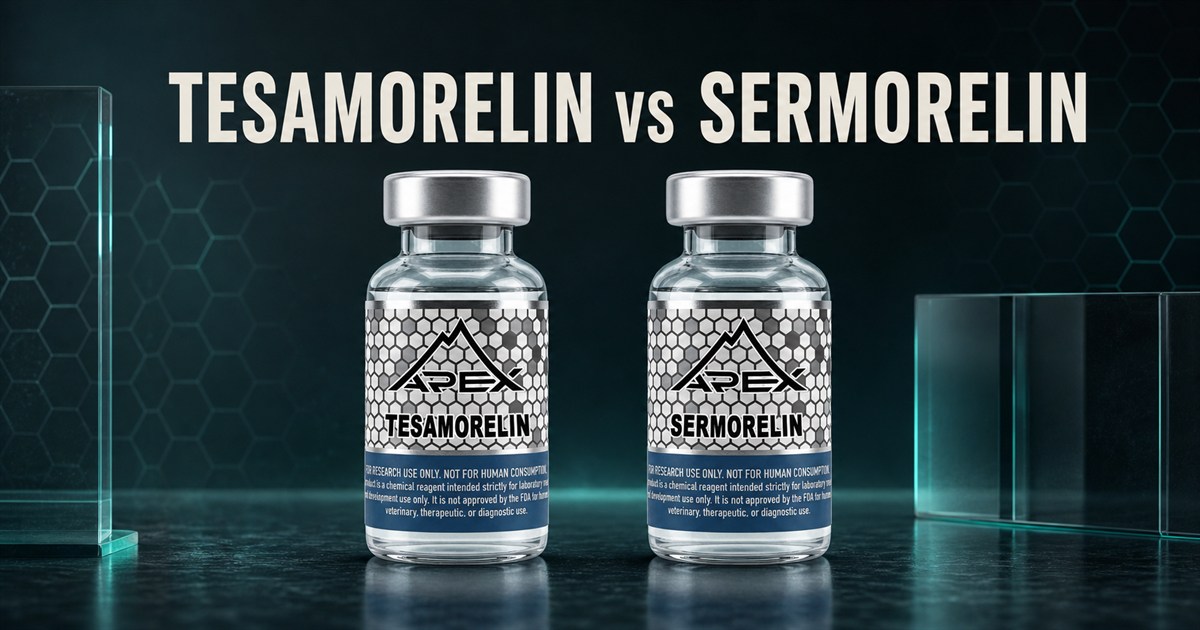
Tesamorelin and Sermorelin are distinct growth hormone-releasing hormone analogs that share GHRHR as a named receptor. Tesamorelin is a modified 44-residue GHRH chain, whereas Sermorelin is the amidated 29-residue N-terminal fragment. They also have different pharmaceutical evidence and regulatory histories, so neither a pathway diagram nor a cross-study result supports a universal claim that one is stronger, better, or interchangeable with the other.
The useful version of a Tesamorelin-versus-Sermorelin comparison begins with the research question, not a winner. The molecules differ in chain length and terminal chemistry. Their human finished-drug records were built around different indications and eras. Their current Apex vials are research-use-only materials that must be evaluated through their own specifications and lot documents.
- Tesamorelin is a 44-residue GHRH analog with an N-terminal trans-3-hexenoyl group; Sermorelin is GHRH(1-29)-NH2.
- Both are studied through GHRHR, but shared receptor biology does not imply equal exposure, activity, or outcomes.
- Tesamorelin has a current U.S. finished-drug record through Egrifta presentations; historical Geref Sermorelin applications were withdrawn after discontinuation.
- The Tesamorelin clinical program and the Geref record studied different finished products and questions. Cross-study comparisons cannot create a potency ranking.
- No direct head-to-head trial was identified in the verified evidence set used for this refresh.
- For laboratory selection, the relevant variables are model, assay, controls, analyte identity, material form, and analytical specification.
Tesamorelin vs Sermorelin at a Glance
| Comparison point | Tesamorelin | Sermorelin |
|---|---|---|
| Peptide design | 44-residue human GHRH chain with an N-terminal trans-3-hexenoyl group | Residues 1-29 of human GHRH with C-terminal argininamide |
| Common shorthand | Modified GHRH(1-44) | GHRH(1-29)-NH2 |
| Named receptor | GHRHR | GHRHR |
| U.S. finished-drug context | Egrifta; NDA 022505 approved November 10, 2010, with current presentations in FDA records | Historical Geref NDAs approved in 1990 and 1997; withdrawals effective in 2009 |
| Direct head-to-head trial in reviewed set | None identified | None identified |
| Apex material | Research-use-only reagent; not Egrifta | Research-use-only reagent; not historical Geref |
The table answers definitional questions. It does not rank potency, duration, safety, or efficacy. Any such ranking would require comparable materials, methods, exposures, endpoints, and a direct experimental design. The reviewed source set does not provide that head-to-head evidence.
How Do the Molecular Designs Differ?
Tesamorelin retains the 44-residue human GHRH chain and adds an N-terminal trans-3-hexenoyl group. That terminal modification is part of the registered substance definition, not a decorative label. Sermorelin is shorter: the first 29 residues of human GHRH, with the C-terminal arginine amidated. Sermorelin acetate is the corresponding acetate material form.
The common lineage begins with the discovery and characterization of human growth hormone-releasing factor.[1][2] Both are historical characterization papers: the Science report resolved a 44-residue primary sequence from a human pancreatic tumour, and both carry no quantitative endpoint that could rank a later analog. From that shared parent sequence, the two designs take different approaches. Tesamorelin retains the full 44-residue chain with an N-terminal modification. Sermorelin preserves the biologically active N-terminal region in a shorter amidated fragment.
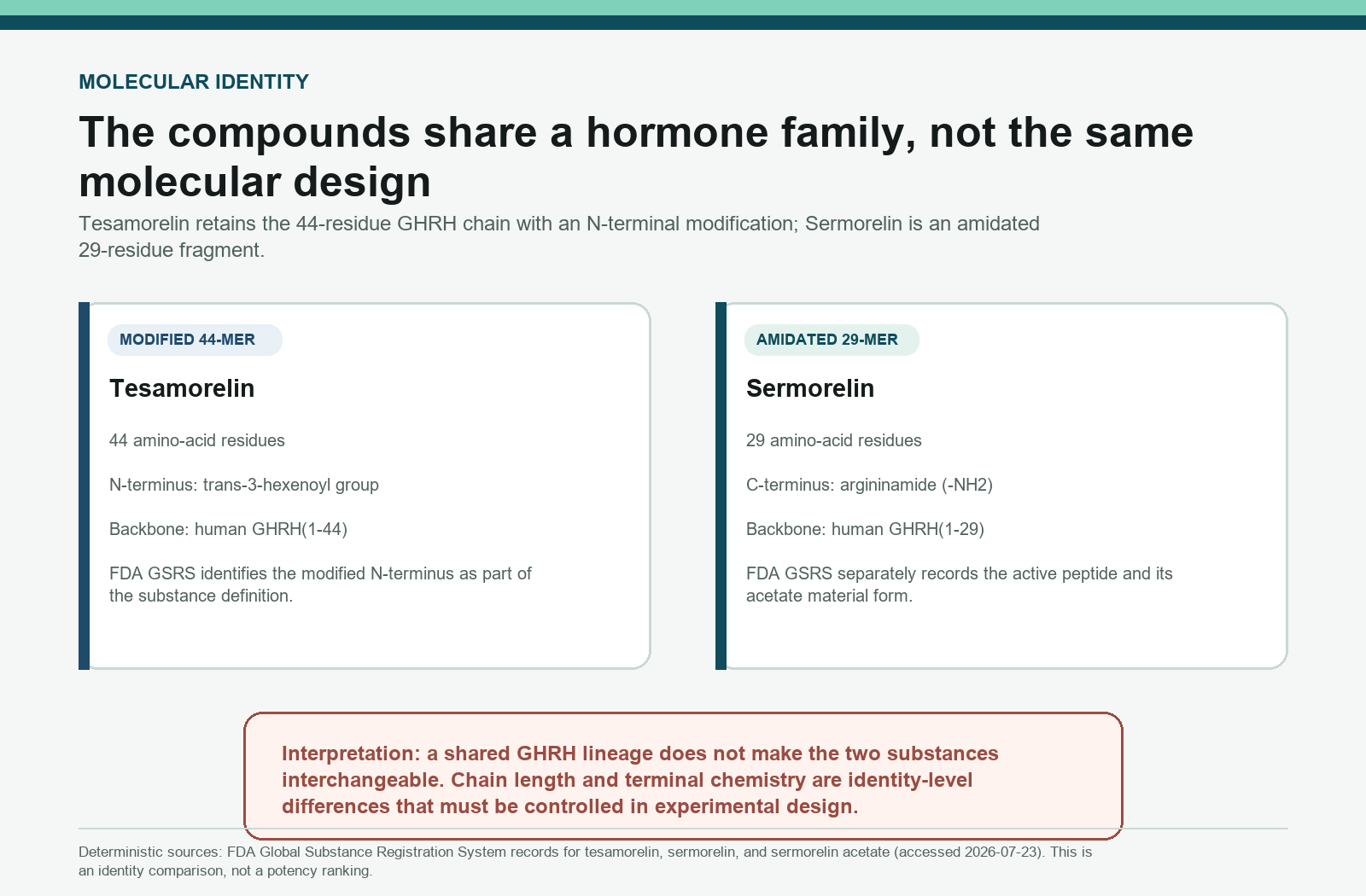
Identity differences can influence experimental behavior, but the direction and magnitude must be measured. They do not justify replacing one analyte with the other in a protocol. Reference standards, expected masses, chromatography, stability plans, controls, and data interpretation all need to match the material actually under study.
What Mechanism Do Tesamorelin and Sermorelin Share?
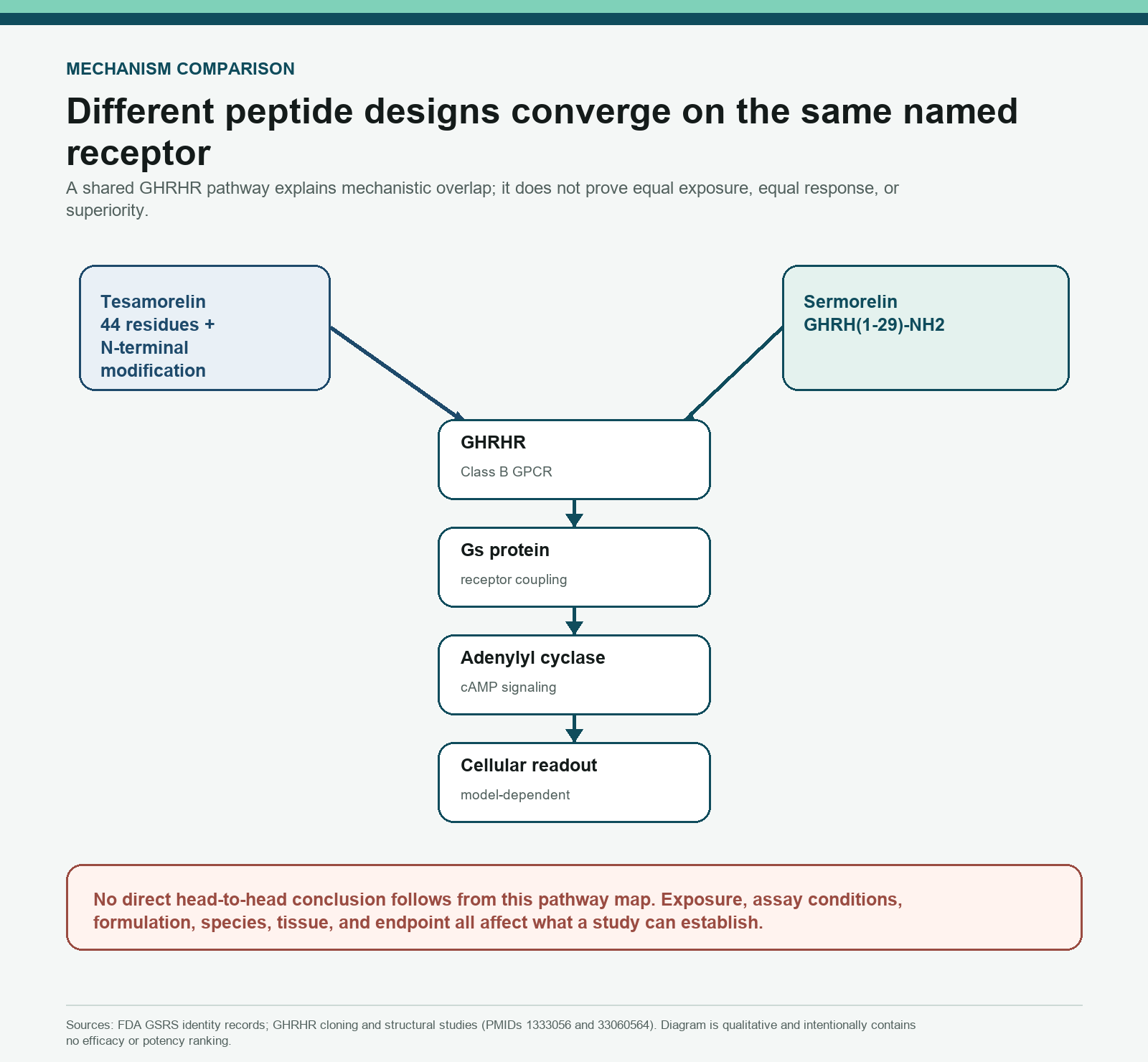
Both are studied as ligands of GHRHR. Molecular cloning established the pituitary receptor for growth hormone-releasing hormone, and structural studies later described ligand-dependent receptor activation.[3][4] The receptor was cloned from rat pituitary mRNA and its human homolog expressed in kidney 293 cells; the 2020 cryo-EM work resolved the human GHRHR-GHRH-Gs complex at 2.6 Å. Neither studied either analog, and the 1992 cloning report carries no quantitative endpoint. The canonical pathway proceeds through the stimulatory G protein Gs, adenylyl cyclase, cAMP, and downstream cellular responses.
A common receptor creates mechanistic overlap, not interchangeability. Two ligands can share a receptor while differing in degradation, exposure, formulation, concentration-response behavior, matrix stability, or off-target observations. A receptor diagram also cannot answer whether a given lot has the expected identity or purity.
Can Tesamorelin and Sermorelin Pharmacokinetics Be Ranked?
Not from the evidence assembled here. Native human GHRH is susceptible to plasma degradation, including cleavage associated with dipeptidyl peptidase IV.[5] That in-vitro human-plasma work placed the primary cut at the 2-3 bond of both GHRH(1-44)-NH2 and the GHRH(1-29)-NH2 fragment, blocked by the DPP-IV inhibitor diprotin A, and carries no quantitative result for either analog. Both shortening and terminal modification can be relevant to stability research, but a structural rationale is not the same as a directly comparable pharmacokinetic result.
Sermorelin’s commonly repeated rapid-elimination statement traces to hGRF(1-29)-NH2 work in anesthetized rats, not a universal human comparison.[6] That study dosed the rats with 10 µg intravenously and reported a 1.9 minute distribution-phase half-life and a 10.4 minute elimination-phase half-life, with subcutaneous delivery reaching only 4% of the intravenous circulating amount. Those are rat immunoreactive-GRF values; the widely repeated 11-12 minute and 26-38 minute half-lives remain unverified in this evidence set and are not asserted here. Tesamorelin’s finished-drug program includes human studies, but those studies used a specific pharmaceutical formulation, population, schedule, and assay framework. They cannot be placed beside a rat fragment study to calculate a clean ratio or declare one reagent “longer acting.”
A valid head-to-head pharmacokinetic experiment would need matched species or participants, analytical method, matrix, sampling design, dose normalization, formulation, route, and endpoint definition. Immunoreactive concentrations would also need to be distinguished from intact active peptide. Without those controls, apparent numerical precision would conceal an invalid comparison.
The previous cover visually labeled one side with greater potency and longer duration. Those claims were not supported by a direct comparison and converted heterogeneous evidence into a winner. The replacement cover is intentionally neutral, and the article keeps every conclusion attached to its source and model.
How Do Their U.S. Regulatory Histories Differ?
FDA approved Egrifta, a Tesamorelin finished drug, under NDA 022505 on November 10, 2010. The FDA Purple Book currently distinguishes presentations: the original Egrifta 1 mg entry is discontinued, while Egrifta SV and Egrifta WR are listed as active. Those status statements concern named finished products and should be rechecked against FDA records at deployment.
Sermorelin’s Geref history followed a different path. FDA approved NDA 19-863 on December 28, 1990, for a diagnostic use and NDA 20-443 on September 26, 1997, for a pediatric indication. The manufacturer discontinued the products in 2008 for commercial reasons and requested withdrawal; both withdrawals became effective June 18, 2009. FDA’s 2013 determination that the products were not withdrawn for reasons of safety or effectiveness did not return them to the market.
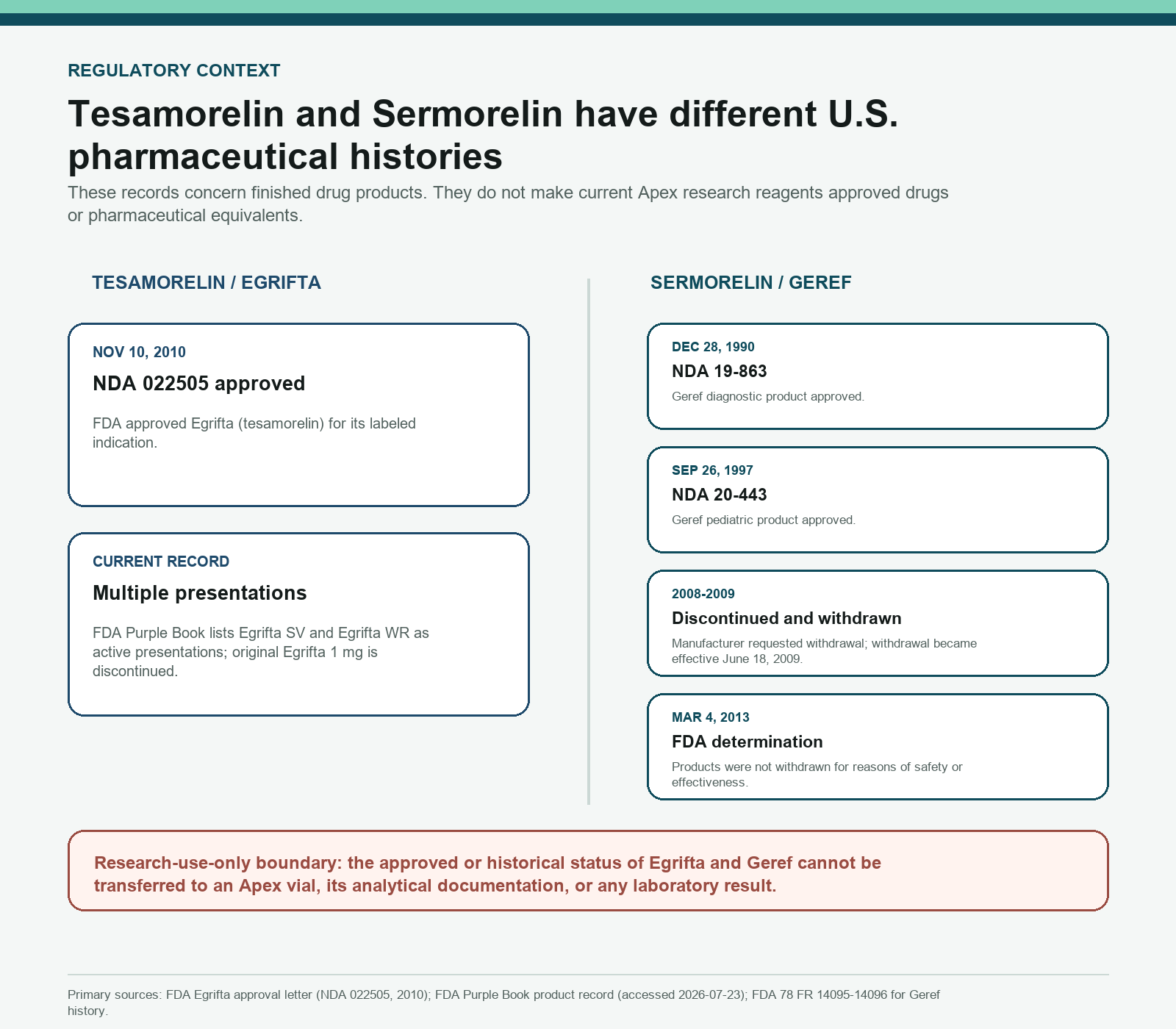
Same molecules, categorically distinct regulatory frameworks: Egrifta and Geref records describe finished pharmaceuticals evaluated under drug applications. Apex supplies Tesamorelin and Sermorelin acetate as research-grade chemical reagents for in-vitro and preclinical research. Neither is represented as its finished-drug counterpart. Neither Apex reagent holds FDA, EMA, NMPA, or any other regulatory approval anywhere globally; approval attaches to the named finished drugs, not to research-grade material. The research-grade versus pharmaceutical-grade guide explains why molecular identity does not transfer approval, formulation, sterility, or therapeutic equivalence.
How Do the Evidence Bases Differ?
Tesamorelin has a randomized finished-drug clinical program tied to a specific labeled pharmaceutical context. Published trials evaluated metabolic and body-composition endpoints in people with HIV and excess abdominal fat, and pooled phase 3 analyses supported the regulatory dossier.[7][8] The pivotal 26-week trial randomized 412 adults with HIV and abdominal fat accumulation to tesamorelin 2 mg daily subcutaneously or placebo; CT-measured visceral adipose tissue fell 15.2% on tesamorelin and rose 5.0% on placebo (P<0.001).[7] The pooled phase 3 analysis (n=806) put the week-26 visceral-fat treatment effect at -15.4%, held at -17.5% through week 52 in the arm that continued.[8] Those findings belong to the studied population, formulation, and endpoints. They do not validate off-label outcomes or an Apex reagent.
Sermorelin’s historical finished-drug record includes diagnostic and pediatric work. A multicenter Geref study reported growth outcomes in growth-hormone-deficient children during the first year of its protocol.[9] In it, 110 previously untreated prepubertal children received GHRH(1-29) 30 µg/kg subcutaneously at bedtime for up to a year; among the 86 evaluable, mean height velocity rose from 4.1 cm/yr at baseline to 8.0 cm/yr at 6 months and 7.2 cm/yr at 12 months. That record does not answer the questions studied in Tesamorelin trials and cannot serve as the other arm of an informal comparison.
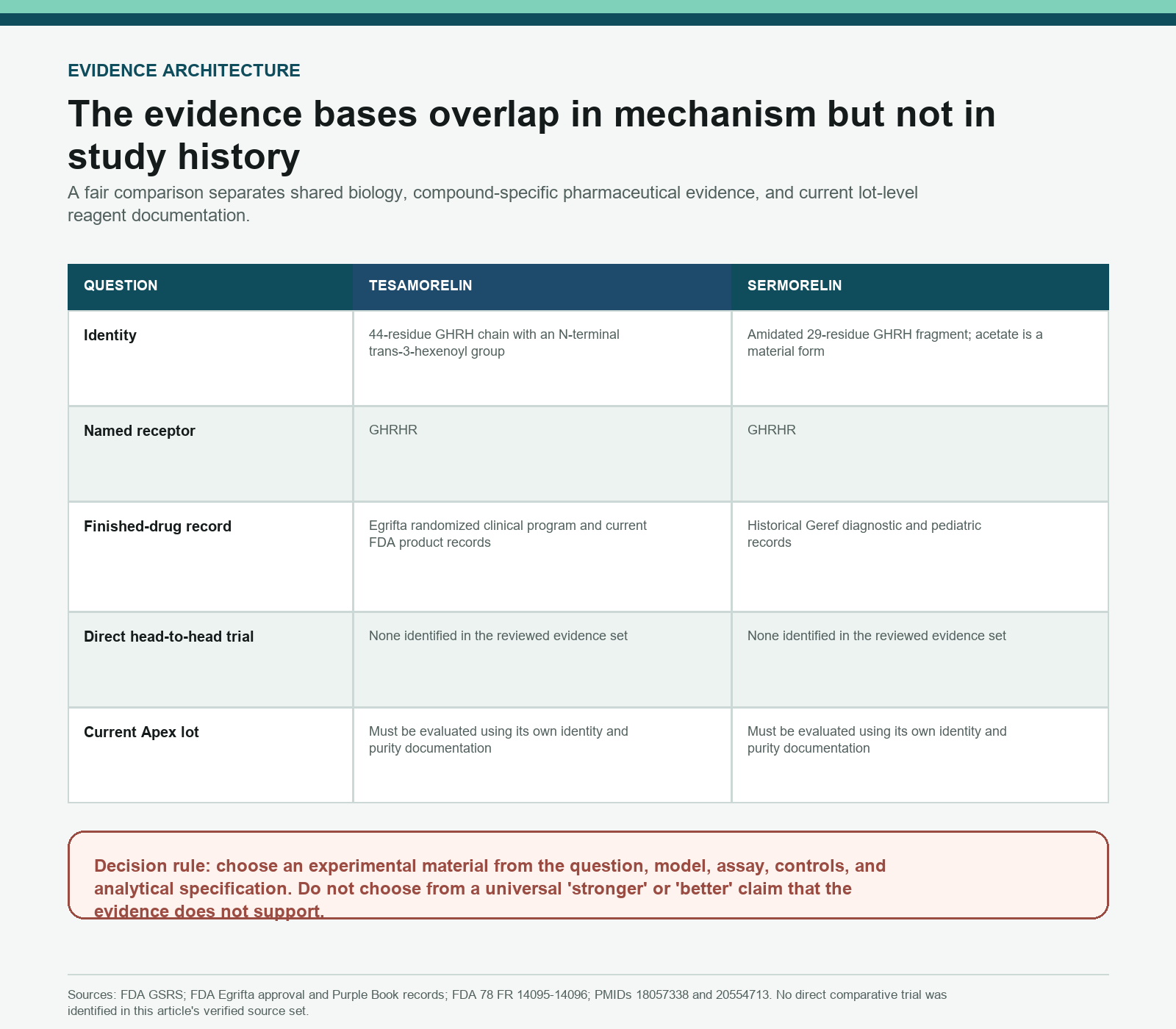
The absence of a direct trial is not proof that the compounds are equal. It means the reviewed evidence cannot support a controlled comparative claim. Search pages often turn different regulatory pedigrees into a simple “which is better” answer; this article preserves the harder but more useful conclusion that the best-supported choice depends on the defined laboratory question.
Additional reported findings
These readouts sit outside the head-to-head question. Each names the compound and model studied; none licenses transferring a result to the other analog.
| Compound studied | Model and population | Endpoint | Reported result | Source |
|---|---|---|---|---|
| Tesamorelin | HIV-infected adults, 26 weeks (n=410) | Fibrinolytic markers | tPA antigen -2.2 vs -1.6 ng/mL (P<0.05); PAI-1 not significant | PMID 21516030 |
| Tesamorelin | HIV-infected adults, 6 months (n=50) | Visceral and liver fat | VAT -34 cm2 vs +8 cm2; liver lipid-to-water -2.0% vs +0.9% (P=0.003) | PMID 25038357 |
| Tesamorelin | Pooled phase 3 (n=806), 6 months | Odds of VAT below 140 cm2 | 3.9-fold greater than placebo (95% CI 2.03-7.44) | PMID 26457580 |
| [Nle27]GHRH(1-29)-NH2 | Healthy men; IV, SC, intranasal | Growth hormone release | 10-fold higher SC dose than IV for comparable release | PMID 3096623 |
| [Nle27]GHRH(1-29)-NH2 | Adults 55-71 years (n=19), 16 weeks, 10 µg/kg nightly | Nocturnal GH and IGF-1 | Nocturnal GH rose (P<0.01 women, P<0.05 men); lean mass rose in men only | PMID 9141536 |
How Should a Study Choose Between Them?
A laboratory should begin with the hypothesis and the analyte it intends to test. A sound research design names that independent variable before selecting material. If the project concerns the 44-residue modified GHRH analog, Tesamorelin is the relevant identity. If it concerns the amidated 1-29 fragment or historical Sermorelin literature, Sermorelin is the relevant identity. Substituting one because both engage GHRHR changes the independent variable.
| Planning question | Why it matters | Required control |
|---|---|---|
| Which molecular identity does the hypothesis name? | Chain length and terminal chemistry differ | Sequence and material-form verification |
| What model and matrix are used? | Proteolysis and response can be model-dependent | Matrix-matched stability and negative controls |
| What endpoint is measured? | Receptor activation, cAMP, gene expression, and other endpoints answer different questions | Predefined assay acceptance criteria |
| How is the lot characterized? | Published identity does not prove the supplied lot | Lot-specific HPLC and mass-identity documents |
| Is the comparison direct? | Cross-study numbers are confounded by methods and formulations | Matched side-by-side design when comparison is the goal |
HPLC and mass spectrometry should also be interpreted within their limits. Chromatographic purity is not sequence confirmation; matching mass is not a biological-activity result. The Apex guides to reading a peptide COA and interpreting HPLC testing provide the method framework.
For qualified laboratory work, consult the current Tesamorelin research reagent page and Sermorelin acetate research reagent page equally. Product availability, pricing, and lot documentation are current-state facts and must be checked at deployment. For entity-level depth, see the Sermorelin research guide and the broader growth hormone axis research hub.
Frequently Asked Questions
What is the main difference between Tesamorelin and Sermorelin?
Tesamorelin is a modified 44-residue GHRH analog with an N-terminal trans-3-hexenoyl group. Sermorelin is the amidated 29-residue N-terminal GHRH fragment, commonly written GHRH(1-29)-NH2.
Do Tesamorelin and Sermorelin use the same receptor?
Both are studied through the growth hormone-releasing hormone receptor, GHRHR. A shared receptor supports mechanistic overlap but does not prove equal exposure, potency, duration, outcomes, or interchangeability.
Is Tesamorelin stronger than Sermorelin?
The verified source set does not support a universal stronger-or-weaker ranking. A valid comparison would require matched materials, formulations, models, analytical methods, exposures, and endpoints in a direct study.
Is there a direct Tesamorelin versus Sermorelin trial?
No direct head-to-head trial was identified in the verified evidence set used for this article. Separate studies of different products, populations, and endpoints cannot substitute for a controlled comparative trial.
How do their U.S. FDA histories differ?
Tesamorelin has a current finished-drug record through Egrifta presentations. Sermorelin’s Geref products had separate 1990 and 1997 approvals, were discontinued, and had their application withdrawals become effective in 2009.
Are Apex Tesamorelin and Sermorelin vials Egrifta or Geref?
No. Apex supplies research-grade chemical reagents for in-vitro and preclinical work. They are not Egrifta, historical Geref, approved drugs, pharmaceutical equivalents, or materials for human or veterinary use.
How should a laboratory choose between Tesamorelin and Sermorelin?
The choice should follow the hypothesis, molecular identity, model, assay, endpoint, controls, and analytical specification. Shared GHRHR signaling is not a sufficient reason to substitute one compound for the other.
References
- Rivier J, et al. Characterization of a growth hormone-releasing factor from a human pancreatic islet tumour. Nature. 1982;300(5889):276-8. PMID: PMID 6292724.
- Guillemin R, et al. Growth hormone-releasing factor from a human pancreatic tumor that caused acromegaly. Science. 1982;218(4572):585-7. PMID: PMID 6812220.
- Mayo KE. Molecular cloning and expression of a pituitary-specific receptor for growth hormone-releasing hormone. Mol Endocrinol. 1992;6(10):1734-44. PMID: PMID 1333056.
- Zhou F, et al. Structural basis for activation of the growth hormone-releasing hormone receptor. Nat Commun. 2020;11(1):5205. PMID: PMID 33060564.
- Frohman LA, et al. Dipeptidylpeptidase IV and trypsin-like enzymatic degradation of human growth hormone-releasing hormone in plasma. J Clin Invest. 1989;83(5):1533-40. PMID: PMID 2565342.
- Rafferty B, et al. Growth hormone-releasing factor analogue (hGRF1-29NH2): immunoreactive-GRF plasma levels after intravenous and subcutaneous administration. J Endocrinol. 1985;107(3):R5-8. PMID: PMID 2866222.
- Falutz J, et al. Metabolic effects of a growth hormone-releasing factor in patients with HIV. N Engl J Med. 2007;357(23):2359-70. PMID: PMID 18057338.
- Falutz J, et al. Effects of tesamorelin (TH9507), a growth hormone-releasing factor analog, in human immunodeficiency virus-infected patients with excess abdominal fat: a pooled analysis of two multicenter, double-blind placebo-controlled phase 3 trials with safety extension data. J Clin Endocrinol Metab. 2010;95(9):4291-304. PMID: PMID 20554713.
- Thorner M, et al. Once daily subcutaneous growth hormone-releasing hormone therapy accelerates growth in growth hormone-deficient children during the first year of therapy. Geref International Study Group. J Clin Endocrinol Metab. 1996;81(3):1189-96. PMID: PMID 8772599.