Batch documentation
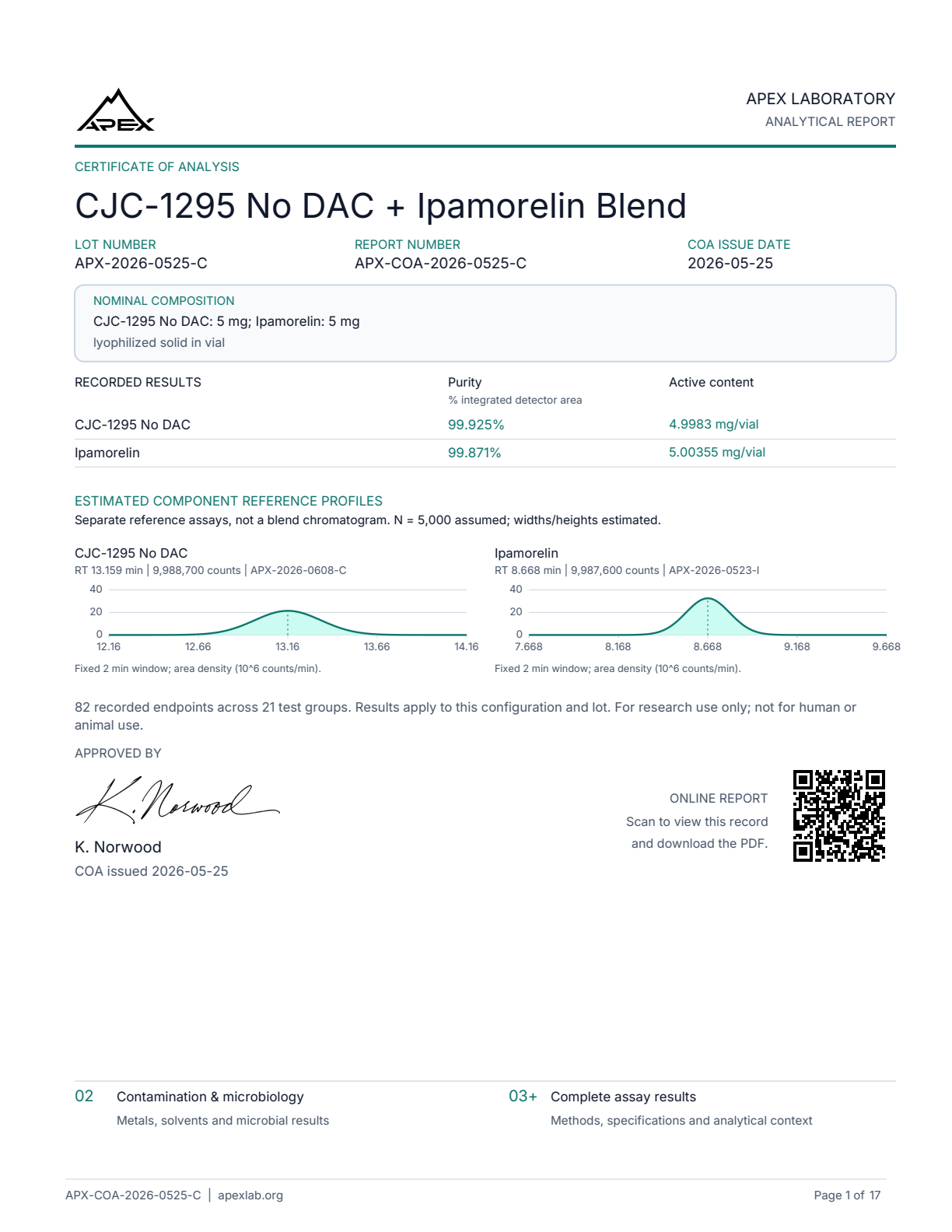
Certificate of analysis
Apex Laboratory results for the listed configurations. Match the lot on your label with the report.
CJC-1295 No DAC + Ipamorelin Blend
- CJC-1295 No DAC chromatographic purity
- 99.925 % integrated detector area
- Ipamorelin chromatographic purity
- 99.871 % integrated detector area
- CJC-1295 No DAC active content
- 4.9983 mg/vial
- Ipamorelin active content
- 5.00355 mg/vial
Chromatographic purity by analyte

About this graph
Recorded scalar results against the stated specification. Each row uses its own labeled scale; purity is detector-area purity, not active-material content.
Measured active content

About this graph
Calibrated active content, concentration or activity compared with the stated same-unit specification. Each row uses its own labeled scale; no conversion from chromatographic purity is made.
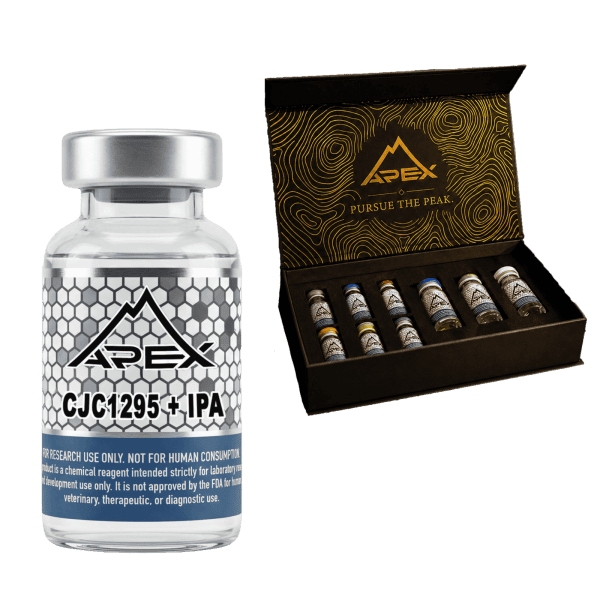
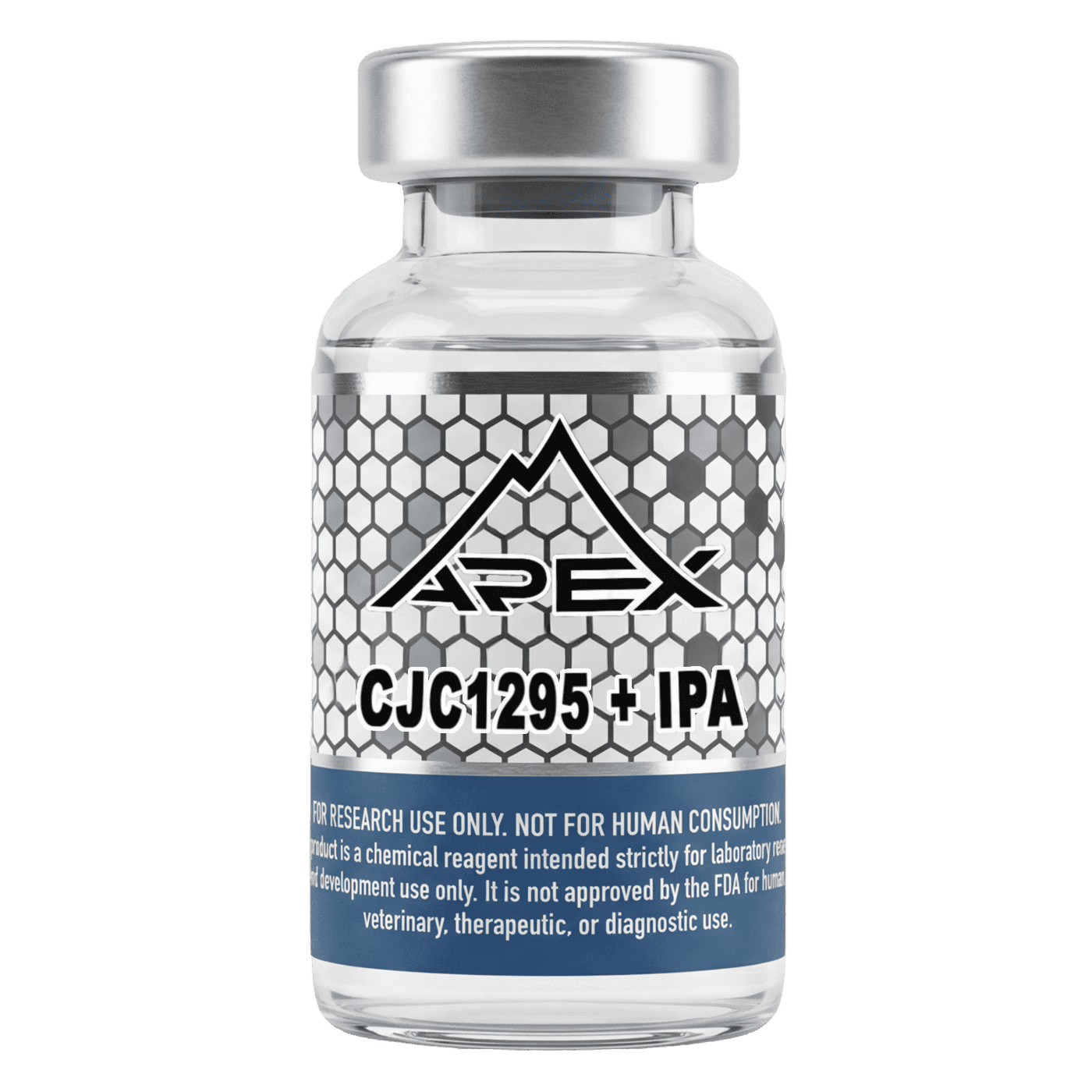
The CJC-1295 No DAC + Ipamorelin Blend is a co-lyophilized research reagent containing Modified GRF (1-29), commonly labelled CJC-1295 No DAC, and Ipamorelin: 5 mg of each, 10 mg total per vial. The 1:1 ratio is by nominal mass, not molecule count. Read the published in-house report for lot APX-2026-0525-C (issued 2026-05-25) together with its supporting-data clarification note. Match the configuration and actual material label; a published report does not identify the lot assigned to a future shipment. This product is for in-vitro laboratory research, not human or veterinary use.
Compound Overview
A premixed vial fixes the nominal starting composition. It does not by itself establish compatibility, stability, homogeneity, biological synergy or superiority to separately supplied components. The CJC-1295/Ipamorelin research guide separates the No DAC and DAC identities, component studies and evidence limits for this exact blend.
CJC-1295 No DAC, also catalogued as Modified GRF (1-29), is a 29-residue modified GHRH fragment. The No DAC label distinguishes it from the albumin-reactive DAC construct studied as long-acting CJC-1295. Published persistence and hormone-response findings for that DAC construct cannot establish a half-life or outcome for this No DAC mixture.
Ipamorelin is the pentapeptide Aib-His-D-2-Nal-D-Phe-Lys-NH₂. Its original pharmacology study examined growth-hormone release in rat and swine models. In swine, its ACTH and cortisol responses differed from those of GHRP-6 and GHRP-2; none of the tested secretagogues changed prolactin in that model. This is component-specific animal evidence, not a demonstration of benefit or an optimal 1:1 ratio for the blend.
Research Background & Published Literature
Different receptor pathways provide a reason to investigate combinations, but do not prove that this formulation is synergistic. The sources below studied separate components or a DAC-bearing construct; none validates the efficacy, compatibility or optimal composition of this 5 mg + 5 mg vial. The research guide reviews the exact-combination evidence separately.
- Raun et al. (1998) — Ipamorelin pharmacology in rat and swine models
- Jetté et al. (2005) — design and preclinical evaluation of albumin-reactive CJC-1295 with DAC
- Teichman et al. (2006) — long-acting CJC-1295 in healthy adults, not this No DAC blend
Technical Specifications
| Product Name | CJC-1295 No DAC + Ipamorelin Blend (5mg + 5mg) |
| Other Names / Synonyms | Modified GRF (1-29) + Ipamorelin; CJC-1295 DAC-free / Ipamorelin co-blend |
| Classification | Two-component peptide blend — GHRH-receptor analog + selective GHS-R1a secretagogue |
| Component 1 — CJC-1295 No DAC | 5 mg nominal · approximately 3367.9 g/mol parent reference · 29-residue modified GHRH fragment |
| Component 2 — Ipamorelin | 5 mg nominal · approximately 711.9 g/mol parent reference · pentapeptide Aib-His-D-2-Nal-D-Phe-Lys-NH₂ |
| Blend Ratio | 1:1 by mass · 10 mg total per vial |
| Analytical Results | Read the component-specific identity, chromatographic purity and content results in the named report; see the supporting-data clarification below. A whole-mixture purity number cannot substitute for component-resolved results. |
| Physical Form | Co-lyophilized powder · sealed glass vial |
| Preparation Method | Use the solvent and conditions specified by the applicable validated laboratory method. |
| Available Size | One 10 mg vial (5 mg + 5 mg) — $63.00 |
| Intended Use | In-vitro research only — not for human consumption |
Storage, Handling & Stability
Set dry-material storage and preparation conditions from the applicable lot documentation and validated laboratory method. Different molecular sizes do not establish which peptide tolerates freezing better or whether the blend remains stable after preparation. This page does not assign a universal solvent, handling recipe or prepared-solution shelf life.
The concentration calculator can calculate nominal component concentrations from the entered masses, stated ratio and final solution volume. It cannot establish compatibility or stability. The laboratory preparation guide and storage evidence guide explain how to read method-specific requirements.
- Record the material lot, solvent, component concentrations, final solution volume and preparation conditions required by the method.
- Label prepared material and aliquots with the blend identity and laboratory record so both components remain traceable.
Quality Assurance & Analytical Verification
The published Apex Laboratory report for lot APX-2026-0525-C, issued 2026-05-25, reports component-specific identity, chromatographic purity and active-content results. Read the issuer, sample basis and method for each result. Its CJC purity summary is 99.925%, while the displayed supporting peak areas give 99.871%; their relationship to the stated mean of independent preparations is not identified. This difference alone does not prove either measurement wrong. The existing supporting-data note explains why the underlying component and replicate records are needed before those areas can verify that mean.
The guide to HPLC purity, mass identity and measured content explains these distinct endpoints. Published reports are available through the Lab Verified hub; contact support for a specific material-lot or underlying-record question.
Frequently Asked Questions
What exactly is in this vial, and at what ratio?
The vial contains nominally 5 mg CJC-1295 No DAC and 5 mg Ipamorelin, for 10 mg total. This is equal mass, not equal molecule count. Using the parent reference masses gives approximately 1.48 micromoles of CJC No DAC and 7.02 micromoles of Ipamorelin; those calculated amounts are not a measured lot ratio, potency ratio or dosing instruction.
What does the “No DAC” designation change?
DAC refers to the albumin-reactive group used in the long-acting CJC construct. This vial uses the No DAC material, catalogued as Modified GRF (1-29). The DAC human studies therefore cannot supply a validated half-life, effect duration or benefit timeline for this blend.
Does combining the two peptides prove a stronger effect?
No. A GHRH-pathway analog and a growth-hormone secretagogue provide a rationale for testing a combination, but different pathways alone do not prove synergy, a superior result or an optimal 1:1 mass ratio. Evidence for either component or for other GHRH/GHRP combinations does not establish those outcomes for this formulation.
How should I read retention times and component purity?
Retention time belongs to a particular analyte and chromatographic method; molecular weight alone cannot predict the elution order. Use the run labels, method and peak assignments in the named report. Do not combine or average component results to create a whole-blend purity value, and read the supporting-data clarification before using the displayed areas as verification of the reported CJC mean.
Is buying the blend different from buying the two singles?
The blend supplies both components in one vial at a fixed nominal 1:1 mass ratio. Separate products allow a laboratory to select components and design other ratios under its validated method; neither format alone proves better stability or repeatability. For single-material or DAC-specific work, compare CJC-1295 No DAC, Ipamorelin and CJC-1295 with DAC.
Is this product approved for human use?
No. This product is supplied for in-vitro laboratory research, not as a finished medicine for human or veterinary use. It should not be treated as interchangeable with a clinical-study formulation, and this page does not provide a self-use protocol.
Related Research Compounds
Researchers studying growth-hormone-axis pharmacology may also want the individual components or comparator secretagogues: CJC-1295 No DAC (single), Ipamorelin (single), CJC-1295 with DAC, and Sermorelin Acetate as an alternate GHRH analog. For a component-level comparison see the Ipamorelin vs CJC-1295 research guide, and to browse the full range of secretagogue and GHRH reagents, visit the complete Apex Laboratory research catalog.
Shipping, Packaging & Delivery
Orders with cleared payment before 2:00 PM ET on a business day usually ship the same business day. Apex uses USPS tracked domestic service; typical transit is about 2–5 business days after carrier acceptance. Timing is an estimate and exceptions can apply. Review the shipping policy for handling, tracking, coverage and delivery support.
Research Use Disclaimer
For in-vitro research use only. Not for human or veterinary consumption. The CJC-1295 No DAC + Ipamorelin Blend — including both peptide components — is sold by Apex Laboratory exclusively to qualified researchers, accredited laboratories, and educational institutions. Purchasers assume full responsibility for safe handling, proper storage, and compliance with all applicable federal, state, local, and institutional requirements governing chemical research reagents.