Ipamorelin and CJC-1295 are different growth-hormone-axis research compounds. Ipamorelin is a pentapeptide growth-hormone secretagogue studied through GHS-R1a, while literature-defined CJC-1295 is a DAC-bearing GHRH(1-29) analog studied through the GHRH receptor. No direct head-to-head study between the exact compounds was identified in the verified source set, so the evidence does not establish a universal winner, a combination benefit, or interchangeable pharmacokinetics.
The useful version of an Ipamorelin-versus-CJC-1295 comparison starts with receptor identity and then slows down at the limits of the evidence. The two compounds can influence overlapping growth-hormone-axis readouts through different receptors, but that mechanistic relationship is not itself a comparative experiment. A second problem is naming: the CJC-1295 in the foundational papers contains a Drug Affinity Complex, or DAC, while the catalog phrase “CJC-1295 no DAC” commonly refers to Modified GRF 1-29.
- Ipamorelin is a pentapeptide growth-hormone secretagogue studied through GHS-R1a, the ghrelin receptor.
- Peer-reviewed CJC-1295 is a tetrasubstituted GHRH(1-29) analog whose DAC element was designed for covalent albumin binding.
- The label “CJC-1295 no DAC” usually points to Modified GRF 1-29 and cannot inherit the DAC construct’s human pharmacokinetic evidence.
- A human Ipamorelin PK/PD study and historical CJC-1295 studies used different compounds and designs; their values are not a direct ratio.
- No direct Ipamorelin-versus-CJC-1295 head-to-head study was identified in the current verified source set.
- Different receptor lanes do not prove additive, synergistic, safer, stronger, or clinically useful effects.
Ipamorelin vs CJC-1295 at a Glance
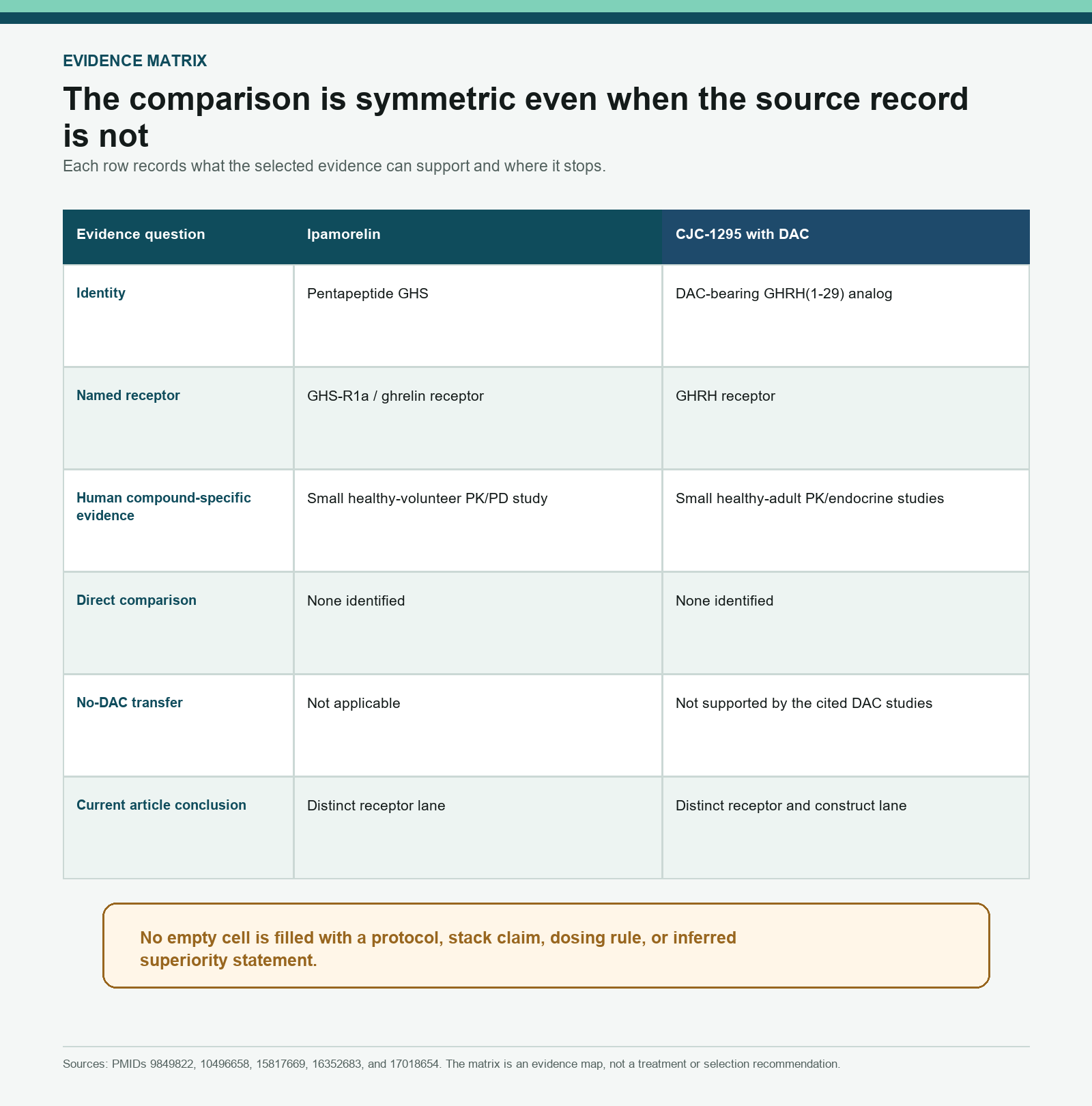
| Comparison point | Ipamorelin | CJC-1295 in the cited literature |
|---|---|---|
| Core identity | Pentapeptide growth-hormone secretagogue; reported sequence Aib-His-D-2-Nal-D-Phe-Lys-NH2 | Tetrasubstituted hGRF(1-29) analog carrying an Nε-3-maleimidopropionamide lysine derivative at the C terminus — the DAC element |
| Primary identity source | PMID 9849822 | PMID 15817669 |
| Primary receptor lane | GHS-R1a, the ghrelin receptor | GHRH receptor |
| Design emphasis | Selective GH-secretagogue pharmacology in the foundational animal study | Albumin-binding persistence built into the DAC-bearing construct |
| Compound-specific human evidence highlighted here | Small healthy-volunteer PK/PD study | Small healthy-adult PK/endocrine and pulsatility studies |
| Common naming risk | Confusion with the broader GHRP class | Confusion between CJC-1295 with DAC and Modified GRF 1-29 / “no DAC” |
| Direct head-to-head evidence | None identified in this refresh’s verified source set | |
| Current Apex context | Research-grade chemical reagents; not finished drugs and not for human consumption | |
The table is intentionally symmetric in its questions, not in the amount or maturity of the evidence. Each compound receives the same comparison fields, while unknowns remain unknown. It does not use receptor count, a study-specific half-life, or supplier terminology as a shortcut to superiority.
What Is the Main Difference Between Ipamorelin and CJC-1295?
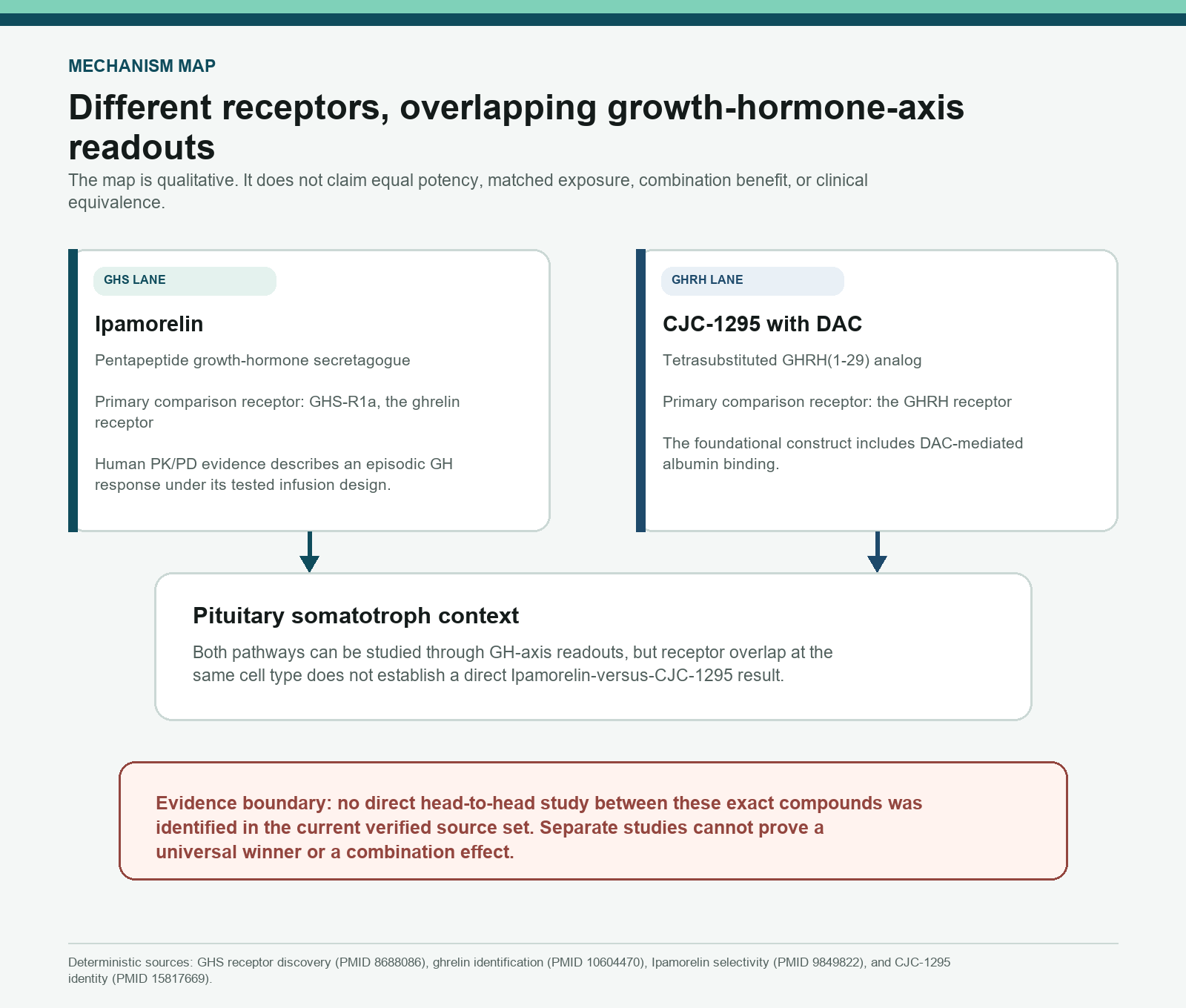
The main difference is the receptor system each compound is designed to engage. Ipamorelin belongs to the growth-hormone secretagogue family and is studied through GHS-R1a. The receptor was cloned from swine and human pituitary and hypothalamic tissue in 1996, before ghrelin was purified from rat stomach in 1999 as a 28-residue peptide acylated at serine 3.[1][2] Both are identification records and report no quantitative endpoint for growth-hormone release. CJC-1295 belongs to the GHRH-analog lane and is studied through the GHRH receptor.
Both receptor systems can be examined in pituitary somatotroph research, which explains why they appear in the same scientific conversation. That convergence does not make the compounds equivalent. Receptor identity, ligand structure, exposure, model, assay, and endpoint remain distinct variables.
The standalone Ipamorelin research guide owns the compound’s deeper identity and evidence task. The CJC-1295 research guide owns the with-DAC versus no-DAC nomenclature task. This page owns the direct comparison and its limits.
Why Does CJC-1295 Naming Matter?
In the foundational paper, CJC-1295 is a tetrasubstituted hGRF(1-29) analog with a reactive DAC group. The design supports covalent binding to albumin and prolonged circulation in the tested models.[5] The DAC component is therefore part of the studied molecular construct, not a detachable description.
Commercial pages often use “CJC-1295 no DAC” for Modified GRF 1-29. That label is useful for navigation, but it cannot make the no-DAC material the same analyte tested in the CJC-1295-with-DAC papers. Removing the albumin-binding element changes the construct and creates a separate evidence lane. A study result transfers only when the source explicitly identifies and tests the relevant material.
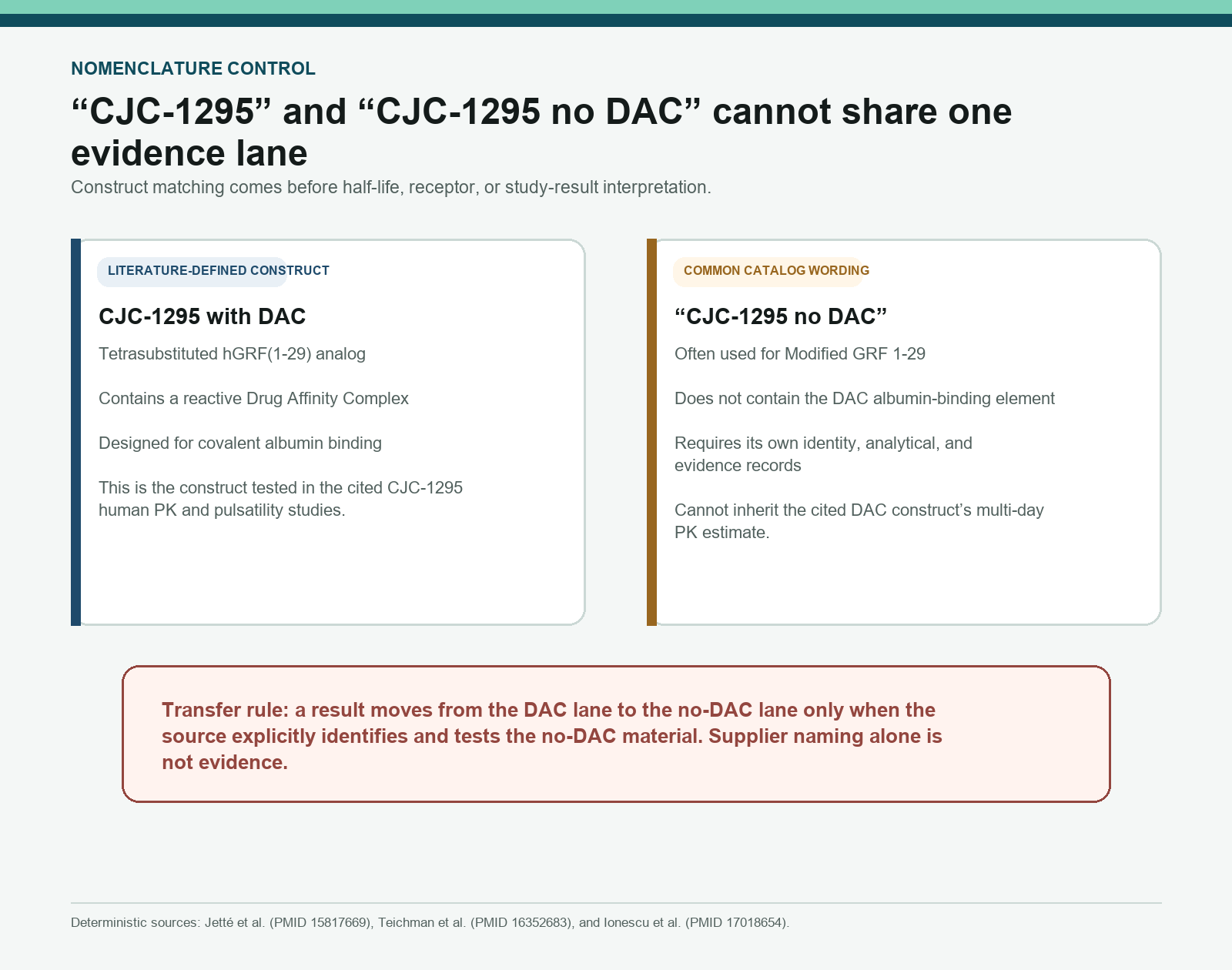
When a source says CJC-1295, verify whether the material includes DAC before using its result. Do not assign the DAC construct’s albumin-binding or human pharmacokinetic findings to Modified GRF 1-29 by name alone.
What Does the Ipamorelin Evidence Show?
Raun and colleagues described Ipamorelin as a pentapeptide growth-hormone secretagogue and tested its pharmacology in cell, rat, and swine experiments.[3] In primary rat pituitary cells it released GH with an EC50 of 1.3 ± 0.4 nmol/L and an Emax of 85 ± 5% of the GHRP-6 maximum; in pentobarbital-anaesthetised rats its ED50 was 80 ± 42 nmol/kg. In conscious swine it did not raise ACTH or cortisol significantly above GHRH-stimulated levels even at doses more than 200-fold above its GH ED50, while GHRP-6 and GHRP-2 raised both. That selectivity finding is often simplified into a broad safety statement, but the study did not establish universal human selectivity, clinical benefit, or comparative safety against CJC-1295.
A later PK/PD study examined Ipamorelin in healthy male volunteers using five 15-minute intravenous infusion rates from 4.21 to 140.45 nmol/kg, with eight men at each level.[4] The authors reported dose-proportional pharmacokinetics, a terminal half-life of two hours, and a single modeled GH-release episode peaking at 0.67 hours. Those values belong to the tested participants, infusion design, analytical model, and sampling schedule. They are scientific context, not administration instructions.
The evidence supports a narrow statement: Ipamorelin has compound-specific preclinical pharmacology and a small human PK/PD record. It does not create a direct comparison with CJC-1295, and it does not establish what happens when the compounds are combined.
What Does the CJC-1295 Evidence Show?
The CJC-1295 evidence used here belongs to the DAC-bearing construct. Jetté and colleagues described the albumin-bioconjugation design in preclinical work and identified CJC-1295 as a long-lasting GHRH analog in those experiments.[5] In male Sprague-Dawley rats it produced a 4-fold greater two-hour GH area under the curve than unmodified hGRF(1-29) and remained measurable in plasma beyond 72 hours. That paper supports the construct’s design logic and receptor activity. It does not compare the compound with Ipamorelin.
Teichman and colleagues later evaluated CJC-1295 in two small randomized, placebo-controlled studies in healthy adults.[6] They reported an estimated half-life of 5.8 to 8.1 days for the tested material; single subcutaneous injections raised mean plasma GH 2- to 10-fold for 6 days or more and IGF-I 1.5- to 3-fold for 9 to 11 days. The result is construct-specific and cannot be transferred to “CJC-1295 no DAC.”
Ionescu and Frohman examined GH pulsatility in healthy men before and one week after the DAC-bearing construct.[7] In 12-hour overnight sampling one week after 60 or 90 µg/kg, pulse frequency and magnitude were unchanged while trough GH rose 7.5-fold (P<0.0001), mean GH 46% (P<0.01), and IGF-I 45% (P<0.001). It did not test Ipamorelin, Modified GRF 1-29, or a combination.
Can Ipamorelin and CJC-1295 Half-Life Be Compared?
The study-specific values can be reported side by side only with their conditions attached. The Ipamorelin estimate came from a healthy-volunteer infusion study and was approximately two hours. The CJC-1295 estimate came from a different healthy-adult program using the DAC-bearing construct and was 5.8 to 8.1 days. These were not arms of one trial.
A direct ratio would ignore differences in molecular design, protein binding, study protocol, route, sampling, assay, and model. It would also invite a second error: assigning the multi-day DAC result to Modified GRF 1-29. The defensible conclusion is qualitative. The cited studies describe very different exposure architectures under different conditions; they do not identify a universally preferable compound.
One figure the earlier version of this page carried is qualified here rather than quietly deleted: the approximately 30-minute half-life routinely attributed to “CJC-1295 no DAC.” This refresh’s verified source set contains no compound-specific pharmacokinetic record for Modified GRF 1-29, so that value has no primary support on this page.
Is There Direct Combination Evidence for Ipamorelin and CJC-1295?
No direct head-to-head or combination study between these exact compounds was identified in the verified source set for this refresh. The receptor biology provides a reason scientists might ask the question, because GHS-R1a and the GHRH receptor are distinct inputs in the growth-hormone axis. A biological rationale is not an experimental result.
No compound-matched evidence in the verified source set supports a supra-additive or synergistic combination claim. Receptor separation cannot establish combination performance, and clinical study arms cannot be translated into use guidance. Any combination claim would require a study that identifies the exact materials, controls the exposure conditions, prespecifies the endpoint, and reports the result.
Additional Reported Findings
Each record below stays inside its own compound and model. Two narrative reviews cited by the earlier version are not restored, neither having reported a quantitative endpoint.
| Compound or target | Model and species | Endpoint | Reported result | Source |
|---|---|---|---|---|
| Ghrelin + GHRH-29 — not Ipamorelin or CJC-1295 | 7 healthy men aged 24-32; 6 of them in the combination arm; 1.0 µg/kg IV | Peak GH, 180 min | Ghrelin 92.1 ± 16.7 and GHRH-29 26.7 ± 8.7 µg/L alone; 133.6 ± 22.5 µg/L combined (P<0.05). Different molecules; does not transfer here | PMID 11238504 |
| Native GHRH(1-44)NH2 | Human plasma in vitro; IV injection in humans | Half-life, DPP-IV cleavage | 17 min in vitro and 6.8 min after IV injection; the GHRH(3-44)NH2 product kept under one thousandth of parent activity | PMID 3093533 |
| GHS-R1a receptor | In-vitro mutagenesis of the cloned receptor | Agonism vs inverse agonism | An efficacy-switch region on transmembrane helix III decides which a ligand produces at this constitutively active receptor; reports no quantitative endpoint | PMID 17371869 |
What Is the Regulatory Status of Ipamorelin and CJC-1295?
Stated per compound, and current as of this review date: Ipamorelin holds no FDA, EMA, NMPA, MHRA, PMDA or other approval anywhere globally and has never been part of an approved finished drug. CJC-1295 with DAC holds no approval in any jurisdiction either; its healthy-adult studies were investigational, and no approval followed. Modified GRF 1-29, the material sold as “CJC-1295 no DAC,” carries the same status: no marketing authorization anywhere, and no application on which one could rest. Neither has an approved counterpart whose evidence or quality system could be borrowed, a distinction the research-grade versus pharmaceutical-grade guide covers.
How Should an Ipamorelin-vs-CJC-1295 Comparison Be Interpreted?
Begin with the exact material. Record Ipamorelin, CJC-1295 with DAC, or Modified GRF 1-29 rather than treating the last two names as interchangeable. Then match every scientific claim to a compound-specific primary source. A supplier page can document a current lot, but it cannot replace a pharmacology paper.
Next, match the model and endpoint. A receptor assay, a healthy-volunteer PK study, a hormone-sampling experiment, and a Certificate of Analysis answer different questions. HPLC can describe chromatographic purity under a defined method, while mass spectrometry can support analyte identity; neither analytical method establishes biological activity, clinical safety, or comparative performance. The guides to HPLC purity testing, mass-spectrometry verification, and reading a peptide COA explain those boundaries.
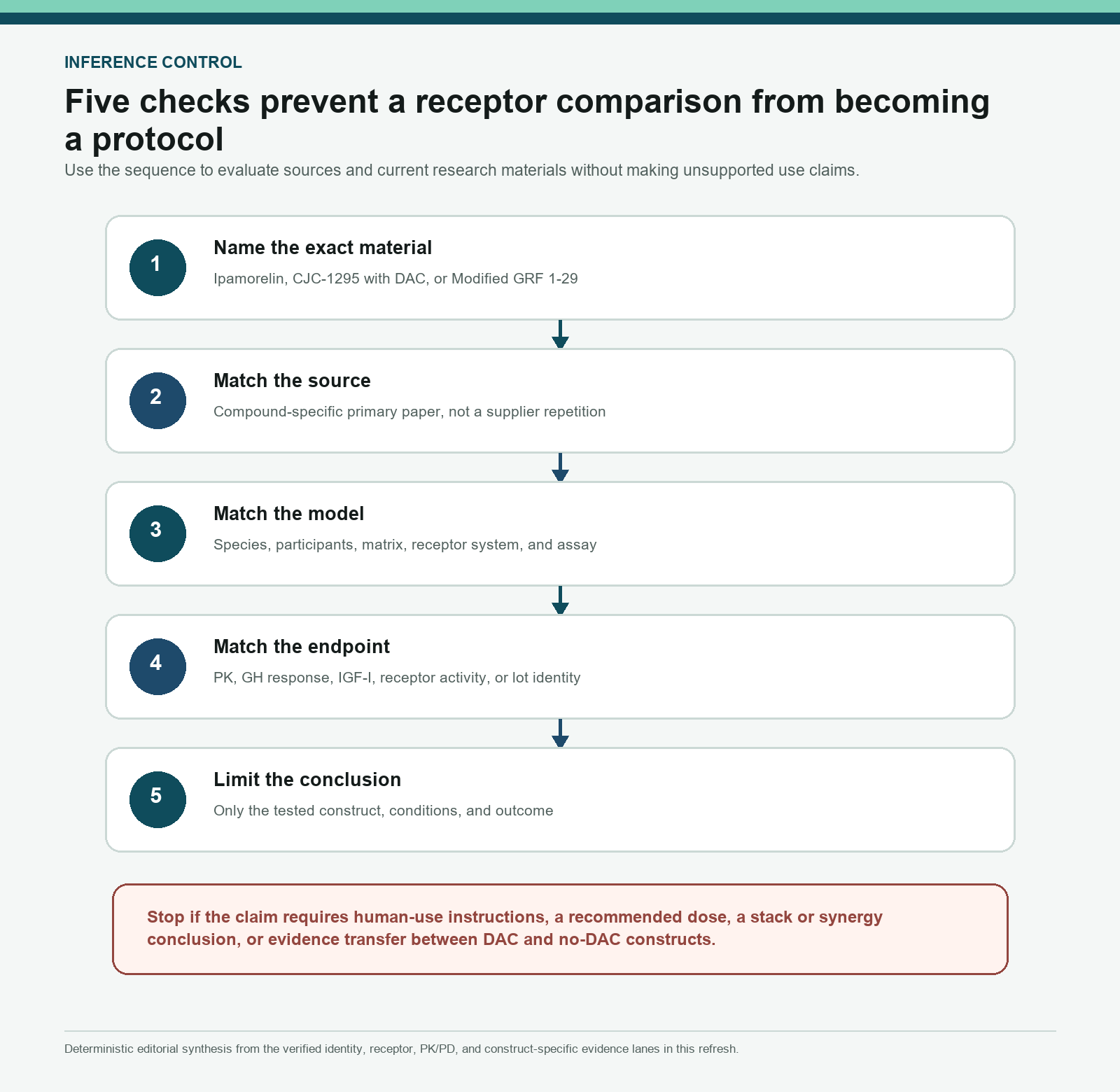
Finally, limit the conclusion to the tested construct, conditions, and outcome. A compound-specific result is useful precisely because it is narrow. Expanding it into treatment, combination, or universal-winner language reduces its accuracy and its value for researchers.
Research-Material and Documentation Handoff
Qualified laboratories with an independently defined in-vitro or preclinical study can inspect the current research-reagent records below. Apex lists both as lyophilized research reagents; read each applicable configuration report for its identity, lot, methods and results. Product availability, variants, specifications, and lot documentation must be rechecked at the time of evaluation. These links are balanced handoffs, not a recommendation to combine the materials.
Ipamorelin research record
Review the current identity, variants, and lot-specific analytical documentation for the Ipamorelin research reagent.
View the current Ipamorelin recordModified GRF 1-29 / CJC-1295 no-DAC record
Review the current no-DAC material separately from literature-defined CJC-1295 with DAC. Do not transfer the DAC construct’s PK evidence.
View the current no-DAC recordFor the wider topic map, use the growth hormone axis research hub. The two dedicated entity guides remain the canonical destinations for deeper single-compound questions.
Frequently Asked Questions About Ipamorelin vs CJC-1295
What is the main difference between Ipamorelin and CJC-1295?
Ipamorelin is a pentapeptide growth-hormone secretagogue studied through GHS-R1a. Literature-defined CJC-1295 is a DAC-bearing GHRH(1-29) analog studied through the GHRH receptor.
Do Ipamorelin and CJC-1295 use the same receptor?
No. Ipamorelin is studied through GHS-R1a, the ghrelin receptor, while CJC-1295 is studied through the GHRH receptor. Their pathways can converge on growth-hormone-axis readouts without becoming equivalent.
Is CJC-1295 no DAC the same construct used in the cited CJC-1295 studies?
No. The foundational and human papers cited here tested a DAC-bearing CJC-1295 construct. “CJC-1295 no DAC” commonly refers to Modified GRF 1-29 and requires a separate evidence lane.
Which has the longer half-life, Ipamorelin or CJC-1295?
The cited studies reported about two hours for Ipamorelin and 5.8 to 8.1 days for CJC-1295 with DAC, but the compounds and study designs differed. Those values are not a direct head-to-head ratio and do not apply to no-DAC material.
Is there a direct Ipamorelin-versus-CJC-1295 study?
No direct head-to-head study between the exact compounds was identified in the verified source set used for this refresh.
Does different receptor signaling prove that Ipamorelin and CJC-1295 work better together?
No. Distinct receptor lanes provide a mechanistic question, not proof of an additive or synergistic combination effect. A compound-matched controlled study would be required.
Are Apex Ipamorelin and CJC-1295 materials finished drugs?
No. Apex supplies research-grade chemical reagents for in-vitro and preclinical laboratory research only. They are not finished drugs and are not for human consumption.
References and Primary Records
- Howard AD, et al. A receptor in pituitary and hypothalamus that functions in growth hormone release. Science. 1996;273(5277):974-7. PMID: PMID 8688086.
- Kojima M, et al. Ghrelin is a growth-hormone-releasing acylated peptide from stomach. Nature. 1999;402(6762):656-60. PMID: PMID 10604470.
- Raun K, et al. Ipamorelin, the first selective growth hormone secretagogue. Eur J Endocrinol. 1998;139(5):552-61. PMID: PMID 9849822.
- Gobburu JV, et al. Pharmacokinetic-pharmacodynamic modeling of ipamorelin, a growth hormone releasing peptide, in human volunteers. Pharm Res. 1999;16(9):1412-6. PMID: PMID 10496658.
- Jetté L, et al. Human growth hormone-releasing factor (hGRF)1-29-albumin bioconjugates activate the GRF receptor on the anterior pituitary in rats: identification of CJC-1295 as a long-lasting GRF analog. Endocrinology. 2005;146(7):3052-8. PMID: PMID 15817669.
- Teichman SL, et al. Prolonged stimulation of growth hormone (GH) and insulin-like growth factor I secretion by CJC-1295, a long-acting analog of GH-releasing hormone, in healthy adults. J Clin Endocrinol Metab. 2006;91(3):799-805. PMID: PMID 16352683.
- Ionescu M, et al. Pulsatile secretion of growth hormone (GH) persists during continuous stimulation by CJC-1295, a long-acting GH-releasing hormone analog. J Clin Endocrinol Metab. 2006;91(12):4792-7. PMID: PMID 17018654.