Evaluate a peptide vendor by verifying five connected layers: the exact material and intended research scope, lot-to-report traceability, molecular-identity evidence, method-qualified purity evidence, and a documented disposition. No badge, price, vendor category, “third-party tested” phrase, or 99% figure clears all five layers. A defensible decision can be reconstructed from the received lot, its records, the methods used, the open questions, and the reviewer’s dated conclusion.
Choosing a supplier is a procurement and quality-system task, not a popularity contest. Peptide synthesis can generate deletion sequences, truncations, side products, and handling-dependent changes, while analytical methods answer different questions about a sample.[1] That bench protocol reports a 41-residue peptide assembled in roughly 80 hours of working time by the standard Fmoc/tBu route, with aggregation of the growing chain the main cause of chemosynthesis failure. The practical goal is therefore not to find a vendor that uses the most reassuring words. It is to decide whether the evidence for one exact material and lot is adequate for one defined research purpose.
This checklist is vendor neutral. Apply it to Apex Laboratory and to every alternative under review. It does not certify any seller, and it deliberately avoids displaying a fictional COA, chromatogram, spectrum, or purity result. The companion guides on reading a peptide COA, HPLC purity, and mass spectrometry provide the method-level depth that this procurement framework routes to.
- Start with a written analyte, form, research scope, and acceptance criteria.
- Require the catalog record, received lot, sampled material, and report to match.
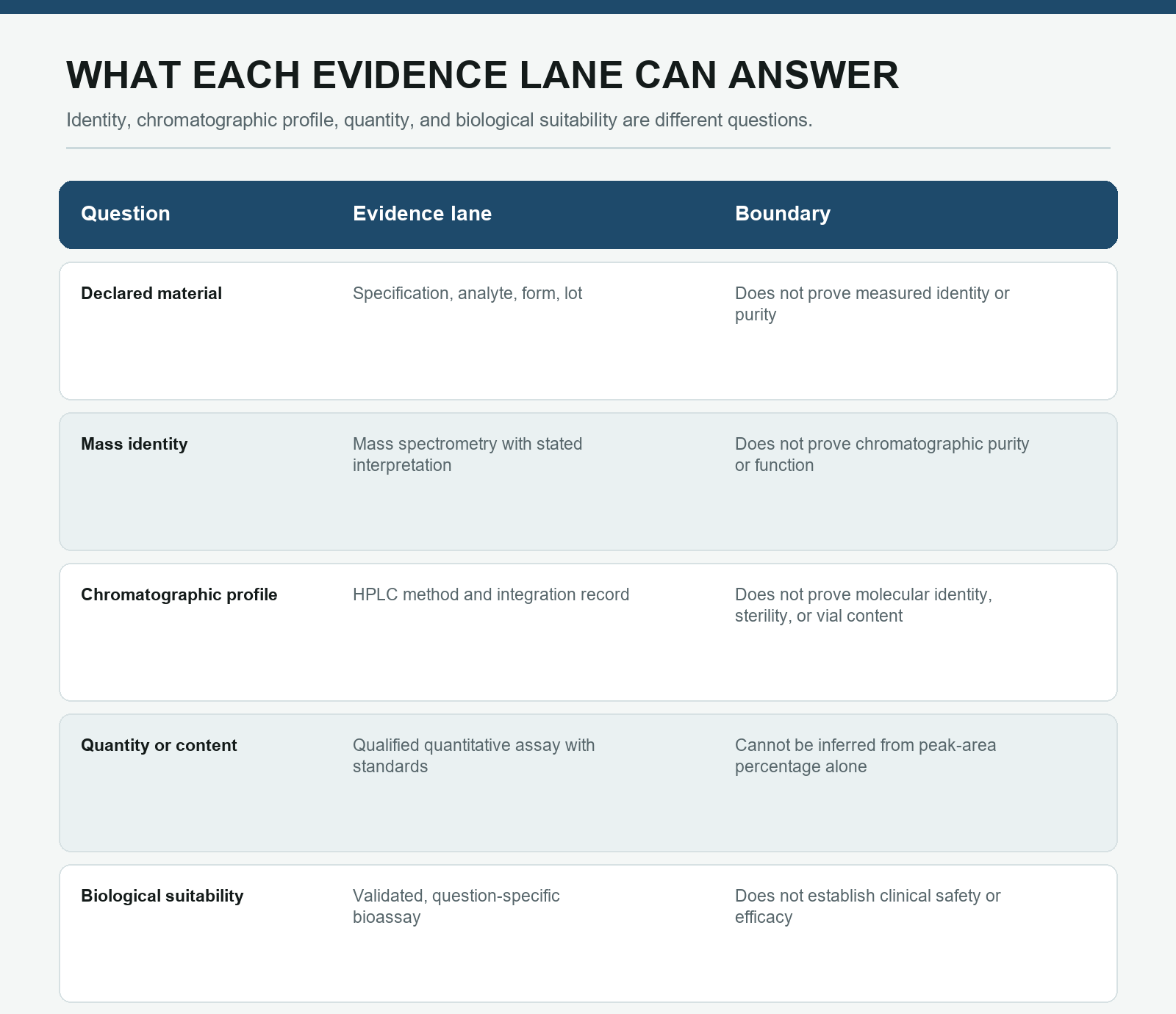
- Treat mass identity and chromatographic purity as separate evidence lanes.
- Do not equate HPLC area percentage with container content, sterility, activity, or clinical suitability.
- Use pass, conditional pass, or reject—and preserve the reason.
Scope and Prerequisites
Before opening vendor tabs, write down what is being purchased. At minimum, define the peptide or other analyte, sequence or authoritative identifier, declared salt or counterion, expected physical form, and the research context in which it will be evaluated. A free-base record, acetate material, and pamoate depot formulation are not interchangeable descriptions merely because they share an active peptide name.
Next define acceptance criteria. These may include an identity expectation, a chromatographic criterion, a content or quantity criterion, solvent or counterion information, and any experiment-specific contaminant or biological-quality test. The correct panel depends on the research question. A cell-based project may require evidence that a purely chemical screen does not provide; an identity-only check does not automatically establish functional suitability.
Materials for the review
- catalog or quotation record naming the exact material and form;
- purchase and shipment record;
- received container label and lot identifier;
- lot-specific COA and, when relevant, underlying chromatogram or spectrum;
- method description, laboratory identity, test date, and reviewer;
- a short decision record with acceptance criteria, questions, and disposition.
Peptide development literature emphasizes that synthetic route, purification, characterization, and stability are connected rather than interchangeable stages.[2] That methods review reports no quantitative endpoint of its own. That is why this review does not collapse every quality question into one “purity” field.
The Five-Step Peptide Vendor Checklist
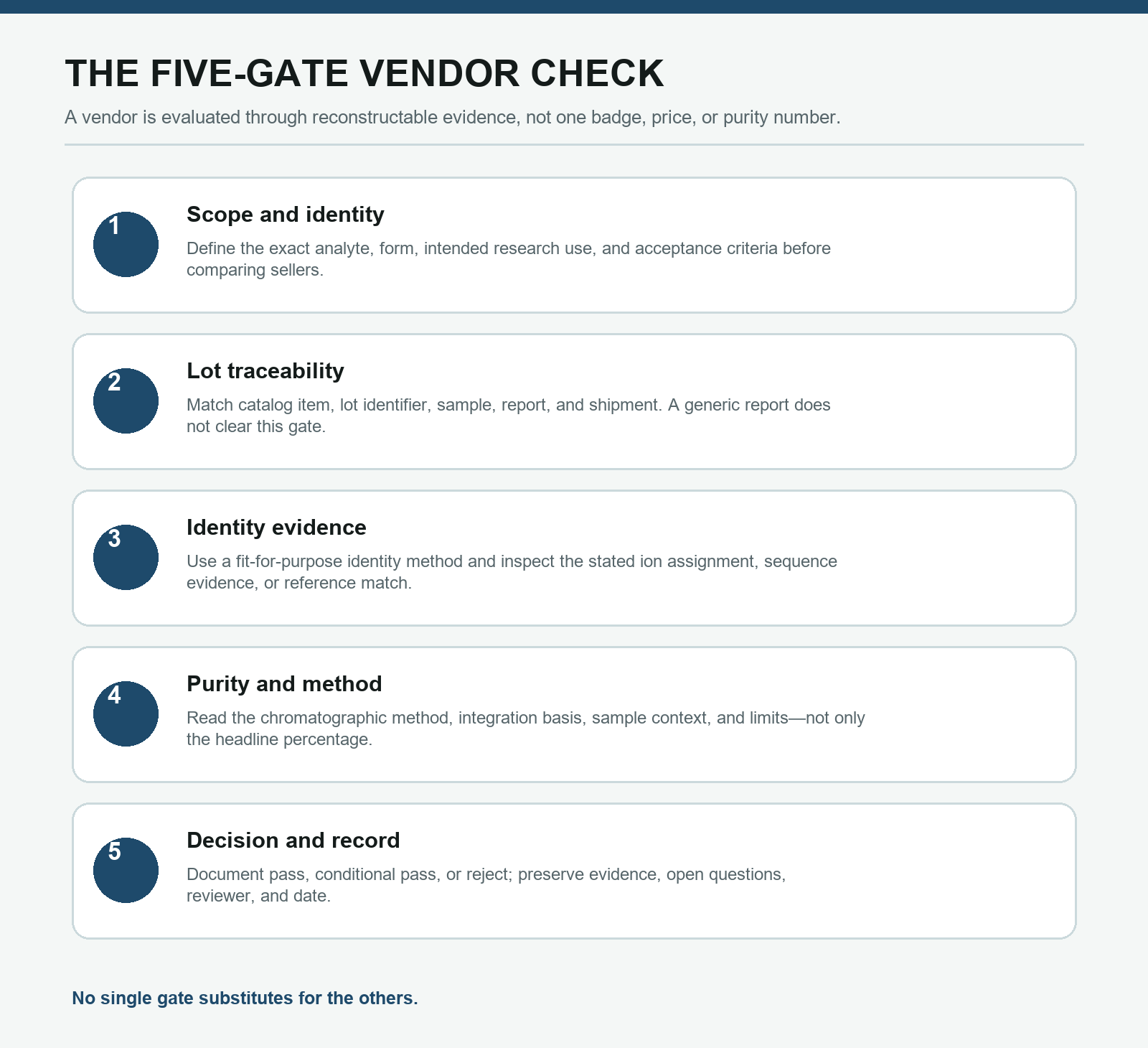
1Lock the material and scope
Record the name, sequence or identifier, chemical form, intended research setting, and required evidence. Reject category errors early: a research reagent is not a pharmaceutical formulation, and a supplier’s marketing category does not change the regulatory status of the material.
2Build lot-to-report traceability
Match the lot on the received container to the lot on the COA and laboratory report. If the website shows an example or reference-batch report, label it that way. A reference record may illustrate a format; it does not prove the identity or purity of a different shipment.
3Evaluate identity evidence
Mass spectrometry can support molecular-mass identity when the expected mass, ionization mode, charge state or deconvolution approach, observed signal, and interpretation are coherent. Modern mass-spectrometry workflows are powerful precisely because instrument output requires an explicit analytical model and interpretation.[3] That proteomics review reports no quantitative result to transfer here. A cropped image with no analyte, ion assignment, or lot link is weak evidence.
4Evaluate purity and the method behind it
For HPLC, inspect the column or stationary phase, mobile phases, gradient, detector wavelength, run time, integration convention, sample preparation, and calculation basis when available. Peak-area percentage is method conditional. Co-elution, detector response, excluded peaks, and non-UV-responsive material limit what the number can mean. Analytical-development literature has long treated method suitability as part of the result rather than an optional footnote.[4] That process-development chapter reports no quantitative finding of its own.
5Record a disposition
Use a controlled conclusion: pass, conditional pass, or reject. A conditional pass identifies the missing evidence and limits how the material may be used pending resolution. Record the reviewer, date, documents examined, unresolved questions, and why the chosen disposition follows from the stated acceptance criteria.
Worked Example: Comparing Supplier Documentation
Review date: September 5, 2026. Apex Laboratory publishes this guide and sells research reagents, including a product represented below. We reviewed three public PDF documents from American Peptides, Apex Laboratory and PS Peptides. We did not purchase or test these samples, authenticate the external issuers, or confirm that these records cover a current shipment. Each result below is attributed to its document.
These examples apply the five-step checklist to different compounds, vial sizes and analytical records. Keep the declared amount, measured content, molecular-mass result and chromatographic percentage in separate fields.
| Supplier and sampled record | Information reported in the document | Next verification step |
|---|---|---|
| American Peptides GHK-Cu 50 mg, COA7628 (PDF) |
The document bears the Bioviridian name and lists lot GHK50-0803, sample receipt on August 11 and issue on August 17, 2026. It reports 51.02 mg content and 99.77% purity, with LC-MS/MS identity, RP-HPLC at 214 nm and HPLC quantitation listed as methods. Chromatogram and spectrum images are included. | Use the issuer verification code to authenticate the record, then connect that sample and report to the lot offered or received. Request the underlying analytical files and method details needed for your acceptance criteria. The issuer name and images alone do not establish that connection. |
| Apex Laboratory GHK-Cu 100 mg, APX-2026-0625-G (HTML report and PDF) |
This Apex Laboratory in-house COA identifies the 100 mg configuration and lot APX-2026-0625-G, with a COA issue date of June 25, 2026. It reports 99.92% integrated detector area and a separate active-content result of 100.01 mg/vial. The report provides identity, method, specification and supporting-result sections. Its issue date is not a testing or manufacture date; the published numerical results are not raw chromatogram or spectrum files. | Match the report configuration and official lot to the label on the material under review. Check the stated method, result basis and acceptance criteria, and request underlying analytical files when the decision requires them. An in-house COA is not independent third-party verification, and a published report does not by itself identify the lot currently shipping. |
| PS Peptides Retatrutide 5 mg, NAD-0036014 (PDF) |
The document bears the North American Diagnostics name and identifies ProSupply Peptides as its client, batch PSP-08212026RT, and August 28, 2026 as the date ordered. It reports 4.88 mg content, 99.97% HPLC purity and retatrutide identity, with HPLC-UV coupled to mass spectrometry stated as the method. This one-page document shows no chromatogram or spectrum. | Authenticate test ID NAD-0036014 with the issuer and request the analysis/report dates, underlying chromatogram, integration details and identity data. Confirm the tested sample matches the shipment. Preserve the document’s date label instead of treating an order date as a test date. |
Carry the observations through the five steps
- Material and scope: record GHK-Cu 50 mg, GHK-Cu 100 mg and retatrutide 5 mg as separate materials. Decide which evidence your research project requires before comparing records.
- Traceability: connect the quoted or received lot to the document and tested sample. A matching supplier name alone leaves this step open.
- Identity: examine the original method and interpretation supporting the reported identity or mass. A displayed molecular-mass result needs its measurement basis and sample link.
- Purity and content: assess the chromatographic percentage using its method. Keep any measured mg result separate from the nominal vial size; these fields answer different questions.
- Disposition: record which documents were examined and which questions remain open. This public-document review does not assign a vendor or shipment a pass, score or recommendation.
Review boundary: these are three document examples, not a review of either competitor’s full catalog. An external laboratory name is a claim of provenance until the issuer and report are authenticated. Apply that standard to Apex’s records as well, and repeat the review when the lot or document changes.
Lot-to-Report Traceability
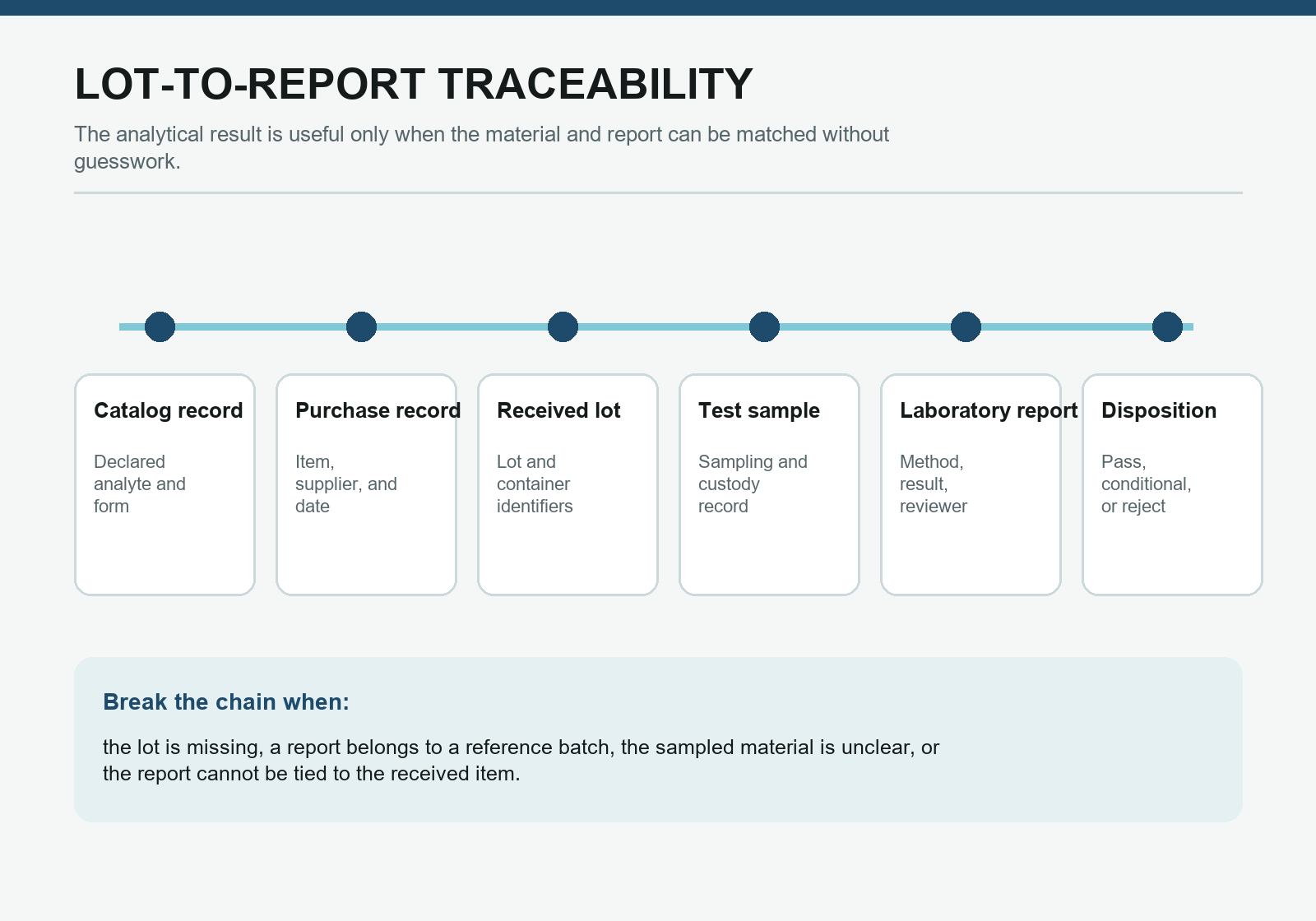
A trustworthy-looking report can still be irrelevant to the received sample. The vendor review should preserve a simple chain: catalog record → purchase record → received lot → sampled material → laboratory report → disposition. If the vendor commissioned the test, the report should still identify which sample the laboratory received. If the buyer commissioned the test, sample custody and labeling should be documented.
“Third party” describes a relationship, not an analytical result. Independence is useful, but it does not fix an unlabeled sample, inappropriate method, unreadable report, or wrong lot. Likewise, ISO/IEC 17025 accreditation can support laboratory competence within an accredited scope; it does not make every method, analyte, or conclusion automatically valid. Check the scope and the report itself.
If a lot-specific report is unavailable, do not silently substitute a reference-batch document. Mark the evidence gap and decide whether independent testing or rejection is appropriate for the project’s risk and acceptance criteria.
Analytical Evidence Boundaries
| Claim under review | Evidence to request | Do not infer |
|---|---|---|
| The material is the declared peptide | Analyte/form specification plus fit-for-purpose identity evidence tied to the lot | Purity, container amount, sterility, or biological activity |
| The sample has a stated HPLC area percentage | Method, chromatogram, integration record, calculation basis, and lot match | Molecular identity or absolute amount in the container |
| The observed mass is consistent with the analyte | Expected mass, observed ion or deconvoluted mass, tolerance, and interpretation | Chromatographic purity, receptor activity, or clinical equivalence |
| The material is suitable for a specific model | Acceptance criteria and a relevant, validated test panel | Suitability for other models or any human use |
Counterfeit and black-market product studies illustrate why appearance and labeling are not enough. Among 337 black-market products analyzed in Germany between 2010 and 2013, 12.8% were peptide hormones or growth factors, several of them fake or non-approved.[5] Of 1,190 doping products seized at the Swiss border, 146 (12%) were labeled as peptide hormones or growth factors, and fewer than 20% of all products contained the claimed substance in the labeled amount.[6] A 2021 French forensic series of 110 products seized from the bodybuilding black market reported 24 of 75 pharmaceuticals (32%) counterfeit and 25 of 75 (33%) substandard, with only 14 of 75 (19%) fully matching their declared formulation.[7] Those percentages describe seized consumer and doping-market products, not audited research-reagent supply chains. These studies do not prove that any named research supplier is unreliable; they show why chain-of-identity and analytical verification matter.
Recent online-market surveillance of semaglutide products also found quality and authenticity risks outside controlled supply channels. Three test-purchase vials delivered by illegal online pharmacies measured 7.7% to 14.37% semaglutide purity against the 99% stated on their labels, exceeded their labeled content by 28.56% to 38.69%, and carried detectable endotoxin in every sample.[8] That evidence supports careful procurement; it does not justify treating a generic “lab tested” badge as equivalent to a lot-specific, interpretable report.
Common Errors and Red Flags
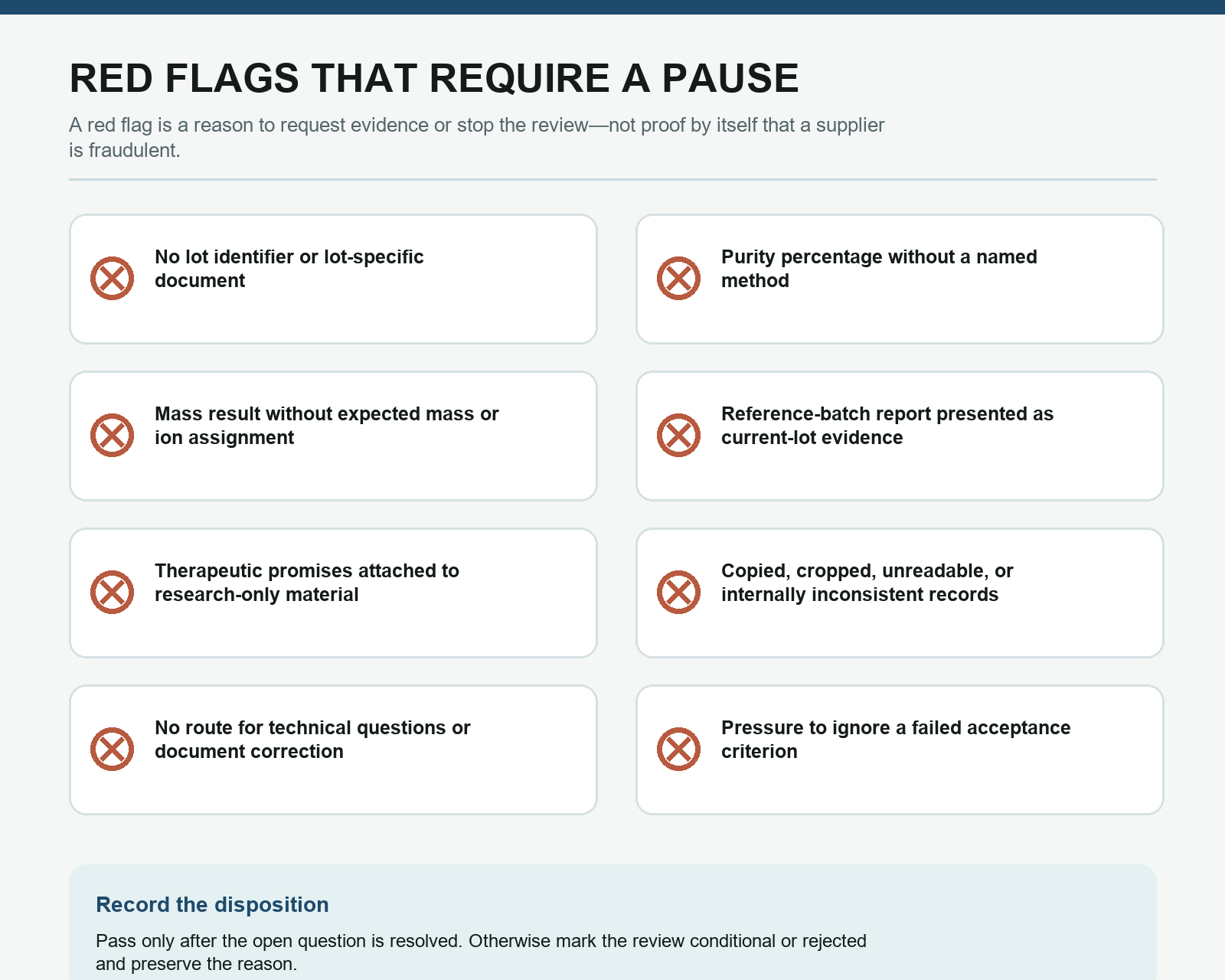
Common review errors include approving the vendor rather than the lot, treating “GMP” as a complete description without asking what standard and scope applies, mistaking a mass match for purity, and accepting a purity number without the chromatographic method. Another error is equating editorial sophistication with laboratory evidence. Clear educational content is useful, but it cannot replace the documents for the material under review.
Therapeutic promises attached to research-only material are a separate warning. A supplier should not use research-grade classification to imply that an unapproved product is a therapeutic substitute. The same-molecule distinction is especially important when an FDA-approved formulation exists: shared active identity does not erase differences in formulation, manufacturing controls, approval, labeling, or intended use. See research-grade versus pharmaceutical-grade materials.
Verification Checklist and Decision Record
- The exact analyte, form, lot, and intended research scope are written down.
- The received lot matches the COA and any underlying laboratory report.
- Identity evidence includes a readable method and interpretable result.
- Purity evidence states the method and does not overclaim what the percentage means.
- Any required quantity, contaminant, or bioassay question has its own evidence lane.
- Reference-batch and current-lot records are labeled correctly.
- Research-use and regulatory boundaries are explicit.
- Open questions, response, reviewer, date, and disposition are preserved.
A compact decision record can be a single page. It should name the vendor and material, identify the lot, list evidence examined, state the acceptance criteria, record each gate as pass/fail/open, and finish with a signed or attributable disposition. That record makes future re-review possible when a new lot arrives or a document changes.
Frequently Asked Questions
What should I check first when evaluating a peptide vendor?
Define the exact analyte, chemical form, intended research use, and acceptance criteria before comparing vendors. Then require a traceable connection among the catalog record, received lot, test sample, and analytical report. Price and a headline purity percentage are not substitutes for that chain.
Is a 99% HPLC purity claim enough to approve a vendor?
No. HPLC peak-area percentage is conditional on the stated chromatographic method, detector response, integration, and sample. It does not by itself establish molecular identity, amount in a container, counterion or water content, sterility, endotoxin status, biological activity, or suitability for a specific experiment.
How can I tell whether a COA is lot specific?
The certificate should identify the same material, form, and lot shown on the received container or shipment record. The report should also identify the laboratory, dates, methods, results, specifications, and reviewer. A generic example or reference-batch report should be treated as supporting information, not proof for the received lot.
Does third-party testing automatically make a peptide vendor reliable?
No. Independence can reduce one conflict of interest, but the report still needs sample identity, chain of custody, fit-for-purpose methods, readable results, and a clear lot match. Laboratory competence and report traceability matter more than the phrase third-party by itself.
What should I do if a vendor cannot answer a documentation question?
Record the unresolved question and use a conditional or reject disposition rather than filling the gap with an assumption. A reliable review preserves the evidence requested, the response received, the reviewer, and the date so that the decision can be reconstructed later.
References and Standards Context
- Coin I, et al. Solid-phase peptide synthesis: from standard procedures to the synthesis of difficult sequences. Nat Protoc. 2007;2(12):3247-56. PMID: 18079725.
- Chandrudu S, et al. Chemical methods for peptide and protein production. Molecules. 2013;18(4):4373-88. PMID: 23584057.
- Aebersold R, et al. Mass spectrometry-based proteomics. Nature. 2003;422(6928):198-207. PMID: 12634793.
- Anicetti V, et al. Analytical considerations in the development of protein purification processes. Bioprocess Technol. 1994;18:11-36. PMID: 7764169.
- Krug O, et al. Identification of black market products and potential doping agents in Germany 2010-2013. Eur J Clin Pharmacol. 2014;70(11):1303-11. PMID: 25168622.
- Weber C, et al. Qualitative and Semiquantitative Analysis of Doping Products Seized at the Swiss Border. Subst Use Misuse. 2017;52(6):742-753. PMID: 28156209.
- Fabresse N, et al. Analysis of pharmaceutical products and dietary supplements seized from the black market among bodybuilders. Forensic Sci Int. 2021;322:110771. PMID: 33838562.
- Ashraf AR, et al. Multifactor Quality and Safety Analysis of Semaglutide Products Sold by Online Sellers Without a Prescription: Market Surveillance, Content Analysis, and Product Purchase Evaluation Study. J Med Internet Res. 2024;26:e65440. PMID: 39509151.
- International Council for Harmonisation. Quality guidelines, including Q2(R2) and Q14. Accessed July 23, 2026.
- International Organization for Standardization. ISO/IEC 17025 testing and calibration laboratories. Accessed July 23, 2026.