
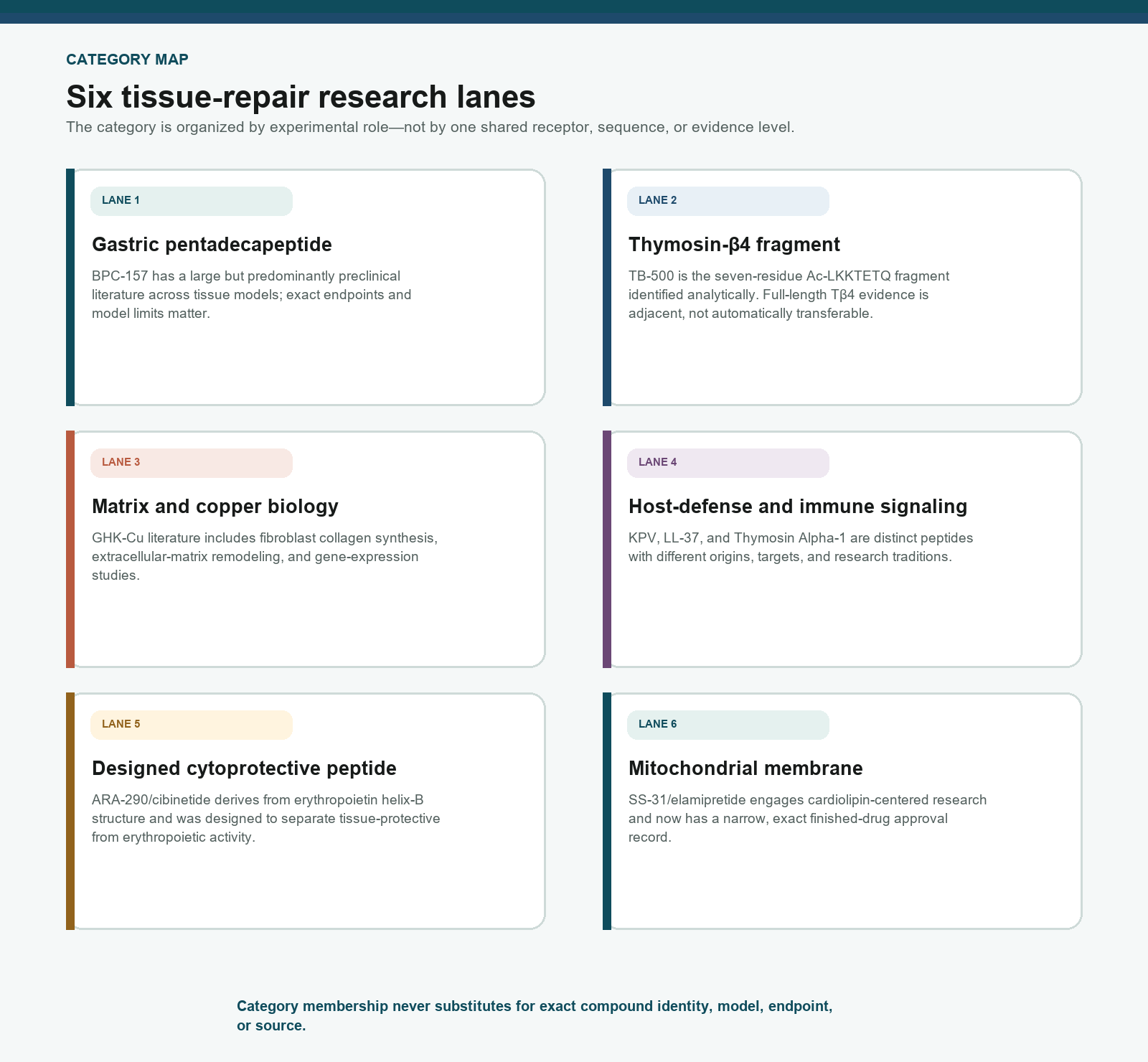
Tissue-repair research peptides are a cross-mechanism category used to study extracellular-matrix remodeling, cell migration, host-defense signaling, inflammatory regulation, cytoprotection, and mitochondrial resilience. The group includes BPC-157, the seven-residue TB-500 fragment, GHK-Cu, KPV, LL-37, Thymosin Alpha-1, ARA-290, and SS-31. Category membership does not establish shared pharmacology, equal evidence, human efficacy, or interchangeability between a parent molecule, fragment, analog, finished drug, and research reagent.
This pillar is a research map rather than a list of promised outcomes. It organizes the major tissue-repair lanes, records the reagent identity of each material, sets out the reported figures behind the representative sources, corrects the highest-risk identity errors, and routes each compound-specific question to the page that owns it.
- “Tissue repair peptides” is a research-navigation term, not a single receptor or structural class.
- TB-500 is locked in this project to the seven-residue N-acetylated fragment Ac-LKKTETQ—not full-length 43-residue Thymosin-β4.
- BPC-157 evidence is predominantly preclinical; GHK-Cu, KPV, LL-37, Thymosin Alpha-1, ARA-290, and SS-31 have separate identities and research programs.
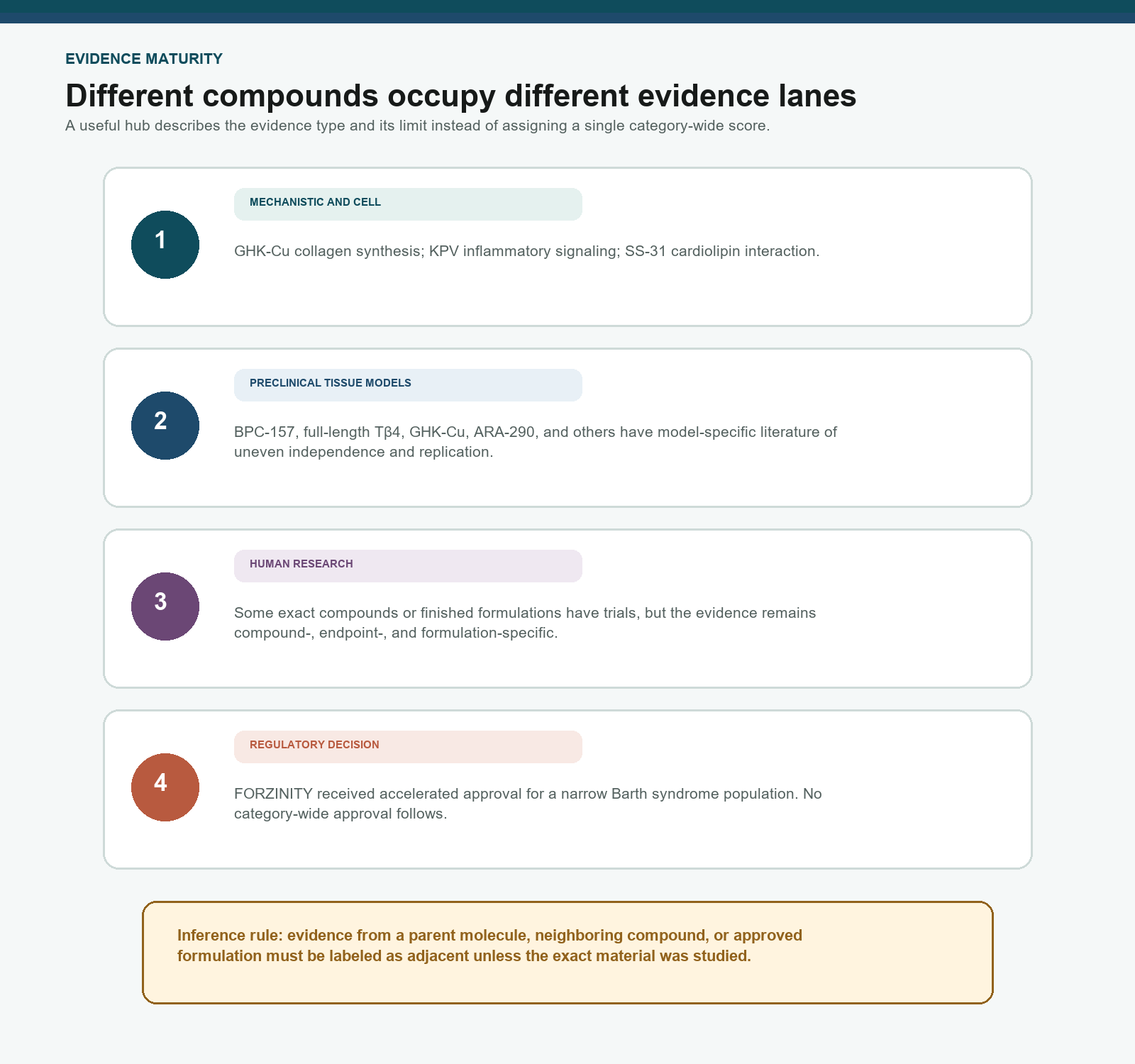
- Evidence for a parent molecule or neighboring analog is adjacent unless the exact named material was studied.
- Identity comes before evidence: BPC-157 is Gly-Glu-Pro-Pro-Pro-Gly-Lys-Pro-Ala-Asp-Asp-Ala-Gly-Leu-Val at 1,419 Da, free GHK is not the same material as its copper complex, and LL-37 is released from the hCAP18 precursor.
- Regulatory status is per compound and is tabulated below. Most materials on this page have no approval from the FDA, EMA, NMPA or any other regulator, in any jurisdiction.
- FORZINITY is an FDA-approved elamipretide finished drug with a narrow label. An Apex SS-31 research reagent is not that formulation.
What “Tissue-Repair Research Peptides” Means
The category groups materials by the experimental processes researchers investigate: cell migration, vascular responses, fibroblast behavior, collagen or extracellular-matrix turnover, epithelial repair, immune signaling, cytoprotection, and mitochondrial function. Those processes overlap in tissue biology, but the compounds do not share one sequence, receptor, or evidence base.
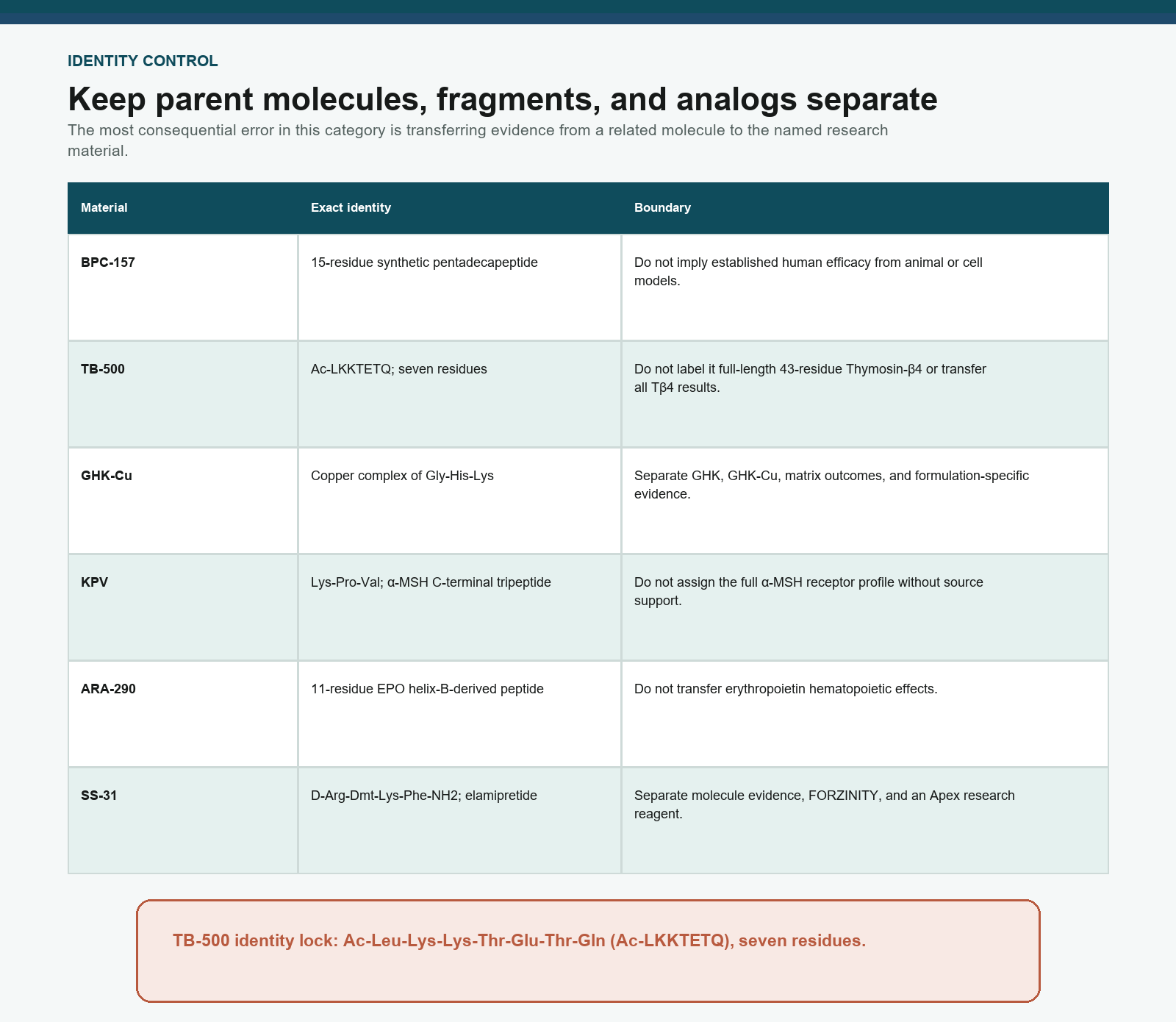
A category-level article is useful only if it preserves those differences. A BPC-157 animal study cannot establish GHK-Cu activity. Full-length Thymosin-β4 findings cannot be silently assigned to the seven-residue TB-500 fragment. Erythropoietin biology cannot be transferred wholesale to ARA-290. An FDA decision for a named elamipretide finished drug cannot validate a separate SS-31 research reagent.
The grouping has a published precedent. Cushman and colleagues at Texas Tech University Health Sciences Center assembled a narrative review of local and systemic peptide therapies for soft-tissue regeneration, sorting compounds with unrelated molecular targets by route of administration and by the repair process studied rather than by receptor family (PMID 39351323). That paper is a taxonomy, and it reports no quantitative endpoint of its own; treat it as a map of where the literature sits, never as evidence for a particular material.
Reagent Identity Reference
Identity precedes evidence. A source is only usable if the material it tested matches the material named on the label, and most bad inferences in this category begin with a sequence, complex, or fragment mismatch rather than with a study-design flaw. The table records the identity fields documented for each material in the records used on this page. Where a value is not stated in those records, the cell says so; nothing here is inferred from a supplier listing.
| Material | Documented sequence | Residues | Mass or CAS | Identity note | Source |
|---|---|---|---|---|---|
| BPC-157 | Gly-Glu-Pro-Pro-Pro-Gly-Lys-Pro-Ala-Asp-Asp-Ala-Gly-Leu-Val (GEPPPGKPADDAGLV) | 15 | 1,419 Da as printed in the review | Also designated PL 14736; described as stable in human gastric juice | PMID 21548867 |
| TB-500 | Ac-Leu-Lys-Lys-Thr-Glu-Thr-Gln (Ac-LKKTETQ) | 7 | Not stated in the indexed record | N-terminally acetylated 17–23 fragment of Thymosin-β4, characterized after recovery from a commercial TB-500 material | PMID 22962027 |
| Thymosin-β4 (parent) | Full-length polypeptide; sequence not reproduced in the indexed records | 43 (project-locked identity value; the cited record states the mass, not the residue count) | 4.9 kDa | Major G-actin-sequestering protein; the parent of the TB-500 fragment and not the same material | PMID 11891186 |
| GHK (free tripeptide) | Gly-His-Lys | 3 | 340.38 g/mol; C14H24N6O4; CAS 49557-75-7 | Isolated from human plasma; the uncomplexed form | PMID 3169264 |
| GHK-Cu | Gly-His-Lys coordinated to Cu(II) | 3 plus copper | Not stated in the indexed record; CAS 89030-95-5 | The copper complex is the species tested in the collagen-synthesis and wound-chamber literature; do not read a GHK result as a GHK-Cu result | PMID 8227353 |
| KPV | Lys-Pro-Val | 3 | Not stated in the indexed records | C-terminal tripeptide of α-melanocyte-stimulating hormone, α-MSH(11–13); distinct from the D-proline analog KdPV | PMID 12750433 |
| LL-37 | C-terminal cathelicidin fragment; sequence not reproduced in the indexed records | 37 | Released from the 18 kDa hCAP18 precursor | Endogenous human host-defense peptide, not a synthetic analog | PMID 12603850 |
| Thymosin Alpha-1 | Thymic peptide; sequence not reproduced in the indexed records | 28 | Not stated in the indexed records | Produced in vivo by cleavage of prothymosin alpha; unrelated to Thymosin-β4 despite the shared family name | PMID 17495242 |
| ARA-290 (cibinetide) | Peptide reproducing the aqueous face of erythropoietin helix B, residues 58–82 region | 11 | Not stated in the indexed records | Engineered non-erythropoietic peptide; erythropoietin is its structural parent, not its evidence base | PMID 18676614 |
| SS-31 (elamipretide) | D-Arg-Dmt-Lys-Phe-NH2, where Dmt is 2′,6′-dimethyltyrosine | 4 | Not stated in the indexed records | Research name for the molecule marketed as the FORZINITY finished drug; the reagent and the drug product are not the same item | PMID 23813215 |
Compound and Family Map
| Material | Exact identity or origin | Representative research lane | Highest-risk inference error | Next page |
|---|---|---|---|---|
| BPC-157 | 15-residue synthetic pentadecapeptide | Angiogenesis, cell migration, and multi-tissue animal models | Presenting preclinical outcomes as established human efficacy | BPC-157 research and evidence guide |
| TB-500 | Ac-Leu-Lys-Lys-Thr-Glu-Thr-Gln; seven residues | Fragment identity and parent Tβ4 adjacency | Calling it full-length Tβ4 or transferring the entire Tβ4 literature | TB-500 sequence and evidence guide |
| GHK-Cu | Copper complex of Gly-His-Lys | Fibroblast, collagen, matrix, and gene-expression research | Treating every GHK, GHK-Cu, or formulation result as interchangeable | GHK-Cu guide |
| KPV | Lys-Pro-Val; α-MSH C-terminal tripeptide | Inflammatory-signaling and transport models | Assigning the full α-MSH receptor profile without exact support | KPV guide |
| LL-37 | 37-residue human cathelicidin-derived peptide | Host defense, re-epithelialization, and immune signaling | Reducing a context-dependent host-defense peptide to one outcome | LL-37 guide |
| Thymosin Alpha-1 | 28-residue thymic peptide | Immune regulation, inflammation, and tolerance research | Confusing it with Thymosin-β4 or TB-500 | Thymosin Alpha-1 guide |
| ARA-290 | 11-residue EPO helix-B-derived peptide; cibinetide | Nonerythropoietic tissue-protective signaling | Transferring erythropoietin’s hematopoietic effects | This pillar’s ARA-290 section |
| SS-31 | D-Arg-Dmt-Lys-Phe-NH2; elamipretide | Cardiolipin and mitochondrial membrane research | Transferring the FORZINITY approval to a research reagent | SS-31 guide |
The Programs Behind the Literature
Most of the durable evidence in this category comes from a small number of long-running laboratory programs rather than from a broad field. Knowing which program produced a result is part of reading it, because single-laboratory depth and independent replication are different kinds of support.
The copper-tripeptide program
Loren Pickart isolated the Gly-His-Lys tripeptide from human plasma and pursued its copper-complex chemistry for four decades. The program-level review summarizes actions attributed to GHK and GHK-Cu across chemoattraction of repair cells, suppression of free radicals and thromboxane formation, increased synthesis of collagen, elastin, metalloproteinases, and several growth factors, and increased fibroblast and keratinocyte proliferation (PMID 18644225). It is a program overview and reports no quantitative finding of its own, so the figures below come from the primary papers rather than from the review.
The thymic-peptide program
Allan Goldstein first described and characterized Thymosin Alpha-1 in 1972, and the same laboratory lineage later carried the Thymosin-β4 work that underpins the modern actin-sequestration literature. The two molecules share a family name and nothing else that matters for a repair inference: Thymosin Alpha-1 is a 28-residue immunoregulatory peptide, while Thymosin-β4 is a 4.9 kDa actin-binding protein whose 17–23 fragment is sold as TB-500.
The Body Protection Compound program
Predrag Sikiric and colleagues at the University of Zagreb built the BPC-157 literature, and the Current Pharmaceutical Design review that anchors it prints the identity fields directly: GEPPPGKPADDAGLV, molecular weight 1,419 Da, designation PL 14736, described as stable in human gastric juice with no reported toxicity, and studied across esophageal, gastric, duodenal, intestinal, hepatic, and pancreatic lesion models in rats, including a short-bowel model followed over 4 weeks (PMID 21548867). Depth from one group is a strength and a limitation at the same time, which is why the independent replications noted below matter.
BPC-157: A Broad but Predominantly Preclinical Research Lane
BPC-157 is a 15-residue synthetic pentadecapeptide. Sikiric and colleagues’ review frames its research through the brain–gut axis and a large set of animal models; it is a narrative synthesis and reports no quantitative result for any single model.[1] A later synthesis compares BPC-157 observations against EGF, FGF, and VEGF across gastrointestinal, tendon, ligament, muscle, and bone-healing research models, and likewise reports no quantitative finding attributable to a single experiment.[2]
The cleanest quantified anchor in the lane is a ligament model. In rats whose medial collateral ligament had been surgically transected, healing was followed for 90 days after surgery, with the first application 30 minutes after surgery and the last 24 hours before sacrifice. BPC-157 was given once daily intraperitoneally at 10 µg or 10 ng/kg, topically as a thin layer of 1.0 µg dissolved in distilled water per gram of neutral cream, or per-orally at 0.16 µg/mL in drinking water at roughly 12 mL per rat per day; the report describes consistent functional, biomechanical, macroscopic, and histological improvement across all three routes (PMID 20225319). Those are rat figures for a transected ligament, and they do not translate to an intact tissue, another species, or a human endpoint.
The vascular axis has independent support from outside the originating group. Working at Chang Gung Memorial Hospital, Hsieh and colleagues reported increased vessel density in a chick chorioallantoic membrane assay and an endothelial tube-formation assay, accelerated blood-flow recovery measured by laser Doppler in the rat hind-limb ischemia model, and increased VEGFR2 messenger RNA and protein — but not VEGF-A — in human vascular endothelial cells, with receptor internalization and VEGFR2-Akt-eNOS activation both blocked by the endocytosis inhibitor dynasore (PMID 27847966). The indexed abstract reports no quantitative outcome for the vessel-density or blood-flow measurements, so the finding should be read as a mechanism direction rather than an effect size.
The breadth of that literature can be misleading if study count is mistaken for clinical maturity. Many outcomes arise from related groups, animal injury models, or cell experiments. Model choice, comparator, replication, endpoint, and independence all matter. The correct summary is that BPC-157 has substantial preclinical breadth—not that it has established human tissue-repair efficacy. The BPC-157 research guide and the BPC-157 versus GHK-Cu comparison preserve those limits.
TB-500 and Thymosin-β4: The Identity Boundary Comes First
TB-500 is the N-terminally acetylated 17–23 fragment of Thymosin-β4: Ac-Leu-Lys-Lys-Thr-Glu-Thr-Gln, written Ac-LKKTETQ. Esposito and colleagues synthesized and characterized that seven-residue fragment after it was identified in a commercial TB-500 material by high-resolution mass spectrometry in doping-control analytical work.[3] It is an analytical characterization and reports no quantitative outcome in any biological model — its value is identity, not effect.
Full-length Thymosin-β4 is a different 4.9 kDa, 43-residue molecule with its own quantified literature. In a rat full-thickness wound model, topical or intraperitoneal Thymosin-β4 increased re-epithelialization by 42% over saline controls at 4 days and by as much as 61% at 7 days, and treated wounds contracted at least 11% more than controls by day 7, with increased collagen deposition and angiogenesis reported in the same wounds. In a Boyden-chamber assay, keratinocyte migration was stimulated 2-fold to 3-fold over medium alone after 4–5 hours with as little as 10 pg of the peptide added.[4] Every one of those figures belongs to the 43-residue parent in a rat model. None of them is a TB-500 figure, and neither this page nor the dedicated TB-500 guide carries them over to the fragment unless the fragment itself is tested.
The parent-molecule caveat that belongs in an honest review
The same actin machinery that supports migration in a wound also supports migration in a tumor. In malignant mouse fibrosarcoma cells, Thymosin-β4 was identified as overexpressed relative to the weakly tumorigenic parental line, and all six independently derived malignant lines expressed high levels of its messenger RNA. Sense-transfected cells developed tumors and formed numerous lung metastases in syngeneic C57BL/6 mice, while antisense-transfected cells with reduced expression significantly lost tumor formation and distant-organ metastasis; motility, cell shape, and F-actin organization tracked expression level (PMID 11891186). This is a transfection experiment in mouse tumor lines, not a safety statement about any material, and it is recorded here because a mechanism review that omits it is incomplete.
GHK-Cu and Extracellular-Matrix Research
GHK-Cu is the copper complex of the tripeptide Gly-His-Lys. Maquart and colleagues reported that stimulation of collagen synthesis in fibroblast cultures began between 10⁻¹² and 10⁻¹¹ M — that is, between roughly 1 pM and 10 pM — reached its maximum at 10⁻⁹ M, or 1 nM, and was independent of any change in cell number.[5] An earlier version of this page reported that dose range inconsistently in two places; the values above follow the indexed abstract.
The in-vivo extension came five years later in a rat subcutaneous wound-chamber model, where sequential injections of GHK-Cu produced concentration-dependent increases in dry weight, DNA, total protein, collagen, and glycosaminoglycan content. Collagen-synthesis stimulation was reported at 2-fold that of non-collagen proteins, type I and type III collagen messenger RNAs increased while transforming growth factor beta messenger RNAs did not, and a control tripeptide had no significant effect (PMID 8227353). Rat wound chambers are an accumulation model, not a wound-closure outcome.
Pickart and Margolina later reviewed regenerative and protective actions in the light of gene-expression data, describing effects on blood-vessel and nerve outgrowth, collagen, elastin, and glycosaminoglycan synthesis, and dermal fibroblast function.[6] As a review it reports no quantitative outcome for any individual pathway, and its breadth is a description of the literature rather than a measured result.
Three distinctions remain important. GHK at 340.38 g/mol and the copper complex are related but not analytically identical, and the papers above tested the complex. A result for a specific topical, scaffold, hydrogel, cell system, or animal formulation belongs to that experimental design. Collagen synthesis, matrix turnover, gene expression, and visible tissue outcomes are different endpoints. The GHK-Cu research guide owns the full identity and mechanism review.
KPV, LL-37, and Thymosin Alpha-1 Are Separate Immune and Host-Defense Lanes
KPV
KPV is the tripeptide Lys-Pro-Val derived from the C-terminal region of α-melanocyte-stimulating hormone. Getting and colleagues compared it against core melanocortin peptides in mouse crystal-induced peritonitis: systemic KPV reduced polymorphonuclear leukocyte accumulation in the peritoneal cavity, its antimigratory effect was not blocked by the MC3/MC4 receptor antagonist SHU9119, it failed to raise cyclic AMP in macrophages, and it retained activity in recessive yellow mice carrying a nonfunctional MC1 receptor — leading the authors to conclude that KPV probably acts by inhibiting interleukin-1β rather than through melanocortin receptors.[7] The indexed abstract reports no quantitative result for the reduction, so the direction is supported and the magnitude is not.
Dalmasso and colleagues then studied transporter-mediated uptake, showing that KPV enters human intestinal epithelial and Jurkat T cells through PepT1, inhibits NF-κB and MAP-kinase signaling at nanomolar concentrations, and reduces the incidence of DSS- and TNBS-induced colitis in mice when added to drinking water.[8] The abstract states a nanomolar activity range but reports no quantitative endpoint value for the colitis scores.
A keratinocyte-signaling refinement completes the lane. In HaCaT and normal human keratinocytes, neither α-MSH, KPV nor ACTH raised cyclic AMP; instead KPV produced rapid intracellular calcium responses across a 10⁻¹⁵ to 10⁻⁷ M range — 1 fM up to 100 nM — but only in the presence of the adenosine agonist PIA, and Chinese hamster ovary cells stably transfected with the MC-1 receptor showed the same calcium elevation (PMID 15102092). These are human cell-line and transfected-cell data supporting a calcium-dependent rather than cyclic-AMP-dependent route, not a therapeutic conclusion.
LL-37
LL-37 is the 37-residue C-terminal fragment released from the 18 kDa hCAP18 precursor. Heilborn and colleagues reported that hCAP18 levels in wounded human skin peaked at 48 hours after injury and declined to pre-injury levels on wound closure, that immunoreactivity was absent from ulcer-edge epithelium in chronic ulcers, and that affinity-purified anti-LL-37 antibodies inhibited re-epithelialization in a concentration-dependent manner in organ-cultured human skin, with the proliferation marker Ki67 absent from the inhibited epithelium.[9] This is human ex-vivo tissue with an antibody-blockade design — loss-of-function evidence, which is a different claim from adding the peptide to a wound.
LL-37 also has antimicrobial, chemotactic, inflammatory, and nucleic-acid-interaction literature. That context dependence is exactly why a single “repair peptide” label is insufficient; use the LL-37 guide for the full evidence map.
Thymosin Alpha-1
Thymosin Alpha-1 is a 28-residue thymic peptide and is not Thymosin-β4. Romani and colleagues reviewed it as an endogenous regulator of inflammation, immunity, and tolerance, describing dendritic-cell priming through Toll-like receptor and MyD88-dependent signaling with protection against aspergillosis, plasmacytoid dendritic-cell activation with protection against primary murine cytomegalovirus infection, and induction of indoleamine 2,3-dioxygenase associated with transplantation tolerance in mice.[10] The review reports no quantitative result for those murine protection experiments. It also records that the peptide is used worldwide for some immunodeficiencies, malignancies, and infections — a usage statement, not a jurisdiction-specific approval, and this page does not convert it into one.
ARA-290: A Designed Nonerythropoietic Research Peptide
ARA-290, also called cibinetide, is an 11-residue peptide reproducing the aqueous face of erythropoietin helix B, the region spanning residues 58–82. Brines and colleagues showed that helix B itself was tissue protective in ischemic stroke, diabetes-induced retinal edema, and peripheral nerve trauma models, and that the 11-amino-acid peptide forming its aqueous face was tissue protective in ischemic stroke and renal ischemia-reperfusion models in rodents, accelerated wound healing, and was not erythropoietic in vitro or in vivo. That record describes the 11-amino-acid peptide by structure and never uses the name ARA-290 or cibinetide, so the identity match to ARA-290 is asserted here rather than taken from it.[11]
The compound is the only material on this page other than elamipretide with a published controlled human trial. In a Phase 2 study, subjects with type 2 diabetes and painful neuropathy self-administered 4 mg of ARA-290 or placebo subcutaneously each day for 28 days and were followed for a further month, giving a 56-day observation window. The report describes improvement in haemoglobin A1c and lipid profile across that window, a significant improvement in neuropathic symptoms on the PainDetect questionnaire, and — in the subgroup whose mean corneal nerve fibre density sat more than 1 standard deviation below normal — a significant increase in nerve fibre density against no change under placebo, with no safety issues identified (PMID 25387363). A 28-day Phase 2 result in one population is an early clinical signal, not an efficacy conclusion, and no Phase 3 outcome is cited here.
The design rationale sets a strict interpretation boundary: erythropoietin is the structural parent, not evidence that ARA-290 shares all EPO effects. The exact peptide, receptor-complex hypothesis, model, and endpoint must be named. No standalone ARA-290 guide exists in the July 22 inventory, so this pillar retains the bounded identity and design summary without inventing a destination.
SS-31, Cardiolipin, and the Current Regulatory Context
SS-31 is the research name for the tetrapeptide elamipretide. Birk and colleagues reported that it binds cardiolipin on the inner mitochondrial membrane, inhibits cytochrome c peroxidase activity by protecting the heme iron, and — in rats pretreated before renal ischemia — protected cristae membranes and prevented mitochondrial swelling with prompt ATP recovery on reperfusion.[12] The indexed abstract reports no quantitative endpoint for those protective measures. That molecule-specific mechanism is relevant to mitochondrial resilience and cytoprotection, but it does not make SS-31 a general tissue-repair agent.
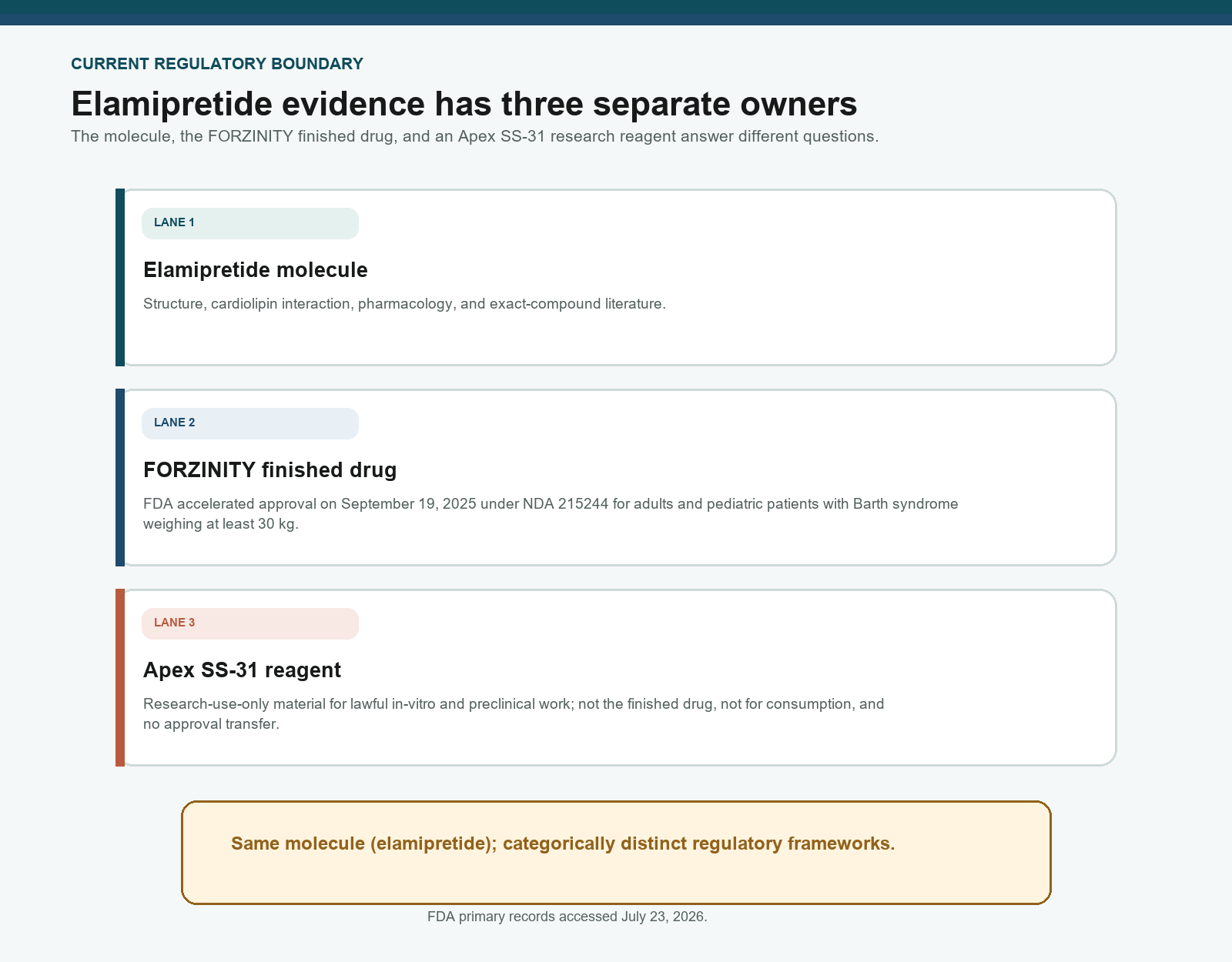
FDA granted accelerated approval to FORZINITY (elamipretide) on September 19, 2025 under NDA 215244. The approved finished drug is indicated to improve muscle strength in adult and pediatric patients with Barth syndrome weighing at least 30 kg. A 2026 review describes elamipretide as the first cardiolipin-directed mitochondrial therapeutic approved under accelerated approval, and it also records the limits of the evidence package: the randomized, double-blind, placebo-controlled crossover trial produced no significant improvement in the 6-minute walk test or in fatigue scores, the sustained benefit was observed during a 168-week open-label extension, the most common adverse events were mild injection-site reactions, and a confirmatory trial is required as a condition of the approval.[13]
Same molecule (elamipretide); categorically distinct regulatory frameworks. FORZINITY is a named pharmaceutical formulation with an FDA-reviewed label, sponsor, manufacturing system, and postmarketing obligations. Apex SS-31 is a research-grade chemical reagent for lawful in-vitro and preclinical research. It is not FORZINITY, not a pharmaceutical substitute, and not for human or veterinary use or consumption. The distinction is set out in full on the research-grade versus pharmaceutical-grade reference.
Regulatory Status, Stated Per Compound
A category-level statement about regulatory status is worthless because the statuses differ. The table records the position for each material at the July 2026 evidence freeze, and separates what the status is from what readers commonly assume it implies. Supplier status is not regulatory status: describing a material as a research reagent says who sells it and under what terms, not what any medicines regulator has decided.
| Material | Status at the July 2026 freeze | What that status does not mean |
|---|---|---|
| BPC-157 | No FDA, EMA, NMPA or other regulatory approval anywhere globally; no marketing authorisation in any jurisdiction | A large preclinical literature is not an approval pathway or a human efficacy finding |
| TB-500 (Ac-LKKTETQ) | No FDA, EMA, NMPA or other regulatory approval anywhere globally | Appearance in doping-control analytical work is a detection record, not a regulatory record |
| Thymosin-β4 (parent) | No FDA, EMA, NMPA or other regulatory approval anywhere globally | Investigation of the parent protein confers no status on the seven-residue fragment |
| GHK and GHK-Cu | No approval as a medicine from the FDA, EMA, NMPA or any other regulator, in any jurisdiction | A five-decade research history and non-medicinal sector use are not a medicines approval |
| KPV | No FDA, EMA, NMPA or other regulatory approval anywhere globally | Transporter-mediated uptake in colitis models is not an approved indication |
| LL-37 | No FDA, EMA, NMPA or other regulatory approval anywhere globally | Being an endogenous human peptide grants no regulatory standing to a synthetic reagent |
| Thymosin Alpha-1 | No FDA approval in the United States. The peer-reviewed literature describes the peptide as used worldwide for some immunodeficiencies, malignancies and infections; no specific national marketing authorisation is asserted here because none was verifiable from the records used on this page | A usage statement in a review is not a verified approval in a named country |
| ARA-290 (cibinetide) | Investigational. No FDA, EMA, NMPA or other regulatory approval anywhere globally; the published clinical record cited here stops at a 28-day Phase 2 trial | A Phase 2 signal is not a completed development programme or an approval |
| SS-31 / elamipretide | The finished drug FORZINITY holds FDA accelerated approval granted September 19, 2025 under NDA 215244, for improving muscle strength in Barth syndrome patients weighing at least 30 kg, with a confirmatory trial required | An approval for a named finished drug does not extend to a research-grade reagent of the same molecule |
Additional Reported Findings
These sources sit inside the category but do not carry a section of their own. Each row records the compound, the model and species, the endpoint, the reported result, and the source, so that a reader can see what was measured without the claim being absorbed into general prose. Where the indexed record carries no effect size, the row says so rather than implying one.
| Compound | Model and species | Endpoint | Reported result | Source |
|---|---|---|---|---|
| Thymosin-β4 (parent, not TB-500) | Coronary artery ligation; embryonic and postnatal cardiomyocytes; mouse | Cell migration, myocyte survival, cardiac function | Formed a complex with PINCH and integrin-linked kinase and activated Akt; after ligation, upregulated ILK and Akt activity, enhanced early myocyte survival and improved cardiac function. Reports no quantitative endpoint | PMID 15565145 |
| Thymosin-β4 (parent, not TB-500) | Narrative review of dermal, corneal, cardiac and CNS applications | Repair and regeneration cascade | Describes actin binding, promotion of cell migration, mobilisation of stem and progenitor cells, and fewer myofibroblasts with reduced scar formation. Review; reports no quantitative finding | PMID 22074294 |
| LL-37 (recombinant P-LL37 and synthetic) | Dexamethasone-treated excisional wounds, mouse; endothelial cells in vitro | Vascularisation and re-epithelialisation | Neutralised lipopolysaccharide-driven macrophage activation and induced endothelial proliferation, migration and tubule-like structure formation; topical application increased vascularisation and re-epithelialisation. Reports no quantitative outcome | PMID 21693141 |
| Thymosin Alpha-1 | Review of preclinical and clinical immune-modulation studies | Immune cell subsets and cytokine production | Acts through Toll-like receptors in myeloid and plasmacytoid dendritic cells, initiating cytokine production. Review; reports no quantitative result | PMID 27450734 |
How to Interpret Evidence Across the Category
A useful comparison starts with the evidence type. A cell study can characterize collagen synthesis or signaling. An animal injury model can test a defined histologic, mechanical, or behavioral endpoint. A human trial can evaluate an exact formulation and prespecified outcome. A regulatory decision applies to the evidence package, finished drug, and population reviewed. None of those categories can be replaced by the phrase “supports repair.”
Read the figures on this page with their qualifiers attached. A 42% increase in re-epithelialization is a rat wound figure for a 43-residue parent protein. A 90-day ligament result is a rat transection figure. A 1 nM maximum for collagen synthesis is a fibroblast-culture figure for a copper complex. A 28-day Phase 2 change in PainDetect score is a human figure in one diagnosed population. Detaching any of them from its model is how a research map turns into a claim.
1. Verify identity
Match sequence, complex, fragment, parent molecule, salt or formulation before using a source.
2. Classify the source
Name whether the evidence is molecular, cellular, animal, observational human, interventional human, or regulatory.
3. Inspect the endpoint
Collagen synthesis, cell migration, histology, tensile properties, inflammation, and clinical function are different outcomes.
4. State the inference break
Label parent or neighboring evidence as adjacent. Record what the source does not establish.
Reagent Specification and What It Does Not Certify
Apex lists the materials discussed here as research reagents. Check the product configuration and the applicable published COA for its stated lot, methods, results and acceptance criteria. A report applies to its identified sample and analytical scope. It is not evidence of biological activity, it is not a regulatory status, and it does not extend any finding in this article to a use outside lawful in-vitro and preclinical work.
The same discipline applies to multi-compound preparations listed in the catalog. No source cited on this page characterizes a combination preparation as an intervention, so any expectation about combined behavior rests solely on the separately published single-compound records, each of which carries its own model, species, and endpoint.
Method, Source Date, and Limitations
This refresh used the July 22, 2026 WordPress export as the post-identity, taxonomy, and internal-link baseline. The FORZINITY statements were checked against the FDA approval announcement, approval letter, and labeling for NDA 215244 on July 23, 2026. The July 25, 2026 update expanded the cited-source set from 13 to 26, and every PMID on the page was checked against its NCBI record for title, first author, year, journal, and retraction signal.
Citation style reflects that history. The numbered list below is the primary-reference set, regenerated verbatim from NCBI and left unedited; sources added in the July 25 update are cited inline by PMID. Each figure was re-read against the indexed abstract before it was written, and where an earlier version of this page disagreed with the abstract the abstract governs — the GHK-Cu dose range is the worked example. Three earlier sources were not reinstated: one reported the D-proline analog Lys-D-Pro-Val rather than KPV, one is a Letter for which PubMed indexes no abstract, and one is a 2005 review superseded by the same authors’ 2012 review, which is retained above.
This is a curated pillar, not a systematic review or meta-analysis. It selects representative program anchors and prioritizes identity errors that can corrupt the entire evidence chain. Study quality and independence vary. Absence from this page is not proof that no study exists. FDA records, internal destinations, and catalog definitions should be rechecked immediately before publication.
Frequently Asked Questions
Are tissue-repair research peptides one pharmacological class?
No. The category groups materials by research use across matrix remodeling, cell migration, immune signaling, cytoprotection, and mitochondrial biology. The compounds have different sequences, targets, and evidence bases.
Is TB-500 the same as full-length Thymosin-β4?
No. TB-500 is treated here as the seven-residue N-acetylated fragment Ac-LKKTETQ. Full-length Thymosin-β4 is a different 43-residue molecule, so its evidence is adjacent unless the exact TB-500 fragment was studied.
Does BPC-157 have established human tissue-repair efficacy?
No established human tissue-repair efficacy can be concluded from the cited evidence. The literature summarized here is predominantly preclinical and must remain tied to the model, endpoint, comparator, and exact material studied.
Are GHK-Cu and KPV interchangeable because both appear in tissue research?
No. GHK-Cu is a copper complex of Gly-His-Lys with matrix and gene-expression research, while KPV is the Lys-Pro-Val tripeptide derived from α-MSH with a different inflammatory-signaling literature.
Is GHK the same thing as GHK-Cu?
No. GHK is the free tripeptide Gly-His-Lys at 340.38 g/mol, while GHK-Cu is its copper complex. The collagen-synthesis and wound-chamber papers summarized above tested the copper complex, so a GHK result and a GHK-Cu result are not interchangeable.
Which compounds on this page have any regulatory approval?
Elamipretide is approved as the FORZINITY finished drug under NDA 215244. Thymosin Alpha-1 is described in the literature as used worldwide for certain immunodeficiencies, malignancies and infections but has no FDA approval, and no specific national authorisation is asserted here. BPC-157, TB-500, Thymosin-β4, GHK-Cu, KPV, LL-37 and ARA-290 have no approval from the FDA, EMA, NMPA or any other regulator, in any jurisdiction.
What did the ARA-290 Phase 2 trial measure?
Subjects with type 2 diabetes self-administered 4 mg of ARA-290 or placebo subcutaneously each day for 28 days and were followed for a further month. The report describes improvement in haemoglobin A1c and lipid profile over the 56-day window, a significant improvement on the PainDetect questionnaire, and increased corneal nerve fibre density in the most affected subgroup.
Is Apex SS-31 the same product as FORZINITY?
No. FORZINITY is an FDA-approved elamipretide finished drug under NDA 215244 for a defined Barth syndrome population. Apex SS-31 is a research-use-only chemical reagent and is not the FORZINITY formulation or a pharmaceutical substitute.
Primary References
- Sikiric P, et al. Brain-gut Axis and Pentadecapeptide BPC 157: Theoretical and Practical Implications. Curr Neuropharmacol. 2016;14(8):857-865. PMID: PMID 27138887.
- Seiwerth S, et al. BPC 157 and Standard Angiogenic Growth Factors. Gastrointestinal Tract Healing, Lessons from Tendon, Ligament, Muscle and Bone Healing. Curr Pharm Des. 2018;24(18):1972-1989. PMID: PMID 29998800.
- Esposito S, et al. Synthesis and characterization of the N-terminal acetylated 17-23 fragment of thymosin beta 4 identified in TB-500, a product suspected to possess doping potential. Drug Test Anal. 2012;4(9):733-8. PMID: PMID 22962027.
- Malinda KM, et al. Thymosin beta4 accelerates wound healing. J Invest Dermatol. 1999;113(3):364-8. PMID: PMID 10469335.
- Maquart FX, et al. Stimulation of collagen synthesis in fibroblast cultures by the tripeptide-copper complex glycyl-L-histidyl-L-lysine-Cu2+. FEBS Lett. 1988;238(2):343-6. PMID: PMID 3169264.
- Pickart L, et al. Regenerative and Protective Actions of the GHK-Cu Peptide in the Light of the New Gene Data. Int J Mol Sci. 2018;19(7). doi:10.3390/ijms19071987. PMID: PMID 29986520.
- Getting SJ, et al. Dissection of the anti-inflammatory effect of the core and C-terminal (KPV) alpha-melanocyte-stimulating hormone peptides. J Pharmacol Exp Ther. 2003;306(2):631-7. PMID: PMID 12750433.
- Dalmasso G, et al. PepT1-mediated tripeptide KPV uptake reduces intestinal inflammation. Gastroenterology. 2008;134(1):166-78. PMID: PMID 18061177.
- Heilborn JD, et al. The cathelicidin anti-microbial peptide LL-37 is involved in re-epithelialization of human skin wounds and is lacking in chronic ulcer epithelium. J Invest Dermatol. 2003;120(3):379-89. PMID: PMID 12603850.
- Romani L, et al. Thymosin alpha1: an endogenous regulator of inflammation, immunity, and tolerance. Ann N Y Acad Sci. 2007;1112:326-38. PMID: PMID 17495242.
- Brines M, et al. Nonerythropoietic, tissue-protective peptides derived from the tertiary structure of erythropoietin. Proc Natl Acad Sci U S A. 2008;105(31):10925-30. PMID: PMID 18676614.
- Birk AV, et al. The mitochondrial-targeted compound SS-31 re-energizes ischemic mitochondria by interacting with cardiolipin. J Am Soc Nephrol. 2013;24(8):1250-61. PMID: PMID 23813215.
- Zhao C, et al. Elamipretide: The first cardiolipin-directed mitochondrial therapeutic for Barth syndrome approved under accelerated approval. Drug Discov Ther. 2026;19(6):435-436. PMID: PMID 41260682.
Research materials and supporting guides
Research materials
- BPC-157 + TB-500 Blend
- GHK-Cu
- Glow Blend 70mg
- Klow Blend 80mg
- BPC-157
- BPC-157 Caps (100pcs)
- ARA290 (Cibinetide) 10mg
- KPV
- LL-37 5mg
- TB-500
Supporting research guides
- KLOW vs GLOW vs BPC-157/TB-500 Blend: Component-Level Research Comparison
- LL-37 Research Guide: Mechanisms, Evidence, and Trial Limits
- What Is KPV? Gut Research, Oral Delivery and Human Evidence
- BPC-157 vs GHK-Cu: Evidence and Research Design
- BPC-157 vs TB-500: Mechanism & Research Comparison
- GHK-Cu Explained: Copper Peptides, Skin Research and Human Evidence
- What Is TB-500? The Peptide, the Research and the Differences
- BPC-157 Explained: Research, Benefit Claims and Human Evidence