Batch documentation
Certificate of analysis
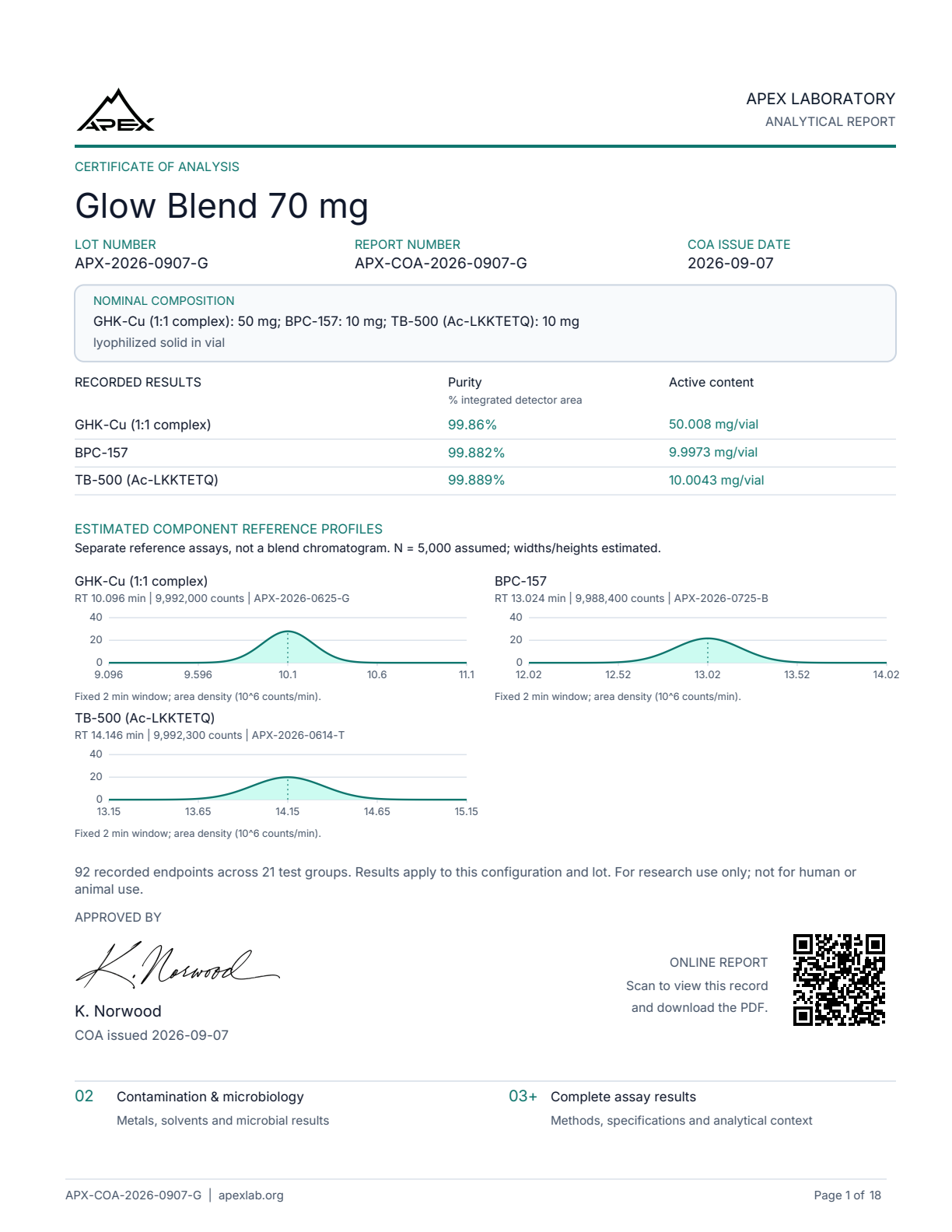
Apex Laboratory results for the listed configurations. Match the lot on your label with the report.
Glow Blend 70 mg
- GHK-Cu (1:1 complex) chromatographic purity
- 99.86 % integrated detector area
- BPC-157 chromatographic purity
- 99.882 % integrated detector area
- GHK-Cu (1:1 complex) active content
- 50.008 mg/vial
- BPC-157 active content
- 9.9973 mg/vial
Chromatographic purity by analyte

About this graph
Recorded scalar results against the stated specification. Each row uses its own labeled scale; purity is detector-area purity, not active-material content.
Measured active content

About this graph
Calibrated active content, concentration or activity compared with the stated same-unit specification. Each row uses its own labeled scale; no conversion from chromatographic purity is made.
The combined lot purity and the per-component purity values reported for this blend are independent chromatographic measurements (the co-formulated lot and component reference runs); they are not arithmetically derived from one another.
GLOW Blend 70mg — Three-Peptide Research Reagent
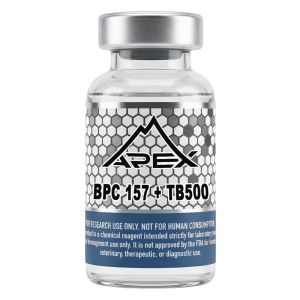
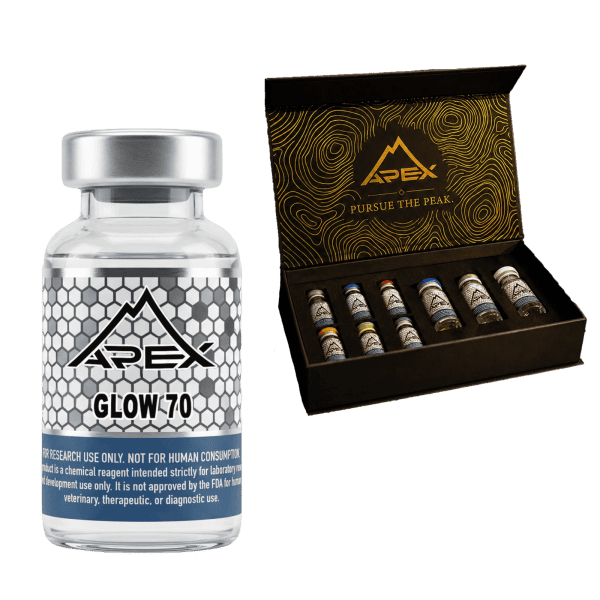
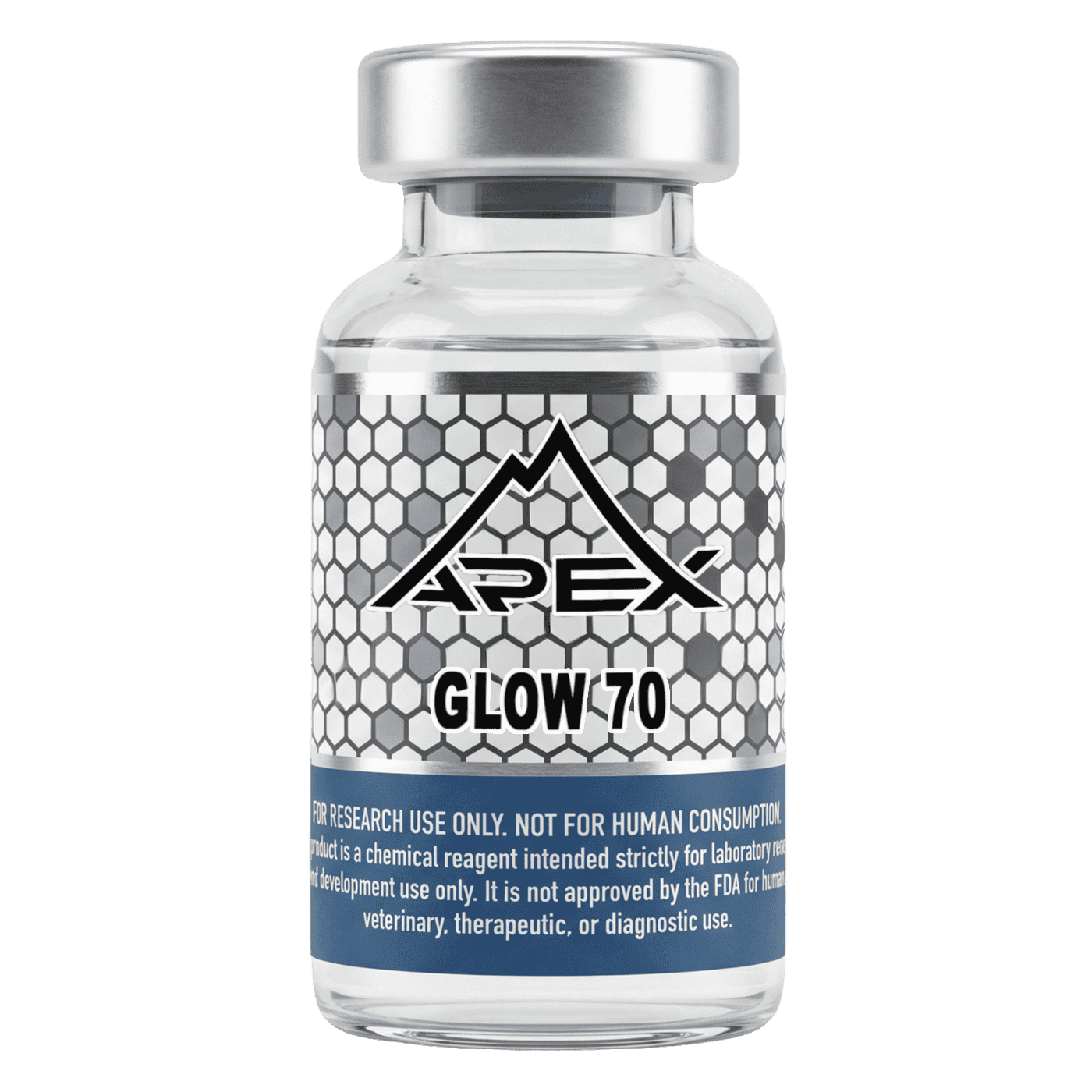
GLOW Blend 70mg combines GHK-Cu 50 mg, BPC-157 10 mg and TB-500 10 mg in one lyophilized research vial. The declared 50:10:10 composition is a 5:1:1 mass ratio totaling 70 mg. A single vial simplifies the list of materials to document, but the label alone does not establish mixture homogeneity, recovery, stability or reproducibility in an assay. Start with the GLOW ingredients, mass ratio and research-evidence guide for the evidence behind each component and the limits of blend-level conclusions.
Component Research Context
GHK-Cu (Copper Tripeptide, 50 mg)
GHK-Cu is the copper(II) complex of the tripeptide glycyl-L-histidyl-L-lysine. Cell-culture research has examined collagen synthesis and matrix-remodeling endpoints. The 50 mg label amount is its mass contribution to this formulation; it is not a molar fraction, an established optimal amount or an effect size. For identity measurements, use the reference species and ion basis stated in the applicable report.
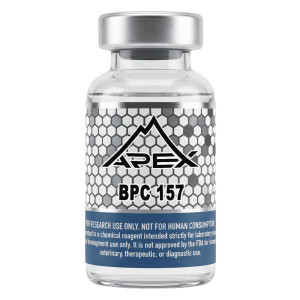
BPC-157 (Pentadecapeptide, 10 mg)
BPC-157 is a synthetic 15-amino-acid peptide. Its separate literature includes cell and animal experiments, which require attention to the actual model, material and endpoint. GLOW lists 10 mg BPC-157 alongside 10 mg TB-500. Equal label masses and co-formulation do not establish equal molar amounts, compatibility or a combined biological response.
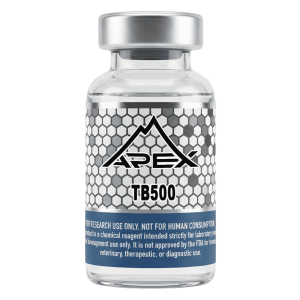
TB-500 (Thymosin β4 Fragment, 10 mg)
The TB-500 identity used on this page is Ac-LKKTETQ, an acetylated seven-residue fragment associated with the thymosin β4 research lineage. It is not the full 43-residue protein. Findings about the parent protein, a non-acetylated sequence or a metabolite must be checked before they are attributed to this fragment. Different molecular weights do not by themselves make components separate on a chromatogram.
Understanding the 5:1:1 Mass Ratio
The declared composition is 50 mg GHK-Cu plus 10 mg each of BPC-157 and TB-500. It describes component masses, not the number of molecules or the relative effects of the components. A chosen final volume permits a nominal mass-per-volume calculation; measured content and method recovery remain separate questions. The ratio is a formulation specification, not evidence that 5:1:1 is biologically optimal.
Research Workflow Notes
Document which mass basis is being used: the label claim, a reported active-content measurement or a separately validated assay result. Calculate each component’s nominal concentration using the selected mass and final volume. A calculator can reduce arithmetic errors, but it cannot verify recovery, mixture compatibility or suitability for a biological experiment.
Identity & Purity Verification
The published GLOW record APX-COA-2026-0907-G identifies Apex Laboratory as issuer and describes in-house testing for the named configuration and lot. Review its identity, chromatographic-purity and active-content results through the panel above or the GLOW analytical report. The component reference runs and combined-lot measurement are independent measurements, as the panel note explains. The record does not establish a third-party laboratory result, the shipping assignment of a new order or a biological effect.
Cost & Convenience vs. Buying Components Separately
| Approach | What you get | Price |
|---|---|---|
| GHK-Cu 50 mg (single) | 1 component | $36 |
| BPC-157 10 mg (single) | 1 component | $58 |
| TB-500 10 mg (single) | 1 component | $89 |
| Three components separately | 3 vials, manual ratio matching | $183 |
| GLOW Blend 70 mg | 1 vial, ratio pre-matched | $114 |
Sourcing the same three compounds individually costs $183 across three vials and leaves the researcher to match the ratio manually at reconstitution. The co-formulated blend is $114 — roughly a 38% reduction — in a single lot with one Certificate of Analysis and one reconstitution step.
Reconstitution, Storage & Handling
The published report describes dry, sealed-vial storage at -20 ±5 °C, protected from light. Select preparation conditions for the actual validated experiment rather than assuming one diluent works for every mixture or assay. The concentration calculator performs arithmetic; the preparation guide and storage guidance explain documentation and handling questions. They do not establish a universal refrigerated shelf life after reconstitution.
Selecting GLOW for a Research Program
The selection question is whether the experiment needs all three declared components together at this fixed ratio. Separate materials may be necessary when one component must vary independently or an effect must be attributed to a particular ingredient. The GLOW, KLOW and BPC-157/TB-500 comparison distinguishes composition choices, including KLOW’s additional KPV, without treating component count as biological strength.
Documentation & Batch Records
Compare the received vial identifier with the configuration and lot named in the analytical record before filing them as a matched set. Keep the issuer, report version, issue date, method and relevant results with the experiment. Resolve any mismatch with Apex before relying on the record for that material. A supplier-issued report documents its stated sample scope; it does not automatically verify a new order’s lot assignment or constitute independent third-party testing.
Frequently Asked Questions
What exactly is in GLOW Blend 70mg?
The declared composition is GHK-Cu 50 mg, BPC-157 10 mg and TB-500 10 mg: 70 mg total at a 5:1:1 mass ratio. The applicable report separately states its identity, chromatographic-purity and active-content results for the identified material.
How is GLOW different from KLOW?
GLOW lists three components. KLOW adds 10 mg KPV to the same GHK-Cu, BPC-157 and TB-500 label masses, taking the total to 80 mg. This is a compositional difference; it does not demonstrate stronger effects or a wholly separate biological pathway.
Can each component be verified independently?
Use the labeled analytical runs and their method context. A component-reference chromatogram is not proof that every component resolved in a combined-lot run. Different molecular weights alone do not establish chromatographic separation, and component purity is not arithmetically interchangeable with a combined-lot detector-area result.
How should the blend be reconstituted for research?
Use the diluent, container, concentration and handling procedure validated for the intended laboratory experiment and consult the applicable lot documentation. Concentration arithmetic does not establish chemical compatibility, sterility after handling or a post-reconstitution stability period.
Why is GHK-Cu the largest fraction?
The label specifies 50 mg GHK-Cu versus 10 mg each of the other components. That is the formulation’s declared mass ratio. Molecular size alone does not explain why that ratio was selected or show that it is optimal; no validated biological rationale for an optimal ratio is established on this page.
Is this product for human use?
No. GLOW Blend 70mg is a research reagent for in-vitro and laboratory use only and is not for human or veterinary consumption.
For in-vitro research use only. Not for human or veterinary consumption. Glow Blend 70mg is intended exclusively for qualified researchers, accredited laboratories, and educational institutions. Purchasers are responsible for safe handling, storage, and compliance with applicable federal, state, local, and institutional requirements governing chemical research reagents.