Batch documentation
Certificate of analysis
Apex Laboratory results for the listed configurations. Match the lot on your label with the report.
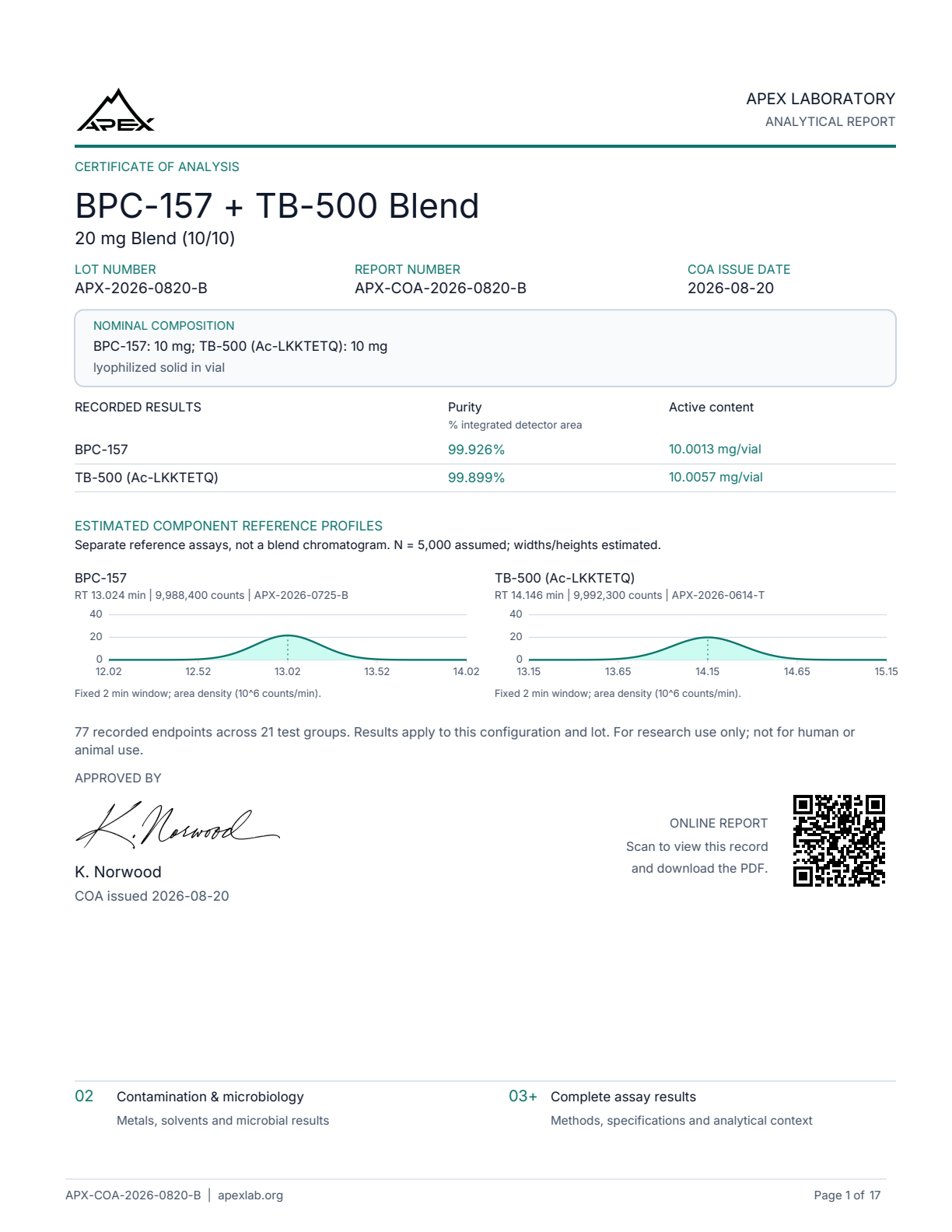
BPC-157 + TB-500 Blend - 20 mg Blend (10/10)
- BPC-157 chromatographic purity
- 99.926 % integrated detector area
- TB-500 (Ac-LKKTETQ) chromatographic purity
- 99.899 % integrated detector area
- BPC-157 active content
- 10.0013 mg/vial
- TB-500 (Ac-LKKTETQ) active content
- 10.0057 mg/vial
Chromatographic purity by analyte

About this graph
Recorded scalar results against the stated specification. Each row uses its own labeled scale; purity is detector-area purity, not active-material content.
Measured active content

About this graph
Calibrated active content, concentration or activity compared with the stated same-unit specification. Each row uses its own labeled scale; no conversion from chromatographic purity is made.
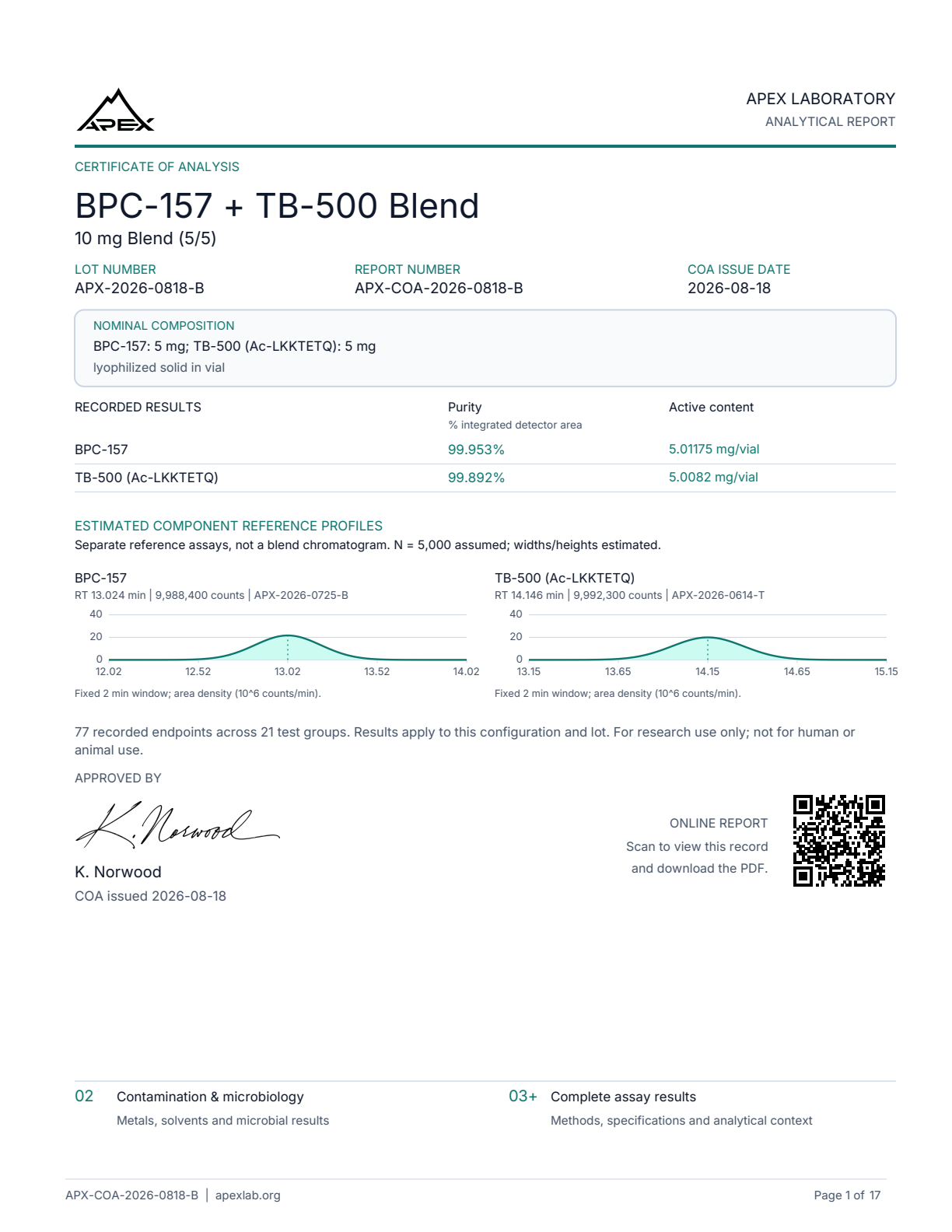
BPC-157 + TB-500 Blend - 10 mg Blend (5/5)
- BPC-157 chromatographic purity
- 99.953 % integrated detector area
- TB-500 (Ac-LKKTETQ) chromatographic purity
- 99.892 % integrated detector area
- BPC-157 active content
- 5.01175 mg/vial
- TB-500 (Ac-LKKTETQ) active content
- 5.0082 mg/vial
Chromatographic purity by analyte

About this graph
Recorded scalar results against the stated specification. Each row uses its own labeled scale; purity is detector-area purity, not active-material content.
Measured active content

About this graph
Calibrated active content, concentration or activity compared with the stated same-unit specification. Each row uses its own labeled scale; no conversion from chromatographic purity is made.
BPC-157 + TB-500 Blend — Paired Tissue-Research Reagent
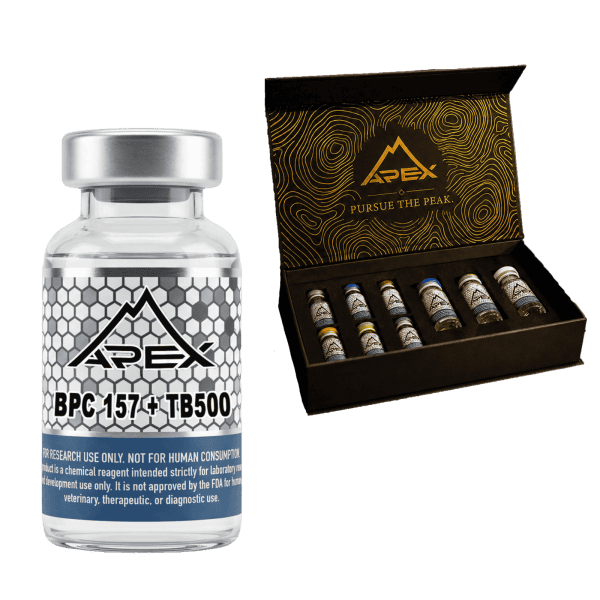
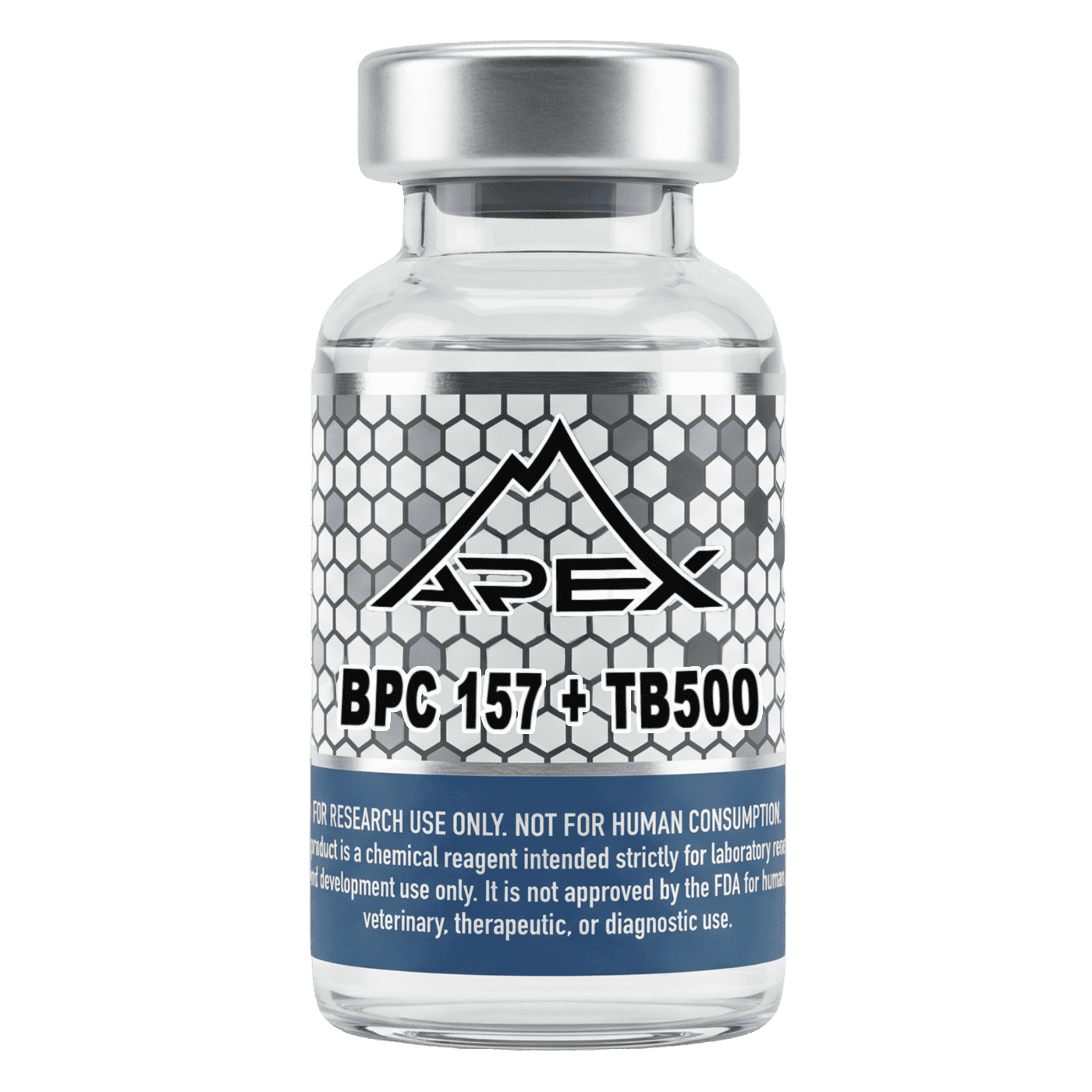
This research blend contains BPC-157 and TB-500 at a declared 1:1 mass ratio. The 10 mg configuration contains 5 mg of each component; the 20 mg configuration contains 10 mg of each. These are total label quantities, not equal molecule counts or a demonstrated optimal ratio. The BPC-157/TB-500 blend and Wolverine stack evidence guide explains the composition, fixed-versus-separate research design and limits of the combination studies. This material is for laboratory research only.
Component Research Context
BPC-157 (Pentadecapeptide, MW 1419.53)
BPC-157 is a synthetic 15-amino-acid peptide studied in specified cell and animal models, including migration and tissue-response experiments. Those component studies do not establish clinical efficacy or an effect for the co-formulated blend. Equal mass with TB-500 specifies this product configuration; it is not evidence that the two substances are most often studied together.
TB-500 (Thymosin β4 Fragment, MW 889.01)
The TB-500 identity used here is Ac-LKKTETQ, an acetylated seven-residue fragment related to the 43-residue thymosin β4 protein. Parent-protein actin-binding findings and results for a nonacetylated fragment cannot automatically be assigned to Ac-LKKTETQ. Its lower reference molecular weight also does not, by itself, establish chromatographic separation from BPC-157; separation and quantification depend on the actual analytical method.
Why a 1:1 Pairing
A 1:1 mass ratio is the declared configuration of this blend. Both size options retain that ratio, while the larger vial contains twice the labeled mass of each component. Equal masses do not mean equal molecule counts, equal biological effects or equal solution concentrations without a defined preparation volume. The current combination evidence does not establish this ratio as a generally preferred or optimal research design.
Identity & Purity Verification
Read the applicable analytical record for the specified configuration and lot. Component identity, detector-area purity and calibrated active content answer different questions; do not treat them as interchangeable or infer a combined purity from two component percentages. The laboratory report library identifies the issuer, dates, methods and result basis. Apex-issued records are in-house documentation, not independent third-party certificates. A report alone does not establish sterility, stability or clinical suitability.
Cost & Convenience vs. Buying Components Separately
| Approach | What you get | Price |
|---|---|---|
| BPC-157 5 mg + TB-500 5 mg (singles) | 2 vials | $88 |
| BPC-157 + TB-500 Blend 10 mg (5+5) | 1 vial | $42 |
| BPC-157 10 mg + TB-500 10 mg (singles) | 2 vials | $147 |
| BPC-157 + TB-500 Blend 20 mg (10+10) | 1 vial | $65 |
At the 5 mg-per-component size, the two singles total $88; the blend is $42 — roughly half. At the 10 mg-per-component size the singles total $147 versus $65 for the blend. Beyond price, the blend supplies a declared fixed composition. Whether that format suits a study depends on its controls and preparation requirements; it is not evidence that most paired-study protocols prefer a co-formulated vial.
Reconstitution, Storage & Handling
Follow the applicable material documentation and the laboratory’s validated procedure for diluent, container, concentration, temperature and elapsed storage time. The concentration calculator performs arithmetic; it does not establish compatibility, stability or a usable lifetime. Consult the storage evidence guide for the distinction between general handling practices and material-specific stability evidence. Do not assume that one diluent or a universal refrigerated shelf life is appropriate for every mixed-peptide experiment.
Selecting This Pairing for a Research Program
A fixed-ratio blend can serve a laboratory question that specifically requires both named components at the declared composition. Separate materials may be needed when an experiment must vary one component, include single-component controls or attribute an observed effect. Changing from the 10 mg to the 20 mg blend changes the labeled quantity while retaining the mass ratio. Neither configuration establishes synergy, biological superiority or a generally preferred protocol.
Documentation & Batch Records
Compare the identifier on the received material with the configuration and lot named in its applicable report. Retain the report version, issuer, issue date and relevant results with the experiment. An issue date is not automatically the laboratory test date, and an example report does not guarantee which lot will be assigned to a future order. If identifiers or the analytical scope are unclear, resolve the discrepancy with Apex before assigning the report to the material.
Frequently Asked Questions
What are the two size options?
The declared options are a 10 mg blend containing 5 mg BPC-157 plus 5 mg TB-500, and a 20 mg blend containing 10 mg of each. Both retain the same 1:1 mass ratio. Solution concentration also depends on the actual preparation volume.
Why are these two peptides blended together?
The blend provides the two named components at a fixed declared mass ratio. That can suit a question about the combined material, while separate components permit individual controls. Limited combination studies do not establish a universally preferred ratio or superior biological effect for this product.
How can I assess each component’s identity and purity?
Check the report’s identity evidence, chromatogram labels and method-specific results for each named component. Different molecular weights do not prove resolution in a single chromatographic run. A component-reference trace and a combined-material measurement are different evidence, and area purity is not a calibrated amount or proof of sterility.
How do I calculate concentration for the blend?
The concentration calculator can calculate nominal per-component concentration from the declared component amounts and an entered preparation volume. The laboratory must independently validate the diluent, preparation, recovery and stability relevant to its experiment; calculator arithmetic does not establish those properties.
Is this blend for human use?
No. It is a research reagent for in-vitro and laboratory use only and is not for human or veterinary consumption.
For in-vitro research use only. Not for human or veterinary consumption. BPC-157 + TB-500 Blend is intended exclusively for qualified researchers, accredited laboratories, and educational institutions. Purchasers are responsible for safe handling, storage, and compliance with applicable federal, state, local, and institutional requirements governing chemical research reagents.