Batch documentation
Certificate of analysis
Apex Laboratory results for the listed configurations. Match the lot on your label with the report.
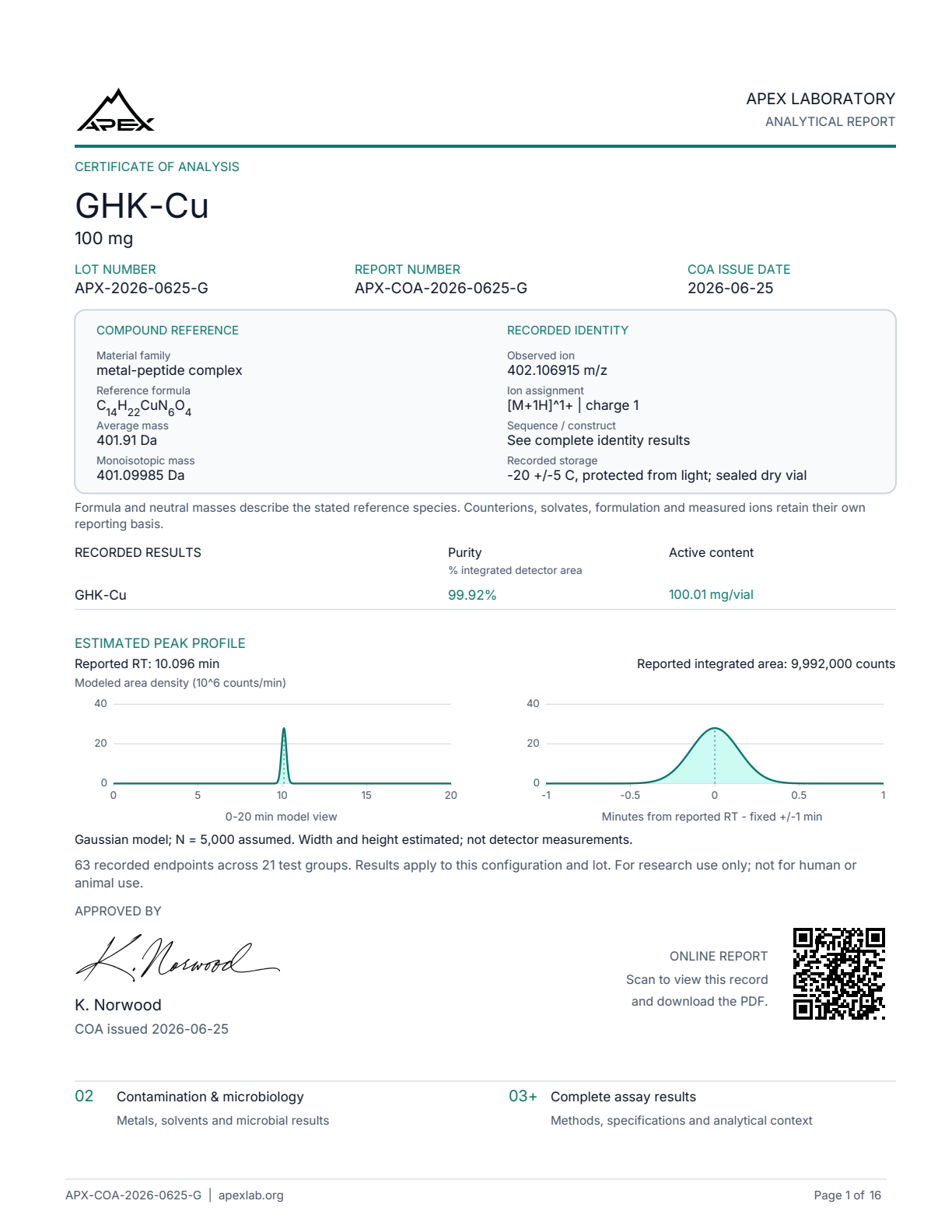
GHK-Cu - 100 mg
- GHK-Cu chromatographic purity
- 99.92 % integrated detector area
- GHK-Cu active content
- 100.01 mg/vial
- Intentional bound-plus-free total copper
- 15.811 mg Cu/vial
- Bacterial endotoxins
- <0.025 EU/mg active-equivalent
Chromatographic purity by analyte

About this graph
Recorded scalar results against the stated specification. Each row uses its own labeled scale; purity is detector-area purity, not active-material content.
Measured active content

About this graph
Calibrated active content, concentration or activity compared with the stated same-unit specification. Each row uses its own labeled scale; no conversion from chromatographic purity is made.
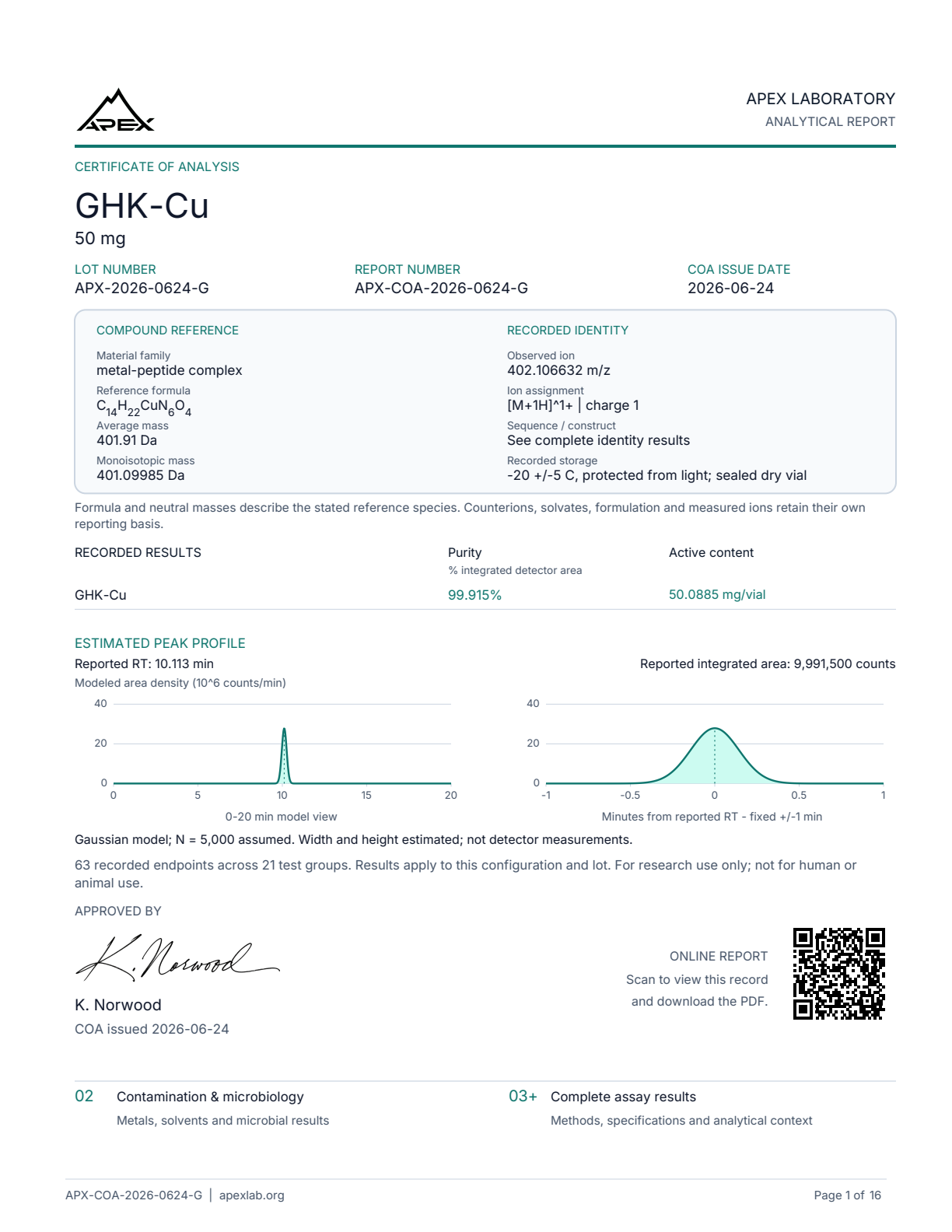
GHK-Cu - 50 mg
- GHK-Cu chromatographic purity
- 99.915 % integrated detector area
- GHK-Cu active content
- 50.0885 mg/vial
- Intentional bound-plus-free total copper
- 7.9055 mg Cu/vial
- Bacterial endotoxins
- <0.025 EU/mg active-equivalent
Chromatographic purity by analyte

About this graph
Recorded scalar results against the stated specification. Each row uses its own labeled scale; purity is detector-area purity, not active-material content.
Measured active content

About this graph
Calibrated active content, concentration or activity compared with the stated same-unit specification. Each row uses its own labeled scale; no conversion from chromatographic purity is made.
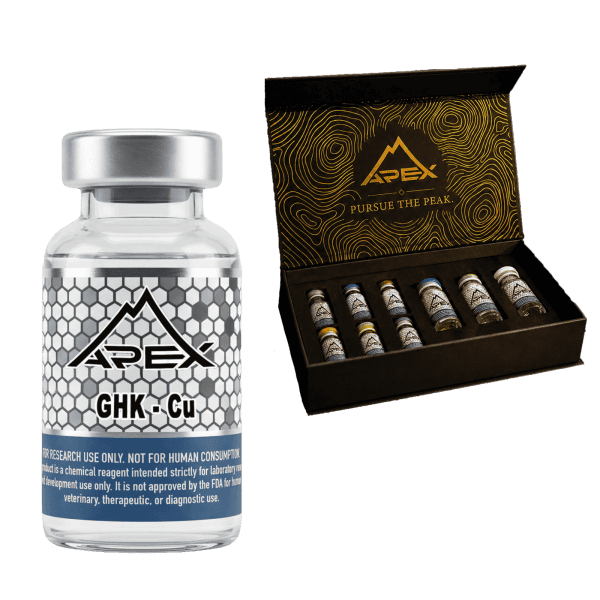
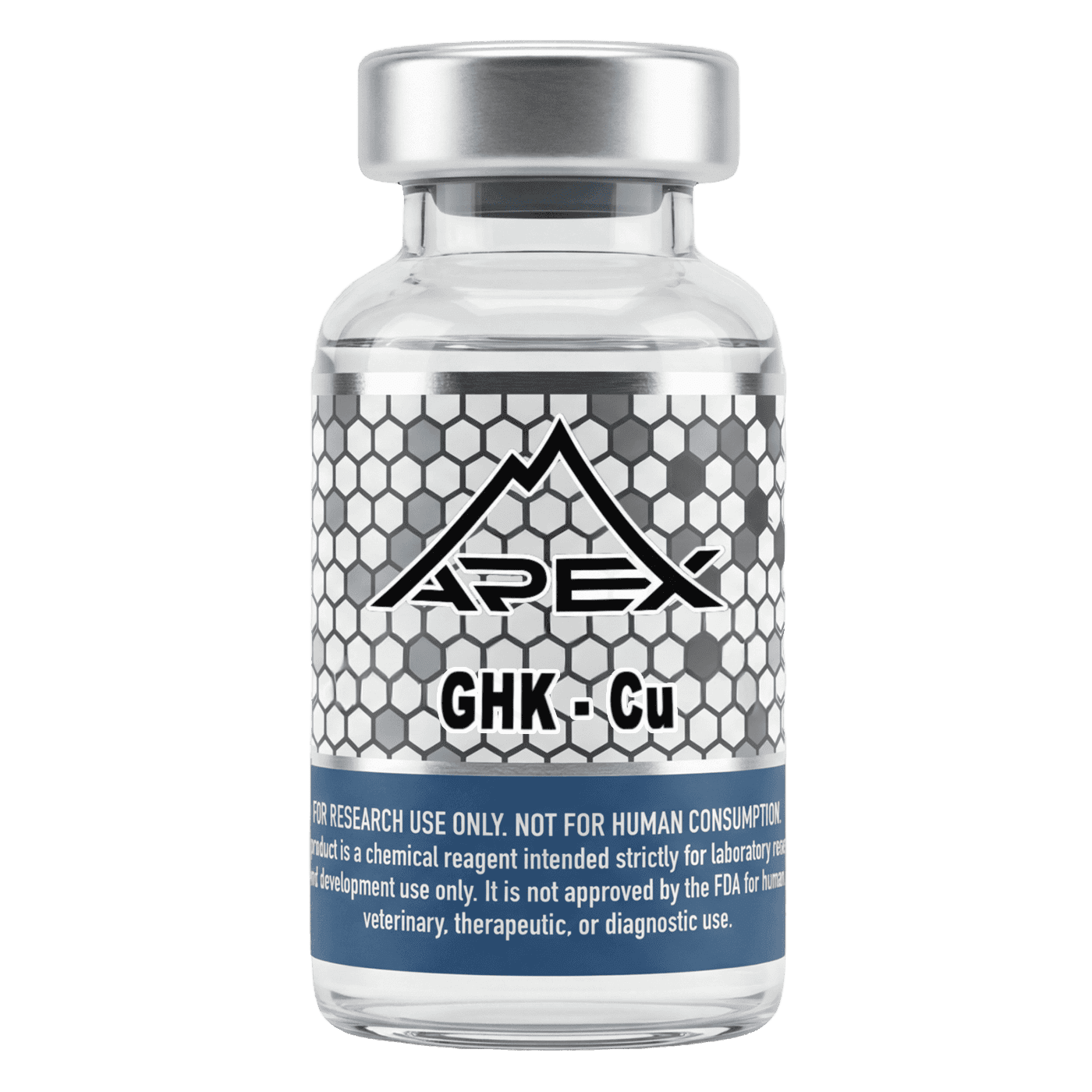
GHK-Cu is a copper peptide complex supplied by Apex Laboratory as a high-purity research peptide intended strictly for in-vitro laboratory research and development applications.
Compound Overview
GHK-Cu is the copper(II) complex of GHK, the three-amino-acid sequence glycyl-L-histidyl-L-lysine. Researchers distinguish the copper complex from copper-free GHK and from copper salts when interpreting cell-culture experiments. The GHK-Cu identity and research-evidence guide explains those distinctions and separates laboratory findings from human studies of specific formulations.
Copper binding is part of GHK-Cu identity, not an extra amino acid in its sequence. Chemical reference entries may describe different charge states or associated species, so a quoted molecular weight needs its reference form. For a supplied reagent, use the identity basis, expected ion and material description in the applicable report rather than assuming that every salt, solvate or measured ion has the same mass.
Published laboratory work includes collagen synthesis and matrix-remodeling endpoints in fibroblast cultures. Responses depend on the experimental system: in one MMP-2 study, copper ions reproduced the response seen with GHK-Cu, while copper-free GHK did not. That result supports including appropriate copper and peptide controls; it does not establish a universal mechanism or a clinical outcome.
Research Background & Published Literature
GHK and its copper complex have a long research history, but reviews, cell-culture experiments and human formulation studies answer different questions. The resources below are reviews for orientation; primary experimental examples follow.
Researchers interested in the published literature surrounding this compound can explore the following peer-reviewed resources for additional context on its mechanism of action, signaling pathways, and experimental applications in controlled laboratory settings:
- Pickart et al. (2012) — review of GHK-Cu and oxidative-stress research
- Pickart et al. (2015) — review of GHK and skin-regeneration pathways
Gene-expression discussions in the 2015 review are a way to generate research questions, not a demonstration that this reagent reverses aging or produces a particular result in people. An experiment still needs a defined material, model, comparison group and measured endpoint.
Two primary examples are Maquart et al. (1988), fibroblast collagen synthesis, and Siméon et al. (2000), MMP-2 expression in fibroblast cultures. These experiments concern specified laboratory systems. They are not tests of the current Apex lot or evidence that a research vial reproduces a human treatment outcome.
Technical Specifications
- Product Name: GHK-Cu
- Classification: Copper Peptide Complex
- Structural Description: Tripeptide-copper complex (Glycyl-L-histidyl-L-lysine:copper(II))
- CAS Number: 89030-95-5
- Molecular Weight: 402.92 g/mol for a defined positively charged GHK-Cu reference species; consult the report for the assigned material and ion basis.
- Analytical Results: See the applicable report for chromatographic purity, identity and active content as separate measurements.
- Physical Form: Lyophilized (freeze-dried) powder
- Intended Use: In-vitro research use only — not for human consumption
Storage, Handling & Stability Guidelines
Use the applicable lot documentation and your institution’s validated storage procedure. Protect dry material from moisture and light; select diluent, concentration, container and aliquoting conditions for the actual experiment. Refrigeration after reconstitution is a handling condition, not proof of a universal usable lifetime.
- Minimize time at ambient temperature during handling to preserve compound integrity.
- Avoid moisture exposure by resealing vials promptly after each withdrawal.
- Use appropriate personal protective equipment and follow your institution’s chemical safety protocols at all times.
- Label all aliquots with the compound name, concentration, date of reconstitution, and operator initials for complete traceability.
Quality Assurance & Analytical Verification
The batch verification panel provides the available analytical record for the selected configuration. Review its issuer, identified lot, methods, acceptance criteria and reported results. Chromatographic detector-area purity, identity measurements and active content answer different questions. A report should be evaluated on its stated scope rather than treated as a guarantee about every future lot.
Read the mass-spectrometry result against the report’s assigned molecular species, ion/adduct and charge state. A chromatographic retention time depends on the method and conditions; small molecular size alone does not prove identity, early elution or separation from impurities. The published analytical records identify their own lots and issuers. Match the received vial identifier to the appropriate record before assigning it to a research sample.
Frequently Asked Questions
What is the primary research application of this compound?
This compound is classified as a copper peptide complex and is used in laboratory settings to study related signaling pathways and biological mechanisms in controlled in-vitro experiments.
What storage conditions are recommended?
Follow the applicable lot documentation and a validated laboratory procedure for the specific dry or reconstituted material. Record the diluent, concentration, container, preparation date and storage conditions. This page does not establish a universal post-reconstitution shelf life.
How does GHK-Cu differ from copper-free GHK as a research reagent?
GHK is the metal-free tripeptide; GHK-Cu is its copper(II) complex. A study of one form is not automatically evidence for the other. In the cited fibroblast MMP-2 experiment, the copper complex and copper ions produced a response that copper-free GHK did not. Other models need their own controls and interpretation.
What molecular features confirm the identity of the copper complex by mass spectrometry?
The assigned ion, charge state, expected mass and observed result must agree under the stated method. Copper-related isotope information can contribute to identity interpretation, but a universal single-peak rule is not a substitute for the report’s reference and method. Use the applicable lot record, not a presumed shipping-lot match.
What extracellular-matrix endpoints have GHK-Cu studies measured?
Examples include collagen synthesis and MMP-2 expression in fibroblast cultures, as described in the primary studies linked above. These are model-specific endpoints; the studies do not establish a clinical outcome for the supplied research material.
Related Research Compounds
Researchers studying copper peptide complex pathways may also be interested in related compounds available from Apex Laboratory, including Snap-8 10mg, BPC-157, TB-500. Explore our complete research catalog to browse all available peptides, reagents, and laboratory supplies, or visit our About page to learn more about our quality verification process.
Shipping, Packaging & Delivery
All orders placed before 2:00 PM ET ship the same business day via tracked domestic carriers. Products are packaged in insulated, temperature-appropriate containers designed to preserve compound stability during transit. Upon delivery, transfer all materials to appropriate storage conditions immediately. For time-sensitive research protocols or special delivery requirements, contact our support team in advance to coordinate optimal shipping timing for your laboratory workflow.
Research Use Disclaimer
For in-vitro research use only. Not for human consumption. All products sold by Apex Laboratory are intended exclusively for qualified researchers, accredited laboratories, and educational institutions. Purchasers assume full responsibility for ensuring safe handling, proper storage, and compliance with all applicable federal, state, and local laws, regulations, and institutional policies governing the purchase and use of chemical research reagents.