Thymosin alpha-1 is an N-terminally acetylated 28-amino-acid peptide originally isolated from thymosin fraction 5 and synthesized as thymalfasin. Research reports context-dependent effects in dendritic-cell, T-cell, and innate-signaling models, but does not establish one universal direct receptor-binding mechanism or clinical effect. Apex Laboratory supplies Thymosin Alpha-1 as a research-grade chemical reagent for in-vitro and preclinical research, distinct from the Zadaxin finished pharmaceutical formulation.
Thymosin alpha-1 spans almost five decades of research, from thymic-factor isolation and sequence work to structural studies, dendritic-cell models, infection research, and randomized clinical investigations. That breadth makes evidence discipline especially important. A mechanistic observation in a cell system, an adjunctive clinical trial, a foreign finished-drug record, and an Apex research reagent are different records.
This refresh narrows unsupported country-count claims, reports trial doses only as study parameters rather than administration guidance, and corrects the prior article’s treatment of TB-500 and full-length thymosin beta-4. The specialty research hub owns family navigation; this page owns the Thymosin Alpha-1 entity.
- Thymosin alpha-1 is a defined, N-acetylated 28-residue peptide; thymalfasin is the synthetic form of that active identity.
- TLR-dependent signaling has been observed in specific models, but direct universal receptor binding is not established.
- Mechanistic and structural literature is more consistent than the applied clinical-outcome literature.
- Thymalfasin has foreign finished-drug history but is not FDA approved in the United States; orphan designation is not marketing approval.
- TB-500, full-length thymosin beta-4, and Thymosin Alpha-1 are three separate identities.
Technical Identity and Goldstein-Lineage Discovery
FDA’s 2024 scientific review describes Thymosin alpha-1 (Tα1) as an N-terminally acetylated 28-amino-acid peptide originally isolated from thymosin fraction 5, a crude calf-thymus fraction. The synthetic peptide is called thymalfasin and has the same amino-acid sequence as natural Tα1. The reagent identity record FDA reports for the free base is set out below.
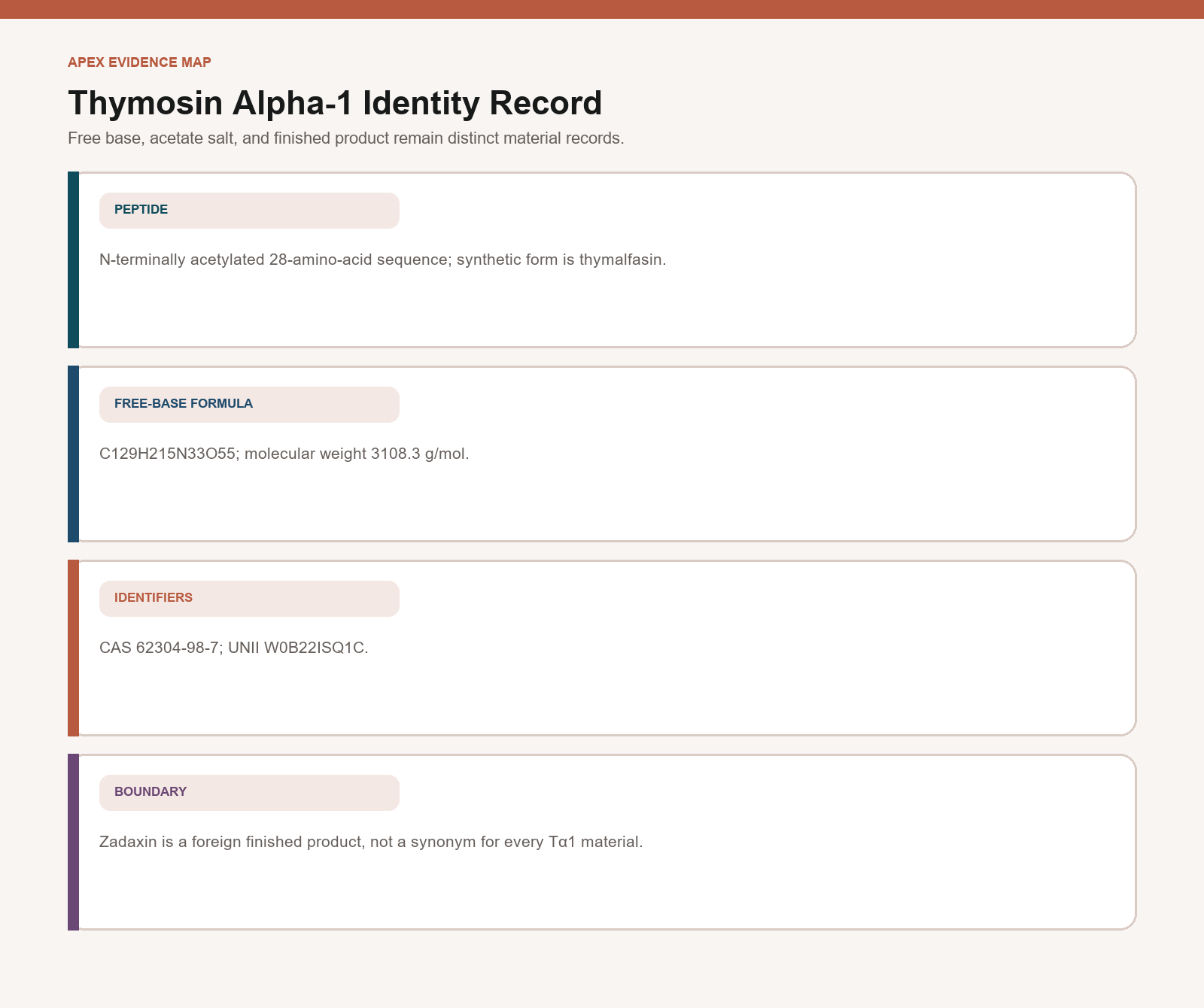
| Identity field | Value | Record |
|---|---|---|
| Residue count | 28 amino acids; N-terminal serine acetylated | FDA review [11] |
| Molecular formula (free base) | C129H215N33O55 | FDA review [11] |
| Molecular weight (free base) | 3108.3 g/mol | FDA review [11] |
| CAS number (free base) | 62304-98-7 | FDA review [11] |
| UNII | W0B22ISQ1C | FDA review [11] |
| Precursor | Cleaved from prothymosin alpha | Romani 2007 [5] |
The research lineage runs through Allan Goldstein and colleagues. The discovery history describes thymosin fraction 5, a partially purified calf-thymus preparation, as a family of at least 40 mostly small acidic polypeptides of about 1,000 to 15,000 Da rather than one substance, and records FDA’s first investigational new drug application for a thymic hormone preparation in 1974.[1] Early work reported functional helper-cell formation and Lyt-1+/2+/3+ subset conversion in T-cell differentiation assays, stated qualitatively with no quantitative result for Tα1 alone.[2]
Thymosin alpha-1 is acidic and intrinsically disordered in aqueous solution. A thymosin structural review reports that structure appears only under charge neutralization at low pH, added Zn2+, organic reagents such as trifluoroethanol, or binding partners.[3] A companion NMR study reported two helical tracts separated by a flexible break at negatively charged surfaces, including phosphatidylserine-exposing K562 cells.[4] Neither states a binding constant, and no quantitative endpoint for Tα1 activity is reported; they do not prove one membrane receptor or clinical pathway.
Mechanistic Evidence: What the Models Support
Published research often summarizes Tα1 through Toll-like receptor signaling. A more careful description is that TLR-dependent effects have been observed in specified immune models. Dendritic-cell work reported TLR/MyD88-dependent Th1 priming, plasmacytoid-dendritic-cell activation through a TLR9/MyD88/IRF7 axis, and induction of indoleamine 2,3-dioxygenase, with pathway assignments and no quantitative endpoint.[5] The wider TLR3, TLR4, IRF3 and NF-κB assignments come from a separate 2023 review, tabulated under additional reported findings. This evidence does not establish that Tα1 is a conventional high-affinity ligand for every listed TLR or that one pathway explains all reported outcomes.
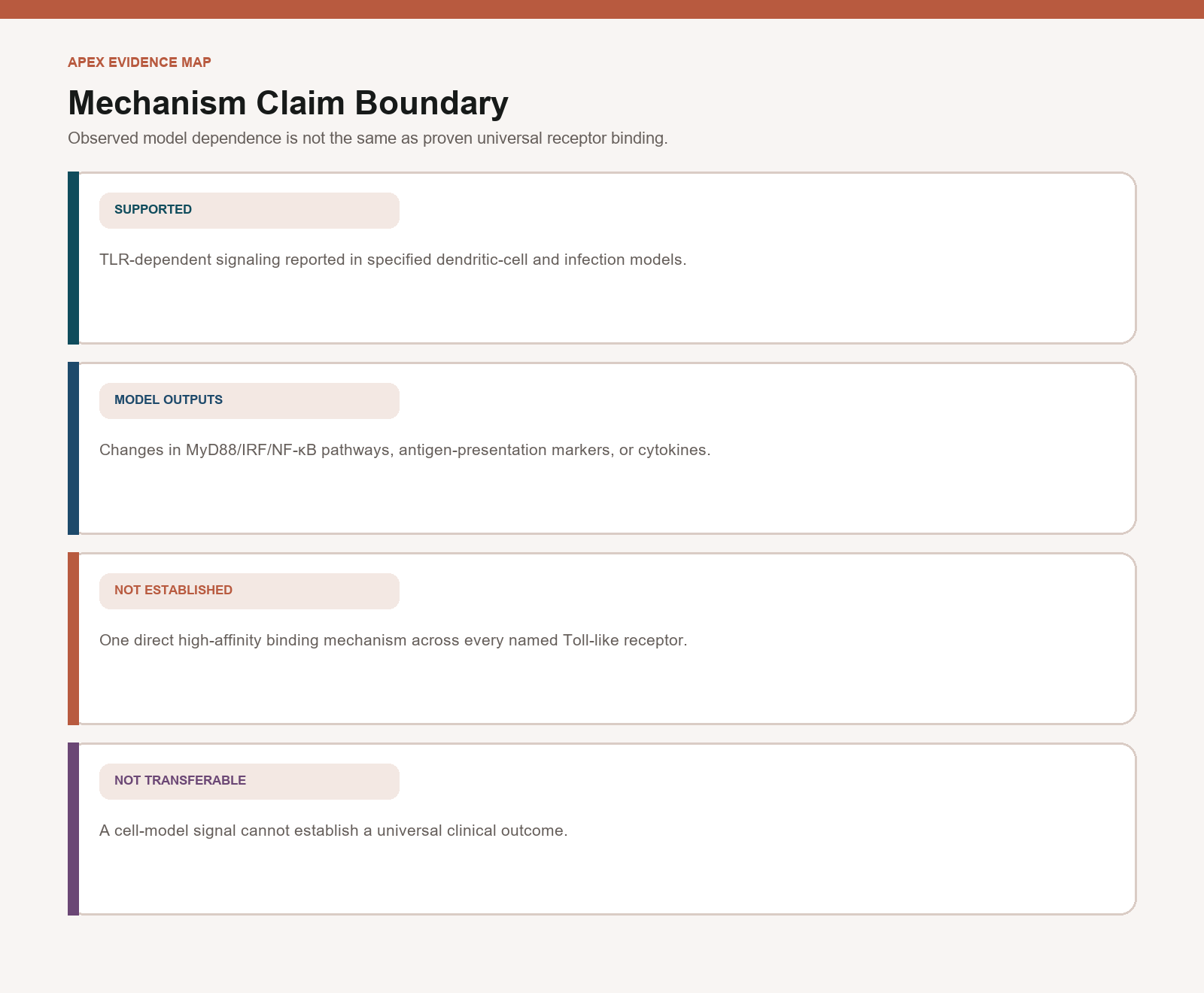
Human monocyte-derived dendritic-cell research illustrates the context dependence. One in-vitro study reported opposite directions of effect in the same cell type: raised HLA-I and HLA-II expression with increased IL-6, TNF-α and IL-8 secretion under viral TLR3 and TLR7/8 agonists, but lowered the same parameters under bacterial TLR2 and TLR4 stimulation.[6] Recent in-vitro work in an HCMV model reported higher CD40, CD80 and TIM-3 with lower PD-L1, and modulated TNF-α, IFN-γ and IL-2 in autologous CD4+ and CD8+ T lymphocytes.[7] Both are human in-vitro flow-cytometry studies giving directional marker changes and no quantitative outcome, not proof of broad human benefit.
Why “immune modulator” is more accurate than “immune booster”
The literature reports both pro-inflammatory and tolerance-associated patterns depending on cell type, stimulus, and disease model. “Booster” implies a uniform one-direction response that the evidence does not support. A useful study therefore names the cell population, priming condition, comparator, endpoint, and time point rather than assigning one global immune effect.
Applied Evidence and Uncertainty
Tα1 has been studied in chronic viral hepatitis, sepsis, malignancy, vaccination, and other immune contexts. Much of that literature evaluates adjunctive regimens, making contribution difficult to isolate. A randomized multicentre trial in 552 adults whose hepatitis C had not responded to prior peginterferon/ribavirin added thymosin alpha-1 1.6 mg subcutaneously twice weekly (n=275) or placebo (n=277) to peginterferon alfa-2a with ribavirin for 48 weeks. Sustained virological response did not differ by intention to treat (12.7% versus 10.5%; P=0.407) but was higher among 48-week completers (41.0%, 34/83, versus 26.3%, 26/99; P=0.048).[8] That divergence is a limitation, not a detail to omit: the completer comparison is no longer randomized.
The TESTS trial — 1,106 adults meeting sepsis-3 criteria at 22 centres in China, randomized 1:1 to subcutaneous thymosin α1 or placebo every 12 hours for seven days — provided a more rigorous contemporary test.[9] In the modified intention-to-treat set (n=1,089), 28-day all-cause mortality was 23.4% versus 24.1% (hazard ratio 0.97; 95% CI 0.76–1.24; P=0.82), with no secondary or safety outcome differing significantly. A 2025 systematic review of 11 randomized trials (967 versus 960 patients) reported lower 28-day mortality overall (odds ratio 0.73; 95% CI 0.59–0.90) but none in the high-quality (OR 0.82; 0.65–1.03) or multicentre (OR 0.86; 0.68–1.08) subgroups, and its trial-sequential analysis found the information size insufficient.[10]
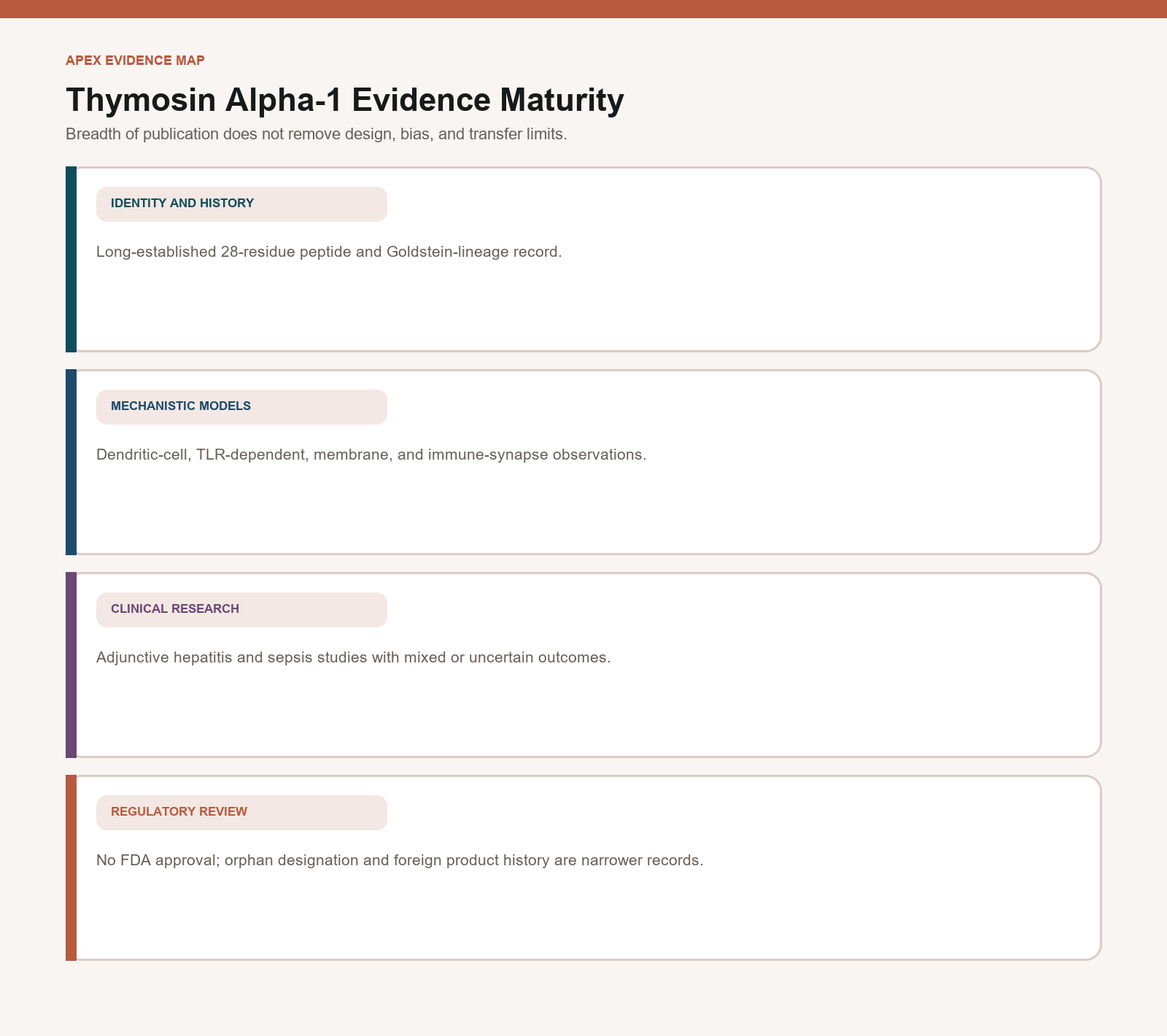
The mechanistic literature supports continued study of dendritic-cell, antigen-presentation, and TLR-dependent contexts. It does not justify a universal efficacy claim. Clinical adjunct studies must be interpreted with their control regimen, analysis population, geographic concentration, and risk of bias intact.
Additional reported findings
All rows report thymosin alpha-1; doses are study parameters, not administration guidance.
| Model | Species | Endpoint | Reported result | Source (PMID) |
|---|---|---|---|---|
| Chronic hepatitis B trials, pharmacy review | human adults | HBV DNA clearance, 6 and 12 months | 40.6% and 25.6% versus 9.4% untreated; 1.6 mg (900 µg/m²) subcutaneously twice weekly; half-life about 2 hours | 11381492 |
| Entecavir plus Tα1 versus entecavir, HBV cirrhosis; 7 RCTs, 1,144 subjects | human; all trials mainland China | HBV DNA undetectable, 24 weeks | RR 1.91 (95% CI 1.56–2.35); none at 48–52 weeks (RR 1.07, 0.96–1.18) | 33076834 |
| Murine cytomegalovirus; susceptible, resistant, TLR-deficient strains | mouse | Protection; pDC TLR9/MyD88/IRF7 sensing | Protected both strains via IFN-α/IFN-γ; no quantitative result reported | 17804687 |
| Narrative review, viral infection | review; no primary model | TLR2/3/4/7/9, IRF3, NF-κB assignments | Pathway map only; no quantitative result reported | 37110771 |
| Ex-vivo lymphocytes, post-acute SARS-CoV-2 sequelae | human, ex vivo | Naive/memory T- and B-cell balance | Restoration largest in severe acute illness; no quantitative result reported | 36989892 |
| Historical review: hepatitis, sepsis, aspergillosis after bone-marrow transplant, vaccine adjuvant | human | Dose–effect; tolerability | Higher later-trial doses called proportionally more effective; no quantitative result reported | 26098768 |
| Endothelial migration, angiogenesis, punch wound models | cells in vitro; in-vivo species not stated | Chemotaxis, angiogenesis, wound closure | Chemoattractant activity and faster healing; source of the 28-amino-acid identity statement; no quantitative result reported | 9551940 |
U.S. and Foreign Regulatory Context
Thymalfasin is not FDA approved for marketing in the United States. FDA’s orphan-drug database records designation for specified investigational indications, including a 1998 designation for DiGeorge anomaly with immune defects, but marks that entry “Not FDA Approved for Orphan Indication.” FDA also explains that orphan designation provides development incentives and is separate from approval or licensure.
FDA’s December 2024 Pharmacy Compounding Advisory Committee materials state that products containing Tα1 were not FDA approved in the United States and note a foreign market history for Zadaxin. The same FDA review distinguishes Tα1 or thymalfasin as the active substance from Zadaxin as a finished drug product available in other countries. Because national authorizations, indications, and status can change, this guide does not repeat an unverified “35-plus countries” count or infer a global approval from manufacturer history.
Stated per compound: the Apex Thymosin Alpha-1 research reagent holds no FDA, EMA, NMPA or other marketing authorization in any jurisdiction, and is neither an approved drug product nor an investigational drug under an active application.
| Record | Accurate statement | Do not infer |
|---|---|---|
| FDA orphan designation | Development designation for a named rare-disease investigation | Marketing approval, safety, or efficacy |
| Zadaxin foreign product history | A finished thymalfasin product has been marketed outside the United States | One current worldwide country count or U.S. approval |
| Apex Tα1 reagent | A separate research-only chemical material | Pharmaceutical equivalence or transfer of any foreign authorization |
Thymosin Alpha-1, Thymosin Beta-4, and TB-500
The shared word “thymosin” does not make these materials interchangeable. Thymosin Alpha-1 is the 28-residue N-acetylated peptide discussed here. Full-length thymosin beta-4 is a separate 43-residue beta-thymosin commonly studied in actin biology. TB-500 is the seven-residue acetylated fragment Ac-Leu-Lys-Lys-Thr-Glu-Thr-Gln (Ac-LKKTETQ).
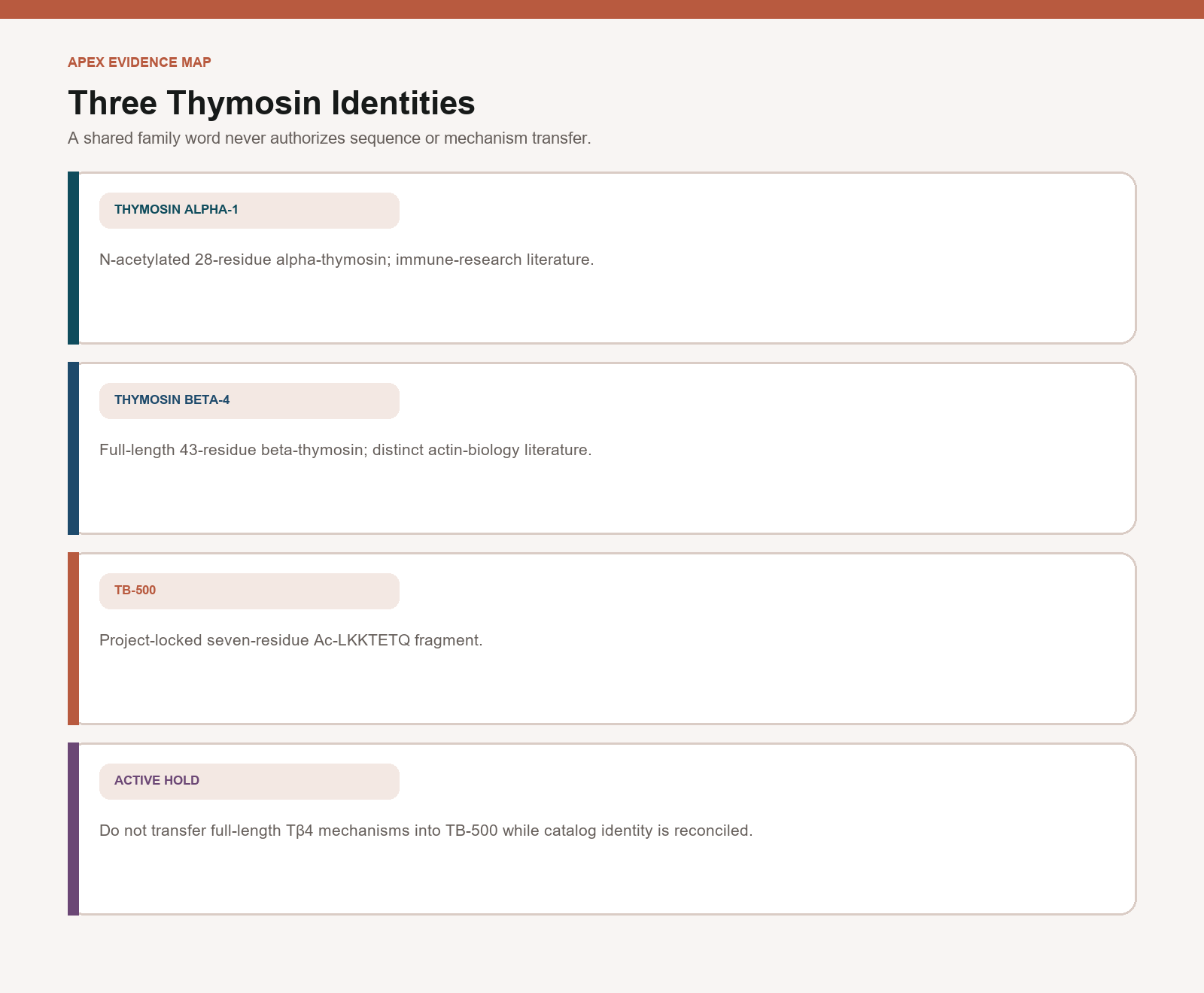
Keep the reagent identity separate from the evidence for related materials. Full-length thymosin beta-4 findings do not establish actin-sequestering or tissue-repair effects for seven-residue Ac-LKKTETQ. The tissue-repair research hub preserves the same boundary.
Verification of a Thymosin Alpha-1 Research Material
The first verification question is whether the material is Tα1 free base, Tα1 acetate, or a finished formulation. FDA’s 2024 review specifically warned that free base and acetate are distinct bulk-drug-substance records and described gaps in publicly available impurity, aggregate, bioburden, and endotoxin information for nominated compounding materials. A generic name or formula is therefore not a complete quality record.
HPLC can describe a chromatographic profile under a stated method. Mass spectrometry can support identity when the observed ion or deconvoluted mass matches the declared material. Neither method alone proves biological activity, aggregation state, sterility, endotoxin control, clinical safety, or equivalence to Zadaxin. Use the COA guide, HPLC guide, and mass-spectrometry guide to examine the current lot record.
Apex lists Thymosin Alpha-1 as a lyophilized research reagent. Read the applicable published configuration report for its identity, lot, methods, results and acceptance criteria. Those in-house results remain subject to the same analytical limits.
Thymosin Alpha-1 research-material record
The product page can document current availability and lot-specific records. It cannot establish an approved indication, pharmaceutical equivalence, or a global regulatory status. Recheck the current analyte declaration and lot documentation before relying on a specification.
Frequently Asked Questions About Thymosin Alpha-1
What is Thymosin Alpha-1?
Thymosin Alpha-1 is an N-terminally acetylated 28-amino-acid peptide originally isolated from thymosin fraction 5. Thymalfasin is its chemically synthesized form. FDA lists the free-base molecular weight as 3108.3 g/mol and CAS number 62304-98-7.
Does Thymosin Alpha-1 directly bind Toll-like receptors?
Published research reports TLR-dependent signaling in specific dendritic-cell, infection, and immune models. That evidence does not establish one universal direct-binding mechanism across every listed TLR. Claims should name the model, stimulus, pathway, and measured endpoint.
Is Thymosin Alpha-1 FDA approved?
No thymosin alpha-1 or thymalfasin product is FDA approved for marketing in the United States. Some investigational uses received orphan-drug designation, but FDA states that designation is separate from approval and does not authorize marketing.
Is Thymosin Alpha-1 the same as Zadaxin?
Thymalfasin is the synthetic active peptide, while Zadaxin is a finished drug product with foreign market history. A research-grade Thymosin Alpha-1 reagent is not that finished product and does not inherit its formulation controls, authorization, or evidence.
Is Thymosin Alpha-1 the same as TB-500?
No. Thymosin Alpha-1 is a 28-residue alpha-thymosin. TB-500 is the seven-residue fragment Ac-LKKTETQ. Full-length 43-residue thymosin beta-4 is a third material, and its actin-related evidence cannot be transferred automatically to TB-500.
What can HPLC and mass spectrometry verify?
HPLC can report a chromatographic profile under a stated method, and mass spectrometry can support mass identity with an interpretable result. Neither method alone establishes biological activity, aggregation state, sterility, endotoxin control, clinical safety, or pharmaceutical equivalence.
References and Regulatory Sources
- Goldstein AL. History of the discovery of the thymosins. Ann N Y Acad Sci. 2007;1112:1-13. PMID: 17600284.
- Low TL, et al. Current status of thymosin research: evidence for the existence of a family of thymic factors that control T-cell maturation. Ann N Y Acad Sci. 1979;332:33-48. PMID: 394636.
- Hoch K, et al. Structures of Thymosin Proteins. Vitam Horm. 2016;102:1-24. PMID: 27450728.
- Nepravishta R, et al. Mechanism of Action of Thymosinα1: Does It Interact with Membrane by Recognition of Exposed Phosphatidylserine on Cell Surface? A Structural Approach. Vitam Horm. 2016;102:101-19. PMID: 27450732.
- Romani L, et al. Thymosin alpha1: an endogenous regulator of inflammation, immunity, and tolerance. Ann N Y Acad Sci. 2007;1112:326-38. PMID: 17495242.
- Giacomini E, et al. Dual effect of Thymosin α 1 on human monocyte-derived dendritic cell in vitro stimulated with viral and bacterial toll-like receptor agonists. Expert Opin Biol Ther. 2015;15 Suppl 1:S59-70. PMID: 26096650.
- Espinar-Buitrago MS, et al. Immune modulation via dendritic cells by the effect of Thymosin-alpha-1 on immune synapse in HCMV infection. Int Immunopharmacol. 2023;125(Pt A):111103. PMID: 38149577.
- Ciancio A, et al. Thymosin alpha-1 with peginterferon alfa-2a/ribavirin for chronic hepatitis C not responsive to IFN/ribavirin: an adjuvant role? J Viral Hepat. 2012;19 Suppl 1:52-9. PMID: 22233415.
- Wu J, et al. The efficacy and safety of thymosin α1 for sepsis (TESTS): multicentre, double blinded, randomised, placebo controlled, phase 3 trial. BMJ. 2025;388:e082583. PMID: 39814420. Correction: BMJ. 2025;389:r1098. PMID: 40447307. The figures quoted above are the corrected values; the PubMed abstract for 39814420 still serves the superseded ones.
- Gu B, et al. Efficacy of thymosin α1 for sepsis: a systematic review and meta-analysis of randomized controlled trials. Front Cell Infect Microbiol. 2025;15:1673959. PMID: 40969554.
- FDA. Thymosin Alpha-1 free base and acetate scientific review for the Pharmacy Compounding Advisory Committee. December 4, 2024.
- FDA. Thymalfasin orphan-drug designation record. Current source check July 24, 2026.