Batch documentation
Certificate of analysis
Apex Laboratory results for the listed configurations. Match the lot on your label with the report.
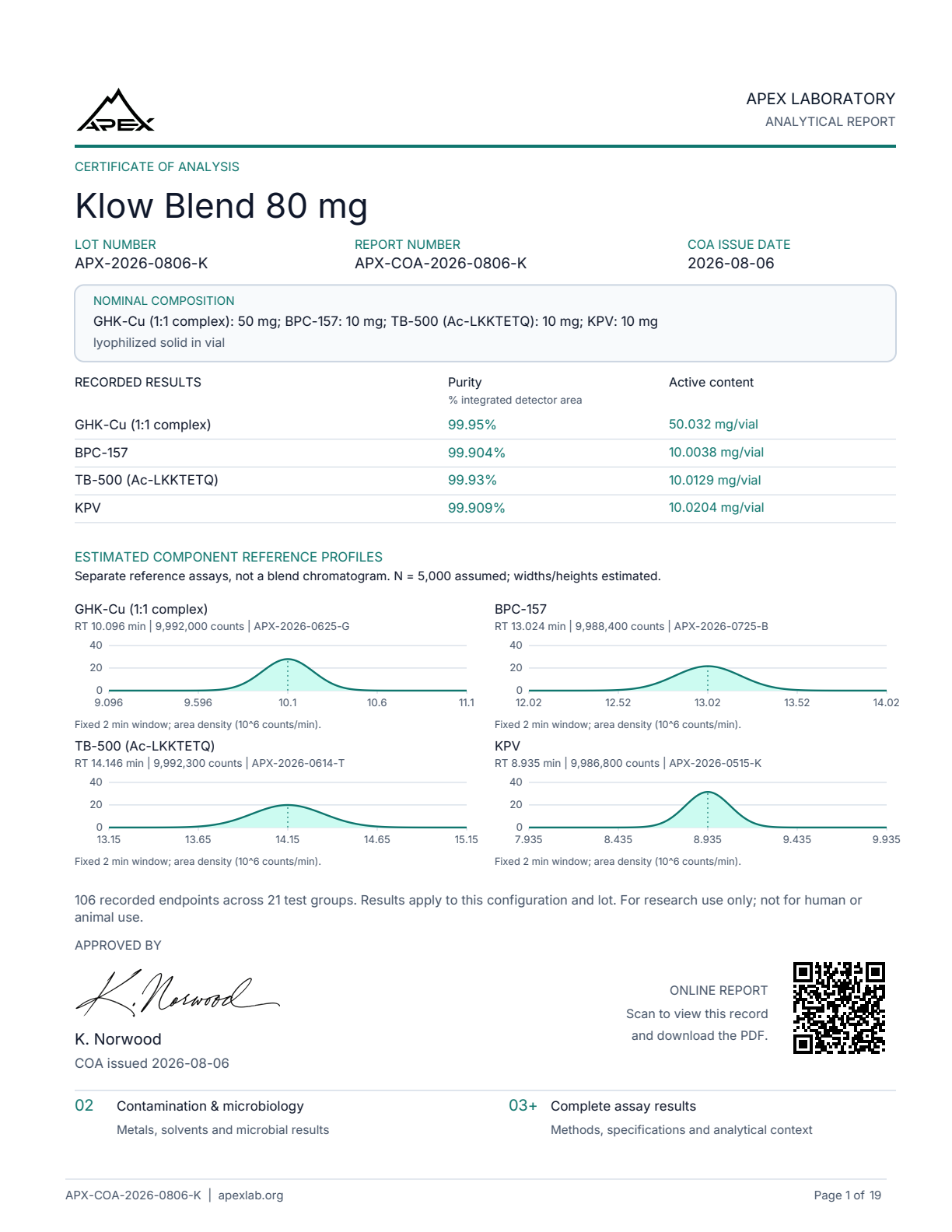
Klow Blend 80 mg
- GHK-Cu (1:1 complex) chromatographic purity
- 99.95 % integrated detector area
- BPC-157 chromatographic purity
- 99.904 % integrated detector area
- GHK-Cu (1:1 complex) active content
- 50.032 mg/vial
- BPC-157 active content
- 10.0038 mg/vial
Chromatographic purity by analyte

About this graph
Recorded scalar results against the stated specification. Each row uses its own labeled scale; purity is detector-area purity, not active-material content.
Measured active content

About this graph
Calibrated active content, concentration or activity compared with the stated same-unit specification. Each row uses its own labeled scale; no conversion from chromatographic purity is made.
KLOW Blend 80mg — Four-Peptide Research Reagent Built Around KPV
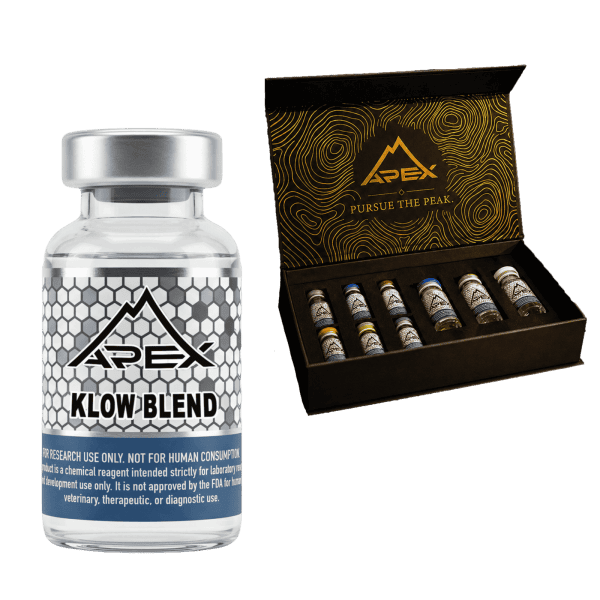
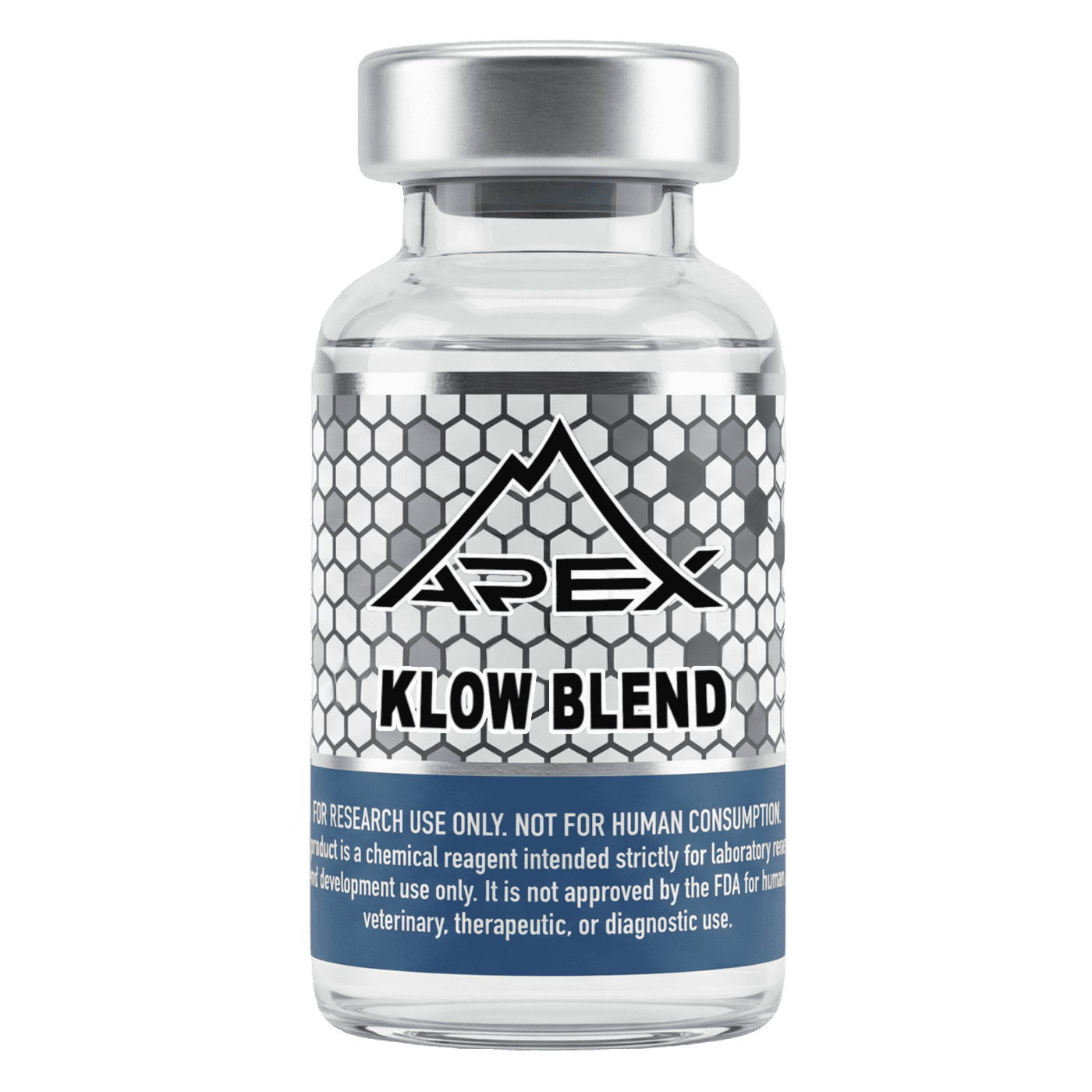
KLOW Blend 80mg contains GHK-Cu 50 mg, BPC-157 10 mg, TB-500 10 mg and KPV 10 mg in one lyophilized research vial. Its label adds 10 mg KPV to the three-component, 70 mg GLOW composition. These are stated component masses, not a molar ratio or a promise of stronger effects. The KLOW composition, KPV and evidence guide explains what the additional component changes and what remains untested. KLOW is supplied for in-vitro laboratory research only.
KPV — The Component That Defines KLOW
KPV is the lysine-proline-valine sequence from the C-terminal region of α-MSH. Published work examines it in specified cell and animal models, including inflammatory-signaling questions. This component literature does not establish an effect for the four-component KLOW mixture. The other components also have overlapping research themes, so the ingredient count should not be presented as a count of independent biological pathways.
Four Components, Separate Evidence Questions
Adding KPV changes the declared composition from three components to four. Whether that combination suits an experiment depends on the question, controls and analytical method. Separate-component studies do not demonstrate compatibility, synergy or a predictable effect for the mixture. A fixed-ratio blend also limits the ability to vary one component while holding the others constant.
The Three Shared Components, In Brief
The shared label composition is GHK-Cu 50 mg, BPC-157 10 mg and TB-500 10 mg. GHK-Cu is a copper-tripeptide complex; BPC-157 has 15 amino acids; the TB-500 identity used here is the acetylated seven-residue fragment Ac-LKKTETQ. The full 43-residue thymosin β4 protein is a different material. Reference masses depend on the assigned species, and the applicable report supplies the identity basis for its measurements.
Identity & Purity Verification
The published KLOW record APX-COA-2026-0806-K identifies Apex Laboratory as the issuer and describes in-house testing for its specified configuration and lot. Inspect the actual identity, chromatographic-purity and active-content results in the panel above or the KLOW analytical report. Component reference runs and a combined-lot measurement answer different questions; a different molecular weight alone does not establish chromatographic separation. The report is not evidence of an independently tested shipping assignment or a biological effect.
Cost & Convenience vs. Buying Components Separately
| Approach | What you get | Price |
|---|---|---|
| GHK-Cu 50 mg | 1 component | $36 |
| BPC-157 10 mg | 1 component | $58 |
| TB-500 10 mg | 1 component | $89 |
| KPV 10 mg | the KLOW differentiator | $49 |
| Four components separately | 4 vials, manual ratio matching | $232 |
| KLOW Blend 80 mg | 1 vial, ratio pre-matched | $155 |
Bought individually the four components total $232 across four vials. KLOW co-formulates them for $155 — about a 33% reduction — in one lot with one Certificate of Analysis. The KPV fraction alone accounts for $49 of the separate-purchase total, which identifies the standalone KPV component in this price comparison.
Reconstitution, Storage & Handling
The published report describes dry, sealed-vial storage at -20 ±5 °C with protection from light. For preparation, select a diluent and container compatible with the validated experiment; a general bacteriostatic-water recommendation cannot establish compatibility or stability for this mixture. The reconstitution calculator provides arithmetic from entered masses and volume. Read the preparation guide and storage guidance alongside the applicable lot record. No universal reconstituted shelf life is established here.
Selecting KLOW for a Research Program
The practical selection question is whether the experimental plan requires KPV together with the three shared components at the stated masses. If components need to be adjusted or tested independently, a fixed-ratio blend imposes constraints. The KLOW, GLOW and BPC-157/TB-500 comparison maps the compositions; it should not be read as a ranking of biological strength.
Documentation & Batch Records
Record the identifier on the received vial and compare it with the configuration and lot named in the analytical record. Retain the report version, issuer, issue date, methods and relevant results with the experiment. If the identifiers do not match, resolve that with Apex before assigning the report to the material. A supplier-issued report provides documentation within its stated scope; it is not automatically an independent laboratory verification or proof of the lot assigned to a new order.
Frequently Asked Questions
What is the single difference between KLOW and GLOW?
The label difference is 10 mg KPV: KLOW lists GHK-Cu 50 mg, BPC-157 10 mg, TB-500 10 mg and KPV 10 mg, while GLOW lists the first three components. The total therefore changes from 70 mg to 80 mg. That compositional difference does not establish a unique fourth pathway or a comparative effect.
When would a researcher pick KLOW instead of GLOW?
When the experimental design calls for all four named components at the declared fixed ratio and has suitable controls and handling procedures. The need to vary KPV separately, or to establish a component-specific effect, may instead call for separate materials.
Is KLOW a stronger version of GLOW?
The label lists the same masses of GHK-Cu, BPC-157 and TB-500 as GLOW and adds KPV. Total dry mass does not determine concentration without a volume, and neither total mass nor an additional component establishes stronger biological effects.
Does the KPV peptide resolve separately on the COA?
Check what the report’s method actually measured. A KPV component-reference chromatogram and a combined-lot chromatogram are different measurements; the mere presence of distinct molecular weights does not prove that all four substances resolved in the same chromatographic run. Read the chromatogram labels, method and result basis together.
How is KLOW reconstituted and stored for research?
Follow the applicable lot documentation and the laboratory’s validated procedure for diluent, container, concentration and storage. The calculator performs concentration arithmetic; it does not validate mixture stability, compatibility or a usable lifetime after reconstitution.
Is KLOW Blend 80mg for human use?
No. It is a research reagent for in-vitro and laboratory use only and is not for human or veterinary consumption.
For in-vitro research use only. Not for human or veterinary consumption. Klow Blend 80mg is intended exclusively for qualified researchers, accredited laboratories, and educational institutions. Purchasers are responsible for safe handling, storage, and compliance with applicable federal, state, local, and institutional requirements governing chemical research reagents.