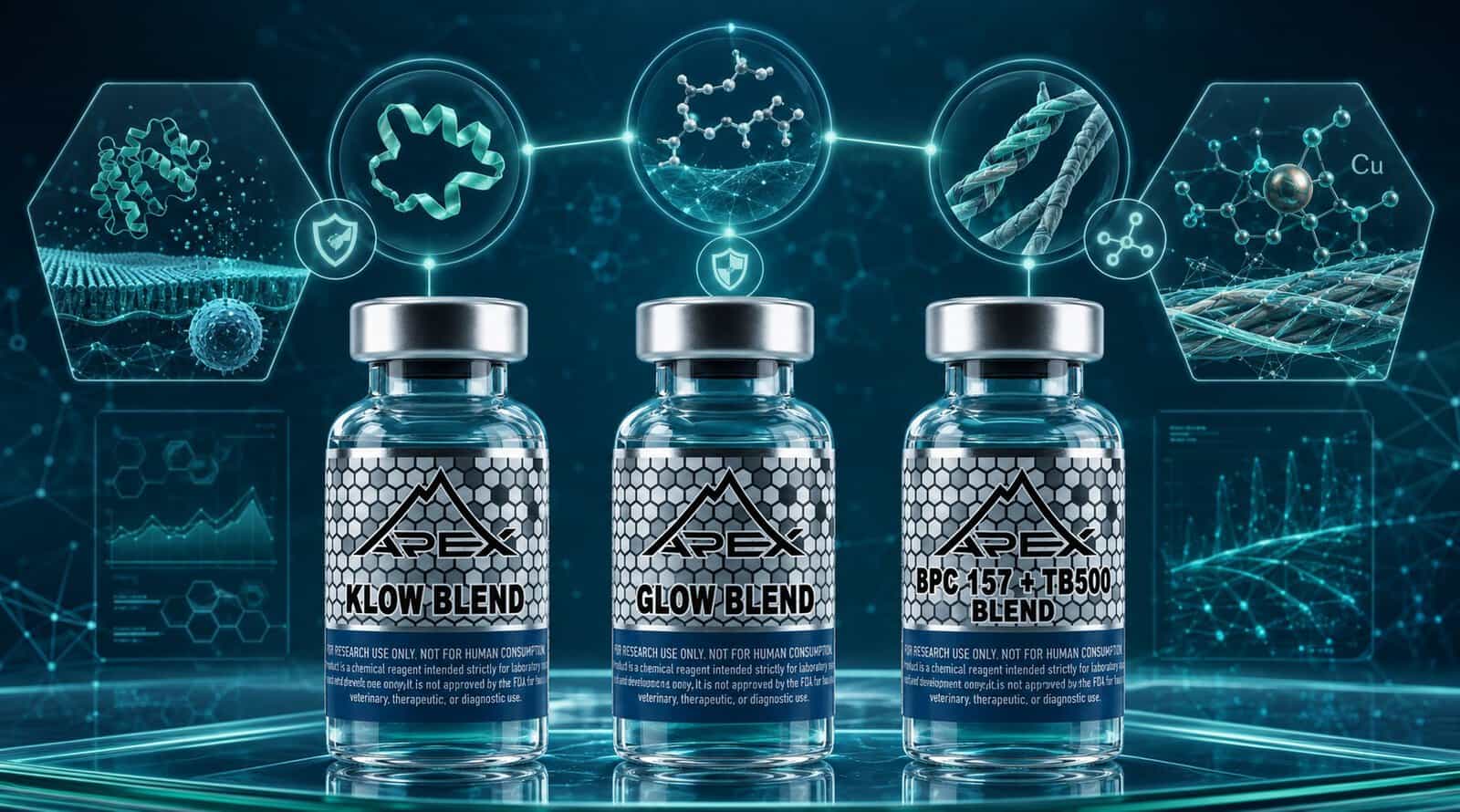
KLOW vs GLOW: the label difference is 10 mg of KPV. GLOW lists GHK-Cu 50 mg, BPC-157 10 mg and TB-500 10 mg, for 70 mg total. KLOW lists those same component amounts plus KPV 10 mg, for 80 mg total. The extra component does not establish stronger effects or a tested benefit for the mixture. The BPC-157/TB-500 Blend is the separate two-component option compared below. All are laboratory research reagents, not products for human or veterinary use.
Dedicated blend guides: this comparison now pairs with full research guides for the KLOW Blend, the GLOW Blend, and the BPC-157/TB-500 Blend.
This comparison separates three decisions: which components a research plan requires, which labeled amounts are supplied, and what the analytical record actually measures. KLOW and GLOW share the same declared masses of GHK-Cu, BPC-157 and TB-500; KLOW adds KPV. The BPC-157/TB-500 Blend contains two of those components in a 1:1 mass ratio. Fixed-ratio blends constrain experiments that need one component varied independently, so component count alone is not a selection rule.
No clinical or controlled-combination studies of these exact KLOW, GLOW, or BPC-157/TB-500 blends were identified in the literature reviewed here. Everything described here is synthesized from separate preclinical, in-vitro, and animal-model studies of the individual components, and those separate studies do not demonstrate activity, compatibility or synergy for the mixture itself. These blends sit within the Apex tissue-repair research peptides cluster and are supplied strictly as research-grade chemical reagents for in-vitro and preclinical investigation — not as drugs, dietary products, or therapies for human or veterinary use.
Three Tissue-Repair Blends at a Glance
- All three list BPC-157 and TB-500; compare the exact configuration because their labeled masses are not identical in every vial.
- The BPC-157/TB-500 Blend is the two-component core (1:1 BPC-157 + TB-500); the catalog lists 10mg (5mg/5mg) and 20mg (10mg/10mg) vials.
- GLOW lists GHK-Cu 50 mg, BPC-157 10 mg and TB-500 10 mg. Separate GHK-Cu studies do not demonstrate those effects for the mixture.
- KLOW adds KPV 10 mg to the same three declared component masses, bringing the labeled total to 80 mg. A label amount is separate from the active-content result for an identified lot, and additional mass does not establish stronger effects.
- Ac-LKKTETQ denotes an acetylated seven-residue fragment of Thymosin β4. Parent-protein actin findings do not establish the fragment’s behavior, and a TB-500 product name does not confirm the construct in a supplied lot.
- No clinical studies of these exact blends were identified in the literature reviewed here; every mechanistic claim here is synthesized from separate per-component preclinical and in-vitro studies, and a supplied blend requires component-resolved analytical evidence. The published Apex in-house COAs now report component-specific results, which must be matched to the identified configuration and received lot; they do not establish clinical effects or independent third-party verification.
BPC-157/TB-500 Blend vs GLOW vs KLOW
Three Tissue-Repair Blends at a Glance: BPC-157/TB-500 vs GLOW vs KLOW
The compositions form a nested ingredient list, with an important amount distinction. The BPC-157/TB-500 Blend lists either 5 mg of each component in a 10 mg vial or 10 mg of each in a 20 mg vial. GLOW lists GHK-Cu 50 mg plus BPC-157 10 mg and TB-500 10 mg. KLOW lists those same masses plus KPV 10 mg. These statements describe labels; they do not establish biological strength, mixture stability or measured content for every lot.
A shared repair core with layered additions
The BPC-157 component anchors a broad cytoprotective and organoprotective profile documented across many preclinical organ systems,[1] while the cited Thymosin β4 literature describes the parent protein’s cell migration, angiogenesis, and survival signaling; it does not authenticate a TB-500 blend component or establish the activity of an acetylated fragment.[2] GLOW’s added GHK-Cu is a copper tripeptide studied for collagen and matrix remodeling,[3] and KLOW’s added KPV is the C-terminal tripeptide of alpha-melanocyte-stimulating hormone (alpha-MSH) studied for NF-κB-modulating anti-inflammatory signaling.[4]
What the product pages publish
The product pages publish the per-component composition of each blend. The BPC-157/TB-500 Blend is a 1:1 pairing (a 10mg vial is 5mg of each). GLOW Blend 70mg is published as GHK-Cu 50mg + BPC-157 10mg + TB-500 10mg, and KLOW Blend 80mg as GHK-Cu 50mg + BPC-157 10mg + TB-500 10mg + KPV 10mg — the same GLOW core with 10mg of KPV added. These are declared formulations; measured component content is a separate result. For example, KLOW lot APX-2026-0806-K, COA issued August 6, 2026, reports GHK-Cu (1:1 complex) active content of 50.032 mg/vial, BPC-157 10.0038 mg/vial, TB-500 (Ac-LKKTETQ) 10.0129 mg/vial and KPV 10.0204 mg/vial. Read the assigned component-material basis, method and specification in the report. These quantities are not inferred from an aggregate HPLC percentage, and the declared GLOW and KLOW formulations are not equal splits. This KLOW result does not establish the composition of another blend or lot.
Composition and Separately Studied Component Literature
The table separates declared ingredients from findings in the individual-component literature. Adding an ingredient does not establish an independent biological pathway, and overlapping research themes do not demonstrate mixture activity. Interpret the mechanism rows as background on the cited study materials, not as measured performance of the blends.
BPC-157/TB-500 Blend vs GLOW Blend vs KLOW Blend — Composition and Separately Studied Component Literature
| Attribute | BPC-157/TB-500 Blend | GLOW Blend 70mg | KLOW Blend 80mg |
|---|---|---|---|
| Components | BPC-157 + TB-500 (2-component) | GHK-Cu 50mg + BPC-157 10mg + TB-500 10mg | GHK-Cu 50mg + BPC-157 10mg + TB-500 10mg + KPV 10mg |
| Stated total | 10mg (5/5) or 20mg (10/10) | 70mg (GHK-Cu 50 / BPC-157 10 / TB-500 10) | 80mg (GHK-Cu 50 / BPC-157 10 / TB-500 10 / KPV 10) |
| Shared declared BPC-157 + TB-500 components | Yes | Yes | Yes |
| Added GHK-Cu component | No | Yes | Yes |
| Added KPV component | No | No | Yes (10 mg declared; the identified KLOW report example above gives its separate measured content) |
| BPC-157 mechanism | Cytoprotection, angiogenic GF modulation, tendon fibroblast migration | Same | Same |
| TB-500 evidence boundary | Parent Tβ4 actin biology and limited motif studies; transfer to the supplied construct is not established | Same | Same |
| GHK-Cu mechanism | Not present | Collagen/GAG synthesis, MMP/TIMP modulation, copper delivery | Same |
| KPV mechanism | Not present | Not present | PepT1 uptake; NF-κB / MAP-kinase inhibition; cytokine reduction |
| Blend-specific clinical data | None (component literature only) | None (component literature only) | None (component literature only) |
| Identity verification | Read the component-specific identity method, result and assigned ion in the applicable lot record | Read the component-specific identity method, result and assigned ion in the applicable lot record | Read the component-specific identity method, result and assigned ion in the applicable lot record |
| Regulatory status | Research reagent; not for human use | Research reagent; not for human use | Research reagent; not for human use |
The repair core: cytoprotection, angiogenesis, and actin-driven migration
BPC-157 and parent Thymosin beta-4 have separate research records; those records do not establish two complementary activities for a supplied blend. BPC-157 contributes cytoprotection and modulation of angiogenic growth-factor pathways — including EGF, FGF, and VEGF-associated signaling reported across tendon, ligament, muscle, and bone healing models.[5] The cited actin/profilin findings concern Thymosin β4; they do not establish that Ac-LKKTETQ or a supplied blend reproduces the parent protein’s behavior.[6] These separate literature lanes motivate research questions; they do not demonstrate the behavior of the declared two-component core or any of the mixtures.
GHK-Cu literature relevant to the additional GLOW component
GLOW includes GHK-Cu; its separate literature discusses copper-dependent extracellular-matrix biology. In fibroblast culture and gene-expression studies, GHK-Cu is associated with collagen and glycosaminoglycan synthesis and with modulation of the matrix-metalloproteinase / tissue-inhibitor (MMP/TIMP) balance.[3] These component studies do not establish a unique biological pathway for GLOW or prove that other components lack overlapping mechanisms.
KPV literature relevant to the additional KLOW component
KLOW differs compositionally by including KPV, whose separate studies examine inflammatory signaling. In intestinal research models KPV is taken up via the PepT1 transporter and is associated with inhibition of NF-κB and MAP-kinase pathways and reduced pro-inflammatory cytokine output.[7] This is a map of separate component-study questions. The reviewed evidence does not establish which pathways a supplied mixture affects or whether its components interact synergistically.
BPC-157: Cytoprotection, Angiogenesis and Tendon Repair (Shared Core Component)
BPC-157 is the gastric pentadecapeptide listed in all three blends. Its separate literature does not establish effects for every formulation containing it. It is a 15-residue peptide (Gly-Glu-Pro-Pro-Pro-Gly-Lys-Pro-Ala-Asp-Asp-Ala-Gly-Leu-Val) described as a partial sequence derived from a protein, BPC, found in human gastric juice.
A pleiotropic cytoprotective and organoprotective profile
The defining characterization of BPC-157 in the literature is breadth: it is described as a stable gastric pentadecapeptide with cytoprotective and organoprotective activity reported across multiple organ systems.[1] That pleiotropy is part of why it serves as a repair-core anchor — it is not narrowly tissue-specific in the preclinical record. For the full single-component treatment, see the Apex BPC-157 research guide.
Angiogenic growth-factor modulation
A recurring mechanistic theme is angiogenesis. A comparative analysis against standard angiogenic growth factors framed BPC-157’s healing actions across the gastrointestinal tract and across tendon, ligament, muscle, and bone in relation to EGF, FGF, and VEGF biology, reporting modulation of these angiogenic growth-factor pathways during healing in preclinical models.[5] This angiogenic-modulation theme recurs throughout the broad cytoprotective profile described above.[1]
Tendon, ligament, muscle, and bone healing context
The same growth-factor comparison drew its ‘lessons’ explicitly from tendon, ligament, muscle, and bone healing, tying BPC-157’s connective-tissue repair context to its angiogenic and cytoprotective actions across these tissues.[5] These findings are entirely from cell-culture and animal models and are reported here as research context, not as evidence of clinical effect.
TB-500 and Thymosin Beta-4: The LKKTETQ Actin-Binding Motif (Shared Core Component)
TB-500 is named as a component in the declared blends, but the product name alone does not establish its chemical construct. Ac-Leu-Lys-Lys-Thr-Glu-Thr-Gln (Ac-LKKTETQ) denotes an acetylated seven-residue peptide corresponding to a motif within the 43-residue Thymosin β4 (Tβ4) sequence. Full-length Tβ4, a synthetic seven-residue motif, and the acetylated fragment must remain separate when reading experimental results. Confirm the supplied sequence, terminal modification and tested sample from original documentation before matching an Apex lot to any of those records.
Thymosin β4 as a multifunctional regenerative peptide
The parent protein is characterized as a multifunctional regenerative peptide that promotes cell migration, angiogenesis, survival, and progenitor-cell mobilization.[2] A structure-function review catalogs this mechanistic breadth — cell migration, angiogenesis, survival, stem-cell differentiation, and cytokine modulation — as the basis for its tissue-repair interest.[8] For the dedicated single-component treatment, see the Apex TB-500 research guide.
Actin sequestration: the 1:1 G-actin complex
The following actin biochemistry concerns Tβ4; it does not establish the behavior of an isolated acetylated seven-residue fragment. Tβ4 is the principal intracellular regulator of the monomeric G-actin pool, classically described as binding G-actin in a 1:1 complex and buffering the supply of polymerizable actin.[2][8] The behavior is more nuanced than simple sequestration, however: Tβ4 also participates in higher-order complexes — for example with profilin — so its regulation of the actin monomer pool is not a strictly isolated 1:1 reaction.[6] These parent-protein findings do not show that Ac-LKKTETQ has the same actin-binding behavior or that a commercial blend reproduces it.
The actin-binding site, migration, and angiogenesis
Fragment and parent-protein experiments must be distinguished. Philp and colleagues tested a synthetic seven-amino-acid motif in endothelial-cell migration and aortic-sprouting models,[9] and earlier work showed that the parent Tβ4 stimulates directional migration of human endothelial cells in vitro.[10]
Survival signaling: integrin-linked kinase and Akt
Beyond actin, Tβ4 has a documented survival-signaling arm. In a preclinical cardiac-repair study, Tβ4 formed a complex with PINCH and integrin-linked kinase, activating Akt to promote cell migration and survival.[11] These ILK/Akt results concern Tβ4 and cannot be assigned to Ac-LKKTETQ or to a commercial blend. The separate seven-residue motif study above has a narrower experimental scope and does not establish N-acetylated-fragment equivalence or an Apex lot’s identity.
GHK-Cu: ECM Remodeling, Collagen and Copper Delivery (GLOW’s Additional Component)
GHK-Cu is the component that distinguishes GLOW from the bare repair core, and its separate research profile does not establish additional effects for GLOW. A point of identity precision is essential here: GHK-Cu is the copper(II) complex of the tripeptide glycyl-L-histidyl-L-lysine (Gly-His-Lys), and its copper-complex CAS number is 89030-95-5. The free GHK peptide base carries a different CAS number, 49557-75-7; the two are commonly conflated but are distinct chemical entities, and a COA should make clear which form it describes.
Collagen and extracellular-matrix synthesis
The foundational mechanistic observation for GHK-Cu is collagen stimulation. An early in-vitro study reported that the GHK-Cu complex stimulated collagen synthesis in cultured fibroblasts at picomolar-to-nanomolar concentrations,[12] describing a finding for GHK-Cu in that cell-culture model, not an established effect of GLOW. Broader reviews extend this to elastin and glycosaminoglycan synthesis and to modulation of the MMP/TIMP balance that governs matrix turnover.[3]
Gene-level remodeling and copper delivery
The GHK/GHK-Cu literature includes gene-expression analyses and cell-model findings involving tissue remodeling, antioxidant responses, DNA repair and inflammatory signaling. The exact peptide or copper-complex form must be checked in each underlying study.[13] The review discusses both GHK and its copper complex; its title does not establish that every gene-expression experiment used GHK-Cu. Match the actual study material and model before comparing a result with a cataloged reagent or blend. For the dedicated single-component treatment, see the Apex GHK-Cu research guide, and for an adjacent two-way contrast see BPC-157 vs GHK-Cu. These are in-vitro and gene-data findings reported as research context only.
KPV: Separate Inflammatory-Signaling Research on KLOW’s Additional Component
KPV is the additional declared component that distinguishes KLOW from GLOW. Its separate research profile does not establish additional effects for the mixture. KPV is the tripeptide lysine-proline-valine (Lys-Pro-Val, CAS 67727-97-3), corresponding to the C-terminal fragment — residues 11 to 13 — of alpha-melanocyte-stimulating hormone (alpha-MSH). Its separate research includes inflammatory-signaling models. That does not establish a fourth independent pathway or an anti-inflammatory effect for KLOW.
Component literature map: BPC-157/TB-500, added GHK-Cu in GLOW, and added KPV in KLOW
These three blends differ by their declared composition. The diagram organizes separate component literature; it does not show experimentally demonstrated pathways for the mixtures. The declared BPC-157/TB-500 core brings together names associated with separate research lanes. BPC-157 cytoprotection and angiogenic growth-factor findings do not establish blend activity; parent Thymosin β4 actin findings cannot be assigned to the acetylated LKKTETQ fragment or an unverified supplied construct. GLOW adds GHK-Cu, a copper tripeptide associated with collagen synthesis and MMP/TIMP-regulated extracellular-matrix remodeling. KLOW adds KPV, the alpha-MSH C-terminal tripeptide taken up via PepT1 and associated with NF-κB and MAP-kinase inhibition. No study of these exact blends was identified in the literature reviewed here; the diagram summarizes component literature only. Dalmasso et al. (2008), Gastroenterology.
PepT1-mediated uptake and NF-κB inhibition
The cornerstone mechanistic finding is gut-focused: in intestinal epithelial and immune cell models, KPV is taken up through the di/tripeptide transporter PepT1 and reduces DSS- and TNBS-induced colitis with decreased pro-inflammatory cytokine output in mice.[7] A later murine model reinforced that PepT1-mediated KPV reduced intestinal inflammation and associated colitis-driven tumorigenesis.[14]
The alpha-MSH C-terminal anti-inflammatory motif
A comprehensive review of alpha-MSH and its related tripeptides situates KPV as the C-terminal anti-inflammatory fragment whose protective effects are linked to NF-κB inhibition.[4] The parent hormone’s broader immunomodulatory behavior — including effects on chemokine-receptor signaling and inflammatory cell responses — provides context for the separate alpha-MSH literature; it does not establish those responses for KLOW.[15] For the dedicated single-component treatment, see the Apex KPV peptide research guide.
Antimicrobial activity beyond inflammation
KPV’s melanocortin-fragment activity extends beyond NF-κB signaling. Both alpha-MSH(1–13) and its C-terminal KPV tripeptide were reported to exert antimicrobial activity in vitro against Staphylococcus aureus and Candida albicans.[16] This breadth illustrates the range of research questions the component has been used to probe; it is not a basis for any application claim, and all findings derive from cell and animal systems.
Shared and Overlapping Mechanisms Across Components
Several components have overlapping research themes in the literature. Such overlap does not show that a blend covers more pathways, that effects add together or that the combination is synergistic. Interpret each finding against the actual material, model and controls used in its study.
Cell migration as a convergence point
Cell migration appears in several separate literature lanes. The cited study reports directional migration with the parent Tβ4, not an authenticated TB-500 blend component,[10] the BPC-157 repair-core component contributes its own cytoprotective and angiogenic-modulation activity across healing tissues,[5] and the migration machinery itself depends on matrix remodeling.
MMP-dependent migration and ECM turnover
The matrix-remodeling overlap is concrete. Tβ4 promotion of epithelial cell migration was reported to require matrix-metalloproteinase (MMP) activity,[17] and GHK-Cu independently modulates the MMP/TIMP balance that governs ECM turnover.[3] These studies share an MMP-related topic at the parent Tβ4 and GHK-Cu literature level; they do not establish an Ac-LKKTETQ mechanism or a combined blend effect.
Converging anti-inflammatory NF-κB suppression
A second convergence appears in anti-inflammatory signaling. KPV acts through an NF-κB-linked mechanism,[4] while Tβ4 has separately been reported to promote wound healing with documented anti-inflammatory activity in corneal wound-healing models.[18] These are separately studied Tβ4 and KPV findings. They do not establish anti-inflammatory activity for Ac-LKKTETQ or for any of the three mixtures. This comparison organizes separate studies; it does not establish combined effects for the blends.
Research-Only Combined-Pathway In-Vitro Use Cases
A fixed-ratio blend can be evaluated when an experiment specifically requires that declared combination. It also limits the ability to vary one component independently, and any observed response needs appropriate component and vehicle controls. Fewer vials do not establish experimental efficiency, compatibility or simultaneous activity across the mechanisms discussed in separate studies.
Interrogating multiple repair axes in one system
Separate literature lanes include cytoprotection and angiogenic signaling (BPC-157),[5] migration and ECM-related repair (parent Tβ4; not established here for Ac-LKKTETQ),[19] copper-dependent matrix remodeling (GHK-Cu in GLOW and KLOW),[3] and anti-inflammatory melanocortin signaling (KPV in KLOW)[7]. These separate findings can motivate hypotheses, but do not establish that a multi-component vial produces those effects together.
An important interpretive caveat
This use-case framing is strictly about research utility. It is not a dosing recommendation, not a therapeutic protocol, and not a claim that the components act synergistically — the individual-component data summarized above cannot establish how the peptides behave in combination, and no study of these exact blends was identified in the literature reviewed here. Any experiment with a blend must control for the confound that observed effects could arise from any single component or from interactions that the component literature simply does not address.
Multi-Component Reconstitution Considerations
Use the peptide reconstitution calculator for concentration arithmetic from the entered mass and final volume. For a blend, calculate each component from its own stated mass; arithmetic does not establish solvent compatibility or prepared stability.
Multi-peptide vials introduce reconstitution considerations that single-component vials do not. The central one is that the per-component amounts are not something to assume — they are stated on the product page or lot COA, and concentration math depends on them.
Concentration math when component splits are per-COA
For the BPC-157/TB-500 Blend, the catalog 1:1 ratio makes per-component concentration straightforward (a 10mg vial yields 5mg of each). For the 70mg GLOW and 80mg KLOW vials, the published composition gives the per-component amounts directly — GLOW is GHK-Cu 50mg + BPC-157 10mg + TB-500 10mg, and KLOW is that same set plus KPV 10mg — which researchers should still confirm against the lot COA before calculating working concentrations. Assuming equal thirds or quarters is exactly the error this guide cautions against.
Solvent selection and differing component solubilities
Components can also differ in their handling profiles — for example, a copper complex such as GHK-Cu and a short hydrophilic tripeptide such as KPV need not behave identically in every solvent. A single reconstitution solvent has to be compatible with all components in the vial, which is a constraint worth confirming against per-component guidance. General procedure is covered in the Apex guides on how to reconstitute peptides and the peptide storage guide; specifics should always be verified per product page and lot COA. Nothing in this section is a human dosing or administration instruction — it concerns in-vitro reagent preparation only.
COA and Identity Verification for Multi-Peptide Vials
For any blend, knowing exactly what is in the vial is what makes an experiment interpretable — and multi-peptide vials make that verification harder, not easier. The key technical point is that a single chromatographic peak cannot confirm a three- or four-component blend.
Why one peak cannot confirm a multi-component blend
Reversed-phase HPLC separates species under the conditions of a particular method; components can co-elute. A single peak does not by itself establish the identity, purity or quantity of every component. Interpretation depends on demonstrated separation and selectivity, appropriate supporting measurements, and an explicit mass or ion assignment. Quantitative content needs a suitable method with stated units; it cannot be read directly from an aggregate peak-area percentage. The specificity discussion in ICH Q2(R2), section 3.1.1, explains the need to distinguish analytes and use supporting procedures where one method is insufficient. These are interpretation principles, not evidence that an Apex lot or method has been validated.
Per-component analytical documentation per lot
A useful blend evidence package identifies each component and separates identity, chromatographic area and quantitative content. Original methods and results must explain the measured species, separation and amount for each analyte, with units and a documented sample-to-lot-to-configuration match. A single aggregate percentage or a supplier-issued summary cannot establish all of those properties. Background on interpreting these documents is available in the Apex primer on how to read a peptide COA; researchers should review the lot-specific COA rather than rely on a generic specification.
Choosing a Blend for a Defined Research Question
Start with the components and controls required by the experiment. If the design calls for KPV together with the three GLOW components at the listed fixed masses, KLOW is the four-component formulation to evaluate. If the design excludes KPV, GLOW has the three-component composition. If the question requires changing KPV while holding other components constant, a fixed blend cannot provide that control on its own. Confirm identity and analytical documentation before treating a label as evidence about the material.
Matching the blend to the research question
The BPC-157/TB-500 Blend is the declared two-component formulation. BPC-157 preclinical literature can inform a model-specific hypothesis, while the TB-500 construct must be matched to its own evidence before parent Tβ4 findings are applied.[5] GLOW includes GHK-Cu, whose separate matrix-biology studies can inform a component-specific hypothesis.[3] KLOW also includes KPV, whose separate inflammatory-signaling studies can inform another hypothesis; the mixture still requires its own controls.[7]
What this selection framework is not
This framework compares declared composition and separate component literature; it does not rank experimental effectiveness. The literature reviewed here did not identify clinical studies of these exact mixtures, head-to-head blend comparisons, or controlled comparisons against their individual components. Comparing declared composition can inform a research-design hypothesis, subject to verifying the supplied material and its documentation; it is not a performance claim. Researchers may also find the broader research library useful for the underlying single-component literature.
Sourcing Research-Grade Tissue-Repair Blends
For any blend experiment, reproducibility depends on knowing exactly what is in the vial — and for multi-peptide reagents that means per-component analytical documentation, not a single label claim. Because none of these blends has published combination data, the integrity of the per-component identity and purity record is what supports interpretable research.
Per-component HPLC purity and ESI-MS identity verification
Apex lists these blends as research-grade chemical reagents and publishes configuration-specific in-house COAs through the COA Library. The reports present component-specific identity, purity and active-content fields with methods and acceptance criteria. Use the KLOW 80 mg report for lot APX-2026-0806-K as an example of how those fields differ. Match the official lot and configuration to the received label; a published report does not identify the current shipping lot by itself. The reports are not independent third-party verification, raw instrument traces or evidence that the blend produces the effects of its individual components.
Research-use-only designation and component reagents
All three blends — and every component within them — are sold strictly for in-vitro and preclinical laboratory research and are not for human or veterinary use. A research-use designation and component studies do not establish an approved therapeutic indication or finished-drug equivalence for a supplied blend. The Apex editorial standards document how each guide is sourced and reviewed. Researchers assembling a tissue-repair panel often pair the blends with their single-component counterparts; the items below are available as research reagents.
Tissue-Repair Research Blends and Component Reagents
KLOW Blend 80mg
Four-component research blend: GHK-Cu 50 mg + BPC-157 10 mg + TB-500 10 mg + KPV 10 mg. Compare the declared masses and the applicable analytical record.
View ProductGLOW Blend 70mg
Three-component research blend: GHK-Cu 50 mg + BPC-157 10 mg + TB-500 10 mg, without KPV. Check the configuration and lot record.
View ProductBPC-157/TB-500 Blend
Two-component 1:1 repair-core research blend (BPC-157 + TB-500); 10mg and 20mg vials.
View ProductFrequently Asked Questions
What is the difference between KLOW, GLOW, and the BPC-157/TB-500 Blend?
All three share a declared BPC-157 + TB-500 core. The BPC-157/TB-500 Blend is the two-component formulation. GLOW adds GHK-Cu, whose separate research includes collagen and extracellular-matrix biology (Pickart 2015). KLOW adds KPV, whose separate research includes inflammatory signaling (Brzoska 2008). The published compositions are GLOW Blend 70mg = GHK-Cu 50mg + BPC-157 10mg + TB-500 10mg, and KLOW Blend 80mg = that same core plus KPV 10mg. These are declared amounts; measured component content requires an original quantitative report and a sample-to-lot-to-configuration match. The component literature does not demonstrate effects of these mixtures. All three are research-grade chemical reagents for in-vitro and preclinical research only.
Is there clinical research on these specific blends?
No clinical or controlled-combination studies of these exact KLOW, GLOW, or BPC-157/TB-500 blends were identified in the literature reviewed here. The reviewed evidence includes separate preclinical, in-vitro and animal-model studies. Parent proteins, fragments and actual supplied materials require separate identity matching before a result is transferred. Those records do not establish the efficacy, safety or therapeutic authorization of an Apex blend.
What does TB-500’s LKKTETQ motif do?
The evidence depends on the exact construct. Intact Thymosin beta-4 has actin-binding and profilin-related biochemistry described in the parent-protein literature (Goldstein 2012; Crockford 2010; Yarmola 2007). Philp 2003 also tested a synthetic seven-amino-acid motif in endothelial-cell migration and aortic-sprouting models. That limited motif finding does not establish equivalence to N-acetylated Ac-LKKTETQ, reproduce all parent-protein functions, or identify the material in an Apex blend. Match the original study material and the supplied sequence, terminal chemistry and sample record before transferring a result.
Why does GLOW include GHK-Cu and what does it add?
GLOW adds 50 mg of GHK-Cu to its declared BPC-157 and TB-500 amounts. GHK-Cu is the copper complex of glycyl-L-histidyl-L-lysine. Separate fibroblast and gene-expression studies discuss collagen, matrix remodeling and copper-related biology (Maquart 1988; Pickart 2018). Those findings concern the studied material and model; they do not demonstrate the same effects for GLOW.
What does KPV add in the KLOW blend?
KLOW adds 10 mg of KPV to the same declared component masses listed for GLOW. KPV is Lys-Pro-Val, the C-terminal tripeptide of alpha-MSH. Dalmasso 2008 examined PepT1-related uptake and inflammatory outcomes in specified cell and mouse models. That component evidence does not establish an anti-inflammatory effect for KLOW or show that KLOW is stronger than GLOW.
Should I use the copper-complex CAS or the free GHK CAS for GHK-Cu?
For the copper complex (GHK-Cu) use CAS 89030-95-5. The free GHK peptide base has a different CAS (49557-75-7); the two are commonly conflated but are distinct chemical entities, so verify which form a COA describes. The cited GHK-Cu studies concern the copper complex and their stated experimental models; they do not establish collagen or matrix-remodeling activity for GLOW.
How is identity confirmed in a multi-peptide vial?
Identity assessment requires component-resolved evidence. The original method and report must distinguish the expected analytes and explain the measured mass or ion assignments; quantitative content requires its own method and units. A single chromatographic peak or aggregate peak-area percentage cannot establish the identity and amount of every component. Match the tested sample to the actual lot and selected configuration. The published Apex in-house COAs report component-specific fields, but their interpretation still requires the stated method and a match to the identified configuration and received lot. They are not independent third-party verification.
How are multi-component blends reconstituted for research?
Use a validated procedure specific to the supplied material and assay. Calculate each component from its stated mass and the final solution volume rather than assuming equal ratios. This arithmetic does not establish solvent compatibility or prepared-solution stability; those require evidence for the actual formulation and conditions. Check the applicable lot documentation and laboratory procedure. This is not a human dosing or administration instruction.
Continue Your Research
Researchers building broader context across the Apex Research Library may find the following references useful:
- Tissue Repair Research Peptides — the cluster hub situating these blends among tissue-repair and anti-inflammatory reagents
- BPC-157 Research Guide — the gastric pentadecapeptide that anchors the shared repair core of all three blends
- TB-500 Research Guide — fragment identity, parent Thymosin beta-4 literature, and material-matching limits
- GHK-Cu Research Guide — the copper tripeptide listed in GLOW and KLOW, with its separate research evidence and limitations
- KPV Peptide Research Guide — the alpha-MSH C-terminal anti-inflammatory tripeptide that KLOW adds to the GLOW core
- BPC-157 vs GHK-Cu — an adjacent two-way comparison of two tissue-repair reagents across mechanism
- How to Reconstitute Peptides — general protocol relevant to preparing multi-component lyophilized blends for in-vitro work
- How to Read a Peptide Certificate of Analysis — interpreting per-component HPLC purity and ESI-MS identity data on a multi-peptide lot COA
Research Use Disclaimer
All KLOW, GLOW, and BPC-157/TB-500 Blend products and the information in this guide are intended strictly for in-vitro and preclinical laboratory research. These blends are research-grade chemical reagents and are not drugs, dietary supplements, or therapeutic products. The scientific sources discussed here do not establish an approved indication or finished-drug authorization for an Apex blend. They are not for human or veterinary consumption, diagnosis, treatment, or any clinical use. No clinical studies of these exact blends were identified in the literature reviewed here; every mechanistic statement here is synthesized from separate per-component cell-culture and animal-model studies and is presented for research context only — it does not constitute therapeutic, efficacy, or safety claims, and no combination synergy is demonstrated. Researchers are responsible for compliance with all applicable institutional, local, and national regulations governing the acquisition, handling, and use of research chemicals.