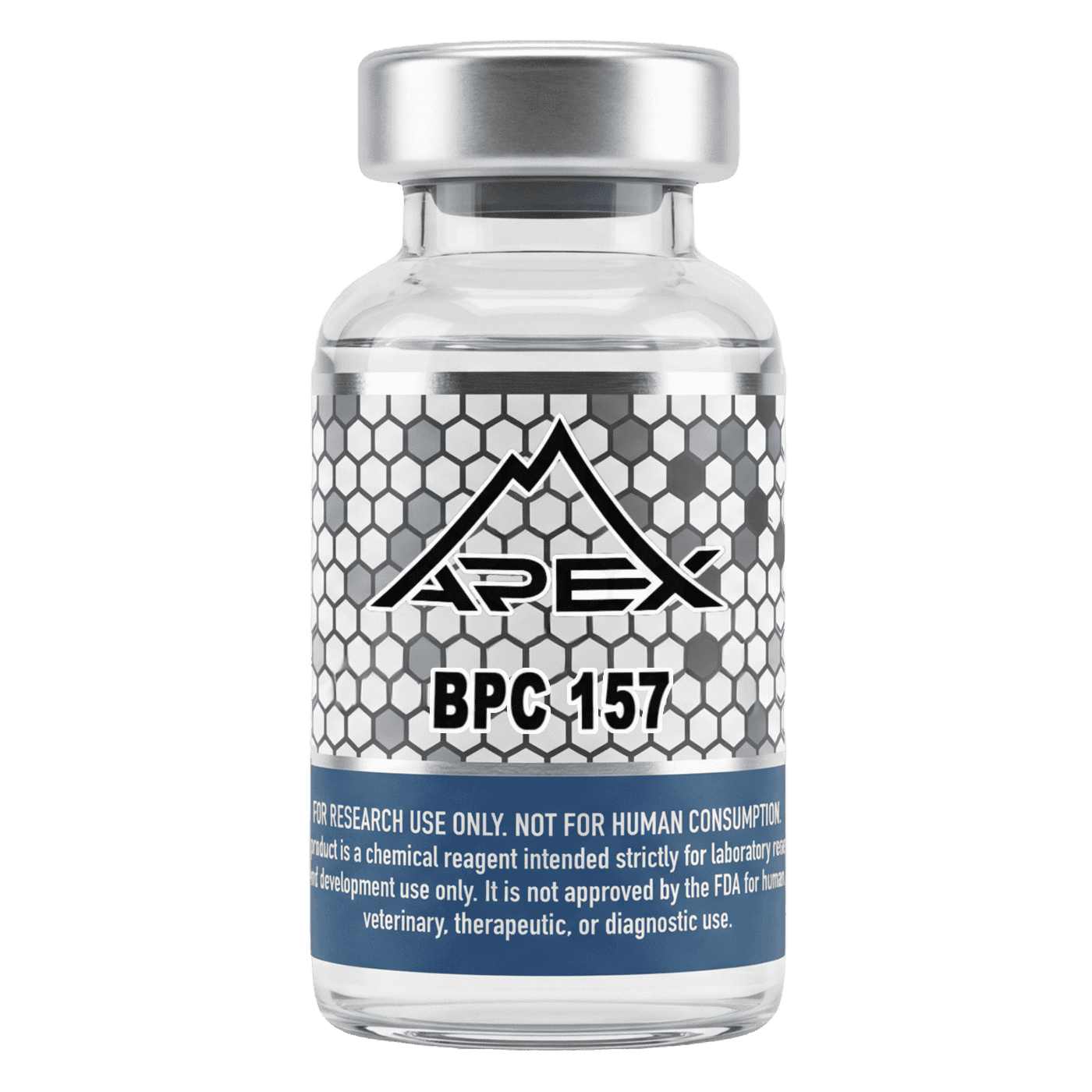
Batch documentation
Certificate of analysis
Apex Laboratory results for the listed configurations. Match the lot on your label with the report.
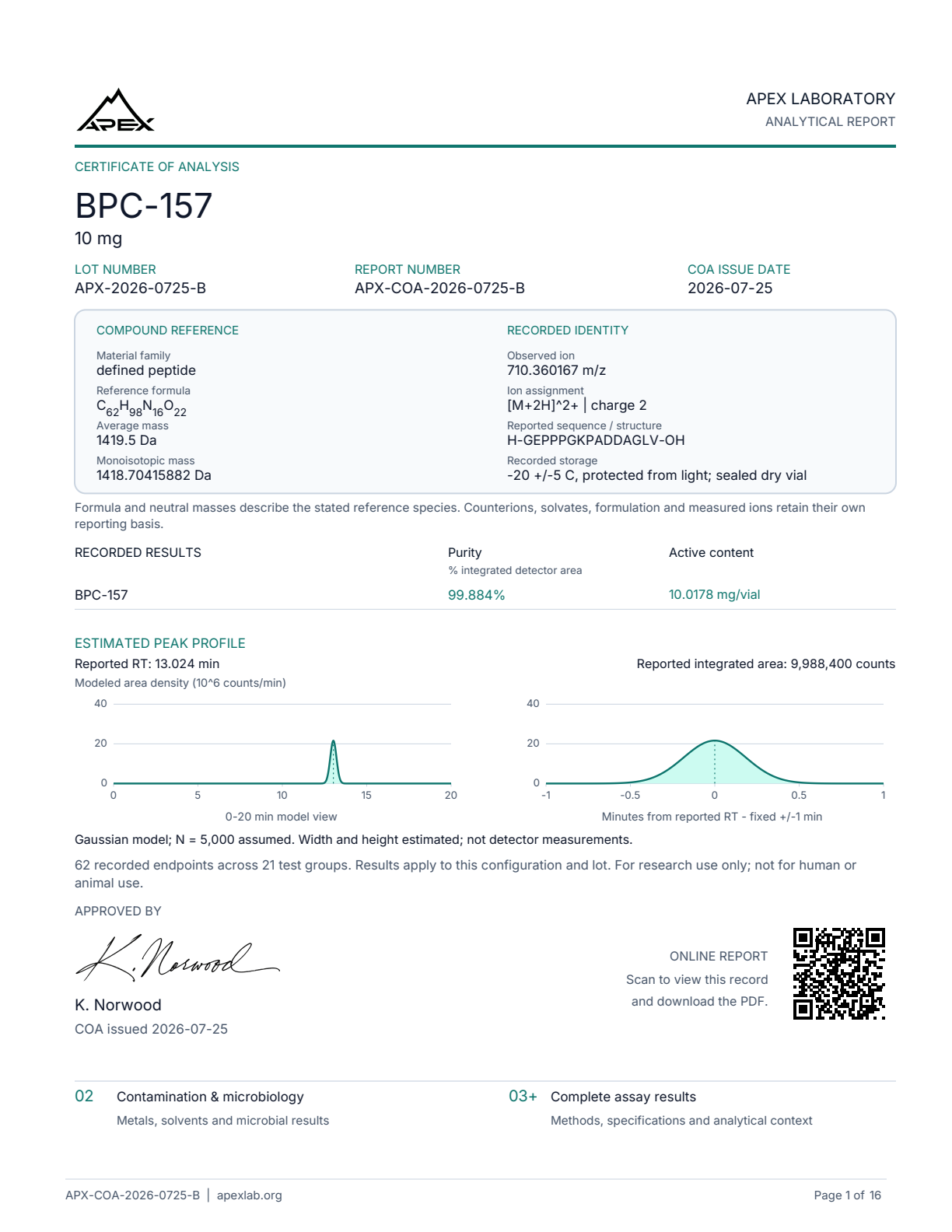
BPC-157 - 10 mg
- BPC-157 chromatographic purity
- 99.884 % integrated detector area
- BPC-157 active content
- 10.0178 mg/vial
- Bacterial endotoxins
- <0.025 EU/mg active-equivalent
- Sterility: FTM
- No growth at 14 days in all 20 units
Chromatographic purity by analyte

About this graph
Recorded scalar results against the stated specification. Each row uses its own labeled scale; purity is detector-area purity, not active-material content.
Measured active content

About this graph
Calibrated active content, concentration or activity compared with the stated same-unit specification. Each row uses its own labeled scale; no conversion from chromatographic purity is made.
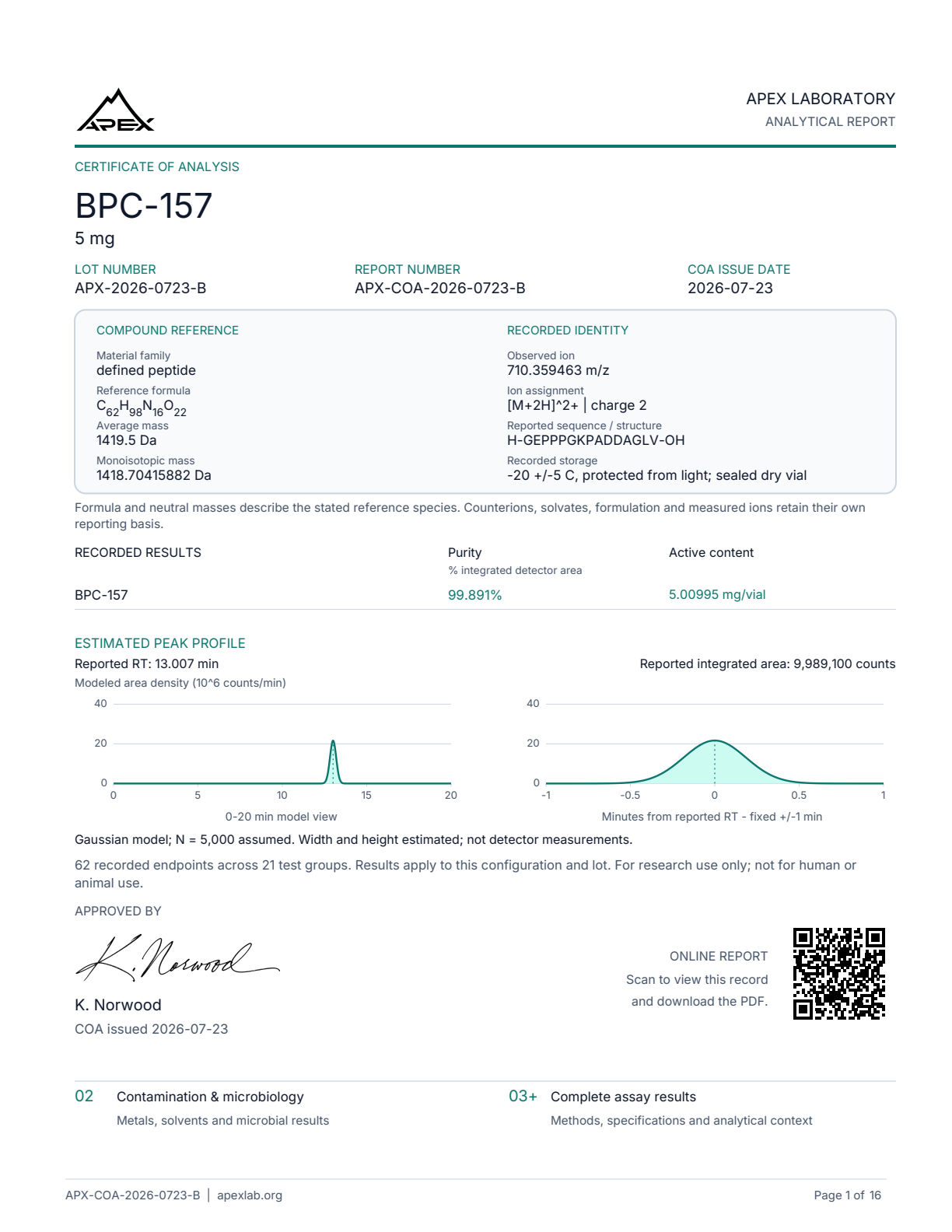
BPC-157 - 5 mg
- BPC-157 chromatographic purity
- 99.891 % integrated detector area
- BPC-157 active content
- 5.00995 mg/vial
- Bacterial endotoxins
- <0.025 EU/mg active-equivalent
- Sterility: FTM
- No growth at 14 days in all 20 units
Chromatographic purity by analyte

About this graph
Recorded scalar results against the stated specification. Each row uses its own labeled scale; purity is detector-area purity, not active-material content.
Measured active content

About this graph
Calibrated active content, concentration or activity compared with the stated same-unit specification. Each row uses its own labeled scale; no conversion from chromatographic purity is made.
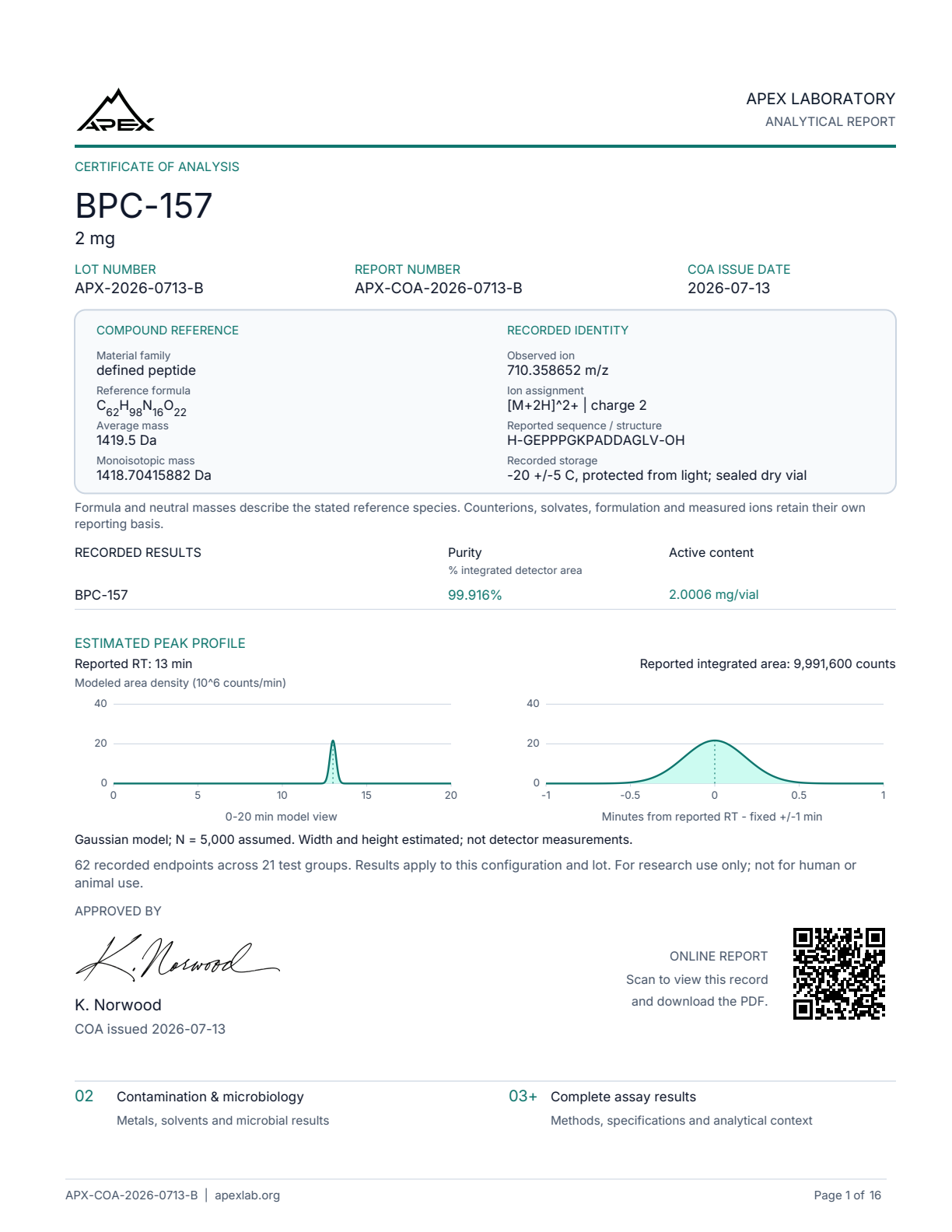
BPC-157 - 2 mg
- BPC-157 chromatographic purity
- 99.916 % integrated detector area
- BPC-157 active content
- 2.0006 mg/vial
- Bacterial endotoxins
- <0.025 EU/mg active-equivalent
- Sterility: FTM
- No growth at 14 days in all 20 units
Chromatographic purity by analyte

About this graph
Recorded scalar results against the stated specification. Each row uses its own labeled scale; purity is detector-area purity, not active-material content.
Measured active content

About this graph
Calibrated active content, concentration or activity compared with the stated same-unit specification. Each row uses its own labeled scale; no conversion from chromatographic purity is made.
BPC-157 is a gastric pentadecapeptide supplied by Apex Laboratory as a high-purity research peptide intended strictly for in-vitro laboratory research and development applications.
Compound Overview
BPC-157 is a synthetic 15-amino-acid peptide discussed in gastric-peptide research. Published work has examined vascular, connective-tissue and gastrointestinal experimental models. The BPC-157 guide to research and human evidence separates these findings from the much smaller human evidence base.
The 15-residue sequence is Gly-Glu-Pro-Pro-Pro-Gly-Lys-Pro-Ala-Asp-Asp-Ala-Gly-Leu-Val (GEPPPGKPADDAGLV). A sequence identifies the peptide chain; material form, analytical specifications and the applicable report still need to be matched to the research material being selected.
A chromatographic retention time belongs to the method used for that run. Review the stated column, mobile phase and conditions before comparing traces. Peak timing or shape alone does not identify BPC-157 or establish that a different sample has the same composition.
Research Background & Published Literature
The references below are specific preclinical examples. They do not establish a human treatment benefit or results for a different formulation.
- Chang and colleagues (2011): tendon outgrowth, cell survival and migration experiments
- Hsieh and colleagues (2017): VEGFR2-related findings in defined experimental systems
Mechanism findings depend on the experimental system. The Hsieh paper reports VEGFR2-related observations; separate tendon experiments examine cell outgrowth, migration and survival. A change in a signaling pathway is an experimental finding, not a demonstrated clinical outcome.
The learning guide also examines negative or nonsignificant results, the small human reports and study-design limits. Cell, animal, isolated-human-tissue and clinical observations answer different questions and should remain distinct when evaluating a research claim.
Technical Specifications
- Product Name: BPC-157
- Classification: Gastric Pentadecapeptide
- Structural Description: Synthetic 15-amino-acid peptide, GEPPPGKPADDAGLV
- CAS Number: 137525-51-0
- Molecular Weight: 1419.53 g/mol
- Analytical Documentation: See the applicable report in the batch verification panel for the stated purity result, identity testing and methods.
- Physical Form: Lyophilized (freeze-dried) powder
- Intended Use: In-vitro research use only — not for human consumption
Storage, Handling & Stability Guidelines
Use the applicable material documentation and your laboratory’s validated handling procedures. A compound name or peptide length alone does not establish a universal storage temperature or reconstituted shelf life. The peptide storage guide explains the variables that affect laboratory handling decisions.
- Minimize time at ambient temperature during handling to preserve compound integrity.
- Avoid moisture exposure by resealing vials promptly after each withdrawal.
- Use appropriate personal protective equipment and follow your institution’s chemical safety protocols at all times.
- Label all aliquots with the compound name, concentration, date of reconstitution, and operator initials for complete traceability.
Quality Assurance & Analytical Verification
Use the batch verification panel and the COA library to review the applicable analytical record. Match its sample or batch identifier, nominal amount, date, method and reported results. Chromatographic purity, molecular identity and measured content are separate measurements; a report should be read for the tests it actually contains.
Mass-spectrometry interpretation depends on the method, ionization conditions and charge assignments. Review the reported method and identity result together. A reported neutral mass does not, by itself, document a specific charge-state distribution, and a product description should not infer that distribution from peptide size.
Frequently Asked Questions
What is the amino acid sequence of BPC-157?
BPC-157 is the synthetic 15-residue peptide GEPPPGKPADDAGLV. Its commonly stated molecular weight is 1419.53 g/mol; use the applicable specification and report to establish the material form and measured identity.
What research areas use BPC-157?
Published studies include tendon-cell and animal-tissue models, vascular signaling and gastrointestinal experiments. The separate learning guide reviews these areas alongside the small human reports and their limits.
What does BPC-157 retention time tell me?
Retention time is specific to the chromatographic method. Compare a reported trace with the method and reference information supplied for that analysis. Early elution or a single peak alone is not a sufficient identity check.
How should I read a BPC-157 mass-spectrum result?
A peptide name and approximate molecular weight do not determine the spectrum that every method will produce. Use the report’s actual ion assignments and analytical method; a neutral-mass value alone does not show a charge-state distribution.
What signaling pathways is BPC-157 associated with in the published research literature?
Published experimental work includes VEGFR2-related signaling and tendon-cell processes involving migration and survival. These are model-specific observations; they do not demonstrate a universal mechanism or human treatment effect.
Related Research Compounds
Researchers studying gastric pentadecapeptide pathways may also be interested in related compounds available from Apex Laboratory, including TB-500, BPC-157 + TB500 Blend, Bacteriostatic Water. Explore our complete research catalog to browse all available peptides, reagents, and laboratory supplies, or visit our About page to learn more about our quality verification process.
Shipping, Packaging & Delivery
All orders placed before 2:00 PM ET ship the same business day via tracked domestic carriers. Products are packaged in insulated, temperature-appropriate containers designed to preserve compound stability during transit. Upon delivery, transfer all materials to appropriate storage conditions immediately. For time-sensitive research protocols or special delivery requirements, contact our support team in advance to coordinate optimal shipping timing for your laboratory workflow.
Research Use Disclaimer
For in-vitro research use only. Not for human consumption. All products sold by Apex Laboratory are intended exclusively for qualified researchers, accredited laboratories, and educational institutions. Purchasers assume full responsibility for ensuring safe handling, proper storage, and compliance with all applicable federal, state, and local laws, regulations, and institutional policies governing the purchase and use of chemical research reagents.