This guide starts with the questions behind the search: what TB-500 is, how its proposed mechanism relates to thymosin beta-4, and what the evidence can actually tell us. It then provides the detailed identifiers, study references and analytical context needed to check a specific material.
Apex Laboratory / Compound field guide
The short name hides an important difference.
Search for TB-500 and you will find discussions about tissue repair, actin, BPC-157 and thymosin beta-4. Those topics are connected, but the names do not always describe the same molecule. Knowing which peptide a paper tested is the first step toward understanding its result.
A sequence relationship
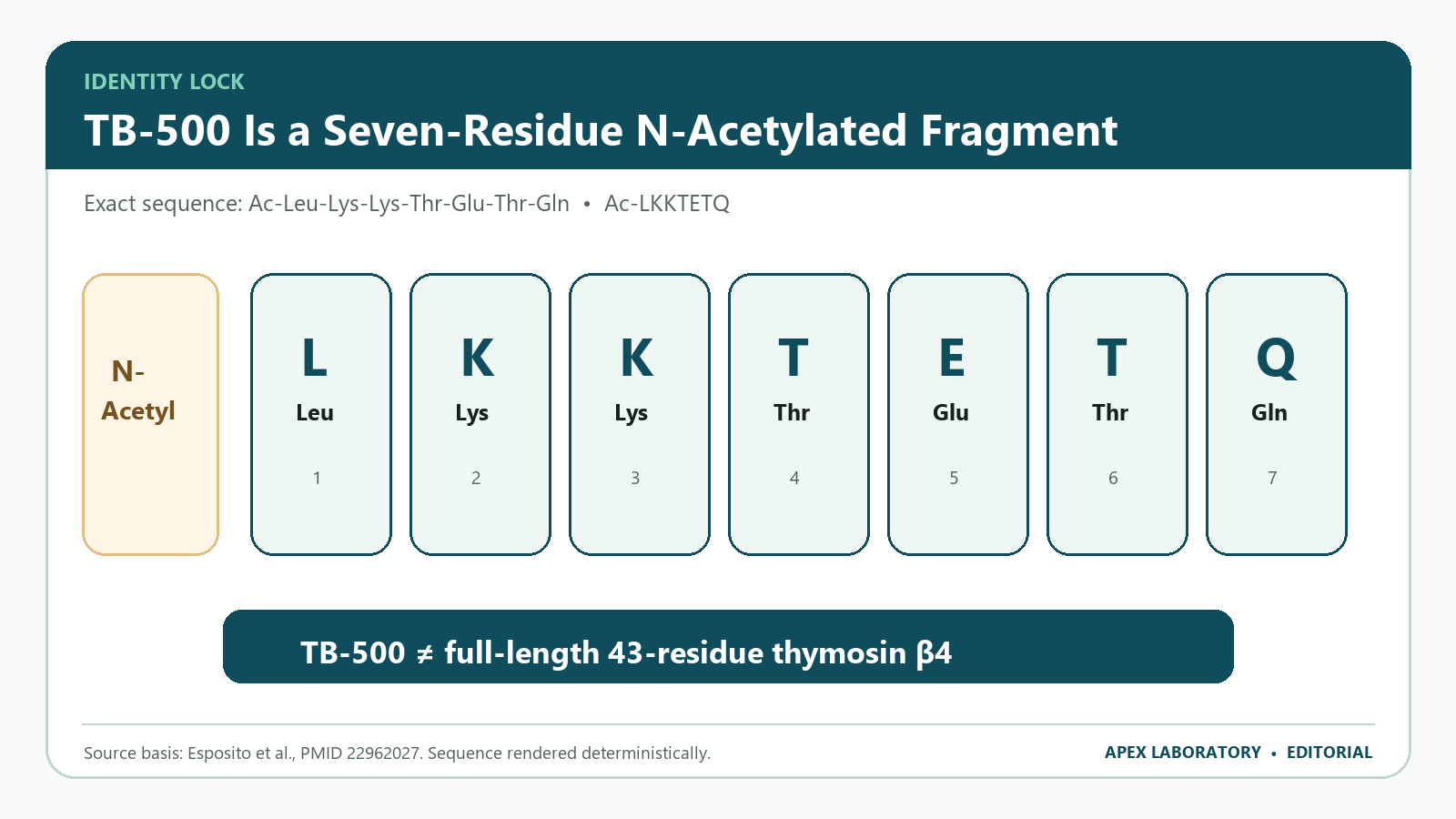
Seven residues. A 43-residue parent.
TB-500 fragment: Ac–LKKTETQ
Ac = N-terminal acetyl group- LLeu
- KLys
- KLys
- TThr
- EGlu
- TThr
- QGln
Here to understand the research?
Start with the mechanism and evidence questions below. The detailed identity table and study references follow.
How does TB-500 work?Comparing research materials?
Check the exact sequence, vial amount and corresponding report. A shared product name is not enough to establish equivalence.
View TB-500 research material and vial optionsHow does TB-500 work?
The frequently repeated explanation starts with actin, a protein involved in cell structure and movement. Full-length thymosin beta-4 interacts with actin, and the TB-500 fragment overlaps one region involved in that interaction. But the parent’s activity also involves other regions that are absent from the seven-residue fragment.
That distinction limits the claim we can make: a plausible relationship to the parent is not a complete, experimentally established mechanism for the isolated fragment. The actin-binding evidence below explains which molecule was tested and why the rest of the sequence matters.
What do claims about TB-500 benefits actually show?
The studies below establish chemical identity and investigate laboratory behavior; they do not establish a human treatment benefit for Apex’s seven-residue fragment. The key is to separate findings about the intact fragment, its metabolites and the full-length parent protein.
IDENTITY
A named fragment was identified.
The 2012 analytical paper identified acetylated LKKTETQ in a product called TB-500. This establishes what that analyzed material contained; it does not establish a treatment benefit. Read the primary identity paper.
FRAGMENT / METABOLITES
Direct laboratory findings need their own labels.
In a 2024 fibroblast assay, only the metabolite Ac-LKKTE showed significant wound-healing activity compared with the control. That result cannot be assigned to the intact parent fragment or treated as a human clinical outcome. Read the fragment and metabolite study.
PARENT PROTEIN
Thymosin beta-4 has a separate literature.
The wound, cardiac and corneal studies discussed later belong to the material actually tested. Their inclusion explains the research interest; it does not convert them into direct evidence for Apex’s seven-residue fragment. Explore the parent-protein studies.
How is TB-500 different from BPC-157?
They are different peptides with different sequences and evidence histories. BPC-157 contains 15 amino acids; the TB-500 material defined here contains seven and is N-terminally acetylated. The popular comparison is therefore about separate research materials, not two names for the same compound.
For the side-by-side evidence and study limitations, see our BPC-157 versus TB-500 comparison. A vial containing both is a further, mixture-specific question covered in the BPC-157/TB-500 blend guide.
Does a detection window tell us TB-500’s half-life?
No. Detecting a compound or metabolite in a particular sample is a different measurement from establishing how quickly the parent compound is eliminated. Sample type, analytical sensitivity and the molecule measured all affect interpretation. The direct analytical literature should not be repurposed as a human timing or administration schedule.
Questions about side effects or heart safety require human safety evidence. The laboratory findings above cannot establish a clinical risk rate; the safety and regulatory section explains the limits of the available information.
What Is TB-500?
TB-500 is the name used here for the N-terminally acetylated seven-residue sequence Ac-LKKTETQ — leucine, two lysines, threonine, glutamate, threonine and glutamine, with an acetyl group on the N-terminus. It corresponds to residues 17–23 within human thymosin β4, but it is not full-length thymosin β4. That category boundary is the foundation for every claim on this page.
The sequence alone is not a complete reagent specification, and “thymosin beta-4 fragment” without a sequence is too ambiguous for reproducible work. The rest of the required record is set out under study controls below.
Reagent Identity: Sequence, CAS, Formula and Mass
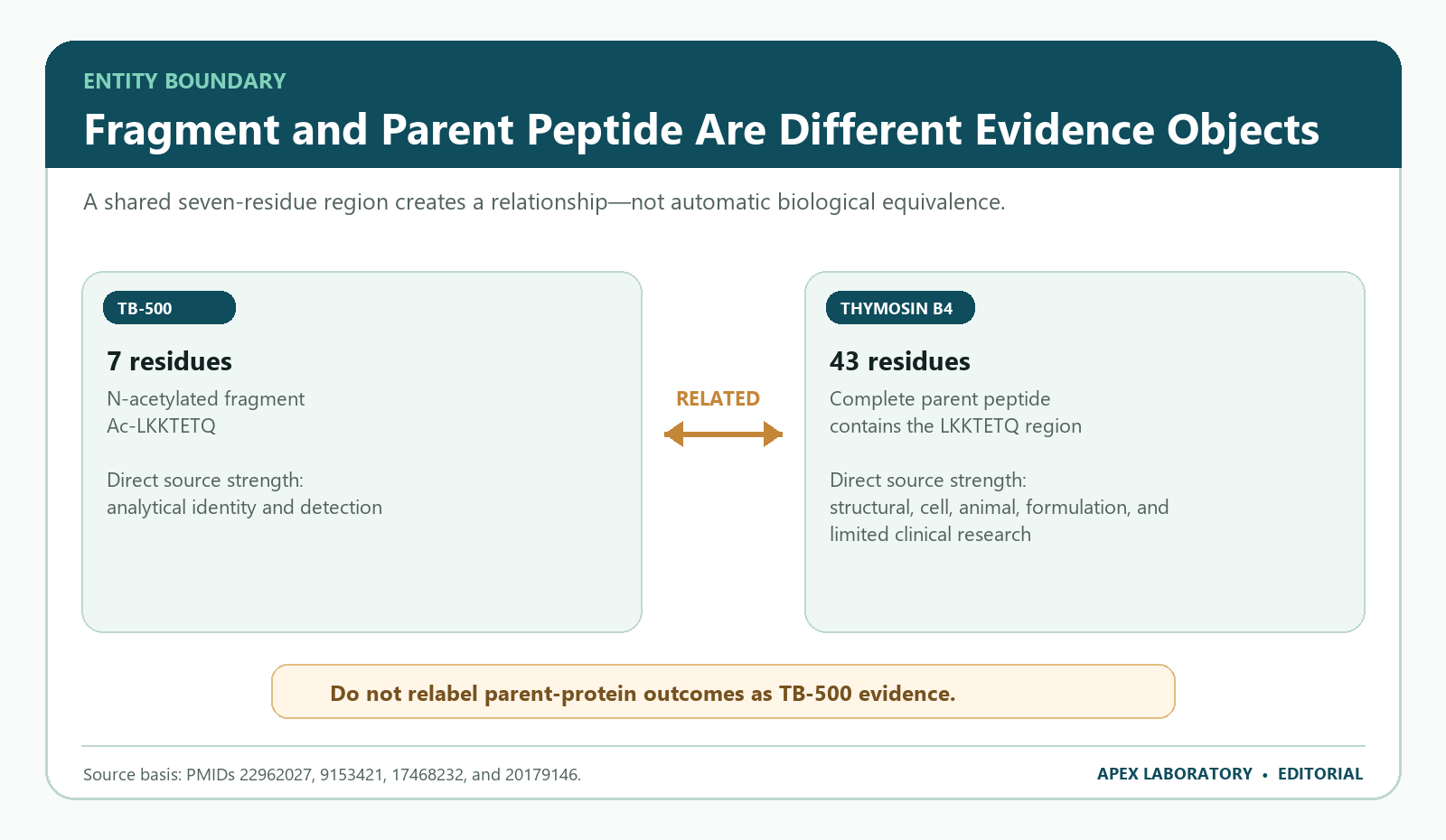
TB-500 and its parent protein carry different CAS numbers, different molecular formulas, and masses differing by more than a factor of five.
| Property | TB-500 (fragment) | Thymosin β4 (parent protein) |
|---|---|---|
| Sequence | Ac-Leu-Lys-Lys-Thr-Glu-Thr-Gln (Ac-LKKTETQ), 7 residues, N-acetylated | 43 residues, including the N-terminal Ser-Asp-Lys-Pro (Ac-SDKP) tetrapeptide the fragment does not contain |
| Position in the parent | Residues 17–23, the central actin-binding domain | Complete peptide |
| CAS number | 885340-08-9 | 77591-33-4 |
| Molecular formula | C38H68N10O14 | C212H350N56O78S |
| Molecular weight | 889.0 g/mol | 4,963 g/mol |
| PubChem CID | 62707662 | 45382195 |
| Form supplied as a reagent | Lyophilized powder, acetate salt | Not supplied by Apex Laboratory |
Identifiers and masses above come from the PubChem compound records for CAS 885340-08-9 (CID 62707662) and CAS 77591-33-4 (CID 45382195). The mass gap is the practical control: an identity check landing near 889 Da is consistent with the acetylated heptapeptide, while a result near 4,963 Da is the 43-residue parent protein.
How Was the TB-500 Identity Established?
Esposito and colleagues analyzed a product called TB-500 using high-performance liquid chromatography and high-resolution mass spectrometry. They identified the active content as the N-terminally acetylated 17–23 fragment of human thymosin β4, Ac-LKKTETQ, and synthesized the same fragment for analytical characterization (PMID 22962027).
That paper is direct evidence for chemical identity in the product analyzed. It is an analytical investigation, not an efficacy trial. Its deliverable is a chemical assignment: the acetylated 17–23 heptapeptide, whose 889.0 Da mass separates it from the ~4,963 Da parent protein. It answers what material was detected, not what that material does.
TB-500 Versus Full-Length Thymosin β4
| Feature | TB-500 in this guide | Full-length thymosin β4 |
|---|---|---|
| Identity | N-acetylated residues 17–23 | Complete human β-thymosin peptide |
| Length | 7 residues | 43 residues |
| Direct source strength | Analytical identity, detection and fragment/metabolite laboratory studies | Extensive structural, cell, animal, formulation, and limited clinical literature |
| Claim rule | Use only fragment-specific evidence | Keep outcomes labeled as parent-protein or formulation evidence |
What Does the Actin-Binding Motif Establish?
Full-length thymosin β4 binds actin monomers. Cross-linking placed its contacts across the whole monomer: Lys-3 of thymosin β4 to Glu-167 of actin, Lys-18 to the actin N-terminal acidic cluster, and Lys-38 to Gln-41, with the C-terminal half held in an extended conformation. That study reports no quantitative outcome of the effect-size kind — its result is a contact map, not a treatment effect (PMID 9153421).
β-Thymosins are characterised as the main intracellular G-actin-sequestering peptides of most vertebrate cells, binding with a dissociation constant in the micromolar range that permits fast association and release (PMID 17468232).
A second review maps activity onto discrete sequence blocks: a 4-residue N-terminal Ac-SDKP site linked to blocking inflammation and fibrosis, a 15-residue N-terminal site linked to cell survival, and the 7-residue LKKTETQ central actin-binding domain at residues 17–23 linked to angiogenesis, wound healing and cell migration. This is a narrative synthesis of the research (PMID 20179146). That mapping is mechanistic rationale for studying fragments. It does not prove that Ac-LKKTETQ has the same affinity, kinetics, stability, localization, or in-vivo effects as the complete molecule.
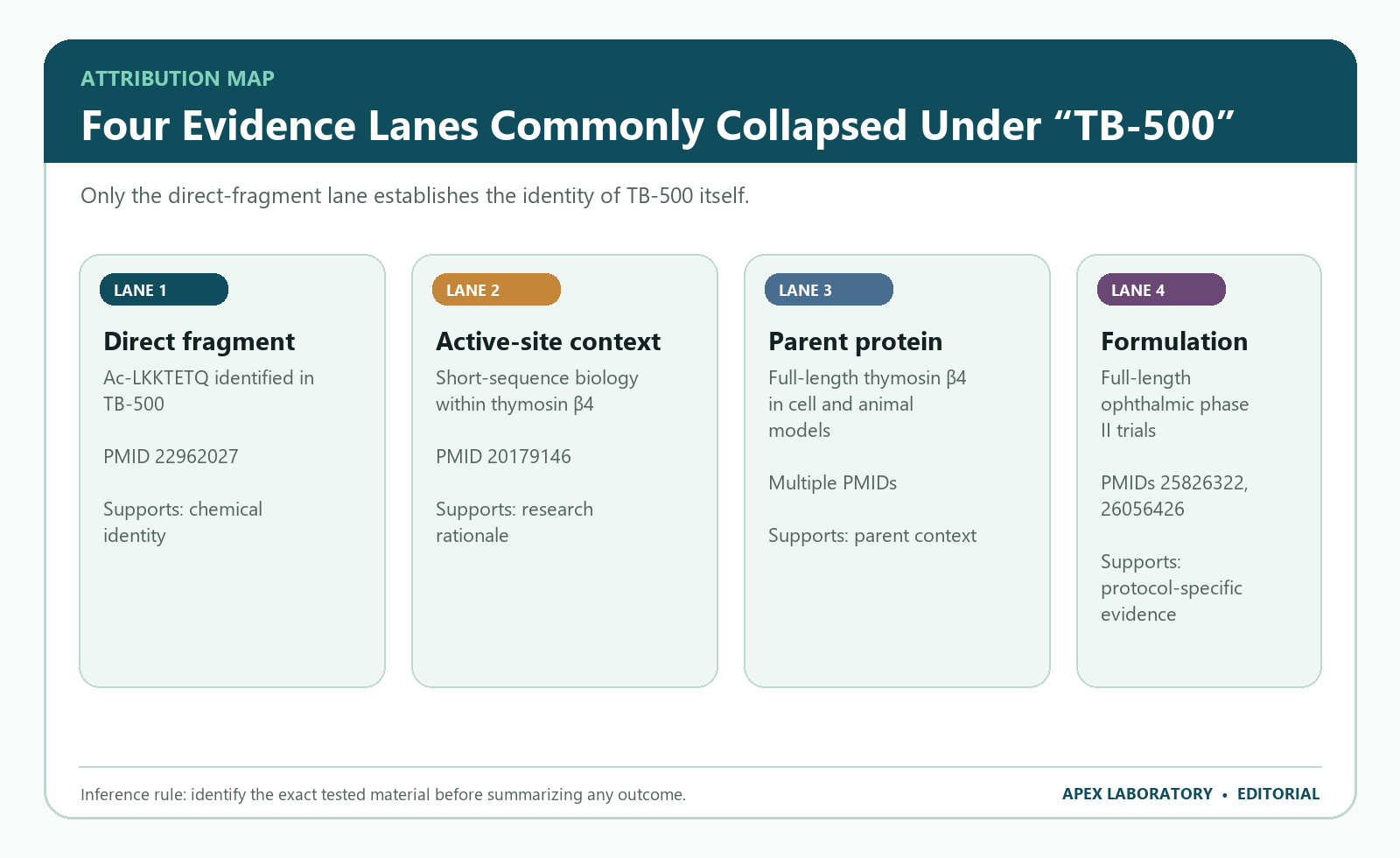
An Evidence-Attribution Map for TB-500
| Evidence lane | Representative source | What it supports | What it does not support |
|---|---|---|---|
| Direct fragment identity | Esposito et al., 2012 | TB-500 product content identified as Ac-LKKTETQ | Biological or clinical efficacy |
| Short-sequence rationale | Sosne et al., 2010 | Active-site research within thymosin β4 | Equivalence between TB-500 and the parent |
| Parent-protein mechanism | Safer et al., 1997 | Full-length thymosin β4–actin structural context | Fragment binding or activity without direct testing |
| Parent-protein preclinical | Wound, cardiac, ligament studies | Outcomes for full-length thymosin β4 in stated models | TB-500 outcomes |
| Parent-protein clinical formulation | Ophthalmic phase II trials | Protocol-specific results for a defined full-length formulation | Safety or efficacy of an RUO TB-500 vial |
What the Full-Length Thymosin β4 Literature Found
Full-length thymosin β4 studies are useful background when labeled correctly, and labeling them correctly means keeping their numbers attached. In a rat full-thickness dermal wound model, topical or intraperitoneal thymosin β4 increased reepithelialization by 42% over saline controls at 4 days and by as much as 61% at 7 days, and treated wounds contracted at least 11% more than controls by day 7. The same report found that as little as 10 pg of thymosin β4 stimulated keratinocyte migration 2–3-fold over medium alone in a Boyden-chamber assay (PMID 10469335). These are animal-wound and separate cultured-cell findings for the 43-residue protein.
Mouse dermal wound work raised MMP-2 and MMP-9 expression several-fold over control on day 2 after wounding, with cell-specific increases in MMP-1, -2 and -9 across cultured keratinocytes, endothelial cells and fibroblasts. That study also localised the responsible region: the central actin-binding domain, amino acids 17–23, carried all of the metalloproteinase-inducing activity (PMID 16607611). This maps a region involved in the parent protein’s activity; it does not establish the same response for the isolated, acetylated heptapeptide. The separate 2024 fragment/metabolite study is discussed below.
In cardiac work, thymosin β4 formed a functional complex with PINCH and integrin-linked kinase that activated Akt; after coronary artery ligation in mice, treatment raised ILK and Akt activity in the heart, enhanced early myocyte survival and improved cardiac function. The report concerns a mouse heart-injury model (PMID 15565145). A rat medial-collateral-ligament transection study placed 1 µg of thymosin β4 in 100 µL of fibrin sealant into the ligament gap and assessed healing at 4 weeks, reporting evenly spaced collagen-fibre bundles, significantly increased fibril diameters, and significantly better biomechanics than in untreated rats (PMID 23523891).
Two randomized, placebo-controlled phase 2 trials tested a 0.1% thymosin β4 ophthalmic solution (RGN-259) in dry-eye disease. A 9-patient multicentre trial dosing 6 times daily for 28 days reported, at day 56, a 35.1% reduction in ocular discomfort in treated eyes versus vehicle control (P = 0.0141) and a 59.1% reduction in total corneal fluorescein staining (P = 0.0108) (PMID 25826322). A larger 72-subject controlled-adverse-environment trial missed both of its primary endpoints at visit 5; among secondary findings it reported a 27% reduction in day-28 discomfort scores versus placebo (P = 0.0244) and improved central and superior corneal staining (P = 0.0075 and P = 0.0210) (PMID 26056426). Both trials tested the complete parent peptide in a defined ophthalmic formulation under an investigational protocol. Neither tested TB-500, and the second is a reminder that the human record here includes a missed primary endpoint.
Additional Reported Findings
A wider set of parent-protein studies sits behind that summary. Each claim-map row names the tested compound, the model and species, the endpoint, the reported result, and the source. Every row is full-length thymosin β4 (Tβ4) or a genetic manipulation of it; none tested Ac-LKKTETQ.
| Compound | Model and species | Endpoint | Reported result | Source |
|---|---|---|---|---|
| Tβ4 | Limited proteolysis and tritium exchange; purified actin monomers, in vitro | Proteolysis at actin Gly-46 | >12-fold faster for MgATP-actin when Tβ4 is bound | PMID 10777749 |
| Tβ4 | FRET and calorimetry; purified actin monomers, in vitro | Probe distances within actin | Gln-41↔Cys-374 +2 Å; εATP↔Lys-61 −1.9 Å; no quantitative outcome beyond those shifts | PMID 16272441 |
| Tβ4 overexpression | Stable lines vs vector control; NIH 3T3 fibroblasts (mouse), in vitro | Cytoskeletal and adhesion proteins | G-actin and F-actin each ~2-fold higher, so the ratio held constant; vinculin ~3-fold | PMID 9331222 |
| Tβ4 | Coronary artery ring sprouting; HUVEC (human) and artery explant, in vitro | Vessel area via branching | Doubled with as little as 100 ng of synthetic Tβ4 | PMID 14517430 |
| Tβ4 | TNF-α-stimulated inflammation; human corneal epithelial cells, in vitro | Nuclear NF-κB p65 | Level, activity and phosphorylation significantly decreased; no quantitative outcome given | PMID 17254567 |
| Tβ4 | TNF-α with PINCH-1 and ILK; human cells, in vitro | NF-κB activation and IL-8 transcription | Both inhibited, independently of G-actin binding; no quantitative outcome given | PMID 21343177 |
| Tβ4 and its sulphoxide | Injured skeletal muscle and C2C12 assays; mouse, in vivo and in vitro | Myoblast chemotaxis and wound closure | Both significantly accelerated; no quantitative outcome given | PMID 20880960 |
| Tβ4 | Collagen–chitosan hydrogel after LAD ligation; rat myocardium, in vivo | Tissue loss after infarction | 13 ± 4% vs 58 ± 3% untreated and 30 ± 8% with Tβ4-free hydrogel; more mature vessels (P < 0.0001) | PMID 22817626 |
| Tβ4 | EPC pretreatment and transplantation; human EPC in vitro, rat heart in vivo | VEGF secretion and tube formation | Both increased and abolished by a VEGF-neutralising antibody; no quantitative outcome given | PMID 29956769 |
| Tβ4 overexpression | Critical-limb-ischaemia model; mouse in vivo, HUVEC in vitro | Ang2, Tie2, VEGFA and CD31 | All increased via Notch/NF-κB and reversed by DAPT and BMS; no quantitative outcome given | PMID 32945357 |
| Tβ4 | Follicle bulge stem cells; rat vibrissa keratinocytes in vitro, rats and mice in vivo | Hair growth and MMP-2 | Both increased; no quantitative outcome given | PMID 14657002 |
| Tβ4 overexpression and knockout | Epidermis-specific and global lines; mouse, in vivo | MMP-2, VEGF, β-catenin and Lef-1 | Raised in overexpressers and sharply reduced in knockouts; no quantitative outcome given | PMID 27130465 |
How Much Direct Biological Evidence Exists for TB-500?
The direct literature establishes the identity of acetylated LKKTETQ and includes laboratory work on its metabolism and activity. In the 2024 fibroblast experiment, the measured wound-closure response belonged to the metabolite Ac-LKKTE. These findings do not establish a therapeutic benefit in humans for the intact TB-500 fragment.
A fragment-specific experiment should therefore name its test article and avoid “thymosin β4” as shorthand. If a paper tested the full-length protein, cite it as parent context; if it tested a different short sequence, terminal chemistry, or formulation, retain that exact description; if the material is not adequately characterized, treat identity as unresolved.
What Is Known About Safety and Regulatory Status?
FDA’s briefing for its July 2026 Pharmacy Compounding Advisory Committee meeting describes TB-500 free base and TB-500 acetate as substances that are not components of an FDA-approved drug. That briefing evaluates a compounding question; it is not a drug approval or, by itself, a final compounding determination. Read the FDA briefing.
The agency’s safety-risk page also identifies limited human-exposure information for the fragment and concerns involving aggregation, impurities and immune responses. An analytical purity result cannot settle those clinical safety questions. Apex’s material is supplied for research use, not human consumption. See FDA’s substance-specific safety discussion.
Sport eligibility is a separate question. Athletes and support personnel should consult the current World Anti-Doping Agency Prohibited List and their governing body’s rules.
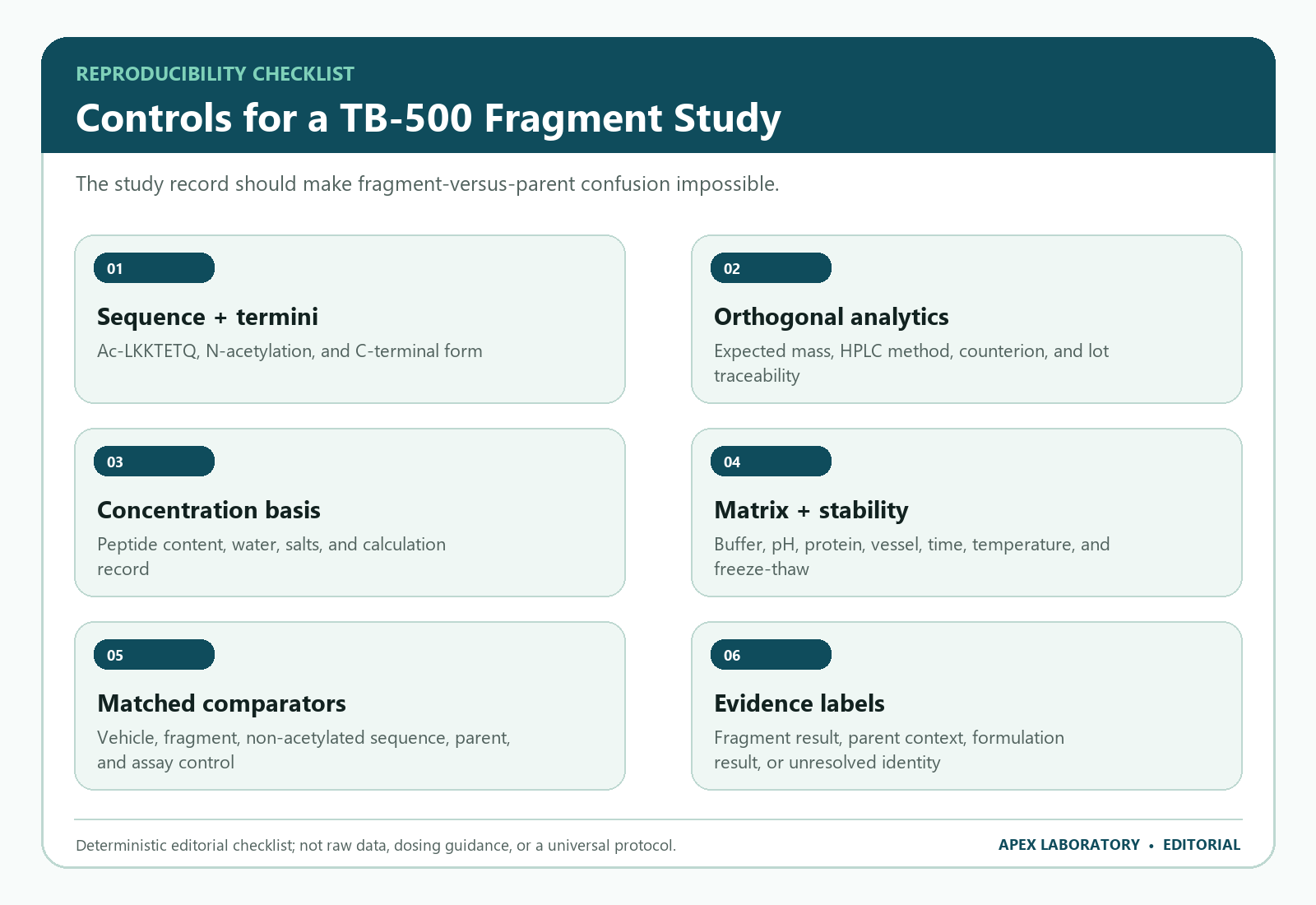
Controls for a TB-500 Fragment Study
Identity comes first: record the exact seven-residue sequence, N-terminal acetylation, C-terminal form, counterion, water content, residual solvents, lot, and concentration basis. Interpret mass-spectrometry evidence against the expected chemical form, and report HPLC purity with its method and detection conditions.
Controls should distinguish the fragment from the parent. Depending on the hypothesis, useful arms include vehicle, untreated, Ac-LKKTETQ, non-acetylated LKKTETQ, full-length thymosin β4, a sequence-scrambled control, and an assay-specific positive control — design examples, not a universal protocol.
Document matrix and stability conditions too: solvent or buffer, pH, ionic strength, protein content, vessel material, temperature, freeze-thaw history, incubation time, and any adsorption control. The mass-spectrometry guide, HPLC purity guide, and COA-reading guide separate identity, purity, and documentation claims.
Research-Material Context
Current vial amount, lot documentation, availability, and fulfillment details belong on the live product record rather than in this evidence guide. Identity and purity documentation does belong here.
The Apex listing identifies TB-500 as a lyophilized research peptide. Read the applicable published COA for its stated construct, configuration, lot, methods, results and acceptance criteria. When a report gives chromatographic purity as integrated detector area, that figure describes a signal fraction under the stated method. It does not establish sterility, endotoxin status, concentration accuracy, or biological activity, and it says nothing about whether the vial holds the 889.0 Da fragment or the 4,963 Da parent protein — the identity record must distinguish the fragment from the parent using the declared sequence and appropriate analytical evidence.
Current TB-500 research-reagent record
Review the live listing for current specifications and documentation. It is a research-use-only listing, not a drug, clinical formulation, or performance protocol.
View the TB-500 research-reagent pageExplore related study areas in the tissue-repair research hub, or compare the identities and evidence in BPC-157 versus TB-500.
Frequently Asked Questions
What is TB-500?
TB-500 is the N-terminally acetylated seven-residue sequence Ac-Leu-Lys-Lys-Thr-Glu-Thr-Gln, abbreviated Ac-LKKTETQ. It corresponds to residues 17–23 of human thymosin β4.
Is TB-500 the same as full-length thymosin β4?
No. TB-500 is a seven-residue fragment, while full-length human thymosin β4 contains 43 residues. A shared sequence region does not make the fragment and parent peptide biologically equivalent.
What is the exact TB-500 sequence?
The exact sequence used in this guide is Ac-Leu-Lys-Lys-Thr-Glu-Thr-Gln, written Ac-LKKTETQ. The Ac prefix records N-terminal acetylation and should not be omitted from the material identity.
What direct evidence identifies TB-500?
Esposito and colleagues used chromatographic and mass-spectrometric methods to identify Ac-LKKTETQ in a product called TB-500. That analytical result establishes identity in the tested product, not biological efficacy.
Can full-length thymosin β4 studies be cited as TB-500 studies?
No. They can be cited as parent-protein context only when the tested material is stated clearly. Wound, cardiac, ligament, corneal, or clinical findings from full-length thymosin β4 do not become fragment evidence.
What controls matter in a TB-500 study?
Document the seven-residue sequence, N-terminal acetylation, C-terminal form, counterion, lot, identity and purity evidence, concentration basis, matrix, stability conditions, matched comparators, contamination controls, and prespecified endpoints.
What is the molecular weight and CAS number of TB-500?
The TB-500 fragment is CAS 885340-08-9, molecular formula C38H68N10O14, molecular weight 889.0 g/mol, PubChem CID 62707662. Full-length thymosin β4 is CAS 77591-33-4, C212H350N56O78S, 4,963 g/mol, CID 45382195. Copy that lists 4,963 g/mol under the TB-500 name has described the parent protein.
Is TB-500 an FDA-approved drug?
FDA’s July 2026 advisory-committee briefing identifies TB-500 free base and acetate as substances that are not components of an FDA-approved drug. Research-grade material should not be treated as an approved pharmaceutical formulation.
What did the thymosin β4 wound-healing studies actually measure?
In a rat full-thickness dermal wound model, thymosin β4 increased reepithelialization by 42% at 4 days and by as much as 61% at 7 days versus saline controls, and treated wounds contracted at least 11% more by day 7. Those are rat data for the 43-residue parent protein, not measurements of Ac-LKKTETQ.
References
- Esposito S, et al. Synthesis and characterization of the N-terminal acetylated 17-23 fragment of thymosin beta 4 identified in TB-500, a product suspected to possess doping potential. Drug Test Anal. 2012;4(9):733-8. PMID 22962027.
- Sosne G, et al. Biological activities of thymosin beta4 defined by active sites in short peptide sequences. FASEB J. 2010;24(7):2144-51. PMID 20179146.
- Safer D, et al. Thymosin beta 4 binds actin in an extended conformation and contacts both the barbed and pointed ends. Biochemistry. 1997;36(19):5806-16. PMID 9153421.
- Hannappel E. beta-Thymosins. Ann N Y Acad Sci. 2007;1112:21-37. PMID 17468232.
- Malinda KM, et al. Thymosin beta4 accelerates wound healing. J Invest Dermatol. 1999;113(3):364-8. PMID 10469335.
- Philp D, et al. Thymosin beta4 promotes matrix metalloproteinase expression during wound repair. J Cell Physiol. 2006;208(1):195-200. PMID 16607611.
- Bock-Marquette I, et al. Thymosin beta4 activates integrin-linked kinase and promotes cardiac cell migration, survival and cardiac repair. Nature. 2004;432(7016):466-72. PMID 15565145.
- Xu B, et al. Thymosin β4 enhances the healing of medial collateral ligament injury in rat. Regul Pept. 2013;184:1-5. PMID 23523891.
- Sosne G, et al. Thymosin β4 significantly improves signs and symptoms of severe dry eye in a phase 2 randomized trial. Cornea. 2015;34(5):491-6. PMID 25826322.
- Sosne G, et al. Thymosin beta 4 ophthalmic solution for dry eye: a randomized, placebo-controlled, Phase II clinical trial conducted using the controlled adverse environment (CAE™) model. Clin Ophthalmol. 2015;9:877-84. PMID 26056426.
- Rahaman et al. Simultaneous quantification of TB-500 and its metabolites in in-vitro experiments and rats by UHPLC-Q-Exactive orbitrap MS/MS and their screening by wound healing activities in-vitro. Journal of Chromatography B. 2024. PMID 38382158.