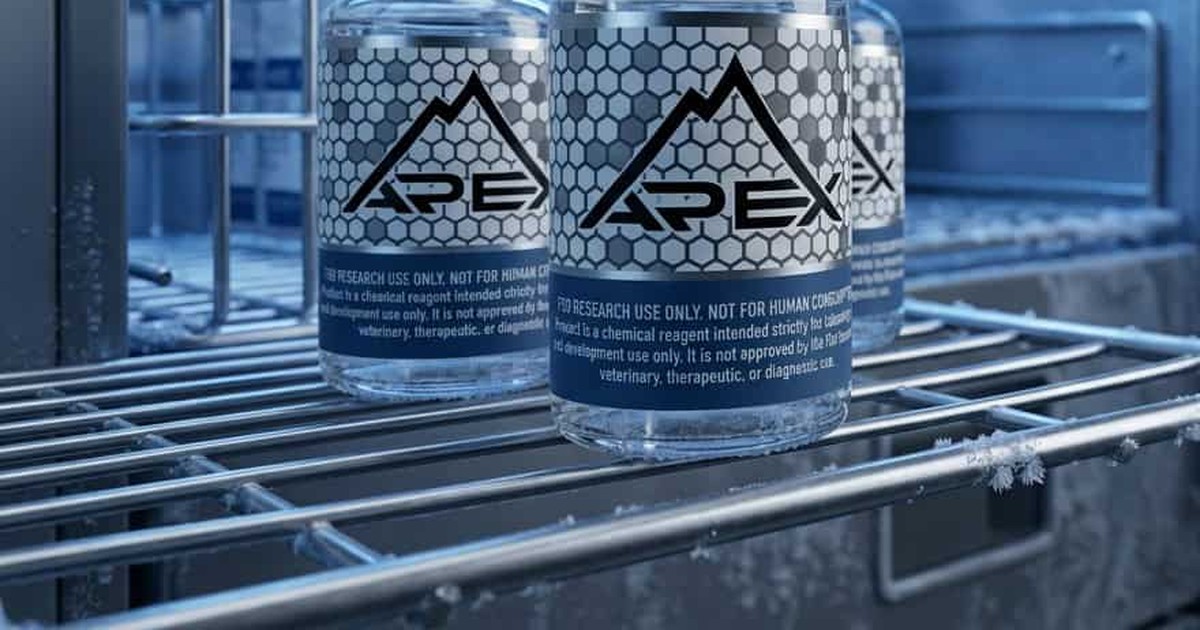
Quick answer: Peptide storage is not one temperature or shelf life. The controlling condition comes from the exact material’s current lot or product documentation and validated method, with sealed dry material handled separately from a prepared solution. General manufacturer guidance identifies risks such as moisture, light, oxygen exposure, and temperature cycling, but it cannot establish the expiry, identity, purity, sterility, stability, or activity of a specific batch.
An evidence-led peptide storage plan begins by identifying what is actually in the container, which state it is in, and which current record applies. A generic table can summarize common handling concerns, but it cannot account for every sequence, counterion, excipient, concentration, solvent, closure, analytical endpoint, or stability study. When a source is missing or an excursion occurs, the defensible response is to stop and document—not to assign a new shelf life from appearance.
Key Takeaways
- The exact record controls. Product- and lot-specific instructions outrank general web guidance.
- Material state changes the question. Sealed dry material and a prepared solution require separate records and decisions.
- “Cold” is not a complete condition. Temperature, moisture, light, oxygen, closure, container, concentration, solvent, and elapsed time can all matter.
- Appearance is not a stability assay. A clear or unchanged-looking sample does not prove identity, purity, sterility, stability, or biological activity.
- Excursions require disposition. Preserve the event record, quarantine when required, and use a responsible laboratory review instead of improvising.
Scope, Prerequisites, and Records
This guide is for qualified personnel storing documented research peptides for in-vitro or preclinical methods. It supplies a decision framework, not a universal temperature table. Before moving or opening a container, identify the material, lot, supplied form, current state, formulation, source-document revision, and the receiving laboratory method.
- Identity record: product or material name, sequence or other identity record, lot number, counterion, and formulation.
- State record: sealed dry material, opened dry material, prepared stock, working dilution, or quarantined material.
- Storage instruction: temperature range, light protection, moisture control, closure, container, orientation, and allowed handling transitions.
- Time record: receipt, entry into controlled storage, opening, preparation, aliquoting, transfer, and any excursion.
- Method record: solvent, concentration, container compatibility, freeze-thaw limits if supported, acceptance criteria, and disposition authority.
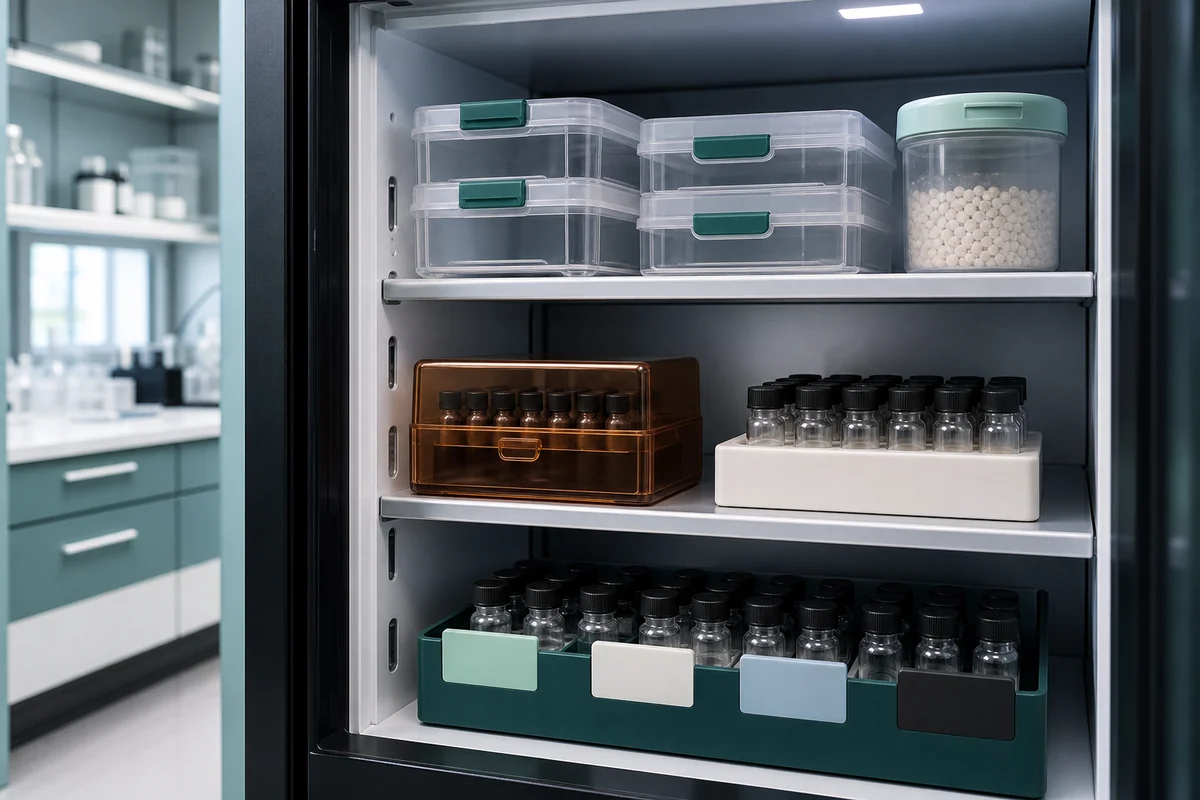
A household label such as “freezer” or “refrigerator” is not precise enough for a controlled laboratory record. Use monitored equipment, the required alarm and excursion process, and labels that remain legible under the stated condition. The guide does not establish whether a particular storage unit, container, or backup plan meets an institution’s quality system.
Which Storage Source Controls?
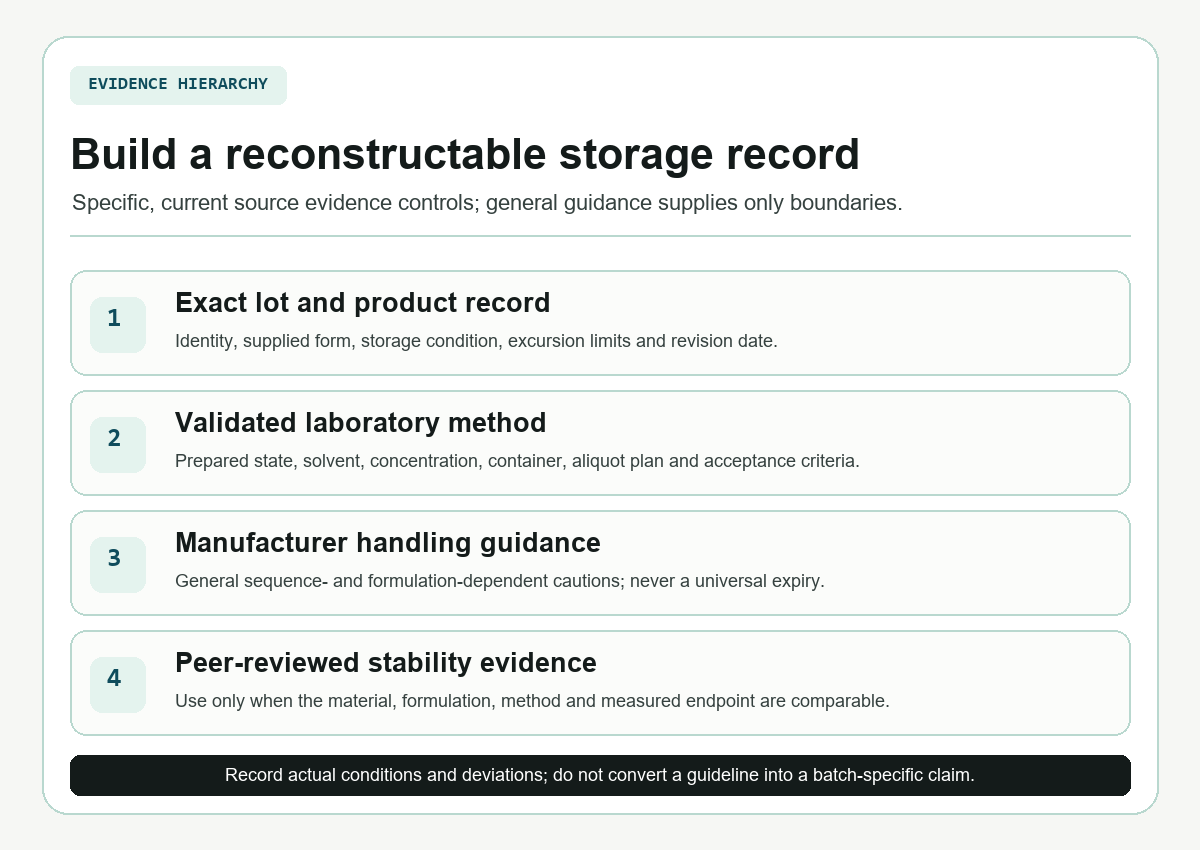
Storage advice becomes less specific as it moves away from the exact material. Use the following precedence unless a validated institutional quality system establishes a stricter rule:
- Current lot- and product-specific documentation. This is the closest source to the actual supplied material and formulation.
- An approved laboratory method or stability protocol. It should define the prepared state, concentration, solvent, container, storage condition, measured endpoint, and acceptance criteria.
- Current manufacturer handling guidance. This identifies broad risks and common practices for that supplier’s materials but does not establish a universal batch expiry.
- Comparable peer-reviewed stability evidence. It is useful only when material, formulation, state, concentration, container, method, and endpoint are sufficiently comparable.
- General educational guidance. Use it to identify questions and risks, never to invent a batch-specific claim.
For example, GenScript’s current guidance says the stability of each peptide is sequence-dependent and gives its lyophilized custom peptides a general -20 °C, dry, light-protected framework. Bachem’s handling guidance uses below -15 °C for longer storage of tightly closed lyophilizate and prefers lower temperatures for longer periods. Thermo Fisher’s standard custom peptide instructions use -20 °C for the named service. All three supplier documents were checked on July 25, 2026, and none of them carries a printed revision date, so each must be rechecked before it is relied on. These are supplier contexts, not evidence that every Apex material or every prepared solution shares one condition or expiry.
Regulatory Status of These Materials
Storage conditions for a medicine are set by its marketing authorisation. The materials in scope here have none. Apex Laboratory supplies them as research-grade chemical reagents for in-vitro and preclinical research only: no research-grade peptide reagent supplied by Apex Laboratory holds FDA, EMA, NMPA, MHRA, PMDA, TGA, or Health Canada marketing authorisation in any jurisdiction, none is an approved medicinal product, and none is for human consumption. Regulatory status is a storage input here, not a footnote.
The practical consequence is that no regulator-reviewed label exists to inherit a storage temperature, an expiry date, or an in-use interval from. That absence is exactly why the precedence above places lot- and product-specific documentation first, and why this guide publishes no universal shelf life.
Some molecules do also exist inside an approved finished formulation — semaglutide in Ozempic and Wegovy, tirzepatide in Mounjaro and Zepbound, bremelanotide in Vyleesi, elamipretide in FORZINITY (FDA accelerated approval September 19, 2025, NDA 215244). Same molecule; categorically distinct regulatory frameworks. Each approval covers one finished product with its own excipients, container-closure system, and stability program, so its labeled storage condition, expiry, and in-use window describe that product alone and must never be carried across to a research-grade lot. Background: Research-Grade vs Pharmaceutical-Grade Peptides.
The same boundary governs solvents. Hospira Bacteriostatic Water for Injection, USP is an approved multiple-dose human prescription drug product, and its current DailyMed label record (revised August 2019) specifies benzyl alcohol at 0.9% (9 mg/mL) or 1.1% (11 mg/mL) depending on the presentation, pH 5.7 within a 4.5–7.0 range, and storage at 20–25 °C. Those figures are properties of that named solvent product rather than of the peptide dissolved in it — and no single preservative concentration or in-use window covers every presentation. Apex Laboratory supplies its own bacteriostatic water as a separate in-vitro research-use product that holds no marketing authorisation, and the two identities must never be merged.
Identify the Material State First
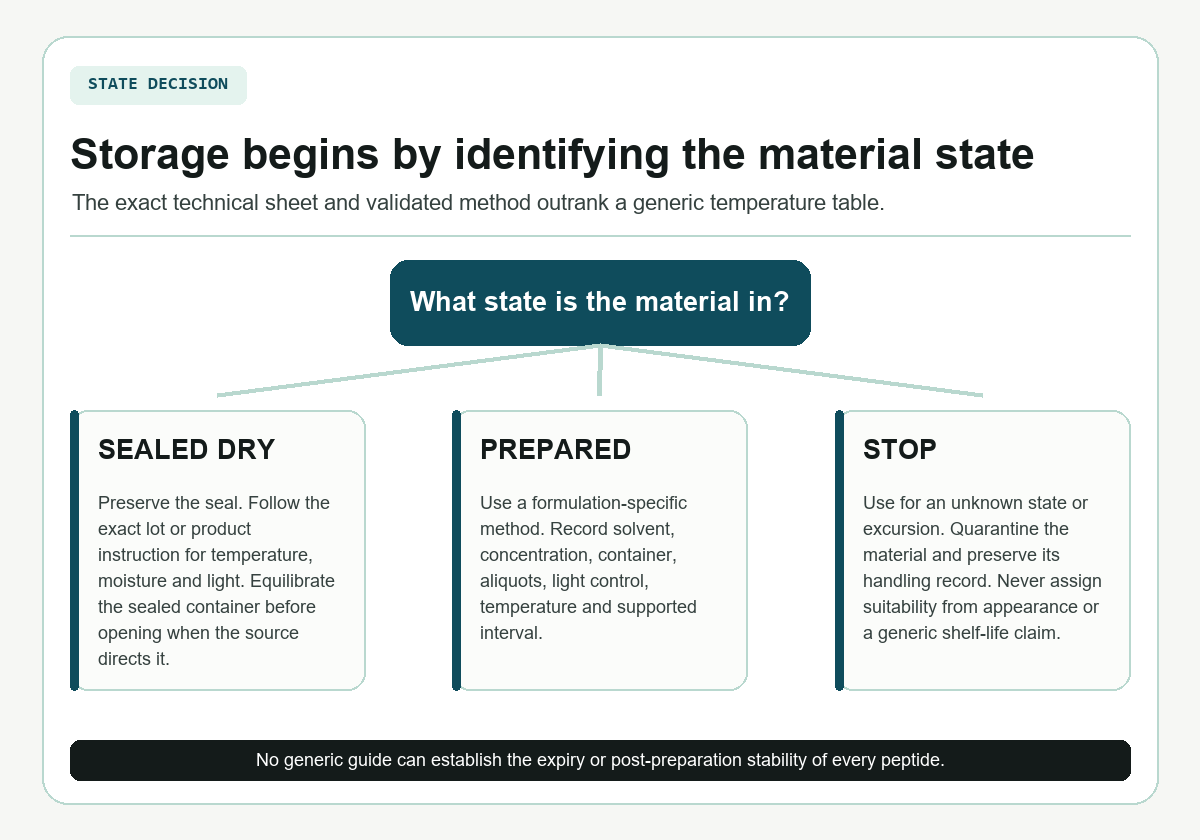
The most important split is between dry material and a prepared solution. Dissolution changes the chemical environment, introduces a solvent and container interface, and can alter the relevance of pH, concentration, oxygen, light, adsorption, microbial control, and temperature transitions. A duration stated for a dry, sealed product cannot be transferred to a prepared stock.
Handling Sealed Dry Material
Lyophilization often improves handling stability by reducing mobile water, but “dry” does not mean chemically inert. Residual moisture, the solid-state structure, counterion, formulation, oxygen, light, closure integrity, and sequence can still affect a peptide. Follow the exact source for temperature and duration rather than inferring them from appearance or molecular size.
- Verify the sealed container and record. Confirm identity, lot, condition, and intact closure before storage.
- Move promptly into the documented condition. Record receipt time and actual placement time. “Shipped ambient” does not automatically mean “store ambient.”
- Control moisture. Bachem and GenScript both warn that many peptides are hygroscopic and that atmospheric water can affect content and stability.
- Protect from light when directed. Use the exact product instruction; colored or modified materials can have additional requirements.
- Minimize unnecessary openings. Each opening can introduce moisture and oxygen and weaken traceability.
- Equilibrate the sealed container when the source directs it. Bachem advises allowing lyophilized material to reach ambient temperature in a desiccator before opening, reducing condensation-related exposure.
- Reseal and return under the approved method. Document the opening, amount removed, closure action, and new state if the container is no longer equivalent to the original sealed presentation.
Handling a Prepared Solution
A prepared solution needs its own method. The solvent container’s label does not establish the solution’s peptide stability, and the presence of a preservative does not create a universal storage interval. Record the exact solvent or buffer, pH when method-relevant, concentration, final volume, container, closure, light condition, preparation time, and allowable interval supported by the source.
- Concentration: lower or higher concentrations can behave differently through adsorption, aggregation, solubility, or reaction kinetics.
- Solvent and pH: aqueous composition, salts, co-solvents, preservatives, reducing conditions, and pH can change degradation pathways and assay compatibility.
- Container and headspace: surface material, closure, fill volume, oxygen exposure, and light transmission can matter.
- Aliquot plan: aliquoting can reduce repeat access or temperature cycles, but it also adds transfers, containers, and contamination opportunities. Use it only when the method supports those tradeoffs.
- Temperature transitions: freezing, thawing, warming, and refreezing are distinct events. Do not assume that one generic “avoid freeze-thaw” rule establishes the disposition of every formulation.
- Acceptance criteria: define the analytical or functional endpoint that determines suitability. Visual clarity alone is insufficient.
GenScript and Bachem both caution against long-term solution storage in general guidance, while their specific wording and conditions differ. That shared caution supports keeping dry and solution states separate; it does not supply an expiration date. Use the preparation workflow in How to Reconstitute Peptides for Laboratory Research and preserve the calculation record described in the concentration and volume guide.
What Can Change During Storage?
Storage controls are intended to limit plausible physical, chemical, and microbiological risks. The pathway that matters depends on sequence and formulation, and multiple pathways can occur together.
| Factor | What it can influence | What the record should capture |
|---|---|---|
| Moisture | Solid-state mobility, water uptake, content basis, and some chemical reactions | Seal, desiccation instruction, opening conditions, and exposure time |
| Oxygen | Oxidation-prone residues or formulation components | Closure, headspace, opening history, and any supported inert-atmosphere requirement |
| Light | Photochemical change in susceptible material or labels | Light-protection instruction, container, and exposure event |
| Temperature and time | Reaction rates, physical state, and cumulative exposure | Set point, monitored range, timestamps, alarm, and excursion history |
| Freeze-thaw transitions | Interfaces, concentration gradients, aggregation, precipitation, or container stress in some solutions | Each transition, duration, method limit, and observed deviation |
| Surface and agitation | Adsorption, foaming, interfacial exposure, or recoverable concentration | Container, mixing method, transfers, and visible event without overinterpreting it |
| Contamination control | Microbiological or particulate risk after opening and transfer | Environment, operator, equipment, closure, transfer, and deviation record |
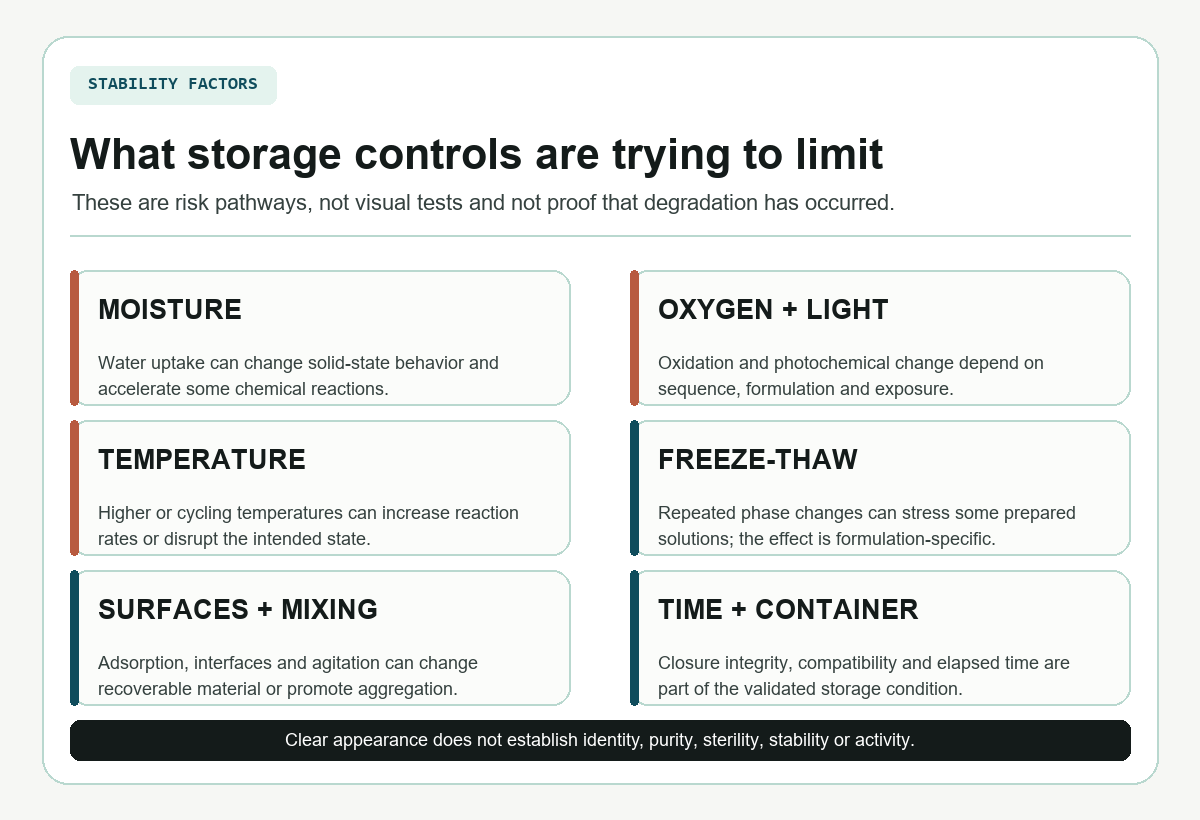
Evidence-Led Storage Matrix
| Decision | Evidence required | Unsafe shortcut to reject |
|---|---|---|
| Storage temperature | Exact product/lot instruction or validated stability method for the same state and formulation | “All peptides use -20 °C” or transferring a supplier’s general service guidance to every material |
| Storage duration or expiry | Assigned product expiry or comparable stability data with defined endpoints and acceptance criteria | Estimating months or years from molecular size, appearance, or a blog table |
| Prepared-solution interval | Method-specific data for the peptide, solvent, pH, concentration, container, and temperature | Using the diluent’s open-container interval as the peptide solution’s shelf life |
| Aliquoting | Approved method that weighs fewer access/cycle events against added transfers and containers | Assuming aliquoting is always safer |
| Freeze-thaw allowance | Defined cycle method and acceptance data for the exact formulation | Assuming one cycle is always harmless or that any cycle always destroys the material |
| Light or oxygen control | Product instruction, sequence/formulation risk, or comparable method evidence | Adding unsupported handling steps or ignoring an explicit instruction |
| Excursion disposition | Time-temperature history, approved excursion limits, responsible review, and documented decision | Returning the material to storage and resetting the clock |
Receipt-to-Disposition Workflow
- Receive and identify. Match container, lot, shipping record, COA, and technical sheet. Record receipt condition and time.
- Classify the state. Sealed dry, opened dry, prepared solution, working dilution, returned material, or quarantine are different states.
- Freeze the controlling instruction. Save the current revision and record which source supports temperature, light, moisture, closure, and duration.
- Assign monitored storage. Confirm the unit, range, alarm, backup, location, and responsible owner under the laboratory SOP.
- Label for reconstruction. Include identity, lot, state, concentration if prepared, solvent, preparation/opening date, condition, supported interval, and record reference.
- Minimize unplanned transitions. Schedule access, use appropriate secondary containment, and record every opening, transfer, warming, freezing, or thawing event required by the method.
- Review before use. Confirm the condition history, source revision, expiry or supported interval, container integrity, and acceptance criteria.
- Stop on deviation. Quarantine when required, preserve evidence, and route the material to the responsible disposition authority.
Common Storage Myths
Myth: all peptides last for years when frozen
Sequence, formulation, moisture, container, state, temperature, and analytical acceptance criteria differ. General supplier language about lyophilized products cannot establish the expiry of a different batch or a prepared solution.
Myth: refrigeration makes every prepared solution stable
Temperature is only one variable. Solvent, pH, concentration, light, oxygen, surfaces, microbial control, and elapsed time remain formulation- and method-specific.
Myth: bacteriostatic water sets the peptide expiry
A solvent label describes that named solvent product. It does not validate compatibility or establish the chemical, physical, microbiological, or functional stability of an unrelated peptide solution. See What Is Bacteriostatic Water? for the composition and label boundary.
Myth: clear appearance proves the material is fine
Some changes are not visible, while visible changes can have multiple causes. Appearance can be recorded as an observation, but identity requires appropriate methods such as mass spectrometry, and chromatographic purity has its own limits. Review the guides to mass-spectrometry identity verification and HPLC purity interpretation.
Excursions and Stop Conditions
A temperature alarm, unknown storage history, damaged closure, missing label, unplanned opening, condensation event, uncertain prepared-state time, unexpected precipitate, or undocumented transfer is a data problem before it is a material-quality conclusion. Preserve the evidence needed for disposition.
- Quarantine or segregate the affected material according to the SOP.
- Record the actual time-temperature history, not only the alarm set point.
- Preserve container, closure, label, logger, transfer, and operator records.
- Compare the event with an approved excursion limit or stability method for the exact state and formulation.
- Do not relabel, extend expiry, re-freeze, re-lyophilize, filter, dilute, or otherwise “rescue” the material unless an approved method and responsible authority direct it.
- Record the final disposition and its evidence source.
Final Storage Checklist
- The container, lot, COA, and technical sheet identify the same material.
- The current state is explicit: sealed dry, opened dry, prepared solution, working dilution, or quarantine.
- The exact source for temperature, light, moisture, closure, and duration is recorded.
- The storage unit is monitored, in range, labeled, alarmed, and covered by the laboratory SOP.
- Opening, preparation, transfer, aliquoting, freezing, thawing, and excursion events are traceable.
- Prepared solutions record solvent, concentration, container, preparation time, supported interval, and acceptance criteria.
- No solvent label or generic table is being used as a peptide expiry.
- Appearance is recorded without treating it as proof of identity, purity, sterility, stability, or activity.
- Any deviation is quarantined and routed to the responsible authority.
- The disposition decision and supporting evidence are preserved.
If the exact condition or history cannot be reconstructed, the guide cannot declare the material suitable. Resolve the gap through the responsible laboratory procedure.
Sources and Scope
- Bachem: Handling and Storage Guidelines for Peptides — supplier guidance on lyophilizate, moisture, oxidation-prone residues, solutions, and source-specific storage.
- Bachem: Care and Handling of Peptides — peptide-content distinction and general handling boundaries.
- GenScript: Peptide Storage and Handling Guidelines — sequence dependence, dry-material guidance, moisture, light, oxidation, aliquoting, and freeze-thaw cautions.
- Thermo Fisher Scientific: Important Information on Your Peptides — handling instructions for its standard peptide service and the peptide-specific solubility boundary.
- DailyMed: Hospira Bacteriostatic Water for Injection, USP — approved multiple-dose label record for preservative concentration, pH range, container status, and labeled storage of that named solvent product.
- Apex Laboratory Editorial Standards — source hierarchy, corrections, review, and research-use boundaries.
These manufacturer sources support general handling principles in their stated contexts. They do not assign a universal Apex product expiry or prepared-solution shelf life. No PMID-based claim is retained in this article.
Research Use Disclaimer
This guide is provided for educational and laboratory reference purposes only. All compounds discussed and all products sold by Apex Laboratory are intended exclusively for in-vitro laboratory research use and are not for human consumption. Storage and handling must follow the exact material record, validated method, institutional SOP, and qualified laboratory oversight.