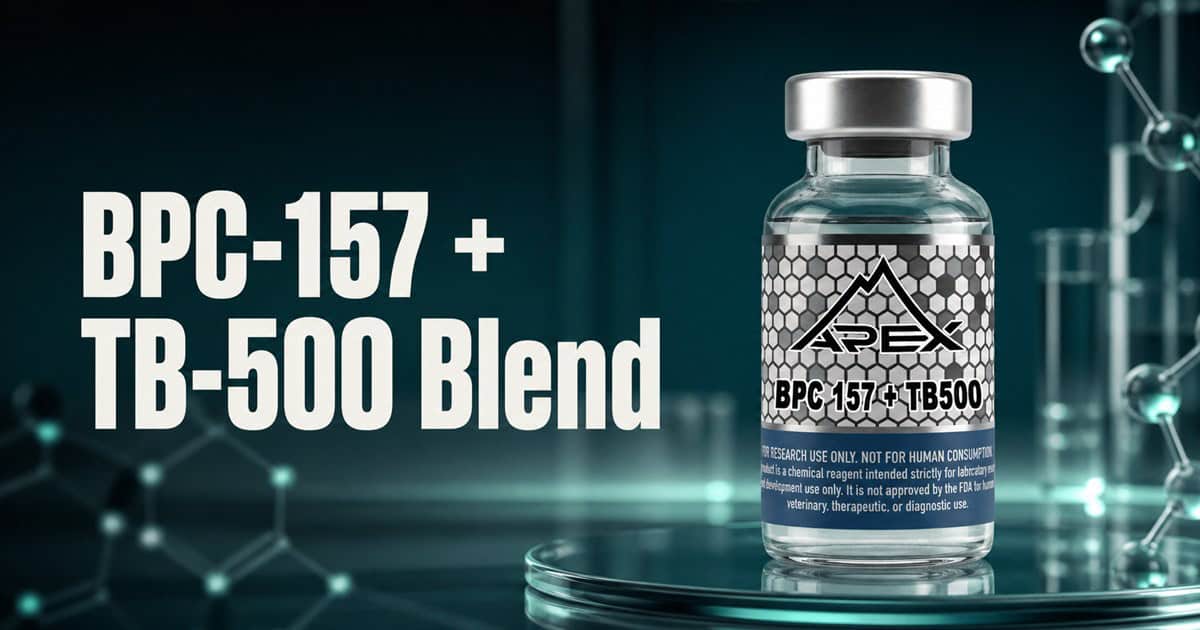
Compound learning guide · BPC-157 + TB-500
One nickname. Two peptides. Several very different kinds of evidence.
The “Wolverine stack” commonly means BPC-157 combined with TB-500. A BPC-157/TB-500 blend puts both ingredients in one research vial, but the nickname does not define their chemical forms, ratio or quality. It is not an approved treatment or proof that the combination heals injuries.
The useful questions are what the vial contains, whether the combination has actually been tested, and what changes when the components come together instead of separately.
What is the BPC-157/TB-500 blend?
It is a co-formulated material containing two separately defined peptides. BPC-157 has 15 amino-acid residues. TB-500, as specified in the Apex blend, is the acetylated seven-residue fragment Ac-LKKTETQ. Combining them does not create a third peptide with its own sequence or molecular weight.
GEPPPGKPADDAGLV15 residues · approximately 1,419.5 g/molAc-LKKTETQ7 residues · approximately 889.0 g/mol“Wolverine peptide,” “Wolverine blend” and “BPC/TB stack” are search and marketplace labels. They often point to this pair, but some pages add other compounds or use different ratios. Read the ingredient specification rather than treating the nickname as a standardized formula. A two-component blend is also different from GLOW, which adds GHK-Cu, or KLOW, which also includes KPV.
What does 10 mg or 20 mg mean on the vial?
In Apex’s declared configurations, 10 mg means 5 mg BPC-157 plus 5 mg TB-500; 20 mg means 10 mg plus 10 mg. Those are total label quantities. A 10 mg blend is not 10 mg of each ingredient. The current BPC-157/TB-500 blend product record lists the available configuration and its linked documentation.
A 1:1 mass ratio does not mean equal molecule counts. Because the fragment is lighter, equal masses contain about 1.60 TB-500 molecules for every BPC-157 molecule, calculated from the stated average molecular weights. That is an identity calculation, not a potency comparison or a recommended research ratio.
BPC-157/TB-500 blend vs separate vials: what changes?
The main difference is control over composition. A blend holds the declared ratio together. Separate materials allow each component to be examined independently. Neither packaging format proves greater biological activity.
One blended material
A fixed ratio can suit a laboratory question that specifically requires both components together. Its identity, recovery and stability need to be assessed as that mixed material. A change in the amount of blend changes both component amounts.
Separate components
Separate BPC-157 and TB-500 materials let a study include single-component controls or vary one component while holding the other constant. Those controls help determine which substance accounts for an observed result.
Claims that the pair is automatically more effective together need direct comparative evidence. The opposite claim—that every blend necessarily becomes unstable—is also too broad. Compatibility depends on the actual chemical forms, matrix, concentration, conditions and elapsed time. A composition label alone establishes none of those stability outcomes.
A useful laboratory distinction: testing a pre-mixed vial, combining separately characterized materials in an experiment, and treating people with two substances are three different activities. Evidence from one does not automatically answer the other two.
Have BPC-157 and TB-500 been studied together?
Yes, there are records involving both named substances. The important qualification is that neither the human report nor the rat experiment establishes clinical efficacy for an equal-mass commercial blend.
Four groups, a small endpoint sample
Biçer and colleagues studied surgically repaired Achilles tendons in 32 rats. Eight animals entered each group, but each outcome type used four tendons per group: four for mechanical testing and four for tissue analysis. Read the primary study.
Only the TB-500 group differed significantly from control on maximum load to failure. The combination showed a lower total Movin tissue-degeneration score than control, but it did not outperform either single-component group. One favorable tissue score is not evidence of greater overall combined benefit.
The study used unequal component amounts, intraperitoneal administration and vendor materials without decisive characterization of the TB analyte. It did not test Apex’s 1:1 co-formulation. The small groups and one injury model also limit generalization.
This experiment is more informative than a list of separate BPC-157 and thymosin studies. It asks a combination question directly. It still does not demonstrate “synergy,” an optimal ratio, faster recovery in people or the performance of a currently supplied lot.
What does the human evidence show?
A 2021 retrospective knee-pain report is often quoted as a study of the Wolverine stack. Of 16 people reached for follow-up, 12 had received BPC-157 alone and four had received BPC-157 with a material called thymosin beta-4. The groups were not randomized; treatment changed during the clinic’s experience. Lee and Padgett, 2021.
The report used telephone follow-up without validated function or quality-of-life instruments. It does not establish repaired cartilage or tendons, comparative efficacy, or equivalence between that thymosin material and Ac-LKKTETQ. Four co-treated participants are too few to support a reliable comparative success rate.
A separate 2025 BPC-157 infusion pilot involved two people who had already received the peptide. It reported no adverse effects during the short observation period, but it was not a combination study and cannot establish a population safety rate. Lee and Burgess, 2025. The 2025 musculoskeletal review maps the limited human literature; a review does not supply missing randomized blend trials.
The genuine BPC-157 registration NCT02637284 still shows unknown status and no posted results in the current registry check. A registration documents a planned study, not a positive result. The present search did not identify a controlled human trial establishing benefit for the exact BPC-157/Ac-LKKTETQ blend.
What is BPC-157, and how does its research fit?
BPC-157 is a synthetic pentadecapeptide with the sequence shown above. Its PubChem identity record lists C62H98N16O22; the commonly used CAS number is 137525-51-0. Names such as PL-14736, Bepecin and PCO-02 occur in particular research or registry records and need to be checked in their source context.
In rat-derived tendon fibroblasts, investigators measured migration, survival under oxidative stress and FAK–paxillin signaling. Cell proliferation was not directly increased in that experiment. Chang et al., 2011. Another study found VEGF-associated changes during animal muscle and tendon healing while reporting no direct angiogenic effect in its cell cultures. Brčić et al., 2009.
These results explain research interest; they do not establish a human injury treatment. The 2016 brain–gut review and 2018 growth-factor review summarize much of the investigator network’s wider work. Separate models and repeated reviews should not be counted as independent confirmation of the blend. The BPC-157 learning guide follows the component evidence in more detail.
Why does TB-500 identity matter so much?
The acetylated fragment Ac-LKKTETQ and the full 43-residue thymosin beta-4 protein are different materials. The fragment’s average mass is about 889.0 g/mol; the parent is about 4,963 g/mol. The fragment’s PubChem record and Esposito’s analytical identification study help establish the distinction.
Even non-acetylated LKKTETQ requires its own evidence category. The 2003 aged-mouse wound experiment and 2018 hepatic-stellate-cell experiment included that non-acetylated sequence. FDA’s 2026 TB-500 evaluation specifically separates those studies from the acetylated material. Removing or adding an acetyl group is not just a spelling change.
Does the proposed mechanism prove the blend works?
No. Sharing a sequence with an actin-binding protein does not establish that the marketed fragment produces the same effects. Descriptions assigning BPC-157 a “local repair” role and TB-500 a “whole-body repair” role simplify very different experiments into a clinical story that has not been demonstrated for this blend.
The acetylated fragment has a limited direct record
In a 2024 fibroblast scratch assay, Ac-LKKTETQ did not produce significantly greater wound closure than vehicle. A metabolite, Ac-LKKTE, did. The result belongs to that laboratory assay and does not establish either clinical ineffectiveness or a human treatment benefit. Rahaman et al., 2024.
Two plausible mechanisms do not demonstrate synergy
A combination study needs appropriately matched controls, characterized materials and a planned comparison. Otherwise, an observed change could come from one component, both components, the formulation or other experimental differences. A pathway diagram cannot substitute for that test.
The TB-500 identity and evidence guide explains the parent, fragment and metabolite distinctions. The BPC-157 versus TB-500 comparison addresses the individual substances rather than this two-component formulation.
What are the side effects and safety uncertainties?
A reliable frequency table of blend side effects has not been established in controlled human studies. It is therefore misleading to call adverse effects “usually mild,” quote a safe cycle length, or infer safety from an absence of events in a very small experiment.
FDA’s 2026 BPC-157 briefing describes a report involving a product labeled with both BPC-157 and TB500. Recurrent skin and gum darkening was reported, but the two-ingredient composition prevented attribution to BPC-157 specifically. An adverse-event report is a signal with limitations, not a measured incidence rate or proof about an Apex product.
Unknown biological effects are also separate from quality questions such as identity, impurities, aggregation, endotoxin and sterility. An HPLC area percentage does not answer all of them. Research materials are not intended for human or veterinary use.
What about oral blends, dosage and how long it takes to work?
An oral capsule, a lyophilized research vial and an experimental injected material are not interchangeable formulations. The available studies do not establish an effective human oral blend, a safe dosage, a cycle, or a time to injury recovery. A unit-conversion calculator can perform arithmetic; it cannot supply those missing clinical facts.
Similarly, a peptide’s laboratory detection window is not a proven duration of benefit. Questions about a suspected injury or adverse reaction need clinical assessment, not a schedule inferred from preclinical papers.
Is the Wolverine stack FDA-approved?
No approved treatment called the Wolverine stack is established by these records. The 2026 FDA briefings evaluate BPC-157-related and TB-500-related bulk substances and explain why staff favored excluding them from the 503A Bulks List. They are advisory-process documents, not a final approval, ban or prescribing authorization. Calling a product a research reagent does not turn it into an approved medicine.
Check the official committee record for subsequent material. Regulatory status, antidoping rules and chemical quality answer different questions; none should be inferred from a seller’s nickname or clinical-looking packaging.
How do you read a BPC-157/TB-500 blend COA?
Start with two analytes, not one large “purity” number. A certificate of analysis should distinguish expected identity, measured active content and chromatographic detector area for each component. A larger molecular-weight difference does not, by itself, prove chromatographic separation.
On a narrow screen, the comparison table scrolls within its border.
| Check | What to look for | What it does not prove |
|---|---|---|
| Component identity | BPC-157 and explicitly specified Ac-LKKTETQ; observed mass compared with the expected analyte. | Full-length thymosin results cannot verify the seven-residue fragment. |
| Chromatographic purity | A separate, method-dependent detector-area result for each analyte. | Averaging two percentages does not create a validated combined purity. |
| Active content | Calibrated quantity for each component, with its units and method. | An area percentage is not milligrams per vial or proof of equal recovery. |
| Traceability | Report identifier, lot, issuer, issue date and applicable configuration. | An issue date is not automatically the test date or the lot that will ship. |
| Other quality attributes | Separate evidence for any claimed sterility, endotoxin, stability or aggregation result. | Identity and area purity alone do not establish biological suitability. |
A concrete report-reading example
Report APX-COA-2026-0818-B identifies the 10 mg configuration, declared as 5 mg plus 5 mg, and lot APX-2026-0818-B. The issuing laboratory is Apex Laboratory. Read its BPC-157 and TB-500 results separately; it is not an independent third-party certificate.
The 20 mg configuration has a different report and lot. These documents are examples of specified records, not a guarantee about future stock, clinical effects or every possible laboratory application.
For the method details, use the peptide COA reading guide, HPLC testing guide and mass-spectrometry identity guide. Confirm the current material record before designing laboratory work.
Frequently Asked Questions About the BPC-157/TB-500 Blend
What is the Wolverine peptide stack?
It commonly refers to BPC-157 combined with TB-500. The nickname does not define a standardized chemical formulation, ratio or approved treatment; some sellers use it for additional ingredients.
Is a BPC-157/TB-500 blend one molecule?
No. It contains two separately defined peptides. It has no single peptide sequence, molecular formula, molecular weight or PubChem identity.
Is a blend better than separate BPC-157 and TB-500?
A blend fixes the declared ingredient ratio; separate materials allow independent comparisons and adjustments in laboratory research. Neither format has been established as a better human treatment, and compatibility must be evaluated for the actual formulation.
Does a 10 mg blend contain 10 mg of each peptide?
Not in the Apex configuration. Its 10 mg total is declared as 5 mg BPC-157 plus 5 mg TB-500. The 20 mg configuration is 10 mg plus 10 mg. Check the specific label and linked report.
Does a 1:1 mass ratio mean equal molecule counts?
No. The components have different molecular weights. Equal masses contain more molecules of the lighter TB-500 fragment; that calculation does not compare potency or establish an optimal ratio.
Has the BPC-157/TB-500 combination been studied?
A small rat tendon experiment included both named substances, and a retrospective human knee-pain report included BPC-157 with thymosin beta-4. Neither establishes clinical efficacy for the exact equal-mass BPC-157/Ac-LKKTETQ commercial blend.
Is TB-500 the same as thymosin beta-4?
The Ac-LKKTETQ fragment specified here has seven residues and an average mass near 889.0 g/mol. Full-length thymosin beta-4 has 43 residues and a mass near 4,963 g/mol. Their evidence is not interchangeable.
What are the side effects of the Wolverine stack?
Controlled human studies have not established a reliable blend-specific safety profile or adverse-effect frequency. Small uncontrolled reports and laboratory quality measurements cannot establish that the combination is safe.
Do oral BPC-157/TB-500 blends work?
The available evidence does not establish an effective human oral blend. Oral products, lyophilized research materials and injected experimental formulations cannot be assumed equivalent.
What should a blend certificate of analysis show?
Look for separately specified component identity, method-dependent detector-area results, calibrated active content and traceable lot information. These results do not by themselves establish sterility, stability or biological performance.
Continue with the question you actually need to answer
Research sources
- Philp D et al. (2003). Thymosin beta 4 and a synthetic peptide containing its actin-binding domain promote dermal wound repair in db/db diabetic mice and in aged mice. Wound repair and regeneration : official publication of the Wound Healing Society [and] the European Tissue Repair Society.
- Brcic L et al. (2009). Modulatory effect of gastric pentadecapeptide BPC 157 on angiogenesis in muscle and tendon healing. Journal of physiology and pharmacology : an official journal of the Polish Physiological Society.
- Chang CH et al. (2011). The promoting effect of pentadecapeptide BPC 157 on tendon healing involves tendon outgrowth, cell survival, and cell migration. Journal of applied physiology (Bethesda, Md. : 1985).
- Esposito S et al. (2012). Synthesis and characterization of the N-terminal acetylated 17-23 fragment of thymosin beta 4 identified in TB-500, a product suspected to possess doping potential. Drug testing and analysis.
- Sikiric P et al. (2016). Brain-gut Axis and Pentadecapeptide BPC 157: Theoretical and Practical Implications. Current neuropharmacology.
- Seiwerth S et al. (2018). BPC 157 and Standard Angiogenic Growth Factors. Gastrointestinal Tract Healing, Lessons from Tendon, Ligament, Muscle and Bone Healing. Current pharmaceutical design.
- Shah R et al. (2018). Thymosin β4 inhibits PDGF-BB induced activation, proliferation, and migration of human hepatic stellate cells via its actin-binding domain. Expert opinion on biological therapy.
- Lee E et al. (2021). Intra-Articular Injection of BPC 157 for Multiple Types of Knee Pain. Alternative therapies in health and medicine.
- Rahaman KA et al. (2024). Simultaneous quantification of TB-500 and its metabolites in in-vitro experiments and rats by UHPLC-Q-Exactive orbitrap MS/MS and their screening by wound healing activities in-vitro. Journal of chromatography. B, Analytical technologies in the biomedical and life sciences.
- Lee E et al. (2025). Safety of Intravenous Infusion of BPC157 in Humans: A Pilot Study. Alternative therapies in health and medicine.
- McGuire FP et al. (2025). Regeneration or Risk? A Narrative Review of BPC-157 for Musculoskeletal Healing. Current reviews in musculoskeletal medicine.
- Biçer O et al. (2026). Effects of BPC-157 and TB-500 on Achilles tendon healing in rats: A histopathological and biomechanical study. Joint diseases and related surgery.
Research-use boundary
This guide explains scientific records and research-material documentation. It is not medical advice, a treatment recommendation or instructions for administration. The materials are for laboratory research only and are not for human or veterinary consumption. Experimental findings remain specific to their materials, models, methods and endpoints.
Authorship and editorial review
Written by Nicholas Tremelling. Reviewed by the Apex Laboratory Editorial Team under the Apex editorial standards. This guide distinguishes component identity, combination evidence, clinical uncertainty and the limits of analytical documentation.