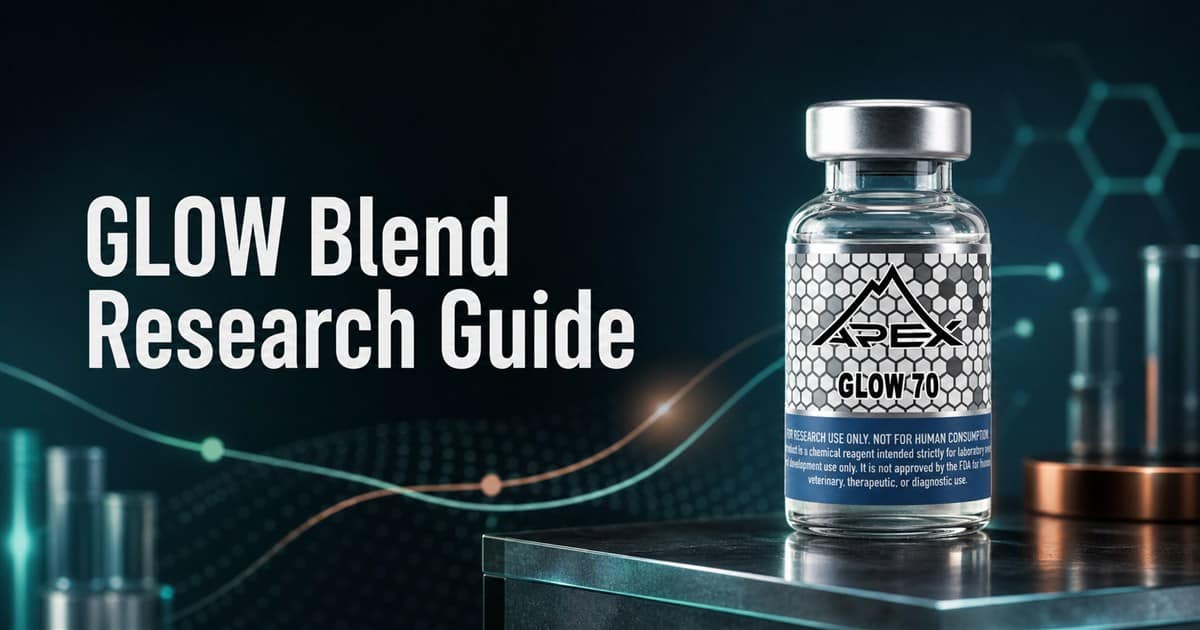
Apex Laboratory / GLOW explained
GLOW is a name used for a research peptide blend, not a single molecule. Apex’s 70 mg formula contains GHK-Cu 50 mg, BPC-157 10 mg and TB-500 10 mg. Those amounts describe what is labeled in the material. They do not show that the mixture produces the skin, recovery or other benefits sometimes attributed to its individual ingredients.
A blend can be easy to name and harder to evaluate. Start by checking which ingredients a supplier means by “GLOW.” Then ask a separate question: does the evidence test that combination, or only a component with a similar name? This guide follows both questions and shows how to read an actual three-component report.
What is in GLOW peptide blend?
The Apex configuration has three named components. GHK-Cu supplies the largest labeled mass, while BPC-157 and TB-500 have equal labeled amounts. The notation 5:1:1 is the same mass ratio as 50:10:10; it is not a claim that this is an optimal biological ratio.
The 70 mg formula
Three components. Three identities.
- GHK-Cu50 mgGly-His-Lys copper complex
- BPC-15710 mgA 15-residue peptide
- TB-50010 mgAc-LKKTETQ, seven residues
These components have different molecular masses, so a 5:1:1 mass ratio is not a 5:1:1 count of molecules. Nor does the total tell you a solution concentration: that requires a volume and a stated component or total basis.
GHK-Cu is the copper complex
Free GHK and copper-bound GHK-Cu are different material descriptions. The GLOW record identifies a 1:1 GHK-Cu complex. A study of copper-free GHK cannot automatically stand in for that ingredient.
TB-500 is the acetylated fragment
Apex identifies TB-500 as Ac-LKKTETQ, a seven-residue fragment. Full-length thymosin beta-4 has 43 residues. The 2012 analytical identification helps establish the fragment’s identity; it does not demonstrate a GLOW benefit.
Does GLOW work for skin or recovery?
The ingredient literature does not establish a clinical result for this exact three-component blend. Studies involving collagen-producing cells, tendon models or a parent protein help explain the research interest. They do not establish that the GLOW mixture improves skin, speeds recovery or produces a predictable result in people.
The scoped PubMed and ClinicalTrials.gov searches checked on September 8, 2026 did not identify an intervention study of the exact GHK-Cu/BPC-157/TB-500 50/10/10 formula. Papers mentioning all three ingredients included reviews; trials using the name “GLOW” concerned other interventions. This is a dated search finding, not a claim that every unpublished experiment has been located.
What was labeled?
The product configuration answers this: three ingredient names and three mass amounts. It establishes neither the measured contents of a particular lot nor a clinical effect.
What was measured?
A named report may provide component-specific identity, content and chromatographic results. Read the method and units for each endpoint; one percentage cannot answer all three questions.
What was studied?
A primary paper identifies the actual material, model, comparison and outcome. Check all four before applying an ingredient finding to a blend.
That distinction also matters for before-and-after photographs, testimonials and claims about how quickly GLOW “starts working.” Without an appropriate comparison and a defined preparation, they do not establish that this formula caused the change or support a reliable timeline.
What has each ingredient actually been studied for?
The short summaries below explain the research interest. Expand the details to see useful findings, negative results and identity limits. None of these rows is a study of the complete GLOW blend.
GHK-Cu
CELL AND ANIMAL MODELS
Maquart and colleagues reported increased collagen synthesis in fibroblast cultures. That is a finding in a defined cell system, not a demonstrated skin outcome from this blend. Read the 1988 study.
The GHK-Cu guide separately examines the copper complex, human topical research and other formulations. Evidence for a topical preparation cannot be assigned to a different material or route.
GHK-Cu study details: mixed results matter
A rat wound-chamber study measured extracellular-matrix changes with an inactive tripeptide control. A later study combined rat wound chambers with fibroblast cultures and reported differing responses for decorin and biglycan, two matrix-associated molecules. Maquart 1993; Siméon 2000.
In dermal fibroblast cultures, Siméon and colleagues found changes in MMP-2 and its tissue inhibitors. Copper ions reproduced the MMP-2 effect; free GHK did not. This is one reason chemical identity matters. These related studies share a research group, so their number alone is not a count of independent replications. Read the culture study.
A rat ligament-reconstruction study found early differences that did not persist at the later assessment. Another study found no significant improvement in the specified irradiated-rat wound outcomes. A useful summary includes those limits alongside positive findings. Fu 2015; Parker 2013. A 2026 orthopaedic narrative review reported that clinical evidence did not support GHK-Cu for musculoskeletal conditions; that narrower conclusion is distinct from saying no human topical research exists. Read the review.
BPC-157
EXPLANTS, CELLS AND ANIMALS
Chang and colleagues studied rat tendon explants and fibroblast behavior, including migration and survival. Hsieh and colleagues investigated vascular-cell responses and VEGFR2-associated signaling in experimental systems. These findings do not establish an additive GLOW effect. Chang 2011; Hsieh 2017.
The BPC-157 guide covers the current individual-component human reports and registries separately from this blend.
BPC-157 study details: a partial combination is still different
A separate report found no direct angiogenic effect in the tested cell cultures but observed different angiogenesis-related markers in injured-animal tissues. The model changed, so one simple “blood-vessel growth” label would hide the distinction. Brcic 2009.
A retrospective knee-pain report included four patients given BPC-157 with material described as thymosin beta-4. It lacked a control group and a validated outcome instrument, included no GHK-Cu, and did not establish equivalence to Apex’s acetylated fragment. A separate infusion report involved only two participants, both previously exposed to BPC-157. Neither establishes GLOW efficacy or a human safety profile for the mixture. Lee 2021; Lee 2025.
Those are examples, not the complete inventory of human BPC-157 reports. The broader review discusses three small human reports while emphasizing the lack of rigorous large studies. Review synthesis is context rather than an additional blend experiment. Read the 2025 review.
TB-500
FRAGMENT AND METABOLITE
In a 2024 study comparing acetylated TB-500 with metabolites, only Ac-LKKTE significantly accelerated scratch closure relative to control in the reported fibroblast assay. That result belongs to the metabolite and assay; it is not evidence that the original Ac-LKKTETQ ingredient or GLOW has that effect in people. Rahaman 2024.
The TB-500 guide follows the fragment, parent protein and primary identification evidence.
TB-500 study details: why parent-protein trials remain separate
A mouse wound study tested the short, non-acetylated sequence LKKTETQ. It is a related material, but its findings do not remove the terminal-chemistry distinction from acetylated Ac-LKKTETQ. Philp 2003.
Two completed registered studies tested topical full-length thymosin beta-4, each with 72 participants. Safety and tolerability were primary outcomes. The posted secondary wound-healing results were 4 of 17 placebo participants versus 12 of 55 pooled parent-protein participants in the venous-stasis study, and 3 of 18 versus 8 of 54 in the pressure-ulcer study. These counts do not demonstrate superiority and cannot be assigned to the fragment or GLOW. NCT00832091; NCT00382174. The registered records were checked September 8, 2026.
Why an ingredient list is not evidence of synergy
“Synergy” would require evidence that the combination produces a defined interaction or effect beyond the relevant comparison. Simply giving each ingredient a different proposed role does not demonstrate that interaction. Nor does separate-component research establish the mixture’s stability or behavior in solution.
A useful partial-combination example
Two ingredients were studied. GLOW was not.
A 2026 study assigned 32 rats to control, BPC-157, material named TB-500, or the two together after Achilles-tendon injury. It included no GHK-Cu. The combined arm did not provide additional benefit over either single-component arm; it had a lower total Movin score than control, but only the TB-500 arm reached significance for maximum load to failure.
Only four tendons per group were used for each outcome category, and the paper did not provide a sequence or mass for its TB material. These details prevent it from establishing a result for Apex’s exact fragment or three-component formula. Biçer and colleagues, 2026.
A separate 2026 scoping review covering these and other peptides concluded that claimed musculoskeletal benefits remained unsubstantiated by the human trials it reviewed. It is a synthesis of component research, not a GLOW intervention. Read the scoping review.
How is GLOW different from KLOW?
Apex’s KLOW configuration keeps the same three labeled amounts and adds KPV 10 mg. GLOW contains no KPV. This is a difference in composition, not a demonstrated ranking of effectiveness.
- GLOW · 70 mg
- GHK-Cu 50 mg + BPC-157 10 mg + TB-500 10 mg
- KLOW · 80 mg
- The same three amounts, plus KPV 10 mg
The KLOW guide explains the fourth ingredient and its specific evidence. The existing KLOW, GLOW and BPC/TB-500 comparison covers the wider family. There is no need to treat a larger total as a stronger formula.
Read an actual GLOW report in three separate columns
The current example below is a published Apex Laboratory record, not a promise about the lot assigned to an order. It lets you distinguish label amount, reported active content and chromatographic detector-area purity without turning them into one combined number.
Published record example
APX-COA-2026-0907-G
- Configuration
- GLOW 70 mg · P2710-SIMPLE
- Lot
- APX-2026-0907-G
- Issuer
- Apex Laboratory · in-house testing
- Issue date
- September 7, 2026
On a narrow screen, scroll the table horizontally to inspect all four columns.
| Component | Label amount | Reported active content | Reported chromatographic purity |
|---|---|---|---|
| GHK-Cu (1:1 complex) | 50 mg | 50.008 mg/vial | 99.86% integrated detector area |
| BPC-157 | 10 mg | 9.9973 mg/vial | 99.882% integrated detector area |
| TB-500 (Ac-LKKTETQ) | 10 mg | 10.0043 mg/vial | 99.889% integrated detector area |
Source: view report APX-COA-2026-0907-G. The numbers are the report’s stated results for individual analytes. The mg/vial endpoint is not the same measurement as an integrated detector-area percentage. Multiplying a label amount by that percentage does not calculate active content, and averaging the three percentages does not create a valid “GLOW purity.”
The issue date identifies the certificate rather than a testing date. The issuer is Apex Laboratory; this is not independent third-party analysis. Read any additional endpoint under its own method and sampling scope. Identity and analytical results do not establish the complete blend’s clinical effect, stability under an untested condition, or suitability for human use.
Use the COA-reading guide, HPLC result guide and mass-spectrometry identity guide for the methods behind these fields. The Lab Verified library lists published records; the GLOW product page owns current material options and availability.
Frequently Asked Questions about GLOW
Is GLOW one peptide or a blend?
GLOW is a blend name, not one molecular identity. Apex’s 70 mg configuration contains GHK-Cu 50 mg, BPC-157 10 mg and TB-500 10 mg. Check the actual ingredient list when comparing similarly named preparations.
What does the 5:1:1 GLOW ratio mean?
It describes relative labeled mass: 50 mg of GHK-Cu to 10 mg each of BPC-157 and TB-500. It is not a molar ratio, a solution concentration or evidence that the ratio is biologically optimal.
Does GLOW contain KPV?
Apex’s GLOW 70 mg formula does not contain KPV. Its KLOW 80 mg formula keeps the same three labeled amounts and adds KPV 10 mg. This composition difference does not establish that either formula is more effective.
Does GLOW help with weight loss?
The studies discussed here do not establish a weight-loss effect for the exact three-component GLOW formula. Research on a different peptide or an individual ingredient cannot establish that result for the mixture.
How long does GLOW take to work?
These records do not establish a reliable human response timeline for the exact blend. A cell-assay observation, an animal experiment or a before-and-after photograph cannot determine how quickly this preparation would produce a clinical result.
What are the side effects of GLOW peptide blend?
The human safety profile of the exact blend is not established by these records. A small study of one component, a different chemical form or a different route cannot quantify the mixture’s risks in people. A COA does not answer the clinical safety question.
Is the TB-500 ingredient full-length thymosin beta-4?
No. Apex identifies the TB-500 ingredient as the acetylated seven-residue fragment Ac-LKKTETQ. The parent thymosin beta-4 protein has 43 residues. Studies of the parent or a metabolite need to remain attached to the material actually tested.
Does a high purity result prove the GLOW formula works?
No. A component’s chromatographic detector-area result answers an analytical question under a stated method. Active content is a separate endpoint, and neither establishes a combined clinical effect. Averaging the three area percentages does not create a valid blend-purity result.
Follow the question to its source
For deeper ingredient evidence, continue with the GHK-Cu, BPC-157 or TB-500 guide. The tissue-repair research guide places related materials in context, while the research-grade explanation separates a reagent description from pharmaceutical approval and therapeutic equivalence.
Sources and study details
- Esposito S et al. Synthesis and characterization of the N-terminal acetylated 17-23 fragment of thymosin beta 4 identified in TB-500, a product suspected to possess doping potential. Drug testing and analysis. 2012. PMID 22962027.
- Maquart FX et al. Stimulation of collagen synthesis in fibroblast cultures by the tripeptide-copper complex glycyl-L-histidyl-L-lysine-Cu2+. FEBS letters. 1988. PMID 3169264.
- Maquart FX et al. In vivo stimulation of connective tissue accumulation by the tripeptide-copper complex glycyl-L-histidyl-L-lysine-Cu2+ in rat experimental wounds. The Journal of clinical investigation. 1993. PMID 8227353.
- Siméon A et al. The tripeptide-copper complex glycyl-L-histidyl-L-lysine-Cu2+ stimulates matrix metalloproteinase-2 expression by fibroblast cultures. Life sciences. 2000. PMID 11045606.
- Siméon A et al. Expression of glycosaminoglycans and small proteoglycans in wounds: modulation by the tripeptide-copper complex glycyl-L-histidyl-L-lysine-Cu(2+). The Journal of investigative dermatology. 2000. PMID 11121126.
- Fu SC et al. Tripeptide-copper complex GHK-Cu (II) transiently improved healing outcome in a rat model of ACL reconstruction. Journal of orthopaedic research : official publication of the Orthopaedic Research Society. 2015. PMID 25731775.
- Parker NP et al. Effects of topical copper tripeptide complex on wound healing in an irradiated rat model. Otolaryngology–head and neck surgery : official journal of American Academy of Otolaryngology-Head and Neck Surgery. 2013. PMID 23744835.
- Mayfield CK et al. Injectable Peptide Therapy: A Primer for Orthopaedic and Sports Medicine Physicians. The American journal of sports medicine. 2026. PMID 41476424.
- Chang CH et al. The promoting effect of pentadecapeptide BPC 157 on tendon healing involves tendon outgrowth, cell survival, and cell migration. Journal of applied physiology (Bethesda, Md. : 1985). 2011. PMID 21030672.
- Brcic L et al. Modulatory effect of gastric pentadecapeptide BPC 157 on angiogenesis in muscle and tendon healing. Journal of physiology and pharmacology : an official journal of the Polish Physiological Society. 2009. PMID 20388964.
- Lee E et al. Intra-Articular Injection of BPC 157 for Multiple Types of Knee Pain. Alternative therapies in health and medicine. 2021. PMID 34324435.
- Lee E et al. Safety of Intravenous Infusion of BPC157 in Humans: A Pilot Study. Alternative therapies in health and medicine. 2025. PMID 40131143.
- McGuire FP et al. Regeneration or Risk? A Narrative Review of BPC-157 for Musculoskeletal Healing. Current reviews in musculoskeletal medicine. 2025. PMID 40789979.
- Philp D et al. Thymosin beta 4 and a synthetic peptide containing its actin-binding domain promote dermal wound repair in db/db diabetic mice and in aged mice. Wound repair and regeneration : official publication of the Wound Healing Society [and] the European Tissue Repair Society. 2003. PMID 12581423.
- Rahaman KA et al. Simultaneous quantification of TB-500 and its metabolites in in-vitro experiments and rats by UHPLC-Q-Exactive orbitrap MS/MS and their screening by wound healing activities in-vitro. Journal of chromatography. B, Analytical technologies in the biomedical and life sciences. 2024. PMID 38382158.
- Biçer O et al. Effects of BPC-157 and TB-500 on Achilles tendon healing in rats: A histopathological and biomechanical study. Joint diseases and related surgery. 2026. PMID 42542926.
- Tewari K et al. Peptide Supplements and Their Therapeutic Applications in Sports Medicine. The American journal of sports medicine. 2026. PMID 42578445.
- Hsieh MJ et al. Therapeutic potential of pro-angiogenic BPC157 is associated with VEGFR2 activation and up-regulation. Journal of molecular medicine (Berlin, Germany). 2017. PMID 27847966.
Research use: Apex materials are supplied for laboratory research, not human or veterinary consumption. This guide explains composition, studies and analytical records; it does not provide administration, dosing or treatment instructions.