
Searching this phrase leads to supplier pages, comparison articles, community discussions, and results about the unrelated AdaMax optimization algorithm. Those results do not all refer to one scientifically defined substance. The useful task is therefore not to choose the most repeated description; it is to separate the public naming record from evidence that directly supports a specific claim.
- “Adamax peptide” is retained here as the phrase people search, not as proof that one peptide identity has been established.
- Market descriptions conflict, and repetition across commercial or secondary pages does not reconcile them.
- The targeted literature and registry searches located no direct Adamax peptide record under that exact name.
- Semax studies remain Semax evidence; adamantane studies remain evidence about the particular molecules they tested.
- A defensible evaluation starts with source wording and compound specificity before any analytical method is interpreted.
- No CAS number, molecular formula, molecular weight or public compound record exists for Adamax; the identifiers set out below belong to Semax, a different molecule.
- Adamax holds no approval or marketing authorisation from any regulator, and no registered clinical trial uses the name.
What does the Adamax name establish?
The name establishes that a source is discussing something it calls Adamax. It does not, by itself, establish a sequence, structure, attachment chemistry, formula, molecular mass, registry identifier, or relationship to another compound. Public-facing descriptions assign incompatible meanings to the same word. Without a primary record that reconciles those descriptions, selecting one would be an unsupported molecular identity assignment.
| Record element | What was found | What it establishes |
|---|---|---|
| Search phrase | “Adamax peptide” appears in market and search language | A discoverable term, not a resolved analyte |
| Public descriptions | Descriptions conflict in compound class and claimed relationship | A naming conflict that must remain visible |
| Direct literature | No direct Adamax peptide paper located in the dated targeted search | An evidence gap for that exact term, not proof that no record can ever exist |
| Authoritative exact-name records | No exact-name compound or trial record located in the reviewed registry searches | No authoritative resolution from those searches |
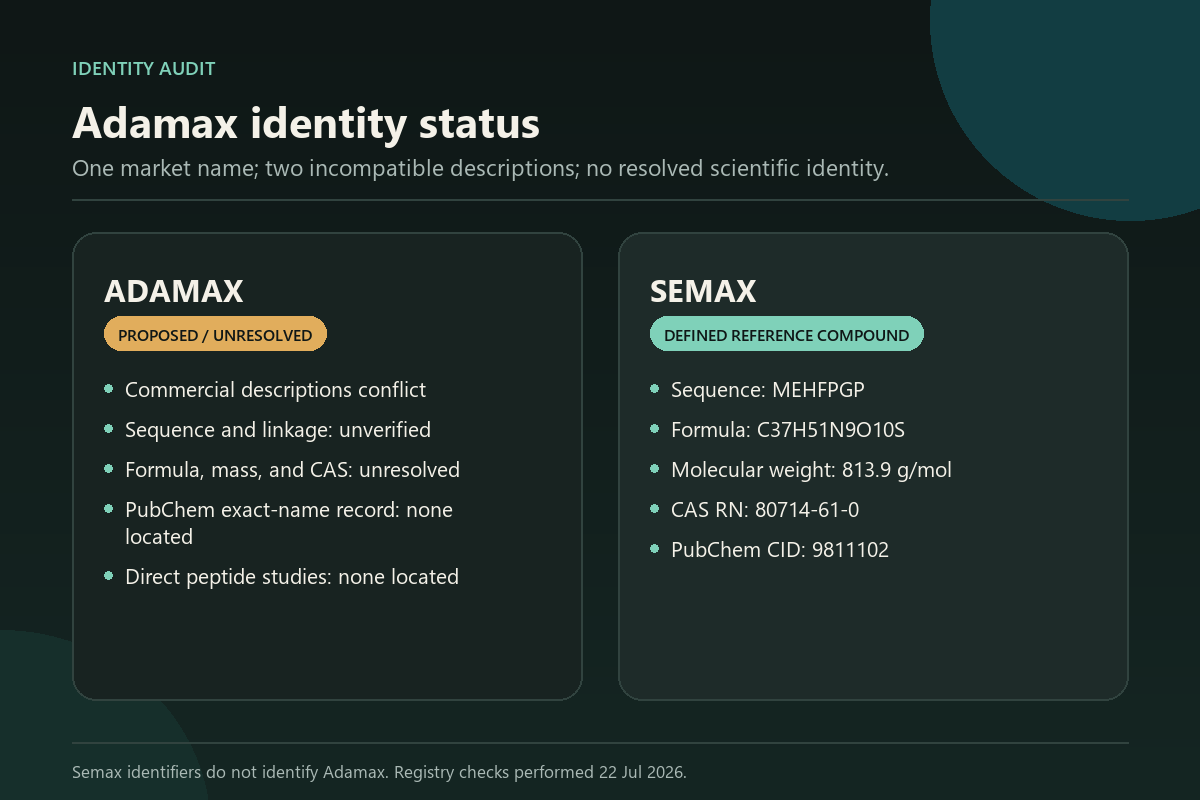
This distinction is the central limitation of the page. An article can report that different sources use the name differently. It cannot turn those descriptions into one molecule without a source capable of resolving the conflict.
Which identity fields exist, and which do not?
A research reagent is normally pinned down by five fields: an amino-acid sequence, a CAS registry number, a molecular formula, an average molecular mass, and an entry in a public compound database. Together they define the expected analyte that any later measurement is compared against. For material discussed under the Adamax name, all five are empty, so the fields are printed as found.
| Identity field | Adamax — the searched name | Semax — a separate, documented compound |
|---|---|---|
| Amino-acid sequence | None published. Supplier text does not agree on the backbone, the attachment point, or whether an adamantane group is present at all. | Met-Glu-His-Phe-Pro-Gly-Pro (one-letter MEHFPGP): the ACTH(4-7) fragment extended by a C-terminal Pro-Gly-Pro tripeptide. |
| CAS registry number | None located. | 80714-61-0 |
| Molecular formula | Not established. | C37H51N9O10S |
| Average molecular weight | Not established. Supplier pages quote an inconsistent approximate range of about 984 to 1032 g/mol, which is supplier-reported and unverified. | 813.9 g/mol |
| Public compound record | An exact-name lookup returned no compound record on July 22, 2026 or July 25, 2026. | PubChem CID 9811102; UNII I5FAL2585H. |
Source for the Semax column: the PubChem compound record for CID 9811102, read July 25, 2026. There is no equivalent record to read for Adamax.
Setting a documented column beside an empty one is a contrast, not an assignment. A registry entry describes only the molecule it was issued for; it cannot lend a formula, a mass or a sequence to a different name that sits near it in supplier copy.
The supplier-quoted mass range repays a closer look. A defined peptide has one average mass, not a 48 g/mol spread. A gap that wide is what you would expect if vendors were describing different materials, different salt forms, or no measured material at all. It describes the market, not a substance.
What did the direct Adamax search find?
Dated direct-evidence search
The PubMed search run on July 22, 2026 used two title-and-abstract queries. The exact query for “Adamax” returned 39 records, but inspection showed uses of AdaMax as an optimization algorithm rather than the market term discussed here. A narrower query requiring Adamax together with peptide, Semax, or adamantane returned zero records.
The same review did not locate an exact-name Adamax compound through PubChem’s name endpoint or an Adamax study in ClinicalTrials.gov. These are dated negative-search findings. They do not exclude a differently named, non-indexed, proprietary, or future record, and they should not be rewritten as proof of universal absence.

That source ranking matters. A supplier or secondary article can show how a term is used in the market. It cannot substitute for a direct study when the claim concerns biological activity, and it cannot substitute for an authoritative identity record when the claim concerns structure.
How should claims made under the Adamax name be checked?
Start with the source’s exact wording instead of a paraphrase. Record whether the source is primary research, an authoritative database, a secondary summary, or a commercial page; note the access date and search scope; then ask whether the record studies Adamax itself or a different named compound. A source is useful only for the claim it actually supports.

This method prevents two common errors: treating search visibility as scientific validation and treating evidence about a related compound as if it directly studied the unresolved term.
Why do Semax studies not validate Adamax?
Semax is a separately defined compound with its own indexed literature, and that literature reports specific numbers in specific models. In glial cell cultures taken from the basal forebrain of newborn rats, BDNF messenger RNA rose 8-fold and NGF messenger RNA rose 5-fold against control 30 minutes after in-vitro Semax exposure (PMID 11457573). In rat basal forebrain, tritium-labelled Semax showed specific, calcium-dependent binding with a dissociation constant of 2.4 ± 1.0 nM and a Bmax of 33.5 ± 7.9 fmol/mg protein, and intranasal Semax at 50 and 250 µg/kg raised BDNF protein in that region within 3 hours while cerebellar levels were unchanged (PMID 16635254). A single intranasal 50 µg/kg dose produced a maximal 1.4-fold rise in hippocampal BDNF protein, a 1.6-fold rise in trkB tyrosine phosphorylation, and 3-fold and 2-fold rises in exon III BDNF and trkB messenger RNA in rats (PMID 16996037).
Every one of those figures carries a rat model, a stated route and a stated dose, and every one was measured on Semax. None was measured on material sold or searched as Adamax. Semax has a human clinical literature as well — one Russian rehabilitation study enrolled 110 patients after ischemic stroke and gave semax as two 10-day courses at 6000 mcg/day (PMID 29798983) — but those figures stay with the dedicated Semax guide, which is where the design limits of that record are assessed.
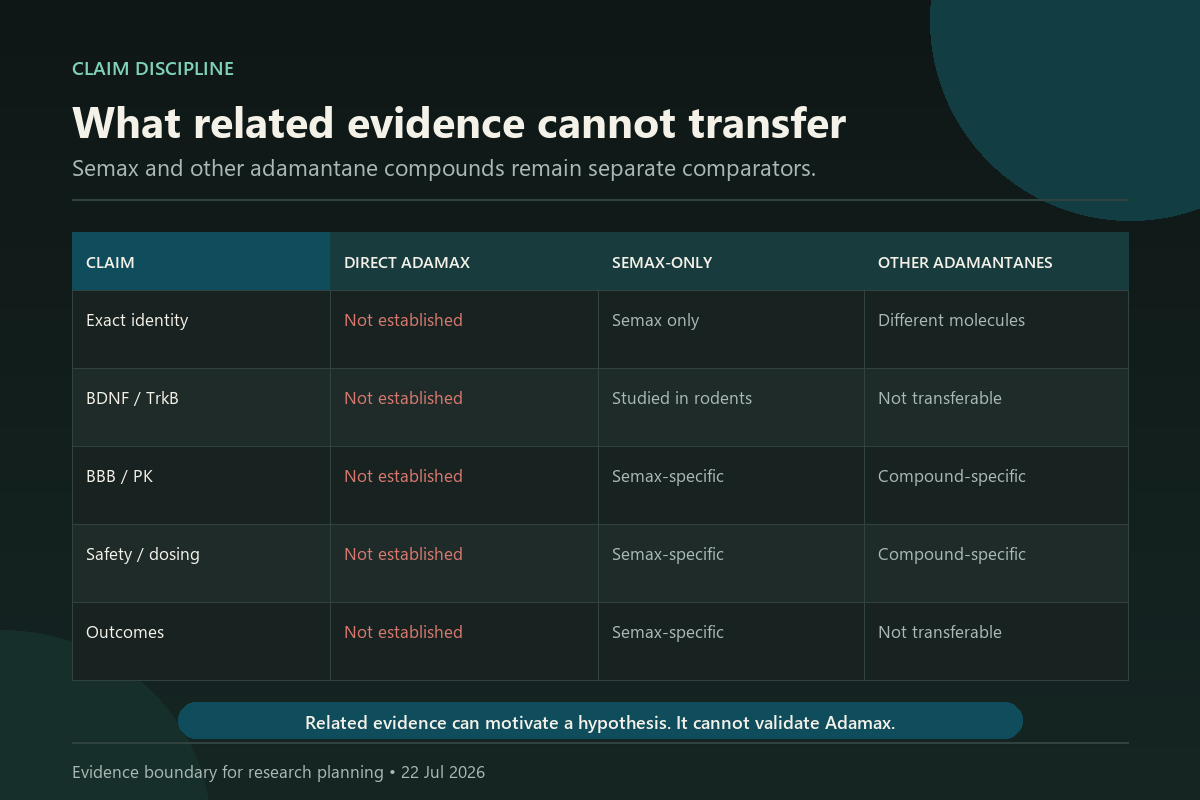
Those papers can help formulate questions for a separately defined test material. They cannot establish that Adamax has the same identity, exposure, target interaction, neurotrophin response, safety profile, or outcome. The boundary applies even when a market page calls Adamax a Semax variant: that description is the claim requiring evidence, not evidence by itself.
| Claim class | Related evidence can show | Related evidence cannot establish for Adamax |
|---|---|---|
| Identity | Semax has its own documented identity | That Adamax is Semax, a Semax variant, or any specific structure |
| Mechanism | Semax studies measured stated endpoints in stated models | An Adamax target, pathway, or BDNF/TrkB effect |
| Exposure | Other compounds may have measured physicochemical or pharmacokinetic properties | Adamax permeability, bioavailability, distribution, or duration |
| Safety and use | A study may report observations for its own compound and protocol | An Adamax safety profile, dose, route, cycle, or contraindication |
| Outcomes | Related molecules may produce model-specific findings | Cognitive, neuroprotective, therapeutic, or performance outcomes for Adamax |
What does adamantane context actually show?
Adamantane is a rigid carbon scaffold used in medicinal chemistry. A review by Lamoureux and Artavia describes how the scaffold has been incorporated into different molecules (PMID 20858176). It is a narrative review and reports no single quantitative result that could be attached to one molecule. That supports a general design-context statement, not a claim that one particular attachment, linkage, or property belongs to Adamax.
A separate mouse study reported learning, memory, neurogenesis and synaptic-plasticity endpoints after peripheral administration of a designed peptide. The paper is titled for neurotrophic peptides incorporating adamantane; its abstract names the tested compound as the hexapeptide Ac-DGGLAG-NH2, designated P21, given to adult C57Bl6 mice, and reports no quantitative result for those endpoints (PMID 20600002). That is a distinct molecule with a published sequence, and its results do not identify Adamax.
Even a chemically accurate generalization about an adamantane-bearing molecule would not resolve an unknown target. Attachment site, linker, ionization, conformation, formulation, and assay conditions can change a compound’s behavior. Claims such as improved stability, blood–brain barrier passage, longer duration, or higher bioavailability therefore remain unsupported for Adamax without direct compound-specific evidence.
What do the related sources actually report?
An earlier version of this page cited a wider source set and used it to sketch a mechanism. That sketch was not supportable and was removed. What those papers measured is a separate matter, and deleting the measurements along with the argument left the page vaguer than the record. The readouts are set out below, one row per source.
Additional reported findings. Every row reports a result for the compound in its first column. No row tested a material called Adamax.
| Compound tested | Model and species | Endpoint | Reported result | Source |
|---|---|---|---|---|
| Semax | Rodent striatum; 0.15 mg/kg intraperitoneal | 5-HIAA, a serotonin metabolite | Tissue 5-HIAA +25% at 2 hours; extracellular striatal 5-HIAA rose to about 180% over 1–4 hours; dopamine and its metabolites unchanged after Semax alone | PMID 16362768 |
| Amantadine, a small-molecule adamantane derivative and not a peptide | Post-mortem human brain tissue; rat striatal microdialysis | Tissue and extracellular drug concentration | 48.2–386 µM in human brain tissue after 10 days or more of treatment with a drug-free interval of 3 days or less; under 17 µM in cerebrospinal fluid and serum; 6–21 µM in rat striatal microdialysate; mean CSF/serum ratio 0.76 | PMID 8532138 |
| Adamantane derivatives in clinical use: amantadine, memantine, rimantadine, tromantadine, adapalene, saxagliptin, vildagliptin | Narrative review of approved drugs | Mechanism, pharmacokinetics, approved indications | Documents the scaffold in approved antiviral, antidiabetic, dermatological and neurodegenerative-disease drugs; reports no single quantitative result of its own | PMID 27222266 |
| More than 75 natural and synthetic adamantane derivatives | Comparative structure–activity review | Reported potential against neurodegenerative disease | Places 1-fluoro- and 1-phosphonic-acid adamantane derivatives above amantadine and memantine on stated pharmacological potential; reports no quantitative endpoint for any individual compound | PMID 32819589 |
Two of those rows describe amantadine, a small molecule with no peptide bond in it, and two are reviews rather than experiments. That is the honest shape of the surrounding literature: a characterised scaffold on one side, a characterised heptapeptide on the other, and nothing between them tested under this guide’s title.
Other sources removed in the same edit have not been reinstated. A hypothesis article proposing Semax for unrelated indications contains no experimental data, and three melanocortin-receptor papers tested other agonists in rat hypothalamus, rat astrocytes and experimental neurodegeneration models. Those four were links in the discarded chain; restoring them would rebuild the argument, not the evidence.
What is the regulatory status of Adamax?
Adamax has no regulatory status anywhere. There is no approval or marketing authorisation from the FDA, the EMA, the NMPA, the MHRA, the PMDA, the TGA or Health Canada; no pending filing was located; and a ClinicalTrials.gov query for the term returned no registered study when it was re-run on July 25, 2026. Because no approved medicine shares the name, there is also no approved counterpart to set beside it, so the research-grade-versus-pharmaceutical comparison this library applies to compounds such as semaglutide or tirzepatide has nothing to attach to here.
Semax has its own, different status. Russian-language clinical literature describes the peptide in post-stroke care, but Semax holds no FDA or EMA approval, and no primary regulatory record was retrieved for this review, so no registration authority or date is asserted here.
Adamantane, the scaffold named in the first half of the search term, is a third case. A review of adamantane derivatives in clinical practice lists amantadine, memantine, rimantadine, tromantadine, adapalene, saxagliptin and vildagliptin as approved drugs, and reports no single quantitative result of its own (PMID 27222266). Approval attached to each of those specific molecules after each was evaluated. A structural motif does not carry regulatory status forward to anything else built around it.
None of this is a safety statement. Absence of approval is not evidence of harm and not evidence of benefit; it means no regulator has assessed the material.
How can an identity claim be evaluated without assigning a molecule?
Begin by defining the question. A terminology question asks how sources use a name. A chemical-identity question requires an unambiguous expected analyte from an authoritative primary record. A biological claim requires direct evidence for that analyte in the stated model. These are different tasks, and no one document or instrument answers all three.
High-performance liquid chromatography describes how a sample separates under a specified method. It can support a method-dependent purity profile, but a dominant peak does not uniquely establish complete structure. Mass spectrometry can test whether observed ions are consistent with an expected mass model, but a mass match alone may not distinguish linkage positions, isomers, sequence alternatives, or mixtures.
A certificate-of-analysis reading guide can help distinguish reported method, result, reference, and limitation. The certificate still has to be interpreted against a defined target; it cannot make an unresolved market name chemically specific by itself.
What remains unknown, and what is the next useful step?
The exact Adamax identity, the relationship between conflicting descriptions, and any compound-specific mechanism, exposure profile, safety record, or outcome remain unresolved in the source set reviewed here. The term should therefore be quoted as a market/search label when used in notes, datasets, or literature reviews, with the source and date recorded beside it.
The next useful step is documentary, not promotional: locate a primary record that defines the compound unambiguously and then evaluate each claim against that record. Until such a source is available, readers can use the Research Library for related scientific and analytical explainers and review the site’s editorial standards for source selection and correction policy.
Frequently Asked Questions
What does the phrase “Adamax peptide” mean?
The phrase “Adamax peptide” is a market/search term, not a resolved chemical identity. Public descriptions conflict, and the dated searches used for this explainer did not locate a direct Adamax peptide paper or an authoritative exact-name compound record.
Is Adamax a verified chemical identity?
Not on the evidence located for this review. The name is attached to conflicting descriptions, and no primary source or authoritative registry record found in the July 22, 2026 search resolved those descriptions into one verified identity.
Does Adamax have a CAS number, molecular formula or molecular weight?
No. No CAS registry number, molecular formula or established molecular weight was located for Adamax, and an exact-name compound lookup returned no record on July 22, 2026 or on July 25, 2026. Supplier pages quote an inconsistent approximate range of about 984 to 1032 g/mol, which is supplier-reported and unverified. The identifiers CAS 80714-61-0, formula C37H51N9O10S and mass 813.9 g/mol belong to Semax, a separate compound, and do not describe Adamax.
Is Adamax approved by any regulator?
No. Adamax has no approval or marketing authorisation from the FDA, the EMA, the NMPA or any other regulator, and a ClinicalTrials.gov query for the term returned no registered study on July 25, 2026. No approved medicine shares the name, so there is no approved counterpart to compare it against.
Do Semax studies validate Adamax?
No. Semax studies describe Semax in their stated models. They do not establish an Adamax identity, exposure profile, mechanism, safety profile, dose, or outcome, even when market descriptions place the two names near each other.
Was direct Adamax peptide research found?
No direct Adamax peptide study was located in the targeted PubMed search run on July 22, 2026. Exact-name results referred to the AdaMax optimization algorithm, while the narrower Adamax-plus-peptide, Semax, or adamantane query returned zero records.
Why does adamantane appear in Adamax descriptions?
Adamantane is a scaffold used in medicinal chemistry, and distinct adamantane-bearing molecules have been studied. That context can explain why the term appears in market descriptions, but it does not prove an Adamax structure, attachment, property, or biological effect.
How should an unresolved identity claim be evaluated?
Start with a primary source that unambiguously defines the expected analyte and the claim being tested. HPLC, mass spectrometry, and a certificate of analysis can each contribute different information, but none can convert an undefined market name into a verified structure by itself.
Does this article validate a commercial Adamax listing?
No. This article does not assign or validate any commercial SKU, vial, lot, certificate of analysis, or listing, including Apex. Its scope is limited to the public naming record, the direct-evidence search, and the boundaries on transferring related-compound evidence.
References and search record
- Shadrina MI, et al. Rapid induction of neurotrophin mRNAs in rat glial cell cultures by Semax, an adrenocorticotropic hormone analog. Neurosci Lett. 2001;308(2):115-8. PMID: PMID 11457573.
- Dolotov OV, et al. Semax, an analogue of adrenocorticotropin (4-10), binds specifically and increases levels of brain-derived neurotrophic factor protein in rat basal forebrain. J Neurochem. 2006;97 Suppl 1:82-6. PMID: PMID 16635254.
- Dolotov OV, et al. Semax, an analog of ACTH(4-10) with cognitive effects, regulates BDNF and trkB expression in the rat hippocampus. Brain Res. 2006;1117(1):54-60. PMID: PMID 16996037.
- Li B, et al. Neurotrophic peptides incorporating adamantane improve learning and memory, promote neurogenesis and synaptic plasticity in mice. FEBS Lett. 2010;584(15):3359-65. PMID: PMID 20600002.
- Lamoureux G, et al. Use of the adamantane structure in medicinal chemistry. Curr Med Chem. 2010;17(26):2967-78. PMID: PMID 20858176.
PubMed searches were run July 22, 2026 using "Adamax"[Title/Abstract] and "Adamax"[Title/Abstract] AND ("peptide"[Title/Abstract] OR "semax"[Title/Abstract] OR "adamantane"[Title/Abstract]). The exact query returned algorithm-related records; the narrowed query returned zero. PubChem exact-name and ClinicalTrials.gov searches also returned no Adamax record in this run. All four checks were repeated on July 25, 2026 with the same outcome, and the Semax identifiers in the identity table were read from PubChem CID 9811102 on that date.