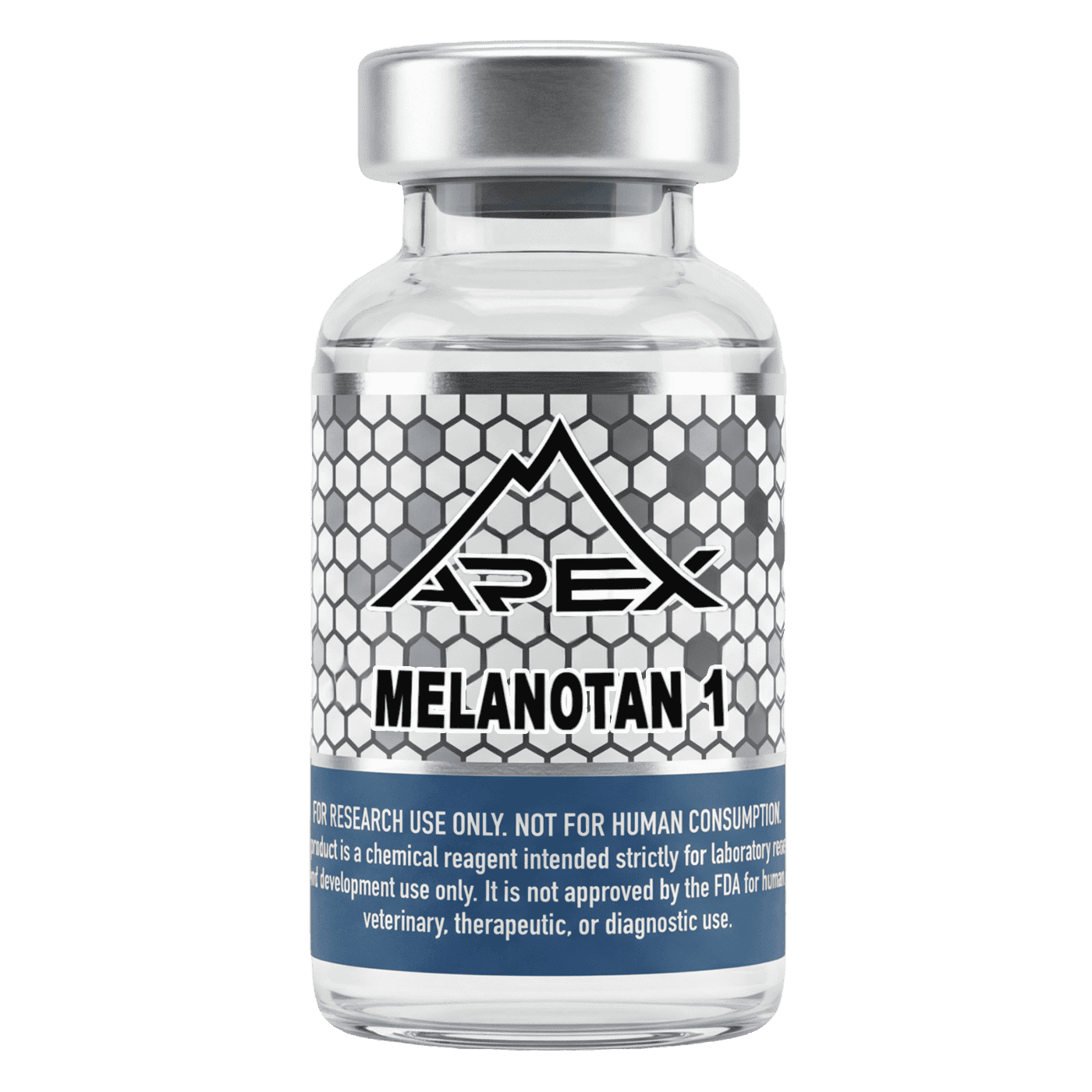
Batch documentation
Certificate of analysis
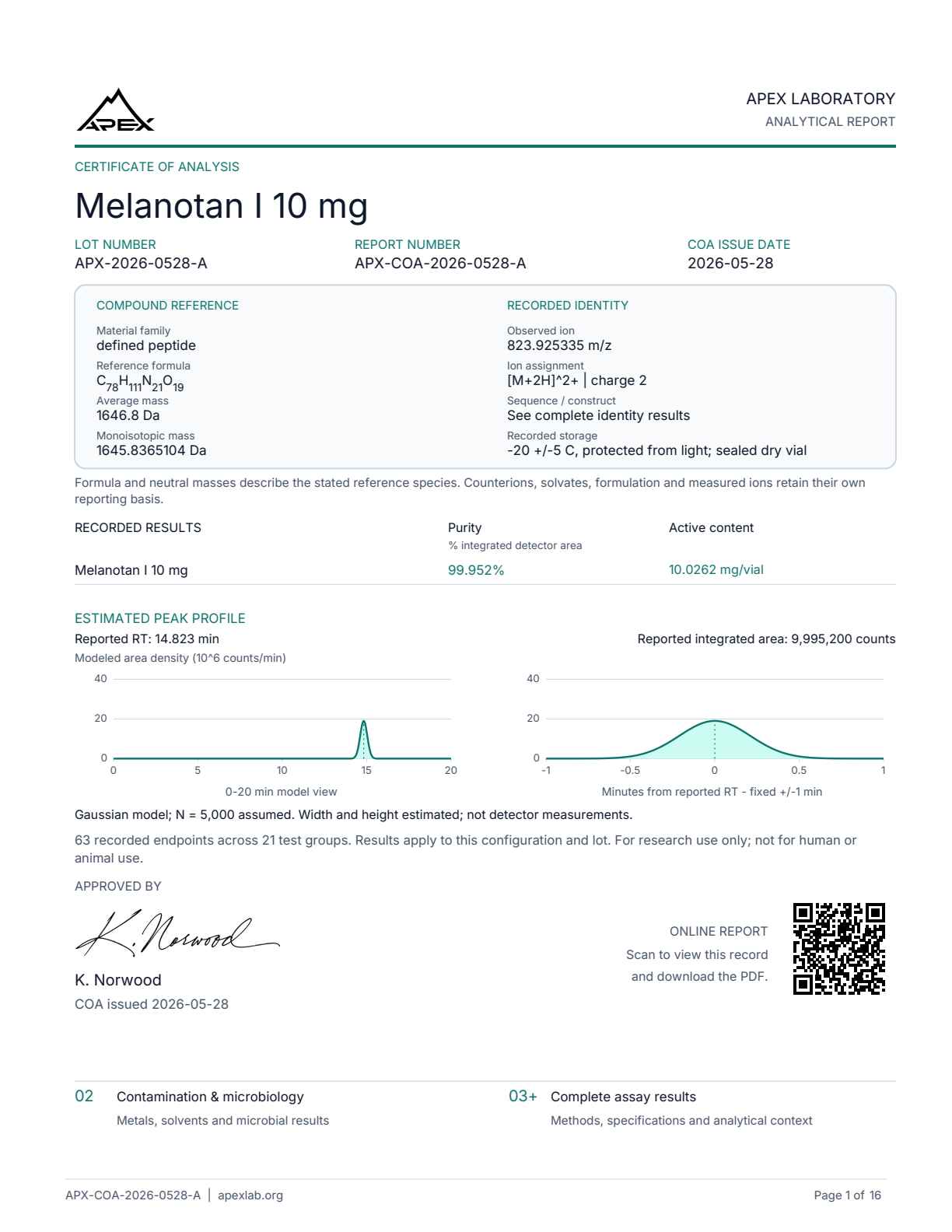
Apex Laboratory results for the listed configurations. Match the lot on your label with the report.
Melanotan I 10 mg
- Melanotan I 10 mg chromatographic purity
- 99.952 % integrated detector area
- Melanotan I 10 mg active content
- 10.0262 mg/vial
- MC1R cAMP response relative potency
- 100.05 % reference response potency
- Bacterial endotoxins
- <0.025 EU/mg active-equivalent
Chromatographic purity by analyte

About this graph
Recorded scalar results against the stated specification. Each row uses its own labeled scale; purity is detector-area purity, not active-material content.
Measured active content

About this graph
Calibrated active content, concentration or activity compared with the stated same-unit specification. Each row uses its own labeled scale; no conversion from chromatographic purity is made.
Melanotan I (afamelanotide; NDP-α-MSH) is a linear tridecapeptide analog of α-melanocyte-stimulating hormone studied as a potent, metabolically stabilized agonist of the melanocortin-1 receptor (MC1R). The latest published in-house report is Melanotan I 10 mg — lot APX-2026-0528-A (COA issued 2026-05-28). Match the report configuration and lot to the label on your material. Supplied by Apex Laboratory strictly as a high-purity reference reagent for in-vitro laboratory research; not for human consumption, veterinary use, or any therapeutic application.
Compound Overview
Melanotan I is the research designation for afamelanotide, formally [Nle⁴, D-Phe⁷]-α-MSH. It is built on the native α-MSH backbone (Ac-Ser-Tyr-Ser-Met-Glu-His-Phe-Arg-Trp-Gly-Lys-Pro-Val-NH₂) but carries two deliberate substitutions that define its behaviour in receptor assays: methionine at position 4 is replaced with norleucine (Nle), removing the oxidation-prone thioether and conferring marked resistance to enzymatic and chemical degradation, while the L-phenylalanine at position 7 is inverted to its D-enantiomer (D-Phe). The D-Phe⁷ switch locks the critical His-Phe-Arg-Trp pharmacophore into a conformation that binds melanocortin receptors with greatly increased affinity and a longer functional half-life than the parent hormone.
Functionally, the peptide is an agonist at MC1R, the melanocortin receptor subtype expressed on epidermal melanocytes. MC1R is a Gαs-coupled GPCR; agonist binding raises intracellular cyclic AMP, activates protein kinase A, and drives phosphorylation of CREB and induction of the microphthalmia-associated transcription factor (MITF). MITF in turn upregulates tyrosinase and the TYRP1/DCT enzymes that govern the eumelanin synthesis cascade — the canonical readout used when Melanotan I is applied to melanocyte and melanoma cell models. What distinguishes Melanotan I from its sibling Melanotan II is breadth of receptor engagement: Melanotan I is a linear 13-residue peptide that binds predominantly to MC1R, whereas Melanotan II is a truncated cyclic heptapeptide that activates MC1R, MC3R, MC4R and MC5R, the alpha-MSH-responsive melanocortin receptors. Researchers comparing receptor-subtype contributions therefore reach for Melanotan I when MC1R-driven cAMP signalling is the experimental variable to be isolated.
Research Background & Published Literature
Afamelanotide is among the most thoroughly characterised melanocortin analogs in the literature, with a research history stretching back to the foundational Arizona melanotropin program of the 1980s and 1990s. As a defined, metabolically stabilized synthetic agonist it became a standard tool for dissecting MC1R coupling to adenylate cyclase, for probing MITF-dependent transcriptional control of the eumelanin pathway, and for modelling melanocortin signalling in cellular photoprotection and oxidative-stress assays. Because the Nle⁴/D-Phe⁷ modifications give consistent, reproducible receptor activation, it is frequently used as a reference agonist when calibrating MC1R cAMP reporter systems or benchmarking newer melanocortin analogs in cell-based work. Apex supplies the lyophilized peptide solely as a laboratory reagent for such in-vitro studies.
Researchers exploring the published record around this compound can begin with the peer-reviewed sources below for context on its mechanism, signalling pathways, and use in controlled laboratory systems:
- PubMed — afamelanotide / MC1R melanocortin literature search
- PubChem — afamelanotide compound record and identifiers
Technical Specifications
| Product Name | Melanotan I 10mg |
| Other Names / Synonyms | Afamelanotide; NDP-α-MSH; [Nle⁴, D-Phe⁷]-α-MSH; Melanotan 1 |
| Classification | MC1R-preferring melanocortin receptor agonist |
| CAS Number | 75921-69-6 |
| Molecular Formula | C₇₈H₁₁₁N₂₁O₁₉ |
| Molecular Weight | 1646.85 g/mol (average, anhydrous free base; monoisotopic [M+H]⁺ observed 1647.01, expected 1646.84) |
| Sequence / Structure | Linear 13-amino-acid α-MSH analog (C-terminal amide) with Nle⁴ and D-Phe⁷ substitutions |
| Purity Specification | ≥99% (HPLC + MS verified — this lot 99.82%, see chromatogram above) |
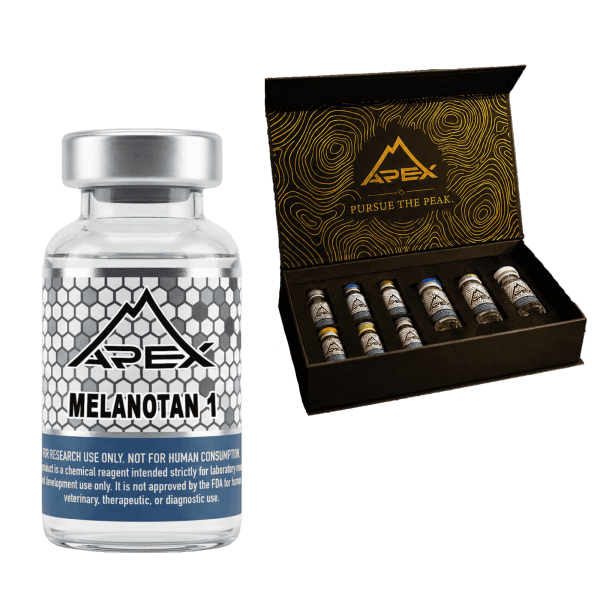
| Physical Form | Lyophilized (freeze-dried) powder in sealed glass vial |
| Recommended Diluent | Bacteriostatic water or sterile water for laboratory reconstitution |
| Available Sizes | 10 mg per vial ($45.00) |
| Intended Use | In-vitro research use only — not for human consumption |
Storage, Handling & Stability
Store the sealed, lyophilized vial at -20°C for long-term stability; protected from light and moisture, the dry powder is robust over extended periods. Although the Nle⁴ substitution makes Melanotan I considerably more degradation-resistant than native α-MSH, it remains a linear peptide and is therefore inherently more conformationally labile than cyclic melanocortin analogs once in solution. Reconstitute only the quantity required for immediate assay work; once dissolved, hold reconstituted material at 2–8°C and use within 14 days, and aliquot to avoid repeated freeze–thaw of the working stock. Because the Trp⁹-adjacent indole and aromatic residues are mildly photosensitive, shield prepared solutions from direct light during handling.
- Allow the vial to equilibrate to room temperature before opening to prevent condensation on the cold powder.
- Reconstitute gently down the vial wall — avoid vigorous vortexing that can shear or foam the dissolved peptide.
- Aliquot reconstituted stock into single-use volumes to minimise freeze–thaw cycling of the linear backbone.
- Label each aliquot with compound name, concentration, reconstitution date, and operator initials for complete lot traceability.
- Wear appropriate PPE and follow your institution’s chemical safety protocols for handling synthetic peptides at all times.
Quality Assurance & Analytical Verification
Chromatographic purity and molecular identity are separate measurements. See Melanotan I 10 mg — lot APX-2026-0528-A, issued 2026-05-28, for the recorded results, acceptance criteria and methods. To understand how to interpret these figures yourself, see our guides on HPLC and mass-spectrometry purity verification and how to read a Certificate of Analysis, or review the full document set in the Lab Verified archive.
Frequently Asked Questions
How does Melanotan I differ from Melanotan II?
They are structurally distinct molecules. Melanotan I (afamelanotide) is a linear 13-residue analog of α-MSH that binds predominantly to MC1R, while Melanotan II is a truncated cyclic heptapeptide that acts as an agonist at MC1R, MC3R, MC4R and MC5R. Investigators isolating MC1R-driven cAMP and MITF signalling typically select Melanotan I; those probing wider melanocortin pharmacology often use Melanotan II.
Is Melanotan I the same compound as afamelanotide and NDP-α-MSH?
Yes. Melanotan I, afamelanotide, and NDP-α-MSH are names for one molecule — [Nle⁴, D-Phe⁷]-α-MSH, CAS 75921-69-6, molecular weight 1646.85 g/mol. The “NDP” label refers directly to the Nle⁴ (norleucine) and D-Phe⁷ substitutions that distinguish it from the native hormone.
What receptor pathway does Melanotan I activate in cell models?
In melanocyte and melanoma cell assays Melanotan I binds MC1R, a Gαs-coupled receptor, raising intracellular cAMP and activating PKA/CREB signalling. This induces MITF and downstream tyrosinase expression, which is why the eumelanin-synthesis cascade is the standard transcriptional and enzymatic readout in MC1R research with this peptide.
Why is the norleucine substitution important for laboratory work?
Replacing the oxidation-prone methionine at position 4 with norleucine removes a reactive thioether, giving the peptide markedly greater resistance to enzymatic and chemical degradation than native α-MSH. For researchers this translates into more reproducible potency and a more stable reference standard across repeated assays, provided storage and reconstitution guidance is followed.
What diluent should be used to reconstitute the lyophilized powder?
Bacteriostatic water or sterile water is standard for laboratory reconstitution of this peptide. Calculate your target mg/mL from the 10 mg vial mass and chosen solvent volume using our peptide reconstitution calculator, then follow aseptic technique as described in how to reconstitute peptides.
Is this product approved for human use?
No. All compounds sold by Apex Laboratory are classified as chemical research reagents intended strictly for in-vitro laboratory research. The lyophilized Melanotan I (afamelanotide) supplied here is not approved for human consumption, veterinary use, or any therapeutic application, and nothing on this page describes, recommends, or endorses use in or on the body. It is offered only as a reference reagent for cell-based and other laboratory model studies. Purchasers who imply intended bodily use will have their orders cancelled and their accounts permanently suspended.
Related Research Compounds
Researchers studying melanocortin-receptor pharmacology may also be interested in related compounds from Apex Laboratory: Melanotan II 10mg (cyclic agonist at MC1R, MC3R, MC4R and MC5R), PT-141 10mg (bremelanotide, an MC4R-focused melanocortin agonist), and KPV (the C-terminal α-MSH tripeptide studied for melanocortin anti-inflammatory signalling). For deeper background, see the Melanotan II research guide on melanocortin receptor pharmacology, and browse the complete Apex Laboratory research catalog to explore all available peptides and reagents.
Shipping, Packaging & Delivery
Domestic US orders confirmed before 2:00 PM Eastern Time on a business day are dispatched the same day through tracked carriers. Each Melanotan I vial travels in insulated, temperature-considered packaging chosen to protect the lyophilized peptide in transit, and we recommend moving it to -20°C storage as soon as it arrives. If your protocol is time-critical or you need a specific delivery window, reach our team ahead of ordering and we will help align the shipment with your bench schedule.
Research Use Disclaimer
For in-vitro research use only. Not for human consumption. Melanotan I (afamelanotide) supplied by Apex Laboratory is intended exclusively for qualified researchers, accredited laboratories, and educational institutions conducting in-vitro and laboratory model studies. It is not a drug, cosmetic, food, or supplement, and is not offered for any use in or on the human or animal body. Purchasers assume full responsibility for safe handling, proper storage, and compliance with all applicable federal, state, and local laws, regulations, and institutional policies governing the purchase and use of chemical research reagents.