CJC-1295 No DAC + Ipamorelin
A CJC-1295/Ipamorelin blend combines two peptides that act through different growth-hormone signaling pathways. The No DAC material discussed here contains modified GRF(1–29) and ipamorelin. It is chemically different from the long-acting CJC-1295 used in the best-known human studies.
The reason for combining them is biologically plausible: GHRH-receptor and ghrelin-receptor stimulation can reinforce growth-hormone release. But studies demonstrating that interaction used other compounds. The research reviewed here does not establish that this exact No DAC/Ipamorelin blend builds muscle, reduces fat, improves sleep or is safe for long-term use.
What is the CJC-1295/Ipamorelin blend?
It is a mixture of two separately defined molecules, not a new peptide with one sequence or molecular weight. CJC-1295 No DAC is a 29-residue GHRH analog, commonly called modified GRF(1–29). Ipamorelin is a synthetic five-residue peptide that stimulates GHS-R1a, the ghrelin receptor.
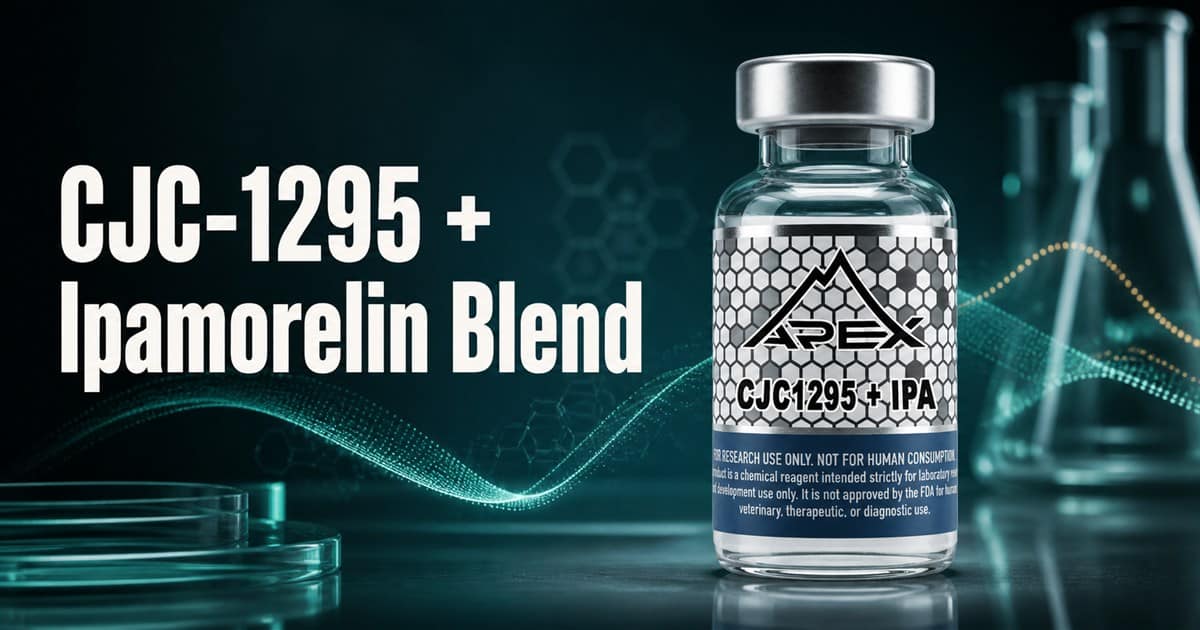
The Apex blend product page describes a 10 mg configuration containing 5 mg of each component. That is an equal mass ratio. Because the molecules differ in size, it is not an equal number of molecules or a promise of equal biological activity.
Equal milligrams, different molecule counts
Illustrative calculation from the nominal 5 mg amounts and parent reference masses of about 3,367.9 and 711.9 g/mol. This gives roughly 4.7 ipamorelin molecules per No DAC molecule. It is not a measured lot ratio, receptor-potency ratio or dosing recommendation; associated salts and the assigned assay basis matter.
Ipamorelin’s sequence is H–Aib–His–D-2Nal–D-Phe–Lys–NH₂. Aib is achiral; D-2Nal is a naphthylalanine residue. Terminal groups and stereochemistry help define the material and cannot be replaced by a generic “peptide purity” percentage. Original ipamorelin characterization
CJC-1295 with DAC versus No DAC: why the distinction matters
No DAC: modified GRF(1–29)
A 29-residue peptide with substitutions at positions 2, 8, 15 and 27 compared with native GHRH(1–29). It has no appended albumin-reactive DAC group. Its parent reference mass is approximately 3.37 kDa.
DAC: albumin-reactive CJC-1295
The long-acting construct adds a modified terminal lysine carrying an albumin-reactive group. The unbound parent is approximately 3.65 kDa; attaching to albumin changes its persistence in circulation.
The original albumin-binding research explains the DAC design. Earlier work on DPP-IV-resistant GRF analogs helps explain why researchers altered native GRF, but it does not supply a human half-life for every later No DAC product. 2005 DAC study · 1995 GRF degradation study
The often-quoted 5.8–8.1 day estimated half-life comes from a human study of the DAC form. It should not be assigned to the No DAC ingredient, to ipamorelin or to the mixed vial. Names and registry synonyms have been inconsistent; compare the specified structure and material basis. The CJC-1295 identity guide goes further into that naming problem. Original human study · FDA review of the distinct CJC substances
Why are CJC-1295 and Ipamorelin combined?
The research rationale is to stimulate two different inputs to pituitary GH release. The GHRH receptor belongs to the class B receptor family; GHS-R1a belongs to Family A. These are two routes toward a shared output, not evidence that their effects are independent or automatically additive. GHRH-receptor classification · Ghrelin-receptor classification
Modified GRF(1–29)
↓
GHRH receptor
Ipamorelin
↓
GHS-R1a receptor
Ipamorelin’s original selectivity experiments found GH release without the same ACTH/cortisol response seen with some comparator secretagogues in the tested animal conditions. That is a useful pharmacological distinction, not proof that cortisol, prolactin or every other hormone will remain unchanged during human blend use. Original animal and pituitary-cell experiments
Has the exact combination been tested in humans?
The dated PubMed search for this guide did not identify a primary intervention study of the exact CJC-1295 No DAC/Ipamorelin pair. The combined-name results included reviews and analytical studies. A separate ClinicalTrials.gov search for both names returned no records on September 9, 2026. Those searches do not prove that no study exists anywhere.
The closest positive evidence is important, but its ingredients must stay attached to its results:
On a narrow screen, scroll the table horizontally to read every column. The table also supports keyboard arrow keys when focused.
| Study and model | What was combined | What the result can support |
|---|---|---|
| Cheng, 1989 Rat pituitary cells | Native GRF and GHRP-6 | Synergistic GH release and amplification of GRF-associated cAMP signaling under those experimental conditions. |
| Paulo, 2008 22 men, including experimentally altered sex-steroid conditions | GHRH and GHRP-2 | Human GH co-stimulation depends on hormonal and body-composition context. Neither compound was ipamorelin or retail No DAC CJC. |
| Veldhuis, 2009 47 men aged 18–74 | GHRH and GHRP-2 | GH responses varied with factors including age and visceral fat under the study’s sex-steroid controls. It did not test a muscle-gain program. |
These studies support investigating co-stimulation. They do not measure the benefit, optimal ratio, safety or stability of a commercial two-component formulation.
What did the human CJC-1295 studies actually show?
Two short ascending-dose studies in healthy adults found sustained increases in GH and IGF-1 after DAC-form CJC-1295. The endpoints were hormone concentrations and pharmacokinetics, not muscle strength, fat loss or improved sleep. Teichman, 2006
Preserved pulses did not mean unchanged GH exposure
A separate study sampled 12 healthy men overnight before and one week after DAC-form CJC-1295.
The intervals between pulses had higher GH levels even though pulses persisted. Calling this a completely unchanged “natural pattern” loses that distinction. These are measured findings for the DAC study, not a simulated pulse trace or a result for the No DAC blend. Ionescu and Frohman, 2006
The separate HIV visceral-obesity record, NCT00267527, is marked terminated and has no posted results. Its present record lists 120 participants without an enrollment-type field. FDA’s 2024 review separately summarizes anecdotal reports of a halted DAC study after a participant’s fatal myocardial infarction; the reported medical explanation was coronary plaque rupture and occlusion. That account is not proof that CJC caused the death, and the registry itself does not give a termination reason.
What does Ipamorelin’s own clinical record add?
GH response: demonstrated
A 1999 intravenous study in healthy male volunteers reported a terminal ipamorelin plasma half-life of about two hours and a GH-response peak around 0.67 hours. Neither time is a personal dosing interval or a validated onset of muscle, sleep or recovery benefits. Original pharmacokinetic study
Postoperative benefit: not demonstrated
The published randomized bowel-surgery trial enrolled 117 people, with 114 in the safety/modified intention-to-treat population. Time to the first tolerated meal was 25.3 versus 32.6 hours; the difference was not significant, P=.15. Key and secondary efficacy outcomes did not show significant improvement. 2014 trial report
Earlier rat postoperative work found improvements in some gastrointestinal measures; a single administration did not improve cumulative stool output, food intake or body-weight change. That mixed animal result and the later human null result should not become a general claim that the peptide improves digestion or recovery. 2009 animal study
The published trial is associated with NCT00672074, whose registry has no posted results even though the journal paper exists. A second postoperative study, NCT01280344, records 320 actual participants and completion, also without posted results. These entries are not blend trials. The Ipamorelin research guide examines the compound’s wider record.
Benefits: muscle, fat loss, sleep and testosterone
Muscle and recovery
Higher GH or IGF-1 is a biological response. Demonstrating stronger muscles, faster injury recovery or improved physical function requires those outcomes to be measured in the relevant population. The exact-blend evidence located here does not establish them.
Sleep
GH secretion and sleep physiology are related, but that relationship does not demonstrate that this blend improves sleep duration, sleep stages or insomnia. A hormone response cannot stand in for a controlled sleep study.
Testosterone
The cited human co-stimulation studies manipulated sex-steroid conditions to examine GH responses. They did not show that taking the blend raises testosterone. Reversing that experimental relationship changes the claim.
Fat loss
Fat loss is not an inevitable consequence of stimulating GH. In a mouse study, ipamorelin increased body fat, including in GH-deficient animals. The authors identified a GH-independent adiposity effect. This is not a human weight-gain estimate; it is a direct counterexample to the simplistic fat-loss argument. Lall, 2001
“How long until results?” therefore has no evidence-based answer for the blend’s advertised body-composition goals. The human studies measured different endpoints, with different compounds or routes. They do not justify a four-week transformation timeline or a before-and-after guarantee.
Is a premixed blend better than separate compounds?
A premix fixes the component ratio for every sampled portion of a homogeneous material. Separate compounds let a research design vary each component independently. That experimental flexibility is different from evidence that one option is clinically better.
Co-formulation also introduces a compatibility question: the behavior of each peptide alone does not establish their stability together at a particular concentration, pH, temperature or storage time. A combined vial needs component-resolved analytical methods; one unidentified peak or one whole-mixture number cannot validate both ingredients.
For the biological differences between the individual compounds, see Ipamorelin versus CJC-1295. The present evidence does not establish a safe human mixing method, dose, cycle or washout schedule for the blend.
What are the side effects and current FDA concerns?
Short studies cannot establish long-term blend safety. FDA’s CJC assessment describes injection-site reactions, headache, flushing, transient hypotension and increased heart rate in the clinical record. Most studied exposures were brief and involved the DAC form, limiting transfer to other forms and populations. CJC assessment, clinical safety section
For ipamorelin, FDA identifies serious adverse events, including deaths, in intravenous postoperative research, while stating that the relationship to the drug is unclear. These were surgical patients, not a study of everyday subcutaneous blend use. The uncertainty does not establish safety for that different setting. Ipamorelin clinical assessment
This blend is not an FDA-approved treatment. The agency’s current safety page also raises concerns about peptide impurities, aggregation and immunogenicity for these substances. Compounding categories, nomination changes and advisory discussion are not FDA product approval. The current sources were checked on September 9, 2026. FDA’s current safety information
How to read a CJC-1295/Ipamorelin COA
Begin with the exact product, component identities and lot. The Apex-issued record APX-2026-0525-C describes the 5 mg + 5 mg configuration. Its component-content rows report 4.9983 mg/vial CJC-1295 No DAC and 5.00355 mg/vial ipamorelin, each against a stated 4.9–5.1 mg/vial criterion. These are report-specific figures, not a promise about a future shipment.
Content is an amount
Milligrams per vial come from a calibrated component assay on the stated material basis. They are not calculated by multiplying the total powder weight by a chromatographic purity percentage. Water, excipient and associated acetate are separate considerations.
Purity is method-specific
Chromatographic detector-area percentages describe assigned peaks under a defined analytical method. A blend needs selective measurement of each component. Retention time is a method-dependent result, not a universal identity number determined by molecular weight.
The CJC purity result is 99.925%, while the displayed supporting peak areas, 9,987,100 divided by 10,000,000, give 99.871%. The result is labeled a mean of independent sample preparations; the displayed supporting areas do not identify their relationship to that mean. Confirm the underlying component and replicate records before treating the areas as verification of the reported percentage. The difference alone does not establish that either measurement is wrong. The active-content figures above are separately reported measurements.
Mass spectrometry can support a specified molecular-ion assignment, but mass alone cannot distinguish every sequence or stereoisomer. A seized-material study identified glycine-extended secretagogue analogs by comparison with analytical standards; it demonstrates why the exact analyte matters, not that every supplier has the same problem. Gajda and colleagues’ analytical study
An Apex-issued summary is not an independent laboratory endorsement or a complete set of original instrument exports. Analytical results do not establish a clinical benefit or suitability for administration. For the measurement distinctions, see HPLC testing and peptide purity and how to read a peptide COA.
Frequently Asked Questions
What is CJC-1295/Ipamorelin?
It is a two-peptide blend combining modified GRF(1–29), commonly called CJC-1295 No DAC, with ipamorelin. They act through different receptor pathways that can influence growth-hormone release. The blend is not one new molecule or an approved treatment.
What are the proven benefits of the blend?
The exact No DAC/Ipamorelin blend did not have a primary intervention study in the dated searches reviewed here. Human component studies demonstrate hormone responses, but they do not establish muscle gain, fat loss, better sleep or recovery benefits for this mixture.
Is CJC-1295 with DAC the same as CJC-1295 No DAC?
No. The long-acting DAC construct has an appended albumin-reactive group. The 29-residue No DAC material lacks it. The often-quoted 5.8–8.1 day human half-life belongs to the DAC form and should not be assigned to the No DAC blend.
Why are CJC-1295 and Ipamorelin used together?
The rationale is to stimulate GHRH and ghrelin receptor pathways together. Studies using native GHRH or GRF with other secretagogues support investigating co-stimulation. They do not establish the clinical benefit, best ratio or long-term safety of this exact pair.
Does the blend increase testosterone?
A reliable testosterone increase from this blend has not been established in the reviewed human evidence. Some co-stimulation studies altered sex-steroid conditions to study GH responses; that does not demonstrate that the peptides raise testosterone.
How long does CJC-1295/Ipamorelin take to work?
No validated timeline for muscle, fat-loss or sleep benefits was identified for the blend. A hormone peak, plasma half-life and clinical benefit are different endpoints. Times measured for intravenous ipamorelin or DAC-form CJC cannot supply a benefit timeline for this mixture.
Is the blend better than taking the compounds separately?
A premixed material fixes the component ratio; separate compounds allow each component to vary independently in a research design. Neither arrangement has been shown clinically superior by the exact-blend evidence reviewed here. Compatibility and stability also require formulation-specific testing.
What are the side effects of CJC-1295/Ipamorelin?
Exact-blend safety is not established. The component record includes injection-site reactions, headache and cardiovascular effects; FDA also identifies peptide impurity and immunogenicity concerns. Serious events occurred in intravenous ipamorelin surgical studies, but their relationship to the drug is unclear.
Is CJC-1295/Ipamorelin FDA approved?
No. A compounding nomination, category change or advisory discussion is not approval of the blend as a medicine. The FDA sources checked for this guide describe substance-specific safety concerns, not a validated everyday regimen.
Does a 5 mg + 5 mg blend contain equal amounts of both peptides?
It contains equal nominal masses, not equal molecule counts. Using parent reference masses, 5 mg corresponds to roughly 1.48 micromoles of No DAC CJC and 7.02 micromoles of ipamorelin. That calculation is not a measured lot ratio, potency ratio or dosing instruction.
Continue your research
Use the CJC-1295 identity guide for the form distinction, the Ipamorelin guide for its individual clinical record and the growth-hormone-axis research hub for related pathways. The blend product page contains current offered configuration and availability.
References and source notes
The references include receptor-classification reviews, animal experiments, human component studies and analytical research. They are not fifteen clinical trials of the blend. Current registry and FDA sources are linked beside the claims they support. Searches were checked on September 9, 2026; where full reports were unavailable, claims are limited to the indexed abstract or the separately attributed FDA assessment.
- Cheng K et al. The synergistic effects of His-D-Trp-Ala-Trp-D-Phe-Lys-NH2 on growth hormone (GH)-releasing factor-stimulated GH release and intracellular adenosine 3',5'-monophosphate accumulation in rat primary pituitary cell culture. Endocrinology. 1989. PMID 2541999.
- Bai JP et al. The involvement of dipeptidyl peptidase IV in brush-border degradation of GRF(1-29)NH2 by intestinal mucosal cells. The Journal of pharmacy and pharmacology. 1995. PMID 8583376.
- Raun K et al. Ipamorelin, the first selective growth hormone secretagogue. European journal of endocrinology. 1998. PMID 9849822.
- Gobburu JV et al. Pharmacokinetic-pharmacodynamic modeling of ipamorelin, a growth hormone releasing peptide, in human volunteers. Pharmaceutical research. 1999. PMID 10496658.
- Lall S et al. Growth hormone (GH)-independent stimulation of adiposity by GH secretagogues. Biochemical and biophysical research communications. 2001. PMID 11162489.
- Mayo KE et al. International Union of Pharmacology. XXXV. The glucagon receptor family. Pharmacological reviews. 2003. PMID 12615957.
- Jetté L et al. Human growth hormone-releasing factor (hGRF)1-29-albumin bioconjugates activate the GRF receptor on the anterior pituitary in rats: identification of CJC-1295 as a long-lasting GRF analog. Endocrinology. 2005. PMID 15817669.
- Teichman SL et al. Prolonged stimulation of growth hormone (GH) and insulin-like growth factor I secretion by CJC-1295, a long-acting analog of GH-releasing hormone, in healthy adults. The Journal of clinical endocrinology and metabolism. 2006. PMID 16352683.
- Davenport AP et al. International Union of Pharmacology. LVI. Ghrelin receptor nomenclature, distribution, and function. Pharmacological reviews. 2005. PMID 16382107.
- Ionescu M et al. Pulsatile secretion of growth hormone (GH) persists during continuous stimulation by CJC-1295, a long-acting GH-releasing hormone analog. The Journal of clinical endocrinology and metabolism. 2006. PMID 17018654.
- Paulo RC et al. Gonadal status and body mass index jointly determine growth hormone (GH)-releasing hormone/GH-releasing peptide synergy in healthy men. The Journal of clinical endocrinology and metabolism. 2008. PMID 18073313.
- Veldhuis JD et al. Determinants of GH-releasing hormone and GH-releasing peptide synergy in men. American journal of physiology. Endocrinology and metabolism. 2009. PMID 19240251.
- Venkova K et al. Efficacy of ipamorelin, a novel ghrelin mimetic, in a rodent model of postoperative ileus. The Journal of pharmacology and experimental therapeutics. 2009. PMID 19289567.
- Beck DE et al. Prospective, randomized, controlled, proof-of-concept study of the Ghrelin mimetic ipamorelin for the management of postoperative ileus in bowel resection patients. International journal of colorectal disease. 2014. PMID 25331030.
- Gajda PM et al. Glycine-modified growth hormone secretagogues identified in seized doping material. Drug testing and analysis. 2019. PMID 30136411.
Research-use boundary
This guide explains research evidence and analytical records. Apex materials are for laboratory research only, not human or veterinary use. A product listing or COA does not turn a research formulation into an approved medicine.