
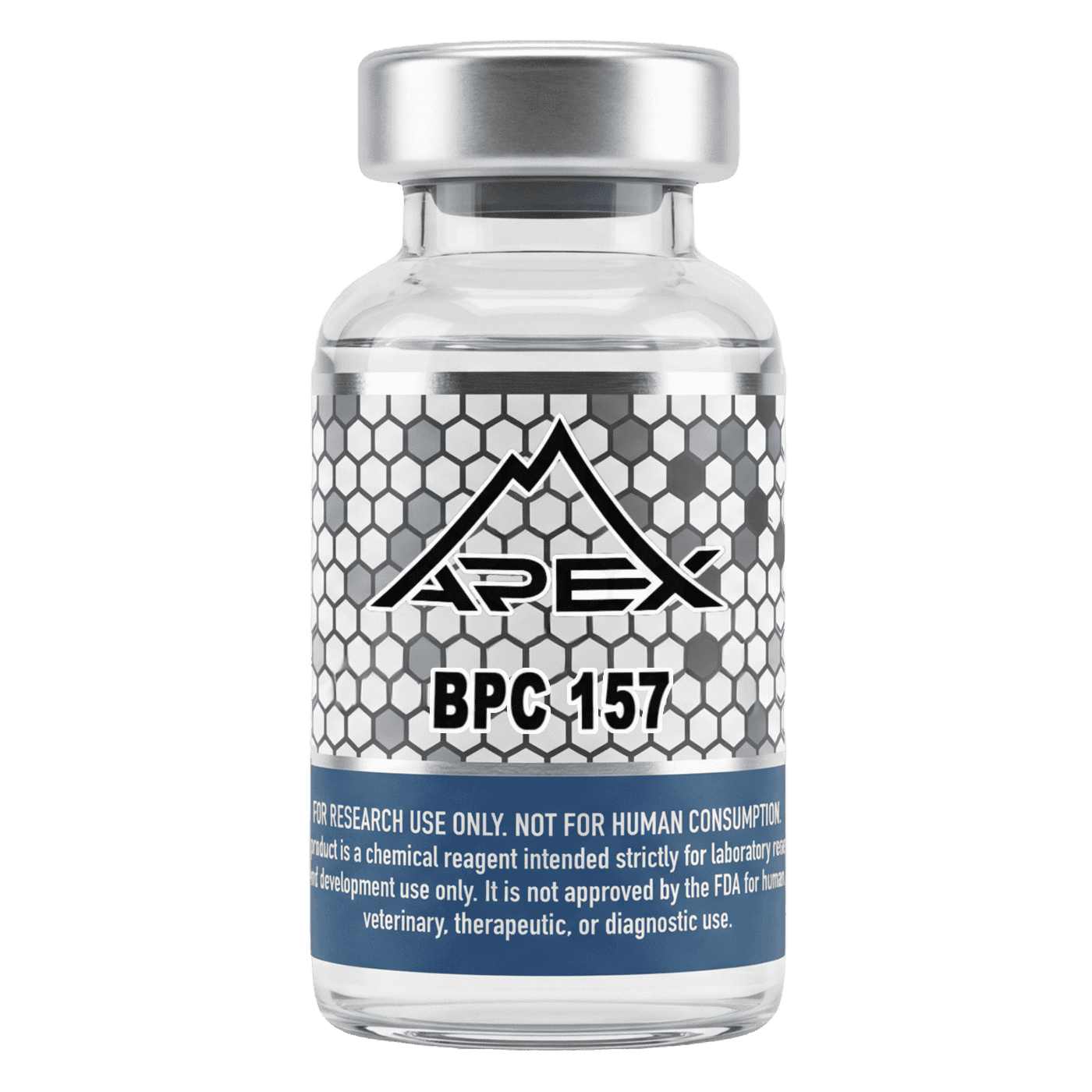
Certificate of Analysis — BPC-157 10mg
Pentadecapeptide gastric protective compound – CAS 137525-51-0
Verified by Apex Laboratory in-house HPLC (purity by 220 nm peak area) and ESI mass spectrometry (mass identity confirmation). Data on this page describes the current shipping lot.
- Purity (HPLC, area %): 99.65%
- Mass found (ESI-MS): 1419.50 Da
- Mass expected: 1419.53 Da
- HPLC retention time: 12.0 min
- Batch ID: APX-2026-0405-B
- Test date: April 5, 2026
- Analyst: K. Norwood
View BPC-157 10mg on the Lab Verified COA archive · Read the BPC-157 Research Guide
BPC-157 is a gastric pentadecapeptide supplied by Apex Laboratory as a high-purity research peptide intended strictly for in-vitro laboratory research and development applications.
Compound Overview
BPC-157 (Body Protection Compound-157) is a 15-amino acid peptide sequence derived from a protein found in human gastric juice. Research has investigated its interactions with nitric oxide (NO) pathways, growth factor modulation (including VEGF and EGF), and the FAK-paxillin signaling cascade involved in tissue remodeling studies.
What distinguishes BPC-157 structurally is that it is an unmodified, naturally derived sequence rather than an engineered analog. It is a fragment of the Body Protection Compound (BPC) found in human gastric juice, and unlike many later research peptides it carries no non-coded residues, no fatty-acid acylation, and no half-life-extending lipid tail. Its 15-residue chain (Gly-Glu-Pro-Pro-Pro-Gly-Lys-Pro-Ala-Asp-Asp-Ala-Gly-Leu-Val) is notably proline-rich — four of the fifteen positions are proline — which is frequently cited in the literature as a contributor to its conformational rigidity and its characteristic stability in aqueous and even acidic media. This proline content is part of why it is routinely described in published work as a “stable” gastric pentadecapeptide.
The compound’s small size and hydrophilic, non-lipidated character also explain its behavior on the analytical column. In reversed-phase HPLC, BPC-157 elutes relatively early (~12.0 min on the current lot) — markedly earlier than larger lipidated peptides, because there is no long hydrophobic moiety to retain the molecule on a C18 stationary phase. Researchers using the displayed chromatogram as an identity check should expect a single, sharp, early-to-mid retention peak rather than the late-eluting profile typical of fatty-acid-modified compounds.
Research Background & Published Literature
BPC-157 is one of the most widely studied gastric peptides in preclinical research. Published literature includes over 100 studies examining its effects in various in-vitro and animal model systems, with research groups investigating gastrointestinal cytoprotection, tendon and ligament tissue models, and neurological signaling pathways. Key publications include Sikiric et al. in Journal of Physiology Paris and Current Pharmaceutical Design.
Researchers interested in the published literature surrounding this compound can explore the following peer-reviewed resources for additional context on its mechanism of action, signaling pathways, and experimental applications in controlled laboratory settings:
- Sikiric et al. (2016) — BPC-157 stable gastric pentadecapeptide review
- Seiwerth et al. (2018) — BPC-157 and wound healing research
The published research framing of BPC-157 centers on cytoprotection and tissue-repair signaling rather than on a single receptor-binding event. A recurring theme across the preclinical literature is its apparent interaction with the nitric-oxide (NO) system: in experimental models, its activity has been reported to interact with both the NO-generating (L-arginine) and NO-blocking (L-NAME) arms of that pathway, positioning it in the literature as an NO-system modulator rather than a direct receptor agonist. A second well-documented research axis is angiogenesis: pro-angiogenic activity has been associated in published work with VEGFR2 activation and upregulation together with downstream Akt and eNOS signaling, which connects the vascular and cytoprotective observations into a single mechanistic narrative.
Connective-tissue research forms a third distinct cluster. In tendon and ligament model systems, BPC-157 has been studied for effects on fibroblast outgrowth, cell survival, and cell migration — processes linked in those papers to focal-adhesion signaling (FAK-paxillin) — and a separate line of work reports upregulation of growth-hormone receptor expression in cultured tendon fibroblasts, offering a candidate mechanism for the tissue-remodeling observations. Together with the gastrointestinal-cytoprotection and brain-gut-axis literature originating from Sikiric and colleagues, these themes make BPC-157 one of the more mechanistically diverse small peptides in the preclinical record, spanning vascular biology, connective-tissue remodeling, and gut-brain signaling. The references below are provided so researchers can examine these signaling pathways and experimental systems in their original, peer-reviewed context. All such findings derive from in-vitro and animal-model research and are not statements about activity in humans.
Technical Specifications
- Product Name: BPC-157
- Classification: Gastric Pentadecapeptide
- Structural Description: 15-amino acid fragment of human gastric juice protein BPC (Body Protection Compound)
- CAS Number: 137525-51-0
- Molecular Weight: 1419.53 g/mol
- Purity: ≥99% (verified by HPLC and Mass Spectrometry)
- Physical Form: Lyophilized (freeze-dried) powder
- Intended Use: In-vitro research use only — not for human consumption
Storage, Handling & Stability Guidelines
Due to its relatively small size (15 amino acids), lyophilized BPC-157 demonstrates excellent stability. Store at -20°C long-term. Reconstituted solutions should be refrigerated and used within 10 days.
- Minimize time at ambient temperature during handling to preserve compound integrity.
- Avoid moisture exposure by resealing vials promptly after each withdrawal.
- Use appropriate personal protective equipment and follow your institution’s chemical safety protocols at all times.
- Label all aliquots with the compound name, concentration, date of reconstitution, and operator initials for complete traceability.
Quality Assurance & Analytical Verification
Apex Laboratory applies a dual-verification quality protocol to every batch before it enters inventory. Each lot undergoes High-Performance Liquid Chromatography (HPLC) to confirm chromatographic purity and Mass Spectrometry (MS) to verify molecular identity and molecular weight. This two-step analytical process ensures that the material you receive meets our ≥99% purity standard with confirmed molecular integrity. Certificates of Analysis documenting these results are available upon request for your internal quality records.
Because BPC-157 is a small peptide (~1419 Da), its mass-spectrometric identity check looks different from that of larger compounds. Under positive-mode electrospray (ESI+), a peptide of this size is dominated by a single low-charge ion — typically the singly protonated [M+H]+ near m/z 1420, with a minor doubly protonated [M+2H]2+ contribution — rather than the multi-charge-state envelope seen for peptides above roughly 3,000 Da. The neutral mass reported on the certificate above (found 1419.50 Da against an expected 1419.53 Da) reflects this straightforward deconvolution: for a compact, non-lipidated 15-mer, a single dominant charge state cleanly confirms intact molecular weight, and the tight agreement between found and expected mass is the primary identity criterion for a peptide in this size range.
Frequently Asked Questions
What is the amino acid sequence of BPC-157?
BPC-157 is a 15-amino acid peptide fragment (Gly-Glu-Pro-Pro-Pro-Gly-Lys-Pro-Ala-Asp-Asp-Ala-Gly-Leu-Val) derived from human gastric juice protein BPC. Its molecular weight is 1419.53 g/mol.
What research areas use BPC-157?
BPC-157 is studied in gastrointestinal cytoprotection, tissue remodeling, tendon and ligament research models, and nitric oxide signaling pathways. Over 100 preclinical studies have been published.
Why does BPC-157 elute so early in the HPLC chromatogram?
BPC-157 is a small, hydrophilic 15-residue peptide with no fatty-acid modification, so it has little affinity for the hydrophobic C18 stationary phase used in reversed-phase HPLC and elutes relatively early (~12.0 min on the current lot). This is in deliberate contrast to lipidated research peptides, which carry a long hydrophobic tail that retains them on the column much longer. A single sharp, early-to-mid peak is the expected identity signature for this compound.
Why does the BPC-157 mass spectrum show essentially one peak instead of a multi-peak envelope?
At roughly 1419 Da, BPC-157 is small enough that positive-mode electrospray (ESI+) produces predominantly the singly protonated [M+H]+ ion near m/z 1420, with only a minor [M+2H]2+ contribution. The multi-charge-state envelope you would see for a peptide above ~3,000 Da does not develop at this molecular size, so a single dominant charge state that back-calculates to the expected neutral mass (1419.53 Da) is the appropriate identity check here.
What signaling pathways is BPC-157 associated with in the published research literature?
Preclinical literature most often associates BPC-157 with the nitric-oxide (NO) system (interacting with both the L-arginine and L-NAME arms), with pro-angiogenic VEGFR2-Akt-eNOS signaling, and with focal-adhesion (FAK-paxillin) and growth-hormone-receptor pathways in connective-tissue model systems. It is generally described as a cytoprotective NO-system modulator rather than a direct single-receptor agonist. These descriptions reflect published in-vitro and animal-model research only and are not statements about activity in humans.
Related Research Compounds
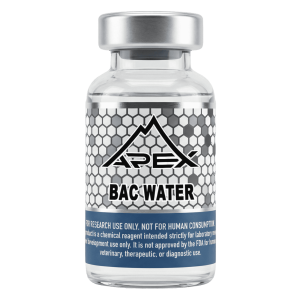
Researchers studying gastric pentadecapeptide pathways may also be interested in related compounds available from Apex Laboratory, including TB-500, BPC-157 + TB500 Blend, Bacteriostatic Water. Explore our complete research catalog to browse all available peptides, reagents, and laboratory supplies, or visit our About page to learn more about our quality verification process.
Shipping, Packaging & Delivery
All orders placed before 2:00 PM Eastern Standard Time ship the same business day via tracked domestic carriers. Products are packaged in insulated, temperature-appropriate containers designed to preserve compound stability during transit. Upon delivery, transfer all materials to appropriate storage conditions immediately. For time-sensitive research protocols or special delivery requirements, contact our support team in advance to coordinate optimal shipping timing for your laboratory workflow.
Research Use Disclaimer
For in-vitro research use only. Not for human consumption. All products sold by Apex Laboratory are intended exclusively for qualified researchers, accredited laboratories, and educational institutions. Purchasers assume full responsibility for ensuring safe handling, proper storage, and compliance with all applicable federal, state, and local laws, regulations, and institutional policies governing the purchase and use of chemical research reagents.

Reviews
There are no reviews yet.