
FOXO4-DRI is a designed D-retro-inverso peptide studied as a competitor of the FOXO4–p53 protein interaction in senescent-cell models. The foundational Baar study linked that perturbation to p53 nuclear exclusion and cell-intrinsic apoptosis in specified cell and mouse systems. The evidence remains preclinical: there is no established human evidence for efficacy, dosing, or safety.
FOXO4-DRI is often introduced with a compressed label—“senolytic peptide”—that hides the most important research questions. Which construct did a paper test? How was senescence identified? What comparator was used? Was the result molecular, cellular, ex-vivo, or whole-animal? The answers determine how far a conclusion can travel.
- FOXO4-DRI is a D-retro-inverso, cell-penetrating peptide construct derived from a FOXO4 interaction region.
- Baar et al. is the foundational direct paper; it connects FOXO4–p53 perturbation to senescent-cell apoptosis and named mouse-model observations.
- Later structural work directly characterizes how FOXO4-DRI and FOXO4 engage the p53 transactivation domain.
- Direct cell and animal papers are model-specific. Findings from generic senolytics or another disease model do not automatically transfer.
- No published human outcome claim is established by this evidence set, and no approved FOXO4-DRI indication exists.
- A current reagent still requires lot-specific identity and purity documentation; a paper does not validate an unlabeled commercial material.
What Is FOXO4-DRI?
FOXO4-DRI is a designed peptide research tool named for its target concept and its stereochemical format. “FOXO4” refers to forkhead box O4, a transcription factor implicated in stress responses and senescent-cell viability. “DRI” means D-retro-inverso. In the foundational study, the peptide was engineered to perturb an interaction between FOXO4 and the tumor-suppressor protein p53.[1]
The label does not mean that every reagent sold under the same short name is analytically identical to the paper construct. Construct length, terminal chemistry, the cell-permeability segment, counterions, purity, aggregation state, and lot handling can all matter to an experiment. A defensible article therefore separates the published construct from a current material and avoids implying that literature outcomes certify a commercial vial.
FOXO4-DRI is also not a general synonym for “senolytic.” Senolytic is a functional category for interventions investigated for preferential effects on senescent cells. Different members of that category can act through different targets and show different selectivity across models. A result obtained with a BCL-2-family inhibitor, for example, does not become FOXO4-DRI evidence simply because both papers use senescence language.
What Is on the FOXO4-DRI Identity Record?
These are catalog-record values for the research material, not measurements from the cited literature.
| Identity field | Catalog record |
|---|---|
| Molecular weight | ≈4,800 g/mol (catalog-stated; no mass appears in the cited abstracts) |
| CAS number | None assigned; none asserted here |
| Molecular formula | Not specified; circulating values are not catalog-authoritative |
| Sequence | FOXO4-derived, all-D residues in reversed order; specific sequence not catalog-listed |
| Form, sizes, storage | Lyophilized powder, 2 mg and 10 mg; −20°C, protected from light and moisture; freeze-thaw cycling minimized |
| Purity specification | Read the applicable published FOXO4-DRI report for its construct, methods, results and acceptance criteria |
| Regulatory status | Research use only; no FDA, EMA, NMPA or other approval in any jurisdiction |
Two fields are absent rather than withheld: this construct has no assigned CAS number and no catalog-authoritative formula, so the declared construct and applicable analytical criteria must be made explicit in the lot documentation.
What Does D-Retro-Inverso Mean?
A D-retro-inverso design combines two changes relative to a parent L-peptide concept. The sequence order is reversed, and the residues use D rather than L chirality. The purpose is to approximate a side-chain presentation while changing the peptide backbone. That design can alter recognition by proteases and binding partners, but the name alone does not prove stability, cell entry, affinity, selectivity, or activity.
For FOXO4-DRI, the design is especially relevant because the intended target is an intracellular protein interaction. The foundational construct also included a cationic cell-permeability component. Later solution-NMR work reported that both the FOXO4-derived region and the cationic segment contribute to interaction with the p53 transactivation domain.[2] That result sharpens the molecular model without turning a peptide-design concept into a clinical outcome.
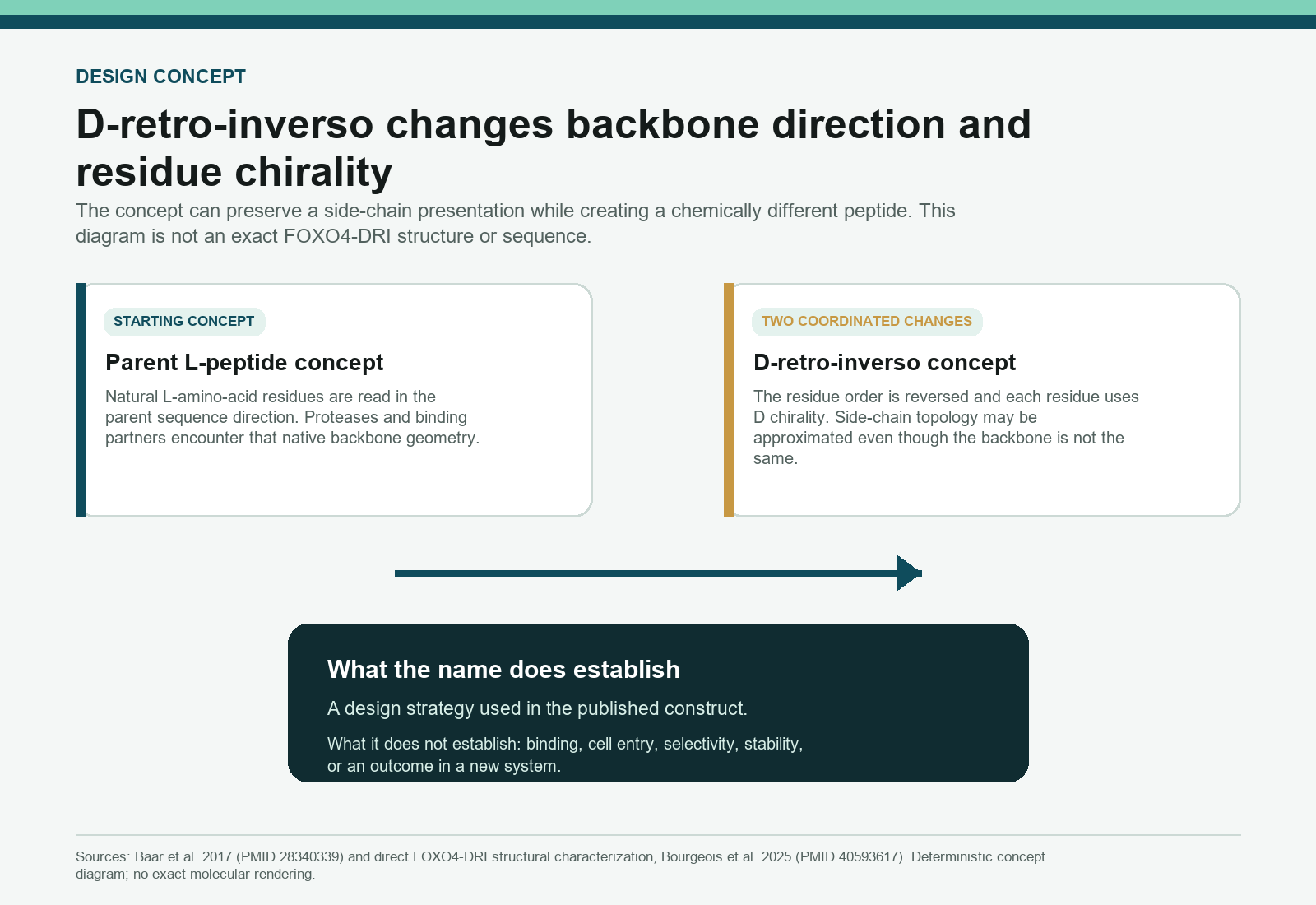
Terms such as “protease resistant” or “cell penetrating” should be tied to the tested construct and method. They should not be treated as universal properties of every material carrying the FOXO4-DRI name.
How Is the FOXO4–p53 Model Studied?
Cellular senescence is a durable cell-state program associated with cell-cycle arrest and multiple context-dependent phenotypes. It is not identified reliably by one universal marker. The International Cell Senescence Association consensus recommends combining markers and interpreting them in the experimental context.[3] It is a methods framework and reports no single quantitative result. That matters because a “senescent” label is the first gate in any selectivity claim.
The FOXO4–p53 model proposes that FOXO4 helps maintain viability in at least some senescent-cell contexts through interaction with p53. Baar and colleagues designed a peptide to disturb that interaction. They reported p53 nuclear exclusion and cell-intrinsic apoptosis in the tested senescent cells.[1] Later molecular work characterized a dynamic complex involving the disordered p53 transactivation domain and FOXO4-DRI.[2]
These studies answer complementary questions. Biophysical work asks where and how molecules interact. Cell experiments ask whether disrupting the interaction changes viability under specified conditions. Animal experiments ask whether a defined exposure changes a measured endpoint in a named model. None of these layers can be silently relabeled as a human efficacy study.
What Did Baar et al. Report in 2017?
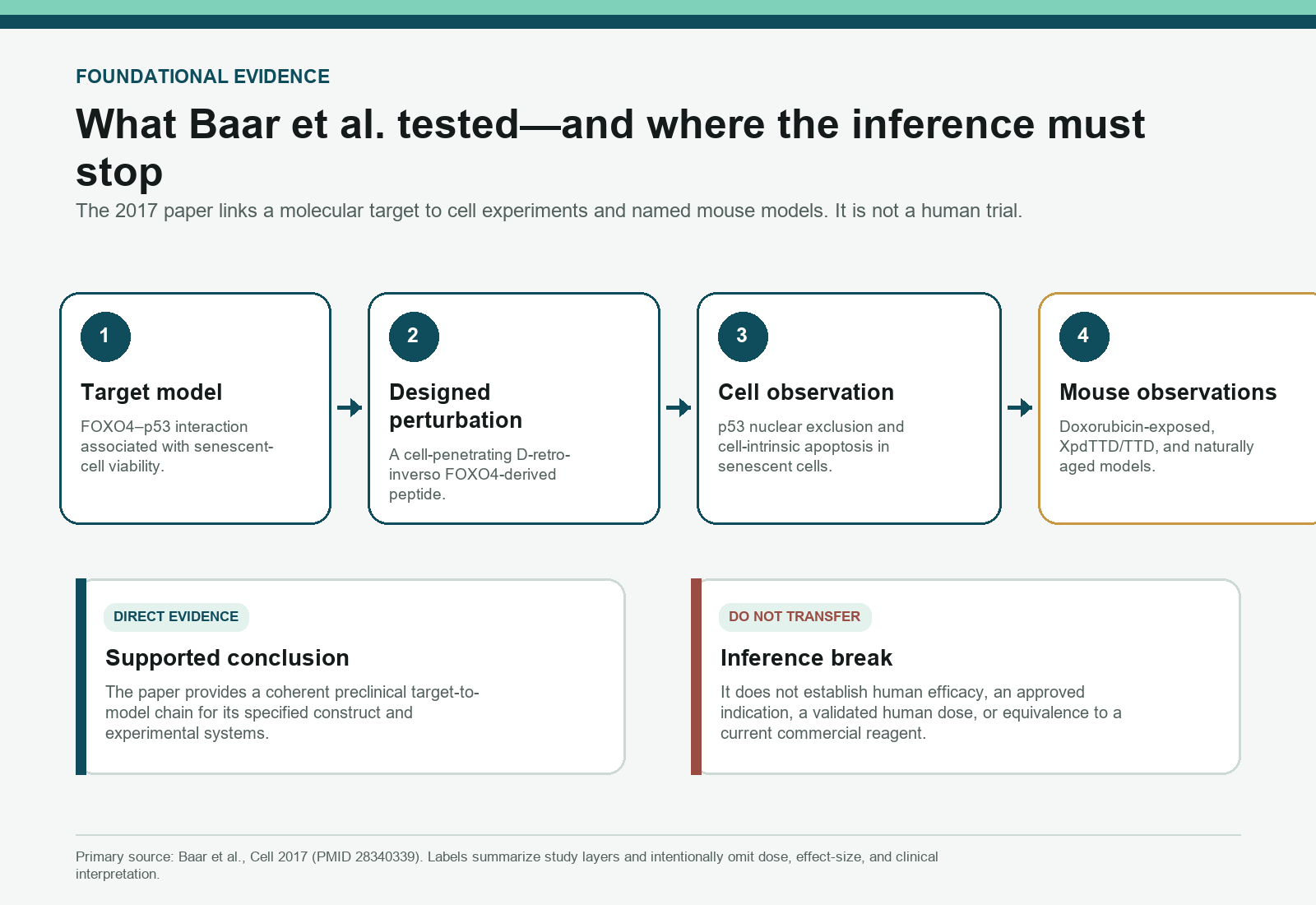
The Baar paper is the central direct-evidence source for FOXO4-DRI. Its research chain begins with the observation that FOXO4 participates in senescent-cell viability. The authors then designed a FOXO4-derived D-retro-inverso peptide, tested the FOXO4–p53 perturbation, and evaluated cellular and mouse-model consequences.[1]
In the cell experiments, the paper reported preferential effects in senescent versus control cells under the tested conditions, with p53 dependence and caspase-associated cell-intrinsic apoptosis. The study also used doxorubicin-exposed animals, fast-aging XpdTTD/TTD mice, and naturally aged mice. It reported changes in specific measures, including fitness, fur-density, and renal-function readouts, within those mouse models. The abstract of record reports no quantitative endpoint for those readouts.
The accurate summary is therefore narrow: a specified FOXO4 peptide produced a coherent target-to-cell-to-mouse evidence chain in a foundational preclinical study. The paper did not evaluate a human population, establish an approved indication, define a validated human regimen, or demonstrate that every commercial FOXO4-DRI material reproduces the paper construct.
What Do Later Direct Studies Add?
Molecular detail
The 2025 solution-NMR paper by Bourgeois and colleagues directly examined p53 in complex with the FOXO4 forkhead domain and with FOXO4-DRI. It reported a transiently folded complex involving the disordered p53TAD2 region and found that p53 phosphorylation enhanced affinity for both FOXO4 and FOXO4-DRI.[2] The abstract reports no quantitative result for that affinity change. This adds molecular resolution to the target model. It does not establish a whole-organism benefit.
Expanded human chondrocytes
Huang and colleagues tested FOXO4-DRI in an in-vitro expansion model using human chondrocytes. In human donor chondrocytes expanded to population doubling level 9 (PDL9), treatment removed more than 50% of the cells and significantly reduced senescence level, while minimally expanded PDL3 controls were not significantly affected. Importantly, pretreatment did not improve the chondrogenic potential of the PDL9 cells in the study’s pellet-culture readout.[4] The mixed endpoint is more informative than a simplified “rejuvenation” headline.
Leydig-cell and mouse models
Zhang and colleagues used a hydrogen-peroxide-induced senescent Leydig-cell model and naturally aged mice. They reported p53 nuclear exclusion and apoptosis in the senescent mouse TM3 Leydig-cell system and changes in testicular microenvironment and testosterone-secretion measures in naturally aged mice. The abstract states no quantitative endpoint for those measures.[5] Because both components are preclinical, the work cannot be presented as an established human endocrine intervention.
Keloid organ cultures and fibroblasts
Kong and colleagues examined keloid organ cultures and fibroblast models. The study linked FOXO4-DRI exposure with p53-serine-15 nuclear exclusion, apoptosis, and fewer G0/G1-phase cells in those human-derived pro-senescence models. Its abstract reports no quantitative finding for those measures.[6] The paper expands the model list, but it does not demonstrate prevention or treatment of recurrent keloids in people.
How Strong Is the FOXO4-DRI Evidence?
The evidence is strongest for a specific mechanistic proposition: FOXO4-DRI can interact with the p53 transactivation region and perturb FOXO4–p53 biology in defined experimental systems. It is also direct, though model-limited, for selected senescent-cell and mouse observations. The record becomes weaker when a claim shifts from a specified model to a general organ, disease, or human outcome.
No established human evidence in this source set supports efficacy, a validated human dose, comparative effectiveness, or a clinical safety profile. A human-derived cell or organ culture is not the same as a human clinical study. A naturally aged mouse is not a human aging trial. Strong content states those distinctions where the findings appear, not only in a footer.
FOXO4-DRI has no approved pharmaceutical formulation and no regulatory approval anywhere globally: it is not approved by the FDA, EMA, NMPA, or any other authority, and holds no approved indication in any jurisdiction. That is a statement about the compound, not about supplier status.
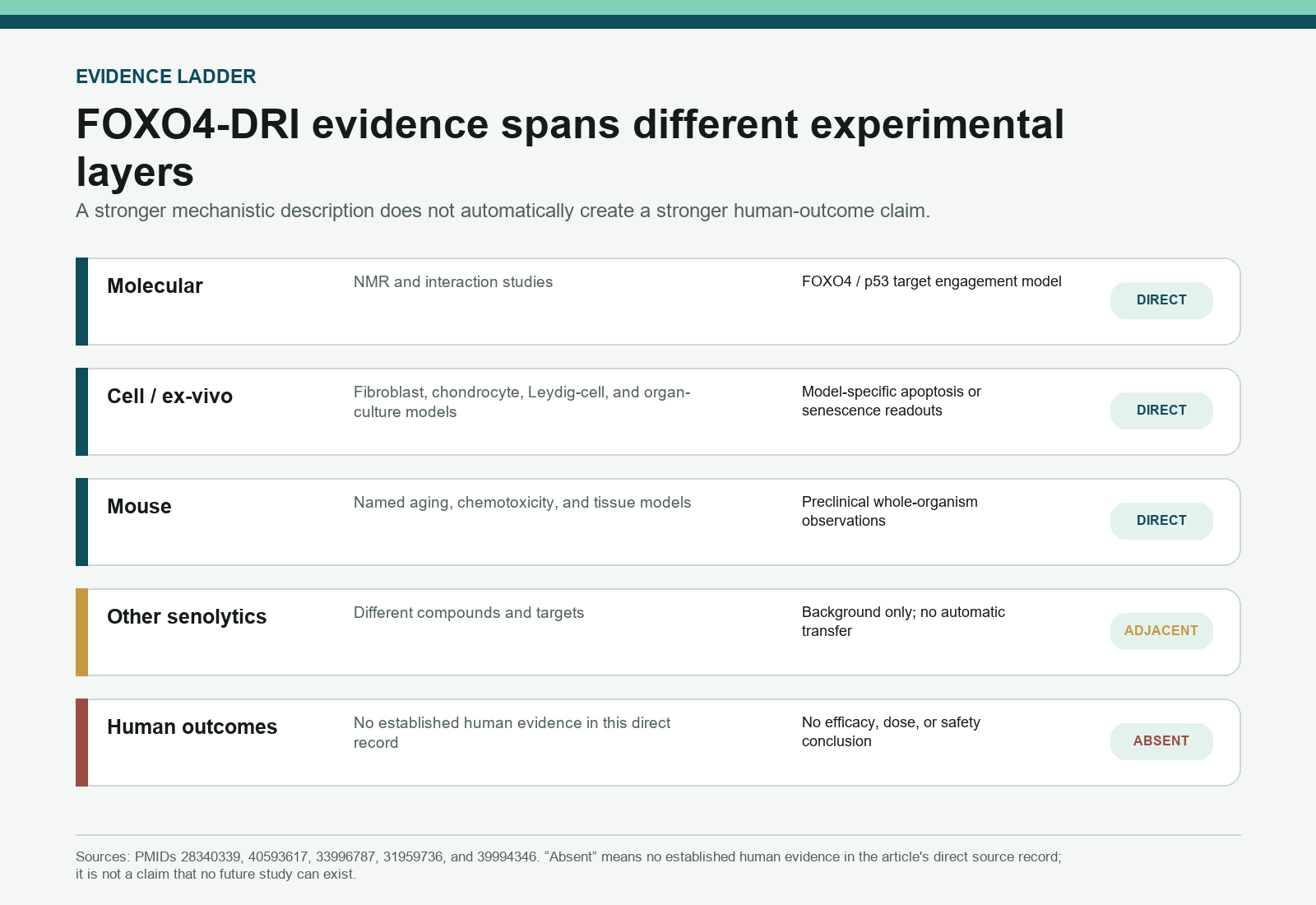
| Evidence lane | What it can establish | What it cannot establish by itself |
|---|---|---|
| Solution NMR / interaction work | A molecular interaction model for the tested components | Cell selectivity, organism-level effect, or clinical outcome |
| Senescent-cell experiments | Response in a defined cell state, model, and assay | Response across all senescent cells or tissues |
| Mouse experiments | Measured outcomes under a named preclinical design | Human efficacy, safety, or exposure |
| Other senolytic literature | Category and pathway context | A FOXO4-DRI-specific result |
| Current lot documentation | Results of stated identity and purity tests for that lot | Biological activity, sterility, or human suitability |
Additional reported findings
Sources dropped from the prose are kept as claim-map rows with model, species, and linked source; where an abstract states no effect size, the row says so.
| Agent | Model and species | Endpoint | Reported result | Source |
|---|---|---|---|---|
| FOXO4 peptide (direct) | Bleomycin-induced pulmonary fibrosis; mouse | Senescent-cell burden, SASP, collagen deposition | Decreased senescent cells and SASP, attenuated collagen deposition, similar to pirfenidone; abstract reports no quantitative endpoint (2024 erratum) | PMID 35510614 |
| FOXO4-DRI (direct) | Oxygen-glucose-deprivation senescent endothelial cells in vitro; aged and progeroid mice | p53 localization, BAX, cleaved caspase-3, aortic function | Phosphorylated p53 nuclear export with BAX and cleaved caspase-3 induction; suppressed aortic aging; abstract reports no quantitative result | PMID 41625068 |
How Should a FOXO4-DRI Paper Be Evaluated?
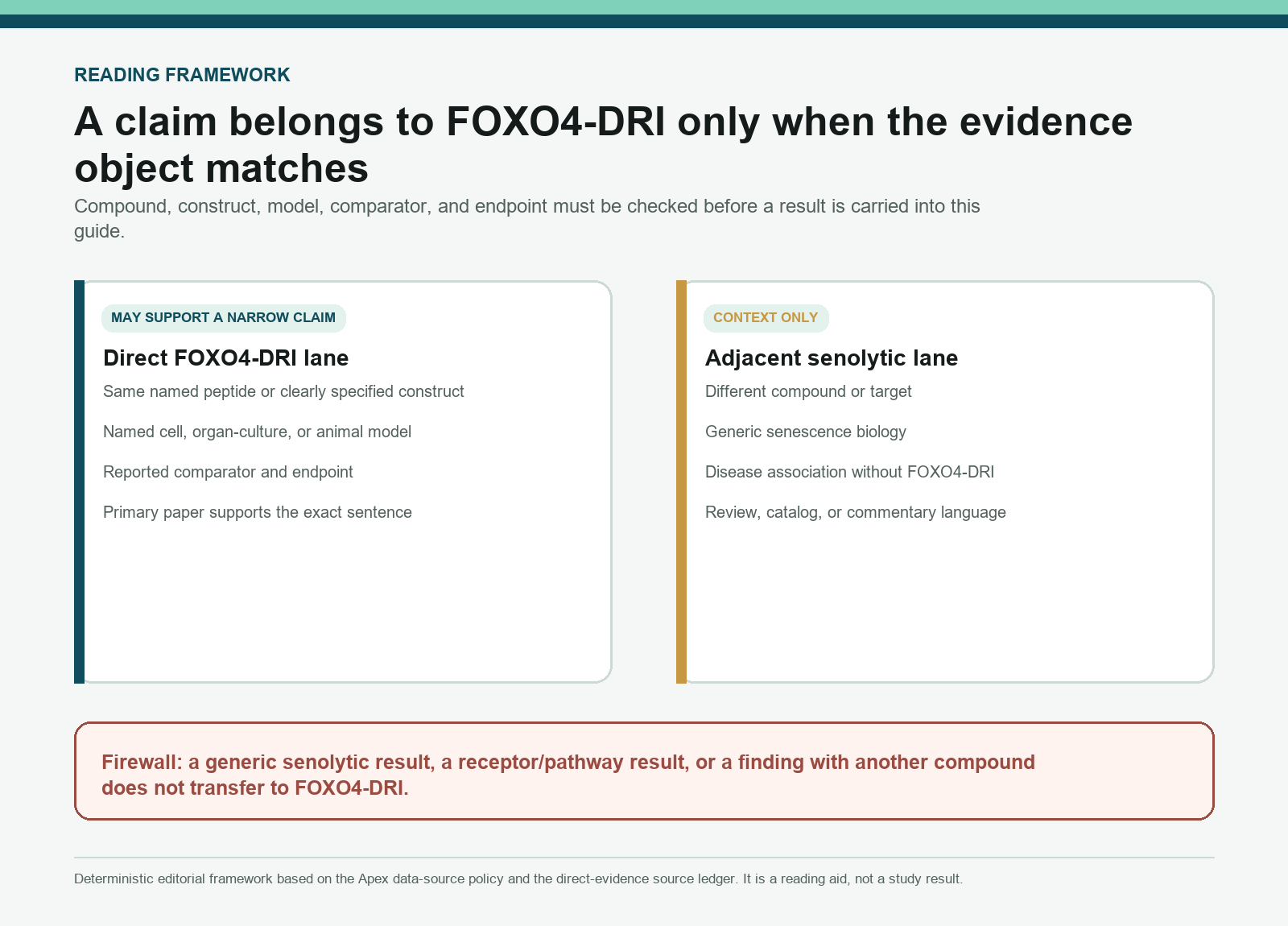
Start with the evidence object. Confirm that the study used FOXO4-DRI or a clearly specified related construct, not a different FOXO4 peptide or an unrelated senolytic. Record the sequence or construct description when the paper provides it. Then identify the cell-permeability segment, terminal chemistry, comparator, model, exposure window, and endpoint.
Next, inspect how senescence was established. A single marker can be misleading because markers vary with cell type and induction method. Stronger studies triangulate cell-cycle state, damage signaling, morphology, secretory phenotype, and other context-appropriate measures. Also ask whether the comparator was proliferating, quiescent, stressed, or otherwise non-equivalent.
Finally, keep the conclusion at the same level as the experiment. An interaction assay supports an interaction sentence. A cell-viability experiment supports a cell-model sentence. A mouse result supports a mouse-model sentence. A review or catalog can help find primary work but should not supply a stronger claim than the primary experiment.
What Can Current Analytical Documents Show?
A lot-specific certificate of analysis can report the named material, lot identifier, test methods, and results generated under those methods. Mass spectrometry can support a mass-identity question. Reversed-phase HPLC can report chromatographic purity under a defined method. Neither result proves sequence by itself, and neither establishes receptor binding, senescent-cell selectivity, sterility, or an organism-level outcome.
The expected analyte definition is especially important for a modified peptide. A useful identity package should distinguish the FOXO4-derived region, cell-permeability segment, D-residue design, terminal groups, salt or counterion assumptions, and calculated mass basis. If those elements are missing, a mass match can be ambiguous.
The Apex guides to reading a peptide COA and interpreting HPLC purity explain these method boundaries. They are analytical literacy resources, not evidence that a particular lot reproduced a published biological result.
Current research-material record
Qualified laboratories with an independently defined study can review the current FOXO4-DRI research-material record. Availability, specifications, and lot documents must be rechecked at deployment. Published literature outcomes do not validate the identity, purity, activity, or suitability of any current lot.
Related Research Guides
The longevity and bioregulator research hub maps adjacent entities without treating them as substitutes. The Epithalon research guide covers a mechanistically distinct peptide and illustrates why compound-specific evidence lanes matter. For category and regulatory boundaries, see research-grade versus pharmaceutical-grade.
Frequently Asked Questions
What is FOXO4-DRI?
FOXO4-DRI is a designed D-retro-inverso peptide studied as a competitor of the FOXO4–p53 interaction in senescent-cell models. Its direct evidence is molecular and preclinical, not an established human efficacy record.
What does D-retro-inverso mean?
D-retro-inverso describes a design in which residue order is reversed and D-amino-acid chirality is used. The approach changes the backbone while attempting to approximate a side-chain presentation; it does not guarantee activity.
What target does FOXO4-DRI study?
The published construct is studied in relation to the FOXO4–p53 protein interaction. Later solution-NMR work characterizes binding involving the p53 transactivation domain and contributions from both peptide regions.
What did Baar et al. 2017 show?
Baar et al. reported p53 nuclear exclusion and cell-intrinsic apoptosis in tested senescent-cell systems, followed by observations in doxorubicin-exposed, XpdTTD/TTD, and naturally aged mouse models.
Does FOXO4-DRI have established human evidence?
No established human evidence for efficacy, dosing, or safety is provided by the direct source set in this guide. Human-derived cells and organ cultures remain preclinical experimental systems.
Do findings from other senolytics transfer to FOXO4-DRI?
No. A different compound, target, construct, model, or endpoint provides adjacent context only. It becomes a FOXO4-DRI claim only when direct evidence supports the same evidence object.
What can a FOXO4-DRI COA establish?
A lot-specific COA can document the stated material, methods, chromatographic result, and mass result for that lot. It cannot establish biological activity, senescent-cell selectivity, sterility, human safety, or clinical efficacy.
References
- Baar MP, et al. Targeted Apoptosis of Senescent Cells Restores Tissue Homeostasis in Response to Chemotoxicity and Aging. Cell. 2017;169(1):132-147.e16. PMID: PMID 28340339.
- Bourgeois B, et al. The disordered p53 transactivation domain is the target of FOXO4 and the senolytic compound FOXO4-DRI. Nat Commun. 2025;16(1):5672. PMID: PMID 40593617.
- Gorgoulis V, et al. Cellular Senescence: Defining a Path Forward. Cell. 2019;179(4):813-827. PMID: PMID 31675495.
- Huang Y, et al. Senolytic Peptide FOXO4-DRI Selectively Removes Senescent Cells From in vitro Expanded Human Chondrocytes. Front Bioeng Biotechnol. 2021;9:677576. PMID: PMID 33996787.
- Zhang C, et al. FOXO4-DRI alleviates age-related testosterone secretion insufficiency by targeting senescent Leydig cells in aged mice. Aging (Albany NY). 2020;12(2):1272-1284. PMID: PMID 31959736.
- Kong YX, et al. FOXO4-DRI induces keloid senescent fibroblast apoptosis by promoting nuclear exclusion of upregulated p53-serine 15 phosphorylation. Commun Biol. 2025;8(1):299. PMID: PMID 39994346.