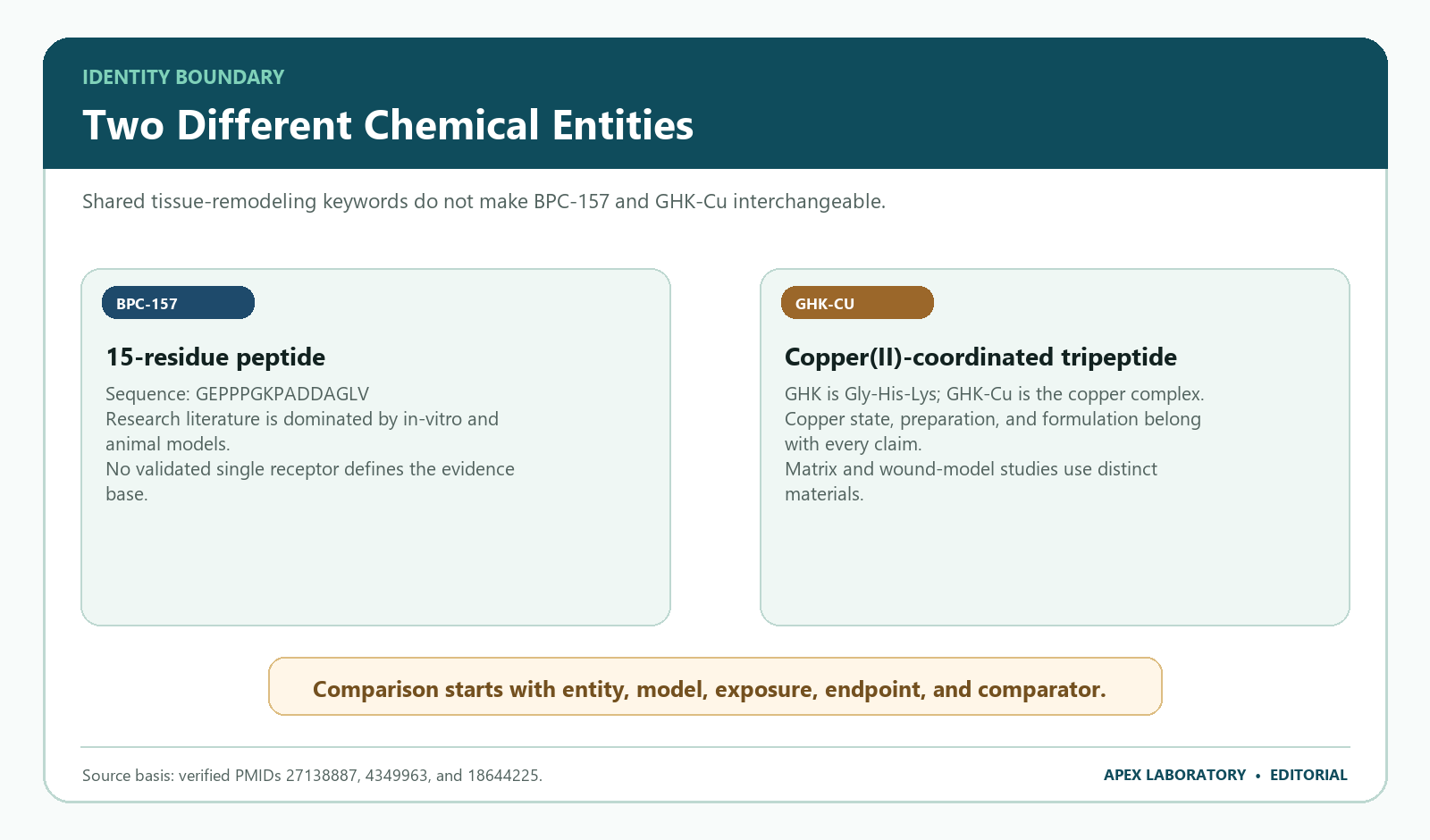
BPC-157 and GHK-Cu are chemically different research entities studied in different experimental systems: BPC-157 is a 15-residue synthetic peptide, while GHK-Cu is a copper(II)-coordinated tripeptide complex. Their literature overlaps around tissue-remodeling questions, but it does not provide a direct head-to-head trial or a basis for declaring one universally superior; model, material form, endpoint, and analytical controls determine the defensible choice.
Key takeaways
- BPC-157 and GHK-Cu differ in size, chemical form, experimental history, and the controls needed to interpret them.
- The BPC-157 literature is largely preclinical and spans several proposed pathways without one validated universal receptor mechanism.
- GHK-Cu findings depend on copper coordination, preparation, formulation, model, and endpoint; evidence about GHK alone cannot be silently reassigned to GHK-Cu.
- No direct head-to-head study was identified in the current evidence set, so “better” is not an evidence-supported conclusion.
- The useful decision is which material and evidence lane fit a defined laboratory question—not which compound carries the broader marketing label.
Who this comparison is for
This comparison is for researchers choosing a material for a defined in-vitro, ex-vivo, animal, or materials-science question. It is not a human-use protocol and does not translate animal exposures, topical formulations, or small safety observations into dosing guidance. The comparison dimensions were fixed before interpreting the literature: chemical identity, evidence lane, studied endpoint, formulation dependence, analytical verification, and inference limit.
That structure matters because “tissue repair peptide” is a search label, not a mechanistic class. It can hide the difference between a 15-residue peptide investigated across heterogeneous preclinical models and a copper-coordinated tripeptide whose behavior changes with chemical form and matrix. The separate BPC-157 benefit claims and human studies and GHK-Cu research guide provide deeper single-entity context.
BPC-157 vs GHK-Cu: side-by-side comparison
| Dimension | BPC-157 | GHK-Cu |
|---|---|---|
| Chemical identity | 15-residue peptide, GEPPPGKPADDAGLV | Gly-His-Lys coordinated with copper(II) |
| Identity variable most often missed | Exact sequence, form, counterion, and lot | GHK versus GHK-Cu, copper stoichiometry, preparation, and formulation |
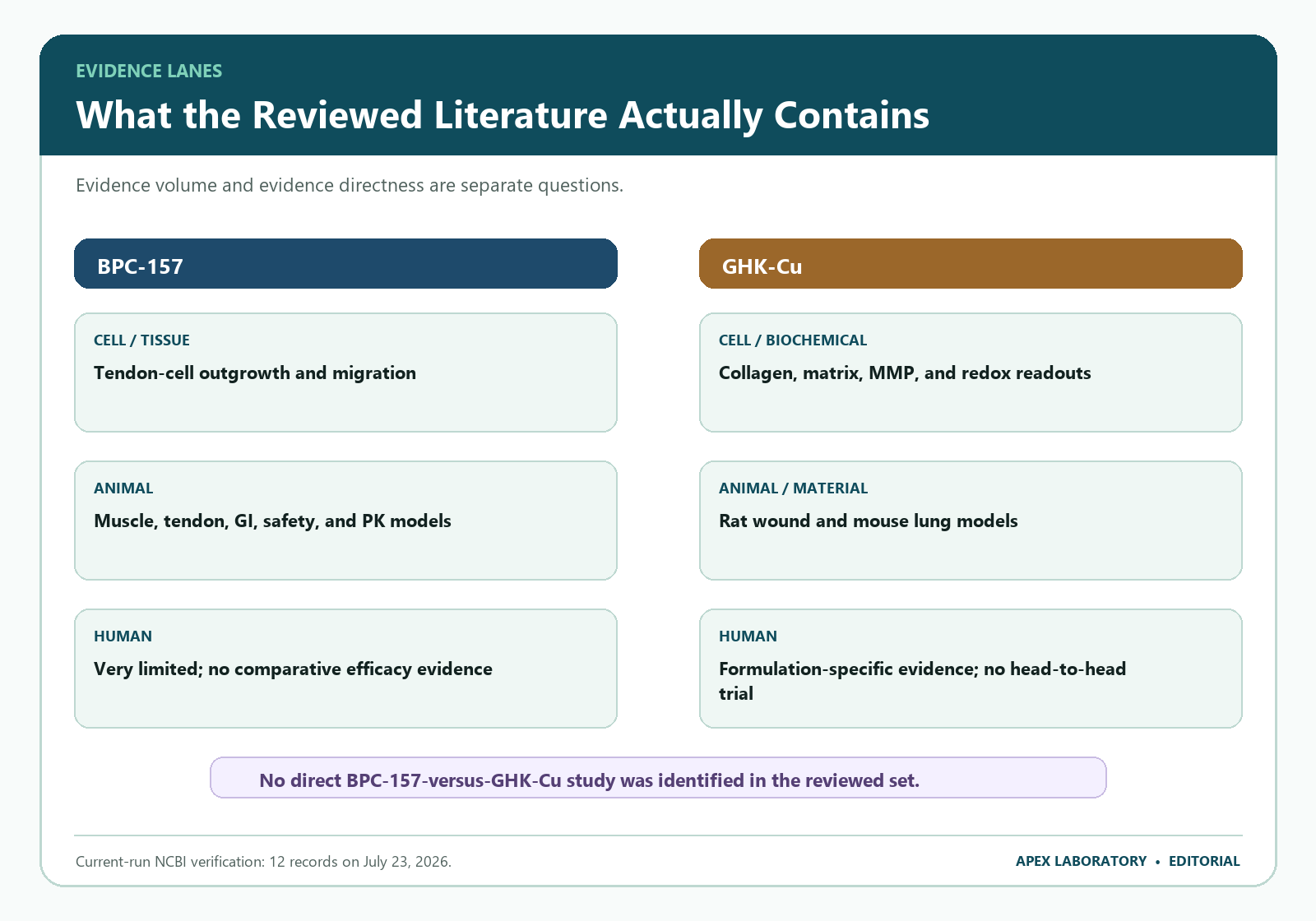
| Dominant evidence lanes | Cell, tissue, animal, safety, and pharmacokinetic models | Biochemical, fibroblast, rat-wound, mouse-disease, ex-vivo, and formulation studies |
| Commonly measured endpoints | Cell migration/survival, angiogenesis-related readouts, tendon or GI model outcomes | Collagen or glycosaminoglycan synthesis, matrix turnover, inflammatory and material readouts |
| Mechanism certainty | Multiple proposed pathways; no single universal receptor mechanism established | Copper-dependent biochemical context plus model-specific matrix and signaling findings |
| Human evidence | Very limited and insufficient for comparative efficacy conclusions | Formulation- and endpoint-specific; not evidence of equivalence across materials |
| Direct comparison | No direct head-to-head study identified in the reviewed evidence set | |
| Research decision rule | Choose only when its specific model and endpoint fit the study question | Choose only when chemical form, copper controls, model, and endpoint fit the study question |
Criterion-by-criterion tradeoffs
A useful comparison does not ask which label sounds more comprehensive. It asks which literature is closest to the planned entity, model, endpoint, and measurement system. BPC-157 has a broader set of heterogeneous preclinical models in the reviewed corpus, which can be useful when a protocol is anchored to one of those specific models. The tradeoff is interpretive distance: diversity across studies does not create one validated mechanism, standardized material, or transferable human conclusion.
GHK-Cu has a chemically explicit copper-coordination variable and a literature that includes biochemical, fibroblast, wound, material, and selected disease-model questions. That can make it a closer fit for a copper-dependent matrix or formulation experiment. The tradeoff is preparation dependence: GHK, preformed GHK-Cu, copper source, stoichiometry, vehicle, and delivery matrix can change what is actually being tested. Evidence from one preparation cannot be silently assigned to another.
| Selection criterion | BPC-157 evidence fit | GHK-Cu evidence fit | Unresolved by either lane |
|---|---|---|---|
| Closest experimental precedent | A named BPC-157 cell, tissue, animal, safety, or pharmacokinetic model with a comparable endpoint | A named GHK-Cu biochemical, fibroblast, wound, material, or disease model using a comparable preparation | Whether results transfer to a different species, tissue, material, exposure, or endpoint |
| Identity burden | Sequence, form, counterion, lot, preparation, and analytical identity | GHK versus GHK-Cu, copper state and ratio, matrix, vehicle, lot, and analytical identity | Equivalence between a catalog material and the material used in a paper |
| Control burden | Vehicle, viability, positive control, time, concentration, and model-specific controls | The same controls plus GHK-only, copper-only, and matrix controls where the hypothesis requires them | A universal control set that fits every study |
| Comparative conclusion | Each lane can test a prespecified endpoint under matched conditions; neither literature ranks the two compounds universally | No direct head-to-head result, clinical winner, or evidence of synergy | |
Chemical identity comes before biological comparison
BPC-157 is reported as the 15-residue sequence GEPPPGKPADDAGLV. The reviewed literature describes it as a stable gastric pentadecapeptide, but that historical label does not establish a single receptor or make every formulation interchangeable. The current BPC-157 evidence base includes tendon-cell experiments, animal tissue models, safety work, and pharmacokinetic studies. Each result remains attached to its model and material.
GHK is the tripeptide Gly-His-Lys. GHK-Cu is its copper(II)-coordinated complex. Pickart’s 1973 report established the circulating tripeptide history (PMID 4349963), while later GHK-Cu studies examined copper-complex preparations in fibroblasts and wounds. A claim about copper-free GHK, a preformed GHK-Cu complex, or a GHK-containing material must keep that chemical distinction visible.
| Attribute | BPC-157 | GHK (copper-free) | GHK-Cu (copper complex) |
|---|---|---|---|
| Sequence | Gly-Glu-Pro-Pro-Pro-Gly-Lys-Pro-Ala-Asp-Asp-Ala-Gly-Leu-Val (GEPPPGKPADDAGLV), 15 residues | Gly-His-Lys, 3 residues | Gly-His-Lys with one Cu(II) in 1:1 coordination |
| Molecular formula | C62H98N16O22 | C14H24N6O4 | C14H24N6O4·Cu, the 1:1 registry formula |
| Molecular weight | 1419.53 Da | 340.38 Da | 403.93 Da; the 63.55 Da gap is the single copper atom |
| CAS number | 137525-51-0 | 49557-75-7 | 89030-95-5 |
Those are registry identifiers, not experimental results and not lot data. A certificate printing CAS 49557-75-7 beside the name GHK-Cu has identified the copper-free peptide. The Zagreb reports give BPC-157 as GEPPPGKPADDAGLV, M.W. 1419 Da (PMID 14554208).
The evidence architectures are different
For BPC-157, Brcic and colleagues reported angiogenesis-related findings in muscle and tendon models (PMID 20388964), and Chang and colleagues examined tendon outgrowth, survival, and migration (PMID 21030672). Sikiric and colleagues synthesized brain–gut-axis hypotheses in a review (PMID 27138887), while Seiwerth and colleagues discussed relationships with standard angiogenic growth factors (PMID 29998800). These papers do not form a direct comparison with GHK-Cu.
For GHK-Cu, Maquart and colleagues reported collagen-synthesis effects in fibroblast cultures (PMID 3169264) and connective-tissue accumulation in rat experimental wounds (PMID 8227353). Siméon and colleagues studied matrix-metalloproteinase expression and activation in wound contexts (PMID 10383745). Pickart later reviewed the GHK tissue-remodeling literature (PMID 18644225). Again, these are different experiments, not a common ranking scale.
| Compound | Model | Species | Reported result | Source |
|---|---|---|---|---|
| BPC-157 | Single- and repeated-dose toxicity, local tolerance, genotoxicity | Mouse, rat, rabbit, dog | Only finding was a creatinine fall in dogs at 2 mg/kg, absent at lower doses and resolved after 2 weeks of withdrawal; no genetic or embryo-fetal toxicity | PMID 32334036 |
| BPC-157 | Single IV and IM dosing; [3H] radiolabel tracing | Rat, beagle dog | Prototype elimination half-life under 30 min; IM absolute bioavailability about 14–19% (rat) and 45–51% (dog); urine and bile the main excretion routes | PMID 36588717 |
| GHK-Cu | Collagen synthesis in fibroblast culture, in vitro | Not stated in the abstract | Stimulation began between 1 and 10 pM, peaked at 1 nM, and was independent of any change in cell number | PMID 3169264 |
| GHK-Cu | Subcutaneous wire-mesh wound chamber | Rat | Concentration-dependent rise in dry weight, DNA, protein, collagen and glycosaminoglycan; collagen stimulation 2-fold that of non-collagen protein; type I and III collagen mRNA up, TGF-beta mRNA unchanged | PMID 8227353 |
| GHK-Cu | Subcutaneous wound chamber, 2 mg per injection vs saline | Sprague-Dawley rat | Pro-MMP-9 left the wound fluid after day 18 but persisted in treated chambers to day 22; pro- and activated MMP-2 rose at days 18–22; interstitial collagenase unchanged | PMID 10383745 |
| GHK-Cu | Bleomycin 3 mg/kg intratracheally; GHK-Cu 0.2, 2 or 20 µg/g/day intraperitoneally on alternate days; day 21 | C57BL/6J mouse | BALF TNF-alpha, IL-6, myeloperoxidase activity and collagen deposition all reduced; MMP-9/TIMP-1 imbalance reversed | PMID 31809714 |
Six sources carry no figure to restore: three narrative reviews (PMID 27138887, PMID 29998800, PMID 18644225), a 1973 report indexed without an abstract (PMID 4349963), and two primary papers reporting qualitatively — VEGF-linked angiogenesis in treated animals, with no direct effect on cell cultures (PMID 20388964), and dose-dependent outgrowth and migration of rat Achilles-tendon fibroblasts (PMID 21030672). Each reports no quantitative endpoint.
What the BPC-157 lane can and cannot answer
A BPC-157 cell or animal study can answer whether a defined exposure changed its prespecified readouts relative to controls in that model. A tendon-cell experiment can inform migration, outgrowth, survival, or related assay behavior under the reported culture conditions. An animal injury, gastrointestinal, safety, or pharmacokinetic study can characterize outcomes or material behavior in the tested species, route, formulation, sampling schedule, and analytical method. These are useful precedents when a new protocol genuinely matches those variables.
The same lane cannot establish a universal receptor, a single tissue-repair mechanism, a human efficacy outcome, an optimal exposure, or equivalence between lots and formulations. A positive endpoint in one model also does not predict that a different endpoint will move in the same direction. Publication volume expands the map of tested questions; it does not erase the distance between models.
What the GHK-Cu lane can and cannot answer
A GHK-Cu biochemical, cell, wound, or material study can answer whether the specified copper complex and preparation affected defined collagen, glycosaminoglycan, matrix-metalloproteinase, redox, inflammatory, or tissue readouts under its controls. Those studies can guide selection of assays and copper-sensitive comparators when the planned system uses a materially similar complex and matrix.
They cannot establish that copper-free GHK, any GHK-Cu product, a hydrogel, a topical formulation, and a solution preparation are equivalent. They also cannot supply a universal human outcome or rank GHK-Cu against BPC-157. When the copper source or matrix is part of the causal hypothesis, a design that lacks GHK-only, copper-only, and matrix controls may be unable to separate coordination-dependent effects from the components around it.
Mechanism claims need model-specific boundaries
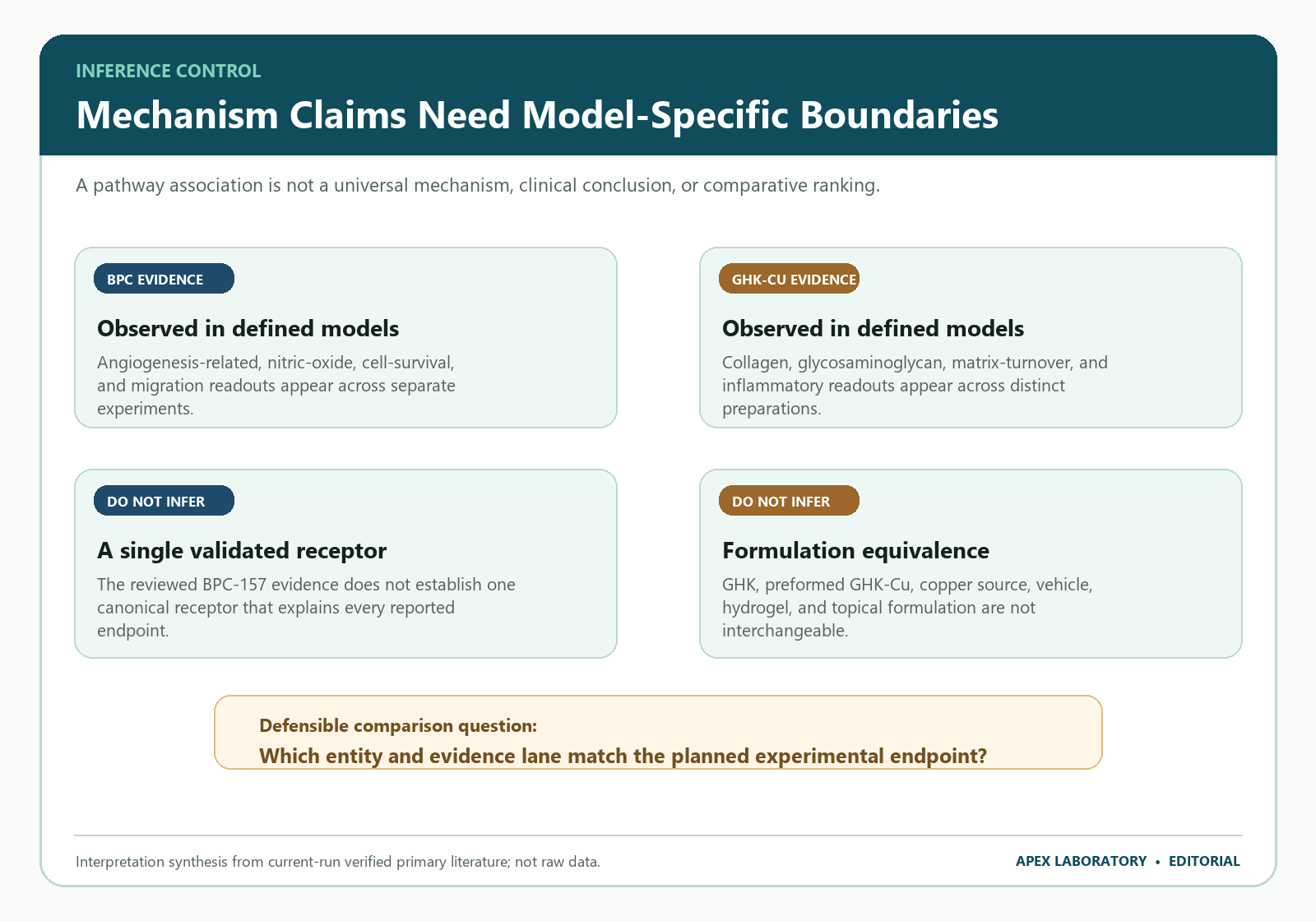
BPC-157 is frequently described through nitric-oxide, angiogenesis-related, growth-factor, cell-survival, and migration findings. Those observations come from separate models and should not be compressed into a single proven receptor pathway. Preclinical safety evaluation (PMID 32334036) and rat/dog pharmacokinetic work (PMID 36588717) add useful material-behavior context, but they do not validate a human-use outcome or make the compound comparable to GHK-Cu on one potency scale.
GHK-Cu mechanism statements require the same discipline. Collagen, glycosaminoglycan, matrix-turnover, keratinocyte, lung-injury, and fibrosis findings arise from different systems. For example, a mouse pulmonary-fibrosis study reported oxidative-stress and inflammatory endpoints (PMID 31809714), but it cannot be used as evidence that every GHK-Cu formulation has the same behavior in another tissue or species.
Human evidence and comparative limits
The current evidence set does not support a clinical comparison. BPC-157 has extensive preclinical publication volume, but publication count does not substitute for well-controlled human efficacy evidence. GHK-Cu has human and ex-vivo literature in selected topical or tissue contexts, yet formulation-specific observations do not establish the behavior of a different GHK-Cu material. Neither lane supplies a direct BPC-157-versus-GHK-Cu experiment.
Regulatory status is explicit for each compound separately. BPC-157 carries no FDA, EMA, NMPA or other marketing authorization in any jurisdiction. GHK-Cu likewise carries no FDA, EMA, NMPA or other marketing authorization in any jurisdiction, and its cosmetic-ingredient history is not a drug approval. A 2026 orthopaedic review lists both among wound-healing peptides and records that clinical trials are currently lacking (PMID 41490200); it reports no quantitative endpoint.
Evidence boundary: absence of a direct comparison means this page cannot name a universal winner, convert model exposures into a protocol, infer synergy, or claim that a commercial blend reproduces any published experiment.
A research decision framework
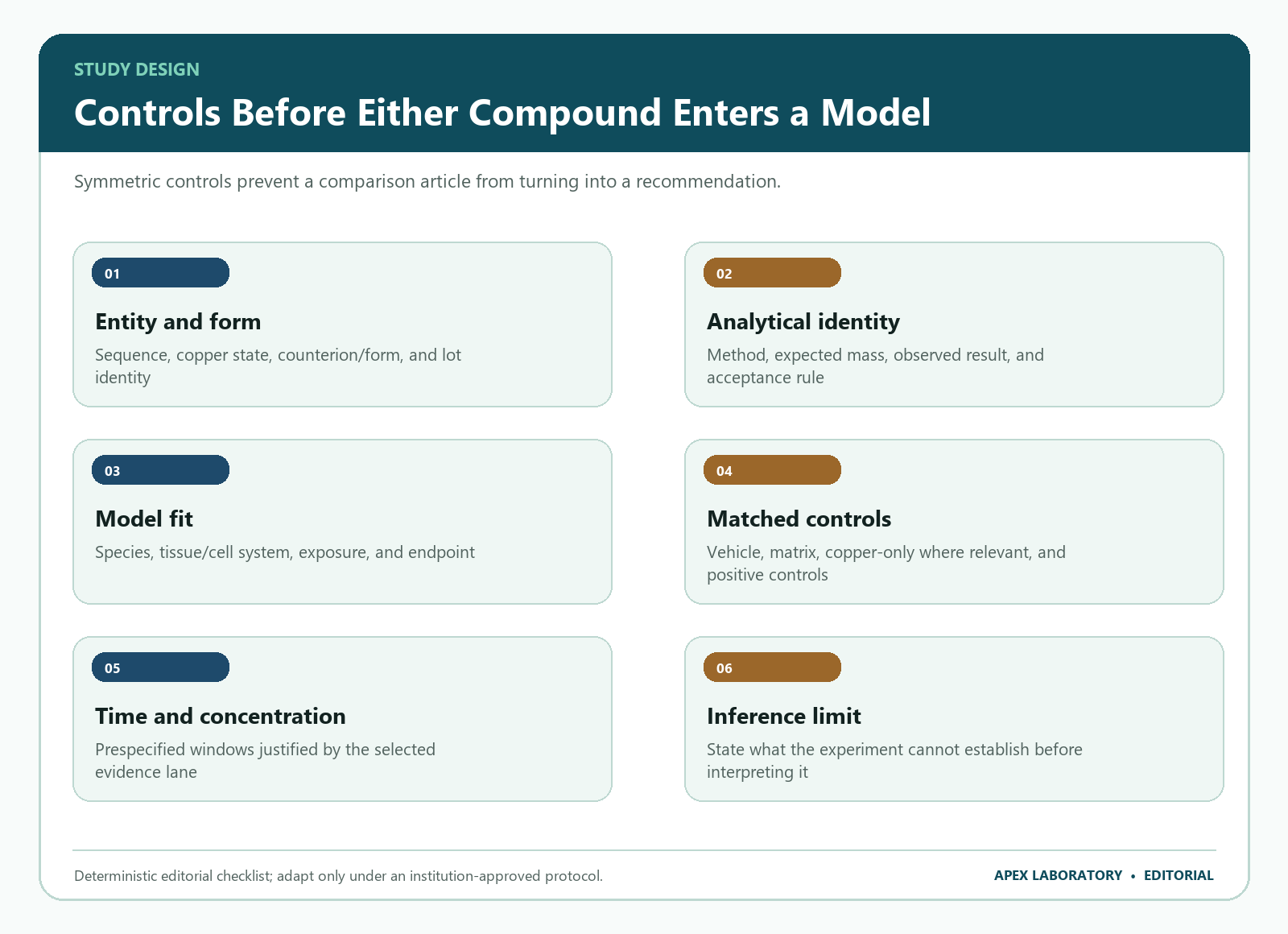
Start with the endpoint, not the product name. A tendon-cell migration question belongs to a different evidence lane from a copper-dependent fibroblast matrix question. Then identify the exact entity and form used in the closest primary study. For GHK-Cu, include copper-only and GHK-only controls when they are necessary to isolate coordination-dependent effects. For either material, prespecify concentration, timing, vehicle, analytical identity, viability, positive controls, and the inference limit.
A combined-material study adds variables rather than resolving them. It needs single-agent arms, matched vehicle and matrix controls, a justified interaction model, and enough replication to distinguish additivity from noise. A catalog combination is not itself evidence of synergy.
A seven-step selection test
- Write the endpoint first. Name the measurable primary endpoint, time point, biological or material system, and decision rule before selecting either compound.
- Locate the closest evidence lane. Identify the primary study whose entity, model, exposure, comparator, and endpoint most closely resemble the planned work. If neither lane is close, the comparison article cannot supply the missing precedent.
- Resolve the material. For BPC-157, document sequence, form, counterion, preparation, and lot. For GHK-Cu, also document whether copper is pre-coordinated, the intended stoichiometry, copper source, matrix, and vehicle.
- Match analytical evidence to the claim. Use identity and purity methods for the exact lot, but do not treat an HPLC area percentage as molecular identity or a mass match as absolute content. Record acceptance criteria before reviewing the result.
- Build symmetric controls. Apply matched vehicle, viability, positive, time, and concentration controls to both lanes. Add GHK-only, copper-only, and matrix controls when they are necessary to answer the coordination question.
- Predefine interpretation boundaries. State which conclusion the experiment can support and which claims—human efficacy, universal mechanism, cross-formulation equivalence, superiority, or synergy—remain outside scope.
- Use a stop rule. If the material cannot be mapped to its paper, the model does not fit the endpoint, the controls cannot isolate the variable, or lot documentation is unresolved, pause rather than filling the gap with a marketing analogy.
This process may select BPC-157, select GHK-Cu, justify a properly controlled comparison, or conclude that neither is appropriate for the planned question. All four outcomes are valid research decisions. What the current literature does not justify is starting with a desired winner and retrofitting unrelated preclinical findings into support.
Verification and next steps
Before procurement, verify the current lot’s identity documentation, analytical method, expected-versus-observed result, purity method, and traceability record. HPLC and mass spectrometry answer different questions; the HPLC testing guide, mass-spectrometry verification guide, and COA-reading guide explain those boundaries.
A published purity specification is not a measurement of the vial in hand: the number describing an individual lot is the area-percent value printed on that lot’s certificate under a stated chromatographic method, and it must be rechecked on the day of purchase. For GHK-Cu the certificate must also name the copper complex, CAS 89030-95-5, rather than the copper-free tripeptide.
Qualified researchers can review the current BPC-157 research-reagent page and GHK-Cu research-reagent page as balanced commercial handoffs. Product availability, variants, specifications, and lot documents are deployment-day facts and must be rechecked before publication. This article does not treat either PDP as scientific evidence.
Selected primary sources
- Staresinic M et al. 2003. Rat Achilles-tendon transection model; sequence and molecular-weight reference. PMID 14554208.
- Brcic L et al. 2009. Muscle and tendon angiogenesis model. PMID 20388964.
- Chang CH et al. 2011. Tendon outgrowth, survival, and migration. PMID 21030672.
- Sikiric P et al. 2016. Brain–gut-axis review. PMID 27138887.
- Seiwerth S et al. 2018. Angiogenic growth-factor review. PMID 29998800.
- Xu C et al. 2020. Preclinical safety evaluation. PMID 32334036.
- He L et al. 2022. Rat and dog pharmacokinetics. PMID 36588717.
- Pickart L et al. 1973. Human-serum tripeptide report. PMID 4349963.
- Maquart FX et al. 1988. Fibroblast collagen-synthesis study. PMID 3169264.
- Maquart FX et al. 1993. Rat experimental-wound study. PMID 8227353.
- Siméon A et al. 1999. Wound MMP study. PMID 10383745.
- Pickart L. 2008. GHK tissue-remodeling review. PMID 18644225.
- Ma WH et al. 2020. Mouse pulmonary-fibrosis study. PMID 31809714.
- Rahman OF et al. 2026. Orthopaedic therapeutic-peptide review. PMID 41490200.
Research-use disclaimer
This article is educational research reference material, not medical advice or a human-use protocol. Apex Laboratory supplies research-use-only chemical reagents for in-vitro and preclinical work. Nothing here establishes safety, efficacy, dosing, administration, treatment, or equivalence to an approved pharmaceutical product.