A certificate of analysis can be a useful summary of testing, but the document is not self-validating. A polished PDF, a large purity percentage, or a mass value close to expectation can all look persuasive while leaving the sample, method, specification, or raw-data connection unresolved. The practical question is not merely “Does this COA look real?” It is “Does this controlled report support the exact decision my laboratory needs to make?”
This guide applies a method-neutral review sequence grounded in ICH analytical-procedure guidance, FDA method-validation guidance, ISO/IEC 17025 competence principles, NIST traceability concepts, USP chromatography and peptide-mapping chapters, and ILAC decision-rule guidance. It does not authenticate a specific report, replace a qualified laboratory review, or establish that any material is suitable for a particular experiment.
- Start with traceability. If the lot, sample identity, laboratory, method, or report revision cannot be connected, stop before interpreting the number.
- Read result and specification separately. A measured value is not a pass until an appropriate, predefined acceptance criterion and decision rule are applied.
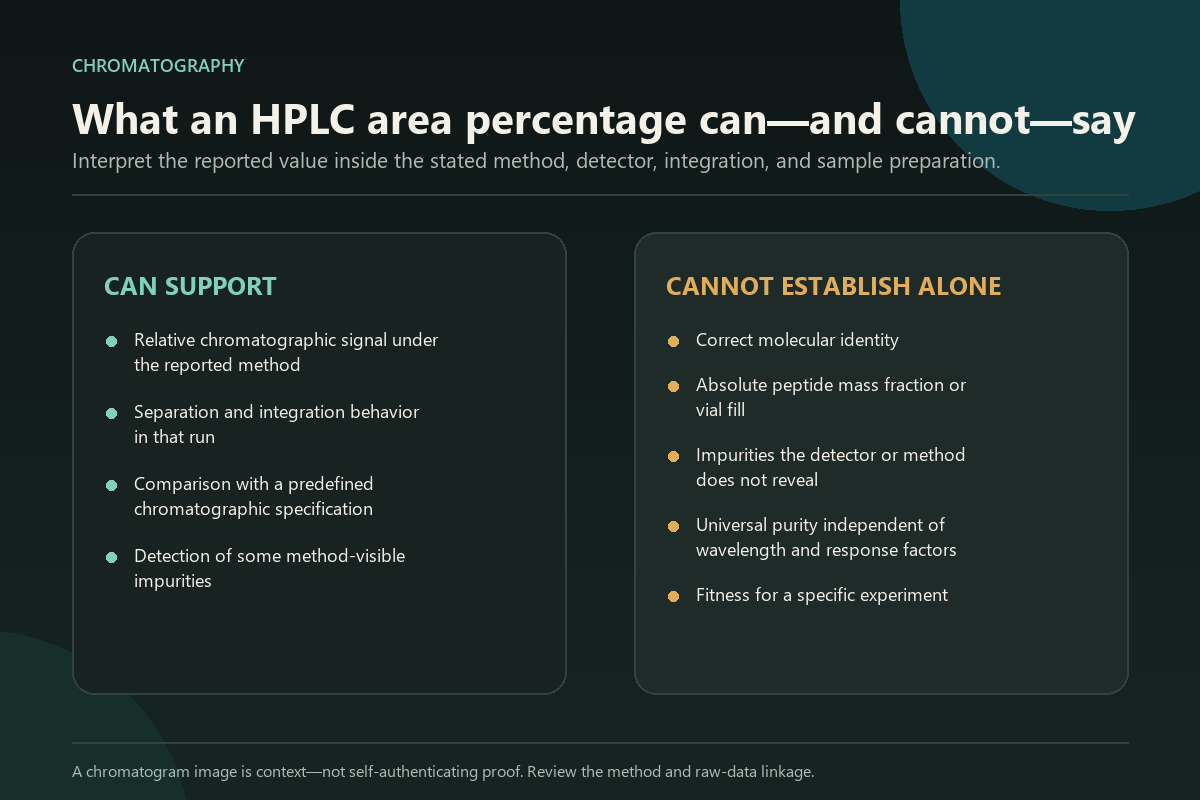
- HPLC area percentage is method-dependent. It does not equal universal purity, absolute peptide content, vial fill, or identity.
- Mass spectrometry needs an ion model. Compare charge state, isotope convention, adducts, and deconvolution under the laboratory’s validated tolerance.
- Use complementary methods. Identity, chromatographic purity, content, water, residual solvents, counterions, endotoxin, and bioburden are different questions.
What can a peptide COA actually show?
A COA summarizes results for a named sample or production lot against stated tests and, when applicable, specifications. It can support a traceable conclusion such as “the laboratory reported this result for this sample using this method on this date.” The strength of that conclusion depends on whether the sample identity, chain of custody, method, data processing, specification, approval, and report revision are controlled.
A COA cannot, by its existence alone, prove that the sampled material represents every container in a lot, that the method detects every possible impurity, or that the material is fit for every downstream use. It also cannot convert a chromatographic percentage into absolute peptide content or a mass match into complete sequence confirmation.
| Question | Useful evidence | What not to infer |
|---|---|---|
| Is this the reported lot? | Matching lot and sample identifiers, chain-of-custody record | That the PDF belongs to the material because the product name looks similar |
| What chromatographic profile was reported? | Method ID, detector, chromatogram linkage, integration, area result | Absolute mass fraction, identity, sterility, or every impurity |
| Is the observed ion consistent with expectation? | Expected species, charge/adduct model, spectrum and deconvolution record | Complete sequence or modification assignment from one intact-mass value |
| Did the result pass? | Predefined specification, uncertainty where relevant, decision rule | That a favorable-looking number is automatically conforming |
| Is it fit for the experiment? | Methods addressing the experiment’s actual quality risks | Universal suitability from a generic panel |
Step 1: Match the report to the material
Begin with identity and traceability before reading analytical values. Compare the material label, order or receipt record, internal sample identifier, and report. The compound name, lot or batch number, sample ID, supplied form, and report revision should agree. If a distributor, manufacturer, and testing laboratory are different entities, the report should make those roles clear enough to reconstruct the chain.
- Does the exact lot or batch identifier match the container and receiving record?
- Is the sample identifier unique, and can it be linked to the submitted material?
- Are the laboratory name, address or contact record, and report number present?
- Are sample receipt, analysis, report, and approval dates distinguishable?
- Does the document show its revision, page count, and superseded status when applicable?
- Is the tested form clear: dry material, solution, salt or counterion form, blend, or another presentation?
A QR code, logo, electronic signature, or verification URL can help, but none is sufficient alone. Confirm the report through a known laboratory channel rather than a link supplied only inside the document when authenticity is uncertain. Never assume that a report for one lot supports another lot with the same product name.
For Apex materials, the COA Library is the current first-party document destination. Match any retrieved report to the exact lot before using it, and do not treat a document’s presence in the library as independent verification of a batch or analytical claim.
Step 2: Read the COA as a chain of linked fields
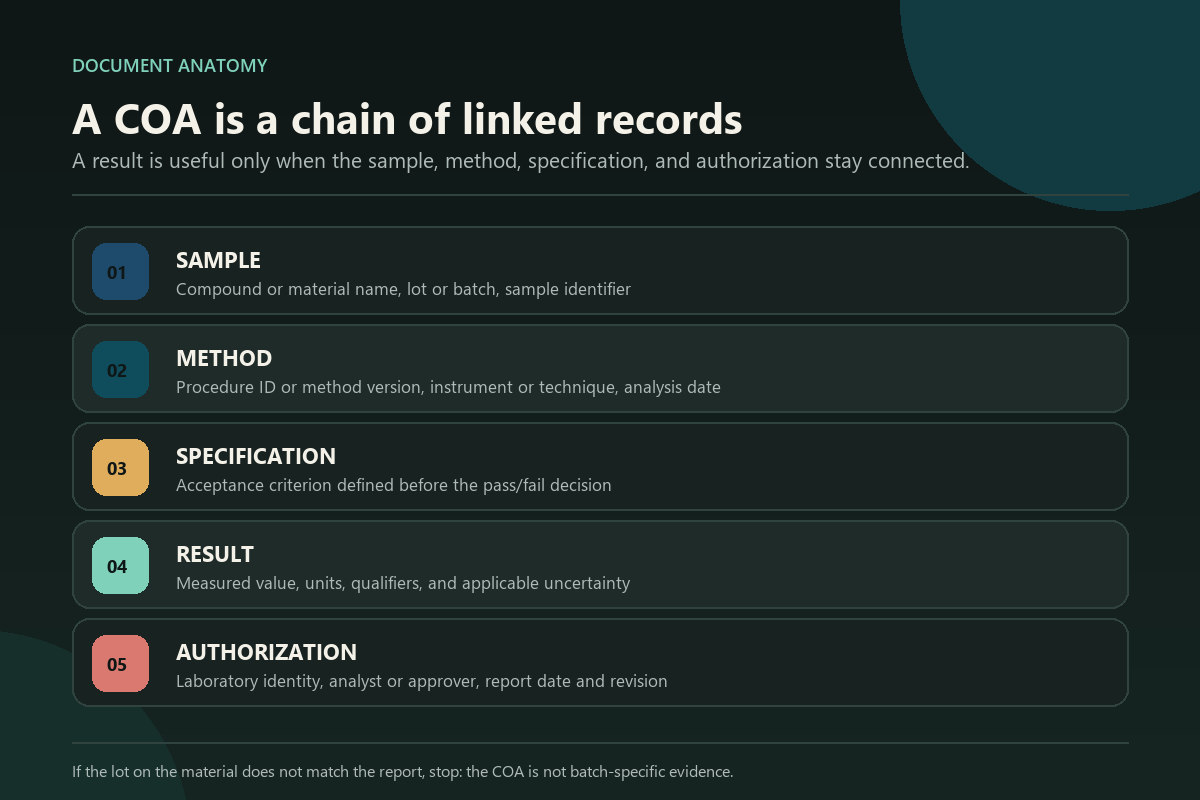
Five groups of fields should remain connected: sample, method, specification, result, and authorization. Missing one group does not always make a document fraudulent, but it limits the decision the document can support.
Sample fields
Look for the material name, lot, sample ID, submitted quantity or form where relevant, and any condition noted on receipt. A trade name alone may not resolve sequence, termini, modifications, counterion, hydration state, or formulation. Those details can affect expected mass, content basis, chromatography, and downstream methods.
Method fields
A result should name the analytical technique and provide a controlled method ID, compendial chapter, or sufficient method reference. The method version matters. “HPLC” or “MS” without a method link does not reveal column chemistry, mobile phase, gradient, detector, wavelength, ionization mode, acquisition settings, processing, system suitability, or acceptance criteria.
Specification and result fields
The specification is the acceptance criterion; the result is what was measured or observed. Keep them in separate columns. A statement such as “conforms” should be traceable to a rule, and a numerical result should include units, qualifiers, and reporting conventions. Symbols such as “<“, “>”, “ND”, and “NMT” need definitions. Rounding can also affect a borderline decision.
Authorization fields
Check the analyst, reviewer, or authorized approver; report date; revision; and any electronic-signature or document-control statement. Authorization shows that the laboratory released the report under its process. It does not prove that the selected methods were adequate for your use, so competence and fit-for-purpose review still follow.
Step 3: Interpret HPLC purity without overclaiming
High-performance liquid chromatography separates sample components under a specified method. A commonly reported “purity” value is the target peak’s integrated area as a percentage of the total included chromatographic area at the selected detector conditions. That is a relative response measurement. It is not automatically the peptide’s mass fraction in the container.
Before interpreting an area percentage, ask:
- Which mode and column were used? Reversed-phase HPLC is common, but the stationary phase and gradient determine separation selectivity.
- Which detector and wavelength were used? Different species can have different response factors, and some impurities may respond weakly or not at all.
- Which peaks were included or excluded? Solvent fronts, system peaks, baseline events, and integration thresholds can change the reported denominator.
- Was system suitability met? Suitability criteria help show that the system performed adequately for the run.
- Was identity assigned to the main peak? Retention time alone rarely supplies complete molecular identity.
- Is the chromatogram linked to the report and sample? A detached image with no run, sample, method, or audit-trail context is weaker evidence.
A chromatogram is valuable context, but it is not self-authenticating proof. Conversely, a COA without an embedded chromatogram is not automatically invalid if the report controls and underlying data are available through the laboratory. The stronger practice is a reconstructable link among report, method, sequence, raw data, processing, and review.
For a deeper treatment, see How HPLC Peptide Purity Testing Works and the companion discussion of what a 99% purity claim does and does not mean.
Step 4: Interpret mass spectrometry as an identity-supporting method
Mass spectrometry measures mass-to-charge ratio, written m/z, for detected ions. The value shown on a spectrum is not necessarily the neutral molecular mass. Charge state, isotope selection, protonation or deprotonation, metal or solvent adducts, counterion assumptions, oxidation, neutral loss, and deconvolution all affect the comparison.
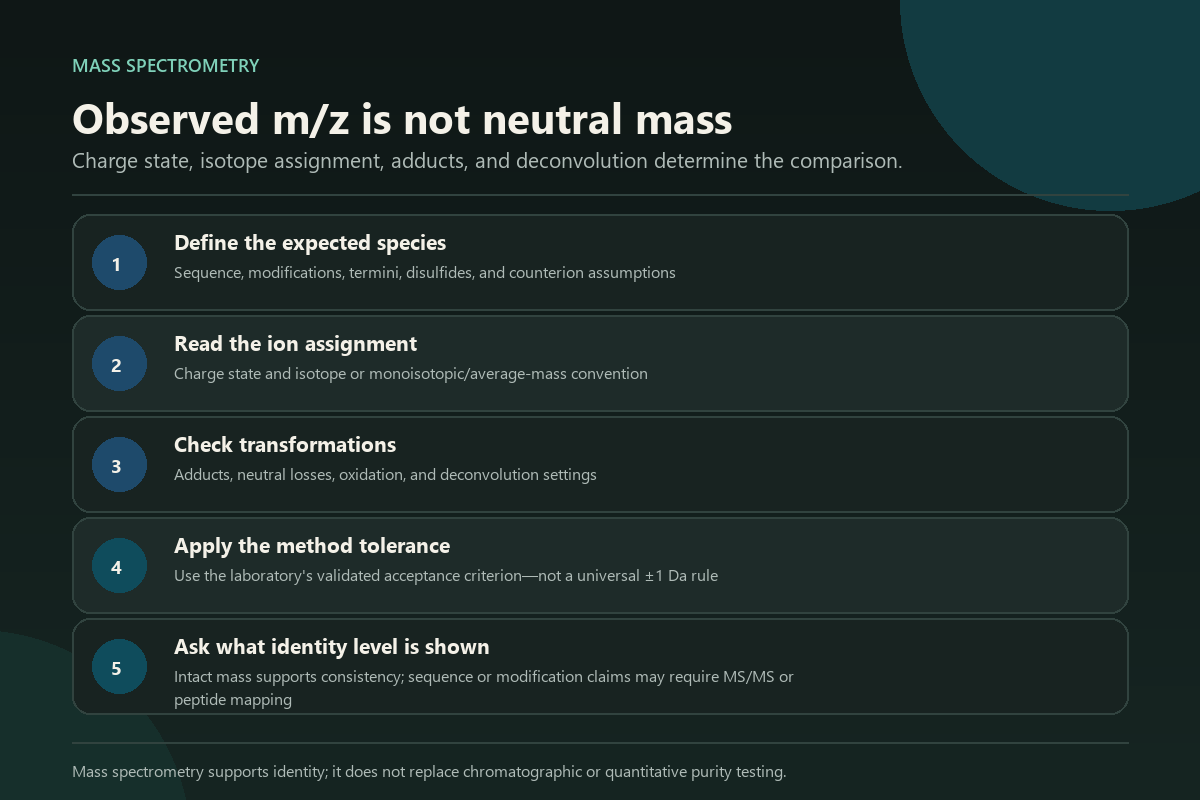
Use a five-part comparison:
- Define the expected species. Record sequence, termini, disulfides, modifications, isotope convention, and whether the expected value is neutral, monoisotopic, or average mass.
- Identify the observed ion. Read the assigned charge state and isotope peak rather than comparing an arbitrary labeled peak.
- Account for transformations. Consider adducts, neutral losses, oxidation states, and deconvolution settings supported by the method.
- Apply the laboratory’s acceptance criterion. Mass accuracy depends on instrument, calibration, acquisition, processing, and method validation. A universal tolerance is not defensible.
- State the identity level honestly. Intact-mass consistency can support identity, but sequence order, site-specific modification, isomers, and some mixtures may require MS/MS, peptide mapping, or orthogonal methods.
NIST’s work on spectral comparison emphasizes that deciding when spectra match is a method and evidence problem, not a single-number shortcut. USP peptide-mapping guidance likewise treats mapping as a structured identity tool rather than a decorative figure. The site’s mass spectrometry verification guide provides additional context.
Step 5: Ask whether the rest of the test panel fits the material and experiment
HPLC and intact-mass MS answer important but incomplete questions. Other quality attributes may need separate methods. The appropriate panel depends on the material, supplied form, synthesis and purification process, storage, container, and intended research method.
| Attribute | Possible method | Key limitation |
|---|---|---|
| Peptide content or assay | Quantitative amino-acid analysis or another validated assay | Not interchangeable with HPLC area percentage; basis and uncertainty matter |
| Water | Karl Fischer or validated alternative | Method suitability and sample handling affect the result |
| Residual solvents | Validated gas chromatography or compendial approach | Target list must reflect plausible process solvents |
| Counterion | Ion chromatography or another suitable method | Counterion content affects mass balance and interpretation |
| Sequence or modification | MS/MS, peptide mapping, amino-acid analysis | Intact mass alone may not locate a modification or resolve isomers |
| Endotoxin | Appropriate bacterial-endotoxin method | Not a universal requirement or sterility test; interference controls matter |
| Bioburden or sterility | Purpose-specific microbiological methods | One does not imply the other, and neither follows from chemical purity |
Do not add tests merely to make a certificate look comprehensive. Each result should address a defined risk or requirement. Equally, do not treat an omitted attribute as acceptable simply because other numbers look strong. A fit-for-purpose specification explains why each attribute, method, and limit matters.
Worked example: read two GHK-Cu results separately
The GHK-Cu 50 mg COA for lot APX-2026-0624-G, issued June 24, 2026, shows why chromatographic purity and active content need separate rows. The comparison below uses that record and the 100 mg record for lot APX-2026-0625-G, issued June 25, 2026. Both are Apex Laboratory in-house reports.
| Separate measurement | 50 mg configuration | 100 mg configuration |
|---|---|---|
| Chromatographic purity | 99.915% integrated detector areaCriterion: 99.7–100% integrated detector area. | 99.92% integrated detector areaCriterion: 99.7–100% integrated detector area. |
| Active content | 50.0885 mg/vialCriterion: 49–51 mg/vial. | 100.01 mg/vialCriterion: 98–102 mg/vial. |
In each report, the chromatographic result belongs to Chromatographic purity (T02), with RP-UPLC and diode-array detection. The active-content result belongs to Active content and assay (T03), with a separate calibrated-material-content method. Its basis excludes vehicle, excipient and water and follows the material specification; it is not gross vial fill.
Read across the value, unit, method and criterion before interpreting either result. 99.915% area does not mean 99.915% of the 50 mg label amount. Likewise, the 100 mg result comes from its own report; doubling the 50 mg result would not reproduce it. Open the result rows and method notes, then match the report to the received configuration and lot. The GHK-Cu configurations and COAs page connects both records to the existing product.
These are report-specific results, not independent third-party authentication or a statement about the lot currently shipping. The issue dates are report dates. Each cited result records three finished containers and two analytical replicates, reported as a mean of independent sample preparations; it is not a test of every vial. Any estimated peak profile displayed with the report is a model, not a raw instrument trace.
How should laboratory competence, accreditation, and traceability be evaluated?
ISO/IEC 17025 provides a framework for testing and calibration laboratory competence, impartiality, and consistent operation. Accreditation can strengthen confidence when the accreditation is current and the relevant method or testing activity falls within the laboratory’s scope. A logo or general accreditation statement does not establish that every reported method is accredited.
Third-party testing can reduce some conflicts of interest, but “third party” does not automatically mean correct, independent, or fit for purpose. Review who selected and submitted the sample, who paid for testing, whether the laboratory developed or validated the method, and whether the complete report can be verified. In-house testing is not automatically invalid either; its value depends on controls, competence, data integrity, and method suitability.
Metrological traceability connects a measurement result to a stated reference through a documented, unbroken calibration chain, with each contribution affecting uncertainty. Traceability does not make an unsuitable method suitable. A calibrated instrument can still answer the wrong question, use the wrong sample, or apply an inadequate decision rule.
When a specification decision is close to a limit, ask how measurement uncertainty and the decision rule were handled. ILAC G8 explains why a conformity statement should make the rule and risk explicit. Never invent a guard band or uncertainty adjustment from the rounded number printed on a COA.
What are the most important COA red flags?
- Lot mismatch or no unique sample ID. The report cannot be connected to the material.
- No method reference. A technique name is provided without a controlled method, version, or compendial basis.
- One number used for multiple claims. HPLC area percentage is presented as purity, identity, content, and safety at once.
- A detached chromatogram or spectrum. The figure lacks sample, run, method, date, or report linkage.
- Expected and observed values are unexplained. Charge state, adduct, isotope convention, or deconvolution is missing.
- Specification written after the result. The acceptance criterion has no prior document or revision history.
- Implausibly uniform reports. Different lots show identical values, dates, chromatograms, or spectra without explanation.
- Unverifiable laboratory. Contact details, accreditation scope, report number, or verification channel cannot be confirmed.
- Conflicting dates or approvals. Analysis predates receipt, approval precedes testing, or the signature belongs to another revision.
- Missing limitations. The report implies universal fitness despite a narrow method and sample scope.
A red flag is a reason to pause and request clarification, not automatic proof of fraud. Preserve the original file, record the source and access date, and ask the laboratory or supplier a precise question. The peptide vendor evaluation guide places the COA review inside a broader supplier and batch-verification process.
A five-gate workflow for accepting or rejecting a COA claim
Use the following verification checklist in order. A favorable answer at a later gate cannot repair a lot mismatch, broken traceability chain, or method-interpretation gap at an earlier gate.
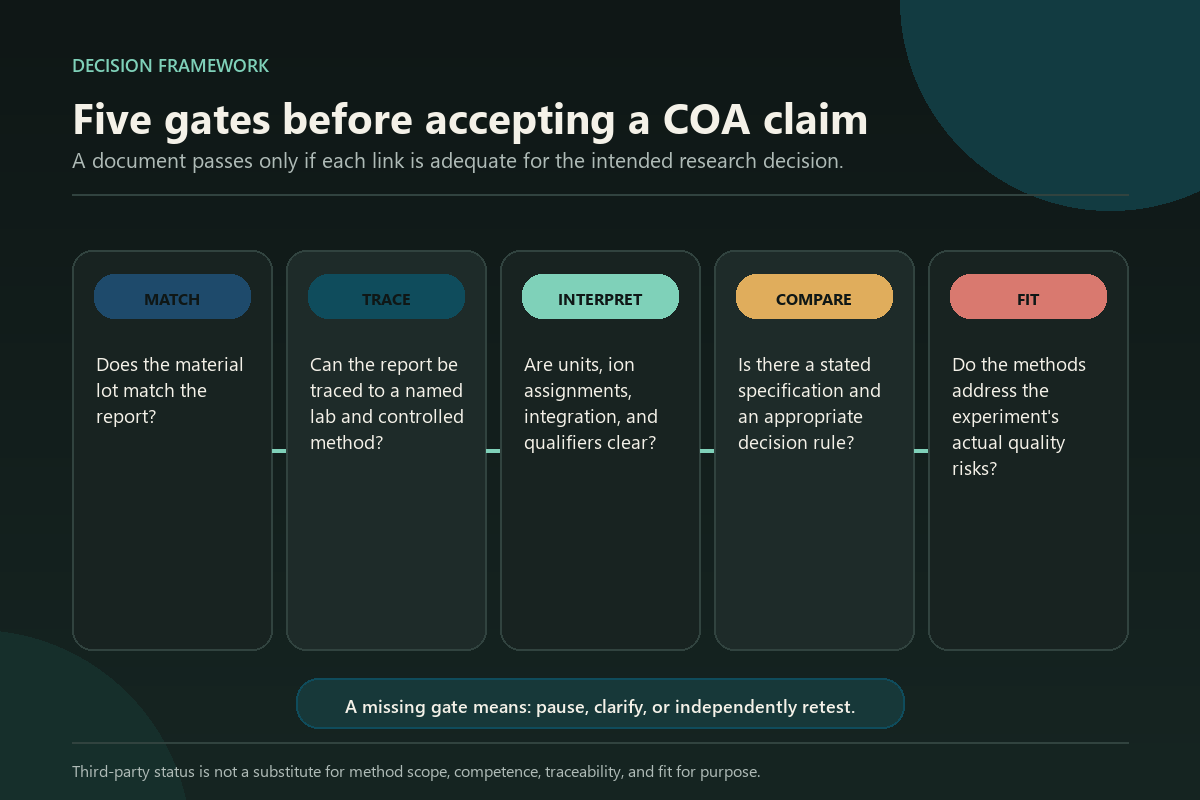
- Match: Verify the lot, sample, material form, report number, and revision.
- Trace: Connect the sample to a named laboratory, controlled method, dates, raw-data identifier, and authorized report.
- Interpret: Read units, qualifiers, integration, ion assignments, reporting basis, and method limitations.
- Compare: Apply the correct predefined specification, measurement uncertainty when relevant, and stated decision rule.
- Fit: Decide whether the tested attributes address the actual risks of the planned in-vitro or preclinical method.
Frequently asked questions
Does 99% HPLC purity mean the material is 99% peptide by mass?
No. An HPLC area percentage is a relative chromatographic response under the stated method, detector, integration, and sample preparation. It does not automatically equal absolute peptide mass fraction, vial fill, identity, sterility, or experimental suitability.
Does a matching molecular mass prove peptide identity?
It supports consistency with an expected species when the ion assignment and method are appropriate. Complete sequence, modification site, isomer, or mixture questions may require MS/MS, peptide mapping, or other orthogonal methods.
Must every peptide COA include a chromatogram?
An embedded chromatogram provides useful context but is not the only valid document design. The stronger requirement is a reconstructable link among the sample, method, run, raw data, processing, result, and authorized report.
Is third-party testing always more reliable?
No. Independence can reduce some conflicts, but reliability still depends on sample chain, laboratory competence, method suitability, data integrity, specification, and report verification. In-house testing is not automatically invalid for the same reason.
What should I do if the COA lot does not match the material?
Stop the review and request the correct lot-specific report through a verified channel. A certificate for another lot does not support the material in hand, even when the product name and reported values look similar.
Standards and primary guidance
- International Council for Harmonisation. ICH Q2(R2): Validation of Analytical Procedures. Final guideline, 2023.
- International Council for Harmonisation. ICH Q14: Analytical Procedure Development. Final guideline, 2023.
- U.S. Food and Drug Administration. Analytical Procedures and Methods Validation for Drugs and Biologics. July 2015.
- International Organization for Standardization. ISO/IEC 17025:2017, General requirements for the competence of testing and calibration laboratories.
- National Institute of Standards and Technology. Metrological Traceability.
- International Laboratory Accreditation Cooperation. ILAC G8: Guidelines on Decision Rules and Statements of Conformity.
- United States Pharmacopeia. General Chapter <621> Chromatography.
- United States Pharmacopeia. General Chapter <1055> Peptide Mapping.
- National Institute of Standards and Technology. Comparing Mass Spectra: When Do They Match?
- U.S. Food and Drug Administration. Biotechnology Inspection Guide.
- National Institute of Standards and Technology. Isotope-dilution LC-MS/MS for quantitative amino-acid analysis.