What is bacteriostatic water? Bacteriostatic water is Water for Injection prepared with an antimicrobial preservative so a labeled multiple-dose container can support repeated withdrawals. Benzyl alcohol is common, but concentration, storage, and use windows come from the named product label. Peptide-research solvent selection must follow compound-specific documentation and assay requirements.
That source-specific distinction is the key to reading bacteriostatic-water guidance correctly. A pharmaceutical label describes one named formulation. A research supplier’s specifications describe its own SKU and current lot. Neither source automatically establishes the other product’s composition, sterility controls, storage range, or suitability for a particular experimental system.
Bacteriostatic Water: Definition and Composition
Bacteriostatic water belongs to a class of sterile aqueous diluents that include an antimicrobial preservative. The preservative is what distinguishes it from preservative-free Sterile Water for Injection. The exact formulation still belongs to the label—not to the generic name.
For example, the current DailyMed record for Hospira Bacteriostatic Water for Injection, USP describes sterile, nonpyrogenic Water for Injection with benzyl alcohol. Its 30 mL multiple-dose presentation contains 0.9% benzyl alcohol, or 9 mg/mL; the record also lists a 1.1%, or 11 mg/mL, presentation without implying that both presentations are currently marketed. The label reports a pH of 5.7 with a range of 4.5 to 7.0 and directs readers to the manufacturer’s instructions when selecting a vehicle.

Source boundary. Hospira’s pH, concentration, packaging, and storage statements apply to the named Hospira product. They do not establish specifications for the Apex product or for every item sold as bacteriostatic water.
Why a Bacteriostatic Preservative Changes the Container’s Role
The preservative allows a manufacturer to label a container for multiple doses or repeated withdrawals. By contrast, the current Hospira Sterile Water for Injection label says its preparation contains no bacteriostat, antimicrobial agent, or added buffer and is supplied only in single-dose containers.
“Multiple-dose” does not mean that the contents remain sterile indefinitely or that handling no longer matters. The named Hospira label still requires aseptic technique, an intact seal, and visual inspection for unexpected precipitation or discoloration. A preservative also does not prove that the solvent is chemically compatible with a peptide, buffer, cell system, or analytical method.
The practical reading rule is simple: use the container classification and storage language on the exact product, then apply the receiving laboratory’s approved procedure. Do not convert a preservative concentration into a universal shelf-life or compatibility claim.
Bacteriostatic Water vs Sterile Water, Saline, and Acidified Solvents
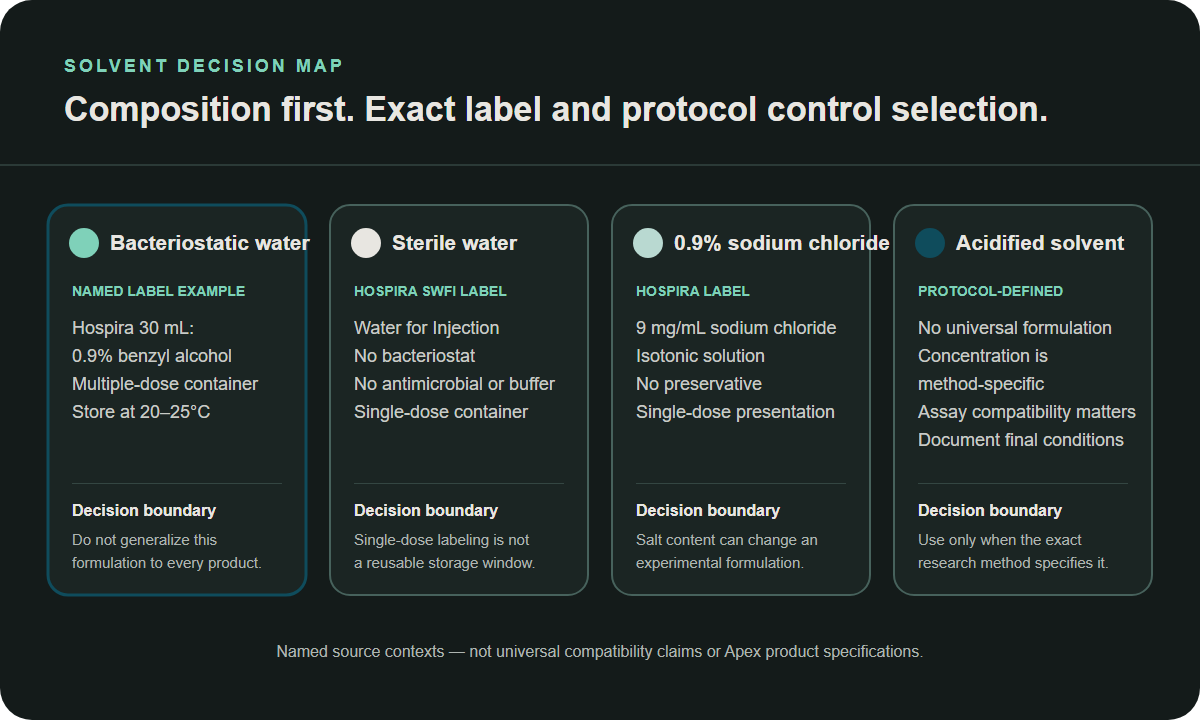
These solvent names answer different composition questions. They are not interchangeable labels for “clean water,” and none of them can be selected responsibly without the material’s technical documentation and the downstream method.
| Solvent context | What the cited source establishes | What the source does not establish |
|---|---|---|
| Hospira Bacteriostatic Water, 30 mL | Water for Injection with 0.9% benzyl alcohol; multiple-dose container; labeled storage at 20–25°C. | A universal 28-day puncture window, Apex specifications, or compatibility with a particular peptide. |
| Hospira Sterile Water for Injection | Water for Injection with no bacteriostat, antimicrobial agent, or added buffer; single-dose container. | A reusable post-opening interval or suitability for every experimental formulation. |
| Hospira 0.9% Sodium Chloride Injection | Isotonic solution containing sodium chloride 9 mg/mL; no preservative; single-dose presentation. | Interchangeability with preservative-free water or compatibility with a specific assay. |
| Protocol-defined acidified solvent | Only the cited compound method can establish the acid, concentration, pH, order of addition, and downstream dilution. | A universal acid concentration or a general fallback for material that has not dissolved. |
How Long Does Bacteriostatic Water Last?
There is no responsible single answer without naming the product state and source. For an unopened container, use the expiration date and storage conditions on that exact product. After first puncture, use the product’s explicit instruction together with the laboratory’s approved multiple-dose-container policy. Do not borrow a puncture window from another brand, container, or formulation.
The two current examples checked for this review show why attribution matters:
- Hospira pharmaceutical label: the cited label calls the 30 mL, 0.9% presentation multiple-dose and specifies storage at 20–25°C. The cited label text does not supply a universal post-puncture interval for unrelated products.
- Current Apex research product documentation: the Apex bacteriostatic-water page, checked July 21, 2026, states 0.9% benzyl alcohol, storage at 15–30°C away from light, no freezing, and use within 28 days of first puncture. Those are current Apex SKU statements and must be rechecked when the article is deployed.
Refrigeration should not be added as a generic rule when the exact label specifies controlled room temperature. Likewise, a 28-day instruction should be treated as an outside limit for the product that carries it—not as proof that a mishandled or visibly abnormal vial remains suitable until day 28.
How to Choose a Solvent for a Research Protocol
Solvent selection is a method decision, not a popularity contest. Before preparing a material, a researcher should resolve five questions in order:
- What exact material is in the vial? Confirm identity, formulation, counterion, supplied mass, peptide content where applicable, and lot documentation.
- What does the compound-specific source require? Use the current technical sheet, validated method, or primary protocol rather than a category-wide solvent list.
- What must the downstream system tolerate? Preservatives, salt, pH, and organic co-solvents can affect cell systems, binding assays, chromatography, and other measurements.
- How will concentration be verified? Define final volume and stock concentration before handling. Record the inputs, units, formula, and result in the laboratory notebook, then verify the arithmetic independently before the in-vitro workflow begins.
- What is the stop condition? Unexpected particulates, precipitation, discoloration, or a source conflict should pause the workflow for compound-specific review instead of triggering an improvised solvent change.
The procedural owner for this cluster is the laboratory peptide reconstitution protocol. It explains verification, solvent choice, concentration math, documentation, and troubleshooting without turning this definition page into a second how-to.
Benzyl alcohol and assay compatibility
Question three above is the one most often skipped, and benzyl alcohol is the reason it matters here. The preservative that makes a vial multi-use is not inert toward the downstream system: benzyl alcohol can interfere with certain sensitive in-vitro assays, particularly those involving neural cell cultures or neonatal tissue models. Where an assay is known or suspected to be sensitive to it, the appropriate solvent is plain sterile water used single-use, accepting the loss of multi-puncture capability rather than carrying a preservative into the measurement. This is an assay-compatibility decision, not a sterility one — the preservative is still doing its job; it is simply the wrong reagent for that particular readout.
When an alternative solvent is indicated
Bacteriostatic water is the default for most research peptides, but two alternatives exist for materials that resist aqueous dissolution. Dilute acetic acid, typically 0.6–1%, is the usual first alternative for larger or more hydrophobic sequences and for some GLP-1 analogs at higher stock concentrations. For material that resists aqueous solvent entirely, a small volume of DMSO — conventionally 10–20% of the final volume — can serve as an initial co-solvent, with the peptide dissolved in DMSO first and then brought to final volume with aqueous buffer. DMSO carries its own constraint: at higher concentrations it can interfere with biological assays, so the final DMSO fraction should be kept as low as the dissolution allows and recorded in the method. Neither alternative should be adopted improvisationally — use whichever the compound-specific source specifies, and record the deviation.
Common Bacteriostatic-Water Misconceptions
| Misconception | Source-corrected interpretation |
|---|---|
| All bacteriostatic water contains 0.9% benzyl alcohol. | No. The current DailyMed label record for Hospira lists 0.9% and 1.1% presentations. Read the exact label and product status. |
| Every punctured vial is good for 28 days. | No. A puncture window belongs to the exact product instruction and institutional procedure. The current Apex page states 28 days for its SKU. |
| The preservative makes poor handling harmless. | No. A bacteriostatic preservative does not replace contamination controls or visual inspection. |
| A “distilled water” claim answers the same questions as a sterile-water label. | No. A distillation claim does not establish whether the exact product is labeled sterile, single- or multiple-dose, preservative-free, or suitable for a research protocol; those details require the product label and method documentation. |
| Bacteriostatic water, saline, and acidified solvent are interchangeable. | No. They differ in preservative, salt, pH, and method context. The compound-specific protocol and downstream assay control selection. |
What to Verify Before Using Current Product Documentation
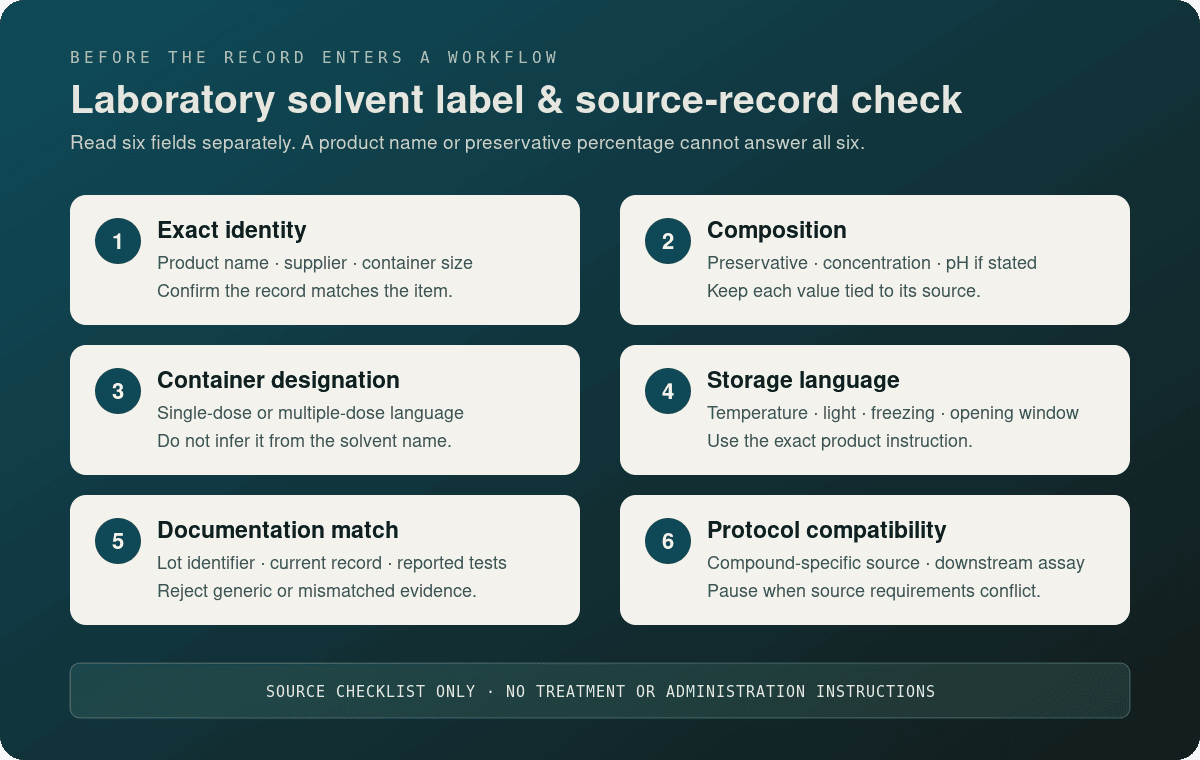
An evergreen explainer should not cache facts that can change with a supplier, lot, or catalog update. Before using or purchasing a research solvent, verify the current record for:
- the exact product name, composition, preservative concentration, and container size;
- the current storage and first-puncture instructions;
- the lot identifier and which tests are actually reported for that lot;
- whether the documentation matches the item being supplied rather than a generic example;
- the compound-specific solvent requirement and downstream assay limits; and
- the receiving laboratory’s documentation, contamination-control, and disposal procedures.
Apex’s current product specifications are maintained on the bacteriostatic-water product page, while current lot records belong in the Lab Verified archive. For the analytical distinction between a reported test and the question it answers, see the guide to HPLC peptide verification. The broader regulatory distinction is covered in research-grade versus pharmaceutical-grade context.
Sources and Scope
- DailyMed: Hospira Bacteriostatic Water for Injection, USP — formulation, pH, container, and labeled storage for the named product.
- DailyMed: Hospira Sterile Water for Injection, USP — preservative-free, unbuffered, single-dose labeling.
- DailyMed: Hospira 0.9% Sodium Chloride Injection, USP — 9 mg/mL sodium chloride, isotonicity, preservative status, and single-dose context.
- Apex Laboratory Editorial Standards — sourcing, corrections, and review method.
Research Use Disclaimer
The Apex Laboratory bacteriostatic-water SKU discussed here is supplied only for in-vitro and preclinical laboratory research. It is not an FDA- or EMA-approved pharmaceutical product and is not intended for human therapeutic use; this statement applies to the Apex research SKU, not to the named Hospira pharmaceutical product.
This guide is provided for educational and laboratory reference purposes only. All compounds discussed and all products sold by Apex Laboratory are intended exclusively for in-vitro laboratory research use and are not for human consumption. Researchers should consult primary peer-reviewed literature for detailed protocols, experimental designs, and verified specifications.