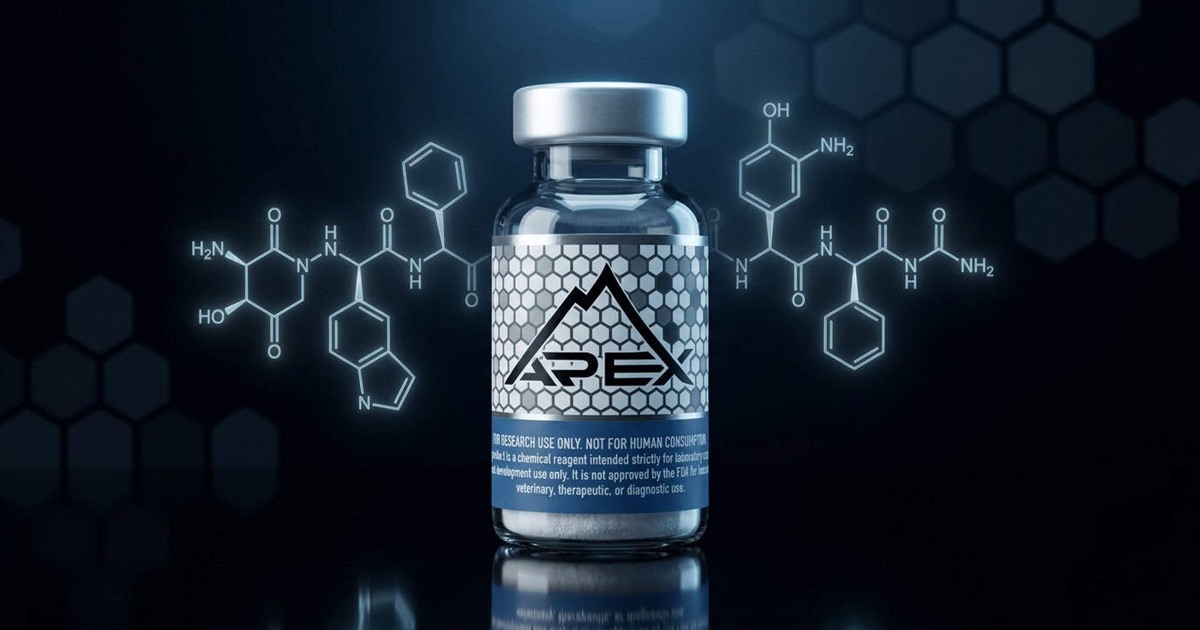
What is BPC-157?
BPC-157 is a pentadecapeptide: “penta-deca” means fifteen, and peptide means a chain of amino acids. The name is commonly expanded as Body Protection Compound-157. It appears in research on tissue injury and gastrointestinal models, but the name itself is not evidence of a protective effect.
GEPPPGKPADDAGLVBPC-157 is a peptide, rather than an anabolic steroid. It is also a different molecule from TB-500 or GHK-Cu. Similar online claims about these materials do not make their structures, biological behavior or evidence interchangeable.
At Apex Laboratory, BPC-157 is offered as a research material. A laboratory reagent is not a finished medicine, and a catalog listing does not establish a treatment, a suitable route of administration or a human-use protocol.
What is BPC-157 claimed to do—and what has actually been measured?
“Does BPC-157 work?” needs a second question: work for which outcome, in which model? Moving cells across a culture dish, improving a rat tendon score and reducing a person’s pain are different endpoints. The most useful answer keeps those distinctions visible.
A research observation can justify the next study without proving the broader promise.
This is a claim about recovery of an injured structure.
Rat tendon cells and explants showed changes in migration, outgrowth and stress survival. These are laboratory observations, not proof of healed human tendons. Chang et al., 2011.
This groups several different diseases and outcomes together.
A rat surgical study measured healing after intestinal segments were joined. It did not establish treatment of a human digestive disorder. Vuksic et al., 2007.
A proposed vascular effect is often presented as a general benefit.
Endothelial-cell experiments and a rat hind-limb ischemia model found VEGFR2-related signaling and vascular changes. That does not establish a cardiovascular benefit in people. Hsieh et al., 2017.
Not observing a problem is different from ruling one out.
A short pilot in two previously exposed adults reported no changes in selected laboratory markers or reported side effects. That design cannot estimate rare events or long-term risk. Lee and Burgess, 2025.
How might BPC-157 work in the experiments?
Several pathways have been investigated. They are better understood as model-specific findings than as one established “repair switch.”
Cell movement: FAK and paxillin
FAK and paxillin help organize how cells attach and move. In rat tendon-cell and explant experiments, BPC-157 was associated with increased phosphorylation of these proteins, alongside changes in migration and spreading. This connects a cellular behavior with a signaling response; it does not identify a universal receptor or demonstrate human tendon repair.
Blood-vessel signaling: context matters
Brcic and colleagues reported vascular-marker changes in injured-animal tissue but no direct angiogenic effect in their cell-culture arm. Hsieh and colleagues used different systems and reported VEGFR2 expression, internalization and downstream signaling. These findings should be read with their models attached, not flattened into “BPC-157 always grows new blood vessels.”
Nitric oxide: animal models and isolated human tissue
A rat surgical study used interventions that alter nitric-oxide signaling to investigate BPC-157 responses. More recently, a 2026 study of artery segments from 12 surgical donors reported relaxation that depended partly on the vessel lining and nitric-oxide signaling. The latter used tissue outside the body. It was not a trial administering BPC-157 to patients or showing improved heart health.
Broader growth-factor and brain-gut reviews help map research hypotheses. They remain secondary syntheses, not independent confirmation of every proposed pathway.
What human studies of BPC-157 exist?
The published record is larger than “no human studies,” but much weaker than “clinically proven.” Three small reports illustrate the gap. They used different materials, procedures and endpoints; their participant counts should not be combined into a single clinical trial.
Retrospective knee-pain report
Investigators reviewed 17 patient records and reached 16 people by telephone. Twelve had received BPC-157 alone; four had received BPC-157 with a material described as TB4. Eleven of the 12 BPC-157-only respondents reported improvement. There was no untreated comparison group, and the study did not use standardized measures of function or confirm structural repair by follow-up imaging. These observations cannot establish that BPC-157 repaired cartilage or a tendon. Read the primary report.
Interstitial-cystitis pilot
Twelve women with persistent symptoms reported improvement after a clinical procedure involving BPC-157. The report had no control arm. It cannot separate a peptide-specific effect from other features of the procedure, expectations or changes over time, and it does not establish a general treatment for bladder pain. Read the primary report.
Short intravenous safety pilot
The study reported no measured change in selected blood markers or reported side effects over a short observation period. Two participants, prior exposure and no control group make this a preliminary observation. It did not test injury recovery and cannot settle long-term, organ-specific or uncommon risks. Read the primary report.
What would change the answer? Larger, adequately controlled studies with clearly characterized materials, prespecified outcomes and sufficient follow-up. A successful cell assay, an encouraging case report and a registered study are each a different step toward that evidence.
What about newer trial registrations?
A ClinicalTrials.gov check on September 8, 2026 found the following BPC-157-related records. None had posted results in the registry at that check. Registry status is supplied by the responsible party; it is not an independent confirmation of recruitment, completion, effectiveness or approval.
On a small screen, scroll the table horizontally to read all three columns.
| Record | Study question | Listed status |
|---|---|---|
| NCT02637284 | PCO-02 safety and pharmacokinetics | Unknown; last update in 2015 |
| NCT07437547 | Acute hamstring injury | Recruiting |
| NCT07752381 | A named peptide-gummy formulation; single-group study | Completed; no results posted |
| NCT07803250 | Recovery after rotator-cuff repair | Not yet recruiting |
The gummy record was first posted after its listed completion date. The rotator-cuff record contains inconsistent descriptions of its comparator. Those are reasons to read the actual records carefully and await results, rather than turn registration into a claim that a product works.
Does BPC-157 help injuries recover faster?
The preclinical literature gives reasons to investigate that question, but it does not establish a reliable human recovery benefit or timetable. The human knee-pain report measured recalled symptoms, not repaired tissue. The two are not interchangeable.
A 2026 exploratory rat Achilles-tendon study compared control, BPC-157, a supplier-named TB-500 material and the combination. BPC-157’s maximum-load and total histology results did not reach significance against control for the reported comparisons. The combination did not show an additional benefit over either agent alone. This is a useful counterweight to claims that every experiment demonstrates strong repair or that a blend must work better. It does not settle human efficacy, and the paper does not establish that its TB-500 test article was the same fragment as a particular catalog material.
For the direct cross-compound question, use the dedicated BPC-157 versus TB-500 comparison. This guide keeps the single-compound evidence in view.
Does the gut research establish a human digestive benefit?
No reliable general human benefit follows from the cited animal findings. A rat intestinal-anastomosis experiment measured tissue healing, leakage-related mechanics and postoperative changes. The design is specific to a surgical model; it does not demonstrate treatment of a person’s reflux, inflammatory bowel disease or broadly defined “leaky gut.”
References to historical clinical-development programs in animal-paper introductions also need care. Mentioning a program is not the same as publishing an accessible controlled human result. Evidence should be judged from the actual study and outcome report.
Oral versus other forms: what can the research tell us?
The studies reviewed here do not establish that one marketed form is more effective or safer for people. A capsule, a lyophilized research vial and a studied pharmaceutical preparation are not interchangeable simply because each uses the name BPC-157.
The older PCO-02 registration concerns a defined oral test formulation, but has no posted results. The newer gummy record concerns a particular finished combination of ingredients and also has no posted results. Neither validates an Apex capsule or supplies a comparison with another route.
Rat and dog pharmacokinetic work measured absorption, metabolism and elimination under its own test conditions. Those data cannot provide a human onset time, dosing interval or percentage absorbed from a different preparation. A claim such as “oral works just as well” requires a suitable direct comparison, not extrapolation from a different species or formulation.
What are the side effects and safety uncertainties?
A reliable human side-effect profile has not been established by these small reports. The absence of a reported problem in a short study cannot rule out uncommon reactions, longer-term effects or risks that depend on the material’s impurities and preparation.
Nonclinical toxicology across several animal species provides information about the tested preparations and study conditions. It cannot certify a different research product as safe for human use.
The FDA safety-risk record identifies limited human safety information and concerns involving immune responses, peptide-related impurities and ingredient characterization for compounded BPC-157. This does not establish the frequency of a particular side effect; it explains why blanket reassurance is not justified.
The FDA briefing prepared for the July 2026 advisory meeting states that neither BPC-157 free base nor its acetate form is a component of an FDA-approved drug. Discussion of a substance for compounding should not be described as approval of a finished medicine.
If the question is specifically about the heart, liver or kidneys, the two-person pilot cannot answer it reliably. Neither normal selected blood tests over a few days nor an organ-protection result in an injured animal proves that a material cannot harm that organ in people.
How is BPC-157 different from TB-500, GHK-Cu and blends?
BPC-157 is the 15-residue chain shown above. Apex’s TB-500 identity is the separate acetylated seven-residue fragment Ac-LKKTETQ; full-length thymosin beta-4 is a different, 43-residue peptide. GHK-Cu is a copper complex of the three-residue peptide Gly-His-Lys. These differences matter before comparing a mechanism or a study result.
The TB-500 guide explains fragment-versus-parent evidence, and the BPC-157 versus GHK-Cu guide compares those two research materials. The BPC-157/TB-500 blend, GLOW and KLOW guides address their specific formulas. Combining components does not automatically combine their claimed benefits.
What can a BPC-157 COA tell you?
A certificate of analysis answers questions about a named sample or lot. It does not answer whether BPC-157 works in people. Match the material name, configuration, lot, report issuer and applicable tests before comparing results.
An HPLC area percentage describes integrated detector signal under a stated method. It is not automatically the mass of BPC-157 in a vial. A mass-spectrometry result can support identity, while content, microbiological results and other attributes need their own methods and acceptance criteria. Read the actual COA fields and HPLC interpretation guide before treating one number as a complete quality verdict.
The product listings show current configurations, prices and published report links. A published report should be matched to the material’s actual lot; it should not be assumed to identify the current shipping lot.
Frequently Asked Questions about BPC-157
What does BPC-157 do to your body?
Human effects are not established well enough to give a reliable general answer. Laboratory and animal studies report changes in cell movement, vascular signaling and tissue-injury measures. Small human reports do not demonstrate a predictable benefit across people, injuries or digestive conditions.
Are there human studies of BPC-157?
Yes. Published records include a retrospective knee-pain report and small interstitial-cystitis and intravenous pilots. They lack the size and controls needed for reliable efficacy or general safety conclusions. The four BPC-157-related ClinicalTrials.gov records checked on September 8, 2026 had no posted results.
Does oral BPC-157 work as well as other forms?
The cited evidence does not establish that comparison in people. A registered oral formulation, a commercial capsule and an injectable test preparation can differ in composition and exposure. Animal pharmacokinetics and a capsule label cannot establish human equivalence, effectiveness or safety.
Can BPC-157 harm the liver, kidneys or heart?
The available human studies cannot reliably quantify or exclude those risks. A short pilot in two adults found no changes in selected laboratory markers, but that cannot rule out uncommon, longer-term or material-dependent harm. Animal organ-protection findings do not prove human safety.
How long does BPC-157 take to work?
No reliable human onset or recovery timetable is established by this evidence. A time point in an animal experiment or a patient's recalled symptom change cannot define when another person should expect a benefit. This guide does not provide a dosing interval or treatment schedule.
Is BPC-157 the same as TB-500?
No. BPC-157 is a 15-residue peptide. The TB-500 identity used for Apex's research material is the separate acetylated seven-residue fragment Ac-LKKTETQ. Full-length thymosin beta-4 is a different 43-residue peptide. Their names, studies and analytical records should not be interchanged.
Does a high-purity COA prove BPC-157 is safe or effective?
No. A COA reports specified tests for a named sample or lot. Chromatographic area, identity and content results answer different analytical questions. None establishes human effectiveness, a safe route of administration or the safety of a finished medicine.
Is BPC-157 an FDA-approved drug?
FDA's July 2026 briefing states that neither BPC-157 free base nor BPC-157 acetate is a component of an FDA-approved drug. An advisory discussion about substances used in compounding is a different process from approving a finished medicine. An Apex research listing is not evidence of drug approval.
Sources and further reading
The links throughout this guide lead to the underlying studies or official records. Primary experiments carry the scientific claims. Reviews are identified as reviews and used to orient the broader literature.
- Vuksic T et al. Stable gastric pentadecapeptide BPC 157 in trials for inflammatory bowel disease (PL-10, PLD-116, PL14736, Pliva, Croatia) heals ileoileal anastomosis in the rat. Surg Today. 2007. PMID 17713731.
- Brcic L et al. Modulatory effect of gastric pentadecapeptide BPC 157 on angiogenesis in muscle and tendon healing. J Physiol Pharmacol. 2009. PMID 20388964.
- Chang CH et al. The promoting effect of pentadecapeptide BPC 157 on tendon healing involves tendon outgrowth, cell survival, and cell migration. J Appl Physiol (1985). 2011. PMID 21030672.
- Sikiric P et al. Brain-gut Axis and Pentadecapeptide BPC 157: Theoretical and Practical Implications. Curr Neuropharmacol. 2016. PMID 27138887.
- Hsieh MJ et al. Therapeutic potential of pro-angiogenic BPC157 is associated with VEGFR2 activation and up-regulation. J Mol Med (Berl). 2017. PMID 27847966.
- Djakovic Z et al. Esophagogastric anastomosis in rats: Improved healing by BPC 157 and L-arginine, aggravated by L-NAME. World J Gastroenterol. 2016. PMID 27895400.
- Seiwerth S et al. BPC 157 and Standard Angiogenic Growth Factors. Gastrointestinal Tract Healing, Lessons from Tendon, Ligament, Muscle and Bone Healing. Curr Pharm Des. 2018. PMID 29998800.
- Xu C et al. Preclinical safety evaluation of body protective compound-157, a potential drug for treating various wounds. Regul Toxicol Pharmacol. 2020. PMID 32334036.
- Lee E et al. Intra-Articular Injection of BPC 157 for Multiple Types of Knee Pain. Altern Ther Health Med. 2021. PMID 34324435.
- He L et al. Pharmacokinetics, distribution, metabolism, and excretion of body-protective compound 157, a potential drug for treating various wounds, in rats and dogs. Front Pharmacol. 2022. PMID 36588717.
- Lee E et al. Effect of BPC-157 on Symptoms in Patients with Interstitial Cystitis: A Pilot Study. Altern Ther Health Med. 2024. PMID 39325560.
- Lee E et al. Safety of Intravenous Infusion of BPC157 in Humans: A Pilot Study. Altern Ther Health Med. 2025. PMID 40131143.
- Yildirim AK et al. Endothelium-Dependent Nitric Oxide-Mediated Vasorelaxant Effects of BPC 157 in Human Internal Mammary Artery. J Clin Med. 2026. PMID 42123221.
- Biçer O et al. Effects of BPC-157 and TB-500 on Achilles tendon healing in rats: A histopathological and biomechanical study. Jt Dis Relat Surg. 2026. PMID 42542926.
Research-use context
This is an educational guide to published research. Apex Laboratory materials are chemical reagents for in-vitro and preclinical laboratory research only. They are not intended for human or veterinary use, diagnosis, treatment, prevention or consumption. This page does not provide dosing, preparation or administration instructions.