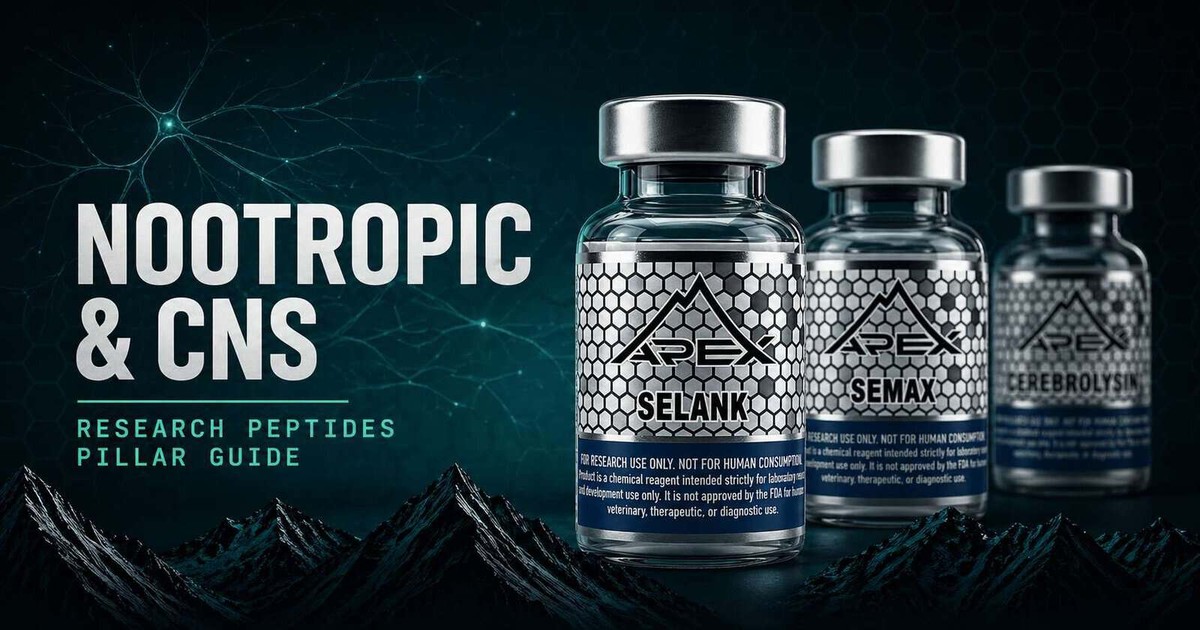
“Nootropic and CNS research peptides” is a topic label, not one chemical or mechanistic class. This guide separates six defined peptides, the peptide-derived peptidomimetic Dihexa, and the multi-component preparation Cerebrolysin, then assigns evidence to each exact material. Apex Laboratory supplies Cerebrolysin as a research-grade chemical reagent for in-vitro and preclinical research, distinct from the Cerebrolysin pharmaceutical product documented by Austria’s Federal Office for Safety in Health Care.
CNS research is especially vulnerable to category drift. A material can be described as “brain related,” “neurotrophic,” or “nootropic” even when the supporting evidence comes from a cell model, an animal experiment, a different analog, or a multi-component pharmaceutical preparation. A useful pillar does not rank compounds by hype. It shows which research question each material can address and where inference must stop.
- The category contains six defined peptides, one peptide-derived peptidomimetic, and one multi-component peptide/amino-acid preparation.
- Semax and Selank have distinct sequences, discovery programs, molecular hypotheses, and evidence records.
- DSIP, Humanin, PE-22-28, and Pinealon represent different research lineages; none can borrow evidence from a neighboring compound.
- Dihexa evidence must exclude the retracted 2014 article and rely on current, verified sources such as Wright 2015 and Sun 2021.
- Cerebrolysin’s mixture identity and pharmaceutical history make it a separate evidence object, not a single defined peptide.
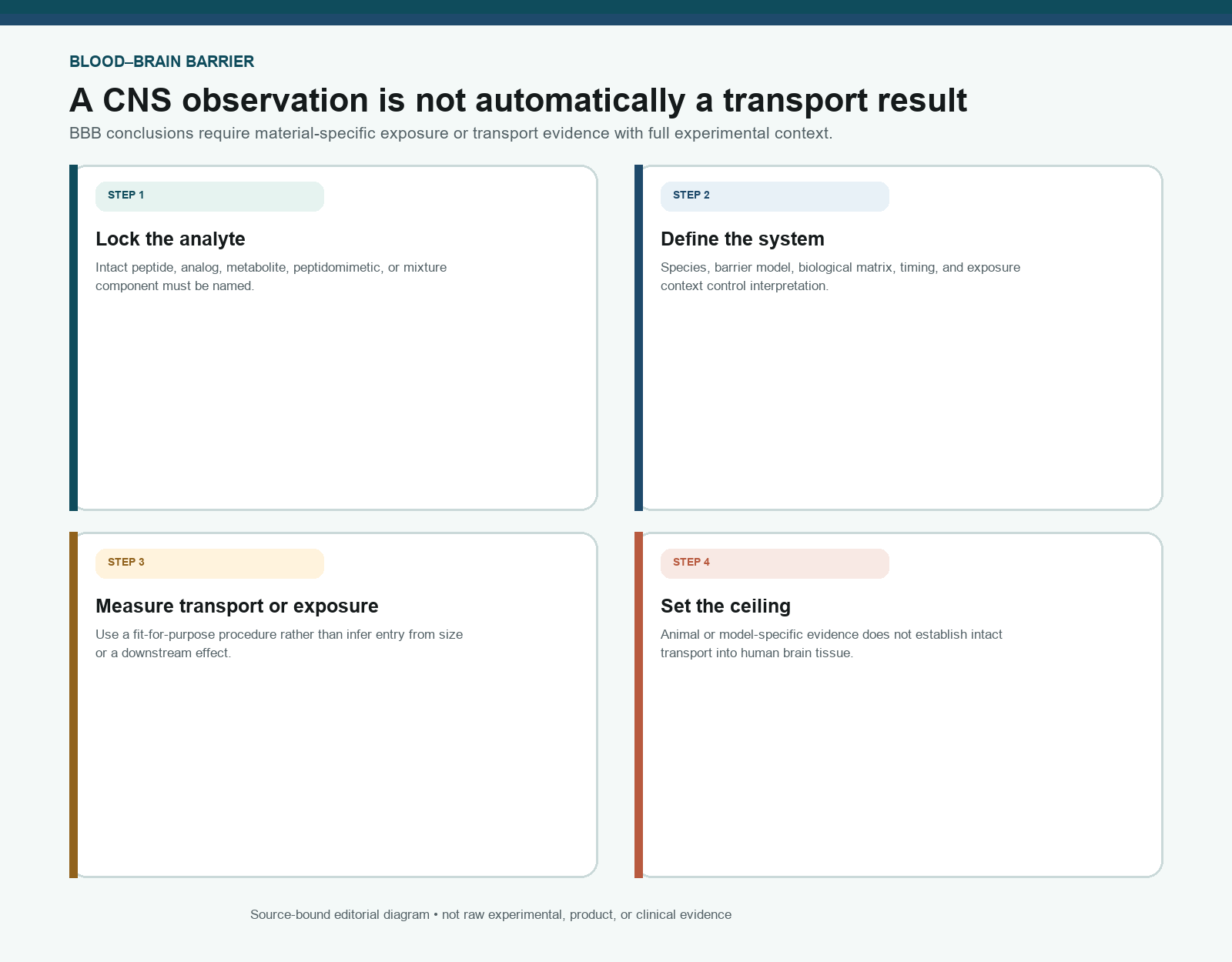
- Small size, lipid affinity, or a CNS outcome in an animal model does not by itself prove blood–brain barrier transport in humans.
One Search Category, Three Material Classes
The phrase “CNS research peptides” is useful for navigation, but it is not a scientifically uniform class. The materials covered in this guide fall into three materially different groups:
- Defined peptides: Semax, Selank, delta sleep-inducing peptide (DSIP), Humanin, PE-22-28, and Pinealon each have a defined peptide identity.
- Peptide-derived peptidomimetic: Dihexa arose from an angiotensin IV analog program but is better classified as a small peptide-derived peptidomimetic than as an ordinary peptide.
- Multi-component preparation: Cerebrolysin is a preparation containing low-molecular-weight peptides and amino acids, not one sequence-defined peptide.

That distinction changes nearly every downstream decision. A sequence-defined peptide can be assessed against a defined molecular identity. A peptidomimetic may require small-molecule-style characterization in addition to lineage context. A mixture such as Cerebrolysin requires composition- and preparation-aware controls that cannot be reduced to one molecular mass.
Eight CNS Research Materials at a Glance
| Material | Identity class and principal research lane | Evidence boundary |
|---|---|---|
| Semax | Defined ACTH(4–10)-derived peptide analog; neurotrophin-expression and CNS model research | Rat hippocampal gene-expression findings do not establish human cognitive benefit |
| Selank | Defined heptapeptide; GABAergic gene-expression and molecular anxiolytic hypotheses | Cell-line and molecular studies do not establish clinical effectiveness |
| DSIP | Defined nonapeptide first isolated through sleep-related electrophysiology research | The historical name does not make every sleep claim reproducible or settled |
| Humanin | Mitochondrial-derived peptide discovered in a neuronal-cell-death rescue screen | Discovery and cell-survival models do not prove treatment of neurodegenerative disease |
| PE-22-28 | Seven-residue analog from the sortilin-derived spadin research program | One laboratory holds the direct analog data; parent spadin literature is not a substitute |
| Pinealon | Short defined peptide studied in cellular and animal neurobiology models | Free-radical, viability, and prenatal-model findings remain model-specific |
| Dihexa | Angiotensin IV-derived peptidomimetic; synaptogenic and neurodegeneration-model hypotheses | Evidence is preclinical; the retracted 2014 article is excluded |
| Cerebrolysin | Multi-component peptide/amino-acid preparation with cell, animal, trial, and regulatory records | Finished pharmaceutical formulations and research materials are categorically distinct |
Reagent identity for each material
Identity is the first gate for literature retrieval and for analytical control. Where a figure could not be confirmed, the table says so instead of repeating it.
| Material | Sequence or composition | CAS number and molecular weight (source stated below) |
|---|---|---|
| Semax | Met-Glu-His-Phe-Pro-Gly-Pro — ACTH(4–10) carrying a C-terminal Pro-Gly-Pro extension | CAS 80714-61-0 · 813.93 g/mol |
| Selank | Thr-Lys-Pro-Arg-Pro-Gly-Pro — the tuftsin fragment Thr-Lys-Pro-Arg with the same Pro-Gly-Pro extension | CAS 129954-34-3 · 751.87 g/mol |
| DSIP | Trp-Ala-Gly-Gly-Asp-Ala-Ser-Gly-Glu — nonapeptide; only the alpha-aspartyl form was active in the original synthetic series | CAS 62568-57-4 · 848.82 g/mol |
| Humanin | MAPRGFSCLLLLTSEIDLPVKRRA — 24 residues, encoded within the mitochondrial 16S rRNA region | No single CAS in general use · 2,687.1 g/mol |
| PE-22-28 | Seven-residue fragment of the sortilin-derived propeptide spadin (PE 12-28) | CAS 1801959-12-5 · 773.9 g/mol expected |
| Pinealon | Glu-Asp-Arg — the EDR tripeptide named in the cited cell and rat studies | 418.40 g/mol, neutral peptide C15H26N6O8; PubChem CID 10273502 |
| Dihexa | N-hexanoic-Tyr-Ile-(6)-aminohexanoic amide — angiotensin IV-derived peptidomimetic, not a sequence-defined peptide | CAS 1401708-83-5 · molecular weight not confirmed |
| Cerebrolysin | Mixture: about 25% peptides below 10 kDa and about 75% free amino acids, measured by total nitrogen content | No single CAS or molecular weight describes a mixture |
Pinealon now has a source-verified neutral reference: PubChem CID 10273502 records C15H26N6O8 and 418.40 g/mol for Glu-Asp-Arg. This value describes the neutral peptide, excluding counterions and solvents; it does not verify a supplied lot, its measured ion mass or its amount per vial. The Dihexa mass is left open because the product-record value and the stated structure disagree. Other CAS numbers and masses above remain supplier-reported values from the Apex product record; neither those values nor the Pinealon reference is evidence of purity, activity, or transport.
Semax
Semax is an ACTH(4–10)-derived heptapeptide analog developed within a Russian research program. In rats, a single intranasal dose of 50 mcg/kg produced a maximal 1.4-fold rise in hippocampal BDNF protein, a 1.6-fold rise in trkB tyrosine phosphorylation, and 3-fold and 2-fold rises in exon III BDNF and trkB messenger RNA, alongside more conditioned avoidance reactions.[1] Those are rat expression measurements at one dose. They support a defined neurotrophin-expression research lane, and they do not establish a human cognitive outcome or justify borrowing evidence from a different ACTH-derived analog.
ACTH ancestry is structural and historical context; it does not mean that every ACTH function belongs to Semax. A useful Semax experiment should specify the exact material, species or cell system, tissue, sampling interval, target transcript or protein, and whether the question concerns expression, signaling, behavior, or another endpoint. “BDNF-related” is not one result: messenger RNA, protein abundance, receptor expression, localization, and functional response require different assays and interpretations. The dedicated Semax guide explains its exact sequence, human studies and BDNF evidence in more detail.
Semax is also frequently discussed beside Adamax, another analog in the broader ACTH-derived research ecosystem. That proximity does not permit evidence transfer. Substitution, terminal modification, stability, transport, or exposure differences can change the biological record. The Adamax research guide addresses Adamax-specific claims, while this guide keeps Semax anchored to its own verified literature.
Selank
Selank is a defined heptapeptide examined through molecular, cellular, and behavioral hypotheses. Across a panel of n = 84 neurotransmission-related transcripts in human IMR-32 neuroblastoma cells, Selank on its own changed none of the messenger RNA levels measured; differences appeared only in combination, where Selank suppressed the changes GABA produced and widened the set of genes altered by olanzapine.[2] A 2018 radioligand study of isolated brain-cell membranes describes Selank as a positive allosteric modulator of tritiated GABA binding that can block the modulatory activity of diazepam and olanzapine, but reports no quantitative endpoint for the magnitude of that shift.[3] The dedicated Selank and Semax research guide compares the two without presenting them as interchangeable.
The GABAergic lane illustrates why wording matters. A change in expression of genes associated with neurotransmission is not the same claim as direct binding to a GABA receptor, altered synaptic current, changed neurotransmitter concentration, or a behavioral effect. Each step requires its own procedure. Review articles can organize these proposed relationships, but a primary experiment remains the source for the exact model and endpoint.
Selank studies should also distinguish the intact peptide from fragments, metabolites, or related tuftsin-family sequences. A result obtained with a derivative belongs to that derivative, and a readout obtained in a neuroblastoma cell line stays at the cell-model tier until an animal or human study tests the same hypothesis. The standalone Selank guide examines the human anxiety studies, mechanistic findings and safety gaps alongside those distinctions.
Delta sleep-inducing peptide (DSIP)
DSIP is a nonapeptide whose name came from early electrophysiological sleep research. The 1978 sequence-and-synthesis report established a defined chemical object and measured its activity: in rabbits given 6 nmol/kg by intraventricular infusion over 3.5 minutes, mean EEG delta activity in the neocortex and limbic cortex rose by 35% against controls, across a series of 61 animals in which eight related synthetic peptides produced no comparable effect.[4] A 1984 review put the nonapeptide at a molecular weight of 849 Da, described a U-shaped relationship for both dose and infusion time, and documented a broad and sometimes inconsistent experimental record — mainly delta-sleep effects in rabbits, rats, mice, and humans, but a more pronounced REM effect in cats.[5] The right modern interpretation is historical and question-specific: “sleep-inducing” is a name, not a universal result.
DSIP is a useful lesson in phenotype-first naming. Early isolation conditions and electrophysiological observations shaped the name before modern target-deconvolution standards existed. Later experiments varied across species, preparations, endpoints, and exposure conditions. A current study should not use the name as a positive control by assumption. It should define the sleep-stage, EEG, circadian, stress, endocrine, receptor, or molecular question being tested. The DSIP guide compares the small human sleep studies and hormone findings, including weak results that the compound name can obscure.
Reproducibility also depends on material identity and assay timing. A negative result under one procedure does not erase a historical observation, and a positive result in one model does not establish a general sleep effect.
Humanin
Humanin is a 24-residue mitochondrial-derived peptide discovered in a functional-expression screen for factors that protected neuronal cells from death associated with familial Alzheimer’s disease genes and amyloid-β-related stress. The screen also defined the boundary of the effect: rescue was specific to those insults and absent against Q79 and superoxide-dismutase-1 mutants, and it depended on the primary structure of the peptide. The discovery paper is a screening report and states no quantitative result for the size of the rescue.[6] Discovery in a cell-survival model does not establish disease modification in humans, and analog-specific findings must stay with the analog tested.
Humanin sits within the mitochondrial-derived peptide field, where gene annotation, transcript context, peptide detection, subcellular origin, and signaling function can be separate questions. A synthetic Humanin experiment can test the activity of a defined peptide without proving how much endogenous peptide is produced in a tissue. Conversely, detection of an endogenous signal does not establish that an externally supplied research peptide reproduces the same localization or kinetics.
Many Humanin papers use substituted analogs designed to change potency or stability. Those results cannot be silently relabeled as native Humanin results; the evidence record should carry the exact sequence or analog name, model, stressor, comparator, concentration range, and endpoint.
PE-22-28
A dedicated PE-22-28 Research Guide now covers identity, mechanism, and evidence limits in full.
PE-22-28 belongs to the sortilin-derived spadin research lineage. The foundational spadin paper identified a sortilin-derived peptide that targeted rodent TREK-1 channels, reporting binding to TREK-1 with an affinity of 10 nM, blocked TREK-1 activity in COS-7 cells and in cultured hippocampal and CA3 neurons, and — after a 4-day intravenous course in mice — increased hippocampal CREB phosphorylation and neurogenesis.[7] That paper is a parent-program anchor, not direct proof for every shorter analog.
Direct PE-22-28 data do exist, from the same research group. In hTREK-1/HEK cells the seven-residue analog inhibited TREK-1 with an IC50 of 0.12 nM against 40–60 nM for spadin, and in mice its measurable action lasted roughly 23 hours against roughly 7 hours for spadin; a 4-day course reduced immobility in the forced-swim test, shortened latency in the novelty-suppressed feeding test, and induced neurogenesis (PMID 28955242). That is one laboratory’s cell-line and mouse record rather than an independent replication set, so claims should still state when they rest on spadin lineage rather than on PE-22-28-specific experiments.
TREK-1 is a two-pore-domain potassium channel whose functional study can include electrophysiology, binding or competition approaches, genetic controls, and behavioral models. A parent spadin result may justify a hypothesis about a shorter analog, but it does not establish the analog’s potency, selectivity, stability, channel engagement, or behavioral profile. Those properties need PE-22-28-specific data.
PE-22-28 therefore belongs in an evidence-gap lane as much as a mechanism lane. A well-designed program would confirm the exact material, then test target engagement and functional channel response with positive, negative, and scrambled-sequence controls, and stay cautious until independent studies exist.
Pinealon
Pinealon is the short defined peptide Glu-Asp-Arg, studied in cellular and animal systems. A cellular report described dose-dependent restriction of reactive-oxygen-species accumulation and less necrotic death in rat cerebellar granule cells, neutrophils, and PC12 pheochromocytoma cells, with a delayed ERK 1/2 activation time course and a shifted cell cycle; the published summary reports no quantitative finding for either the concentrations used or the effect size.[8] A separate rat study dosed dams under methionine-loaded prenatal hyperhomocysteinemia and described improved spatial orientation and learning in the offspring, with lower reactive-oxygen-species accumulation and fewer necrotic cerebellar neurons; that record carries no quantitative outcome for any of those measures.[9] These are distinct model results, not a single general claim about cognition, aging, or neuroprotection.
Pinealon is often grouped with “peptide bioregulators,” a broader research tradition that proposes short peptides may influence gene expression and age-associated processes. The review that frames that tradition reports mean life-span increases of 20–40% in rodents under long-term treatment with several different short-peptide preparations, plus slowed change in aging biomarkers and suppressed induced tumorigenesis.[10] That is a class-level rodent figure belonging to the specific preparations tested in those experiments; it is not a pinealon result and must not be relabeled as one. A cellular viability assay, oxidative-stress readout, developmental animal model, and aging hypothesis each need separate controls and should not be merged into a single “neuroprotective” score.
Short peptides can also create analytical and experimental challenges: identity must be distinguished from closely related sequences, concentration must be verified in the relevant matrix, and assay interference must be considered. Pinealon conclusions should name the exact endpoint rather than use broad outcome language. The Pinealon identity, human studies and evidence guide brings these distinctions together with the underlying research.
The Pinealon research-material record lists current configurations and available documentation. Match the selected material to its original report and lot; the neutral reference above and published model results do not establish supplied-lot identity or performance.
Dihexa
Dihexa emerged from development of small angiotensin IV analogs for neurodegeneration research. Wright’s 2015 review describes that analog-development program, including the unresolved identity of the AT4 receptor protein and the design goal of metabolic stability with blood–brain barrier penetration; as a narrative review it reports no quantitative endpoint of its own.[11] The compound is better treated as a peptide-derived peptidomimetic than as a conventional sequence-defined peptide. That classification matters for literature retrieval, material characterization, and comparisons with parent angiotensin fragments.
The Dihexa research narrative includes proposed hepatocyte growth factor/c-Met-related synaptogenic mechanisms and preclinical cognition models. Mechanistic evidence should be separated into binding or pathway engagement, cellular synapse-related endpoints, animal behavior, and disease-model interpretation. A pathway label cannot replace direct target-engagement evidence, and an animal behavioral result cannot establish human therapeutic activity.
A 2021 APP/PS1 mouse study reported restored Morris water-maze learning, more neuronal cells and higher synaptophysin expression on Nissl staining, reduced astrocyte and microglial activation, lower interleukin-1β and tumour necrosis factor-α, higher interleukin-10, and PI3K/AKT activation that the inhibitor wortmannin reversed.[12] The published summary states that several dose levels were compared but gives no quantitative result for any of those endpoints, so it supports a directional mouse-model finding only. It does not resolve human pharmacokinetics, BBB exposure, long-term safety, disease modification, or a clinically effective formulation.
Retraction control is non-negotiable in this topic. A formerly cited 2014 Dihexa article is retracted and is excluded from the article, its references, and the visual evidence map. Removing one paper also means removing downstream claims that depended only on that paper; a retracted source cannot be rescued by repeated citation elsewhere.
Cerebrolysin
Cerebrolysin differs from every other entry because it is a multi-component peptide and amino-acid preparation: measured by total nitrogen content it is roughly 25% low-molecular-weight peptides below 10 kDa and roughly 75% free amino acids. It is not represented by one sequence, one molecular mass, or one receptor. Composition, preparation, manufacturing, and formulation context therefore belong inside the identity question rather than being treated as secondary details.
Cell and animal studies have examined antiapoptotic and neurotrophin-related effects. Hartbauer and colleagues used primary cultures of embryonic chick cortical neurons under a 2% serum-supplement stress model and found the proportion of cells with apoptotic chromatin changes significantly reduced (p < 0.01), while a matched artificial amino-acid mixture did not reproduce that reduction; viability at 8 days in vitro likewise separated the peptide fraction from the amino-acid fraction, which supported only a transient nutritional effect.[13] Ubhi and colleagues dosed human amyloid-precursor-protein transgenic mice and reported normalized pro-NGF, increased mature NGF, unchanged BDNF, NT3, NT4 and CNTF, preserved TrkA and p75 receptor immunoreactivity, and a reduced cholinergic deficit in the nucleus basalis; the published summary reports no quantitative finding for the magnitude of those shifts.[14] These studies use different models and endpoints and should not be compressed into a universal mechanism.
The human evidence lane includes randomized studies in defined stroke and rehabilitation settings. CASTA randomized 1,070 patients with acute ischemic hemispheric stroke within 12 hours of onset — 529 to 30 mL Cerebrolysin daily for 10 days and 541 to saline, both with aspirin — and followed them for 90 days; the confirmatory combined global endpoint showed no significant difference between groups, and only a post-hoc subgroup with NIHSS above 12 showed separation, with cumulative 90-day mortality of 10.5% under Cerebrolysin against 20.2% under placebo.[15] CARS gave 30 mL/day for 21 days inside a standardized rehabilitation program and reported a day-90 Action Research Arm Test Mann-Whitney estimator of 0.71 (95% CI 0.63 to 0.79; P<0.0001), a multivariate global estimator of 0.62 (95% CI 0.58 to 0.65), and a 3.8% premature-discontinuation rate in a sample the authors themselves called relatively small.[16] Differences in population, timing, background care, endpoint, and analysis prevent one trial’s result from standing in for the whole evidence base.
A 2023 Cochrane review synthesized seven randomized trials and 1,773 participants in acute ischaemic stroke.[17] With moderate-certainty evidence, all-cause death showed a risk ratio of 0.96 (95% CI 0.65 to 1.41; 6 trials, 1,689 participants) — that is, probably no benefit — and the total number of people with serious adverse events showed a risk ratio of 1.16 (95% CI 0.81 to 1.66; 3 trials, 1,335 participants). Non-fatal serious adverse events rose, at a risk ratio of 2.39 (95% CI 1.10 to 5.23), reaching 2.87 (95% CI 1.24 to 6.69) in the 30 mL for 10 days dosing subgroup. Those conclusions are endpoint-specific and should be interpreted with the review’s risk-of-bias, precision, and formulation context.
Austria’s Federal Office for Safety in Health Care publishes official product information for a Cerebrolysin pharmaceutical formulation. This national record should not be generalized into an EU-wide authorization. The Cerebrolysin research guide provides additional formulation-specific context. An Apex research material is a separate research-only material and is not represented as the pharmaceutical formulation.
The regulatory firewall also controls how evidence is contextualized. A pharmaceutical trial may be discussed as formulation-specific evidence, but it cannot validate a separate research reagent. A research-material record may describe lot identity and analytical results, but it must not inherit the finished formulation’s route, indication, safety information, efficacy, or authorization.
Every Claim Needs an Evidence Owner
Evidence ownership means that each statement is attached to the exact material, model, endpoint, and source that produced it. The rule prevents five common transfers:
- from a parent peptide to a shorter analog;
- from one melanocortin, ACTH-derived, or mitochondrial peptide to another;
- from a cell line to an animal or human outcome;
- from an approved pharmaceutical formulation to a research reagent; and
- from chromatographic or mass identity evidence to biological activity.

The framework also protects against attractive but weak comparisons. Semax and Selank are often paired because both appear in CNS research, but that pairing is editorial rather than chemical equivalence, and a mouse result for Dihexa does not strengthen the evidence for Humanin.
Cross-Material Research Lanes Without Evidence Transfer
Materials can share a research lane without sharing evidence. A lane is a way to organize experimental questions; it is not a claim that the materials converge on one target or produce the same outcome.
Neurotrophin and cell-survival lane
Semax expression studies, Humanin cell-rescue work, and Cerebrolysin neurotrophin-related models can all appear under a neurotrophin or cell-survival heading. Their assays are fundamentally different. Semax may be studied through transcript and receptor-expression changes; Humanin through stress-induced cell survival; Cerebrolysin through a multi-component preparation and neurotrophin-processing readouts. A comparison should align endpoints before comparing direction or magnitude.
Membrane excitability and signaling lane
PE-22-28’s spadin/TREK-1 lineage and Selank’s GABAergic gene-expression literature both touch neuronal signaling. One centers a potassium-channel research program, while the other includes transcriptional observations connected to GABAergic neurotransmission. A shared “signaling” label does not imply shared receptors, ion-channel effects, kinetics, or cell types.
Neurodegeneration-model lane
Humanin, Dihexa, Cerebrolysin, and some Pinealon research can be retrieved with neurodegeneration-related terms. This is a search overlap, not a validated comparative treatment set. APP/PS1 mice, transgenic cholinergic models, cultured neurons under defined stress, and prenatal hyperhomocysteinemia are different experimental systems. A result in one model should be reported with its construct, background, age, endpoint, and limitations.
Behavioral and cognitive lane
Behavioral outcomes are several steps downstream from molecular identity. They can be influenced by locomotion, stress, motivation, sensory function, training, handling, and statistical choices. If two materials are compared, the experiment should use the same model, blinded allocation, appropriate positive and negative controls, prespecified endpoints, and a sample-size rationale. Cross-paper comparison without those controls is hypothesis generation, not head-to-head evidence.
| Shared lane | Possible materials | Comparison rule |
|---|---|---|
| Neurotrophin expression or processing | Semax; Cerebrolysin | Align analyte, tissue, time point, and procedure before comparison |
| Cell-survival or stress models | Humanin; Cerebrolysin; Pinealon | Keep stressor, cell type, viability endpoint, and analog identity explicit |
| Membrane signaling | PE-22-28 lineage; Selank | Do not merge channel-function and gene-expression claims |
| Neurodegeneration models | Dihexa; Humanin; Cerebrolysin | Report the exact disease construct and translational gap |
| Behavioral phenotypes | Several materials | Require matched models and control for non-cognitive performance effects |
Does a CNS Research Peptide Cross the Blood–Brain Barrier?
The blood–brain barrier (BBB) is not a binary filter that can be inferred from a compound’s size or a CNS-related outcome. Peptides may encounter passive permeability limits, saturable transport systems, enzymatic degradation, efflux, endothelial binding, or route- and species-dependent exposure. Early work demonstrated that some peptides use saturable transport across the BBB, characterizing one system with radiolabelled Tyr-MIF-1 that also carries the enkephalins, beta-casomorphin and dynorphin (1-8), and a separate system for vasopressin-like peptides; that 1987 paper is a synthesis of transport properties and reports no quantitative outcome.[18] A later review explains why peptide BBB behavior is diverse rather than governed by one rule — transporters are not static, but change with development, physiology and disease — and it too reports no quantitative endpoint of its own.[19]
A behavioral or biochemical change in an animal model does not automatically prove intact-peptide entry into human brain tissue. The result may involve peripheral signaling, metabolites, barrier modulation, a study-specific delivery context, or another mechanism. A strong BBB claim needs material-specific pharmacokinetic or transport evidence with species, route, time, assay, and analyte clearly defined.
How Mature Is the Evidence?
Evidence maturity is not a leaderboard. A compound can have extensive literature that still leaves a key translational question unanswered. The useful ladder is qualitative:
- Identity and mechanism: a defined material, receptor, transporter, pathway, or cell-based hypothesis.
- Preclinical replication: findings across independent experiments, laboratories, or model types.
- Human research: controlled studies in defined populations with a specified formulation and endpoints.
- Systematic synthesis: review of bias, heterogeneity, precision, and consistency across studies.
- Regulatory decision: a jurisdiction- and product-specific conclusion—not a category-wide endorsement.
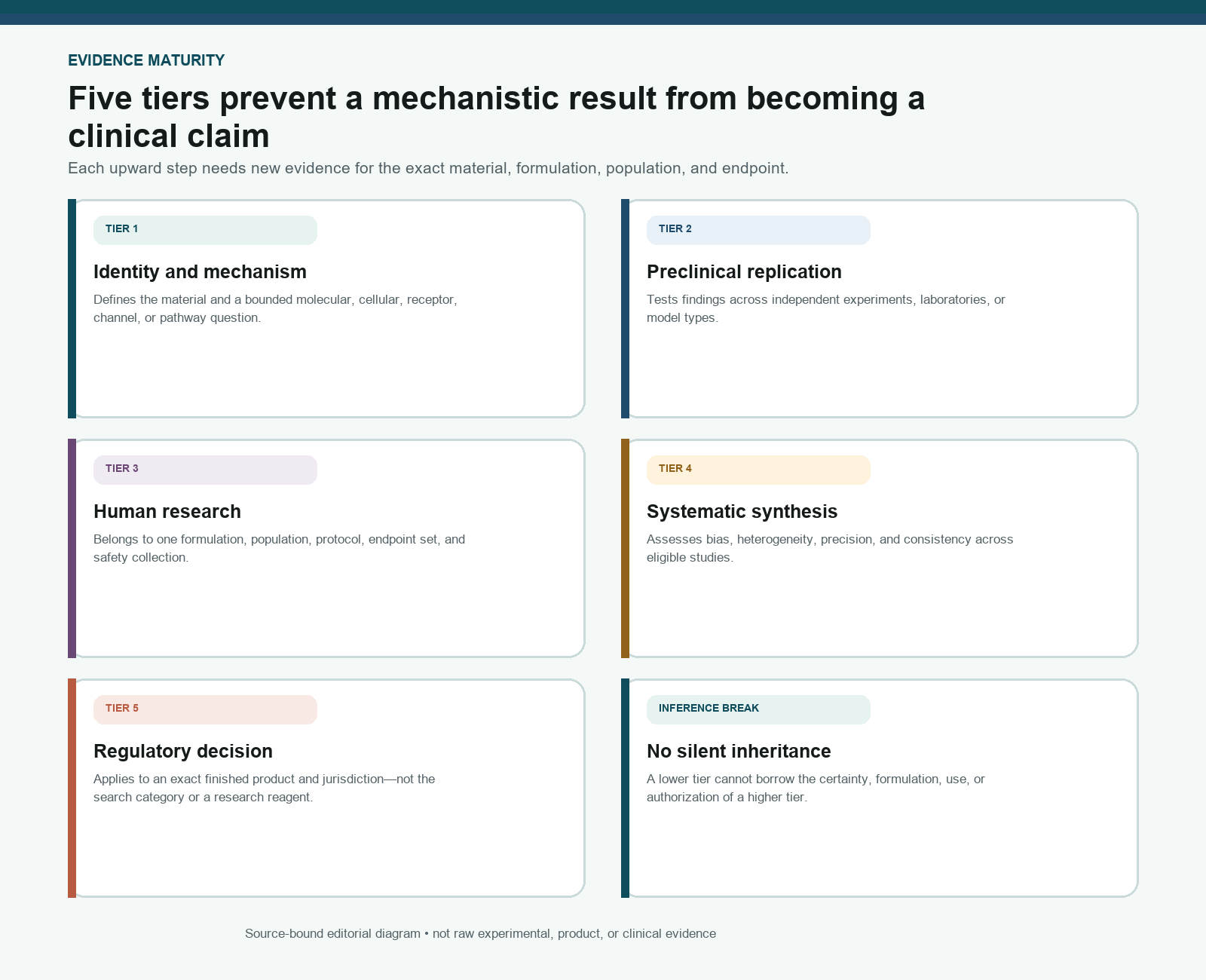
Most materials in this pillar remain concentrated in molecular, cell, and animal research. Cerebrolysin has additional human trial and regulatory lanes because a particular multi-component pharmaceutical preparation entered clinical development in several jurisdictions. That makes its evidence architecture broader, not transferable to the other seven materials.
Additional reported findings
These readouts sit outside the narrative above but belong to the record of this material set. Each row carries its own source, so no figure floats free of the study that produced it.
| Material and model | Species or system | Endpoint and reported result | Source |
|---|---|---|---|
| Semax · intranasal dosing, basal forebrain binding | Rat | Specific tritiated-Semax binding with KD 2.4 ± 1.0 nM and BMAX 33.5 ± 7.9 fmol/mg protein; BDNF rose 3 h after 50 or 250 mcg/kg in basal forebrain but not cerebellum | PMID 16635254 |
| Semax · post-stroke rehabilitation cohort | Human, n = 110 | Two 10-day courses at 6,000 mcg/day: higher plasma BDNF and faster Barthel-index recovery; no placebo arm described | PMID 29798983 |
| Selank · frontal-cortex expression panel | Rat | After 300 mcg/kg, 45 of the 84 neurotransmission genes assayed changed at 1 h and 22 at 3 h, correlating with the GABA comparator | PMID 26924987 |
| Selank · generalized anxiety disorder and neurasthenia trial | Human, n = 62 (30 selank, 32 medazepam) | Anxiolytic effect comparable to the benzodiazepine comparator, plus antiasthenic and psychostimulant components | PMID 18454096 |
| DSIP · chronic insomnia, double-blind placebo-controlled | Human, n = 14 | Seven consecutive nightly doses improved polysomnographic sleep efficiency and daytime alertness, persisting into the first post-treatment placebo night | PMID 3622582 |
| Humanin · endogenous production | Mouse tissue and human brain | 3-kDa Humanin immunoreactivity in testis and colon at 3 weeks and testis at 12 weeks; detected in an Alzheimer brain, little in normal brain | PMID 12009529 |
| Humanin · downstream signaling | Neuronal cells, in vitro | SH3BP5 binds and directly inhibits JNK through two MAPK-interaction motifs; knockdown attenuated protection. Reports no quantitative endpoint | PMID 23861391 |
| PE-22-28 · TREK-1 inhibition and antidepressant models | hTREK-1/HEK cells and mouse | IC50 0.12 nM against 40–60 nM for spadin; action for about 23 h against about 7 h; a 4-day course induced neurogenesis | PMID 28955242 |
Three earlier sources are deliberately not reproduced. A 2018 expert review of Cerebrolysin in stroke recovery is superseded here by the 2023 Cochrane synthesis cited above; a 2016 donepezil-combination study reports a finished formulation given with a second approved drug, and those figures stay with the dedicated Cerebrolysin guide; and a 2018 review of peptide cognitive enhancers covers FGL, PTD4-PI3KAc and a PTEN-derived peptide, none of them among the eight materials mapped here.
A Study-Design Framework for CNS Research Materials
A strong project begins with a falsifiable question, not a catalog category. “Which peptide is best for cognition?” is not a laboratory question. “Does this exact material alter a prespecified molecular or behavioral endpoint in this model under these controls?” can become one.
1. Lock exact material identity
Record the material name, sequence or chemical identity when defined, salt or counterion state when relevant, lot, source, and analytical evidence. For Cerebrolysin, record the exact preparation and formulation context rather than inventing a single sequence. For Dihexa, do not treat an angiotensin IV lineage label as sufficient chemical identity.
2. Define the model and translation boundary
Name the cell line, primary culture, organoid, species, strain, sex, age, genetic construct, disease model, or other system. State what the model can answer and what it cannot. A neuronal cell line can test molecular response under controlled stress, but it cannot reproduce human BBB exposure or a clinical disease course.
3. Separate mechanism from phenotype
Mechanistic endpoints may include receptor or channel engagement, transcript abundance, protein level, phosphorylation, localization, mitochondrial function, or electrophysiology. Phenotypic endpoints may include viability, morphology, learning-task performance, EEG features, or other system-level observations. A causal chain requires evidence linking the levels; parallel changes are not automatically mechanism.
4. Choose controls that answer the failure modes
Useful controls can include vehicle, untreated, positive, inactive or scrambled sequence, parent peptide, pathway inhibitor, receptor knockout or knockdown, matrix blank, and assay-interference controls. The right set depends on the claim. For a short analog such as PE-22-28, a parent-spadin comparator and direct channel-function control may be more informative than an unrelated “nootropic” comparator.
5. Prespecify endpoints and analysis
Define the primary endpoint, sampling window, exclusions, normalization, replicate structure, and statistical plan before viewing results. Technical replicates do not replace independent biological replicates, and secondary endpoints should be labeled exploratory — particularly when a broad panel creates many opportunities for chance findings.
6. Add identity and exposure checks to the biological record
A nominal amount added to a system does not prove the material remained intact or reached the intended compartment. Stability, adsorption, matrix effects, degradation, and nonspecific binding can change effective exposure. When exposure is load-bearing, use a validated measurement suited to the material and matrix rather than infer it from the starting solution.
7. Set an interpretation ceiling
Before running the study, state the strongest conclusion the design could support. A cell-expression study might support “changed transcript abundance under these conditions.” It cannot support “improves cognition.” A mouse behavior study might support a model-specific phenotype while leaving human exposure, safety, and effectiveness unresolved. The ceiling prevents conclusions from expanding after an interesting result appears.
Choose the Research Question Before the Material
| Research question | Potential starting material | Required control or caution |
|---|---|---|
| ACTH-derived peptide and neurotrophin-expression models | Semax | Separate gene-expression observations from behavioral or human conclusions |
| GABAergic gene-expression hypotheses | Selank | Keep cell-line, molecular, animal, and human evidence distinct |
| Historical sleep-peptide biology | DSIP | Do not convert the compound name into an expected outcome |
| Mitochondrial-derived peptide cell-survival signaling | Humanin | Track exact sequence or analog and the model used |
| Sortilin/spadin/TREK-1 lineage | PE-22-28 | Label parent-spadin evidence and direct analog evidence separately |
| Short-peptide cellular stress models | Pinealon | Do not merge viability, oxidative, developmental, and cognitive endpoints |
| Angiotensin IV analog and synaptogenic hypotheses | Dihexa | Exclude retracted literature and keep claims preclinical |
| Multi-component neurotrophic preparation research | Cerebrolysin | Define the preparation and separate pharmaceutical from research-material context |
A research plan should specify the material identity, biological model, comparator, primary endpoint, sampling window, analytical readout, and decision rule before procurement. The Adamax research guide covers that analog’s separate evidence record; it should not be folded into Semax simply because the names are often discussed together.
Selection should also follow the laboratory’s ability to measure the proposed endpoint: validated gene-expression procedures and stable reference controls for a transcript hypothesis, functional electrophysiology or another direct target-engagement method for a channel hypothesis, blinded scoring with controls for locomotor and sensory confounding for a behavioral one. When the required measurement is unavailable, the question should be narrowed or the capability added first.
Analytical and Regulatory Boundaries
Identity, purity, composition, and activity are different questions. HPLC can report chromatographic purity for a defined peptide or suitable analytes under a stated method. Mass spectrometry can support expected mass identity. A mixture preparation may require a broader fingerprint and composition controls. None of these procedures alone proves CNS transport, receptor activity, sterility, safety, efficacy, or equivalence to a finished drug.
Regulatory status, stated for each material
Supplier status, study evidence and finished-product authorization are separate assertions. The table below identifies the evidence boundary for each material; it is not an exhaustive survey of every regulator or jurisdiction.
| Material | Regulatory evidence boundary |
|---|---|
| Semax | The research evidence cited here does not establish a therapeutic authorization for an Apex Semax reagent. Russian-language clinical publications exist; this page asserts no national registration it has not verified against a primary regulatory record. |
| Selank | The research evidence cited here does not establish a therapeutic authorization for an Apex Selank reagent. Comparison against an approved benzodiazepine transfers none of the comparator’s standing. |
| DSIP | The research evidence cited here does not establish a therapeutic authorization for an Apex DSIP reagent. A small 1987 controlled trial is not a marketing authorisation. |
| Humanin | The research evidence cited here does not establish a therapeutic authorization for an Apex Humanin reagent. Endogenous production creates no regulatory category. |
| PE-22-28 | The research evidence cited here does not establish a therapeutic authorization for an Apex PE-22-28 reagent. The research-grade material is supplied for in-vitro laboratory research only. |
| Pinealon | The research evidence cited here does not establish a therapeutic authorization for an Apex Pinealon reagent. The peptide-bioregulator literature is not a regulatory record. |
| Dihexa | The research evidence cited here does not establish a therapeutic authorization for an Apex Dihexa reagent; the evidence base remains preclinical. |
| Cerebrolysin | A Cerebrolysin pharmaceutical formulation holds a national marketing authorisation in Austria, and the 2023 Cochrane review records wide clinical use in Russia, Eastern Europe, China and other Asian and post-Soviet countries. The cited Austrian record establishes a national finished-product authorization, not a worldwide status. The Apex research material is not that authorised formulation. |
The scientific sources discussed here do not establish therapeutic authorization for Apex research reagents. A finished pharmaceutical product requires its own primary regulatory record, jurisdiction and authorized indication. The cited Cerebrolysin record concerns a specific Austrian finished formulation; its authorization does not transfer to the other materials or to an Apex research reagent.
Frequently Asked Questions
Are all eight materials in this guide peptides?
No. Six are defined peptides, Dihexa is a peptide-derived peptidomimetic, and Cerebrolysin is a multi-component peptide and amino-acid preparation.
Are Semax and Selank interchangeable?
No. They have different peptide identities, discovery histories, molecular hypotheses, and evidence records. Their shared CNS category does not make one compound evidence for the other.
Why is the retracted 2014 article excluded from Dihexa evidence?
The article has been retracted and cannot support a current claim. This guide instead uses verified, non-retracted sources including Wright 2015 and Sun 2021.
Does small peptide size prove blood–brain barrier transport?
No. BBB transport is material-, species-, route-, time-, and assay-dependent. A CNS observation does not by itself prove intact-peptide transport into human brain tissue.
Is Cerebrolysin one defined peptide?
No. Cerebrolysin is a multi-component preparation containing low-molecular-weight peptides and amino acids, so its identity and analytical framework differ from a sequence-defined peptide.
Do HPLC and mass spectrometry prove a CNS research material is biologically active?
No. They can support bounded purity and identity conclusions under stated methods. Biological activity and BBB transport require separate fit-for-purpose experiments.
References
- Dolotov OV, et al. Semax, an analog of ACTH(4-10) with cognitive effects, regulates BDNF and trkB expression in the rat hippocampus. Brain Res. 2006;1117(1):54-60. PMID: PMID 16996037.
- Filatova E, et al. GABA, Selank, and Olanzapine Affect the Expression of Genes Involved in GABAergic Neurotransmission in IMR-32 Cells. Front Pharmacol. 2017;8:89. PMID: PMID 28293190.
- Vyunova TV, et al. Peptide-based Anxiolytics: The Molecular Aspects of Heptapeptide Selank Biological Activity. Protein Pept Lett. 2018;25(10):914-923. PMID: PMID 30255741.
- Schoenenberger GA, et al. The delta EEG (sleep)-inducing peptide (DSIP). XI. Amino-acid analysis, sequence, synthesis and activity of the nonapeptide. Pflugers Arch. 1978;376(2):119-29. PMID: PMID 568769.
- Graf MV, et al. Delta-sleep-inducing peptide (DSIP): a review. Neurosci Biobehav Rev. 1984;8(1):83-93. PMID: PMID 6145137.
- Hashimoto Y, et al. A rescue factor abolishing neuronal cell death by a wide spectrum of familial Alzheimer’s disease genes and Abeta. Proc Natl Acad Sci U S A. 2001;98(11):6336-41. PMID: PMID 11371646.
- Mazella J, et al. Spadin, a sortilin-derived peptide, targeting rodent TREK-1 channels: a new concept in the antidepressant drug design. PLoS Biol. 2010;8(4):e1000355. PMID: PMID 20405001.
- Khavinson V, et al. Pinealon increases cell viability by suppression of free radical levels and activating proliferative processes. Rejuvenation Res. 2011;14(5):535-41. PMID: PMID 21978084.
- Arutjunyan A, et al. Pinealon protects the rat offspring from prenatal hyperhomocysteinemia. Int J Clin Exp Med. 2012;5(2):179-85. PMID: PMID 22567179.
- Anisimov VN, et al. Peptide bioregulation of aging: results and prospects. Biogerontology. 2010;11(2):139-49. PMID: PMID 19830585.
- Wright JW, et al. The development of small molecule angiotensin IV analogs to treat Alzheimer’s and Parkinson’s diseases. Prog Neurobiol. 2015;125:26-46. PMID: PMID 25455861.
- Sun X, et al. AngIV-Analog Dihexa Rescues Cognitive Impairment and Recovers Memory in the APP/PS1 Mouse via the PI3K/AKT Signaling Pathway. Brain Sci. 2021;11(11). doi:10.3390/brainsci11111487. PMID: PMID 34827486.
- Hartbauer M, et al. Antiapoptotic effects of the peptidergic drug cerebrolysin on primary cultures of embryonic chick cortical neurons. J Neural Transm (Vienna). 2001;108(4):459-73. PMID: PMID 11475013.
- Ubhi K, et al. Cerebrolysin modulates pronerve growth factor/nerve growth factor ratio and ameliorates the cholinergic deficit in a transgenic model of Alzheimer’s disease. J Neurosci Res. 2013;91(2):167-77. PMID: PMID 23152192.
- Heiss WD, et al. Cerebrolysin in patients with acute ischemic stroke in Asia: results of a double-blind, placebo-controlled randomized trial. Stroke. 2012;43(3):630-6. PMID: PMID 22282884.
- Muresanu DF, et al. Cerebrolysin and Recovery After Stroke (CARS): A Randomized, Placebo-Controlled, Double-Blind, Multicenter Trial. Stroke. 2016;47(1):151-9. PMID: PMID 26564102.
- Ziganshina LE, et al. Cerebrolysin for acute ischaemic stroke. Cochrane Database Syst Rev. 2023;10(10):CD007026. PMID: PMID 37818733.
- Banks WA, et al. Saturable transport of peptides across the blood-brain barrier. Life Sci. 1987;41(11):1319-38. PMID: PMID 3306236.
- Banks WA. Peptides and the blood-brain barrier. Peptides. 2015;72:16-9. PMID: PMID 25805003.