Batch documentation
Certificate of analysis
Apex Laboratory results for the listed configurations. Match the lot on your label with the report.
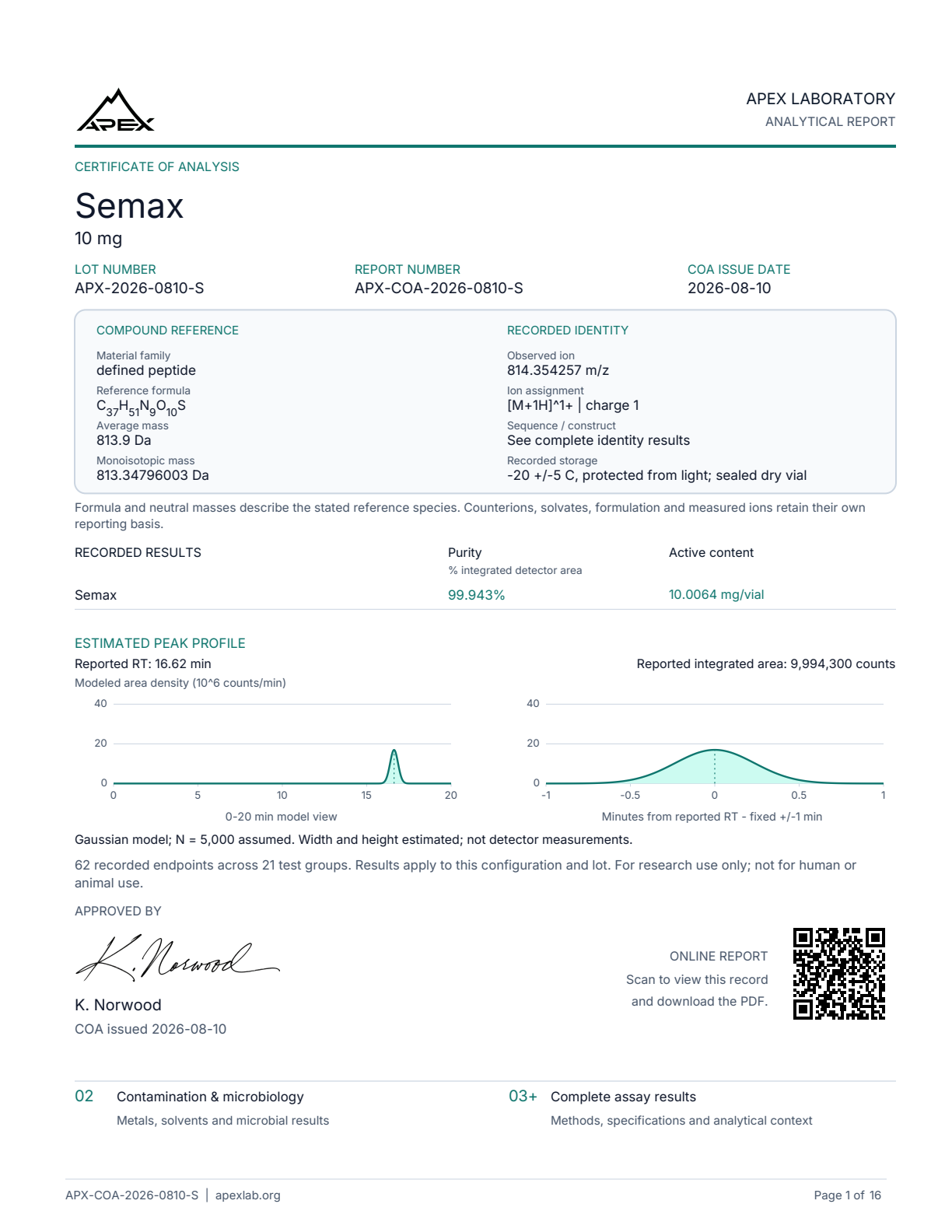
Semax - 10 mg
- Semax chromatographic purity
- 99.943 % integrated detector area
- Semax active content
- 10.0064 mg/vial
- Bacterial endotoxins
- <0.025 EU/mg active-equivalent
- Sterility: FTM
- No growth at 14 days in all 20 units
Chromatographic purity by analyte

About this graph
Recorded scalar results against the stated specification. Each row uses its own labeled scale; purity is detector-area purity, not active-material content.
Measured active content

About this graph
Calibrated active content, concentration or activity compared with the stated same-unit specification. Each row uses its own labeled scale; no conversion from chromatographic purity is made.
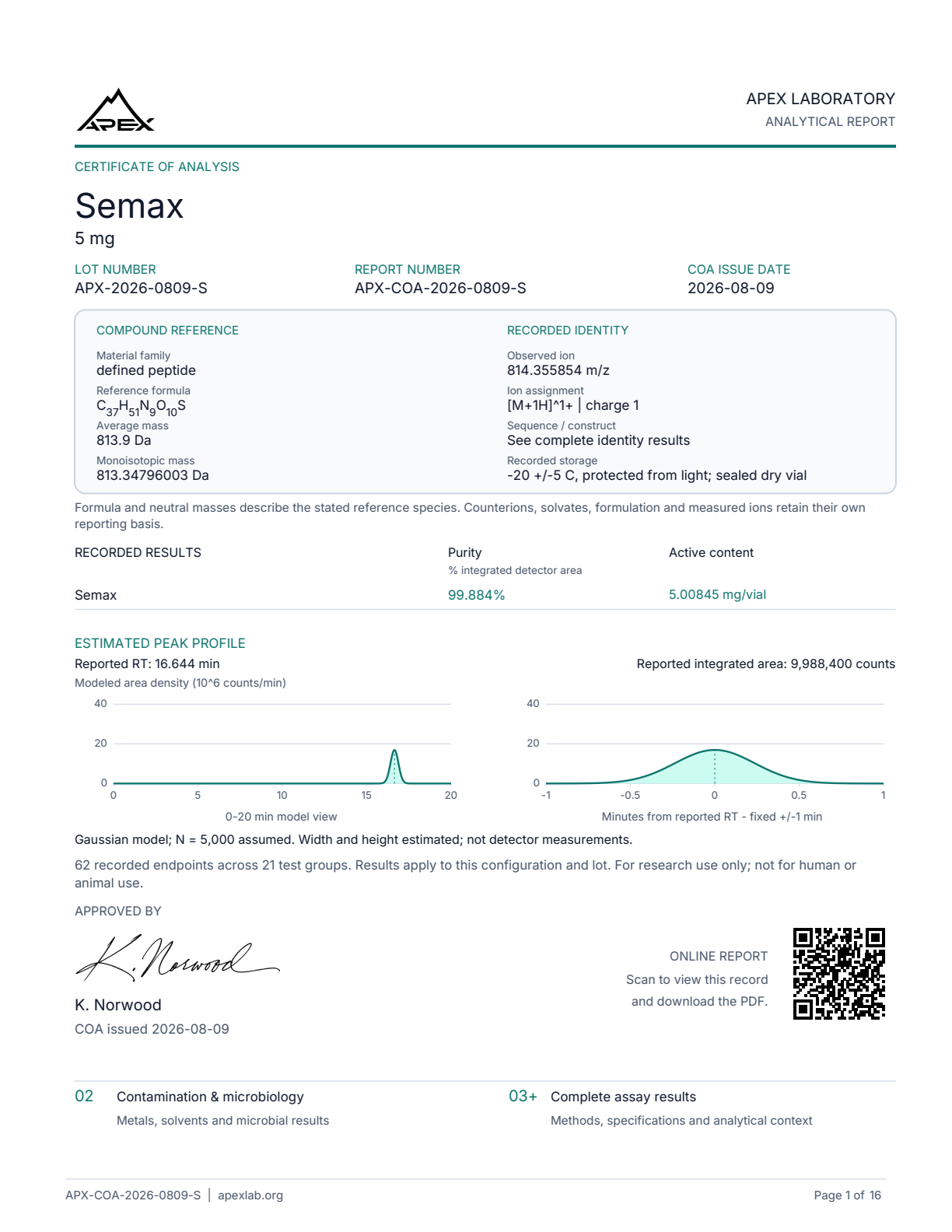
Semax - 5 mg
- Semax chromatographic purity
- 99.884 % integrated detector area
- Semax active content
- 5.00845 mg/vial
- Bacterial endotoxins
- <0.025 EU/mg active-equivalent
- Sterility: FTM
- No growth at 14 days in all 20 units
Chromatographic purity by analyte

About this graph
Recorded scalar results against the stated specification. Each row uses its own labeled scale; purity is detector-area purity, not active-material content.
Measured active content

About this graph
Calibrated active content, concentration or activity compared with the stated same-unit specification. Each row uses its own labeled scale; no conversion from chromatographic purity is made.
Semax is a synthetic seven-residue peptide with the sequence Met-Glu-His-Phe-Pro-Gly-Pro, derived from an ACTH fragment. One published in-house record is Semax – 10 mg — lot APX-2026-0810-S (COA issued 2026-08-10). Match the report configuration and lot to the label on your material. For the distinction between human observations and laboratory mechanisms, read our Semax guide to human studies, brain effects and safety. This product is supplied for in-vitro laboratory research, not for human consumption or veterinary use.
Compound Overview
Semax combines the Met-Glu-His-Phe sequence corresponding to ACTH(4-7) with a C-terminal Pro-Gly-Pro extension. It is a seven-residue analog, not the full ACTH hormone or the unmodified ACTH(4-10) sequence. That structural relationship does not establish that Semax shares every ACTH function. Experimental degradation work identifies shorter peptide fragments; it does not provide a universal human or laboratory-solution half-life for this product.
Cell and rodent studies examine Semax-related changes in neurotrophic factors, neurotransmitter measures and responses to experimental injury. These are distinct endpoints: a rat hippocampal study reported BDNF and TrkB-related changes, while other experiments found different directions across tissues and sampling times. Such results do not demonstrate a predictable human cognitive benefit or direct binding to a particular receptor. Selank is a different, tuftsin-derived peptide; a simple GABA-versus-BDNF split does not describe the full evidence for either material.
Research Background & Published Literature
Published Semax research includes rodent neurotrophic-factor experiments, cell and animal injury models, and small human imaging or clinical reports. Study design matters when interpreting this literature: a brain-connectivity measurement is not a memory test, and an open-label symptom report does not establish treatment effectiveness. Identify the exact peptide, population or model, comparison group and endpoint before transferring a finding to another experiment.
Researchers exploring the published literature surrounding this compound can review the following sources for additional context on its mechanism of action, signaling pathways, and experimental applications in controlled laboratory settings:
- Dolotov and colleagues — rat hippocampal BDNF and TrkB study
- PubChem — defined Semax parent-peptide reference
Technical Specifications
| Product Name | Semax |
| Other Names / Synonyms | ACTH(4-7)-Pro-Gly-Pro; Met-Glu-His-Phe-Pro-Gly-Pro |
| Classification | Synthetic ACTH-fragment analog; research reagent |
| Parent-peptide CAS | 80714-61-0 |
| Neutral peptide formula | C₃₇H₅₁N₉O₁₀S |
| Neutral peptide molecular weight | 813.93 g/mol (reference peptide; salt or counterion composition requires separate documentation) |
| Sequence / Structure | 7-residue heptapeptide — ACTH(4-7) core with C-terminal Pro-Gly-Pro extension |
| Published analytical results | Read the applicable report for its methods, results and reporting limits; match its lot and configuration to the material. |
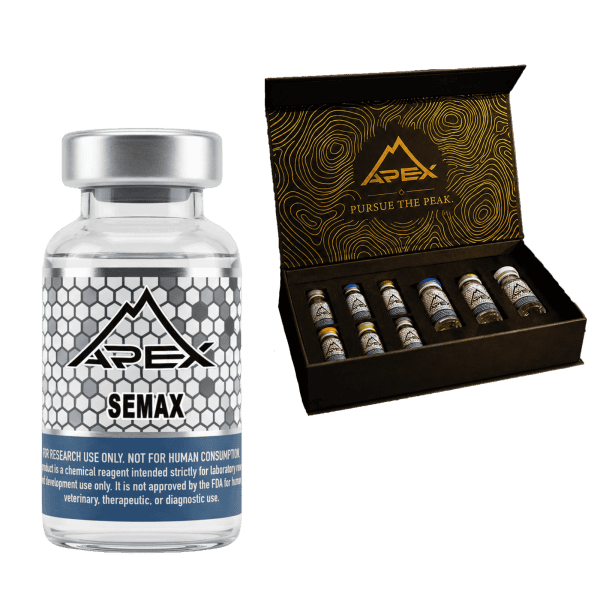
| Physical Form | Lyophilized (freeze-dried) powder — sealed vial |
| Handling basis | Use the applicable product label and a validated laboratory procedure; this table does not establish solution compatibility or stability. |
| Available Sizes | 5 mg ($32.00) · 10 mg ($43.00) |
| Intended Use | In-vitro research use only — not for human consumption |
Storage, Handling & Stability
Use the applicable product label and your laboratory’s validated handling procedure for storage and solution preparation. A molecular sequence or published chromatogram does not establish shelf life after opening or preparation. Record the actual conditions used and assess whether the material remains suitable for the intended assay.
- Check the labeled storage conditions before receipt and handling.
- Document solvent, concentration, preparation time and any relevant compatibility assessment.
- Track conditions and handling changes that could affect the analytical result.
- Keep compound, configuration and lot identifiers with each prepared sample.
Quality Assurance & Analytical Verification
A published report describes the material and methods identified in that record. See Semax – 10 mg — lot APX-2026-0810-S, issued 2026-08-10, for that record’s results, acceptance criteria and methods. Its existence does not establish that a different configuration or the material in a later order shares those results.
Mass-spectrometry interpretation depends on the reported ions, charge states, adducts and method. A value near a calculated molecular mass alone does not confirm the complete amino-acid sequence, and a peptide’s size does not guarantee a single-charge spectrum. Chromatographic retention time is also method-dependent. For the distinction between these measurements, see our guides on HPLC and mass spectrometry purity testing and how to read a Certificate of Analysis. Current and prior lot reports are also collected in the Lab Verified archive.
Frequently Asked Questions
What distinguishes Semax from the ACTH hormone it is derived from?
Semax has the ACTH(4-7) Met-Glu-His-Phe core followed by Pro-Gly-Pro. It is a synthetic seven-residue analog, not intact ACTH. Structural ancestry should be kept separate from evidence for any particular receptor, hormone response or clinical outcome.
Why does the Pro-Gly-Pro tail matter in this peptide?
The Pro-Gly-Pro extension helps define Semax as a different molecule from the bare ACTH(4-7) fragment. Experimental work examines its processing into shorter fragments. Those measurements depend on the model and conditions; they do not establish a fixed functional half-life or a human benefit for this vial.
How does Semax differ from Selank in research use?
Semax is an ACTH-fragment analog; Selank is a tuftsin-derived peptide with a different sequence and research history. Their studies use varied molecular, behavioral and clinical endpoints. Neither a shared research label nor complementary-sounding mechanism claims establish that they have interchangeable effects or a proven combined benefit.
How should I read the reported retention time and mass?
See Semax – 10 mg — lot APX-2026-0810-S, issued 2026-08-10, for the recorded results, acceptance criteria and methods. Chromatographic purity and the identity result should be read alongside their stated methods and acceptance criteria.
Is this product approved for human use?
No. This product is supplied as an in-vitro laboratory research reagent, not a finished medicine for human or veterinary use. It should not be treated as interchangeable with a clinical study formulation. The product page does not provide a self-use protocol.
Is bulk ordering available for Semax?
For a bulk-quantity or packaging inquiry, contact our team with the compound name, desired quantity, preferred size and target timeline. Confirm availability, pricing and any special requirements before placing the order.
Related Research Compounds
Researchers studying ACTH-analog and nootropic neuropeptide pathways may also be interested in related compounds from Apex Laboratory: Selank (tuftsin-analog research peptide), Adamax 10mg (adamantane-modified Semax derivative), and Cerebrolysin 60mg (neurotrophic peptide mixture). For the broader CNS category, see the Nootropic & CNS research peptides pillar guide, or browse the full Apex Laboratory research catalog.
Shipping, Packaging & Delivery
The stated shipping cutoff is 2:00 PM ET. Check the current shipping terms and order information for dispatch and delivery details. For a time-sensitive laboratory requirement, confirm availability and timing with the team before ordering. On receipt, follow the applicable product label and validated laboratory handling procedure.
Research Use Disclaimer
For in-vitro research use only. Not for human consumption. Semax is supplied here as a laboratory research reagent, not as a finished medicine for human or veterinary use. Researchers are responsible for appropriate handling, documentation and compliance with the requirements that apply to their laboratory and intended experiment.