Cerebrolysin is a porcine-brain-derived peptide mixture rather than one defined molecule, so composition, finished formulation, and study context are central to every claim. Cell, animal, and human studies span different mechanisms and clinical questions, with mixed outcomes and important evidence limits. Apex Laboratory supplies Cerebrolysin research material for in-vitro and preclinical work, categorically distinct from registered Cerebrolysin pharmaceutical formulations.
Cerebrolysin has an unusually broad literature because one product name appears across cell experiments, animal models, clinical trials, systematic reviews, and national medicine registers. The name alone does not make those evidence layers interchangeable. This guide starts with mixture identity, then separates proposed mechanisms, human outcomes, regulatory geography, and the boundary around current research material.
Apex-specific research boundary: Apex Laboratory supplies Cerebrolysin as research-use material for in-vitro and preclinical research only. It is not a finished pharmaceutical formulation, is not for human consumption, and is not represented here as a treatment, administration product, or substitute for a nationally authorized medicine.
- Cerebrolysin is a complex peptide mixture, not a single peptide, molecule, receptor ligand, or exact chemical structure.
- Cell and animal studies support several proposed biological pathways, but no one pathway is a verified general human mechanism.
- Human evidence is mixed across Alzheimer disease, stroke, rehabilitation, traumatic brain injury, and aphasia research.
- Cerebrolysin has product-specific national authorizations in Austria and some other markets, but it holds no EMA centralized marketing authorisation, is not EU-wide authorized, and is not FDA-approved in the United States.
- Pharmaceutical trial evidence does not transfer to an Apex research lot merely because both use the Cerebrolysin name.
What Is Cerebrolysin?
Cerebrolysin is not one synthetic sequence. Registered product information describes a proteolytic peptide fraction derived from porcine brain proteins, supplied as a finished medicinal product in jurisdictions where a specific product is authorized. That mixture identity is the first fact to preserve because it changes how molecular mechanism, analytical equivalence, and evidence transfer should be evaluated.
A single-compound article can often anchor identity to one formula, sequence, or molecular mass. Cerebrolysin requires a different framework: source material, fractionation and manufacturing process, peptide-size distribution, non-peptide components, finished formulation, lot controls, and the regulatory dossier can all matter. An exact-looking chemical structure is therefore misleading as a cover image or as a shorthand for the product.
Composition is where precision is possible. A CAS registry number does exist for the preparation, but it registers a substance rather than describing a structure. The remaining identity fields that assume a single molecule are not missing data; they do not exist for this material.
| Identity field | Documented value | Source |
|---|---|---|
| CAS registry number | 12656-61-0, registered for the preparation as a whole; a registry entry for a hydrolysate does not imply a single molecule | Apex product record, Cerebrolysin 60mg |
| Molecular formula, single molecular weight, single sequence | Not specified and not applicable — a hydrolysate is not a discrete chemical entity, and its peptide fraction is a size-bounded distribution rather than one defined molecule | Apex product record, Cerebrolysin 60mg |
| Peptide fraction | ~25% of total nitrogen content; peptides below 10 kDa | PMID 11475013 |
| Free amino-acid fraction | ~75% of total nitrogen content; an artificial amino-acid control gave transient viability support only, without the anti-apoptotic effect | PMID 11475013 |
| Source material | Peptides and amino acids derived from porcine brain | PMID 37818733 |
| Manufacturer in the source record | EBEWE Arzneimittel, Austria (2001 paper); Austrian authorization recorded by BASG | PMID 11475013; BASG |
| Apex research lot — presentation and specification | 60 mg lyophilized powder; read the applicable published record for its mixture characterization, methods and results; stored at −20 °C long term and refrigerated after reconstitution | Apex product record, Cerebrolysin 60mg |
| Plasma half-life | Not stated — no primary human pharmacokinetic record in the cited literature supports a figure | — |
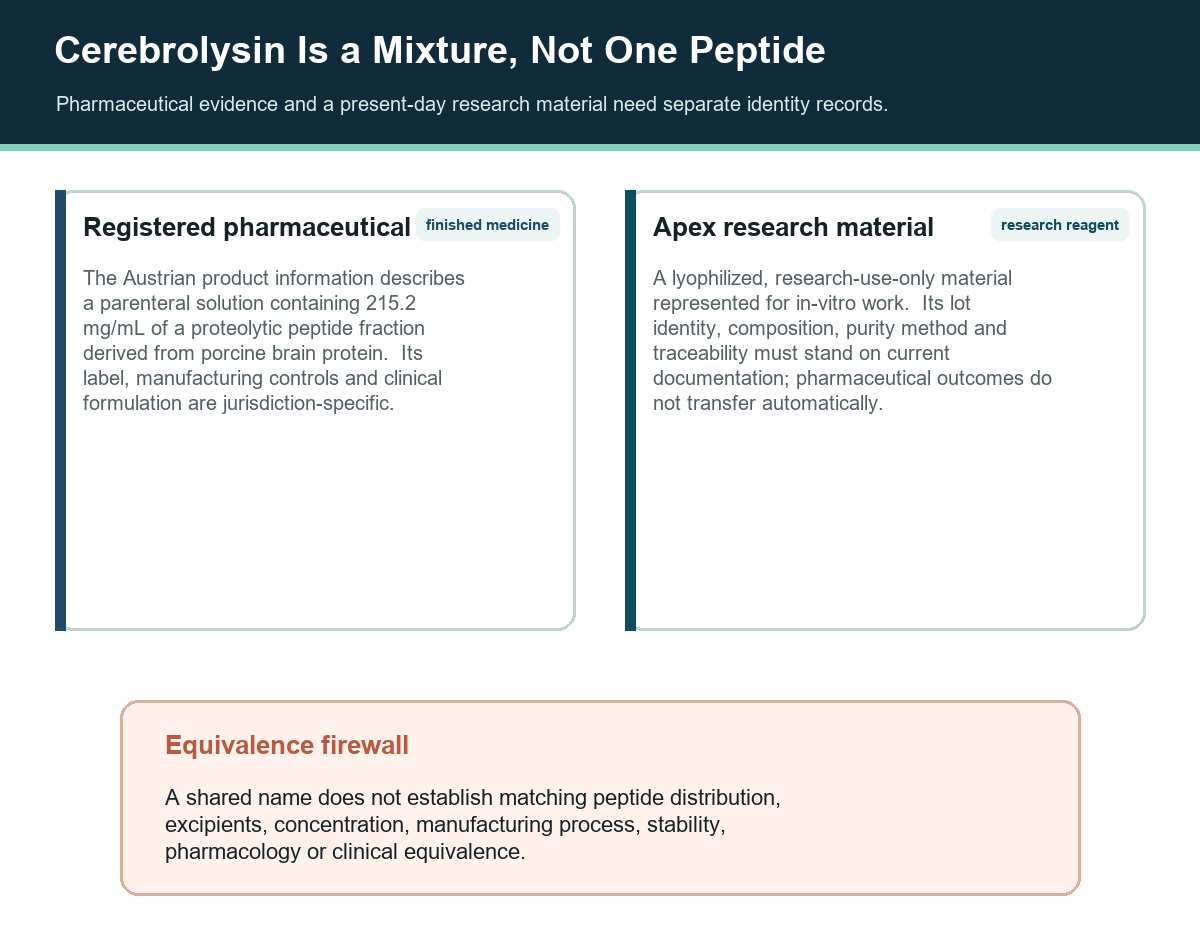
Two categorical distinctions follow. First, evidence about a registered finished pharmaceutical formulation belongs to that formulation and protocol. Second, a current research lot can support analytical and experimental questions only within its own documentation and intended use. A shared label does not erase those boundaries.
Why Mixture Identity Matters
A peptide mixture can generate multi-target hypotheses, but “multi-target” is a research description rather than a completed mechanism. Different fractions may contribute to different assay readouts, and a cell-culture observation may depend on the model, concentration, exposure time, preparation, and endpoint. Without a defined causal component, one pathway cannot be assigned confidently to the whole mixture.
| Layer | What it can establish | What it cannot establish alone |
|---|---|---|
| Registered product information | Product-specific composition description, dosage form, authorization, and labeled conditions | Authorization in every country or equivalence to another material |
| Cell and animal studies | Model-specific pathway and outcome observations | A verified general human mechanism or clinical effect |
| Clinical trials | Outcomes for the studied finished formulation, population, protocol, and endpoint | An effect for an unstudied research lot |
| Current Apex lot | Lot-specific analytical and fit-for-purpose in-vitro questions | Pharmaceutical equivalence, human safety, efficacy, or use guidance |
This framework also prevents a reverse error. A neutral or uncertain clinical result does not invalidate every cell or animal observation; it limits what those observations can predict. Mechanistic research and clinical outcome research can both be real while answering different questions.
What Do Mechanism Studies Show?
Cell-culture survival and apoptosis findings
Hutter-Paier et al. (1998) reported protection-related observations in isolated chicken cortical neurons in-vitro: after 8 days of exposure to 1–5 µM ammonium iron(III) citrate, Cerebrolysin prevented iron-induced neurodegeneration and raised neuronal viability up to 10-fold relative to controls, and it also counteracted a 1 mM L-glutamate lesion over 48 hours of recovery. Hartbauer et al. (2001) examined apoptosis-linked endpoints in primary embryonic chick cortical neurons under low-serum (2%) stress, where apoptotic chromatin changes fell significantly (p < 0.01) while an artificial amino-acid mixture control did not reproduce that effect. These studies support cell-survival and apoptosis as experimental lanes; they do not establish a clinical neuroprotective effect.
Animal neurotrophin and stroke pathways
Ubhi et al. (2013) reported a pro-nerve-growth-factor to nerve-growth-factor shift toward control levels and reduced cholinergic loss in hAPP transgenic mice, with BDNF, NT-3, NT-4 and CNTF protein levels unchanged; that abstract reports no quantitative endpoint for the shift. Zhang et al. (2013) linked neurological-function observations in a rat embolic stroke model to Sonic hedgehog signaling: treatment begun 24 hours after stroke significantly increased subventricular-zone progenitor proliferation and improved function from week 3 to week 5 versus vehicle, and the smoothened inhibitor cyclopamine abolished the effect in-vitro and in-vivo.
Those results identify testable pathways within their respective models. They do not show that one ingredient in the mixture is a nerve-growth-factor mimetic, that Sonic hedgehog signaling explains every outcome, or that either pathway is a verified human mechanism. “Neurotrophic-factor-like” is best treated as a broad research frame.
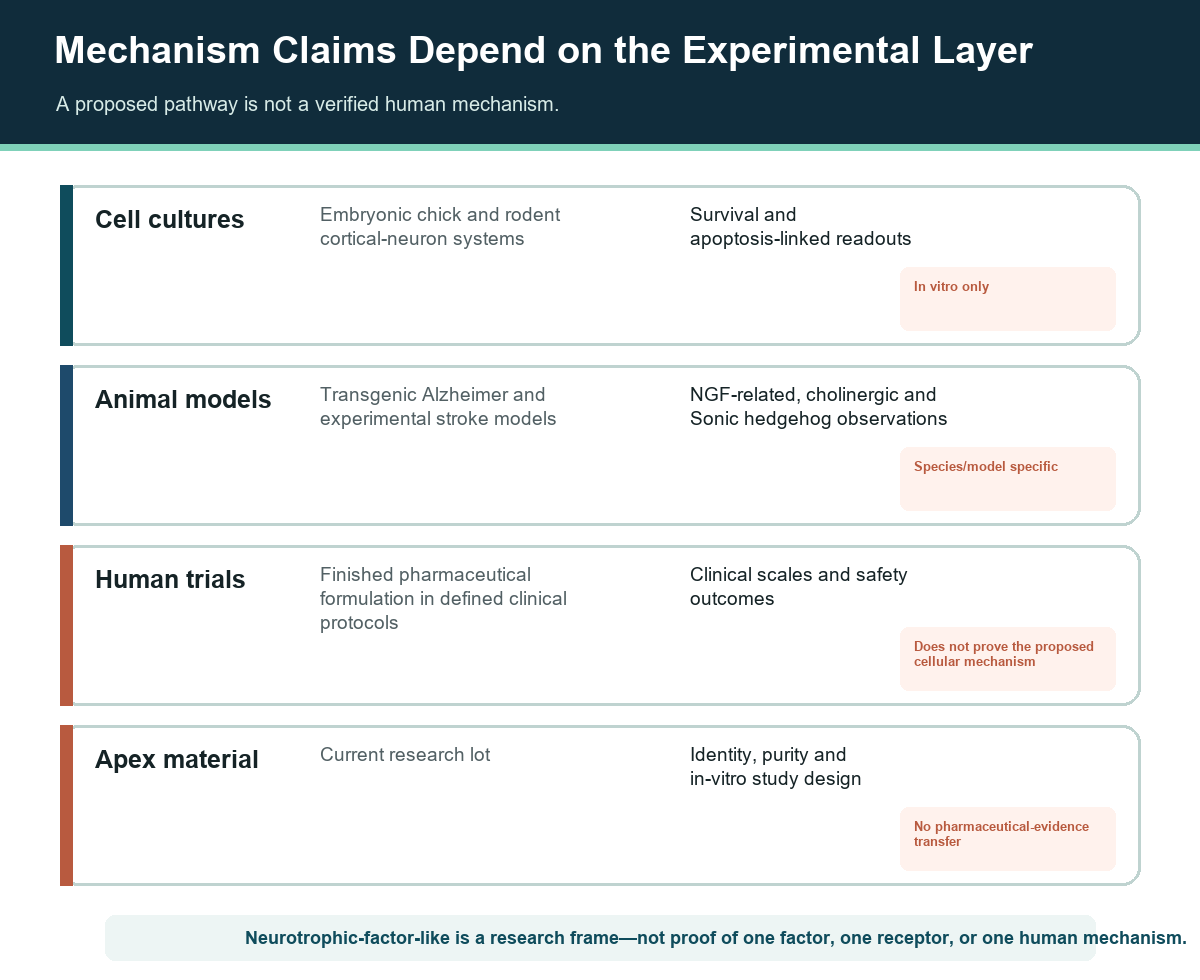
Mechanism rule: A pathway association in cultured neurons or a rodent disease model is evidence for that experimental layer. It is not proof of one active peptide, one receptor, one human mechanism, or a treatment effect.
What Does the Human Evidence Show?
The human evidence must be read by indication and trial design. A result in Alzheimer disease does not answer an acute-stroke question, and a rehabilitation trial does not answer a mortality question. Sample size, primary endpoint, multiplicity, subgroup status, comparator, and replication all affect interpretation.
Alzheimer disease
Alvarez et al. (2006) conducted a 24-week, double-blind, placebo-controlled trial across three Cerebrolysin dosage groups in 279 participants with mild-to-moderate Alzheimer disease. The reported pattern varied by dose and outcome rather than producing one simple linear conclusion. One study does not settle long-term benefit, comparative effectiveness, or the mixture’s active mechanism.
Acute stroke and rehabilitation
The CASTA and CARS trials are complementary but not equivalent. Heiss et al. (2012) randomized approximately 1,070 participants in the CASTA acute ischemic stroke study. The confirmatory primary outcome was neutral; a favorable severe-stroke subgroup signal was discussed after the main analysis and should remain labeled as subgroup evidence.
Muresanu et al. (2016) reported a favorable day-90 arm-function result in the smaller CARS early-rehabilitation trial. Its rehabilitation setting, sample size, and functional endpoint differ from CASTA. A Bornstein et al. (2018) meta-analysis reported a favorable pooled early neurological-deficit signal across nine randomized trials, but pooled estimates inherit the designs and limitations of their component studies.
Traumatic brain injury and aphasia
Muresanu et al. (2020) reported favorable multidimensional outcomes in the 142-participant, single-center CAPTAIN II traumatic-brain-injury trial. The single-center design and composite analysis make independent confirmation important.
Homberg et al. (2025) reported the 132-participant ESCAS pilot study of speech therapy combined with Cerebrolysin after acute ischemic stroke. The pilot result is hypothesis-supporting and needs confirmation in larger, independently replicated cohorts before it carries broad clinical weight.
| Study, design and population | Reported result | Source |
|---|---|---|
| Alvarez 2006 — Alzheimer RCT; 10 / 30 / 60 mL daily arms | Week-24 ADAS-cog improved in the 10 mL arm (P=0.038); the 30 and 60 mL arms improved on CIBIC+ but not cognition — a reversed U-shaped dose-response | PMID 16420392 |
| CASTA 2012 — 30 mL daily for 10 days, started within 12 hours of onset | Neutral confirmatory endpoint; post-hoc NIHSS >12 subgroup 90-day mortality 10.5% versus 20.2% on placebo | PMID 22282884 |
| CARS 2016 — 30 mL daily for 21 days from 24–72 hours post-stroke, alongside 21 days of rehabilitation | Day-90 Action Research Arm Test Mann-Whitney estimator 0.71 (95% CI 0.63–0.79; P<0.0001); 3.8% discontinued early | PMID 26564102 |
| Bornstein 2018 — nine pooled RCTs; 30–50 mL daily for 10–21 days | Day-30 NIHSS Mann-Whitney 0.60 (P<0.0001; N=1,879); number needed to treat 7.7 (95% CI 5.2–15.0) | PMID 29248999 |
| Cochrane 2019 — vascular dementia, 6 RCTs, 597 participants | Cognition SMD 0.36 (95% CI 0.13–0.58; 3 studies, 420 people); global response RR 2.69 (95% CI 1.82–3.98); very-low-certainty, and effects may be too small to be clinically meaningful | PMID 31710397 |
| CAPTAIN II 2020 — TBI, GCS 7–12; 50 mL daily for 10 days, then two 10-day cycles at 10 mL | Day-90 ensemble of 13 outcome scales, Mann-Whitney 0.59 (95% CI 0.52–0.66; P=0.0119) | PMID 31897941 |
| Cochrane 2023 — acute ischaemic stroke, 7 RCTs, 1,773 participants, including one 272-participant trial of Cortexin, a Cerebrolysin-like peptide mixture the review describes as derived from cattle brain | All-cause death for Cerebrolysin or Cortexin RR 0.96 (95% CI 0.65–1.41; 6 trials, moderate certainty); non-fatal serious adverse events RR 2.39 (95% CI 1.10–5.23; 3 trials, 1,335 participants) | PMID 37818733 |
| ESCAS 2025 — nonfluent aphasia pilot; three 10-day cycles over 90 days | Day-90 Western Aphasia Battery gain 35.6 ± 16.3 points versus 20.8 ± 12.5 points on placebo, a 14.8-point difference (95% CI 9.5–20.1; P<0.001) | PMID 39957612 |
What Do Systematic Reviews Conclude?
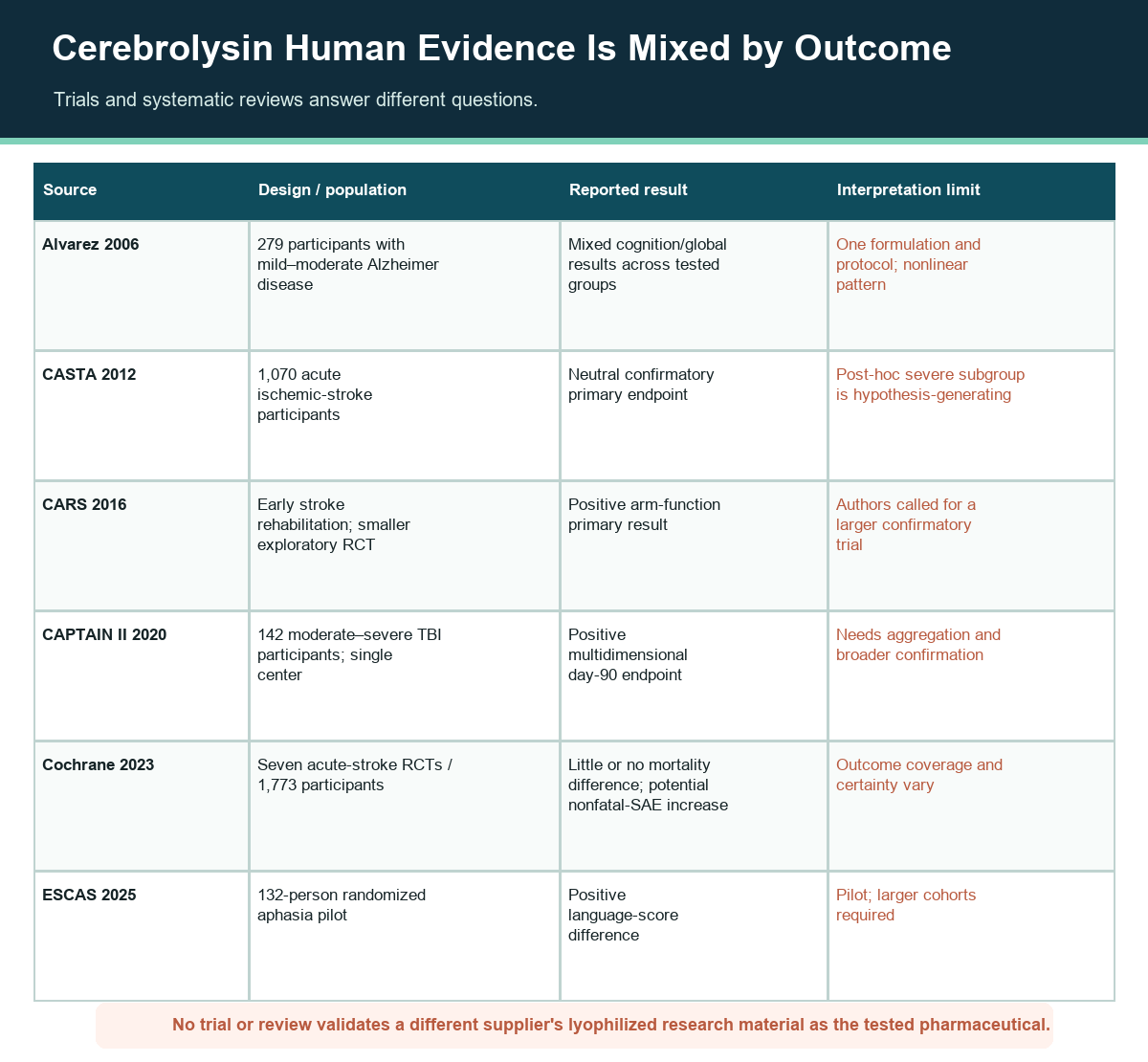
Systematic reviews are especially important when individual trials point in different directions. For acute ischemic stroke, the 2023 Cochrane review by Ziganshina et al. found that Cerebrolysin probably has little or no effect on all-cause mortality and may increase nonfatal serious adverse events. Certainty varied across outcomes, and the review did not support a simple general-benefit conclusion.
For vascular dementia, the 2019 Cochrane review by Cui et al. described possible cognitive signals but judged the evidence weak or very low quality and insufficient for firm clinical conclusions. A favorable point estimate is not the same as high-certainty evidence.
| Evidence item | Finding | Correct inference | Source |
|---|---|---|---|
| CASTA | Neutral confirmatory primary endpoint; post-hoc severe subgroup discussed | Do not promote the subgroup as the main trial result. | PMID 22282884 |
| CARS | Favorable rehabilitation arm-function outcome | Promising in that design; not a universal stroke conclusion. | PMID 26564102 |
| Bornstein 2018 | Favorable pooled early neurological-deficit estimate | Interpret with component-study quality and heterogeneity. | PMID 29248999 |
| Cochrane 2023 | Little or no mortality effect; possible nonfatal serious-adverse-event increase | Best broad synthesis for acute-stroke benefits and harms. | PMID 37818733 |
The result is a mixed, indication-specific human evidence base. It is scientifically reasonable to study defined questions further. It is not reasonable to replace the systematic-review conclusions with one favorable trial, pooled subgroup, pathway diagram, or marketing summary.
Where Is Cerebrolysin Authorized?
Cerebrolysin’s regulatory status is national and product-specific. Austria’s BASG product information records a nationally authorized Cerebrolysin medicinal product. Slovakia’s SÚKL register also lists a specific product. Those national records do not create an EU-wide authorization.
Official records also identify product registrations outside the European Union, including Russia and Asian markets. The Hong Kong Drug Office provides one current product-level example. Availability, indication, presentation, and legal status can differ by country and can change over time.
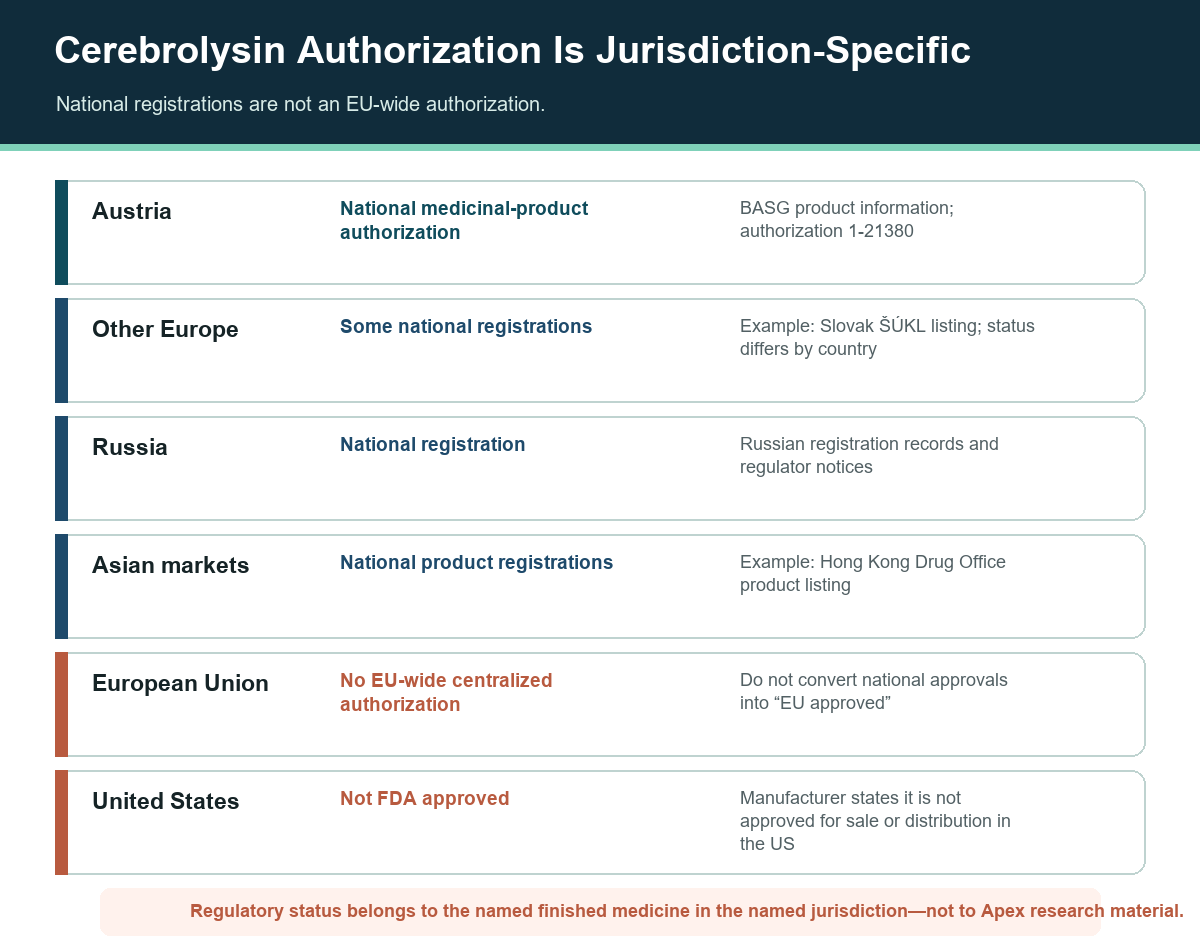
The precise summary is therefore: Cerebrolysin has national authorization in Austria, some other European countries, Russia, and some Asian markets; it is not EU-wide authorized through one centralized approval, and it is not FDA-approved in the United States. Stated as explicit negatives: there is no FDA approval and no EMA centralized marketing authorisation for Cerebrolysin, and no regulator in any jurisdiction has approved research-use Cerebrolysin material for human use. A country-specific medicine register should be checked for any current legal or labeling question.
Same product name; categorically distinct regulatory frameworks: nationally registered Cerebrolysin pharmaceutical formulations are evaluated as finished medicinal products. Apex Cerebrolysin is research-use material for in-vitro and preclinical study and is not represented as therapeutically equivalent.
Why Evidence Does Not Transfer to an Apex Lot
Clinical Cerebrolysin studies used finished pharmaceutical formulations manufactured and controlled under product-specific dossiers. A current Apex lot is a different category of material with a research-only intended use. Evidence transfer would require much more than a shared name: composition comparability, manufacturing comparability, finished-formulation comparability, analytical bridging, stability, and fit-for-purpose biological evidence would all matter.
A certificate of analysis can document specified results for the tested research lot when sample identity, methods, acceptance criteria, and traceability are clear. It cannot establish equivalence to a registered finished medicine, recreate a clinical trial, or prove human safety and efficacy. The Apex COA guide provides a field-by-field audit framework.
The same rule applies to analytical purity. A chromatographic result answers a separation-and-detection question under one method. For a complex mixture, it cannot be reduced to the same interpretation used for one defined synthetic peptide. The research-grade versus pharmaceutical-grade guide explains why intended use, manufacturing system, finished-product controls, and authorization are distinct quality layers.
For an in-vitro project, a defensible plan specifies the lot, preparation, cell system, comparator, exposure window, endpoint, replication, and analysis before results are collected. It also avoids using a pharmaceutical trial outcome as a positive control for an unbridged research material. Researchers mapping nearby CNS topics can use the Nootropic and CNS research guide without assuming that different compounds share Cerebrolysin’s mixture identity or evidence base.
Frequently Asked Questions
What is Cerebrolysin?
Cerebrolysin is the name used for a complex, low-molecular-weight peptide mixture derived from porcine brain proteins in registered pharmaceutical products. It is not one defined peptide or one molecular structure. Exact formulation, manufacturing, quality, and regulatory context must be identified before evidence is interpreted.
Is Cerebrolysin approved throughout the European Union?
No. Cerebrolysin has national authorization in Austria and listings in some other European countries, but it does not have an EU-wide centralized authorization. Status differs by product and jurisdiction, and it should not be generalized from one national register to all of Europe.
What did the CASTA and CARS stroke trials find?
The large CASTA acute-stroke trial did not show a significant benefit on its confirmatory primary endpoint, although a severe-stroke subgroup signal was discussed after the main analysis. The smaller CARS rehabilitation trial reported a favorable arm-function result. Different populations, endpoints, and designs prevent those results from being collapsed into one conclusion.
What did the 2023 Cochrane review conclude?
The 2023 Cochrane review found that Cerebrolysin probably has little or no effect on all-cause mortality in acute ischemic stroke and may increase nonfatal serious adverse events, with certainty varying by outcome. That review is a stronger general guide than a single favorable trial or subgroup.
Do pharmaceutical Cerebrolysin studies prove an effect for an Apex research lot?
No. Clinical trials studied defined finished pharmaceutical formulations under specified protocols. An Apex lot is research-use material for in-vitro and preclinical work. Shared naming does not establish formulation equivalence, manufacturing equivalence, clinical safety, efficacy, or an administration protocol.
References and Primary Sources
- Hutter-Paier et al. (1998). Cortical-neuron culture study.
- Hartbauer et al. (2001). Apoptosis-linked observations in primary cortical-neuron cultures.
- Alvarez et al. (2006). Placebo-controlled Alzheimer disease trial.
- Heiss et al. (2012). CASTA acute ischemic stroke trial.
- Ubhi et al. (2013). Transgenic Alzheimer model.
- Zhang et al. (2013). Sonic hedgehog signaling in a rat stroke model.
- Muresanu et al. (2016). CARS stroke-rehabilitation trial.
- Bornstein et al. (2018). Meta-analysis of nine randomized stroke trials.
- Cui et al. (2019). Cochrane review for vascular dementia.
- Muresanu et al. (2020). CAPTAIN II traumatic-brain-injury trial.
- Ziganshina et al. (2023). Cochrane review for acute ischemic stroke.
- Homberg et al. (2025). ESCAS randomized pilot aphasia study.
- Austrian BASG product information.
- Slovak SÚKL product listing.
- Hong Kong Drug Office product record.
Research-use notice: Cerebrolysin supplied by Apex Laboratory is research material for in-vitro and preclinical research only. It is not for human consumption. This article is educational, does not provide medical advice or administration guidance, and does not represent an Apex research lot as an approved, compounded, or therapeutically equivalent pharmaceutical product.