Batch documentation
Certificate of analysis
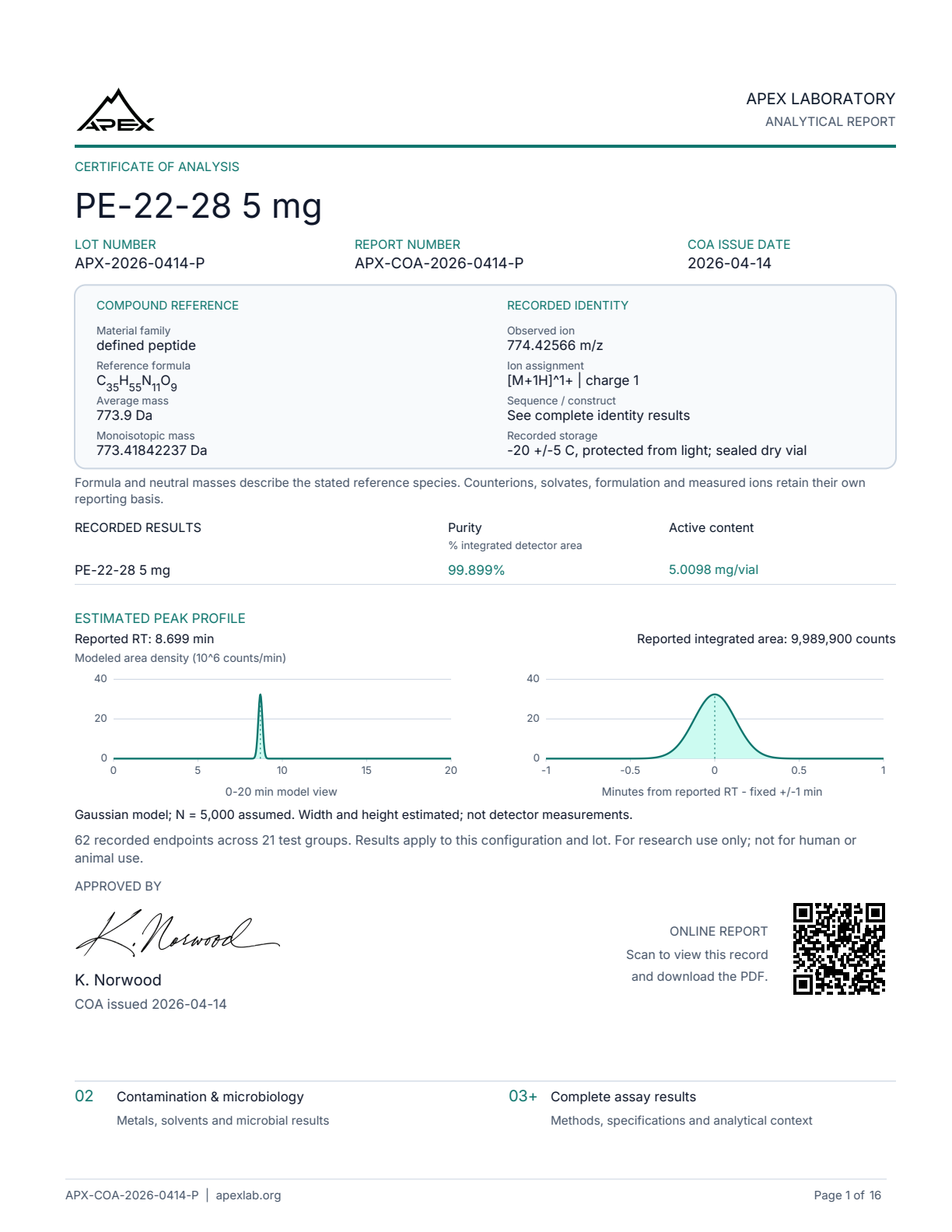
Apex Laboratory results for the listed configurations. Match the lot on your label with the report.
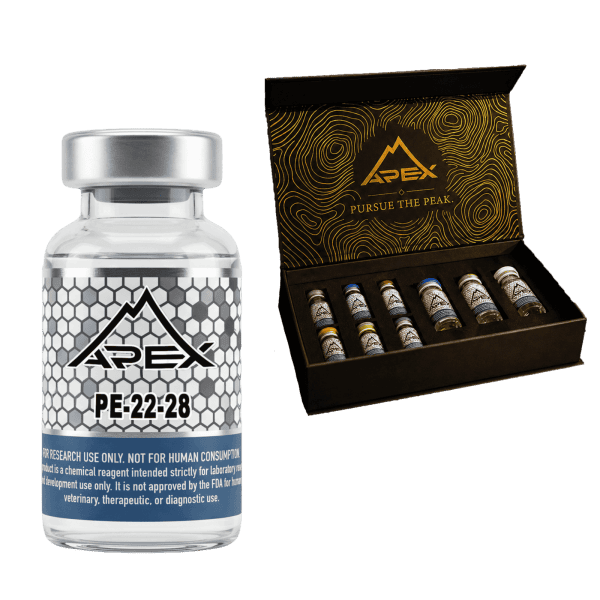
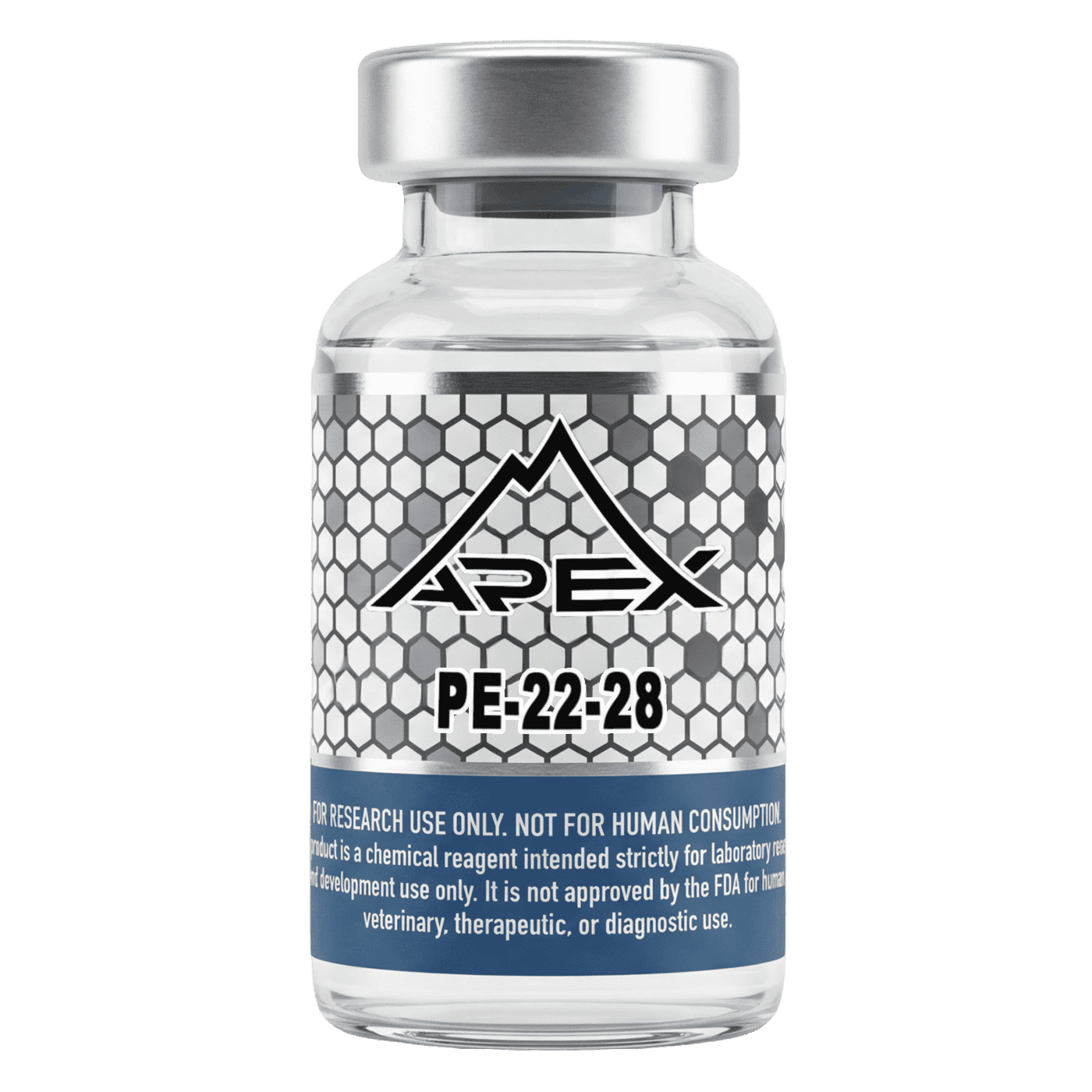
PE-22-28 5 mg
- PE-22-28 5 mg chromatographic purity
- 99.899 % integrated detector area
- PE-22-28 5 mg active content
- 5.0098 mg/vial
- Bacterial endotoxins
- <0.025 EU/mg active-equivalent
- Sterility: FTM
- No growth at 14 days in all 20 units
Chromatographic purity by analyte

About this graph
Recorded scalar results against the stated specification. Each row uses its own labeled scale; purity is detector-area purity, not active-material content.
Measured active content

About this graph
Calibrated active content, concentration or activity compared with the stated same-unit specification. Each row uses its own labeled scale; no conversion from chromatographic purity is made.
PE-22-28 is a synthetic heptapeptide TREK-1 potassium-channel modulator (CAS 1801959-12-5) supplied by Apex Laboratory as a lyophilized research reagent. The latest published in-house report is PE-22-28 5 mg — lot APX-2026-0414-P (COA issued 2026-04-14). Match the report configuration and lot to the label on your material. PE-22-28 is offered strictly for in-vitro laboratory research and development; it is not approved for human consumption, veterinary use, or any therapeutic application.
Compound Overview
PE-22-28 is a short seven-residue peptide that acts as an inhibitor of TREK-1, a member of the two-pore-domain potassium (K2P) channel family encoded by KCNK2. Unlike voltage-gated or inward-rectifier potassium channels, TREK-1 carries a background “leak” potassium current that contributes to the resting membrane potential of the cells in which it is expressed. In electrophysiological assays, PE-22-28 is studied as a reagent that reduces this leak conductance, and the resulting change in recorded membrane current is the central readout under investigation in cell-based and rodent-tissue model systems. The framing here is strictly biophysical: the compound is a tool for probing K2P channel behavior in vitro, not an agent with any characterized human effect.
What distinguishes PE-22-28 from the broader pool of nootropic research peptides such as Semax and Selank is its mechanistic target: those compounds engage neurotrophic and regulatory-peptide pathways, whereas PE-22-28 acts directly on an ion-channel substrate. It is an optimized fragment that emerged from spadin research — spadin being the natural propeptide-derived TREK-1 blocker first characterized at IPMC-CNRS. PE-22-28 was engineered as a shorter, metabolically more stable sequence intended to retain the channel-blocking pharmacology of the parent molecule while improving its handling characteristics in experimental work. Its compact 773.90 g/mol mass and single-charge-state ionization make it analytically straightforward to verify, which is reflected in the clean 8.0-minute retention peak on this lot’s chromatogram.
Research Background & Published Literature
The scientific lineage of PE-22-28 traces to the discovery of spadin as an endogenous antagonist of the TREK-1 channel, reported by Mazella and colleagues in 2010. That work established TREK-1 as a tractable molecular target for ion-channel electrophysiology and motivated the design of shorter analog peptides — PE-22-28 among them — that preserve channel-blocking activity in a more stable scaffold. Subsequent preclinical investigations have used these analogs as tool compounds to characterize K2P channel inhibition and the associated changes in membrane conductance recorded in cell-culture and rodent-tissue model systems. In these studies the peptide functions purely as an experimental probe of channel function; no human-relevant outcome is described or implied.
Researchers interested in the published literature surrounding this compound can consult the following peer-reviewed and database resources for additional context on its mechanism, channel target, and experimental applications in controlled laboratory settings:
- PubMed — PE-22-28 and TREK-1 channel research literature
- PubChem — PE-22-28 chemical record and identifiers
Technical Specifications
| Product Name | PE-22-28 5mg |
| Other Names | PE 22-28 · spadin-derived TREK-1 inhibitor peptide |
| Classification | TREK-1 (K2P) potassium-channel inhibitor / nootropic research peptide |
| CAS Number | 1801959-12-5 |
| Molecular Formula | C₃₅H₅₅N₁₁O₉ |
| Molecular Weight | 773.90 g/mol (expected) · 774.01 found (this lot) |
| Sequence / Structure | Synthetic heptapeptide (7 residues), TREK-1 modulator fragment |
| Purity Specification | See PE-22-28 5 mg — lot APX-2026-0414-P, issued 2026-04-14, for the recorded results, acceptance criteria and methods. |
| Physical Form | Lyophilized (freeze-dried) powder · sealed vial |
| Recommended Diluent | Bacteriostatic water or laboratory-grade sterile water |
| Available Sizes | 5 mg vial |
| Intended Use | In-vitro research use only — not for human consumption |
Storage, Handling & Stability
As a small lyophilized peptide, PE-22-28 is comparatively robust in its dry state but is sensitive to moisture uptake and to repeated freeze-thaw once in solution. Store the sealed vial at -20°C for long-term stability, protected from light. Reconstitute with bacteriostatic water or laboratory-grade sterile water; once in solution, refrigerate at 2–8°C and aliquot working volumes so the bulk stock is not repeatedly warmed and re-frozen. Because the molecule is a short peptide, dissolution is typically rapid and complete with gentle swirling rather than vigorous agitation.
- Keep the lyophilized vial desiccated; allow it to equilibrate to room temperature before opening to avoid condensation on cold glass.
- Reseal promptly after each withdrawal to limit moisture exposure of the remaining powder.
- Aliquot reconstituted solution into single-use volumes to minimize freeze-thaw degradation of the channel-active sequence.
- Label every aliquot with compound name, concentration, reconstitution date, and operator initials for full lot traceability against the original container’s batch label and its matching COA.
Quality Assurance & Analytical Verification
Every PE-22-28 lot is released only after a dual-verification protocol: reversed-phase High-Performance Liquid Chromatography to establish chromatographic purity, and Mass Spectrometry to confirm molecular identity against the expected 773.90 g/mol parent mass. See PE-22-28 5 mg — lot APX-2026-0414-P, issued 2026-04-14, for the recorded results, acceptance criteria and methods. For a compact peptide of this size, electrospray ionization typically yields a clean low-charge-state signal rather than the multi-charge envelope seen with large peptides, so identity can be assigned from a singly or doubly protonated ion that back-calculates directly to the heptapeptide’s parent mass. To learn how to interpret these traces, see our guide on mass spectrometry for peptide verification and how to read a Certificate of Analysis; archived lot records are available in the Lab Verified archive.
Frequently Asked Questions
What ion channel does PE-22-28 target?
PE-22-28 is studied as an inhibitor of TREK-1, a two-pore-domain (K2P) potassium channel encoded by the KCNK2 gene. TREK-1 carries a background “leak” potassium current that contributes to resting membrane potential; in laboratory models, the measurable reduction of this conductance recorded by electrophysiology is the central mechanism under investigation for this peptide.
How is PE-22-28 related to spadin?
PE-22-28 is an optimized short-peptide fragment that arose from research on spadin, the propeptide-derived TREK-1 antagonist characterized by Mazella and colleagues. The intent of the shorter sequence is to retain channel-blocking pharmacology in a more stable scaffold suitable for controlled in-vitro experiments.
Why is the reported molecular weight near 774 rather than the ~850 sometimes listed?
The Certificate of Analysis for this lot reports a theoretical mass of 773.90 g/mol with a found mass of 774.01, consistent with the molecular formula C₃₅H₅₅N₁₁O₉. The measured value on the batch you receive is the authoritative figure; older rounded approximations should be disregarded in favor of the COA above.
How should PE-22-28 be reconstituted and stored for laboratory use?
The lyophilized powder is stored at -20°C and reconstituted with bacteriostatic water or laboratory-grade sterile water. After reconstitution, refrigerate at 2–8°C, aliquot to avoid repeated freeze-thaw, and use within your validated working window. Concentration can be calculated from vial mass and solvent volume using our peptide reconstitution calculator.
What distinguishes PE-22-28 from other nootropic research peptides?
Most nootropic research peptides act on neurotrophic or regulatory-peptide pathways; PE-22-28 is unusual in acting directly on an ion-channel target (TREK-1). This makes it a useful tool compound for isolating channel-level conductance effects from broader signaling effects in comparative model studies.
Is this product approved for human use?
No. All compounds sold by Apex Laboratory are classified as chemical research reagents intended strictly for in-vitro laboratory research. PE-22-28 is not approved for human consumption, veterinary use, or any therapeutic application, and it has not received marketing authorization from any regulatory authority. Purchasers who imply intended bodily use will have their orders cancelled and their accounts permanently suspended.
Related Research Compounds
Researchers studying CNS ion-channel and neurosignaling pathways may also be interested in related nootropic research peptides from Apex Laboratory: Semax and Selank (regulatory neuropeptides studied for neurotrophic and modulatory activity in models), and Adamax (an adamantane-modified Semax derivative). For mechanism and study context, see the nootropic & CNS research peptides pillar guide. Browse the full selection in the complete Apex Laboratory research catalog.
Shipping, Packaging & Delivery
Domestic US orders confirmed before 2:00 PM Eastern Time on a business day are dispatched the same day through tracked carriers. The 5 mg vial is sealed and cushioned in protective, temperature-appropriate packaging chosen to preserve the lyophilized powder during transit. On arrival, move the vial to -20°C storage without delay. If your protocol is time-critical or you need a specific delivery window, reach out to our support team beforehand so we can coordinate dispatch around your laboratory schedule.
Research Use Disclaimer
For in-vitro research use only. Not for human consumption. All products sold by Apex Laboratory — including PE-22-28 5mg — are intended exclusively for qualified researchers, accredited laboratories, and educational institutions. PE-22-28 has not received marketing authorization from the FDA or any other regulatory authority for any indication. Purchasers assume full responsibility for safe handling, proper storage, and compliance with all applicable federal, state, and local laws, regulations, and institutional policies governing the purchase and use of chemical research reagents.