
Triptorelin is a synthetic GnRH-receptor superagonist built from the native ten-residue hormone with D-tryptophan substituted at position 6. Sustained receptor exposure produces an initial agonist response followed by reduced pituitary responsiveness and lower LH and FSH signaling. FDA-approved triptorelin pamoate depot products and a research-grade chemical reagent share an active identity but occupy categorically distinct regulatory and formulation contexts.
Triptorelin is useful as a research reference because it makes a timing-dependent pharmacology problem visible. Native gonadotropin-releasing hormone reaches pituitary gonadotrophs in pulses. A long-acting agonist supplies a different signal: receptor activation is sustained, and the system transitions from an initial response to reduced responsiveness. Reviews of GnRH analogs describe this flare-to-suppression sequence across pituitary and downstream HPG-axis endpoints.[1]
This guide separates four records that are often collapsed online: Triptorelin’s chemical identity, the qualitative receptor mechanism, compound/formulation evidence, and the regulatory status of finished pharmaceutical products. It contains no protocol, dose, administration, reconstitution, or personal-use instruction. The broader specialty research hub owns HPG-axis family navigation; this page owns the Triptorelin entity.
- Triptorelin is a ten-residue GnRH analog defined by a D-tryptophan substitution at position 6.
- Pulsatile native signaling and sustained superagonist exposure are different experimental inputs.
- The initial agonist phase and later suppression phase must not be merged into one undated effect claim.
- Depot evidence is formulation specific and cannot be transferred automatically to a laboratory reagent.
- Trelstar and Triptodur are approved finished drugs; Apex Triptorelin is a research-grade chemical reagent, not either pharmaceutical.
Triptorelin Technical Identity
Triptorelin is a synthetic decapeptide analog of GnRH, also called luteinizing-hormone-releasing hormone. Its sequence is pGlu-His-Trp-Ser-Tyr-D-Trp-Leu-Arg-Pro-Gly-NH2. Native GnRH carries glycine at position 6; Triptorelin carries D-tryptophan. PubChem reports the free-base formula C64H82N18O13, molecular weight 1311.4 g/mol, and CAS Registry Number 57773-63-4.
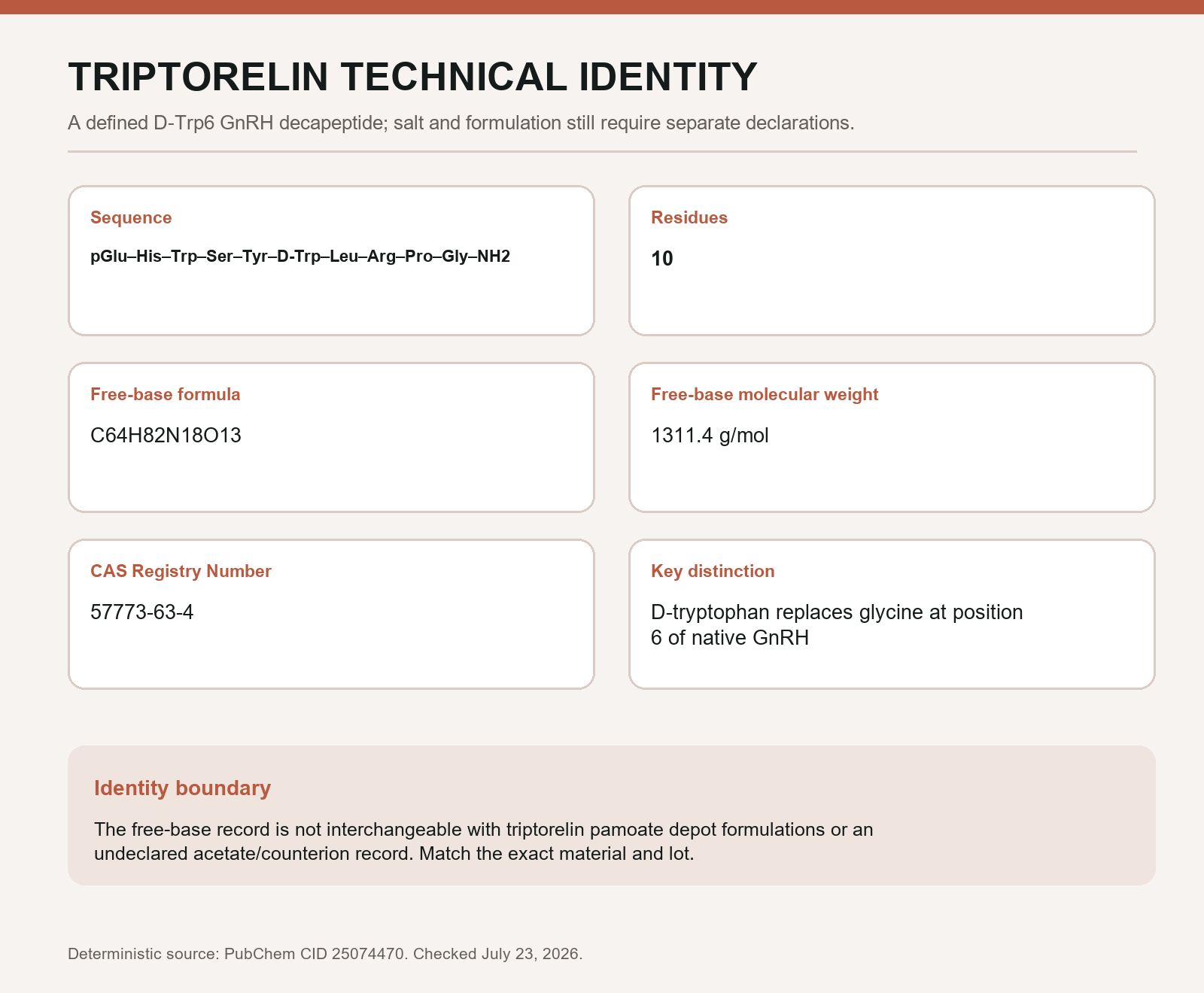
The phrase “Triptorelin acetate” adds a counterion description; “Triptorelin pamoate” names the salt used in approved depot formulations. Those labels should not be treated as formatting variants. A mass calculation, specification, chromatographic method, and reference standard must match the material actually examined.
The D-residue is more than a naming detail. Reviews and early pharmacology associate the analog design with enhanced agonist potency and extended action relative to the native hormone.[2] That statement belongs to the analog and the reported study systems; it does not specify the behavior of every salt, matrix, depot, route, or exposure pattern.
GnRH Signaling: Pulses Versus Sustained Exposure
The hypothalamic-pituitary-gonadal axis uses signal timing as information. Pulsatile GnRH maintains pituitary gonadotropin signaling. Sustained agonist exposure first activates the receptor and can transiently increase downstream hormone signals, then produces desensitization and downregulation. Work in gonadotroph-derived cell models and mechanistic reviews describes loss of responsiveness at the receptor and at downstream signaling steps.[3][4]
In gonadotroph-derived αT3-1 cells in vitro, a 60-minute pretreatment with 100 nM native GnRH reduced cell-surface GnRH-receptor number by 48%, cut maximal GnRH-stimulated inositol-phosphate accumulation to 66% of control, and shifted the EC50 roughly 3-fold — native-GnRH values in a cell line, not triptorelin values in an organism.[3] The companion receptor-biology review is mechanistic and reports no single quantitative endpoint.[4]
The cited records do not agree on where that loss of responsiveness sits or how complete it is. The receptor-biology review treats tail-less mammalian GnRH receptors as natural desensitization- and internalization-deficient receptors and assigns the larger role to post-receptor mechanisms.[4] Lahlou reports alpha-subunit secretion that remains responsive to exogenous GnRH, read in the 2005 review as showing that the agonist does not induce actual pituitary desensitization[2] and in the 2000 review as showing that the gonadotrophs are not totally desensitized.[8] A review of LHRH analogs in oncology instead describes chronic agonist administration as producing downregulation and desensitization of pituitary LHRH receptors.[1] Suppression of gonadotropin output is what those records share; the locus and the completeness of pituitary desensitization are not settled across this source set.
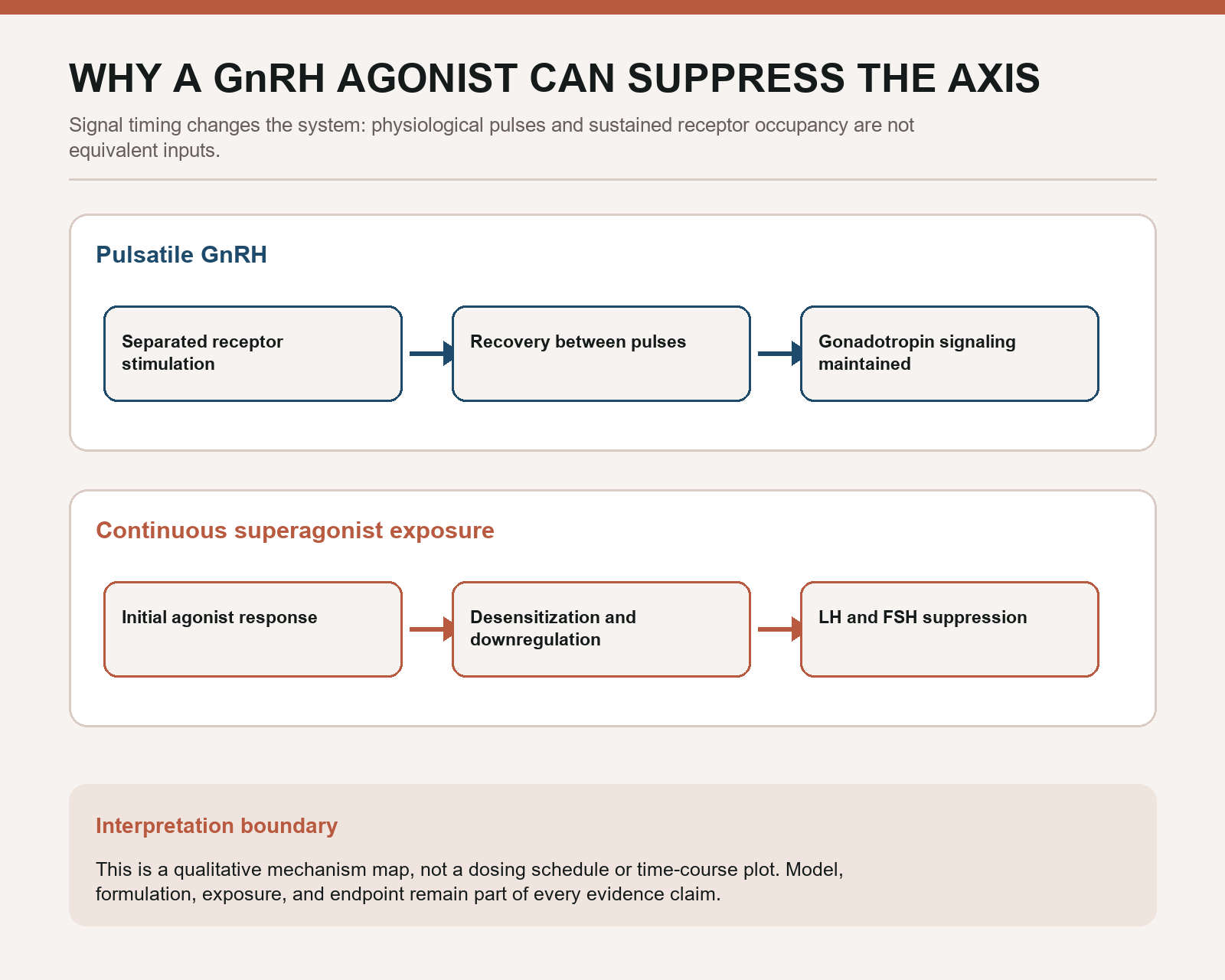
Keep the phases separate
A claim about an “increase” can be true at an early phase while a claim about “suppression” can be true later in the same sustained-exposure model. A useful evidence summary therefore names the phase, model, formulation, and endpoint. Removing timing from the claim makes the mechanism sound contradictory and can produce invalid cross-study comparisons.
GnRH analog research also distinguishes pituitary from possible extrapituitary observations. Limonta and colleagues reviewed both sites while emphasizing that the established endocrine sequence runs through pituitary gonadotropin regulation; that review reports no quantitative result.[1] A receptor observation in one tissue does not automatically establish a whole-organism outcome.
Evidence Landmarks and Their Limits
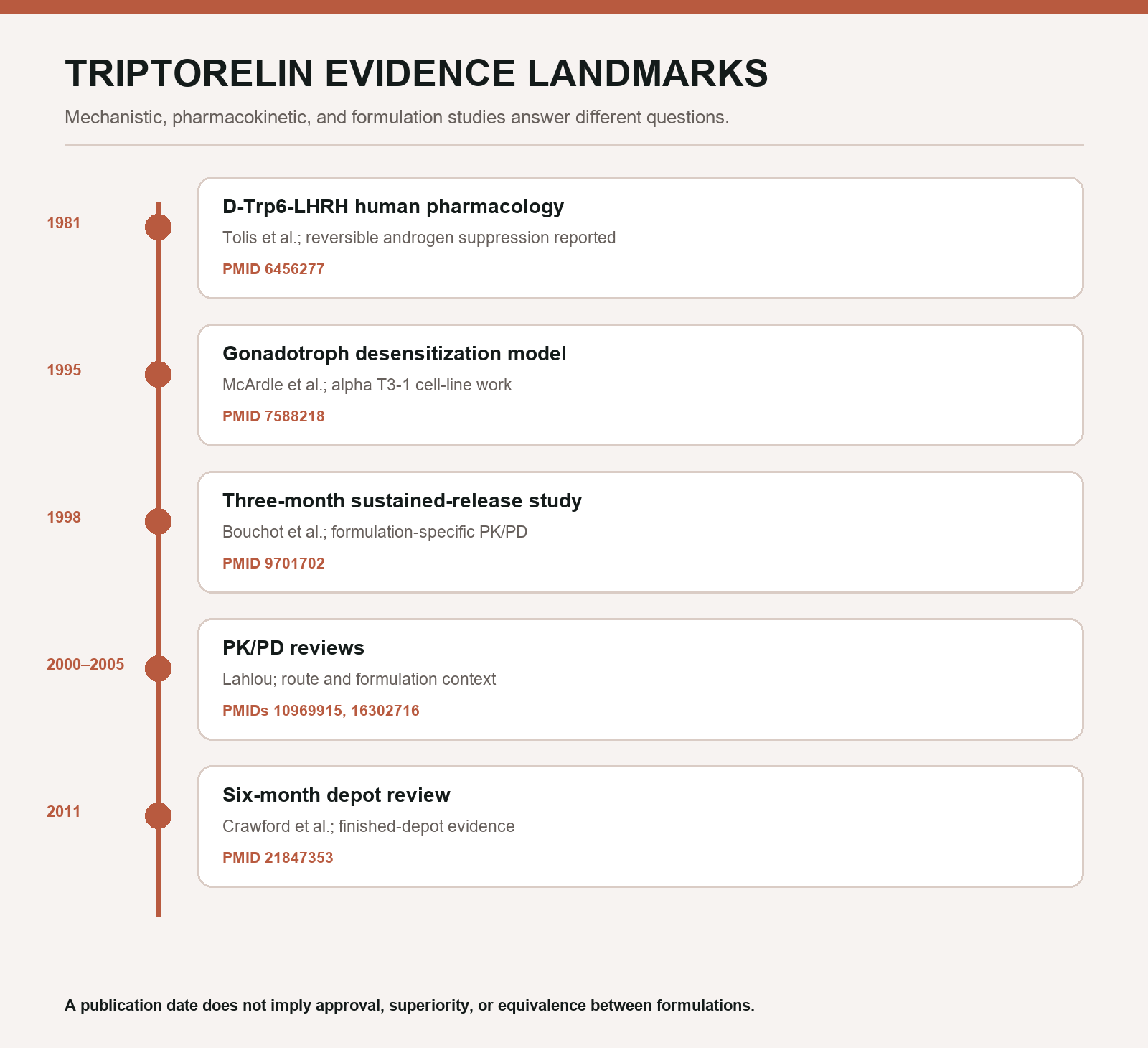
Early human pharmacology with D-Trp6-LHRH reported reversible suppression of androgen production after sustained exposure.[5] Four male human subjects (n=4) received 100 µg daily for 3 to 6 months; plasma testosterone and dihydrotestosterone fell to castrate values, acutely releasable luteinizing hormone was suppressed, and testosterone normalized after treatment stopped. The study is historically important, but its population, formulation, and clinical design are not a laboratory protocol. It supports the flare-to-suppression pharmacology in context; it does not create instructions for a research reagent.
Bouchot and colleagues studied a three-month sustained-release formulation in advanced prostate-cancer research and reported formulation-specific pharmacokinetic and pharmacodynamic observations.[6] In 14 human patients with advanced prostatic adenocarcinoma, one 11.25 mg depot injection moved mean serum testosterone into the surgical-castration range by day 22 and held it for the three-month interval; plasma triptorelin peaked at 35.70 ng/mL 2.5 hours after injection, then held at 0.06 ± 0.05 ng/mL through day 91. Later reviews addressed longer-interval depot products and their clinical evidence.[7] Across the pivotal trials of the two approved six-month depots — triptorelin pamoate 22.5 mg and leuprolide acetate 45 mg — chemical castration (serum testosterone at or below 50 ng/dL) was reached in 93% to 99% of human subjects, with hot flashes the most frequently reported adverse event. These records belong to engineered finished depots. They should not be used to assign a half-life, release profile, exposure interval, or performance claim to a non-depot reagent.
Lahlou’s reviews put figures on that route and formulation dependence: the half-disappearance time of infused GnRH agonists is reported as 3 to 10-fold that of native GnRH, a class-level kinetic comparison the review states without attaching a species or study population to it, and in children treated with depot triptorelin or leuprorelin alpha-subunit secretion is markedly increased while LH-beta secretion is suppressed — a differential subunit pattern that parallels mRNA levels measured in rat pituitary after in-vivo triptorelin exposure;[8] and the biological half-life of D-Trp6-LHRH after subcutaneous injection is about 10 times the intravenous value, attributed to progressive release from the injection site.[2] The most defensible synthesis is therefore layered: the analog has a defined identity; sustained receptor exposure can produce desensitization; and depot behavior is a property of a specified finished formulation and study.
No cited study establishes that an Apex research reagent is equivalent to Trelstar, Triptodur, or another finished formulation. Clinical evidence is included to define the molecule’s published and regulatory context, not to promote therapeutic use.
Additional reported findings
| Compound and model | Species / population | Endpoint | Reported result | Source |
|---|---|---|---|---|
| Depot triptorelin, half dose 1.87 mg versus full dose 3.75 mg, mid-luteal long protocol | Human; 180 randomized assisted-reproduction patients | Premature LH surge; cumulative pregnancy rate | No premature LH surge in either arm; LH on the day of hCG 1.04 ± 0.05 (half dose) vs 0.7 ± 0.06 IU/L (full dose); cumulative pregnancy 56.8% vs 35.4% | PMID 15271868 |
Regulatory and Formulation Firewall
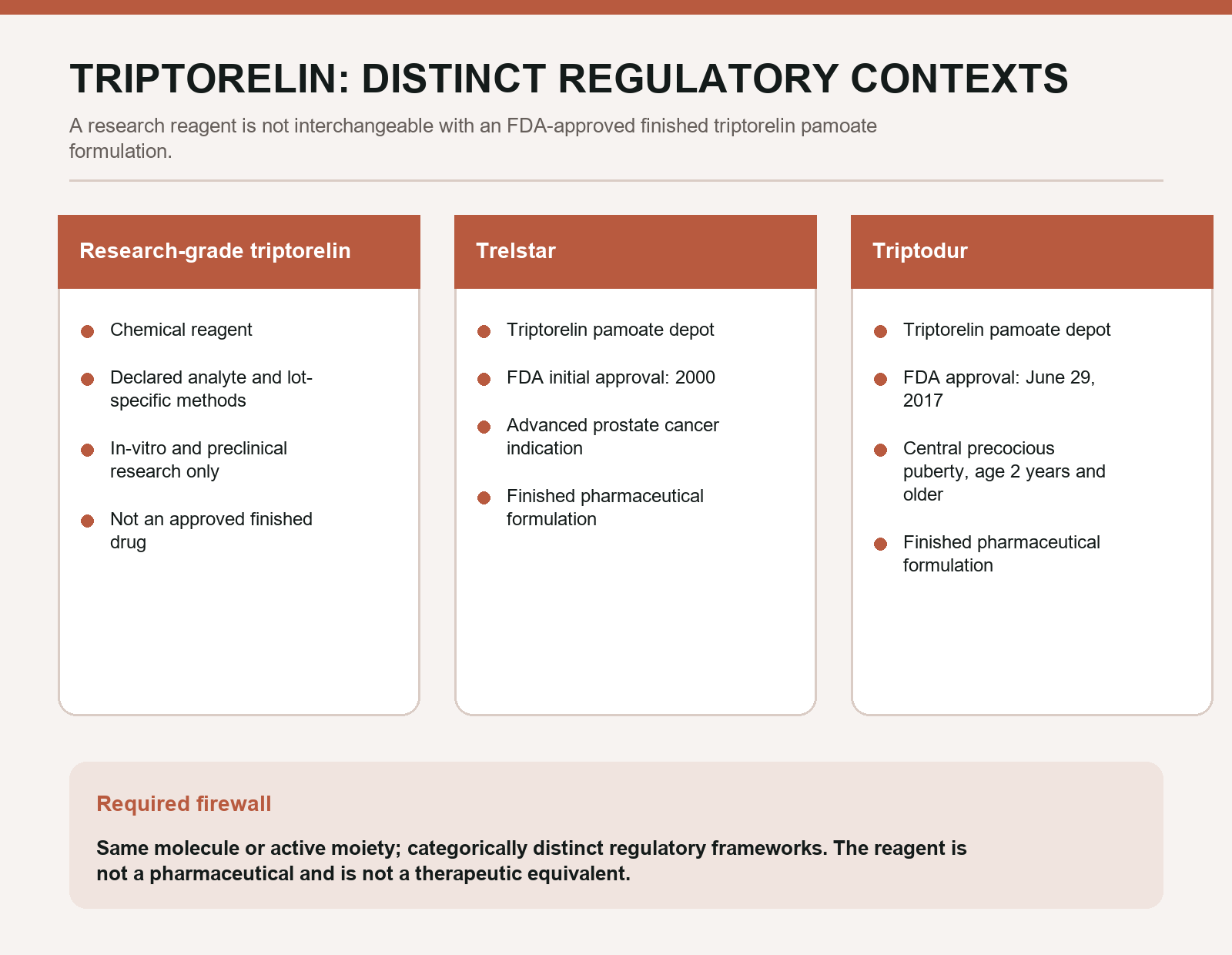
FDA first approved Trelstar under NDA 020715 on June 15, 2000. Current FDA labeling identifies Trelstar as a triptorelin pamoate injectable depot suspension supplied in 3.75 mg one-month, 11.25 mg three-month, and 22.5 mg six-month strengths, indicated for advanced prostate cancer, distributed by Verity Pharmaceuticals and manufactured by Debiopharm Research & Manufacturing SA. FDA approved Triptodur — triptorelin extended-release for injectable suspension, a 22.5 mg six-month depot — under NDA 208956 on June 29, 2017 for central precocious puberty in pediatric patients age 2 years and older. Its current label identifies Azurity Pharmaceuticals as the distributor and the company for which the product is manufactured, with Debiopharm Research & Manufacturing SA as the manufacturer.
| Record | What it establishes | What it does not establish |
|---|---|---|
| Research-material specification and lot record | Declared analyte, form, lot, and stated analytical results | FDA approval, clinical safety, efficacy, or pharmaceutical equivalence |
| Trelstar FDA label | Approved finished formulation, labeling, and advanced-prostate-cancer indication | Properties of a separate laboratory reagent |
| Triptodur FDA approval record | Approved finished formulation and central-precocious-puberty indication | Interchangeability with Trelstar or a research material |
The required wording is direct: same molecule or active moiety; categorically distinct regulatory frameworks. Apex supplies Triptorelin as a chemical research reagent for in-vitro and preclinical research. It is not Trelstar or Triptodur, not a pharmaceutical, and not for human or veterinary consumption. The research-grade reagent itself holds no marketing authorization anywhere: no FDA, EMA, NMPA, MHRA, or other national regulatory approval covers it, and neither the Trelstar nor the Triptodur approval extends to it. The general framework is detailed in research-grade versus pharmaceutical-grade peptides.
Research Questions and Model Boundaries
Triptorelin literature can inform several well-bounded research questions: how sustained GnRH-receptor activation changes receptor responsiveness; how gonadotroph signaling differs between early and later phases; how LH and FSH endpoints respond in a defined model; and how an engineered depot changes exposure relative to a non-depot formulation. Weiss and colleagues reviewed the action of GnRH analogs in pituitary gonadotrophs and the influence of ovarian-steroid context, reinforcing that background biology changes interpretation.[9] In their cultured female rat pituitary cells, 0.1 nM triptorelin lowered the total LH pool from 137 to 36 ng/mL within 1 hour, and its suppressive effect on LH secretion was complete by 3 hours.
Researchers should not transfer evidence across four boundaries without support:
- native hormone to analog: Gonadorelin and Triptorelin differ in residue identity and sustained-action profile;
- free analyte to salt or depot: formulation controls release and exposure;
- cell model to organism: receptor behavior does not alone define systemic endocrine output;
- clinical study to research reagent: an approved finished drug carries product-specific evidence and controls.
Antagonists provide another mechanistic contrast. A GnRH antagonist blocks receptor activation without the same initial agonist phase; a superagonist activates before desensitization. Reviews of antagonist development describe that difference in narrative form and report no quantitative endpoint for triptorelin itself, and a general class comparison should not be converted into a universal superiority claim.[10]
Analytical Verification of a Triptorelin Research Material
Verification begins with identity fields: exact analyte, sequence, salt or counterion, lot, expected mass, and reference source. HPLC and mass spectrometry then answer different questions. HPLC can report a chromatographic profile under a stated method. Mass spectrometry can support mass identity when the expected and observed ion or deconvoluted mass are interpretable. Neither method alone proves receptor activity, sterility, container content, safety, or efficacy.
Apex lists triptorelin acetate as a lyophilized research reagent. Read the applicable published report for its declared material, lot, methods, results and acceptance criteria. A parent-peptide mass does not by itself specify salt or counterion composition, and analytical results do not establish a pharmacological effect.
Use the COA interpretation guide, HPLC guide, and mass-spectrometry guide to inspect a current lot record. Do not rely on a generic badge or an evidence-looking image.
Apex Triptorelin Acetate research record
The product page can document current availability and lot-specific commercial records. It cannot establish pharmacology, an approved indication, or equivalence to a finished depot product. Confirm the current analyte declaration and request the current lot documentation before relying on a specification.
Frequently Asked Questions About Triptorelin
What is Triptorelin?
Triptorelin is a synthetic ten-residue gonadotropin-releasing hormone receptor agonist. It differs from native GnRH at position 6, where D-tryptophan replaces glycine. The free-base identity record is distinct from the triptorelin pamoate depot formulations used in approved finished drugs.
Why can a GnRH agonist suppress LH and FSH?
Physiological GnRH signaling is pulsatile. Sustained agonist exposure initially activates the receptor, then reduces gonadotroph responsiveness; the cited records describe that state as desensitization and downregulation but disagree on its locus and how complete it is. The result documented in the literature is an early agonist response followed by suppression of luteinizing hormone and follicle-stimulating hormone signaling.
What does the D-Trp6 substitution change?
Replacing glycine at position 6 with D-tryptophan defines the Triptorelin analog and contributes to its superagonist profile relative to native GnRH. The substitution is an identity feature; it does not by itself specify a salt, depot formulation, exposure pattern, or experimental outcome.
Is Triptorelin FDA approved?
FDA has approved finished triptorelin pamoate products, including Trelstar for advanced prostate cancer and Triptodur for central precocious puberty in pediatric patients age 2 years and older. A research-grade Triptorelin reagent is not either finished drug and is not an approved therapeutic equivalent.
How is research-grade Triptorelin different from Trelstar and Triptodur?
The research material is a chemical reagent defined by its analyte, form, lot, and analytical records. Trelstar and Triptodur are FDA-approved triptorelin pamoate depot formulations with product-specific manufacturing, excipients, labeling, and indications. Shared active identity does not make the reagent interchangeable with either pharmaceutical.
What can HPLC and mass spectrometry verify for Triptorelin?
HPLC can describe a chromatographic profile and area percentage under a stated method, while mass spectrometry can support mass identity with an interpretable ion or deconvoluted result. Neither method alone establishes receptor function, sterility, clinical safety, efficacy, or equivalence to an approved depot formulation.
References and Regulatory Sources
- Limonta P, et al. LHRH analogues as anticancer agents: pituitary and extrapituitary sites of action. Expert Opin Investig Drugs. 2001;10(4):709-20. PMID: 11281820.
- Lahlou N. [Pharmacokinetics and pharmacodynamics of triptorelin]. Ann Urol (Paris). 2005;39 Suppl 3:S78-84. PMID: 16302716.
- McArdle CA, et al. Desensitization of gonadotropin-releasing hormone action in the gonadotrope-derived alpha T3-1 cell line. Endocrinology. 1995;136(11):4864-71. PMID: 7588218.
- McArdle CA, et al. The tail of the gonadotrophin-releasing hormone receptor: desensitization at, and distal to, G protein-coupled receptors. Mol Cell Endocrinol. 1999;151(1-2):129-36. PMID: 10411327.
- Tolis G, et al. Suppression of androgen production by D-tryptophan-6-luteinizing hormone-releasing hormone in man. J Clin Invest. 1981;68(3):819-22. PMID: 6456277.
- Bouchot O, et al. Three-month sustained-release form of triptorelin in patients with advanced prostatic adenocarcinoma: results of an open pharmacodynamic and pharmacokinetic multicenter study. Horm Res. 1998;50(2):89-93. PMID: 9701702.
- Crawford ED, et al. Six-month gonadotropin releasing hormone (GnRH) agonist depots provide efficacy, safety, convenience, and comfort. Cancer Manag Res. 2011;3:201-9. PMID: 21847353.
- Lahlou N, et al. Pharmacokinetics and pharmacodynamics of GnRH agonists: clinical implications in pediatrics. J Pediatr Endocrinol Metab. 2000;13 Suppl 1:723-37. PMID: 10969915.
- Weiss JM, et al. Actions of gonadotropin-releasing hormone analogues in pituitary gonadotrophs and their modulation by ovarian steroids. J Steroid Biochem Mol Biol. 2006;101(2-3):118-26. PMID: 16891115.
- Reissmann T, et al. Development and applications of luteinizing hormone-releasing hormone antagonists in the treatment of infertility: an overview. Hum Reprod. 1995;10(8):1974-81. PMID: 8567825.
- FDA. Trelstar NDA 020715 approval letter. Effective June 15, 2000.
- FDA. Trelstar prescribing information. Current source check July 23, 2026.
- FDA. Triptodur NDA 208956 approval letter. Effective June 29, 2017.
- FDA. Triptodur prescribing information. NDA 208956; current source check July 23, 2026.
- NCBI. PubChem Compound Summary: Triptorelin, CID 25074470. Accessed July 23, 2026.