Semaglutide and tirzepatide are distinct peptide molecules: semaglutide activates the GLP-1 receptor, while tirzepatide activates GIP and GLP-1 receptors. Two direct trials answer different questions – SURPASS-2 studied adults with type 2 diabetes for 40 weeks, while SURMOUNT-5 studied adults with obesity without diabetes for 72 weeks. Apex Laboratory supplies semaglutide and tirzepatide as research-grade chemical reagents for in-vitro and preclinical research, distinct from the Ozempic/Wegovy and Mounjaro/Zepbound pharmaceutical formulations.
Evidence and regulatory facts checked July 23, 2026. The useful question is not simply which molecule “wins.” A defensible comparison asks: which receptor architecture, which population, which pharmaceutical formulation, which comparator strength, which endpoint, and which time point? Semaglutide and tirzepatide now have two major peer-reviewed direct comparisons, but each answers a different clinical research question.
This page is for readers comparing molecule design and evidence architecture, not selecting or using a medicine. Individual technical identity and broader evidence remain on the semaglutide research guide and tirzepatide research guide. The comparison owns the symmetric criteria and direct-trial interpretation.
Semaglutide versus tirzepatide in one minute
- Semaglutide is a GLP-1 receptor agonist. Tirzepatide is a dual GIP and GLP-1 receptor agonist. They are not the same molecule.
- SURPASS-2 directly compared tirzepatide with semaglutide in adults with type 2 diabetes for 40 weeks, with glycated hemoglobin as the primary endpoint.
- SURMOUNT-5 directly compared maximum tolerated doses in adults with obesity without diabetes for 72 weeks, with body-weight change as the primary endpoint.
- Both trials reported greater mean change for tirzepatide on their primary or key outcomes, but the findings remain population-, formulation-, comparator-, and duration-specific.
- FDA-approved semaglutide and tirzepatide formulations have separate applications and labels. Apex research reagents are categorically distinct and do not inherit those approvals or clinical outcomes.
Side-by-Side Research Comparison
| Criterion | Semaglutide | Tirzepatide |
|---|---|---|
| Molecule-level design | GLP-1 receptor agonist | Dual GIP and GLP-1 receptor agonist |
| Direct type 2 diabetes comparison | SURPASS-2 comparator: semaglutide 1 mg | SURPASS-2 test arms: tirzepatide 5, 10, and 15 mg |
| Direct obesity comparison | SURMOUNT-5 comparator: maximum tolerated semaglutide 1.7 or 2.4 mg | SURMOUNT-5 test arm: maximum tolerated tirzepatide 10 or 15 mg |
| Selected U.S. pharmaceutical contexts | Ozempic, Rybelsus, and Wegovy have separate FDA regulatory records | Mounjaro and Zepbound have separate FDA regulatory records |
| Apex material context | Chemical reagent for in-vitro and preclinical research only | Chemical reagent for in-vitro and preclinical research only |
| What this page does not decide | Treatment choice, dosing, administration, switching, individualized risk, or equivalence between research reagents and pharmaceutical formulations | |
The table is deliberately symmetric. It does not attach a clinical observation to one molecule while describing the other only by mechanism, and it does not use pharmaceutical evidence as product proof. Every trial statement below keeps the population, duration, comparator, and endpoint visible.
Mechanism: GLP-1 Alone Versus Dual GIP and GLP-1 Signaling
Semaglutide is an acylated GLP-1 analogue engineered for prolonged action at the GLP-1 receptor. Tirzepatide is a single peptide engineered to engage both the GIP and GLP-1 receptors. The overlap at GLP-1 explains why the molecules are discussed in the same incretin landscape; the added GIP receptor activity is the central architectural difference.
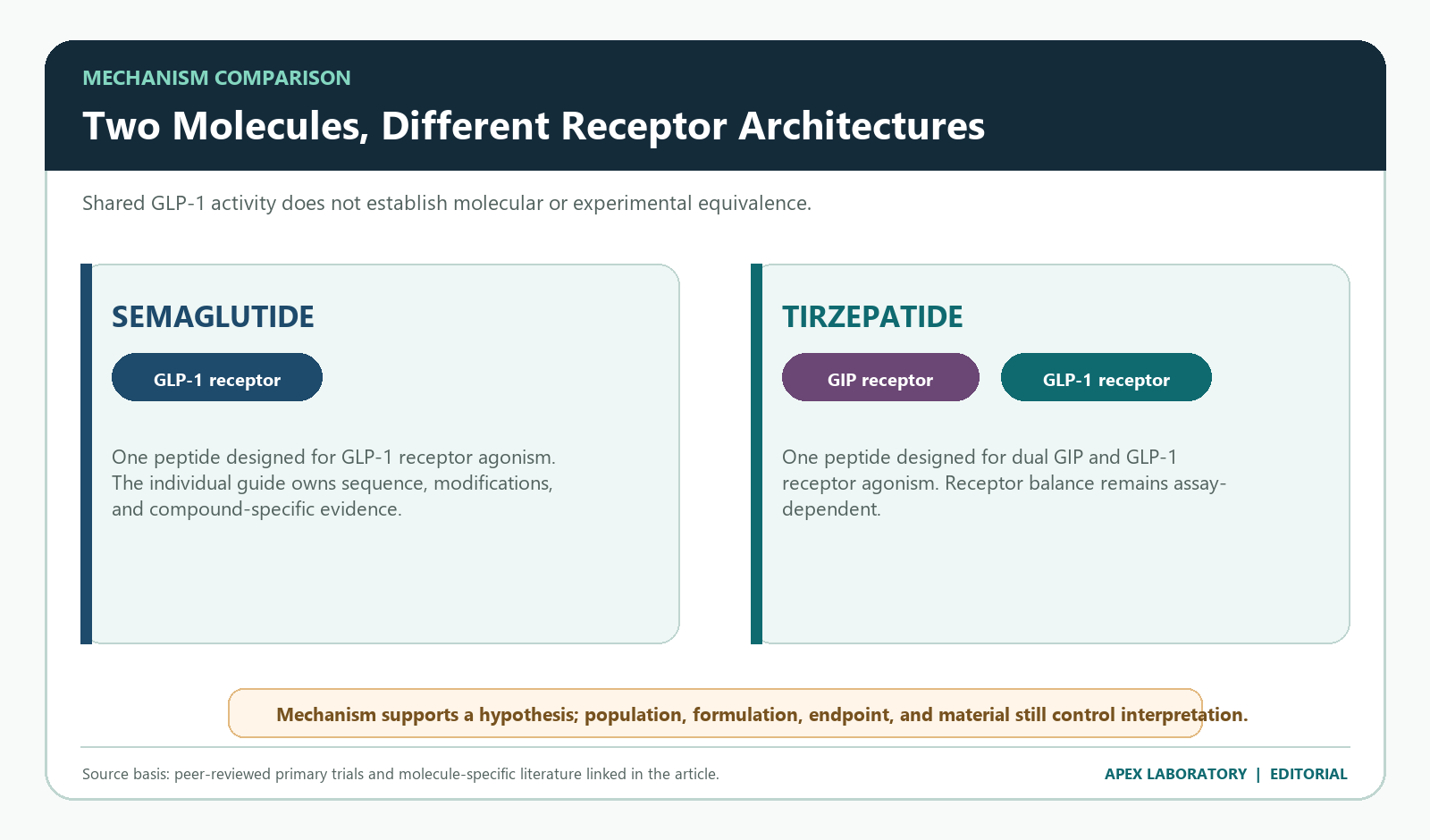
Receptor labels do not by themselves predict an experimental result. Relative activity depends on the assay system, cell background, readout, concentration range, and material state. Clinical observations add further dependencies: pharmaceutical formulation, population, comparator, background care, duration, adherence, and estimand. The mechanism supports a hypothesis; it does not erase those controls.
Use the individual guides for sequence-level identity, modification strategy, and compound-specific literature. Repeating those long profiles here would create competing ownership and make the comparison harder to maintain.
Two Head-to-Head Trials, Two Different Questions
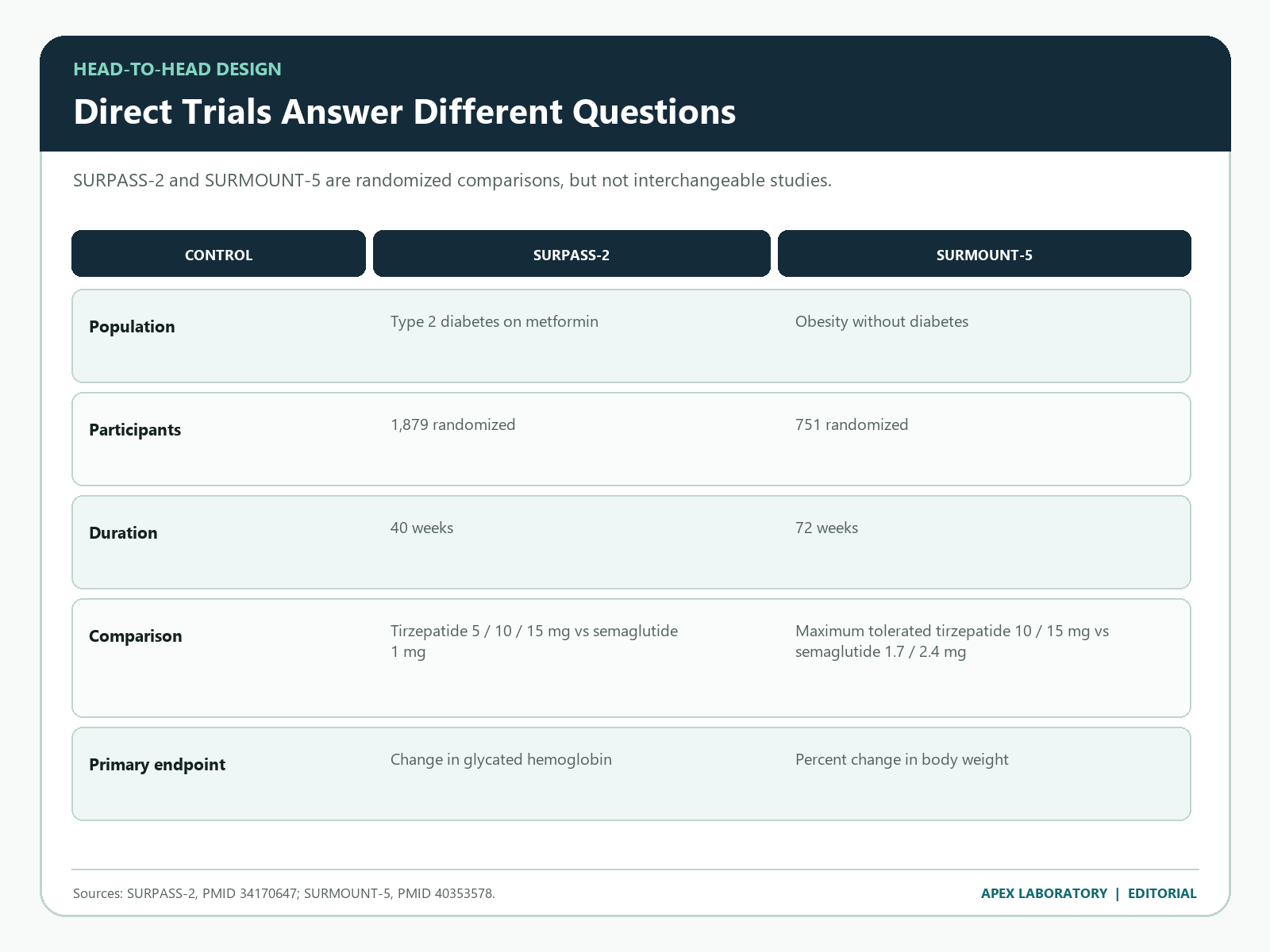
SURPASS-2 and SURMOUNT-5 are more informative than indirect comparisons because each randomized participants between tirzepatide and semaglutide. They still cannot be combined into one context-free result. SURPASS-2 centered glycemic change in adults with type 2 diabetes. SURMOUNT-5 centered body-weight change in adults with obesity without diabetes.
| Design control | SURPASS-2 | SURMOUNT-5 |
|---|---|---|
| Publication | Frias et al., 2021 PMID 34170647 | Aronne et al., 2025 PMID 40353578 |
| Population | Adults with type 2 diabetes inadequately controlled with metformin | Adults with obesity, without type 2 diabetes |
| Randomized participants | 1,879 | 751 |
| Design and duration | Open-label Phase 3; 40 weeks | Open-label Phase 3b; 72 weeks |
| Comparison | Tirzepatide 5, 10, or 15 mg versus semaglutide 1 mg | Maximum tolerated tirzepatide 10 or 15 mg versus maximum tolerated semaglutide 1.7 or 2.4 mg |
| Primary endpoint | Change in glycated hemoglobin from baseline | Percent change in body weight from baseline |
| Key interpretation limit | Does not compare obesity-labeled maximum tolerated regimens | Does not answer glycemic efficacy in type 2 diabetes |
What the Direct Results Show
SURPASS-2: type 2 diabetes and glycated hemoglobin
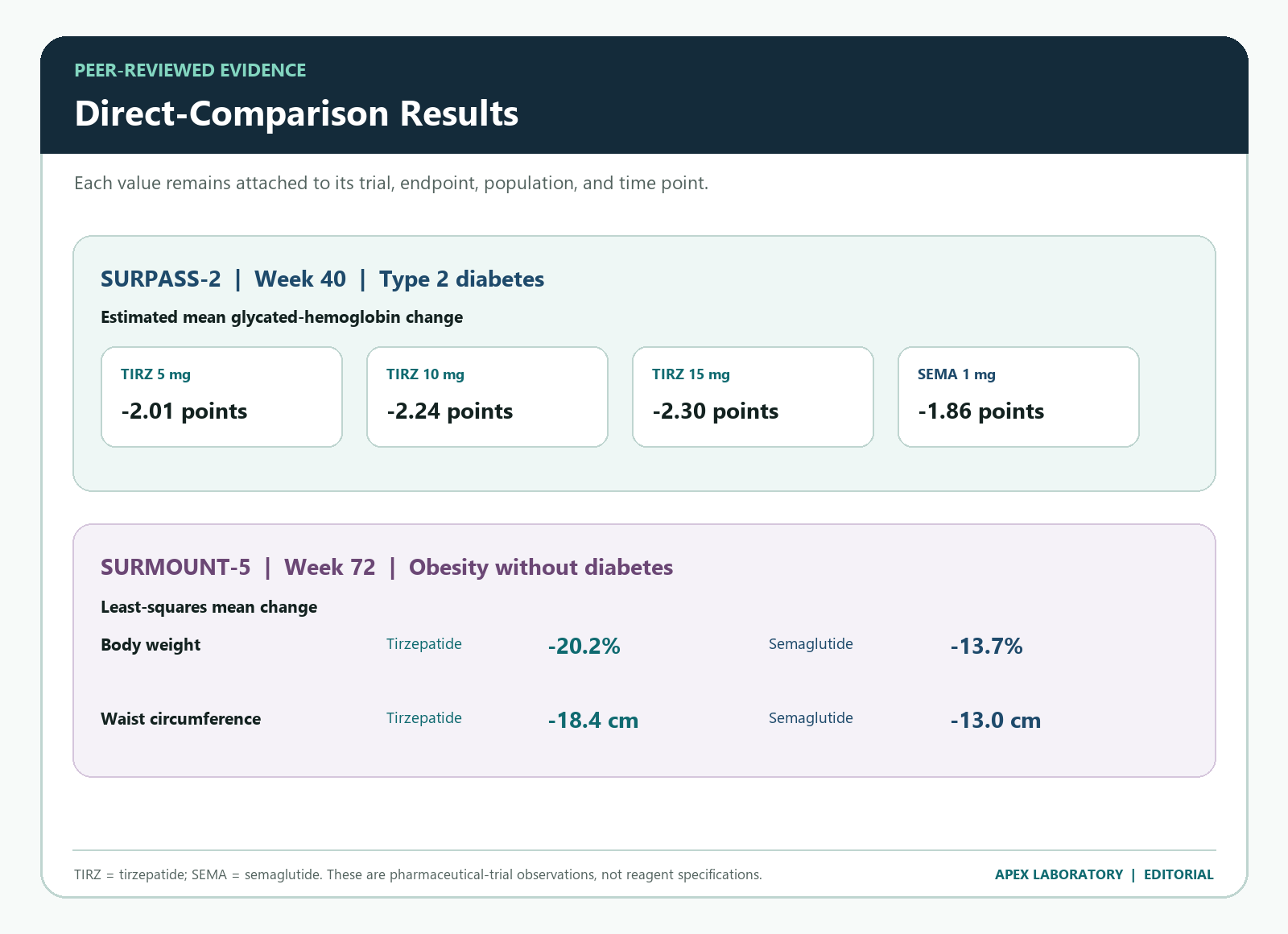
At week 40, the estimated mean glycated-hemoglobin changes were -2.01, -2.24, and -2.30 percentage points with tirzepatide 5, 10, and 15 mg, compared with -1.86 percentage points with semaglutide 1 mg. The estimated between-group differences were -0.15, -0.39, and -0.45 percentage points, respectively. The paper reported noninferiority and superiority for tirzepatide on the primary endpoint under its prespecified analysis.
Body-weight reductions were also greater in the tirzepatide groups, with estimated treatment differences versus semaglutide of -1.9 kg, -3.6 kg, and -5.5 kg across the three tirzepatide groups. Those are between-group differences, not each group’s total mean loss, and they belong to a 40-week type 2 diabetes trial.
SURMOUNT-5: obesity without diabetes and body weight
At week 72, the least-squares mean body-weight change was -20.2% with maximum tolerated tirzepatide and -13.7% with maximum tolerated semaglutide. The mean waist-circumference changes were -18.4 cm and -13.0 cm, respectively. The peer-reviewed report concluded that tirzepatide was superior for body-weight and waist-circumference reduction in the studied population.
SURMOUNT-5 was funded by Eli Lilly, was open label, and compared maximum tolerated dose ranges rather than one fixed strength for every participant. Those facts do not invalidate randomization, but they belong in the interpretation. The result does not establish how every person would respond, does not compare every approved formulation, and does not transfer to a research reagent.
Why Indirect STEP and SURMOUNT Comparisons Are Weaker
STEP 1 reported semaglutide observations in adults with overweight or obesity without diabetes over 68 weeks.PMID 33567185 SURMOUNT-1 reported tirzepatide observations in a broadly related population over 72 weeks.PMID 35658024 These landmark placebo-controlled studies are useful for each molecule’s evidence history, but placing their headline percentages side by side does not create a randomized head-to-head comparison.
Differences in enrollment periods, baseline characteristics, treatment protocols, estimands, missing-data strategies, and trial conduct remain. Since SURMOUNT-5 now provides a direct obesity comparison, it should control the direct semaglutide-versus-tirzepatide claim for that named population. STEP 1 and SURMOUNT-1 belong mainly on the individual evidence pages.
Tolerability: What Can Be Compared
Both direct trials reported gastrointestinal events among the most common adverse events. In SURMOUNT-5, the report states that most were mild to moderate and occurred mainly during dose escalation. SURPASS-2 also reported gastrointestinal events across both groups. A fair comparison describes the trial observations and study discontinuations without turning a research article into individualized risk advice.
Cross-trial event-rate ranking is especially fragile because definitions, exposure time, dose escalation, ascertainment, and populations differ. Current FDA labels remain the controlling sources for approved pharmaceutical warnings, contraindications, and labeled use. This page does not reproduce treatment instructions or advise switching between formulations.
Regulatory Identity: Same Molecule, Categorically Distinct Frameworks
Semaglutide and tirzepatide each appear in FDA-approved pharmaceutical formulations, but the applications and labels belong to those formulations and sponsors. FDA records identify Ozempic under NDA 209637, with initial U.S. approval in 2017, and Wegovy under NDA 215256, approved in 2021. Tirzepatide was first approved in the United States under Mounjaro NDA 215866 in 2022; Zepbound has its own record under NDA 217806, approved in 2023.
| Molecule | Selected FDA pharmaceutical records | Apex research material |
|---|---|---|
| Semaglutide | Ozempic: NDA 209637, initial U.S. approval 2017. Wegovy: NDA 215256, approved June 4, 2021. Rybelsus has a separate application record. | Chemical reagent, not Ozempic, Wegovy, or Rybelsus; no inherited approval, indication, formulation, or clinical outcome. |
| Tirzepatide | Mounjaro: NDA 215866, initial U.S. approval May 13, 2022. Zepbound: NDA 217806, approved November 8, 2023. | Chemical reagent, not Mounjaro or Zepbound; no inherited approval, indication, formulation, or clinical outcome. |
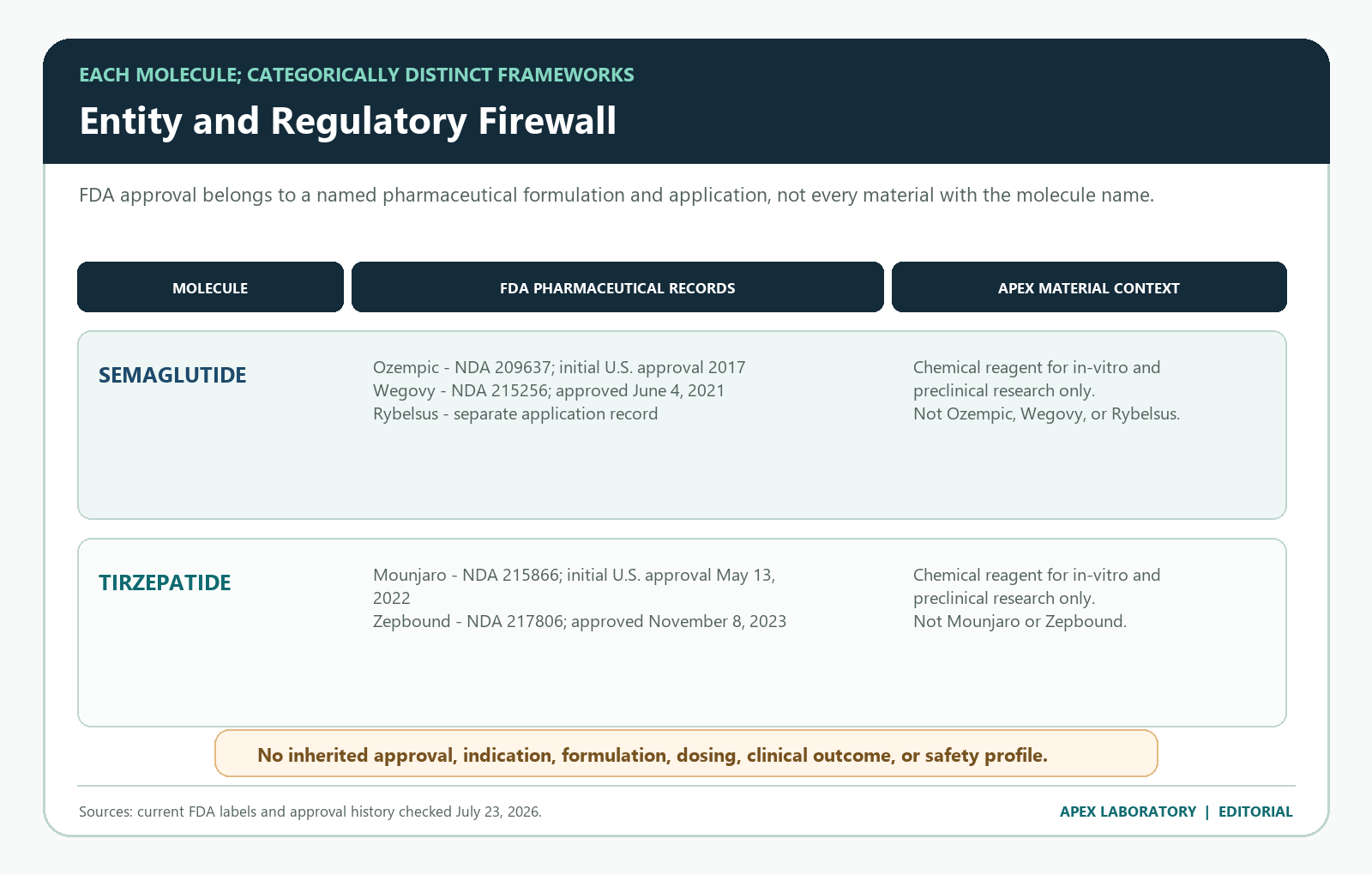
Same molecule (semaglutide); categorically distinct regulatory frameworks. Same molecule (tirzepatide); categorically distinct regulatory frameworks. Apex research reagents are for in-vitro and preclinical research only and not for human consumption. The current Ozempic label revised May 2026 and Zepbound label revised February 2026 are authoritative for those pharmaceutical products. The research-grade versus pharmaceutical-grade guide explains why their evidence does not transfer to an Apex chemical reagent.
Decision Framework for Laboratory Research
For in-vitro or preclinical work, selection begins with the research question rather than the largest clinical percentage. A GLP-1-only design and a dual GIP/GLP-1 design can support different receptor hypotheses. The relevant evidence is then the material’s identity documentation and the experimental system’s ability to resolve the intended comparison.
1. Define the receptor question
Is the study isolating GLP-1 signaling, testing dual-pathway behavior, or using one molecule as a comparator?
2. Control the assay
Match cell background, species, readout, concentration range, exposure, and endpoint before interpreting relative activity.
3. Verify material identity
Review lot-specific identity and purity evidence. A product name or clinical paper is not a certificate of analysis.
4. Preserve entity ownership
Use the individual guides for compound depth and this page for the controlled comparison, preventing contradictory duplicate claims.
Balanced material handoffs: Semaglutide research reagent and Tirzepatide research reagent. These links identify catalog destinations only; they do not imply that either material is suitable for a particular experiment or equivalent to the pharmaceutical formulations used in the trials.
Frequently Asked Questions
What is the main difference between semaglutide and tirzepatide?
Semaglutide is a GLP-1 receptor agonist, while tirzepatide is a dual GIP and GLP-1 receptor agonist. They are distinct peptide molecules with different receptor architectures. Shared GLP-1 activity does not make their assay behavior, pharmaceutical formulations, clinical evidence, or research materials interchangeable.
Has tirzepatide been compared directly with semaglutide?
Yes. SURPASS-2 directly compared them for 40 weeks in adults with type 2 diabetes, using glycated hemoglobin as the primary endpoint. SURMOUNT-5 directly compared maximum tolerated regimens for 72 weeks in adults with obesity without diabetes, using percent body-weight change as the primary endpoint.
Which produced greater body-weight change in SURMOUNT-5?
In SURMOUNT-5, the least-squares mean change at week 72 was -20.2% with maximum tolerated tirzepatide and -13.7% with maximum tolerated semaglutide. That result applies to the randomized trial population, formulations, dose ranges, duration, and analysis; it is not a universal response prediction.
Can STEP 1 and SURMOUNT-1 headline results be compared directly?
They can provide orientation, but they are separate placebo-controlled trials rather than a randomized head-to-head comparison. Differences in population, protocol, trial conduct, estimand, and missing-data handling limit a simple ranking. SURMOUNT-5 is the stronger direct obesity comparison for its named population.
Are semaglutide and tirzepatide FDA approved?
Specific pharmaceutical formulations containing these molecules have FDA approvals under separate applications, including Ozempic and Wegovy for semaglutide and Mounjaro and Zepbound for tirzepatide. An approval belongs to the named formulation and label; it does not transfer to an Apex research reagent.
Does clinical evidence establish equivalence for Apex research reagents?
No. The trials evaluated defined pharmaceutical formulations under controlled clinical protocols. Apex semaglutide and tirzepatide materials are chemical reagents for in-vitro and preclinical research only and do not inherit the approved formulations’ manufacturing records, indications, dosing, efficacy, safety, or regulatory status.
Primary References
- Frias et al. Tirzepatide versus semaglutide once weekly in patients with type 2 diabetes; SURPASS-2. 2021. PMID 34170647
- Aronne et al. Tirzepatide compared with semaglutide for obesity; SURMOUNT-5. 2025. PMID 40353578
- Wilding et al. Once-weekly semaglutide in adults with overweight or obesity; STEP 1. 2021. PMID 33567185
- Jastreboff et al. Tirzepatide once weekly for the treatment of obesity; SURMOUNT-1. 2022. PMID 35658024
- FDA clinical review supporting Mounjaro NDA 215866.
- FDA Drugs@FDA application records: Ozempic NDA 209637, Wegovy NDA 215256, Mounjaro NDA 215866, and Zepbound NDA 217806.
- FDA Ozempic label, revised May 2026.
- FDA Zepbound label, revised February 2026.
Research Use Disclaimer
This comparison is for scientific and editorial context. It does not provide treatment selection, diagnosis, dosing, administration, switching, reconstitution, handling, or medical advice. Apex Laboratory semaglutide and tirzepatide materials are chemical reagents for in-vitro and preclinical research only, not pharmaceutical products and not for human or animal consumption. Clinical trial and FDA evidence for named pharmaceutical formulations does not transfer to an Apex research reagent.