Quick answer: Peptide concentration calculations convert a documented material mass and verified final solution volume into mg/mL or mcg/mL; a separate equation then converts a specified laboratory aliquot amount into a measured volume. U-100 means 100 insulin units per milliliter for a labeled insulin product; it does not define a universal physical tick interval for every device. These equations do not determine a human dose, protocol, or suitability for use.
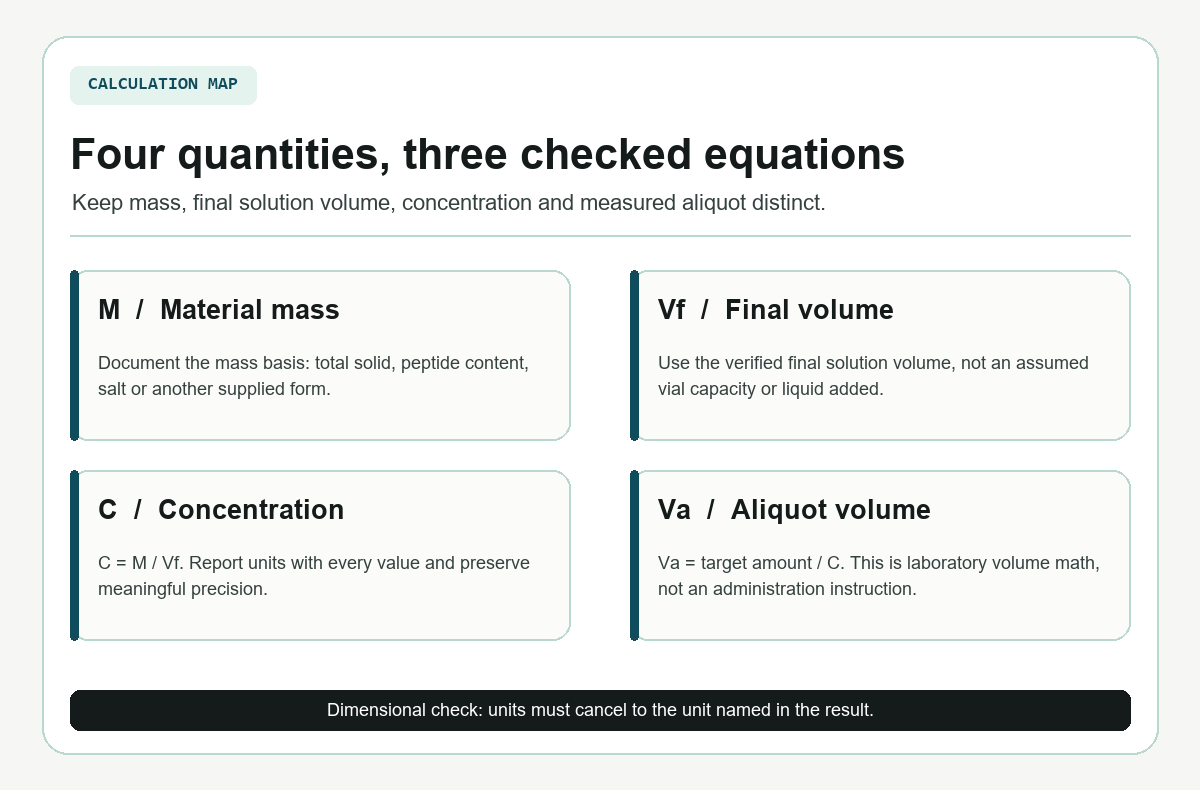
A useful peptide dosing calculator must keep four different quantities separate: material mass, final solution volume, concentration, and the volume of a planned laboratory aliquot. Entering a plausible number in the wrong unit can still produce a polished-looking result, which is why every calculation below begins with the source record and ends with an independent dimensional check.
Key Takeaways
- Concentration is a ratio. Divide documented material mass by verified final solution volume, and keep the units attached.
- Mass and volume are not interchangeable. A microgram amount is not a device graduation, and a graduation is not a dose recommendation.
- Final volume matters. Adding 2.00 mL of liquid does not guarantee a 2.00 mL final solution volume.
- U-100 is an insulin concentration label. It does not establish the physical graduation interval of a device or create a general-purpose unit for another solution.
- Unknown inputs are stop conditions. A calculator cannot repair an uncertain mass basis, supplied form, volume, or device.
Scope and Prerequisites
This guide covers mass concentration, unit conversion, measured laboratory aliquot volume, and the limits of U-100 labels and device graduations. It is intended for qualified personnel documenting in-vitro or preclinical research workflows. It does not select a compound amount, recommend a protocol, establish a therapeutic dose, or provide instructions for human administration.
Before calculating, obtain the exact material record: identity, lot, supplied amount, supplied form, formulation, peptide-content value if applicable, and the source of the intended final volume. The vial label and certificate of analysis must refer to the same material. If the mass basis is ambiguous—for example, total lyophilized solid versus peptide content—resolve it before entering a number.
- A documented material mass and its basis.
- A source-supported solvent or buffer and intended final solution volume.
- Calibrated volumetric equipment appropriate to the range being measured.
- A laboratory worksheet that preserves input values, units, formula, result, and reviewer.
- A defined stop condition for conflicting records, uncertain units, out-of-range equipment, or a result that cannot be independently reproduced.
Define the Quantities Before Calculating
The same number can describe very different things. Writing “5” without a unit and quantity name is not enough. A defensible worksheet defines each variable before the arithmetic begins:
| Variable | Meaning | Required source check | Do not confuse it with |
|---|---|---|---|
| M | Material mass, commonly in mg or mcg | Lot record and stated mass basis | Purity percentage, concentration, or target aliquot |
| Vf | Verified final solution volume in mL | Validated preparation method and calibrated apparatus | Container capacity or liquid nominally added |
| C | Mass concentration, such as mg/mL or mcg/mL | Calculated from compatible M and Vf units | Total material amount |
| A | Specified amount for a laboratory aliquot | Approved experimental method | A recommended human dose |
| Va | Measured aliquot volume in mL or microliters | Calculated from A and C, then checked against equipment range | A device-scale number before its label, units, and smallest graduation are verified |
NIST identifies the milliliter as a special name for the cubic centimeter and recommends the symbol mL. A milligram is 1,000 micrograms, so converting mg to mcg multiplies by 1,000; converting mcg to mg divides by 1,000. Write the conversion factor into the record instead of moving a decimal point from memory.
The Three Core Calculation Equations
1. Calculate mass concentration
C (mg/mL) = M (mg) / Vf (mL)
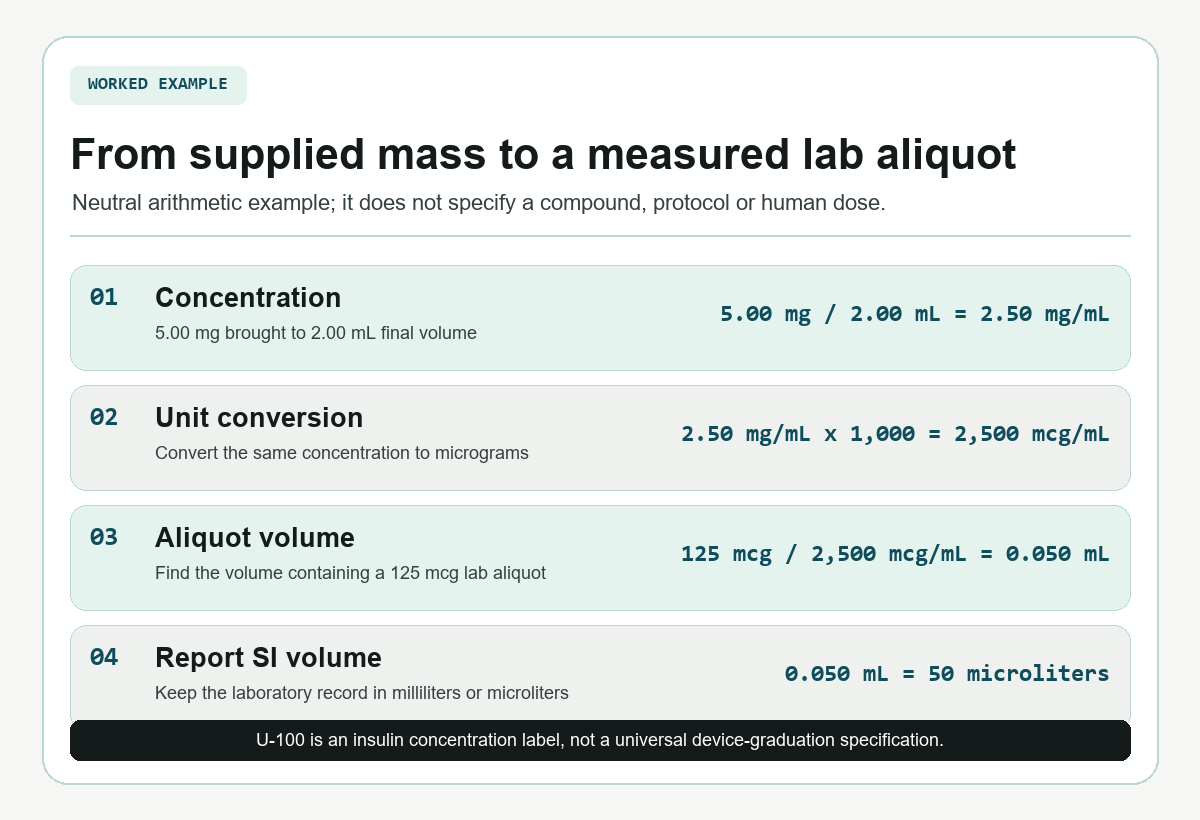
If 5.00 mg of documented material is brought to a verified 2.00 mL final volume, the concentration is 2.50 mg/mL. The units divide with the numbers: mg divided by mL produces mg/mL.
2. Convert mg/mL to mcg/mL
C (mcg/mL) = C (mg/mL) x 1,000 mcg/mg
The 2.50 mg/mL result equals 2,500 mcg/mL. This conversion changes the unit used to express the same concentration; it does not add material or change the solution.
3. Calculate a laboratory aliquot volume
Va (mL) = A (mcg) / C (mcg/mL)
If a validated experimental method specifies a 125 mcg aliquot from a 2,500 mcg/mL stock, the calculated volume is 0.050 mL, or 50 microliters. The word aliquot here means a measured portion for a documented laboratory method. It is not a dose recommendation.
Step-by-Step Calculation Workflow
- Copy the source values. Record identity, lot, supplied amount, mass basis, supplied form, solvent or buffer, and intended final volume without altering the units.
- Define the requested result. Decide whether the worksheet needs concentration, a laboratory aliquot volume, a dilution, or a device-scale equivalent. Do not combine these into one unexplained field.
- Normalize compatible units. Convert mass inputs to the same unit before division. Record the factor used.
- Calculate concentration. Divide material mass by verified final volume. Keep at least one guard digit during intermediate arithmetic.
- Calculate aliquot volume only when a method supplies the target amount. Divide that laboratory amount by concentration.
- Translate volume to a device scale only after identifying the device. Use the actual scale definition and confirm that the result lies within its usable range.
- Apply appropriate precision. Do not report more meaningful digits than the source values and measurement method support.
- Reproduce the result. Use a second calculation method or reviewer, then record both the result and the check.
Worked Laboratory Examples
The following neutral example uses an unnamed research material so that the arithmetic is visible without implying a compound protocol.
Example 1: concentration and aliquot volume
Material mass is 5.00 mg and verified final volume is 2.00 mL. Dividing gives 2.50 mg/mL. Multiplying by 1,000 converts that concentration to 2,500 mcg/mL. A method-defined 125 mcg aliquot therefore occupies 0.050 mL because 125 mcg divided by 2,500 mcg/mL cancels micrograms and leaves milliliters.
Example 2: working dilution
For a simple dilution, use C1 x V1 = C2 x V2. Bringing 1.00 mL of a 2.50 mg/mL stock to a 10.00 mL final volume produces 0.250 mg/mL. This means adding enough compatible diluent to reach 10.00 mL final, not adding 10.00 mL to the original 1.00 mL.
Example 3: a documented peptide-content basis
If a lot-specific analytical record reports 5.00 mg of supplied solid and a validated peptide-content fraction of 0.80, then the peptide-basis mass is 4.00 mg before concentration is calculated. HPLC area purity is a different measurement and must not be substituted for peptide content. Consult the peptide COA guide and the explanation of what HPLC purity does and does not show.
What U-100 Labels and Device Graduations Mean
The current Humulin R label defines that named U-100 insulin product as 100 insulin units per mL and states that 1 mL equals 1 cc. That is a drug-concentration definition, not a peptide protocol and not a universal statement about the spacing of physical lines on every device.
FDA piston-syringe guidance treats device size, scale, graduations, numbering, and legibility as labeling and physical-specification fields. It also says an insulin syringe barrel is graduated in insulin units and labeled for the intended insulin concentration. The exact device record therefore controls how many physical intervals appear between numbered values; the term U-100 alone does not make every visible line equal to 0.01 mL.
For the neutral example above, the laboratory result should remain 0.050 mL, or 50 microliters. This guide does not convert a peptide aliquot into insulin units or a count of syringe tick marks. If a legacy calculator displays a U-100-derived number, treat it as an interface-specific convention, verify the actual device documentation, and record the laboratory volume in mL or microliters.
If the labeling, units, smallest graduation, calibration, or usable range is unclear, stop and select calibrated laboratory equipment suitable for the required volume. A concentration label cannot substitute for a device specification.
Final Volume, Measurement, and Rounding
ISO 8655-1:2022 applies to piston-operated volumetric apparatus such as pipettes and manually operated precision laboratory syringes; it explicitly excludes medical products intended for use on humans. ISO 4787:2021 addresses testing, calibration, and use of laboratory glass and plastic volumetric instruments. Together, these standards reinforce a practical rule: choose an instrument designed and verified for the range being measured.
- Stay within the calibrated range. Do not assume that the smallest visible graduation is accurate enough for the method.
- Separate nominal and verified volume. Container graduations are not automatically equivalent to volumetric calibration.
- Record resolution. The display or graduation limits the precision that can be claimed.
- Round at the end. Keep guard digits during intermediate steps, then round the final result according to the method and input uncertainty.
- Do not round a nonzero volume to zero. If the required volume is below the equipment range, revise the validated dilution plan or use suitable equipment; do not improvise.
Calculator Versus Companion Guide
The Apex peptide reconstitution calculator is the interactive tool for entering documented values and reproducing the arithmetic. This guide explains what each input means, why final volume and mass basis matter, how to check the units, and when a result must be rejected. The tool and guide should agree numerically because they use the same dimensional relationships, but neither validates an uncertain source value or selects an experimental target.
For the preparation steps surrounding the calculation, use the research-only guide to reconstituting lyophilized peptides. Storage after preparation remains compound- and method-specific; use the peptide storage decision guide without assigning a generic shelf life.
Common Calculation Errors
| Error | Why the result fails | Controlled response |
|---|---|---|
| Entering total lyophilized solid as peptide mass without a supported basis | Excipients, counterions, salts, or moisture may be included in the stated solid mass. | Use the exact lot documentation; do not substitute HPLC area purity. |
| Mixing mg and mcg | A factor-of-1,000 error can remain numerically plausible. | Write the conversion factor and reproduce it independently. |
| Using liquid added as final volume | The denominator may not be the actual solution volume. | Use a validated final-volume method or label the result nominal. |
| Converting an amount directly to an insulin-unit or tick-mark number | Concentration is missing, and neither insulin units nor physical ticks are general-purpose peptide-volume units. | Calculate concentration and retain the laboratory result in mL or microliters. |
| Assuming U-100 defines every physical graduation | U-100 defines 100 insulin units per mL for the labeled product; device graduation fields remain device-specific. | Use the device labeling and a calibrated instrument appropriate to the required volume. |
| Reporting excessive decimal places | The result claims precision not supported by the inputs or apparatus. | Preserve guard digits, then round under the method’s uncertainty rule. |
| Trusting a calculator without reproducing it | Correct software still returns the wrong answer for the wrong inputs. | Check source values, units, formula, and result with a second method. |
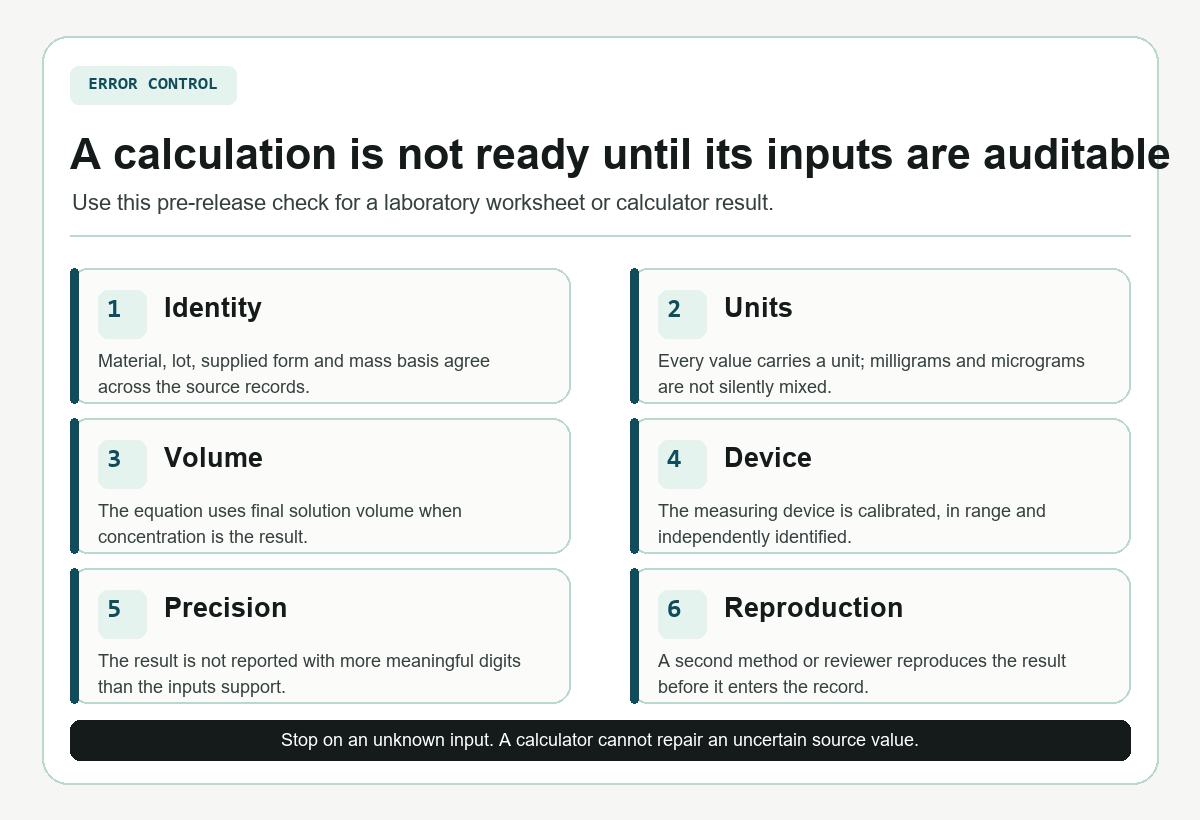
Final Verification Checklist
- The material identity, lot, supplied form, and mass basis match the source documents.
- Every number carries a quantity name and unit.
- mg-to-mcg conversions use the explicit factor 1,000.
- The concentration denominator is a supported final solution volume.
- Any target amount comes from an approved laboratory method, not from this guide or calculator.
- The calculated volume lies within the selected calibrated equipment’s range.
- The result remains in mL or microliters; no peptide amount is relabeled as insulin units or physical tick marks.
- Rounding reflects the precision of the inputs and measuring apparatus.
- A second method or reviewer reproduces the result.
- The record does not imply that arithmetic establishes identity, purity, sterility, stability, activity, or human suitability.
If any check fails, mark the calculation unverified and resolve the source or method gap. Do not force an uncertain input through a calculator to obtain a publishable-looking number.
Sources and Scope
- NIST: SI Units – Volume — milliliter definition and notation.
- NIST: Writing with SI Units — number-and-unit conventions.
- ISO 8655-1:2022 — terminology and user recommendations for piston-operated volumetric laboratory apparatus, with the human-medical-device exclusion.
- ISO 4787:2021 — testing, calibration, and use of laboratory volumetric instruments.
- DailyMed: Humulin R label — named-product support for the U-100 definition only.
- FDA: piston-syringe 510(k) guidance — device labeling, size, scale, graduation, numbering, and legibility are distinct specification fields.
- Apex Laboratory Editorial Standards — sourcing, corrections, review, and research-use boundaries.
The formulas were independently reproduced in the release bundle. No PMID-based scientific claim is retained. This educational guide does not replace a validated laboratory method, institutional SOP, calibration program, qualified review, or the exact technical and lot documentation for a material.
Research Use Disclaimer
This guide is provided for educational and laboratory reference purposes only. All compounds discussed and all products sold by Apex Laboratory are intended exclusively for in-vitro laboratory research use and are not for human consumption. This page does not provide medical advice, dosing recommendations, injection instructions, or a substitute for qualified laboratory oversight.