Quick answer: Peptide reconstitution is the laboratory process of dissolving a lyophilized peptide in a measured, protocol-compatible solvent to produce a defined stock solution. The correct solvent, final volume, mixing method, and storage conditions depend on the exact sequence, supplied form, and downstream assay. Verify the lot documentation and calculate the stock before opening the vial; if the material behaves differently from its source instructions, stop rather than improvise.
Understanding how to reconstitute peptides for research therefore begins with a decision, not with a bottle of solvent. Bacteriostatic water, preservative-free water, buffered aqueous solutions, dilute acid or base, and organic co-solvents have different compositions and experimental consequences. None is a universal choice, and a successful-looking dissolution does not prove identity, purity, sterility, stability, or biological activity.
Scope and Prerequisites
This workflow is for qualified personnel preparing a documented lyophilized peptide stock for an in-vitro laboratory method. It is a planning and handling framework, not a substitute for a validated compound-specific procedure, an institutional contamination-control SOP, or the requirements of the receiving assay.
- Start with an identified material. The vial, lot record, certificate of analysis, and technical sheet must refer to the same item.
- Know the experimental endpoint. Cell-based assays, binding assays, chromatography, spectroscopy, and formulation studies can have different tolerances for pH, salt, preservative, and organic solvent.
- Use calibrated laboratory equipment. Select pipettes, volumetric vessels, and containers appropriate to the intended volume and accuracy.
- Define a stop condition. Missing documentation, an uncertain molecular weight, an unverified solvent, unexpected particulates, or a temperature excursion should pause the workflow.
Apex-specific research boundary. Apex Laboratory materials are supplied for in-vitro and preclinical research only. They are research reagents, not FDA-approved or EMA-authorized pharmaceuticals, and are not for human therapeutic use. This statement applies to Apex materials; the third-party labels cited below establish only the facts specifically attributed to those named products. See the separate discussion of research-grade and pharmaceutical-grade distinctions.
What to Verify Before Opening the Vial
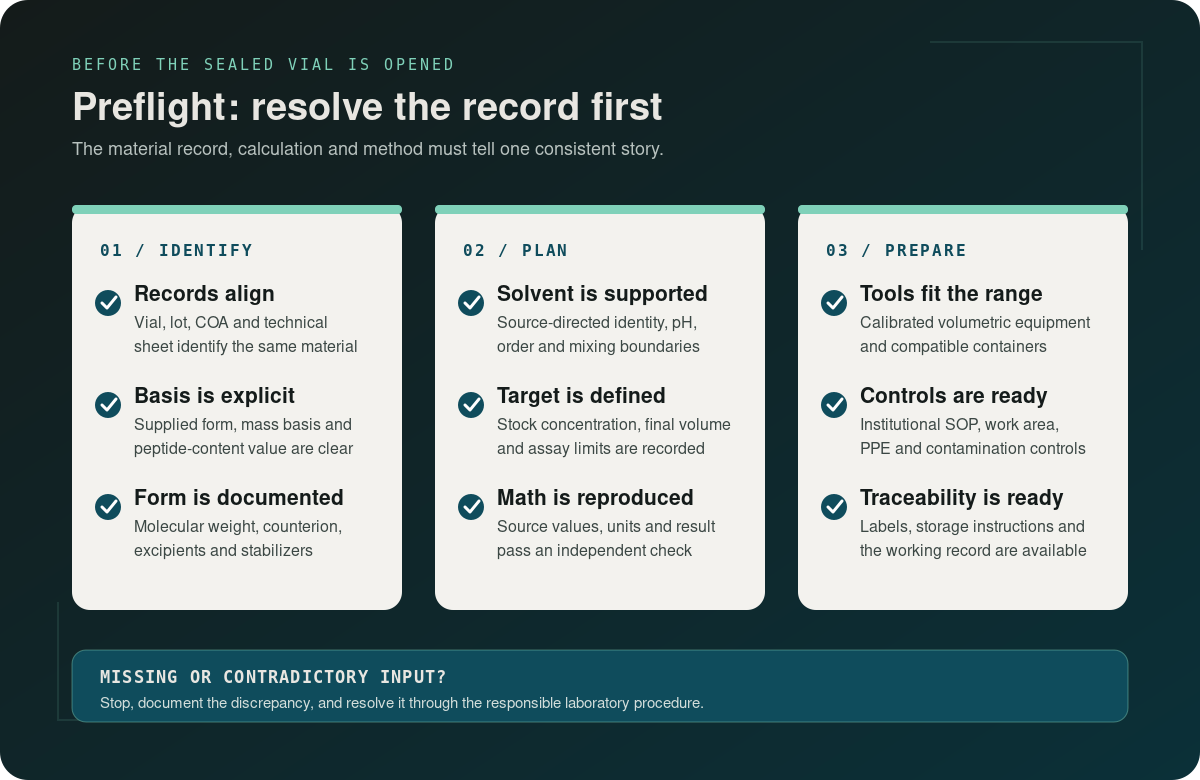
Reconstitution math is only as sound as its inputs. Before the container leaves controlled storage, copy the following facts into the working record and resolve any disagreement between the label, technical sheet, and lot documentation.
- Identity and lot: product name, sequence or other identity record, lot number, and the document revision being used.
- Supplied amount and basis: determine whether the stated mass refers to total lyophilized solid, peptide content, peptide salt, or another formulation basis.
- Formulation: record the counterion, excipients, carrier proteins, salts, buffers, or stabilizers if they are present.
- Molecular weight: use the molecular weight for the documented supplied form when calculating a molar concentration.
- Solvent instruction: identify the recommended solvent, pH range, order of addition, concentration limit, and any explicit mixing instruction.
- Downstream compatibility: confirm that the planned solvent and its final concentration are acceptable in the assay.
- Storage instruction: capture the dry-material and prepared-solution requirements separately, including light and freeze-thaw limitations.
The lot record answers different questions from the vial’s appearance. Use the guide to read the lot-specific certificate of analysis before relying on a stated amount. Remember that HPLC purity testing reports chromatographic composition under a stated method; it does not by itself establish peptide-content mass, sterility, or solution concentration.
Materials and Records for a Controlled Preparation
The exact equipment depends on the laboratory and method, but a controlled preparation normally requires the following categories:
- the sealed lyophilized material and matching lot-specific documentation;
- the source-approved solvent or buffer, with its identity, lot, and preparation record;
- calibrated pipettes or other approved volumetric equipment covering the required range;
- compatible low-binding tubes or volumetric containers when transfer or aliquoting is part of the validated method;
- a clean work area and personal protective equipment specified by the institutional SOP;
- labels resistant to the planned storage conditions; and
- an electronic or paper laboratory record for calculations, observations, and deviations.
Match the tool to the measurement. A calibrated micropipette is appropriate only within its validated range; a volumetric vessel is preferable when final-volume accuracy controls the result. Do not treat container graduations or an assumed amount of added liquid as equivalent to a verified final solution volume.
How to Choose a Reconstitution Solvent
The product-specific technical sheet or validated method has the highest priority. When that instruction is incomplete, sequence charge, hydrophobicity, target concentration, chemical stability, and assay compatibility provide a structured starting point. The manufacturer guidance from Bachem, GenScript, Thermo Fisher Scientific, and Sigma-Aldrich consistently treats solubility as peptide-specific rather than universal.
| Documented condition | Claim-safe next step | Boundary to preserve |
|---|---|---|
| The product or method specifies a solvent | Use the named formulation and record its final concentration in the assay. | Do not substitute a more familiar solvent without method approval. |
| Water-soluble or charged peptide; no complete instruction | Evaluate compatible water or buffer on a small portion before preparing the full stock. | Charge alone does not establish stability, pH, or assay compatibility. |
| Net-positive/basic sequence | Manufacturer guidance may use a dilute acidic condition as a solubility starting point. | The acid identity, strength, pH, and final assay concentration remain method-specific. |
| Net-negative/acidic sequence | Manufacturer guidance may use a weak basic condition as a solubility starting point. | Do not improvise a strong base or assume that dissolution proves stability. |
| Neutral or hydrophobic sequence | A minimal amount of an assay-compatible organic co-solvent may be evaluated before aqueous dilution. | Organic solvent can alter cells, proteins, binding, and analytical measurements; establish its final concentration. |
| Composition or behavior is uncertain | Pause and test a small representative portion under documented conditions. | Do not expose the entire sample to a trial-and-error rescue sequence. |
Bacteriostatic water is one possible vehicle, not the default starting point for every peptide. The current Hospira DailyMed label describes named benzyl-alcohol-preserved presentations and instructs users to consult the solute manufacturer’s directions for vehicle selection and storage. That label does not establish compatibility or shelf life for an unrelated peptide stock. For composition context, compare bacteriostatic water and alternative solvents; use the separate product page only to check current bacteriostatic-water specifications.
Step-by-Step Laboratory Reconstitution Workflow
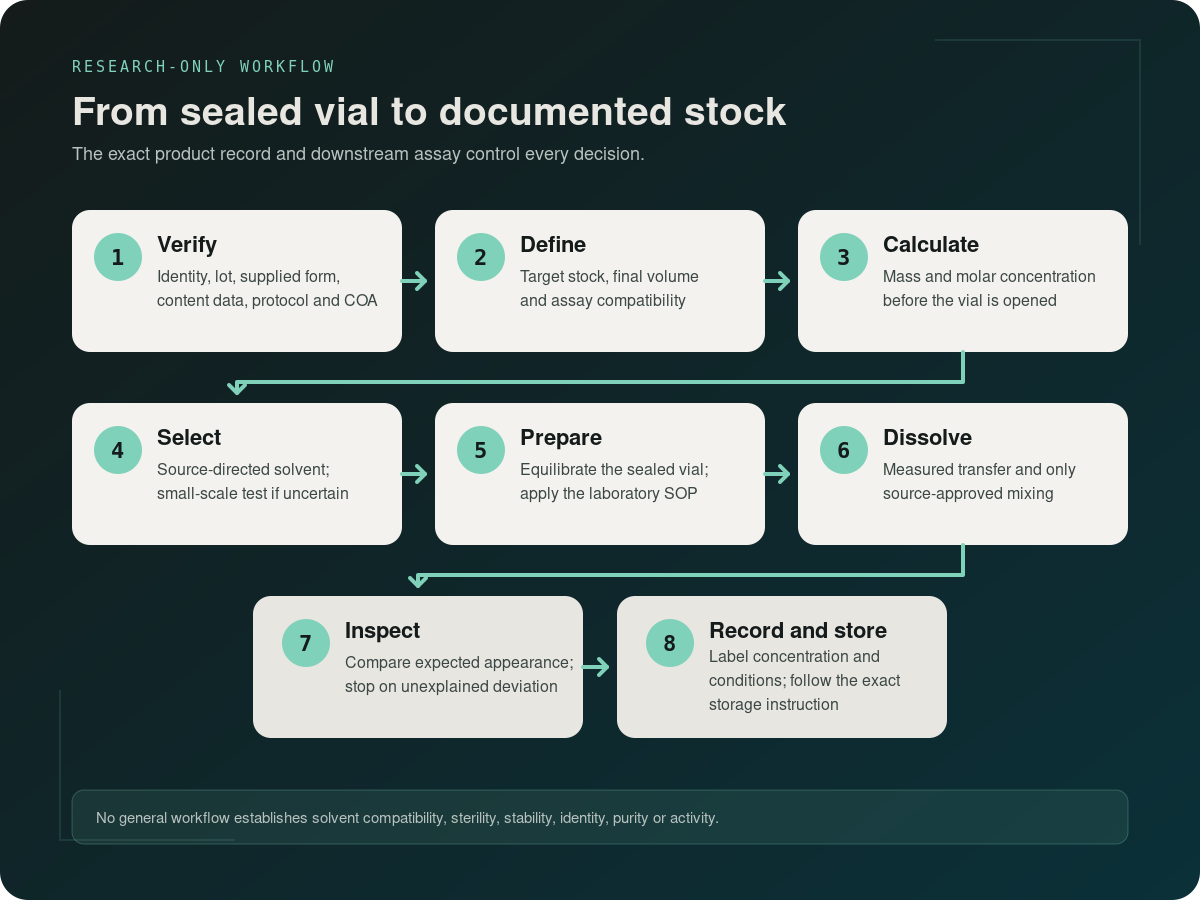
The eight-stage overview below is a decision map. The numbered procedure that follows supplies the operational detail, while the exact product documentation still controls every compound-specific parameter.
1. Verify the material and method
Match the container to its lot record and technical sheet. Confirm the supplied form, mass basis, molecular weight, recommended solvent, expected appearance, and storage instruction. If any essential value is absent or contradictory, record the discrepancy and stop. A generic web recipe cannot resolve a lot-specific conflict.
2. Define the target stock and downstream limits
Work backward from the assay. Choose a stock concentration that is soluble, measurable with calibrated equipment, and compatible with the maximum preservative, salt, pH shift, or organic co-solvent the experiment can tolerate. Specify whether the method requires a mass concentration, a molar concentration, or both.
3. Calculate and independently check the final volume
Calculate the final volume before opening the vial. A second person, validated spreadsheet, or independent calculator should reproduce the result and units. If the material’s peptide-content fraction differs from total supplied solid, apply only the lot-specific value supplied for that purpose; do not substitute HPLC area purity.
4. Prepare the work area and equilibrate the sealed vial
Prepare the workspace according to the laboratory’s contamination-control and safety SOP. Gather the selected solvent, calibrated equipment, compatible containers, and labels before handling the material. Bachem, GenScript, and Sigma-Aldrich advise allowing a sealed chilled peptide container to equilibrate before opening; Bachem specifically describes warming in a desiccator to limit moisture uptake. Thermo Fisher separately advises bringing the peptide to room temperature before solvent addition. None of these sources establishes one universal equilibration time for every package.
5. Confirm the solvent and transfer the planned amount
Recheck the solvent identity, lot, and preparation record against the calculation. Transfer it with calibrated laboratory equipment suited to the volume. Record what was actually delivered and distinguish “solvent added” from “final solution volume.” When exact final volume controls the calculation, use an appropriate volumetric method rather than relying on the nominal liquid addition.
6. Dissolve using the source-approved method
Begin with the least disruptive mixing method specified by the source and observe the material. Avoid turning “gentle handling” into an absolute rule: supplier guidance may permit brief sonication, controlled warming, pH adjustment, or an organic co-solvent for particular sequences. Conversely, vigorous aeration or foaming may be inappropriate for some preparations. Use only the documented escalation path and do not assign a universal five-minute endpoint.
Where the source specifies no delivery technique, the conventional laboratory default is to direct the solvent against the vial wall rather than onto the powder. Angle the needle tip toward the inside glass wall and depress the plunger slowly and steadily, letting the solvent trickle down the wall and pool beneath the lyophilized cake so that it wets from below. A forceful stream delivered straight onto the cake adds mechanical and air–liquid interfacial stress, a recognised physical-instability pathway for peptide and protein preparations that sits alongside the chemical degradation routes. That source is a narrative review of stability pathways and reports no single quantitative result to quote here.[1] After the transfer, stand the vial upright and leave it undisturbed rather than shaking it; if solid remains, roll it slowly between the palms or tilt it gently back and forth. Treat this as a default technique only, and defer to a documented compound-specific method wherever one exists.
7. Inspect against the expected appearance
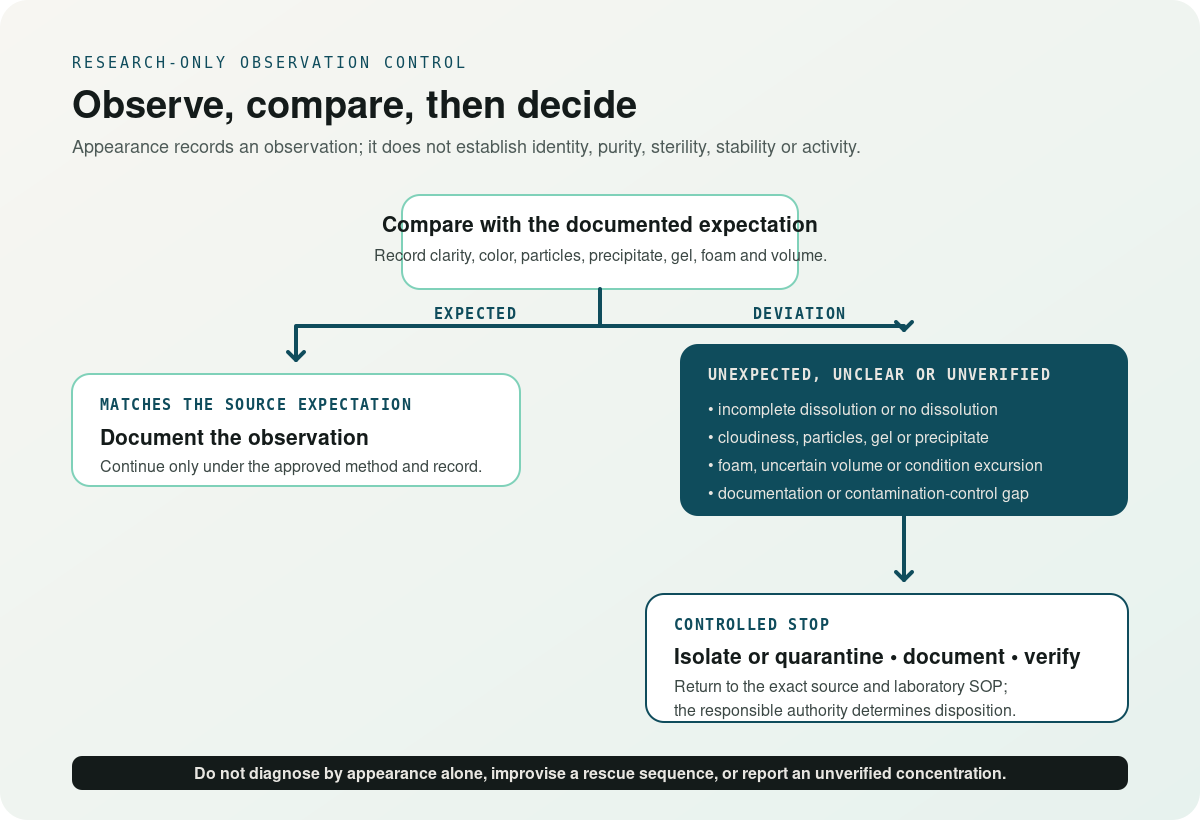
Compare the prepared stock with the product or method’s expected appearance. Record clarity, color, visible particulates, precipitation, foaming, or other observations without diagnosing them from appearance alone. Cloudiness can have more than one cause; it is not proof of aggregation, and adding more solvent is not a universal correction.
8. Label, aliquot, and store only as supported
Label the stock immediately and link it to the complete preparation record. Aliquot only when the validated method, container compatibility, and storage plan support it. Use the product-specific instruction for temperature, light, container, and allowable storage interval. Do not infer the prepared stock’s stability from the solvent container’s label.
How to Calculate Peptide Stock Concentration
Keep mass concentration, molar concentration, and working dilution as separate calculations. Every example below describes a laboratory stock solution only.
Mass concentration
C (mg/mL) = mass (mg) / final volume (mL)Example: 5.00 mg brought to a 2.00 mL final volume equals 2.50 mg/mL.
Molar concentration
C (mM) = 1000 x C (mg/mL) / MW (g/mol)Example: 2.50 mg/mL and a molecular weight of 1000 g/mol equal 2.50 mM.
Working dilution
C1 x V1 = C2 x V2Example: bring 1.00 mL of a 1.00 mM stock to a 10.00 mL final volume to produce 0.100 mM, or 100 micromolar.
Peptide-content correction
peptide-basis mass = solid mass x validated content fractionExample: 5.00 mg of supplied solid at a validated 0.80 peptide-content fraction represents 4.0 mg on a peptide basis.
The phrase final volume matters. Bringing 1.00 mL of stock to 10.00 mL final is not the same as adding 10.00 mL of diluent. Likewise, milligrams per milliliter cannot be converted to millimolar without the molecular weight for the documented supplied form. Reproduce the calculation with a validated spreadsheet, a second operator, or another independent laboratory calculation method, then preserve the source values and result in the laboratory record.
Worked stock concentrations for common vial sizes
The table below works the mass-concentration formula for vial sizes Apex Laboratory commonly supplies. These are arithmetic worked examples for planning a stock, not recommended protocols, doses, or evidence that a given concentration suits any particular method. Confirm the supplied mass and the peptide-content fraction on the lot certificate before relying on any row, and apply the peptide-content correction where the certificate reports one.
| Material | Supplied mass | Solvent added | Resulting stock concentration |
|---|---|---|---|
| BPC-157 | 5 mg | 2.0 mL | 2.5 mg/mL (2,500 µg/mL) |
| TB-500 | 5 mg | 2.0 mL | 2.5 mg/mL |
| Ipamorelin | 5 mg | 2.5 mL | 2.0 mg/mL |
| CJC-1295 no-DAC | 2 mg | 2.0 mL | 1.0 mg/mL |
| Semaglutide | 5 mg | 2.5 mL | 2.0 mg/mL |
| Retatrutide | 5 mg | 2.5 mL | 2.0 mg/mL |
| Melanotan II | 10 mg | 2.0 mL | 5.0 mg/mL |
| AOD9604 | 5 mg | 2.5 mL | 2.0 mg/mL |
Every row is the same division: concentration equals supplied mass divided by the volume of solvent added. Solubility differs by sequence, so a workable arithmetic result is not a guarantee that the material dissolves cleanly at that concentration in that solvent. Where a peptide resists aqueous solvent, the alternative-solvent guidance above applies.
Storage temperatures and planning windows
Storage conditions and light exposure measurably affect peptide quality, and recommendations vary by product rather than following one universal rule.[2] Peptide stability in aqueous solution is governed by sequence, pH, concentration, excipients, temperature, light exposure, and physical stress acting together, which is why a single shelf-life number cannot be transferred between compounds.[4] The windows below are conservative research-use planning figures for a documented laboratory record, not stability guarantees for any specific compound or lot.
| State | Temperature | Conservative planning window |
|---|---|---|
| Sealed lyophilized solid | −20 °C | Months to years, per the lot certificate and supplier documentation |
| Reconstituted in bacteriostatic water | 2–8 °C | 14–28 days for many peptides; the benzyl alcohol acts as the antimicrobial preservative, which is what permits repeat stopper punctures[5] |
| Reconstituted in sterile water (no preservative) | 2–8 °C | 24–48 hours, single puncture — with no preservative, contamination risk begins at first entry |
| Reconstituted in dilute acetic acid | 2–8 °C | 14–21 days for many peptides |
| Frozen aliquots of prepared stock | −20 °C | Longer than refrigerated storage, but freeze–thaw cycling is itself a stress; aliquot to avoid repeat thaws |
Freezing is not a neutral operation. The freezing step itself imposes physico-chemical stresses on peptide and protein material, which is why single-use aliquots are preferred over repeatedly thawing one vial.[3] Record the preparation date, solvent, concentration, and storage temperature at the moment of preparation; a window is only meaningful when its start point is documented. The Peptide Storage Guide covers handling and storage in depth.

Troubleshooting and Stop Conditions
Troubleshooting should narrow uncertainty, not create an undocumented rescue sequence. If the observation falls outside the expected condition, isolate the material, preserve the record, and return to the compound-specific source.
| Observation | Possible categories | Controlled next action |
|---|---|---|
| Material does not dissolve under the specified method | Incorrect solvent, concentration limit, pH, temperature, supplied form, or incomplete source instruction. | Stop. Confirm the identity and method; test any approved alternative on a small portion rather than changing the full stock. |
| Unexpected cloudiness, particles, gel, or precipitate | Incomplete dissolution, incompatibility, contamination, precipitation, or aggregation. | Do not diagnose by appearance alone or automatically add solvent. Compare with the expected appearance and escalate under the laboratory SOP. |
| Foaming or excessive bubbles | Transfer or mixing introduced an air-liquid interface. | Stop active mixing, document the event, and follow the product-specific disposition rule. Do not claim that settling restores the material. |
| Delivered volume is uncertain | Pipetting error, bubbles, out-of-range equipment, leakage, or transcription error. | Do not back-calculate from an uncertain observation. Mark the concentration unverified and repeat only under the approved deviation process. |
| Mass basis or molecular weight is unclear | Peptide-content, salt, counterion, hydrate, or formulation ambiguity. | Obtain the lot-specific value before reporting concentration. Do not use HPLC area purity as a substitute. |
| Unexpected freezing, warming, or light exposure | Possible sequence- and formulation-dependent stability impact. | Quarantine and assess against the exact stability instruction. Do not assume one freeze-thaw event is acceptable. |
| Documentation or contamination-control failure | Traceability gap or uncontrolled handling event. | Treat the preparation as nonconforming until the responsible laboratory authority determines disposition. |
Label, Store, and Document the Prepared Stock
A complete label and record should make the preparation reconstructable without relying on memory. Record:
- material name, supplied form, lot number, and source-document revision;
- solvent or buffer identity, composition, lot, and any preparation record;
- supplied mass, peptide-content correction if applicable, molecular weight, final volume, and calculated concentrations;
- date and time prepared, operator, equipment identifiers where required, and independent calculation check;
- observed appearance, mixing method, deviations, and disposition decisions; and
- container, aliquot plan, storage condition, allowable interval, and source for those instructions.
Storage is part of the method, not an afterthought. GenScript notes that solution shelf life is limited and sequence-dependent, while Bachem similarly warns that peptides vary and that long-term solution storage is generally less desirable than keeping material dry. Those are broad handling cautions, not permission to assign a universal temperature or shelf life. Follow the exact product record and the receiving method, minimize unnecessary temperature cycling where the source supports that control, and consult the dedicated peptide storage controls.
Final Verification Checklist
- The vial, lot, COA, and technical sheet refer to the same material.
- The supplied mass basis, molecular weight, formulation, and peptide-content value are understood.
- The solvent is supported by the compound-specific source and compatible with the downstream assay.
- The target concentration, final volume, and units were independently reproduced.
- The sealed vial was handled under the relevant temperature, moisture, and contamination-control procedure.
- The dissolution method stayed within the documented mixing, pH, temperature, and co-solvent boundaries.
- The observed appearance matches the source expectation, or the preparation was stopped and isolated.
- The label and record capture identity, lots, quantities, conditions, observations, and deviations.
- The storage and aliquot plan come from the exact product or validated method, not from a generic table.
- No claim treats dissolution as proof of identity, purity, sterility, stability, or activity.
If any item fails, the preparation is not ready to enter an experimental workflow. Resolve the gap through the responsible laboratory procedure instead of converting an assumption into a recorded fact.
Sources and Scope
- Bachem: Care and Handling of Peptides – temperature equilibration, peptide-content distinction, charge-aware solubility, and sequence-specific storage boundaries.
- GenScript: Peptide Storage and Handling – moisture control, limited solution shelf life, aliquoting, and freeze-thaw cautions.
- GenScript: Peptide Solubility Guidelines – charge and hydrophobicity decision path for solvent screening.
- GenScript: Peptide Solubility Testing – small-scale testing before committing a complete sample.
- Thermo Fisher Scientific: Standard Peptide Handling Guidance – peptide-specific solubility, small-sample testing, and method-compatible co-solvents.
- Sigma-Aldrich: Handling and Storage Guidelines – sealed-vial equilibration and source-specific solubility guidance.
- DailyMed: Hospira Bacteriostatic Water label – named-product composition and the instruction to consult the solute manufacturer’s directions.
- Apex editorial and verification standards – sourcing, corrections, review, and research-use boundaries.
These sources establish general handling and decision boundaries. They do not replace the current technical sheet, lot record, validated method, or institutional SOP for a specific material. No PMID-based claim is retained in this procedure.
Research Use Disclaimer
This guide is provided for educational and laboratory reference purposes only. All compounds discussed and all products sold by Apex Laboratory are intended exclusively for in-vitro laboratory research use and are not for human consumption. Researchers should consult primary peer-reviewed literature for detailed protocols, experimental designs, and verified specifications.